
Model-Guided Monitoring of a Building Environment by a Mobile Robot
Proceedings of the Eighth International Joint Conference on Artificial Intelligence. Vision. Pages 1125-1126.
© 1983 International Joint Conferences on Artificial Intelligence
Abstract
This paper presents an Initial attempt to build a mobile robot which navigates ' In and monitors buildings such as offices, schools 1 f actorles 1 hospitals 1 etc. and reports changes there to an human operator. The robot is initially parked at a standard position and Is then driven. around passages of the building via a given route. While moving around, it stops every a few meters, takes a picture and compares the picture with a stored model of the building. It first extracts vertical edges • from the Image which often appear in the building scene as stably extracted features, and then determines camera parameters (such as camera position) by matching the extracted features and the model. Using these camera parameters, it generates an Image model from the building model and detects changes in the scene by comparing the Input Image and the generated image model.
- D.B.Gennery; A stereo vision system for an autonomous vehicle, pp. 576-582, IJCAI-77 1977 IJCAI
- A.M.Tompson; The navigation system of the JPL robot, pp. 749-757, IJCAI-77, 1977 IJCAI
- H.P.Moravec; Rover visual obstacle avoidance, pp.785-790, IJCAI-81, 1981 • IJCAI
- J .Iijima, Y.Kanayama, S.Yuta; A location control system for mobile robots, pp: 779-784, IJCAI-81, 1981
- M.Yachida, M.Asada, S.Tsuji; Automatic analysis of moving images, pp. 12-20, : IEEE Trans. On PAMI, vol. PAMI-3, no. l, 1981
- M.Nagao and T.Matsuyama; Edge preserving smoothing, 1 Computer Graphics and Image Processing, vol.9, no.4, pp.394-407,' 1979
References were extracted automatically from the PDF and may contain errors.
Full text extracted automatically from the PDF; figures, tables and equations may differ. The PDF is the version of record.
1. INTRODUCTION
There has been tnuch;work. on mobile: robots which navigate in ·unknown environments, using vision. [1,213] or ultrasonic range finder [ 4]. Because purpose ~f these robots is to find a path in an unknown environment, few robots use a priori knowledge (model) of the environment or find changes there.
In this paper, we describe a mobile·, robot which finds not only obstacles for navigation but. also changes for monitoring an environment. In order to simplify the problem, we restrict the robot's environment to buildings such as offices, factories, schools, etc., most of which consist. of straight edges. The robot is initially given a model of the building where it works, and uses it to guide the image processing process and to find changes in the scene.
The robot is initially ·.parked at a standard position and is ithen driven around passages of the building via a given toute.i While moving :around, it stops every a few meters; takes a picture and. analyzes lthe image to find obstacles and changes ·. in the scene as. followes. It first extracts vertical edges from the image which often appear in the building scene by the ;Hough-like method as "stably extracted features" ·-and . then determines camera parameters by matching the extracted. features and the building model. .· Using these camera parameters, it generates an image model from ;the building model and detects. changes in the scene by comparing the input image and the generated image model. If there are important change's in the scene, it reports them to. a human operater.
2. SYSTEM DESIGN.
Fig.l shows hardware. configuration of the. mobile robot, which consists of a control unit, a micro-computer and a floppy disc; The .image. from the camera is stored; in the floppy disc and is sent to the mini-computer via a communication line.
et.al [5]. Then the size of each non-stationary region is calculated in order to know whether the moving object is coming closer to or going away from the robot. If the size becomes larger, the object is considered as coming closer to the robot, and the robot stays there until the moving object passes . by the robot so that it may not collide against the moving object. If not, it analyzes the image to find changes in the scene. Since the moving objects complicates the image analysis task, it deals the non-stationary regions as "don't care" regions in the rest of the image analysis.
3.2 Vertical edge detectioll
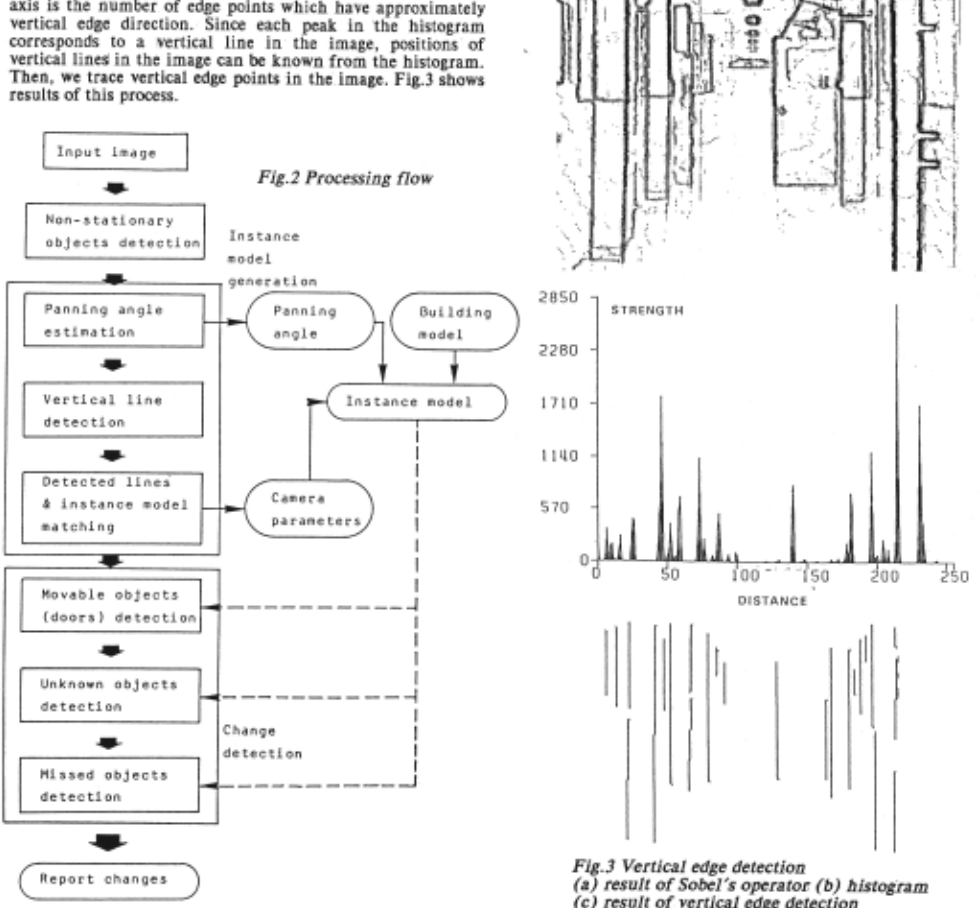
In order to eliminate noise in the input image, we first apply edge preserving smoothing operation [ 6] to the image, and then apply Sobel's operator to find edge points in the image.
Since vertical lines often apear in the building scene and can be extracted stably, they are first sought in the edge image. To find vertical lines, we make a histogram whose horizontal axis is the y axis of image plane and the vertical axis is the number of edge points which have approximately vertical edge direction. Since each peak in the histogram corresponds to a !Vertical line in the image, positions · of vertical lines in the image can be known from the histogram. Then, we trace vertical edge points in the. image. Fig.3 shows results of this process.
When the vertical lines have been found, we try to determine precise camera parameters. Since . we know the approximate · changes of camera parameters by the position sensors, we can generate an image model from the building model and the camera parameters. By matching the vertical lines obtained from the image and the generated image model, we can estimate the precise camera prameters. However, a problem here is that a slight mesurement error o{ the panning angle causes large difference in the ; image model, which makes difficult the comparison between the detected vertical lines and the image modeL Therefore, :it is necessary to esUmate rather precise panning angle before . the above process.
3.3 Pallllillg allgle estimatioll
We can determine the pan angle of the camera from the position of the vanishing point of the. floor. To know the vanishing point in the input 1image, we use the fact that the vanishing point and the floor boundary make a triangle. We first generate this triangle from the building model and the camera parameters, and search a region in the input image which matches to this triangle.
We first set the small window around the center of the triangle and calculates the average gray level (G) in the window. Since the mesurement error of pan angle causes the horizontal translation of the vanishing point in the image, we move the generated triangle horizontally in the image. Then, at each position of translation, the difference between the G and the average gray level in the triangle is calculated. The position of triangle where the difference is minimum gives the position of vanishing point in the input image. It is now easy to calculate the pan angle of the camera from the position of the vanishing point.
3.4 Model
Fig.4 shows a part of the building model. As seen in the figure , the model consists of a map which is viewed from the vertical direction and attributes such as hight and so on which are attached with each object. Therefore, when the camera parameters are given, we can generate the image model. Movable objects such as a1door also has an attribute of maximum movement if they have constraints on the movement.
3.5 Matching vertical lines to image model
Since rather precise pan angle has been obtained, we generate an image model from the building model and the camera parameters. Then this image model · is compared with the vertical lines obtained from the input image as follows.
We first set a search region around each vertical line in the , image model. The size of search region is determined from the estimated· mesurement errors of position sensors. Then we examine if an vertical line: of similar length exists in each search region. From the positions of matched lines, we can determine the precise camera parameters.
3.6 Change detection :
We have obtained the precise camera parameters. Then we generate the more . precise image model using them, and detect · changes in the scene by comparing th~ edge image of input picture and the image model . .
Each line in the generated 1 image model · is examined whether it actually exists in. the input i images. Here , .in order to check the lines of movable objects (doors}, we . simulate their movement and compares the lines generated at each movement and the input. image. After comparing all the lines in the generated image model, we classify those lines which could not be found in the input image into following three cases.
- ( 1) hidden by other objects,
- too small to distiguish,
- the object has been missed.
( 1) is the case when the object is hioden by the moving objects detected earlier or the movable objects. This case is easily distinguished by checking whether the sought line is inside the region of these objects. (2) is the case when an object is far from the robot. These object can be distinguished by the building model and we do not examine lines of these objects in the input image, because the robot can get better· view of them when it moves closer to them later. For the rest of lines, we classify them into the situation (3) and reports that the object is missed.
After all the lines in the generated image model have been examined, we check whether all the edge points in the input image have been matched to some line of the image model. If there are edge points which have not been matched to the image model, the robot considers that they are caused by some unknown objects and reports it. Experimental results will be shown at the conference.
4. CONCLUSION
This paper described a monitoring robot which navigates in and monitors an building. The robot has a model of the building which is used to update its camera parameters, to navigate and to detect changes in the environment. The robot can be used for a different building by changing its model. The authors would like to thank T. Hayase of our university in preparation of the manuscript.
@inproceedings{ijcai1983p261,
  title     = {Model-Guided Monitoring of a Building Environment by a Mobile Robot},
  author    = {Yachida, Masahiko and Ichinose, T. and Tsuji, Saburo},
  booktitle = {Proceedings of the Eighth International Joint Conference on
               Artificial Intelligence, {IJCAI-83}},
  publisher = {International Joint Conferences on Artificial Intelligence},
  editor    = {Alan Bundy},
  pages     = {1125--1126},
  year      = {1983},
  note      = {Vision},
  url       = {https://ijcai.org/proceedings/1983/261},
}
TY - CPAPER TI - Model-Guided Monitoring of a Building Environment by a Mobile Robot AU - Yachida, Masahiko AU - Ichinose, T. AU - Tsuji, Saburo T2 - Proceedings of the Eighth International Joint Conference on Artificial Intelligence, IJCAI-83 PB - International Joint Conferences on Artificial Intelligence PY - 1983 SP - 1125 EP - 1126 UR - https://ijcai.org/proceedings/1983/261 ER -Copied
Machine-readable versions of this paper, for tools and AI agents:





