
Perceptive Robot Moving in 3D World
Proceedings of the Fourth International Joint Conference on Artificial Intelligence. Robots And Productivity Technology. Pages 798-801.
© 1975 International Joint Conferences on Artificial Intelligence
Abstract
This paper reflects the state of development of multilevel control algorithms for a six-legged mobile robot. The robot has a perceptive ability and can measure distances up to points in the terrain relief to be overcome. Tbe measurement process is coordinated with the robot's motion. DC simulation results and the analysis of the robot's moving image on the display screen make it possible to check the algorithms and to search ways for their improvement.
- I. J .M. Moore "Computer system require- ments for an autonomous martian roving vehicle" AIAA Paper N 69-980, AIAA Aerospace Computer Systems Conference, Sept. I969, USA.
- D.E. Okhoteimski, A.K. Platonov "Cont- rol algorithm of the walker climbing over obstacles" Proceedings of the Third International Joint Conference on Artificial Intelligence, Standford, USA, Aug. 1973, pp.3I7-323. IJCAI
- Jl.E. OXOUHYCKHi.t, A.K. fiJI8TOHOB 11 AJirO- pHTY ynpaBJieHHH mara~~HY annapaToY, cnOC06HYY npeo~OJieBaTD npenHTCTBHH 11 , ~3B. AH CCCP, TexHuqecKaH KH6epaeTH- Ka, ~ 5, 1973 r.
- r.K. LopoBHH, ~.~. KapnoB, D.W. ~aay THH, A.K. llnaTOHOB "CHcTeYa BYBO~a HH<JlopuauHH Ha aKpaH ~HenneR" llpenpHHT ~llM AH CCCP, ~ 48, 1973 r.
- n.E. oxouuMcKH~, A.K. nnaToaoB, l'.K. liOJlOBHH, ~.M1. i~apnoB, E.~. Kyry- weB, ~.N. ]aayTHH, B.E. llaBJIOBCKHa, B.C. HpoweBCKd "YnpaBJieHHe HHTerpaJID- HYY noKOYOUHOHHYM poe5oTou", Tpy.IU>~ YI CHunoaHyua ~~AK no ynpaBJieHH~ B npocT- paHcTBe, ceK~HH XI, EpeBaH, CCCP, 1974 r. (~aB.AHOCCP, TexHHqecKaH Kl40epH8THK8, ~ 6, 1974 r.).
- n.E. 0XOU14YCKMiil, A .K. llJiaTOHOB, r .K. EopOBHH, ~L~. KapnoB "Wo~enupo B8HHe Ha UBY ~BH~eHHH wara~~ero anna- paTe" ~aB.AH CCCP, TexHuqecKaH K~Oep H8THK8, ~ 3, 1972 r.
- R.Tomovic , R.B. McGhee "A Finite State Approach to the Synthesis of Bioengineering Control Systems" IEEE Transactions on Human Factors in Electronics, v.9, N 3, I967. "HayKa", M., 1974 r.
- E.~. KyryweB, B.C. HpoweBCKH~ "llpo6- JI8Ybl BYC5opa noxo~KH HHTerpaJihHOro JIOKOYOUHOHHOrO pOC50T8 11 llpe~CT8BJI8HHO Ha IY KOH<JlepeHUH~ no acKyccTBeHHouy HHTenneKTy, TC5HJIHCH, CCCP, 1975 r.
- Jl.E. OXOLUfYCKHi, ~.~. rony6eB, Jl.A. AJiel CeeBa "Ynp8BJl8HMe ,lU!HSUHqeCKO~ Y0~8JIDD marallwero annapaTa" llpenpHHT miY AH CCCP, ~ 20, 1974 r.
- II. B.C. ryp<JlHHK8JID, A.IO. lllHei.t~ep, . E.M. KaHaeB, B.r. OcTanqyK "Mo~eJih marall~ero annapaTa c aBTOHOYHYY ynpaB- nesaeu" Tpy.IU>~ IY BcecoJOaHoh KOH<JlepeH- UHH no 6HOHMKe. Tou Yl, 1973 r.
- E.A. JleBHHHH, a.K. ~aBpoBcKaa, A.B. ReHCKMa, B.A. CaucouoB, A.~. qac- TRKOB, ~.r. UITHJlhM8H "YaKeT ynpaBJIHe- YOrO waraJOIUero annapaTa" Tpy.IU>~ IY BceCOI03HOil KOH<JlepeHUHH no C5HOHHKe, TOY YI, 1973 r.
- A.K. fiJiaTOHOB, ~.~. KapnoB "~H<Jlopua UHOHHOe oe5ecneqeHHe maramwHx annapa- TOB11 Tpy,lU>I 1Y BceCOI03HOli KOH<JlepeHUHH no C5HOHHKe, T.Y1, M., 1973 r.
- R.S. Michalski "Discovering classifi- cation rules using variable valued logic system VLI" Proceedings of the Third International Joint Conference on Artificial Intelligence, Stand- ford, USA, Aug. I973•
- R.B. McGhee, S.S. Sun "On the problem of selecting a gait for a legged vehicle" Tpy,lU>I YI CuunoaHyYa ~~AK no ynpaBJie- HHD B npocTpaHCTBe, ceKUHR XI, EpeBaH, CCCP, I~'/4 r.
- H.B. YYHOB "0 Q14CJie HOr wara~~ero annap8T8 11 C6 • .ZJ.HII8YHK8 Y8WHH, 143~.
References were extracted automatically from the PDF and may contain errors.
Full text extracted automatically from the PDF; figures, tables and equations may differ. The PDF is the version of record.
I. Introduction. The mobile robot (Fig.!)
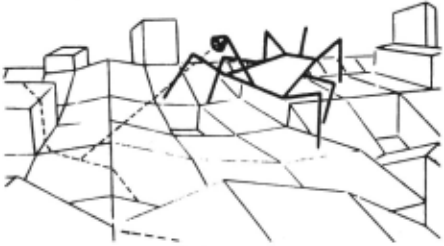
is intended for roving over an unknown and rather complicated world for delive ring loads or collecting informatinn. The guidance and contol systems of such robots should have some operational mo des of different degrees of autonomy 1 ·
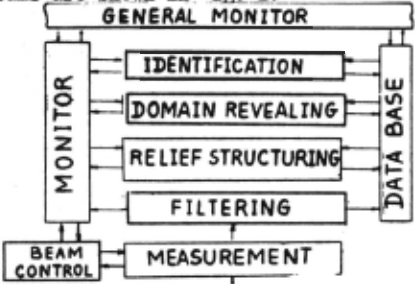
The autonomous functioning of the robot requires development of algorithms providing both the robot's perception of the environment and the robot's motion designing ability. Some results on such problems for a robot's motion over pris matic terrain were given in papers 2 · 4 · The motion in a 3D world of a rather ge neral type, which is treated ~.. ;,~::...:. paper, required the development of more powerful algorithms for motion design and information back-up to ensure the robot's operation in a more sophisticated world. The investigations at the Insti tute of Applied Mathematics cover two problems for a six-legged mobile robot: the problem of synthesizing the control algorithms and the problem of testing the algorithms by means of DC simulation. For this purpose a display system con taining two DC's was developed3. 2. Information problems are complicated by the necessity to arrange the robot's perception ability using for data proces sing a DC with restricted memory and speed capacity. It is assumed that the robot has a measurement system to estima te distances up to terrain relief (Fig.I). Like in the case of the prismatic world~ special algorithms were developed to filter the measurement data and to redu ce the information flow. These algorithms make it possible to reject information which may be considered as negligible when making a decision about the robots motion.
The next phase of data processing gives the information for estimating the feasibility to place the leg tips on the support surface and to move the rvLvt'o body over it. The obstacles which could be overcome when walking along the pres cribed route should be transmitted toge ther with the standpoint and route data to the motion design system. If the ter rain appears to be easy enough for wal king, in this case it is sufficient to transmit to the motion design system only the information on the standpoints and their close confinement.
Thus we observe two stages. The first stage involves preliminary aata processing and filtering necessary for the terrain data base. The second stage covers terrain analysis whicn reveales the convenient places for the legs. 'rhe data base is replenished with the analy sis results. The analysis is carried out by joint efforts of the route selecting and information systems. Their blockare .§.b_O_'t_n i:q . F_i_&_~-------..
ensure stable motion of the walker along the chosen route in a rather complicated relief. The motion design problems for a 11'&aitht.. 5-8 1ne route were considered in papers · They dealt with gait selection, stepping schedule and body motion. In the case of movement in a 3D world it is necessary to make the most efficient use of all six degrees of freedom of the body and of eighteen degrees of freedom of the legs. When the walker moves in a changable di rection it is necessary to make a choice of standpoints in such a way so as to provide a margin of freedom for body mo tion. In order to solve this problem the method of gait description proposed by MacGhee 6 was generalized to involve the case of irregular gait along the arbitra ry route. An algorithm was developed to find the sequence of the support poligons with maximum existence time. The existen ce time is the minimum of two times, the first being the time when the feet can stand on the tops of the support poligon, the second being the time o! the vehicle's static stability while using the poligon.
A special gait which is free of preliminary agreement on the order of functioning the legs and on the order of using the standpoint sequence, appeared to be very efficient and adequate for stable walking in difficult situations. Such "free" gait is governed by a set of rules on the calculation of the "up" ti mes for legs. Priority should be given to the leg for which the rest of possible support time is minimum. More detailed consideration of "free" gait is given in paper9.
'rhe vehicle body rotation (in pitch and roll) may be unavoidable when the level differences for chosen standpoints appear rath~d comparable with the leg length. In this case it is necessary to calculate the corridor of possible body positions. If the vehicle body moves inside the corridor, the body will have no collisions with the terrain; the stand points and timing for the legs can be chosen so as to ensure safe motion of the legs. Some problems of linear and nonlinear programming were solved to syn thesize algorithms for calculating the corridor and the optimal body motion inside it.
The following logics was adopted to simplify the walker's motion design pro cedure:
I. If the route selecting system plans the route using the rough model of motion design system and the regular rules of body motion design, it is possible to use a simplified method of motion design. 2. If the previous approach cannot be applied while at the same time the fea sibility of further vehicle motion can not be rejected with certainty (due to the roughness of the model), the motion design system has to make a more detai led analysis for finding a solution. It may cause deceleration or even stoppage of the walker due to the limitations in 00 capacity.
Thus we can see that the funr.tionin~ of the motion design system is based on the data received from the information the domain of the tolerable values, it and route selecting systems. The rough models appeared to be reasonable to use a make it possible to simplify calculations simplified method of force distribution and to save the DC processor time. Fig.3 shows the block-diagram of the motion system. based on the rough model of the walker's dynamics and on the information about the terrain inclination (Fig.4).
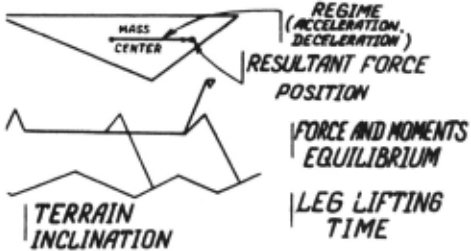
f'~j-'~· Pacto'ls ajjUti11j joue clt'st-zi.Sutio/1.
The motion design system sends the num bers of three "main ... legs of the walker to the execution dynamic level. The three legs may be considered as the "main" ones providing they have contact with the support poligon and have a ma ximum rest of the support time. This rule provided a rather smooth loading the actiators of the driving legs. At the same time it diminished the amount of switchings of the regime - the mo ments of changing the support legs - in comparison with the solution derived from the exact optimization algorithm inio.
According to the simplified method the vertical components of the reaction forces were calculated at the execution level using the kinetostatic equations. The accelerating or decelerating hori zontal components were distr1buted among the main legs of the right and left side of the walker. The terrain inclination was taken into account when choosing the optimal alternative for the horizontal component distribution bet ween the main legs of the same side.
The motion design system together with the route selecting system and information system ensured the pl~~ing of the standpoints with advantageous
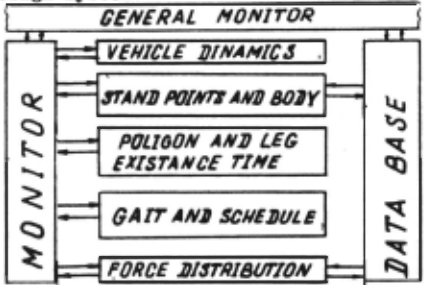
4. Execution problems. The motion design system generates the walker's kinematics. Its realization raises the problem of reasonable force distibution in the stati cally indeterminable supporting system of the walker, and also the problem of mo tion stabilization and compensating the execution errors.
The problem of reasonable force distribution and the calculation of the appropriate torques in the leg joints was investigated in paperi 0 · The principles that were used were the following: I. The maximal value of the normal reac tion forces in the supporting points (for the legs in contact with the groun~should be kept minimum all the time.
2. The maximal angle between the direc tion of the reaction force and the axis of the friction cone schould be kept mi nimum.
Both principles were realized by solving two problems of linear program ming with rather moderate searching. The first principle provides some eveness in the support force distribution, while the second one provides an increase in the friction margin.
In ordinary cases, when the required normal and tangent components of the =c~ ction forces might be chosen deep inside local inclination of the terrain. This made it possible to raise the reliability margin when implementing the walker's acceleration or deceleration.
If the executing level cou~d not solve the force distribution problem for the main ~ega fixed by the simplified methoa mentionea above, the linear prog ramming problem haa to be carried. out according to the algorithm rrow~u. In this case the slowing down of the walker's motion may be take place due to the pro cessor overloading.
The problem of compensating the exe cution errors was presented in papersiO-I~ It was treated as the problem of ayntesi zing the follow-up system for implementa tion the step cycle which was composed from portions of specially chosen basic functions. The basic functions for des cribing the step cycle and programming the follow-up system may chosen in the form of portions of rectilinear motion of the leg tip relative to the body (with indication of the motion velocity). A rather simple stabilization algorithm described in paperiO was baaed on some principles of terminal control and was governed by the navigation system.
Thus we have that the execution le vel responsible for the reasonable force distribution, torques calculation and the walker's stabilization, works in close cooperation with the navigation system and the motion design system of the wal ker.
5· System interaction involves two as pects: the content of interaction and the methods of its realization.
The interaction includes the follo wing processes:
- Scanning over some terrain spots by request of the route selection and motion design.
- Changing the mode of motion:
- upon reception of the signals from the route .selection and informati:::~ ;:;y::. tems,
- upon shortage of information for the motion design system,
- upon processor overloading.
The interaction of the systems and subsystems was implemented through the set of the local monitors (of each system) headed by the general monitor. Each sys tem consists of some independent modules (subsystems) operating in accordance with the signals received from the local mo nitor of the system. Each module sends to the local monitor signals upon succes sful termination of a task or upon the impossibility of fulfilling the tast (with the indication of the cause). The information flow between the modules was organized through a co~non informa tion base.
The idea of stick memory loaded with the help of "situation-action" lists was carried into being when implementing the monitors. The situation names were calculated from the modules signals accor ding to the procedure described in pa peri3. The idea of this approach is simi lar to the idea of classification rules described in paperi 4 ·
The general monitor coordinates the functioning of the local monitors and provides the flow of data and signals from one local monitor to another. 6. DC Simulation. The mathematical model of walker's control system was program med u.sing the FORTRAN language and the assambler BEMSH. The programma were also implemented which simulated the walker itself and the world where the walker had to operate. The programma run in DC BESM-6. The results were reflected on the display screen in the form of the image of the walker moving over the simulated terrain. A motion picture made from the display screen gives an idea of the effectiveness of the developed algorithms.
R E F E R E N C E S
- J .M. Moore "Computer system require ments for an autonomous martian roving vehicle" AIAA Paper N 69-980, AIAA Aerospace Computer Systems Conference, Sept. I969, USA.
- D.E. Okhoteimski, A.K. Platonov "Cont rol algorithm of the walker climbing over obstacles" Proceedings of the Third International Joint Conference on Artificial Intelligence, Standford, USA, Aug. 1973, pp.3I7-323.
- Jl.E. OXOUHYCKHi.t, A.K. fiJI8TOHOB 11 AJirO pHTY ynpaBJieHHH mara~~HY annapaToY, cnOC06HYY npeo~OJieBaTD npenHTCTBHH 11 , ~3B. AH CCCP, TexHuqecKaH KH6epaeTH Ka, ~ 5, 1973 r.
- r.K. LopoBHH, ~.~. KapnoB, D.W. ~aay THH, A.K. llnaTOHOB "CHcTeYa BYBO~a HH<JlopuauHH Ha aKpaH ~HenneR" llpenpHHT ~llM AH CCCP, ~ 48, 1973 r.
- n.E. oxouuMcKH~, A.K. nnaToaoB, l'.K. liOJlOBHH, ~.M1. i~apnoB, E.~. Kyry weB, ~.N. ]aayTHH, B.E. llaBJIOBCKHa, B.C. HpoweBCKd "YnpaBJieHHe HHTerpaJID HYY noKOYOUHOHHYM poe5oTou", Tpy.IU>~ YI CHunoaHyua ~~AK no ynpaBJieHH~ B npocT paHcTBe, ceK~HH XI, EpeBaH, CCCP, 1974 r. (~aB.AHOCCP, TexHHqecKaH Kl40epH8THK8, ~ 6, 1974 r.).
- n.E. 0XOU14YCKMiil, A .K. llJiaTOHOB, r .K. EopOBHH, ~L~. KapnoB "Wo~enupo B8HHe Ha UBY ~BH~eHHH wara~~ero anna paTe" ~aB.AH CCCP, TexHuqecKaH K~Oep H8THK8, ~ 3, 1972 r.
- R.Tomovic , R.B. McGhee "A Finite State Approach to the Synthesis of Bioengineering Control Systems" IEEE Transactions on Human Factors in Electronics, v.9, N 3, I967.
- R.B. McGhee, S.S. Sun "On the problem of selecting a gait for a legged vehicle" Tpy,lU>I YI CuunoaHyYa ~~AK no ynpaBJieHHD B npocTpaHCTBe, ceKUHR XI, EpeBaH, CCCP, I~'/4 r.
- H.B. YYHOB "0 Q14CJie HOr wara~~ero annap8T8 11 C6 · .ZJ.HII8YHK8 Y8WHH, 143~.
- "HayKa", M., 1974 r.
- E.~. KyryweB, B.C. HpoweBCKH~ "llpo6JI8Ybl BYC5opa noxo~KH HHTerpaJihHOro JIOKOYOUHOHHOrO pOC50T8 11 llpe~CT8BJI8HHO Ha IY KOH<JlepeHUH~ no acKyccTBeHHouy HHTenneKTy, TC5HJIHCH, CCCP, 1975 r.
- Jl.E. OXOLUfYCKHi, ~.~. rony6eB, Jl.A. AJiel CeeBa "Ynp8BJl8HMe ,lU!HSUHqeCKO~ Y0~8JIDD marallwero annapaTa" llpenpHHT miY AH CCCP, ~ 20, 1974 r.
- B.C. ryp<JlHHK8JID, A.IO. lllHei.t~ep, . E.M. KaHaeB, B.r. OcTanqyK "Mo~eJih marall~ero annapaTa c aBTOHOYHYY ynpaB nesaeu" Tpy.IU>~ IY BcecoJOaHoh KOH<JlepeH UHH no 6HOHMKe. Tou Yl, 1973 r.
- E.A. JleBHHHH, a.K. ~aBpoBcKaa, A.B. ReHCKMa, B.A. CaucouoB, A.~. qac TRKOB, ~.r. UITHJlhM8H "YaKeT ynpaBJIHe YOrO waraJOIUero annapaTa" Tpy.IU>~ IY BceCOI03HOil KOH<JlepeHUHH no C5HOHHKe, TOY YI, 1973 r.
- A.K. fiJiaTOHOB, ~.~. KapnoB "~H<Jlopua UHOHHOe oe5ecneqeHHe maramwHx annapa TOB11 Tpy,lU>I 1Y BceCOI03HOli KOH<JlepeHUHH no C5HOHHKe, T.Y1, M., 1973 r.
- R.S. Michalski "Discovering classifi cation rules using variable valued logic system VLI" Proceedings of the Third International Joint Conference on Artificial Intelligence, Stand ford, USA, Aug. I973·
@inproceedings{ijcai1975p127,
  title     = {Perceptive Robot Moving in 3D World},
  author    = {Okhotsimsky, D. E. and Platongy, A. K.},
  booktitle = {Proceedings of the Fourth International Joint Conference on
               Artificial Intelligence, {IJCAI-75}},
  publisher = {International Joint Conferences on Artificial Intelligence},
  editor    = {Patrick Winston and Carl Hewitt},
  pages     = {798--801},
  year      = {1975},
  note      = {Robots And Productivity Technology},
  url       = {https://ijcai.org/proceedings/1975/127},
}
TY - CPAPER TI - Perceptive Robot Moving in 3D World AU - Okhotsimsky, D. E. AU - Platongy, A. K. T2 - Proceedings of the Fourth International Joint Conference on Artificial Intelligence, IJCAI-75 PB - International Joint Conferences on Artificial Intelligence PY - 1975 SP - 798 EP - 801 UR - https://ijcai.org/proceedings/1975/127 ER -Copied
Machine-readable versions of this paper, for tools and AI agents:





