
Walking Control And Dynamics Of A Systems With Two Legs
Proceedings of the Fourth International Joint Conference on Artificial Intelligence. Robots And Productivity Technology. Pages 731-735.
© 1975 International Joint Conferences on Artificial Intelligence
Abstract
The present report suggests and investigates a model of the two-legs walking. The walking apparatus is simulated by a heavy rigid body sypplied with a pair of multilink legs. The algorithm for solving the problem of the two-legs walking is composed. A number of the problems on construction of the two-legs walking are solved and analysed within the framework of the suggested algorithm.
- I. Vukobratovic M. A Contribution to the mathematical theory of the artifical biped motion. Tpy;llhl Y MeJK.JcyHapo,llHOa KOH~epeHUH~ no HenHHeaHUU KOne6aBHHU, T.3, 1970.
- ByKoOpaTOBHq M., <llpaHK A., ll.l!ypaq .ll.., 00 yCTO~qHBOCTH nepe,llBH&eHHH H8 .llBYX aorax. CO.nepeBO.llOB "MexaHHKa" N!' I (131), 1972.
- Chow C.K., Jacobson D.H. Studies of Human Locomotion via Optimal Program- ming. Technical Report N 67, Division of Engineering and Applied Physics Harvard University, Cambridge, Mass.
- ByKoOpaTOBHq M. ~CKYCCTBeHHHe BOKO- UOUHOHHUe CHCTeuu: ,llHH8UHK8, anropHT- UU ynpa:aneHHH, ycToaqHBOCTh. 1J.OKTOp- CK8H ,llHCCepT8UHH. MOCKBB, 1972.
- EeneuKHi B.B. nnocKHe nHHe~Hue wo,llenH .llBYHOroro waraHHH. ITpenpHHT N!' 95, 38 1973 r., Op,lleHa AeHBHa ~HCTHTYT ilpHK- na,llHo~ MaTeuaTHKH AKa.IteUHH HayK CCCP , MOCKB8.
- EeneuKHil B.B • .ll.HHaUHKa .ItByHoro. l\ XO.It:&- ou. ITpenpHHT ~ 32, 38 1974 r., Op,lle- Ha AeHHHa ~CTHTYT ilpHKna,llHOM MaTeua- THKH AKa,lleMHH HBYK CCCP, MOCKB8 .
- ?. EeneuKH~ B.B. Ynpa:aneaHe xo,ll:&Oo" H ,llHHBMHKa .llBYHOrBx CHCTeu. Y1 Bceco~3- Hoe co:ae~aHHe no npooneuau ynpa:aneHHH, pe~epaTu ,llOKna,lloB, qacT:& W, H3.ll-BO 11 HayK8 11 1 t.lOCKB8 1 1974.
- beneUKH" B.B., KHpcaHOBa T.C., qy.ItH- HOB il.C. ,ll.HH8MHK8 .llBYHOrO" XO,llhOU. "ITpoOnewu Henade"Hux Kone6aHH~ wexa-
References were extracted automatically from the PDF and may contain errors.
Full text extracted automatically from the PDF; figures, tables and equations may differ. The PDF is the version of record.
Beletskii V.V., Institute of Applied Mathematics, Academy of Sciences, Moscow
Kirsanova T.S., Moscow State University
Tchudinov P.S., Institute of Applied Mathematics, Academy of Sciences, Moscow
Abstract. The present report suggests and investigates a model of the two-legs walking. The walking apparatus is simula ted by a heavy rigid body sypplied with a pair of multilink legs. The algorithm for solving the problem of the two-legs walking is composed. A number of the problems on construction of the two-legs walking are solved and analysed within the framework of the suggested algorithm.
Today one of the actual problem is to create the anthropomorphous locomo tion systems. It appears the whole num ber of investigations concerning to the dynamics and the control of the two legs walking [ I-81 · This is a complex problem which has a great number degrees of freedom, a specific character of con nections and controls. That is why the different dynamical models of the two legs walking suggested earlier (even the simplest models) are very complex. It causes difficulties to analyse the prob lem.
Meanwhile the problem of the two legs walking as well as any problem of dynamics and control needs in a model statement which is sufficiently reaso nable to describe the principle effects and peculiarities of the processes in vestigated. This model statement should be also sufficiently simple to assume an effective analysis.
The represented report describes investigations carried out in this di rection. In a number of cases suggested statements allow to obtain the process discription in the analytical form.
They also allow to give qualitative and parametrical analysis, and to construct the effective and simple algorithms for the numerical calculations.
I. Let us simulate the anthropomorphous system by means of a heavy rigid body (body-beam) which is supplied by a pair of imponderable non-inertial multilink legs suspended in one point of the body (fig.I). The contact of a leg with a surface is point and the interaction of the leg with the surface reduces to the resultant force applied to the point of the contact. In this case the algorithm for the construction of the motion and controls can be described by the follo wing system of equations:
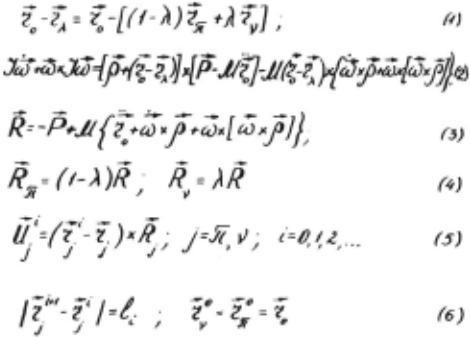
Here we designate: z7~Jis a trajectory of the body's fixed point which coinci des with a point of the leg suspension; i,ftJ, ~(t) are the trajectories (discre te set) of the standpoints for the legs (a footstep trajectory). In this case ~ refers to the leggoing into the stage of a support, Jt refers to the leg going out of the stage of a support. The process of the support transposition from one leg to another one is described by the arbitrary bunction A (t) which sa tisfies the conditions
),{t, )~O ; A(t;.,f)=l f'l) where ( is the beginning of a doublesupport phase of the motion and I,+ { is the end of a double-support phase of the motion. cl is a tensor of the body's inertia in the point of the leg suspen sion, w is a vector of the immediate angular velocity of the body, jJ is a vector fixed in the body from the point of the leg suspension into the center of mass of the body; Jl is a mass of the body; p is a vector of a gravity force, }? is a sum vector of the reactions applied in the points of the leg ~ppor ting ("the vector of reaction"), RJi and ~ are components of this vector-force v -~ in each of the supporting points1 ~· is a vector of control in the i-th joint of the j-th leg, 1' is a trajectory of the i-th joint of the j-th leg1 ~ is a length of the i-th link of the leg. The corresponding matrix function can be introduced instead of the scalar func tion A {t) , and thereby it widens a class of the possible motions (equations (2) will have some different structure [6] ) · Alternativly if we assume A= I we shall narrow a class of the motions up to the single-support walkings; in such wal kings there are no a stage of support on two legs. The single-support walkings are a class of the1motions which is a boundary between the eigen-walking and running. Sequence of calculations: the functions of time, the required trajec tory of the point of the leg suspension and the footstep trajectory and ), (t) , are given as explicit1 equation (2) of the angular motion is integrated and among a set of the possible solutions we select ones which have the given proper ties (for example, the periodical solu tions), the forces of reactions are calculated by formulae (3)-(4)1 the fun ction of time of the trajectory of the leg joints are given as explicit and satisfying connections (6). According to (5) the controls are calculated for ming the given motion.
Let us note that basic equations (2) and (3) do not depend on the motion of the leg joints (and depend only on the footstep trajectory and the trajectory of the suspension point). It represents the different possibilities for the eye thesis of the controls providing the gi ven motion.
2. A number of problems on the construc tion of the two-legs walking are solved and analysed in the framework of the described algorithm.
We call the walking comfortable it the point of the leg suspension moves uniformly and rectilinearly and regular if each coordinate of the footstep tra jectory is a step function obtaining the equal increments in equal intervals of time.
Let the walking be comfortable and regular. Assume also 1]1 =0 (the point o~ the leg suspension coincides with the center of mass of the beam), and the beam is dynamically symmetrical. Then in vir tue of (I)-(6) we come to the very simple model of the walking. This modes allows the complete analytical description: it is accurate in the plane case and appro ximate (but high-accurate) in the spatial case. The angular motions of the body are described by the three-parametric family of the periodical motions. It is shown in fig. 2. The angle B describes the normalized oscillations along the course coun~ed from the vertical line, the angle ~ describes these oscillations across the course. Factually, the trajec tory of a "summit" of the walker (upper view) is shown here.
3. At any ;JoO the body vibrations when the system moves can be small. Then equations (2) allow linearization. The linear problems also allow the analytical solutions. So the problem on the comfor table motion by the steps and the incli ned plane has been solved. The body vib rations in this case are described in the modified Bessel functions (fig.3). The shift of the average value of the body inclination at the expense of the incli nation of the motion trajectory and the footstep path is demonstrative.
4. The considered statement allows effec tively to solve the manoeuvring problems as well as the problem of motion on the rugged terrain, the problem of adaptation to the surface roughness and some other problems of control. The existance of the free parameters in the motion of the two legs systems is very important. Such pa rameters are: the height of the point of the leg suspension, the supporting inter val (the distance from the supporting point to the projection of the point of the leg suspension on the horizontal axis in the moment of change of the supporting leg). Hig. 4 illustrates an influence the parameter ~o on the motion of the walker C~a is proportional to the supporting interval). If ~ >- f the apparatus walks with body inclination backwards on the average, if tS 0 = -1 the apparatus vib rates on the average relative to the ver tical line, if 6 0 ..::. -1 it inclines, on the average, forth. The corresponding possible configurations of the walker at the beginning and at the end of the half period (i.e. at the moment of change of the supporting leg) are shown next to.
Thanks to the existence of the free parameters there is some possibility to optimize with respect to several of them. As an optimized value we can choose, for example, the work of the controlling mo ments during the corresponding angular movings for the halfperiod, i.e. during one step. The dependence of work on the value of the supporting segment for the plane model of the walker is constructed in fig.5. It is seen that at the fixed magnitudes of the remain parameters there exists some optimal value S minimizing the work.
5· The development of the described model is an analogous model having the ponde rable legs. In this model the whole class of the plane motions is studied in detail. The algorithm is investigated which gives the legs' Kinematics. It calcu~tes the motion of the point of the leg sus pension. It construct the oscillational body motion, the algorithm calculates the reactions and the controls providing the fulfilment of the stated locomotional problem. On the whole the algorithm is reduced to the solution of the boundary value problem for one differential equa tion of the second order (describing the body vibration) and to the following calculations by the finite formulae. The boundary value problem can be. solved by analytical way in the case of the small body vibration; then this solution is used as the first approximation to solve the nonlinear problem.
The parametrical analysis is obtai ned for the body vibration, for the cont rol by the supporting and bearable legs, for the forces of reactions at the diffe rent kinds of motions. For the plane linear problem all motions and the acting forces are obtained in the closed analy tical form.
F.ig. 6 illustrates the solutions for the problem of walking (for three types of walking) so called the "full" walking (I) symmetrical man walking (II), non-symmetrical man walking (III). For each type of walking above we construct the trajectories of the represantable points corresponding to the supporting and bearable legs on the plane of variab les ol, fi ( a<, fi are the angles which are formed vertically by a hip and a shin). In the case of "full" walk~ng the repre santable point corresponaing to the sup porting leg passes the are of ellipse I-3-5 and the represantable point corresponding to the bearable leg passes the arc of ellipse I'-3'-5'· In the case of the symmetrical man walking the repre santable points corresponding to the supporting and bearable legs pass one and the same arc I-3-5 but in the oppo site directiona. In the case of the non symmetrical walking the represantable point oscillates along the limitted seg ment of the ellipse arc. In all three walkings the bearable leg moves by "dragging" on the surface. It is not a matter of principle by the way. Below we illustrate the corresponding configura tion of the walker for the different mo ments of time. "Unnatural" motions of the walker's legs in the case of "full" walking are the analiticity fee of the obtained solutions. Dependence of the work on the period of motion is shown in fig. 7 for the indicated types of wal kings (I, II, III). We can see that the non-symmetrical walkings are more econo mical than symmetrical ones.
Jig. 8-I2 illustrate some results of solutions of the walking problems for the plane nonlinear model: fig. 8-9 - for the symmetrical man walking, fig.IO-I2 - for the non-symmetrical comfortable wal king. Fig. 8 shows the vertical component of reaction in the point of the support /? y depending on time (in the halfpe riod). It should be noticed that R y is very close to the analogous component obtained while studying the man locomo tion. Jig. 9 shows the dependence of the controlling moments in the joints on time during one step. The controls in the sup porting leg is one an order more than in the bearable leg. In this case the cont rols in a hip 3-4 times more than the controlsin a shin. Fig. IO illustrates a strong influence of value of the sup porting segment on the value of work of the inner forces. Depending on the value
S the work can almost 4 times be chan ged. Let us introduce the parameter 9 which is equal to the relation of the length of the supporting segment to the step length. At the fixed length of the step, for each set of parameters there exist f= flmln where the work is minimal during one step. Dependence n . on the "'mtn dimensionless value equal to the relation of the leg mass of the walker to t he whole mass of it is constructed in fig.I I. At the fixed step there exists the opti mal velocity of motion minimizing the energetic input for the walker.
@inproceedings{ijcai1975p116,
  title     = {Walking Control And Dynamics Of A Systems With Two Legs},
  author    = {Beletskii, V. and Tchudinov, P. and Kirsanova, T.},
  booktitle = {Proceedings of the Fourth International Joint Conference on
               Artificial Intelligence, {IJCAI-75}},
  publisher = {International Joint Conferences on Artificial Intelligence},
  editor    = {Patrick Winston and Carl Hewitt},
  pages     = {731--735},
  year      = {1975},
  note      = {Robots And Productivity Technology},
  url       = {https://ijcai.org/proceedings/1975/116},
}
TY - CPAPER TI - Walking Control And Dynamics Of A Systems With Two Legs AU - Beletskii, V. AU - Tchudinov, P. AU - Kirsanova, T. T2 - Proceedings of the Fourth International Joint Conference on Artificial Intelligence, IJCAI-75 PB - International Joint Conferences on Artificial Intelligence PY - 1975 SP - 731 EP - 735 UR - https://ijcai.org/proceedings/1975/116 ER -Copied
Machine-readable versions of this paper, for tools and AI agents:
 Welcome
 Future Conferences
 AI Journal Division
 IJCAI Proceedings
 About IJCAI
 IJCAI Awards