
Transport Robot With Network Control System
Proceedings of the Fourth International Joint Conference on Artificial Intelligence. Robots And Productivity Technology. Pages 727-729.
© 1975 International Joint Conferences on Artificial Intelligence
Abstract
A network control system of Transport Automatic Integral Robot (TAIP) motion in the real environment is suggested. Input data and general structure of the network are described. A program is reported of further efforts to investigate and refine the network control systems.
- Nillson N.J., Mobile Automation: An Application of Artificial Intelli- gence Techniques. Proc. of the Intern . Joint Conf. on Artificial Intelli- gence, Washington, May 1969, pp . 509- 520.
- Sutro L.L., Kilmer W.L., Assembly Computers to Command and Control a Robot. Spring Joint Computer Conf., May 14-16, 1969, Boston, Mass., AFIPS Conf. Proc., Vo1.34, pp. 113- ~~.~?:. ~!~oc on, ~ , ~L !t~r:: ~ TY 1 ~H , .1T. " . :~!'l.C:H T K!'- !<t~P.a, C • . ~.T:t .T!A.~!J. '\ :OTO :::;.Tl--T !i ~~. ;,~r ~~- ~: o c n o nc ~e r : :~e . "::. 3.JI<Ollll .11.~'7'~( <:'. 11 , !{,< eB ~ T973. !L:l •.• ::ocon. . ::on.c.m• mo nJ.P.!' <: : }Xl3 ~•~:1l .• " :(,~6e p P s Tw<,.", T97:'>, '''5 .
- K. r .. ~r. 1.6:>6 P. ::. !o:' :.'Ifl)l." ~.:~ : ~'C'"P. T . Tqq' l'• 5 , ~97T.
References were extracted automatically from the PDF and may contain errors.
Full text extracted automatically from the PDF; figures, tables and equations may differ. The PDF is the version of record.
Introduction
~he problem of artificial intelli gence creation for robots is characteri zed by several specific features. A robot has to exist in the natural environment. It receives information from its own sen sing elements mostly during an active work. There is no one here to take care for information to be complete (suffici ent to solve a problem accurately), consistent, and convenient in its form of representation · The framework of build-up of current efforts on the robot artificial intelligence (See, e.g.,[1]) seems to us, therefore, too narrow. The most of suggested procedures does not admit of inconsistent data employ ment and creates great difficulties in real-time work. It entails necessity of limiting the input data volume by all means.
Repeated attempts were undertaken to overcome arising difficulties by net work devices. Obtained results are unsa tisfactory as a whole. No sound methods of synthesis of the network devices for solving specific problems were obtained hitherto. Nevertheleas we are endeavour ing once more to rehabilitate the net work methods of artificial intelligence construction. There are several reasons:
- Network devices possess a large number of advantages in bulk information processing.
- Approach that is being elaboratett oy us differs from those verified earlier and will, possibly, yield other results.
- 3· Achievements of the modern engi neering allow to estimate anew various methods for device synthesis.
Theoretic efforts to study prospects and capabilities of the approach developed have already been carried out at our De partment for a long time. Computer models were created simultaneously to verify theo retic notions. A large number of effective digital mod.els developed by A.M. Kasatkin, L.M. Kasatkina, S.A. Talaev, V.D. Fomenko, and D.N. Galenko testify to the rightful ness of the chosen approach.
Development is currently under way ot a simulator o! the network system for transport robot control in the natural environment. An outline of this system and discussion of further efforts direc tion will be given in what follows.
Problem of Transport Robot
The Department of Biocybernetics engaged in 1972 in designing a simulator of a moving independent system - a tran sport robot - capable of purposeful move ment and performance of some actions with objects in a natural environment of the yard type. The problem of robot is close to that described in L. Sutro's, w. Kil mer's work {2] , however, our principal goal is to test a vehicle onboard cont rol system having the form of a neuron like network with SRI [ 31·
The preliminary check of capabilities of a network of physical elements (con sisting of 26 nodes and approximately 300 connections) was executed on the si mulator modeling a movement system in a hypothetical environment shown on a map. Capability is realized in this system to travel from one point of an area to ano ther with due account of all positive and negative attributes characterizing the given hypothetical environment as well as of constraints on time and energy consum ption. Results of the system experimental investiga tiona [ 4] have shown the feasi bility and expediency of robot control system construction on the base of net works with SRI.
Creation of transport robot presupp oses sOlution of a number of problems on which the system capability hinges large ly. We r~strict ourselves to a brief enu meration of these problems.
- Moving part must provide for mo vements of the robot where roads are im passable.
- System must "know" objectives it is aimed at. Such objectives may consist in:
- a} determining points on an area where the robot must arrive in;
- certain actions that the robot must execute (manipulation with objects, data collection, sam pling, etc.);
- operating in modes with a gi ven energy and time consumption.
- 3· System must be able to orient on an area (to locate itself with respect to one or another coordinate system).
- Robot must be equipped with a set of sensory organs (sensin~ elements) sup plying it with information on the environ ment as well as on its own "inner" states. The "eye"-type system, rangefinder, vari ous distant and contact sensing elements, energy consumption sensors, etc., should be included among them first of all.
- 5· Robot needs efficient devices enabling it to perform one or other ac tions with objects in the environment. These are various manipulators and prima rily - the "hand"-type system.
- Robot must be able to communicate with a human being therefore a system of natural speech discrimination is expedi ent.
7 7· Robot must know how to construct its "inner" model of the outer world and plan its behaviour.
- 8 . Robot must be a system that is able to adopt and learn.
Mechanics and System of Sensing Elements
The robot simulator developed by us is constructively a three-wheel under carri age where sensory organs, the control unit, and other devices are installed
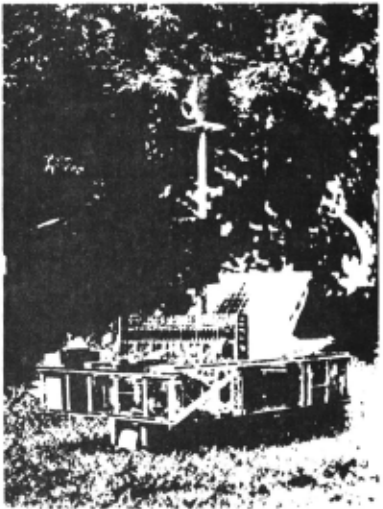
(see Fig.1). The under carriage dimensi ons: 1600x1100x600 mm. All three are driving wheels and each has an indepen dent drive from 60 W d.c. motors. The front wheel is the turning one. Power is supplied by two accumulator batteries each of 12V voltage and 40AhX capacity.
The system of sensing elements may be divided into several groups:
- Sensing elements determining the robot position in space:
- radio-navigation system with two radio beacons and the com pass;
- sensors of angles of the ve hicle inclination in two planes.
- Sensing elements supplying infor mation on the environment:
- distant ones. An active optic rangefinder, whose high speed is up to several hundreds of measurements per second, per mitting to "probe" the surroun ding relief at a distance up to 10m. A system of optic "probes" - rangefinders designed for detecting an object within the specified range of distan ces (about 30 em);
- contact ones - a system of mi croswitches set on an elastic cover of the vehicle.
- temperature sensors on the electric motors;
- 3· Sensors of robot states:
- torque sensors on the wheel drive;
- voltage pickups on the accumu lator batteries;
- vibration pickup.
- Timer.
Control Device
A neuron-like network with semantics and SHI realized physically is a basis of the control system. A detailed characte ristic of such networks, which &ot the name M-networks, is given in (3 J·
The M-network is formally a set of nodes and unidirectional connections lin king the nodes. Each node is made to co rrespond with some meaningful notion. Each connection is put in correspondence with some relation between notions. The nodes can be in the state of excitement. 'l'he. excitement is an analog quantity. The exc1tement can pass along the connections from one node to another. The connections are functionally divided into reinforcing and inhibitory ones. 'l'he existence in the M-network of a specific system for rein forcement and inhibition {SRI), which sets the positive node excitement feed back and thereby provides for the domi nation of one or seve1·al nodes over all others at each time instant is of essence. In the M-network data input/output corres ponds to the excitement of its nodes (in put and output, respectively).
The robot control system is now cal culated to eft'ec t a purposeful movement with provision for its own security (tra vel around obstacles, avoidance of dan gerous places, keeping internal parameters in assigned limits) and minimization of the energy and time consumption. The whole network (whose node number equals 100) is divided into 6 spheres. Semanticsand pur pose of the discriminated spheres are as f ollows (see Fig. 2).
~mation sphere and situation r:~ QOgnitl.on sphere. These spheres are input ones. Similar to sensory systems of the human brain, the CJnalysis of information received by sensing clements is performed here on the basis of which the environment, problem conditions and own states are esti mated integrally.
The character of behaviour in the current situation is chosen in the decision sphere. here the decision can be madedeter minin~ a general direction of movement or a choice of some complex movement maneuver or even execution of some elementary ac tion. Organization of the movement beha viour proper is carried out by three sphe res being output ones for the network, i.e.
.by the sphere of maneuve~s of the upper level, the sphere of maneuvers of the lower level, and by the sphere of elemen tar;y actions~. The sequence of commands deh vered to the effector system - the control system of turning and traction electric motors - is formed here. How ever, the emergency cutoff is envisaged in the system that is shown in the dia gram by the direct connections froa sens ing element system to effector system.
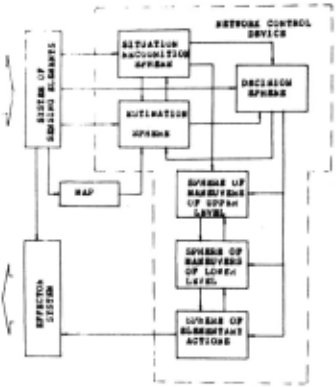
All network nodes are d.c. amplifi ers having special characteristics. Si milarly in every sphe1·e its own SRI acts. Connections between nodes are composed of resistive elements in a matrix-like de vice. 60 channels are used for data input from sensing elements into the network control system.
To plan its behaviour (the choice of a rout to an aim) the robot is supplied with a special locality map where the op timal route to the aim will be determined. In the given version the map is compiled beforenund. It is supposed that in future the robot will compile the map itself and modify it as required.
Experiments Planned.
The robot's moving part, control s~s tem of the lower level (effector system) and individual sensing elements were che cked and tested in the fall of 1973· Set ting up of the rest of devices, of the system as a whole, and experiments with it compose the next stage of developments scheduled to the end of 1975· As stated above, the ability of a purposeful move ment on a real ground of the yard type was only required of the system here.
During the planned tests it is sup posed to find out what capabilities the developed devices, the network control device mainly, have for solving various navigation problems (azimuth travel, tra vel to.an assigned point in the locality, etc. ) · 'l'hey must eventually answer the following principal questions:
- Is it possible to organize a neu ron-like network with SRI to control a transport robot in a respective environ ment efficiently?
- What is a rough amount of equip ment necessary to solve this problem?
- 3· What parts of the problem as a whole it is reasonable to solve by net work devices and to what extent computer application in control is desirable?
- What changes must be introduced into the philosophy of construction and teclmical realization of the network with SHI proper?
Further Research and Development
The program of further research sup poses an extension of the transport robot capabilities. The work is now under way and is performed in several directions·
Learninf. During the research we in tend to deve op methods and facilities for the network devices learning. Main atten tion is directed to creation of suffici ently cheap and simple as to production technology electrochemical elements as learning connections in the networks with SRI. Problems are solved of the elements matrix organization and of theiG commuta tion when they are more than 10 units in number.
Ensemble Or~anization of Network. This direction o our research is associ ated with a more economic use of the net work nodes. To this end it is intended to assign semantics not to individual nodes but to their combinations - ensembles. Each node of such network will take part in organization of many ensembles what promises a great saving of nodes in a number of cases. Moreover, the operational reliability should increase in such net work. The ensemble organization of .the network with SRI designed to solve speci fic problems gives, however, birth to new problems requiring supplementary investi gations.
Setting Ui and Oitimization of Net work Devices.easibi ity is investigated of the setting up of network individual parts (spheres) and auxiliary units by optimization algorithms imitating the evo lution processes. These algorithms impose a number of special requirements on hard ware necessary for their realization. Creation of such a hardware seems possible. Optoelectronics is promising in this res pect.
Visual Perception. At our Department K.G. Agababyan has carried out an investi gation earlier that demonstrated the possi bility to discriminate a large number of informative features in an image by the network devices f51· Employment of specia lized networks wltli SRI is intended in further research to solve the problem of discrimination of objects on a common background with their prerecognition. Te chnical realization of such devices en tails necessity of creating large-scale nonlearning networks. Hardware is develo ped for synthesizing such networks.
Manipulation. Here the research is aimed at solVing problems associated with realization of manipulator control prog rams in the network devices. The basic re quirement consists in the network ca~abi lity to form standard motional acts ("ha bits") and coordinate them in changing worki ng conditions.
Speech Contact. Investigations are directed here to the search of means for creating network devices capable of speech discrimination and of contact with a human being in a language close to the natural one. Consideration will be mainly given t o problems associated with perception and understanding of commands in the context of problems solved by the transport robot.
Construction of Inner Model and Plan B!Bg. To act successfUlly in an enViron ment the robot has to know how to construct a model of the latter and how to plan its own behaviour. Precise discrimination is necessary of the "imaginary" and "real" not to make premature solutions when plan ning. Plans have to be developed, hierar chic, multivariant. The robot has to eva luate feasibility of the plans concurrent ly with their elaboration. We intend to study these mechanisms on the learning network having the ensemble organization. Combination of the network with a computer will be probably of use here.
All enumerated directions imply the use of a network device with 1000 nodes and 2i1oP learning connections for model ing the bench versi.on under development.
Conclusion
On the basis of our experience of work with network control devices we assume that they are fit for an efficient use in solving a wide range of robot en gineering problems. However, one cannot assert preliminary that the network devi ces will prove competitive. The problem should be obviously solved when the net work methods prove actually preferable, when their combination with other methods is advantageous, and where their applica tion is expedient. Our efforts should re sult in a solution of this range of prob lems.
@inproceedings{ijcai1975p115,
  title     = {Transport Robot With Network Control System},
  author    = {Amosov, N. and Kussul, E. and Fomenko, V.},
  booktitle = {Proceedings of the Fourth International Joint Conference on
               Artificial Intelligence, {IJCAI-75}},
  publisher = {International Joint Conferences on Artificial Intelligence},
  editor    = {Patrick Winston and Carl Hewitt},
  pages     = {727--729},
  year      = {1975},
  note      = {Robots And Productivity Technology},
  url       = {https://ijcai.org/proceedings/1975/115},
}
TY - CPAPER TI - Transport Robot With Network Control System AU - Amosov, N. AU - Kussul, E. AU - Fomenko, V. T2 - Proceedings of the Fourth International Joint Conference on Artificial Intelligence, IJCAI-75 PB - International Joint Conferences on Artificial Intelligence PY - 1975 SP - 727 EP - 729 UR - https://ijcai.org/proceedings/1975/115 ER -Copied
Machine-readable versions of this paper, for tools and AI agents:





