
Lean Semantic Interpretation
Proceedings of the Sixteenth International Joint Conference on Artificial Intelligence. Natural Language Processing. Pages 868-874.
© 1999 International Joint Conferences on Artificial Intelligence
Abstract
We introduce two abstraction mechanisms for streamlining the process of semantic interpretation. Configurational descriptions of dependency graphs increase the linguistic generality of interpretation schemata, while interfacing them to lexical and conceptual inheritance hierarchies reduces the amount and complexity of semantic specifications.
- [Allen, 1993] James F. Allen. Natural language, knowledge repre- sentation, and logical form. In M. Bates and R. M. Weischedel, editors, Challenges in Natural Language Processing, pages 146- 175. Cambridge: Cambridge University Press, 1993.
- [Bean et al., 1998] C. A. Bean, T. C. Rindftesch, and C. A. Snei- derman. Automatic semantic interpretation of anatomic spatial relationships in clinical text. In Proceedings of the 1998 AM/A Annual Fall Symposium, pages 897-901.
- Hanley & Belfus, 1998.
- [Charniak and Goldman, 1988] Eugene Charniak and Robert Gold- man. A logic for semantic interpretation. In Proceedings of the 26th Annual Meeting of the Association for Computational Lin- guistics, pages 87-94, 1988.
- [Creary and Pollard, 1985] Lewis G. Creary and Carl J. Pollard. A computational semantics for natural language. In Proceedings of the 23rd Annual Meeting of the Association for Computational Linguistics, pages 172-179, 1985.
- [Friedman and Hripcsak, 1998] C. Friedman and G. Hripcsak. Evaluating natural language processors in the clinical domain. Methods of Information in Medicine, 37(4/5):334-344, 1998.
- [Gomez et al., 1997] F. Gomez, C. Segami, and R. Hull. Determin- ing prepositional attachment, prepositional meaning, verb mean- ing and thematic roles. Computational Intelligence, 13(1):1-31, 1997.
- [Hahn and Schnattinger, 1998] Udo Hahn and Klemens Schnat- tinger. Towards text knowledge engineering. InAAA/'9&1/AA/'98 -Proceedings of the 15th National Conference on Artificial In- telligence & lOth Conf on Innovative Applications of Artificial Intelligence, pages 524-531. AAAI Press & MIT Press, 1998.
- [Hahn et al., 1994] Udo Hahn, Susanne Schacht, and Norbert Broker. Concurrent, object-oriented natural language parsing: the P ARSET ALK model. International Journal of Human-Computer Studies, 41(112):179-222, 1994.
- [Hahn et al., 1999] Udo Hahn, Martin Romacker, and Stefan Schulz. Discourse structures in medical reports -watch out! The generation of referentially coherent and valid text knowledge bases in the MEDSYNDIKATE system. International Journal of Medical Informatics, 53(1):1-28, 1999.
- [Hajicova, 1987] E. Hajicova. Linguistic meaning as related to syn- tax and to semantic interpretation. In M. Nagao, editor, Language and Artificial Intelligence., pages 327-351. North-Holland, 1987.
- [Hirst, 1988] Graeme Hirst. Semantic interpretation and ambiguity. Artificial Intelligence, 34(2):131-177, 1988.
- [Jacobs, 1991] PaulS. Jacobs. Integrating language and meaning in structured inheritance networks. In John F. Sowa, editor, Princi- ples of Semantic Networks. Explorations in the Representation of Knowledge, pages 527-542.
- Morgan Kaufmann, 1991.
- [Markert and Hahn, 1997] Katja Markert and Udo Hahn. On the interaction of metonymies and anaphora. In /JCA/'97-Proceed- ings of the 15th International Joint Conference on Artificial In- telligence, pages 1010-1015. IJCAI
- Morgan Kaufmann, 1997. [MUC-6, 1995] MUC-6. MUC-6-Proceedings of the 6th Message Understanding Conference. Morgan Kaufmann, 1995. Sondheimer et al., 1984]
- Norman K. Sondheimer, Ralph M. Weischedel, and Robert J. Bobrow. Semantic interpretation using KL:ONE. In CO LING' 84-Proceedings of the 1Oth International Conference on Computational Linguistics & 22nd Annual Meet- ing of the ACL, pages 101-107, 1984.
- [Staab and Hahn, 1997] Steffen Staab and Udo Hahn. ''Tall", "good", "high"-compared to what? In /JCA/'97-Proceed- ings of the 15th International Joint Conference on Artificial In- telligence, pages 996-1001.
- Morgan Kaufmann, 1997.
- [van Eijck and Moore, 1992] Jan van Eijck and Robert C. Moore. Semantic rules for English. In Hiyan Alshawi, editor, The Core Language Engine, pages 83-115. MIT Press, 1992.
- [Woods and Schmolze, 1992] W. Woods and J. Schmolze. The KL-ONE family. Computers & Mathematics with Applications, 23(215) : 133-177, 1992.
References were extracted automatically from the PDF and may contain errors.
Full text extracted automatically from the PDF; figures, tables and equations may differ. The PDF is the version of record.
1 Introduction
Natural language processing methodology has matured in the recent years considering the design of grammar formalisms and parsing algorithms. The development of computationally feasible semantic theories and, in particular, their linkage to the grammar level by an adequate semantic interface has not witnessed a comparable level of consolidation. So, only a low degree of consensus has emerged concerning the formulation of semantic interpretation rules by which syntactic structures are mapped onto semantic (or conceptual) representations.
The lack of a mature and commonly shared methodology for semantic interpretation is not only deplorable from a the oretical standpoint but has immediate practical consequences for the design of NLP systems dealing with the diversity of real-world input on a larger scale. In such an environment, rule sets tend to be designed and updated in a less than sys tematic manner to accomodate to the many complex phenom ena in the language data, rule specifications confound differ ent description layers, have heterogeneous formats and some times even ad hoc extensions -in the end, they become non portable. Often this also leads to an unwieldy growth of the number of rules for large-scale NLP systems. As a result, the rules' compatibility, mutual interactions, side effects, order constraints, etc. are likely to get out of hand.
In order to avoid these negative effects, we introduce two abstraction mechanisms by which the process of semantic in terpretation can be streamlined. The first abstraction aims at increasing the linguistic generality of descriptions for se mantic interpretation. The criteria we use address configura tions within dependency graphs rather than hook on particu lar language phenomena. These configurations have a natu ral graph-theoretical reading in terms of "minimal" connected subgraphs of a syntactic dependency graph. This way, we are able to cover a variety of linguistic phenomena by instanti ation of few and general interpretation schemata. The sec ond abstraction relates to the way how these schemata interact with grammar and domain knowledge. By interfacing them to lexical and conceptual inheritance hierarchies, we further increase descriptional economy and supply a parsimonious semantic interpretation system.
Our methodology crucially depends on a strict separation between linguistic grammar knowledge and conceptual do main knowledge, and their linkage via a lean semantic inter face. Granting such an organization of knowledge, portability of semantic interpretation schemata across different domains and applications is made feasible - a feature of advanced system design that was hard to achieve so far.
2 Framework for Semantic Interpretation
We now sketch the knowledge sources required for semantic interpretation. Grammatical knowledge for syntactic analysis is based on a fully lexicalized dependency grammar [Hahn et al., 1994]. A dependency grammar captures binary con straints between a syntactic head (e.g., a noun) and one of its possible modifiers (e.g., a determiner or an adjective). Our preference for dependency structures is motivated, among other things, by the observation that the correspondence of dependency relations (between lexical items) to conceptual relations (between the concepts they denote) is much closer than for any constituent-based grammar [Hajicova, 1987]. Hence, a dependency-based approach eases the description of the regularities underlying semantic interpretation.
In the dependency framework we have chosen, lexeme specifications form the leaf nodes of a lexicon tree, which are further abstracted in terms of word class specifications at different levels of generality. This leads to a word class hi erarchy, which consists of word class names W := {VERB, VERBTRANS, DET, ARTICLE, ... } and a subsumption relation isaw = {(VERBTRANS, VERB), (ARTICLE, DET), ... } C W x W. Inheritance of grammatical knowledge is based on the idea that constraints are attached to the most general word classes to which they apply, leaving room for more and more specific (possibly, even idiosyncratic) grammatical specifica tions when one descends this hierarchy.
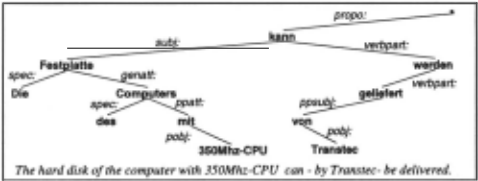
In order to establish a dependency relation V := {specifier, subject, dir-object, ... } between a head and a modifier, the cor responding constraints on word order, compatibility of mor phosyntactic features as well as semantic criteria have to be fulfilled. Fig. 1 depicts a sample dependency graph in which word nodes are given in bold face and dependency relations are indicated by labeled edges. For example, the syntactic head "Festplatte" (hard disk) governs its modifier "Comput ers" via the gen[itive ]att[ribute] dependency relation.
Conceptual knowledge is expressed in terms of a KL ONE-like knowledge representation language [Woods and Schmolze, 1992]. This choice is motivated by the require ment to express domain knowledge in terms of a formally sound representation language. A domain ontology consists of a set of concept names F := {COMPANY, HARD-DISK, ... } and a subsumption relation isa:F = {(HARD-DISK, STOR AGEDEVICE), (TRANSTEC, COMPANY), ... } C F X F. The set of relation names R := {HAS-PART, DELIVER-AGENT, ... } contains the labels of conceptual relations which are also organized in a subsumption hierarchy is an = {(HAS-HARD DISK, HAS-PHYSICAL-PART), (HAS-PHYSICAL-PART, HAS PART), ... }. 1 Concept names are assigned conceptual roles, taken from the repertoire of conceptual relations, as part of the concept definition process. Unless defined as being prim itive, the terminological classifier computes subsumption re lations between these concept definitions in order to generate a domain's concept hierarchy (similarly, for relations).
In our approach, the representation languages for seman tics and domain knowledge coincide (for arguments support ing this view, cf. Allen [1993]). The basic mechanism for linking lexical items and conceptual entities proceeds as fol lows: Upon entering the parsing process, each lexical item w that has a conceptual correlate C in the domain knowledge base, w.C E F (mostly verbs, nouns and adjectives), gets immediately instantiated in the knowledge base, such that for any instance Iw. initially, 2 type(Iw) = w.C holds (e.g., w = "Festplatte", Iw = HARD-DISK.2, w.C = type(HARD DISK.2) = HARD-DISK). In case several conceptual corre lates exist (either due to homonymy or polysemy) each lexical ambiguity is processed independently.
1 All subsumption relations, isaw, isa:F, and isan, are consid ered to be transitive and reflexive.
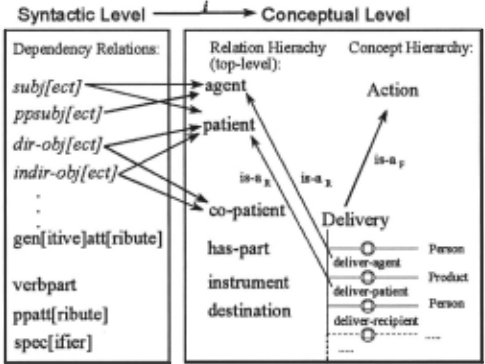
Conceptual relations between instances are determined by different types of dependency relations that are established between their corresponding lexical items. Semantic inter pretation mediates between both levels in a way as abstract and general as possible. First, static semantic constraints re late grammatical and conceptual knowledge via fixed map pings which take inheritance at both knowledge levels into account. The illustration in Fig. 3 (left side) depicts a subset of the dependency relations contained in V at the syntactic level proper. Dependency relations that have a hard-wired mapping to conceptual relations are shown in italics. For in stance, whenever the dependency relation dir-obj[ect] is es tablished it must conceptually be interpreted in terms of PA TIENT or CO-PATIENT including all their subrelations (e.g., DELIVER-PATIENT). gen[itive]att[ribute], however, has no fixed conceptual counterpart as this dependency relation does not restrict conceptual interpretation at all.
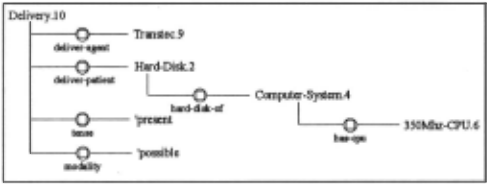
Second, semantic interpretation schemata then dynami cally incorporate these static constraints when translating a dependency graph (such as Fig. 1) into a corresponding con ceptual representation (as depicted in Fig. 2). Schemata are high-level generalizations that abstract away from many lin guistic details one encounters in specific dependency graphs (concrete lexical items, word classes, dependency relations). These abstract schemata get instantiated in the course of se mantic interpretation by reference to the grammatical and conceptual hierarchies previously introduced. So, in our ex ample, instantiating a general interpretation schema by concrete lexical materiallike "hard disk" and "deliver" automat ically specializes high-level conceptual constraints like PA TIENT (from the schema) to low-level ones such as DELIVER PATIENT (from the domain knowledge) by exploiting the hi erarchy of conceptual relations (cf. Fig. 3).
2 Textual phenomena, figurative language, etc. might necessitate changes of this initial reference assignment, cf. Hahn et al. [1999].
3 Semantically Interpretable Subgraphs
In the dependency parse tree from Fig. 1, we can distinguish lexical nodes that have a conceptual correlate (e.g., "Fest platte" (hard disk), "geliefert" (delivered)) from others that do not have such a correlate (e.g., "mit" (with), "von" (by)) . The basic configurations for semantic interpretation are based on this distinction:
- Direct Linkage: If two word nodes with conceptual cor relates are linked by a single dependency relation, a di rect linkage is given. Such a subgraph can immediately be interpreted in terms of a corresponding conceptual re lation. This is illustrated in Fig. 1 by the direct linkage between "Festplatte" (hard disk) and "Computers" via the gen[itive]att[ribute] relation, which gets mapped to the HARD-DISK-OF role linking the corresponding con ceptual correlates, viz. HARD-DISK.2 and COMPUTER SYSTEM.4, respectively (see Fig. 2). This interpretation uses knowledge about the conceptual correlates and the linking dependency relation, only.
- Mediated Linkage: If two word nodes with concep tual correlates are linked via a series of dependency re lations and none of the intervening nodes have a con ceptual correlate, a mediated linkage is given. Such a "minimal" subgraph can only indirectly be interpreted in terms of a conceptual relation. In this case, we include lexical information from intervening nodes in addition to the knowledge about the conceptual correlates and de pendency relations. In Fig. 1 this is illustrated by the syntactic linkage between "Computers" and "350Mhz Cpu" via the intervening node "mit" (with) and the ppatt[ribute] and pobj[ect] relations, the result of which is a conceptual linkage between COMPUTER-SYSTEM.4 and 350MHZ-CPU.6 via the relation HAS-CPU in Fig. 2.
In order to increase the generality and to preserve the sim plicity of semantic interpretation we introduce a generaliza tion of the notion of dependency relation such that it incorpo rates direct as well as indirect linkage: 1\vo content words (nouns, adjectives, adverbs or full verbs) stand in a medi ated syntactic relation, if one can pass from one word to the other along the connecting edges of the dependency graph without traversing word nodes other than prepositions, modal or auxiliary verbs (i.e., elements of closed word classes). In Fig. 1, e.g., the tuples ("Festplatte", "Computers"), ("Com puters", "350Mhz-Cpu"), ("Festplatte", "geliefert") and ( "geliefert", "Transtec ") stand in mediated syntactic rela tions, whereas, e.g., the tuple ( "Transtec ", "Festplatte ")does not, since the connecting path contains "geliefert" (deliv ered), a content word.
This leads us to the following definition: Let w and w' be two content words in a sentence S . In addition, let w2, ... , Wn-1 E S (n 2: 2) be prepositions, auxiliary or modal verbs, and let w1 := w and Wn := w'. Then we say that w and w' stand in a mediated syntactic relation, iff there exists an index l E {1, ... , n} so that the following two conditions hold: ·
- Wi is modifier of Wi+l fori E { 1, . . . , l-1 };
- wiisheadofwi+lforiE{l, ... ,n-1}.
We call such a series w1, . . . , Wn a semantically inter pretable subgraph of the dependency graph of S.
The definition of a mediated syntactic relation encom passes the notion of a direct linkage (n := 2, so that an empty set of intervening nodes emerges). The special cases l := 1 and l := n yield an ascending and descending series of head-modifier relations, respectively. 3
The cases of direct and mediated linkage are the two relevant configurational settings for semantic interpretation. Thus, this paper is concerned with the translation of depen dency graphs, like the one in Fig. 1, to a concept graph as in Fig. 2. The translation is achieved in a strictly composi tional way, i.e., by linking the conceptual representations of the semantically interpretable.subgraphs within the entire de pendency graph.
We do not, however, consider conceptual interpretation, the mechanisms of which reside at the conceptual level only and, therefore, are merely indirectly affected by syntactic structures. As an example of such an inference consider Fig. 4, with the DELIVERS relation linking TRANSTEC.9, a hard ware supplier, and HARD-DISK.2. Note that the correspond ing lexical items, "Transtec" and "Festplatte ", are not linked via a mediated syntactic relation in Fig. 1. Hence, we may clearly discern semantic interpretation, as the interpretation of semantically interpretable subgraphs, and conceptual in terpretation, where the interpretation of relationships among different subgraphs come into play.

4 A Model of Lean Semantic Interpretation
In the following, we shall describe a model of semantic inter pretation that seamlessly integrates the processing of depen dency relations either directly or indirectly linking conceptu ally interpretable word nodes. We distinguish two levels of semantic interpretation - first, static constraints for seman tic interpretation derived from mapping dependency relations to conceptual roles, and, second, a search of the knowledge base when conducting the semantic interpretation, which dy namically takes these static constraints into account.
3 Note that not every such graph may arise in a special depen dency grammar. This need not concern us in this paper.
Static Constraints on Semantic Interpretation. Inter pretation procedures for semantically interpretable sub graphs may inherit restrictions from the type of dependency relations (or even from the lexical material) occurring in these sub graphs. Constraint knowledge from the grammar level comes in two varieties, viz. via a positive list, D ~ex val, and a neg ative list, D !_ex val, of dependency relations, from which ad mitted as well as excluded conceptual relations, R+ and R_, respectively, are derived by a simple static symbol mapping.
Knowledge about D ~ex val and D !_ex val is part of the va lency specifications. It is encoded at the level of word classes W, such that lexval E W x V, and, thereby, it is inherited by all subsumed lexical instances. For instance, the word class of transitive verbs, VERBTRANS E W, de fines for its subject valency D Jverbtrans , subject) := {subject} d D (verbtrans subject) 0 f . al . . l an _ ' := ; or an option preposttJ.ona phrase valency, ppopt, we require nJverbtrans, ppopt) := 0 and D~verbtrans , ppopt) :={subject, dir-object, indir-object}. We may then distinguish three basic cases:
- Knowledge available from syntax determines the seman tic interpretation, if D~exval =/; 0 and D!_exval = 0 (e.g., the subject of a verb).
- Knowledge available from syntax restricts the semantic interpretation, if D ~ex val = 0 and D !_ex val =/; 0 (e.g., most prepositional phrases).
- If D ~exval = 0 and D !_ex val = 0, no syntactic con straints apply and semantic interpretation proceeds en tirely concept-driven, i.e., it relies on the domain knowl edge only (e.g., for genitive attributes). 4
In order to transfer syntactic constraints to the concep tual level, we define i: V ----t 2n, a mapping from depen dency relations onto sets of conceptual relations. This map ping generalizes the illustration depicted in Figure 3 (e.g., i(subject) := {AGENT, PATIENT}). For dependency relations r that cannot be linked a priori to a conceptual relation (e.g. gen[itive]att[ribute]), we require i(r) := 0. The conceptual re strictions, R+ and R_, must be computed from D ~ex val and D !_exval, respectively, by applying the interpretation func tion i to each element of the corresponding sets. This leads us to R+ := {y I x E D~exval 1\ y E i(x)} and R_ := {y I X E D!_exvall\ Y E i(x)} .
Basic Schema for Dynamic Semantic Interpretation. Semantic interpretation is done via a search in the domain knowledge base which takes the just mentioned constraints into account. Two sorts of knowledge have to be combined first, a pair of concepts for which a connecting relation path has to be determined; second, conceptual constraints on the kinds of permitted and excluded conceptual relations when connected relations are being computed. The first constraint type incorporates the content words linked at the dependency level within the semantically interpretable subgraph, the lat ter accounts for the particular dependency relation(s) between them. In technical terms, schema (1) describes a mapping from the conceptual correlates, h.Cfrom and m.Ct 0 , in :F of the two syntactically linked lexical items, h and m, respec tively, to connected relation paths Rcon·
4 We have currently no empirical evidence for the fourth possible case, where D~exval -:/= 0 and D!.·xval-:/= 0.
A relation path is called connected, if for all its n con stituent relations the concept type of the domain of the rela tion ri+l subsumes the concept type of the range of the rela tion ri. 5
In order to compute a semantic interpretation, si triggers a search through the concept graph of the domain knowledge base and identifies all connected relation paths from C from to Cto· Due to potential conceptual ambiguities in interpreting syntactic relations more than one such path can exist (hence, we map to the power set of Rcon).
As a filter for constraining connectivity, si takes into con sideration all conceptual relations R+ c n a priori permitted for semantic interpretation, as well as all relations R_ C n a priori excluded from semantic interpretation. Both of them reflect the constraints set up by particular dependency rela tions or non-content words figuring as lexical relators of~ tent words (for examples, cf. Section 5). Thus, rel E Rcon holds, if rel is a connected relation path from Cfrom to Cto· obeying the restrictions imposed by R+ and R_.
If the function si returns the empty set (i.e., no valid inter pretation can be computed), no dependency relation will be established. Otherwise, for all resulting relation paths RELi E Rcon an assertional axiom is added to the knowledge base by asserting the proposition (h.Cfrom RELi m .Cto) where RELi denotes the ith reading. If i > 1, conceptual ambiguities oc cur (not an issue here).
To map a concept definition C against the constraints im posed by R+ and R_, we define the function get-roles( C) =: C R, which returns the set of all conceptual roles C R associ ated with C. get-roles(Cfrom) extracts the roles that are used as starting points for the path search. As, for ease and gener ality of specification, R+ and R_ consist of the most general conceptual relations only, the concrete conceptual roles CR and the general ones in R+ and R_ may not always be com patible. Prior to semantic interpretation, we therefore expand R+ and R_ into their transitive closures, incorporating all their subrelations in the relation hierarchy. Thus, R.f. := { r* E n I 3 r E R+ : r* is an r } . Correspondingly, R':_ is defined. R+ restricts the search to relations contained in C R n R.f., iff R+ is not empty (otherwise, all CR are allowed), whereas R- allows only for relations in C R \ R':_.
5 A number of additional constraints must hold, e.g., composed relations must be acyclic (cf. Markert and Hahn [1997]).
Whenever a semantically interpretable subgraph is complete semantic interpretation is carried out immediately. Several configurations of these semantically interpretable subgraphs will be discussed subsequently. We start from the interpre tation of direct linkage, and then turn to mediated linkage patterns by considering increasingly complex configurations in dependency graphs as given by prepositional phrases and passive clauses.
Interpreting direct linkage. Consider a fragment of our sample sentence, "die Festplatte des Computers " (the hard disk of the computer) in Fig. 1. "Festplatte" and "Comput ers" are directly linked by the dependency relation gen[itive] att[ribute], "Festplatte" being the syntactic head of its geni tive modifier "Computers ". Both have conceptual correlates, whose type is given by type(HARD-DISK.2) =HARD-DISK and type(COMPUTER-SYSTEM.4) = COMPUTER-SYSTEM. To relate the two instances conceptually, a slight specializa tion of the basic semantic interpretation schema (1), the di rect linkage schema (2), will be applied (substituting Cfrom by Chead and Cto by Cmod).
"Festplatte" belongs to the word class of nouns. It inherits D (noun, genatt) ·-0 d D (noun, genatt) ·- 0 Th + .- an _ .- . us, syntax does not at all restrict the search for valid conceptual rela tions, i.e., no static constraints apply. Hence, R+ = 0 and R_ = 0. In order to dynamically incorporate constraints the function get-roles(HARD-DISK) extracts all roles related to HARD-DISK at the domain knowledge level (e.g., HAS ACCESS-TIME, HAS-NOISE-LEVEL, HARD-DISK-OF, etc.). It is iteratively checked for each of these roles whether the conceptual correlate of the modifier "Computers", i.e., COMPUTER-SYSTEM, is a legal filler (this is only the case for HARD-DISK-OF, cf. Fig. 2).
Interpreting mediated linkage. When interpreting me diated syntactic relations, additional information about the intervening nodes becomes available such that further static constraints are imposed on R+ (and R_) in terms of a list Rzez C R of permitted conceptual relations, which is spec ified at the lexeme level. Note that Rzez relates to closed class items only, so the number of specifications required can be kept manageable. Also, such a specification can be done, once and for all, in a domain-independent way.
In our example (cf. Fig. 1), "Festplatte" (hard disk) and "geliefert" (delivered) are linked by a mediating modal verb ("kann") and a passive auxiliary ("werden"). These mantic interpretation schema for passive auxiliaries (3) ad dresses the concept type of the instance for their syntactic subj[ect], Csubj = type(l8ubj) (i.e., HARD-DISK), and that for their verbpart, Cvrbpart = type(Ivrbpart) (i.e., DELIV ERY). The relation between these two, however, is deter mined by Rpassauz := {PATIENT, CO-PATIENT}, constraint knowledge which resides in the lexeme specification for "werden" (be) as passive auxiliary.
This leads to siauz(DELIVERY, {PATIENT, CO-PATIENT} , 0, HARD-DISK) which yields the conceptual relation DELIVER PATIENT (cf. Fig. 3), since HARD-DISK is subsumed by PRODUCT and, thus, a legal filler of DELIVER-PATIENT E R;assauz ·
We will now turn to the attachment of prepositional phrases. Unlike conceptually neutral auxiliaries, prepositions serve as relators carrying conceptual constraints for the corre sponding instances of their syntactic head and modifier. The "meaning" of a preposition is encoded by a set RPrep C R , for each preposition Prep, holding all permitted relations in terms of high-level conceptual relations. As an example, con sider "von" (by, from, of), with Rvon :={AGENT, SOURCE, STARTING-TIME-POINT, HAS-DEGREE .. . }.
In order to infer a valid semantic interpretation for each semantically interpretable subgraph containing a preposition a precompilation step for integrating static constraints from different sources is carried out. These static constraints arise from the preposition itself and from the syntactic head of the preposition (e.g., "geliefert" (delivered) governs the prepo sition "von" (by) via the ppsubj[ect] dependency relation). The information provided by the syntactic relation between the preposition and its head is exploited such that the positive list D ~ex val and negative list D !_ex val of the preposition's head are consulted prior to· a semantic check in the knowl edge base. By applying the function i to all elements con tained in D ~ex val, a new set P + := {y I x E D ~ezval 1\ y E i ( x)} containing all conceptually permitted relations is cre ated. By analogy, the corresponding set of conceptual re lations P _ is excluded from interpretation. Expanding ap propriately, we get Pf. := { p· E R I 3 p E P + : p* is an p } (correspondingly, we define P~). We say for non-empty P+ : If (RPrep \ P~) n Pf. = 0 (and, similarly, for empty P+ : If (RPrep \ P~) = 0), then further semantic interpretation is ob solete. This is due to the fact that the static constraints given by the syntax (derived by the interpretation function i applied to D~ezval and D!_ezval, respectively) are incompatible with the set of constraints for the preposition, RPrep· Else, we de termineR+ := (RPrep \ P~) n Pf. for non-empty P+ and R+ := (RPrep \ P~) for empty P+, and define a specialized interpretation schema for prepositions siprep:
As far as the example "geliefert von Transtec" (deliv ered by Transtec) in Fig. 1 is concerned, the syntactic re strictions given by the syntactic head of the preposition ("geliefert") are nJverbpartpa88, ppsubj) := {ppsubj} and D (verbpartpa88, ppsubj) 0 s: th b' I hi h . _ := tOr e ppsu '.1 va ency, w c IS specified at the word class level for passive participles verb partpass like "geliefert" (delivered). Since syntactic con straints are encountered, the precompilation step becomes necessary in order to compute Pf. and P~. Since ppsubj[ ect] statically maps to AGENT (cf. Fig. 3) and AGENT is also contained in Rvon· AGENT and all its subrelations are con tained in R+ (i.e., the intersection of P.f- and R; 0 n). Since R+ of. 0 after integrating all static constraints, the semantic interpretation schema for prepositions gets instantiated with siprep(DELIVERY, {AGENT*}, 0, TRANSTEC). 6 The roles to be considered are thus the roles contained in the inter section of the concept roles of DELIVERY (extracted by get roles(DELIVERY) with R+· Given the underlying ontology, this set of relations melt down to a single element, DELIVER AGENT isan AGENT. Thus, satisfaction of dynamic con straints reduces to the check whether TRANSTEC is a legal filler of DELIVER-AGENT. Since TRANSTEC is subsumed by LEGAL-PERSON which IS-A PERSON, the sortal constraints are met and TRANSTEC.9 is asserted to be the DELIVER AGENT ofDELIVERY.10 (cf. Fig. 2).
6 Evaluation of Semantic Interpretation
In this section, we want to discuss, for a particular type of lan guage phenomenon, the adequacy of our approach in the light of concrete language data taken from the corpora we work with. This part of the enterprise, the empirical assessment of semantic interpretation, is almost entirely neglected in the literature (for a notable exception, cf. Bean et al. [1998]).
The semantic interpretation task has to be clearly distin guished from the information extraction task and its standard evaluation setting [MUC-6, 1995]. In the IE task, a subset of the templates from the entire domain is selected into which information from the texts are mapped. Also, the design of these templates focus a priori on particularly interesting facets (roles, in our terminology), so that an IE system does not have to deal with the full range of qualifications that can be attributed even to a relevant concept that might occur. The semantic interpretation task, however, is far less constrained as we evaluate the adequacy of the conceptual representation structures relating to the entire domain of discourse, with all qualifications mentioned in a text.
This increased complexity of the task leads to many un solved methodological questions (for a discussion, cf. Fried man and Hripcsak [1998]). We may illustrate this claim within the framework of our approach. Basically, a triple di vision of test scenarios have to be distinguished. The first class relates to checks whether each static constraint, effected by the mapping from a single dependency relation to one or more conceptual relations is valid. Second, one may investi gate the appropriateness of the results from the search of the domain knowledge base, i.e., whether a relation between two concepts can be determined at all, and, if so, whether that relation (path) is adequate. Third, interactions between static constraints and dynamic constraint propagation may occur, as illustrated by the interpretation of prepositions.
In the small-scale evaluation study we performed, we started from a domain ontology that is divided into an up per generic part (containing about 1,100 concepts and rela tions) and various domain-specific parts. In the study were port on two specialized domains were dealt with - an in formation technology (IT) model and an ontology covering parts of anatomical medicine (MED) (each domain model, in addition, contributes 1,100 concepts and relations). Cor responding lexeme entries in the lexicon provide linkages to the ontology. We also assume a correct parse to be delivered for the semantic interpretation process.
6 Note that due to the precompilation step there is no need to ex pand R+ to its transitive closure.
We then took a random selection of 54 texts (comprising 18,500 words) from our two text corpora. For evaluation pur poses we concentrated on the interpretation of genitives (di rect linkage), prepositional phrase attachments and auxiliary as well as modal verbs (both variants of mediated linkage). In the following, we will focus on the discussion of the results from the semantic interpretation of genitives (cf. Table 1).
At first glance, the choice of genitives may appear some what trivial. From a syntactic point of view, genitives are directly linked and, indeed, constitute an easy case to deal with at the dependency level. From a conceptual perspec tive, however, they provide a real challenge. Since no static constraints are involved in the interpretation of genitives, an unconstrained search (apart from connectivity conditions) of the domain knowledge base is started. Hence, the main bur den rests on the dynamic constraint processing part of se mantic interpretation, i.e., the path finding procedure mud dling through the complete domain knowledge base in order to select the adequate reading(s). Therefore, genitives make a strong case for the second test scenario mentioned above.
The following criteria guided the evaluation of genitives. We considered a semantic interpretation to be a correct one, if the conceptual relation between the two concepts involved was considered adequate by introspection (otherwise, incor rect). This qualification is not as subjective as it may sound, since we applied really strict conditions. 7 Correct interpreta tions were those that contain exactly one relation, as well as cases of ambiguities (up to three readings, the most), where the relation set contained the correct one. A special case of incorrectness, called nil, occurs when no relation path can be determined though the two concepts under scrutiny are con tained in the domain knowledge base.
We also classified the cases where the system failed to pro duce an interpretation due to at least one concept specifica tion missing (with respect to the two linked content words in a semantically interpretable subgraph). In those cases without interpretation, insufficient coverage of the generic model was contrasted with that of the two domain models and with cases in which concepts referred to other domains, e.g., fashion or food. Subareas that could neither be assigned to the generic model nor to particular domains were denoted by phrases referring to time (e.g., "the beginning of the year"), space (e.g., "the surface of the storage medium"), and abstract notions (e.g., "the acceptance of IT technology"). These areas can be distinguished from evaluative expressions (e.g., "the advan tages of plasma display") and figurative language, including idiomatic expressions (e.g., "the heart of the notebook").
7 The majority of cases were easy to judge. For instance, "the infiltration of the stroma" resulted in a correct reading- STROMA being the PATIENT of the INFILTRATION-, as well as in an incorrect one- being the AGENT of the INFILTRATION. Among the incorrect semantic interpretations we also categorized, e.g., the interpretation of the expression "the prices of the manufacturers" in terms of a conceptual linkage from PRICE via PRICE-OF to PRODUCT via HAS MANUFACTURER to MANUFACTURER, since it did not account for the interpretation that MANUFACTURERS fix PRICES as part of their marketing stragegies. Correct interpretations always boiled down to evident cases, e.g., HARD-DISK PART-OF COMPUTER.
| MED | IT | |
|---|---|---|
| #texts #words | 29 4,300 | 25 14,200 |
| recall precision | 57% 97% | 31% 94% |
| # genitives ... . .. with interpretation . . . ... correct (single reading) ...... correct (multiple readings) ... . .. incorrect . . . ... nil . . . without interpretation ...... domain model ..... . generic model . .. .. . other domains . ..... abstracta . .. . .. space . ..... time . ..... figurative .. . ... evaluative . .... . miscellaneous | 100 59 (59%) 53 (53%) 4 (4%) 0 2 41(41%) 23 (23%) 3 0 11 7 0 1 0 0 | 147 49 (33%) 28 (19%) 18 (12%) 3 0 98 (67%) 57 (39%) 23 4 12 8 15 17 8 1 |
We considered a total of almost 250 genitives in all these texts, from which about 59%/33% (MED/IT) received an in terpretation. Of the total loss due to incomplete concep tual coverage, 56%/58% (23 of 41 genitives/57 of 98 geni tives) can be attributed to insufficient coverage in the domain model. Only the remaining 44%/42% are due to the many other factors we have listed in Table 1.
The results we present here are just a preliminary sketch of what has to be done as part of a more serious evaluation. The concrete values we present, disappointing as they may be for recall (57%/31% ), encouraging, however, for preci sion (97%/94% ), can only be interpreted relative to other data still lacking on a broader scale. One should keep in mind, however, that we neither narrowed semantic interpretation down to a very limited range of spatial relations in anatomy [Bean et al., 1998], nor did we bias the result by preselect ing only those phrases that were already covered by our do main models [Gomez et al., 1997]. Judged from the poor figures of our recall data, there is no doubt, whatsoever, that conceptual coverage of the domain constitutes the bottleneck for any knowledge-based approach to NLP. Sub language dif ferences are also mirrored in these data, since medical texts adhere more closely to well-established concept taxonomies than magazine articles in the IT domain.
In our evaluation, we certainly have only scratched the sur face. Besides many open methodological questions related to the evaluation of conceptual structures, a lot of empirical material related to different syntactic structures still has to be considered. In our system, we currently supply semantic interpretation schemata for declaratives, relatives, and pas sives at the clause level, complement subcategorization via PPs, auxiliaries, tenses at the verb phrase level, pre- and and postnominal modifiers at the noun phrase level, and anaphoric expressions. We currently do not cover control verbs, coordi nation and quantification.
7 Related Work
The standard way of deriving a semantic interpretation is to assign each syntactic rule one or more semantic interpreta tion rules (e.g., van Eijck and Moore [1992]), and to deter mine the meaning of the syntactic head from its constituents. There are no constraints on how to design and organize this rule set despite those that are implied by the choice of the se mantic theory. In particular, abstraction mechanisms (going beyond the level of sortal taxonomies for semantic labels, cf., e.g., Creary and Pollard [1985]), such as property inheritance, defaults, are lacking. Accordingly, the number of rules in creases rapidly and easily reaches orders of several hundreds in a real-world setting [Bean et al., 1998]. As an alternative, we provide a small set of interpretation schemata instead of assigning specific interpretation rules to each grammar item (in our case, single lexemes), and incorporate inheritance based abstraction in the use of these schemata during the in terpretation process in the knowledge base.
Sondheimer et al. [1984] and Hirst [1988] treat semantic interpretation as a direct mapping from syntactic to concep tual representations. They also share with us the representa tion of domain knowledge using KL-ONE-style terminologi cal languages, and, hence, they make heavy use of property inheritance (or typing) mechanisms. The main difference to our approach lies in the status of the semantic information rules. Sondheimer et al. attach single interpretation rules to each role (filler) and, hence, have to provide utterly detailed specifications reflecting the idiosyncrasies of each semanti cally relevant (role) attachment. Property inheritance comes only into play when the selection of alternative semantic rules is constrained to the one(s) inherited from the most specific case frame. In a similar way, Hirst uses strong typing at the conceptual object level only, while we use it simultaneously at the grammar and the domain knowledge level for the pro cessing of semantic schemata.
Charniak and Goldman [1988] and Jacobs [1991] already specify semantic rules in the context of inheritance hierar chies. So, they achieve a similar gain in generality as we do (e.g., Charniak and Goldman's rule for case relations corre sponds to our schema (2)). We differ, however, in that we specify semantic interpretation schemata rather than rules. This additional level of generality becomes evident, e.g., in terms of schema (2), which also incorporates the interpreta tion of genitives (and many other direct linkage phenomena). Indeed, Charniak and Goldman have to supply an extra se mantic interpretation rule for every syntactic phenomenon as they base semantic interpretation on syntactic rules and not on abstract configurations in dependency graphs that cover more than one syntactic phenomenon. Jacobs [1991] goes even fur ther and completely ties syntactic role specifications into con ceptual ones. Such an approach, however, mixes knowledge levels at the cost of clean modularization.
8 Conclusions
We proposed a principled approach to the design of compact, yet highly expressive semantic interpretation schemata. They derive their power from two sources. First, the organization of grammar and domain knowledge, as well as semantic in terpretation mechanisms, are based on inheritance principles. Second, interpretation schemata abstract from particular lin guistic phenomena in terms of general configuration patterns in dependency graphs.
Underlying these design decisions is a strict separation of linguistic from conceptual knowledge. A clearly defined in terface is provided which allows these specifications to make reference to fine-grained hierarchical knowledge, no matter whether it is of linguistic or conceptual origin. In addition, the interface is clearly divided into two levels. One makes use of static, high-level constraints supplied by the mapping of syntactic to conceptual roles or supplied as the meaning of closed word classes. The other uses these constraints in a dy namic search through a knowledge base, that is parametrized by few and simple schemata.
It should be clearly noted, however, that the power of this approach is, to a large degree, dependent on the fine granu larity of the knowledge sources we incorporate, the domain knowledge base, in particular. Given such an environment, the formulation of the regularities at the semantic descrip tion level can be kept fairly general. The need for detailed ontologies is by far not restricted to semantic interpretation. Indeed, one cannot do without sophisticated domain repre sentations for many other challenging understanding tasks such as the resolution of reference relations in texts [Hahn et al., 1999], the acquisition of concepts from texts [Hahn and Schnattinger, 1998], or the interpretation of evaluative asser tions [Staab and Hahn, 1997].
Also since the number of schemata at the semantic de scription layer remains rather small, their execution is easy to trace and thus supports the maintenance of large-scale NLP systems. The high abstraction level provided by inheritance based semantic specifications allows easy porting across dif ferent application domains. Our experience rests on reusing the set of semantic schemata once developed for the IT do main in the medical domain without further changes.
Acknowledgements. K. Markert was a member of the Graduate Program Human and Machine Intelligence funded by DFG, while M. Romacker is supported by a grant from DFG (Ha 2097/5-1).
@inproceedings{ijcai1999p124,
  title     = {Lean Semantic Interpretation},
  author    = {Romacker, Martin and Hahn, Udo and Markert, Katja},
  booktitle = {Proceedings of the Sixteenth International Joint Conference on
               Artificial Intelligence, {IJCAI-99}},
  publisher = {International Joint Conferences on Artificial Intelligence},
  editor    = {Thomas Dean},
  pages     = {868--874},
  year      = {1999},
  note      = {Natural Language Processing},
  url       = {https://ijcai.org/proceedings/1999/124},
}
TY - CPAPER TI - Lean Semantic Interpretation AU - Romacker, Martin AU - Hahn, Udo AU - Markert, Katja T2 - Proceedings of the Sixteenth International Joint Conference on Artificial Intelligence, IJCAI-99 PB - International Joint Conferences on Artificial Intelligence PY - 1999 SP - 868 EP - 874 UR - https://ijcai.org/proceedings/1999/124 ER -Copied
Machine-readable versions of this paper, for tools and AI agents:





