
On the Interaction of Metonymies and Anaphora
Proceedings of the Fifteenth International Joint Conference on Artificial Intelligence. Natural-language Processing and Graphical Presentation. Pages 1010-1014.
© 1997 International Joint Conferences on Artificial Intelligence
Abstract
From the analysis of naturally occurring texts we obtained evidence for the systematic interaction between nominal anaphora and metonymies. This leads us to postulate an integrated model incorporating both phenomena simultaneously. The consideration of discourse constraints for metonymy resolution allows us to challenge the commonly held view that the interpretation of metonymies should proceed from a literal-meaning-first approach. Thus, we argue for an equally balanced treatment of literal and figurative language use.
- [Chaffin, 1992] Roger Chaffin. The concept of a semantic relation. In A. Lehrer and E.F. Kittay, editors, Frames, Fields and Con- trasts, pages 253-288.
- Hillsdale, N.J.: Lawrence Erlbaum, 1992.
- [Fass, 1991] Dan C. Fass. met•: A method for discriminating metonymy and metaphor by computer. Computational Linguis- tics, 17(1):49-90, 1991.
- [Gibbs, 1989] Raymond Gibbs. Understanding and literal meaning. Cognitive Science, 13:243-251, 1989.
- [Grosz et al., 1987] Barbara Grosz, Douglas E. Appelt, Paul A. Martin, and Fernando C.N. Pereira. Team: An experiment in the design of transportable natural-language interfaces. Artificial Intelligence, 32(2): 173-243, 1987.
- [Hahn and Markert, 1997] Udo Hahn and Katja Markert. In sup- port of the equal rights movement for literal and figurative lan- guage: A parallel search and preferential choice model. In Proc. of CogSci-97, pages 609-614, 1997.
- [Hahn et al., 1996] Udo Hahn, Katja Markert, and Michael Strube. A conceptual reasoning approach to textual ellipsis. In Proc. of ECA/-96, pages 572-576, 1996.
- [Hobbs et al., 1993] Jerry R. Hobbs, Mark E. Stickel, Douglas E. Appelt, and Paul Martin. Interpretation as abduction. Artificial Intelligence, 63:69-142, 1993.
- [Lakoff, 1987] George Lakoff. Women, Fire, and Dangerous Things. What Categories Reveal about the Mind. Chicago Uni- versity Press, Chicago, IL, 1987.
- [Norvig, 1989] Peter Norvig. Marker passing as a weak method for inferencing. Cognitive Science, 13(4):569-620, 1989.
- [Nunberg, 1995] Geoffrey Nunberg. Transfers of meaning. Journal of Semantics, 12:109-132, 1995.
- [Pustejovsky, 1995] James Pustejovsky. The Generative Lexicon. Cambridge, Mass. : MIT Press, 1995.
- [Stallard, 1993] David Stallard. Two kinds of metonymy. In Pro c. of ACL-93, pages 87-94, 1993.
- [Strube and Hahn, 1996] Michael Strube and Udo Hahn. Func- tional centering. In Proc. of ACL-96, pages 270-277, 1996.
- [Verspoor, 1996] Cornelia Verspoor. Lexical limits on the influence of context. In Proc. ofCogSci-96, pages 116-120, 1996.
- [Woods and Schmolze, 1992] William A. Woods and James G. Schmolze. The KL-ONE family. Computers & Mathematics with Applications, 23(2-5):133-177, 1992.
References were extracted automatically from the PDF and may contain errors.
Full text extracted automatically from the PDF; figures, tables and equations may differ. The PDF is the version of record.
1 Introduction
An almost canonical definition considers an expression A a metonymy, if A deviates from its literal denotation in that it stands for an entity B which is not expressed explicitly but is conceptually related to A via a contiguity relation r. Most computational studies concentrate on the fact that taking A literally often leads to intrasentential semantic or syntactic anomalies, which they take as a starting point for metonymy resolution. This approach disregards the textual embedding of most metonymies, which is reflected by the systematic in teraction in the resolution of nominal anaphora and definite metonymic noun phrases. This is a surprising fact, since metonymy is generally regarded as a phenomenon of ref erence, which obviously may interact with other referential phenomena as well. Focussing on intrasentential phenomena only, almost unequivocally implies subscribing to the literal meaning-first (LMF) hypothesis [Gibbs, 1989]. The most common variant of the LMF view considers the occurrence of sortal conflicts (or, deriving from that, syntactic irregular ities) a necessary condition for metonymy resolution. In all other cases the literal interpretation is preferred, by default.
The subsequent discussion is intended to reveal various in teraction patterns for metonymies and anaphora and the im pact they have on the occurrence of sortal conflicts. We then conclude that restricting the resolution of metonymies to in trasentential analysis, as well as pursuing an LMF approach are both inadequate. Given a definite noun phrase A, we may distinguish between the following usage patterns:
I. A is anaphoric and ...
- A is not metonymic. 1 Hence, the literal denotation of A allows for anaphora resolution; in addition, A fulfils the required sortal constraints.
- A corresponds to a predicative metonymy. 2
- (i) Ten minutes before the notebook switches off, it starts beeping.
- (ii) The clock frequency of the computer is reduced to 8 MHz
In (ii), a literal denotation is available for anaphora res olution in (i)- "computer" resolves to "notebook". It does not, however, fulfil all sortal constraints, as "clock frequency" is a property attributed to a processor, not to a computer as such. No significant interaction between anaphora and metonymy resolution need take place.
- A corresponds to a referential metonymy.
- (i) We also tested the printer Epson EPL-5600. 3
- (ii) a) I liked the laser, as its printouts were excellent.
- I liked the laser.
In both cases, anaphora resolution is fully dependent on metonymy resolution. For case a), the resolution of the part-for-whole metonymy, "laser" for "laser printer", can be achieved without information about the possi ble anaphoric antecedents of "the laser", as the anal ysis of the sentence reveals a sortal conflict (the com bination with "its printouts" fails). Thus, in a syntax first approach, after syntactic processing a (quite so phisticated) metonymy resolution procedure had to pre cede anaphora resolution to solve this case. Con sidering an incremental approach, anaphora resolution for "the laser" would be triggered before the infor mation about the sortal conflict were available so that the problem is reduced to case b) . Example b) illus trates how metonymy resolution can benefit from in formation about possible anaphoric antecedents of "the laser". Firstly, the information may help with choosing amongst several metonymic readings - excluded are those readings, which do not allow for anaphora resolu tion (e.g., the competing metonymic reading "laser" for "light"). Secondly, only the information about possible antecedents can help triggering a metonymy resolution at all, as no sortal restrictions are violated.
1 We restrict figurative speech in this paper to metonymies.
2 Stallard [1993] and Nun berg [1995] discern cases of predicative and referential metonymy, depending on whether the literal or the intended referent is available for subsequent pronominal reference.
3 Given the original discourse context of this text fragment, "Epson EPL-5600" is already known to be a laser printer.
II. A is not anaphoric and ...
- A is not metonymic. When the literal denotation of A fulfils all sortal restrictions but does not allow for anaphora resolution the necessary criteria for textual el lipsis [Hahn et al., 1996] are fulfilled:
- (i) We also tested the printer Epson EPL-5600.
- (ii) I did not like the paper-tray.
The parallel structure of example /.3.(ii).b shows that these criteria can also be met by anaphoric noun phrases A that are referential metonymies. Thus, we may get ei ther truly ambiguous readings here or, at least, readings which cannot be distinguished without further lexical or pragmatic information (cf. [Hahn and Markert, 1997]).
- A is metonymic. In this case, predicative and referen tial metonymies are either marked by sortal conflicts or can only be recognized by very sophisticated inferential mechanisms which are not an issue here.
We argue for an integrated model that accounts for the systematic interdependencies between nominal anaphora and metonymies. Metonymy resolution is not only crucial for anaphora resolution. Discourse restrictions may even facil itate metonymy resolution and the resolution of correspond ing ambiguities. They are also crucial for the distinction be tween predicative and referential metonymies. In addition, evidence from preceding discourse elements may override the literal-meaning-first hypothesis by referential constraints. These interaction effects are highly rewarded for (though by no means restricted to) incremental approaches to natural lan guage analysis, as sortal conflicts may not be recognized at the time when anaphora resolution is carried out.
2 Conceptual and Semantic Constraints
The parser we use establishes syntactic structures only if con ceptual and semantic constraints between the lexical items in volved are met. Conceptual checks identify well-formed role chains between the concepts denoted by the lexical items; semantic checks determine whether these chains mirror metonymic relationships or literal ones. The representation structures to which these checks refer are grounded in a hy brid terminological knowledge representation framework (cf. [Woods and Schmolze, 1992] for a survey). The concept hi erarchy consists of a set of concept names :F ={COMPUTER SYSTEM, PRINTER, ... } and a subclass relation isa;: =
{(LASER-PRINTER, PRINTER), (NOTEBOOK, COMPUTER SYSTEM), .. . } c F X :F. The set of relation names n = {has physical-part, has-laser; clock-frequency-of, ... } contains the labels of all conceptual roles. These are also organized into a hierarchy by the relation isan ={(has-laser; has-physical part), (clock-frequency-of, property-of), .. . } c n X n. For every i E INST, the set of instances, the (direct concep tual) class of i is defined by n ce:F,iEC c. We express this by class( i) = Cor by i inst-ofC.
2.1 Conceptual Relatedness
By definition, we associate with a lexical item lex a stan dard denotation in terms of a concept, LEX.C E :F (e.g., COMPUTER-SYSTEM is associated with the lexical item "computer"). Furthermore, lex.r refers to the instance cor responding to lex. 4 If a syntactic link between two lexical items, A and B, is to be allowed, the concepts A.c and B.c must be conceptually related. In order to determine concep tual relatedness, we employ a path finder, which performs an extensive search in the domain knowledge base looking for well-formed paths between two concepts. The following ba sic criteria for determining well-formed paths are applied:
Given two concepts x, y E :F, a series of conceptual rela tions r; E n (i = J, ... ,n) and concepts Cj E :F (j = O, ... ,n) ( n E N, the natural numbers) is called connective, iff
- r; is a (possibly inherited) conceptual role of c;_ 1 with range(r;) = c; for all i = (J, ... ,n);
- co = x 1\ (en isa;:· y V y isa;:· Cn), where isa;:· de notes the reflexive and transitive closure of is a;:.
In the following, a connected conceptual path like the one above will be denoted by (r1 .. . rn) ·
Furthermore, we require a well-formed path to be non cyclic, favoring a unidirectional search in the knowledge base (cf. Table 1; s- 1 denotes the inverse of relations).
Table 1: Non-Cyclic Paths
Thus, we call a path (r1 ... rn) cyclic iff it contains two relations which are inverses of each other (in this case, in cluding inheritance of conceptual relations).
2.2 Literalness vs. Figurativeness
Every well-formed path between A.c and B .cis interpreted by the path evaluator. Certain predefined path patterns are used to distinguish between a subset C of all types of well formed paths, which is labeled "literal", another subset M which is labeled "metonymic", and all remaining paths which are labeled "unclassified". Hence, a literal path between A.c and B .c mirrors a literal interpretation of both A and B, whereas a metonymic path between A.c and B.c mirrors a metonymic interpretation of A or B.
4 lf lex is meant literally, lex.r E LEX.C holds, whereas for metonymies this need not be the case.
Literal Paths. We call a relation chain a literal one, if it can be treated as a single relation. All paths of unit length 1 are included in C, as they are "literal", by def inition (they refer to the conceptual roles directly associ ated with a concept definition). In addition, we incorpo rate empirical observations about the transitivity of rela tions. [Chaffin, 1992] distinguishes several subtypes of part whole relations and claims that any of these subrelations are transitive, while the general part-whole relation usually is not. Thus, a relation chain containing only relations of one of these subtypes is again a relation of the same subtype, whereas a relation chain containing several different types of part-whole relations does not constitute a part-whole re lation any more. Accordingly, we have included the path patterns (has-physical-part*) , (collection-member*), (mass portion*), (process-phase*), (event-feature*), (area-place*) and the corresponding inverses like (physical-part-oj) in C. We refer to the first six of these patterns as transitive part whole patterns, in short/, and to the inverse patterns as 7- 1 .
Metonymic Paths. Following established classifications [Lakoff, 1987; Pass, 1991] we incorporate whole-for-part, part-for-whole, producer-for-product, container-for-contents and material-for-object metonymies. In order to determine path patterns corresponding to these metonymies consider the conceptual link between the concepts A.c and B.c, where B stands metonymically for an instance of the class Y. A cor responding well-formed conceptual path p = (r1 ... rn) with n E N, n > 1, and r i E n (i = J, ... ,n) must, first, link A.c toY via p1 = (r1 ... rj-1) for some j E {2, ... ,n} . Y is then linked to B .c via P2 = (r; ... rn) ·
With simple metonymies (as opposed to chains of metonymies), p1 E C must hold. The second linkp2 must ex press one of the metonymic relations MS = {has-part, part of, produced-by, contained-in, made-of}, depending on the specific metonymy to be handled. 5 In the case of a producer for-product metonymy, e.g., j = n and rn =produced-by must hold. For a part-for-whole or whole-for-part metonymy, j < n may be possible, as all paths in T and 7- 1 (e.g., (has physical-part*)) also express a single has-part or part-of rela tion. For notational convenience, we now consider the paths in T and 7- 1 as a single relation so that we may write (has physical-part*) isan has-part or (event-feature*) EMS. We summarize the definition of metonymic paths in Table 2.
Considering 1.2.(ii), e.g., a syntactic link between "clock frequency" and "computer" is checked by searching for a well-formed path between the corresponding concepts CLOCK-FREQUENCY and COMPUTER-SYSTEM. The path Metonymic-Path ((r! .. . rn)) :¢>
5 If the direction of the search is reversed (from B.c to A.c) the corresponding inverse relations must be considered. We re fer to these inverse relations as MS- 1 = {part-of, has-part, pro duces, contains, material-of} . This list of metonymic relations is, of course, incomplete and may be augmented on demand.
(r1 ... rn) ~ C 1\ 3j E {2, ... ,n}:
((r1 , r2, ... , Tj -1} E C 1\ (rj , Tj +1 , .. . , rn) E MS)
V ((ri, ri+1, ... , rn) E C 1\ (r1 , r2, ... , r3_1) E MS- 1 )
Table 2: Metonymic Path Patterns
finder locates a single path (clock-frequency-of cpu-of motherboard-of), a metonymic one. With the above notation, n = 3, j = 2, P1 = (rl) =(clock-frequency-of) E C and P2 =(cpu-of motherboard-of) isan part-ofholds. We deduce by this path pattern that "computer" denotes a whole-for-part metonymy for an instance of the concept CPU = range r 1.
Thus, example 1.2(ii) can be handled in a straightfor ward way without incorporating discourse restrictions. Since only a metonymic path between CLOCK-FREQUENCY and COMPUTER-SYSTEM is found, we do not need to consider discourse constraints to resolve any ambiguities. Also, as suming a strict preference for literal over metonymic path patterns (as characteristic of LMF approaches) would not pe nalize metonymy resolution. 6 In contradistinction, example 1.3(ii).b demonstrates that this ranking can be overridden by contextual information in the case of definite noun phrases. Furthermore, in an incremental approach a sortal conflict may be detected at a rather late stage of processing ( cf. exam ple /.3(ii).a). Hence, expensive backtracking becomes nec essary, if information about possible anaphoric antecedents is not taken into account early on. As a consequence, we prefer literal over metonymic paths only in those cases whe·n both concepts are expressed as indefinite noun phrases, verbs or adjectives. If a definite noun phrase occurs, we will incorpo rate information about possible anaphoric antecedents.
3 Interaction of Metonymies and Anaphora
When a definite noun phrase A in the utterance Ui can syn tactically be bound to an H with a conceptual correlate H.c (e.g., the main verb of the sentence), anaphora resolution for A is triggered. Based on a functional centering framework [Strube and Hahn, 1996] each utterance Ui- 1 is assigned a set of forward-looking centers c J ( ui -1) containing the possible anaphoric antecedents for an anaphor in Ui . Thus, c, (Ui-d = [c1.r , .. . , Cn.r] must be searched for potential referents of the expression A in Ui , allowing for coercions of A.
Anaphora and metonymy resolution proceed as follows. First, the path finder and evaluator are called with H.c and A.c as their arguments. 7 This returns a list of all well-formed paths between H.c and A.c, which are marked for their lit eralness or figurativeness. In the example 1.3.(ii).b, anaphora resolution for "the laser" is triggered when the syntactic link between "laser" and "liked" is to be established. The path finder and evaluator are called with the corresponding con cepts, LASER and LIKE, returning the following two paths:
6 We still cannot decide whether "computer" is a predicative or a referential metonymy without incorporating discourse information.
7 In our framework, the path finder makes use of the list of pos sible antecedents of A to restrict the search and to allow additional conceptual specializations. We will neglect this influence here for the sake of brevity.
- (like-patient) 8 is a literal path expressing that "laser" is meant literally.
- (like-patient has-laser) is a metonymic path expressing a part-for-whole metonymy where "laser" stands for an instance of the class LASER-PRINTER=: B.
We then determine how these findings combine with anaphora resolution, i.e., whether a specific interpretation leads to a referent c.r E C1 (U;_!) for A. This brings us back to the distinctions discussed in Section 1. When A is literal and anaphoric, a literal path between A.c and H.c exists (we denote the existence of such a path by literal(H.c, A. c)) and an element is in the centering list whose class is a subconcept of A.c. Generally speaking, the existence of a literal path be tween D.c and A.c must be met for any item Din U; that is related to A by a syntactic relation type CT . This relation type, whether constituency-based or dependency-based, has to be selected in accordance with the underlying grammar theory. We denote the corresponding set of CT-related items D in ut terance U; by Ut (A) (cf. Table 3).
literal(A) 1\ anaphor(A)¢?
0/ D E Ut(A) : literal(D.c, A.c)) 1\
3 c.r E Ct(Ui-1) : class(c.r) isa.r· A.c
Table 3: Literal Anaphora
When A is a metonymy for an instance of the concept B via the relation r E M S, a metonymic path containing r between A.c and H.c exists (we denote the existence o{ such a path by metonymic(H.c, A.c)). When A is anaphoriC we have to distinguish between cases of a predicative metonymy and a referential one. Whereas for a predicative metonymy A.c is available for anaphora resolution, for a referential metonymy only B is (cf. Table 4 for the corresponding generalization).
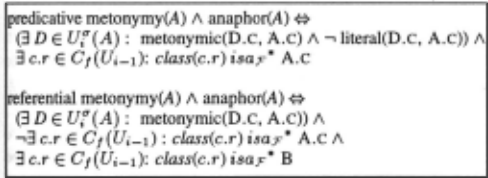
With regard to example 1.3.(ii).b, the literal interpretation of A and the one considering it a predicative metonymy do not allow for anaphora resolution, as CJ (U;_!) = [Epson EPL-5600] with class(Epson EPL-5600) =LASER-PRINTER holds. However, if we regard A as a referential metonymy, anaphora resolution succeeds, as class(Epson EPL-5600) = LASER-PRINTER isa:F* B =LASER-PRINTER holds. Thus, we end up with three interpretation hypotheses:
8 The ACTION part of the concept hierarchy consists of case-role style specifications: For instance, like-patient characterizes the pa tient of a LIKE activity (in this case, the laser (printer)).
- First, "laser" is literal (expressed by a literal path be tween LIKE and LASER). Then "laser" is not anaphoric.
- Second, "laser" is a metonymy (expressed by a meton ymic path between LIKE and LASER) with the following subhypotheses:
- (a) The metonymy is predicative. Then "laser" is not anaphoric.
- (b) The metonymy is referential. Then "laser" is anaphoric and the referent of "laser", laser.r, is given by "Epson-EPL-5600".
Choosing among these readings, we propose the following ranking with respect to the ordering relation str in Table 5:
literal(A) 1\ anaphor(A)
> · tr predicative metonymy(A) 1\ anaphor(A)
> str (referential metonymy (A) 1\ anaphor(A))
V (literal(A) 1\ ..., anaphor(A))
> · tr metonymy(A) 1\ ..., anaphor(A)
Table 5: Ranking Constraints
Considering our example, we encounter a case of ambigu ity as indicated in line 3 of Table 5. This results in instantiat ing two separate readings of sentence /.3.(ii)b and discarding reading 2.a) corresponding to the last line in Table 5. We may now explain the merits and the difficulties of this rank ing by looking at the consequences it has for the resolution of metonymies, anaphors and textual ellipses.
Metonymy Resolution. Metonymies marked by a sortal conflict are handled as in LMF approaches, since no compet ing literal interpretation exists. Thus, "computer" in example /.2.(ii) is treated as a whole-for-part metonymy. As the lit eral meaning of "computer" allows for anaphora resolution we treat the metonymy as a predicative one (second line of Table 5). In contradistinction to LMF approaches, our algo rithm also allows for the resolution of anaphoric metonymies that are not marked by a sortal conflict as example /.3.(ii).b) shows. In addition, we do not depend on information about sortal conflicts that may not be available at the time point when metonymy or anaphora resolution is called for. As a consequence, an incremental approach to metonymy resolu tion is becoming more feasible.
Anaphora Resolution. Similarly, anaphora resolution proceeds as usual when a literal interpretation allows to re solve an anaphor (first line of Table 5). If several items in the center list can be considered possible antecedents, then its most highly ranked element is chosen as the most likely an tecedent. Unlike LMF approaches, nominal anaphora that are referential metonymies can be resolved incrementally with out the need for backtracking. So, in example 1.3.(ii).b, "the laser" can be resolved to "Epson EPL-5600" in sentence (i) in at least one reading (third line of Table 5). Thus, different referential mechanisms are at work in the interpretation of definite noun phrases - anaphoric reference by using a more general expression (printer for laser printer) and anaphoric reference by using a metonymic expression (laser for laser printer) -and they are covered by the same algorithm.
Textual Ellipsis Resolution. A crucial problem with our approach lies in the disjunction in line 3 in Table 5, which is a continuous source of ambiguity. Whereas it leads correctly to an ambiguity in example /.3.(ii).b as explained above, it also leads to the same kind of ambiguity in example Il.l.(ii) where this is clearly not wished for. The algorithm as proposed so far does not yield any criteria to prevent this kind of over generation. This is not an artificial problem created by our algorithm in the first place, however. Rather, it mirrors the fact that the resolution of metonymies is not fully constrained by metonymic patterns like part-for-whole or producer-for product. This is relatively independent of applying an LMF approach or not. In [Hahn and Markert, 1997], we propose three heuristics to further constrain coercion.
4 Evaluation
The test set for our evaluation experiment was composed of naturally occurring texts, viz. 26 German product reviews from the information technology domain. The main part of the evaluation was carried out manually in order to circum vent error chaining in the anaphora resolution, while path finding and evaluation was done automatically.
The sample contained 103 metonymies, 291 nominal anaphors, 351 textual ellipses, all occurring in 606 utterances. Table 6 contains the quantitative distribution of occurrences of metonymies in our test set. The columns indicate whether a sortal conflict (s.c.) occurred directly (known at the time of anaphora resolution and, hence, resolvable in an incremental framework), indirectly (not known at that time), or not at all. With 42.7%, direct sortal conflicts are below expectations, but LMF approaches face even more serious problems for 29.1% of the metonymies which are not marked by any sortal con flict at all. We also want to point out the significant rate of co-occurrences of metonymies and anaphora (56.3% ). Thus, anaphoric processes indeed seem to facilitate the occurrence of metonymies, an observation that supports our claim to ac count for the systematic interaction of both processes.
| direct s.c. | indirect s.c. | no s.c. | I; | |
|---|---|---|---|---|
| Anaphors | 15 (14.6%) | 27 (26.2%) | 16 (15.5%) | 58 (56.3%) |
| Oth. def. NPs | 7 (6.8%) | 2 (1.9%) | 5 (4.8%) | 14 (13.6%) |
| Indef. NPs | 22 (21.4%) | 0 (0%) | 9 (8.7%) | 31 (30.1%) |
| I; | 44 (42.7%) | 29 (28.2%) | 30 (29.1%) | 103 (100%) |
| direct s.c. | indirect s .c. | no s.c. | Overall rate | |
|---|---|---|---|---|
| Anaphors | 93.3% | 85.2% | 87.5% | 87.9% |
| Oth. def. NPs | 100% | 0% | 0% | 50% |
| lndef. NPs | 72.7% | 0% | 0% | 51 .6% |
| Overall rate | 84.1% | 79.3% | 46.7% | 72.8% |
Table 7 depicts the resolution rates for our approach. 9 The high rate of correctly resolved anaphoric metonymies
9 We cannot compare our results to those from other approaches,
(87.9%) lends some credit to our ranking in Table 5. Es pecially important is the fact that 85.2% of all anaphoric metonymies marked by an indirect sortal conflict and 87.5% without a sortal conflict can be resolved by an incremental ap proach without backtracking- due to the timely consideration of anaphoric constraints. LMF approaches are restricted to account for only 42 anaphoric metonymies (72.4%) marked by a sortal conflict ( cf. Table 6, anaphors marked by a direct (15) and indirect (27) sortal conflict, respectively).
Our resolution rates are considerably worse for defi nite non-anaphoric noun phrases (50%) and indefinite noun phrases (51.6% ), the main reason being that metonymies without a sortal conflict are not recognized, as anaphoric con straints are not applicable. Hence, LMF approaches are insuf ficient for non-anaphoric noun phrases as well. However, we do not have a solution to this problem either.
As shown in Table 6, 58 of 291 anaphors (19 .9%) are me tonymic. As 47 of them are referential metonymies, a 16.2% increase of anaphora resolution capacity can be achieved through the incorporation of metonymy resolution. 10 None of the LMF approaches can resolve the 16 metonymic anaphors (constituting 5.5% of all anaphors), which are not marked by a sortal conflict.
The effects our algorithm has on the resolution of textual ellipses are discussed in [Hahn and Markert, 1997].
5 Related Work
Computational approaches to metonymy resolution, up to now, have largely neglected the interdependencies between discourse processes and metonymies- regardless of whether they are based on pragmatics [Hobbs et at., 1993; Norvig, 1989; Fass, 1991] or rooted in lexical semantics [Pustejovsky, 1995; Verspoor, 1996].
Nominal anaphora and metonymies have only been treated in a common framework by [Norvig, 1989] and [Hobbs et at., 1993]. 11 Nevertheless, neither of them considers interaction effects. Even worse, these are particularly excluded in the approach [Norvig, 1989] has chosen. He uses a spreading activation model in which different types of inferences (e.g., metonymic and anaphoric ones) belong to different inference classes. While competing inferences within one class can be ranked and the best can be selected for resolution, ranking and selecting across different inference classes are prohib ited. This contrasts with our approach in which the best combination of anaphoric and metonymic inferences is chosen. Another problem with Norvig's approach relates to the fact that insufficient results from the inference processes do not trigger additional computations in order to try yet another, perhaps not so obvious analysis. If, e.g., for reasons what soever no anaphoric inference is found for a definite noun phrase, Norvig' s system does not attempt to find a less fa vored metonymic reading, which, nevertheless, would allow for a subsequent anaphoric interpretation.
since none of them has been empirically tested, so far. We here con sider instead general problems LMF approaches are likely to face.
10 Note that the resolution of literal nominal anaphors is not af fected by our algorithm.
11 Stallard [1993] from whom we have adapted the distinction be tween predicative and referential metonymies treats only intrasen tential pronominal anaphora. In the lexical semantics camp, Puste jovsky [ 1995] mentions discourse effects but does not go into any details. Verspoor [ 1996] integrates lexical and pragmatic constraints concentrating on rhetorical relations between two propositions (like causality), while she does not consider anaphoric phenomena.
In Hobbs et al.' s work the interpretation of a sentence (or a sequence thereof) amounts to proving its logical form. Al though this allows, in principle, for the interaction between metonymies and anaphora, this problem is not yet addressed in their work. Therefore, their approach to metonymy reso lution is limited to explicitly marked cases of sortal conflicts. Although literal interpretation is regarded as a special case of metonymy resolution, it is preferred when no sortal conflict is encountered, thus actually subscribing to an LMF model.
This leads us to our second point of criticism, namely that all computational approaches we know of converge on the assumption (rejected in our approach) that metonymy reso lution is entirely dependent on encountering intrasentential anomalies. Usually, this amounts to the requirement that sor tal conflicts have to be recognized, e.g., [Fass, 1991; Hobbs et al., 1993; Norvig, 1989]; sometimes a small range of syn tactic conflicts is considered as well, e.g., [Grosz et al., 1987; Pustejovsky, 1995]. Thus, a metonymic interpretation of a sentence is always rejected in favor of the literal one, regard less of discourse processes, if the literal one does not lead to a deviant sentence reading. Our test set indicates, however, that about one third of the metonymies it contains are not marked by a sortal conflict at all. Hence, further relying on this vio lation condition precludes a significant range of metonymies from actually being resolved.
The pragmatic approaches just discussed fully subscribe to a syntax-first paradigm. The incorporation of their mecha nisms for metonymy resolution into an incremental mode is precluded, as they rely on the detection of sortal conflicts. In contradistinction, our predicates in Table 3, 4 and 5 are all compatible with both a syntax-first paradigm and the incre mental interaction of syntax, semantics and pragmatics.
6 Conclusion
We have introduced a model of metonymy resolution that is based on the interaction of metonymic and anaphoric resolu tion processes. Discourse constraints supplied by information about anaphoric antecedents enable us to treat metonymies on a par with literal interpretations. This leads us to a more ef fective procedure than common LMF models.
The empirical data we got from our approach- despite the fact that such an evaluation of metonymy resolution, to the best of our knowledge, has been carried out for the first time - have led us to several follow-up questions. Prime among them is a learning procedure for path patterns, one that is able to automatically determine metonymic relations starting from a given set of literal ones.
While our procedure is language-neutral, several con straints will also have to be assigned at the lexical or syn tactic level of description. Combining these levels is differ ent from the approach by [Pustejovsky, 1995], who pursues language-specific encoding in the lexicon only. As is evident, any approach to metonymy resolution is heavily dependent on the structural richness of the available knowledge sources (whether qualia structures in the lexicon or terminological world knowledge). The more elaborate the representational depth, the more sophisticated the metonymic relations that can be determined. This argument, however, is a truism and applies to any attempt at real natural language understanding.
Acknowledgements. K. Markert is a member of the Graduate Program on Human and Machine Intelligence at Freiburg University, which is funded by DFG. We thank our colleagues, in particular Susanne Schacht and Michael Strube, who commented on earlier drafts of this paper. We also like to express our deep gratitude for the fruitful discussions we had with Bonnie Webber.
@inproceedings{ijcai1997p146,
  title     = {On the Interaction of Metonymies and Anaphora},
  author    = {Markert, Katja and Hahn, Udo},
  booktitle = {Proceedings of the Fifteenth International Joint Conference on
               Artificial Intelligence, {IJCAI-97}},
  publisher = {International Joint Conferences on Artificial Intelligence},
  editor    = {Martha E. Pollack},
  pages     = {1010--1014},
  year      = {1997},
  note      = {Natural-language Processing and Graphical Presentation},
  url       = {https://ijcai.org/proceedings/1997/146},
}
TY - CPAPER TI - On the Interaction of Metonymies and Anaphora AU - Markert, Katja AU - Hahn, Udo T2 - Proceedings of the Fifteenth International Joint Conference on Artificial Intelligence, IJCAI-97 PB - International Joint Conferences on Artificial Intelligence PY - 1997 SP - 1010 EP - 1014 UR - https://ijcai.org/proceedings/1997/146 ER -Copied
Machine-readable versions of this paper, for tools and AI agents:





