
Situated Grounded Word Semantics
Proceedings of the Sixteenth International Joint Conference on Artificial Intelligence. Natural Language Processing. Pages 862-866.
© 1999 International Joint Conferences on Artificial Intelligence
Abstract
The paper repo rts on experim ents in which autonomous visually grounded agents bootstrap an ontology and a shared lexicon without prior design nor other forms of human intervention. The agents do so while playing a particular language game called the guessing game. We show that synonymy and polyse my arise as emergent properties in the language but also that there are tendencies to damp en it so as to mak e the lang ua ge more coherent and thus more optimal from the viewpoints of comm uni cat iv e success, cog ni t iv e co mpl exity, and l earnab ility.
- Hurford et al. 98) Jim Hurford, C . Knight and M. Studdert-Kennedy (eds.) Approaches to the Evolution of Human Language. Edinburgh Univ . Press.
- Langton
- Langton, C. (ed.) Artificial Life. An overview . The MIT Press, Cambridge MA, 1995.
- McLennan 91
- McLennan, B. Synthetic ethology: An approach to the study of communication. In Langton, C. (ed .) Artificial Life II, Redwood City, Ca. 1991, Addison-Wesley Pub. Co.
- Montague 79)
- Montague, R. Formal Philosophy. Uni- versity of Chicago P~ess , Chicago, 1979.
- Oliphant 96
- Oliphant, M. The dilemma of Saussurean communication. Biosystems, 37 (1-2):31-38.
- Steels 97Luc Steels. The synthetic modeling of lan- guage origins. Evolution of Communication, 1(1):1-35.
- Steels 98
- Steels, L. The origins of syntax in visu- ally grounded robotic agents. Artificial Intelligence 103 (1998) 1-24. (Steels & Kaplan 98) Steels, L. and Kaplan, F. Sponta- neous Lexicon Change, In Proceedings of COLING-ACL, Montreal, August 1998, p. 1243-1249. IJCAI
- Steels & Vogt 97) Steels, L. and P. Vogt Grounding adaptive language games in robotic agents. In Harvey, I. et.al. (eds.) Proceedings of ECAL 97, Brighton UK, July 1997. The MIT Press, Cambridge Ma., 1997. (Steels & Brooks 95) Steels. L. and R. Brooks The Ar- tificial Life Route to Artificial Intelligence. Lawrence Erlbaum, New Haven, 1995.
References were extracted automatically from the PDF and may contain errors.
Full text extracted automatically from the PDF; figures, tables and equations may differ. The PDF is the version of record.
1 Introduction
The goal of studying natural language semantics is to determine the systematic relations between language ut terances, their meanings and their referents. Speakers must conceptualise reality to find an adequate mean ing, and they verbalise this meaning to yield an utter ance transmitted to the hearer. The hearer must inter pret the utterance to reconst ruct the meaning and ap ply the meaning in this particular context to retrieve back the referent. One possible framework for study ing these relationships is the theory of formal ( denota tional) semantics and its application to the treatment of natural language [Montague 79). In this framework, functions are defined for mapping natural language ut terances into expressions in the predicate calculus (with sui table extensions) and for mapping logical expressions into their denotations. Such a framework has been the basis of much work in computational semantics and has been used to formalise the communication systems of autonomous agents.
Although this formal approach has many virtues, it makes a number of simplifying assumptions which are not valid for physically grounded evolving autonomous agents that are part of inhomogeneous populations op erat ing in real world open environments . In such cir cumstances, it is first of all not possible to formalise Frederic Kaplan SONY CSL,. Paris LIP6 Universite Paris VI- Paris kaplan @csl. sony.fr the model which acts as the domain of the denotational semantics. The physical environment produces an infi nite set of unforeseeable situations, independent of the agent and not delineatable by an outside observer. Be cause of the open-ended nature of the environment, the language cannot be designed (or pre-programmed) in advance but must expand or shrink to adapt to the changing task settings and evolving environments en countered by the agents. Second, the agents have to learn autonomously the language used in their commu nity, including its underlying ontology (the denotational semantics of the predicates). Consequently, it cannot be assumed that this language is uniform throughout the population. There are going to be different degrees of de tail in the different agents depending on the histories of interaction with the environment. Agents cannot inspect each other's brain states nor is there a central control ling agency that oversees additions to the language, so that polysemy (one meaning having different forms) and synonymy (one form having different meanings) are un avoidable. Finally, because the agents are situated and embodied in the environment, they must bootstrap their competence through strongly context and viewpoint de pendent cases. For example, something that is to the left for one agent may be on the right for another one depending on their respective positions, which makes it hard to learn the meanings of 'left' and 'right'.
We have been developing a framework for studying sit uated grounded semantics that does not make the sim plifying assumptions of classical formal semantics and is therefore more appropriate for studying human natu ral language communication or designing robotic agents. The framework consists of a theory on how agents could construct and acquire their individual ontologies, lexi cons and grammars, and of tools for studying the macro scopic properties of the collective ontologies, lexicons and grammars that emerge in the group. These and similar efforts have been reviewed in [Steels 97). We are also con ducting experiments with physically instantiated robot ic agents, both mobile robots moving around in their environment with relatively weak sensors [SteelsVogt 97] and immobile robots with active vision [Steels 98]. The latter experimental infrastructure is used in the present paper and is known as the Talking Heads experiment.
One of the major themes of our research is that lan guage can be studied as a complex adaptive system. The agents are carriers of individual linguistic knowl edge which becomes overt behavior in local interactions between agents. There is no central coordination nor access of one agent to the internal states of another. The local interactions shape and continuously reshape the language. The overall dynamics should exhibit cer tain emergent properties, which have been observed as universal tendencies in natural languages, such as the emergence of a globally coherent linguistic system or the damping of synonymy and polysemy. Given this broader framework, this research is strongly related to other ef forts to understand how autonomous grounded agents may build up their intelligence [SteelsBrooks 96], and particularly how they may bootstrap language [Hurford, et.al. 1988]. It draws on other research in the origins of complexity in natural systems [Langton 1995].
The rest of the paper first briefly introduces the Talk ing Heads experiment. Then general emergent proper ties of languages are reviewed. Next, results from experi ments in lexicon acquisition are shown and analysed with respect to the reaching of coherence and the damping of polysemy and synonymy.
2 The Talking Heads experiment
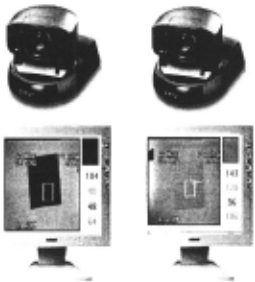
The experimental setup consists of two (possibly more) Sony EV1D31 pan-tilt cameras in which different agents can be loaded (figure 1). Agents can travel through the Internet and install themselves in robots in different loca tions. An agent can only interact with another one when it is physically instantiated in a body and thus perceive the shared environment. For the experiments to be re ported here, the shared environment consists of a mag netic white board on which various shapes are pasted: colored triangles, circles, rectangles , etc. The interac tion between agents takes the form of a language game, further called the guessing game.
The guessing game
The guessing game is played between two visually grounded agents. One agent plays the role of speaker and the other one then plays the role of hearer. Agents take turns playing games so all of them develop the ca pacity to be speaker or hearer. The objects located on the white board at the beginning of the game consti tute the context. Agents are capable of segmenting the perceived image into objects and of collecting various characteristics about each object, specifically the color (decomposed in RGB channels), grayscale, and position in pan/tilt coordinates. The speaker chooses one object from the context, further called the topic, and gives a linguistic hint to the hearer.
The linguistic hint is an expression that identifies the topic with respect to the other objects in the context. For example, if the context contains [1] a red square, [2] a blue triangle, and [3] a green circle, then the speaker may say something like "the red one" to identify [1] as the topic. If the context contains also a red triangle, he has to be more precise and say something like "the red square". Of course, the Talking Heads do not say "the red square" but use their own language and con cepts which are never going to be the same as those used in English. For example, they may say "malewina" to mean [UPPER EXTREME-LEFT LOW-REDNESS]. Due to space limitations, this paper only considers situa tions where the meaning consists of a single perceptually grounded category and the form consist of a single word.
Based on the linguistic hint, the hearer tries to guess what topic the speaker has chosen, and he communicates his choice to the speaker by pointing to the object. A robot points by transmitting in which direction he is looking. The game succeeds if the topic guessed by the hearer is equal to the topic chosen by the speaker. The game fails if the guess was wrong or if the speaker or the hearer failed at some earlier point in the game. In case of a failure, the speaker gives an extra-linguistic hint by pointing to the topic he had in mind, and both agents try to repair their internal structures to be more successful in future games.
The architecture of the agents has two components: a conceptualisation module responsible for categorising reality or for applying categories to find back the refer ent in the perceptual image, and a verbalisation module responsible for verbalising a conceptualisation or for in terpreting a form to reconstruct its meaning. Agents start with no prior designer-supplied ontology nor lexicon. A shared ontology and lexicon must emerge from scratch in a self-organised process. The agents there fore not only play the game but also expand or adapt their ontology or lexicon to be more successful in future games.
The Conceptualisation Module
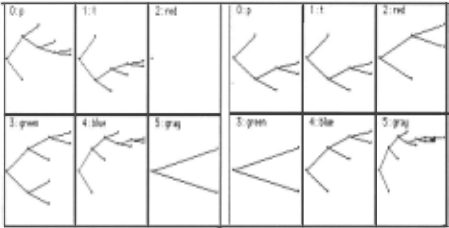
Meanings are categories that distinguish the topic from the other objects in the context. The categories are organised in discrimination trees (figure 2) where each node contains a discriminator able to filter the set of obj ects into a subset that satisfies a category. and an other one that satisfies its opposition. For example, there might be a discriminator based on the horizontal posi tion (HPOS) of the center of an object (scaled between 0.0 and 1.0) sorting the objects in the context in a bin for the category 'left' when HPOS < 0.5, (further indicated as [HPOS-0.0,0.5]) and one for 'right' when HPOS > 0.5 (further written as [HPOS-0.5,1.0)). Further subcate gories are created by restricting the region of each cat egory. For example, the category 'very left' (or [HPOS0.0 ,0.25]) applies when an object's HPOS value is in the region [0.0,0.25].
A distinctive category set is found by filtering the ob jects from the top in each discrimination tree until there is a bin which only contains the topic. This means that only the topic falls within the category associated with that bin, and so this category uniquely filters out the topic from all the other objects in the scene.
Discrimination trees grow randomly by the addition of new categorisers splitting the region of existing cat egories. Categorisers compete in each guessing game. The use and success of a categoriser is monitored and categorisers that are irrelevant for the environments en countered by the agent are pruned .
Verbalisation module
The lexicon of each agents consists of a two-way asso ciation between forms (which are individual words) and meanings (which are single categories). Each associa tion has a score. Words are random combinations of syllables. When a speaker needs to verbalise a category, he looks up all possible words associated with that category, orders them and picks the one with the best score for transmission to the hearer. When a hearer needs to interpret a word, he looks up all possible meanings , tests which meanings are applicable in the present context , i.e. which ones yield a possible single referent, and uses the remaining meaning with the highest score as the winner. The topic guessed by the hearer is the referent of this meanmg.
Based on feedback on the outcome of the guessing game, the speaker and the hearer update the scores. When the game has succeeded , they increase the score of the winning association by a fixed amount (equal to 0.1 for the experiments in this paper) and decrease the competitors with the same amount , thus implementing lateral inhibition. Scores are bounded between 0.0 and 1.0. When the game has failed, they each decrease the score of the association they used. Occasionally new associations are stored. A speaker creates a new word when he does not have a word yet for a meaning he wants to express. A hearer may encounter a new word he has never heard before and then store a new associa tion between this word and the best guess of the possible meaning. This guess is based on first guessing the topic using the extra-linguistic hirit provided by the speaker, and on performing categorisation using his own discrim ination trees as developed thus far. These lexicon boot strapping mechanisms have been explained and validated extensively in earlier papers [Steels & Kaplan 98] and are related to similar mechanisms (e.g. [McLennan 91], [Oliphant 96]).
The conceptualisation module proposes several solu tions to the verbalisation module which prefers those that have already been lexicalised. Agents monitor suc cess of categories in the total game and use this to target growth and pruning. The language therefore strongly in fluences the ontologies agents retains. The two modules are structurally coupled and thus get coordinated with out a central coordinator.
3 Tendencies in natural languages
Clearly, to have success in the game the speaker and the hearer must share a list of words, and the mean ings of these words must pick out the same referent in the same context. However agents can only coordinate their language based on overt behavior. This leads to various types of incoherence. Sometimes an incoherence is immediately detected, for example a speaker uses a word which is interpreted by the hearer as referring to another object . But often the incoherence stays in the language until the environment produces situations that cause further disambiguation.
There are three reasons why coherence is better. First of all it gives a higher chance on success in multiple con texts. For example, if every agent preferentially associates the same meaning with the same word, there is a higher chance that the same word will designate the same referent, even in a context that has not been seen before. Second coherence diminishes cognitive complex ity. For example, if all agents preferentially use the same word for the same meaning, there will be fewer words and therefore less words need to be stored. If all words pref erentially have the same meaning, there is less cognitive effort needed in disambiguation. Third, coherence helps in language acquisition by future generations. If there are fewer words and they tend to have the same mean ings, a language learner has an easier time to acquire them.
Natural languages are clearly not fully coherent in a community, and languages developed autonomously by physically embodied agents will not be fully coherent either .
- Synonymy: Different agents prefer a different word for the same meaning. This situation arises because an agent may construct a new word not knowing that one is already in existence. This is often an intermediary stage for new meanings whose lexical isation has not stabilised yet . Nat ural languages show a clear tendency for the elimination of syn onyms. True synonyms tend to specialise, incorpo rating different shades of meaning from the context or reflecting socio-linguistic parameters of speaker and hearer.
- Polysemy: The same word may have different pre ferred meanings. This situation arises because an agent on hearing an unknown word may incorrectly guess its meaning, whenever there is more than one possible meaning compatible with the same situ ation. Polysemy tends to survive in natural lan guages only when the contexts are sufficiently dif ferent .
- Multi-referentiality: The same meaning may denote different referents for different agents in the same context. This is the case when the application of a category is strongly situated, for example 'left' for the speaker may be 'right' for the hearer. In natural languages, this multi-referentiality is counter-acted by refining the information transmitted about the context or by avoiding multi-referential meanings.
- Categorial indeterminacy: It is possible and very common with a richer categorial repertoire, that a particular referent in a particular context can be conceptualised in more than one way. For example, an object may be to the left of all the others, and much higher positioned than all the others. In the same situation different agents may therefore use different meanings. Agents only get feedback about whether they guessed the object the speaker had
in mind, not whether they used the same mean ing as the speaker. So categorial indeterminacy may cause polysemy. A speaker may mean 'left' by "bovubo", but a hearer may have inferred that "bovubo" meant 'upper'.
So although circumstances cause agents to introduce in coherence in the language system, there are at the same time opposing tendencies attempting to restore coher ence. A major goal of this paper is to see whether these tendencies can be seen as emergent properties of the in dividual agent's architecture. We will not discuss multi referentiality in this paper for space limitations. It is avoided experimentally by using a single body, so that both agents look through the same camera at the same time at the world and hence have exactly the same con text.
Semiotic landscapes
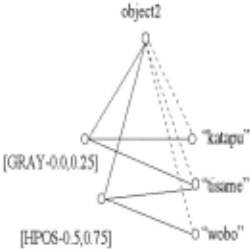
We propose the notion of a semiotic landscape (which we also call RMF-landscape) to analyse grounded se mantic dynamics. The semiotic landscape is a graph, in which the nodes in the landscape are formed by referents, meanings and forms, and the two-way relations between nodes denote co-occurence if there is one (figure 3). For real world environments, the set of possible referents is infinite, so the semiotic landscape is infinite. However, for purposes of analysis, we can restrict the possible envi ronments and thus the possible referents artificially and then study the semantic dynamics very precisely. This is what we will do in the remainder of the paper.
In the case of a perfectly coherent communication system, the semiotic landscape consists of unconnected triangles. Otherwise more complex networks appear. The RMF-landscape in figure 3 contains an example where the agents use two possible meanings for denot ing object-1 namely [GRAY-0.0,0.25] (very light) and [HPOS-0.5,0. 75] (lower upper), and the words "katapu" and "tisame" for [GRAY-0 .0,0.25] and "wobo" and "ti same", for [HPOS-0.5,0.75]. Each meaning has therefore two synonyms and "tisame" is polysemous; it can mean both [GRAY-0.0,0.25] and [HPOS-0 .5,0.75]. Three words are used to refer to object-1. This kind of situa tion is typical in certain stages of our experiments and complexity rapidly increases when the same meaning is also used to denote other referents (which is obviously very common and indeed desirable).
As mentioned earlier, incoherence is not necessarily impinging on the communicative success of the language. The RMF-landscape in 3 still leads to total success in communication whenever both meanings are equally ad equate for picking out the referent. Even if a speaker uses "tisame" to mean [GRAY-0 .0,0.25] and the hearer under stands" tisame" to mean [HPOS-0.5,0.75], they still have communicative success . The goal of the language game is to find the referent. It does not matter whether the meanings are the same. The agents cannot even know this because they have no access to each other's brain states.
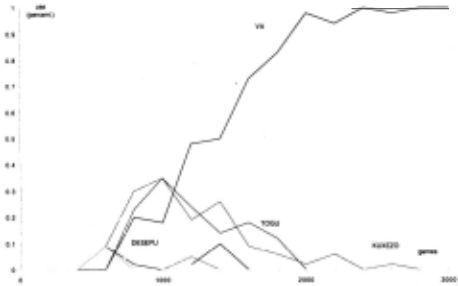
The degree of coherence of a language can be mea sured by observing the actual linguistic behavior of the agents while they play language games, more specifically, by collecting data on the frequency of co-occurrence of items such as the possible forms of a certain referent or all the possible meanings for a certain form. The rela tions are represented in competition diagrams, such as the RF-diagram in figure 5, which plots the evolution of the frequency of use of the Referent-Form relations for a given referent in a series of games. One co-occurrence relation will be most frequent, and this is taken as an indication how coherent the community's language sys tem is along the dimension of the relation investigated. For example, if a particular meaning has only one form, then the frequency of that form in the MF -diagram will be 1.0, which means that there are no synonyms.
The remainder of this paper now looks at a partic ular case study performed with the Talking Heads as currently operational. To allow this investigation, we re strict the set of possible referents (by keeping the en vironment constant) so that we can indeed track the grounded semantic dynamics forming and deforming the semiotic landscape.
4 Damping synonymy and polysemy
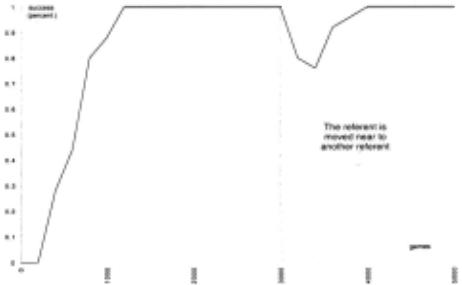
Figure 4 shows typical results for an experiment in which 20 agents start from scratch to build a new communi cation system, both the ontology, by the growing and pruning of discrimination trees, and the lexicon, by cre ating new words and adopting them from each other. As communicative success is reached, there is an evolution towards a unique form for each referent, as illustrated in figure 5. This is expected because the agents get explicit feedback only about this relation, not about any other one. This diagram shows that there must be a damping
'
Figure 5: This RF-diagram shows the frequency of each referent-form co-occurrence in 3000 language games for a single referent. One word "va" comes to dominate.
of synonymy as well (and it is even clearer if we look at the RM-diagram).
When we inspect the different meanings of "va", through the FM-diagram (figure 6), we clearly see that even after 3000 games polysemy stays in the language. Three stable meanings for "va" have emerged: [RED0,0.125], [BLUE-0.3125,0.3125], and [VPOS-0.25,0.5]. They are all equally good for distinguishing the topic "va" designates, and there are no situations yet that would have allowed disentanglement.
In game 3000, the environment produces a scene m which a category which was distinctive for the object designated by "va" is no longer distinctive. More pre cisely, we, as experimenters, have moved the object very close to another object so that the position is no longer distinctive. Figure 4 shows first of all that success drops (meaning there have been some failures in the game), but that it rebounds quickly. The agent's language and ontology is adaptive. What has happened is that a large part of the agents still keep using "va", because the color based categories are still applicable. But "va" no longer picks out the right object for those who believe that "va" means (VPOS-0.25,0.5], so they have to learn an alter native meaning for "va", compatible with the new situ ation. The FM-diagram in figure 6 shows that the po sitional meaning of "va" (namely (VPOS-0 .25,0.5]) has disappeared. The other meanings, based on color, are still possible because they are not affected when the ob ject designated by "va" moved its position .
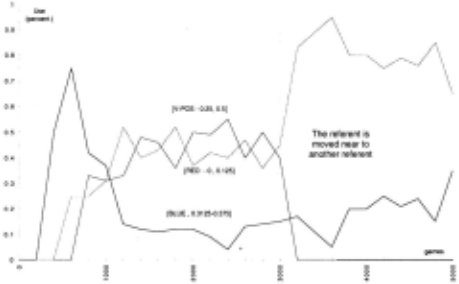
This case study illustrates the main points of the pa per. The overt selectionist force on the language sys tem is success in the game, which is maximised if the agents use the same word for designating the same ref erent (in the same context) . This does not in itself im ply that there are no synonyms nor polysemy because agents could prefer different words which they mutually know from each other and they could associate differ ent meanings with a certain word which are nevertheless compatible with the environments they have seen. We have shown that nevertheless damping of synonymy and polysemy occurs. Synonymy is damped because of the lateral inhibition of alternatives in lexicon use. This cre ates a positive feedback loop in which words that have a slight advantage will further gain in a winner-take-all process . Polysemy is damped because there are situa tions disentangling incoherent form-meaning relations.
5 Conclusions
The construction and acquisition of grounded languages poses specific difficulties for autonomous agents, causing their languages to exhibit partial incoherence. Agents have to develop their own categories for approaching their world, and they cannot know which meaning has been intended by a speaker, even if they know the ref erent through extra-linguistic means. We have shown that a particular agent architecture can achieve the boot strapping of a language system from scratch and that the collective dynamics it generates dampens synonymy and polysemy.
6 Acknowledgement
This research was conducted at the Sony Computer Sci ence Laboratory. We are strongly indebted to Angus Mcintyre for creating the Babel tool that is the technical backbone of our experiments and for technical support in the low level vision interfacing.
7 References
(Hurford et al. 98) Jim Hurford, C. Knight and M. Studdert-Kennedy (eds.) Approaches to the Evolution of Human Language. Edinburgh Univ. Press. Edin burgh, 1997.
(Langton 95) Langton, C. (ed.) Artificial Life. An overview. The MIT Press, Cambridge MA, 1995.
(McLennan 91) McLennan, B. Synthetic ethology: An approach to the study of communication. In Langton, C. (ed .) Artificial Life II, Redwood City, Ca. 1991, Addison-Wesley Pub. Co.
(Montague 79) Montague, R. Formal Philosophy. Uni versity of Chicago P~ess , Chicago, 1979.
(Oliphant 96) Oliphant, M. The dilemma of Saussurean communication. Biosystems, 37 (1-2):31-38.
(Steels 97) Luc Steels. The synthetic modeling of lan guage origins. Evolution of Communication, 1(1):1-35.
(Steels 98) Steels, L. The origins of syntax in visu ally grounded robotic agents. Artificial Intelligence 103 (1998) 1-24.
(Steels & Kaplan 98) Steels, L. and Kaplan, F. Sponta neous Lexicon Change, In Proceedings of COLING-ACL, Montreal, August 1998, p. 1243-1249.
(Steels & Vogt 97) Steels, L. and P. Vogt Grounding adaptive language games in robotic agents. In Harvey, I. et.al. (eds.) Proceedings of ECAL 97, Brighton UK, July 1997. The MIT Press, Cambridge Ma., 1997.
(Steels & Brooks 95) Steels. L. and R. Brooks The Ar tificial Life Route to Artificial Intelligence. Lawrence Erlbaum, New Haven, 1995.
@inproceedings{ijcai1999p123,
  title     = {Situated Grounded Word Semantics},
  author    = {Steels, Luc and Kaplan, Frédéric},
  booktitle = {Proceedings of the Sixteenth International Joint Conference on
               Artificial Intelligence, {IJCAI-99}},
  publisher = {International Joint Conferences on Artificial Intelligence},
  editor    = {Thomas Dean},
  pages     = {862--866},
  year      = {1999},
  note      = {Natural Language Processing},
  url       = {https://ijcai.org/proceedings/1999/123},
}
TY - CPAPER TI - Situated Grounded Word Semantics AU - Steels, Luc AU - Kaplan, Frédéric T2 - Proceedings of the Sixteenth International Joint Conference on Artificial Intelligence, IJCAI-99 PB - International Joint Conferences on Artificial Intelligence PY - 1999 SP - 862 EP - 866 UR - https://ijcai.org/proceedings/1999/123 ER -Copied
Machine-readable versions of this paper, for tools and AI agents:





