
Learning to Achieve Goals
Proceedings of the Thirteenth International Joint Conference on Artificial Intelligence. Machine Learning. Pages 1094-1098.
© 1993 International Joint Conferences on Artificial Intelligence
Abstract
Temporal difference methods solve the temporal credit assignment problem for reinforcement learning. An important subproblem of general reinforcement learning is learning to achieve dynamic goals. Although existing temporal difference methods, such as Q learning, can be applied to this problem , they do not take advantage of its special structure. This paper presents the DG-learning algorithm, which learns efficiently to achie ve dynamically changing goals and exhibits good knowledge transfer between goals. In addition, this paper shows how traditional relaxation techniques can be applied to the problem . Finally, experimental results ar e given that demonstrate the superiority of DG learning over Q learning in a moderately large, synthetic , non-deterministic domain .
- [Barto et al., 1989] A. G. Barto, R. S. Sutton , and C. J. C. H. Watkins. Learning and sequential decision mak- ing. Technical Report 89-95 , Department of Com- puter and Information Science, University of Mas- sachusetts, Amherst, Massachusetts, 1989. Also pub- lished in Learning and Computational Neuroscience : Foundations of Adaptive Networks, Michael Gabriel and John Moore, editors. The MIT Press, Cambridge, Massachusetts, 1991.
- [Barto et al., 1991] Andrew G. Barto, Steven J . Bradtke, and Satinder Pal Singh . Real-time learn- ing and control using asynchronous dynamic program- ming. Technical Report 91-57, Department of Com- puter and Information Science, University of Mas- sachusetts, Amherst, Massachusetts, 1991.
- [Bellman , 1957] Richard Bellman. Dynamic Program- ming. Princeton University Press, Princeton, New Jersey, 1957.
- [Cormen et al., 1990] Thomas H. Cormen, Charles E. Leiserson, and Ronals L. Rivest . Introduction to Al- gorithms. The MIT Press / McGraw Hill , Cambridge, Massachusetts, 1990.
- [Howard, 1960] Ronald A. Howard . Dynamic Program- ming and Markov Processes. The MIT Press, Cam- bridge, Massachusetts, 1960.
- [Kaelbling, 1993a] Leslie Pack Kaelbling. Hierarchical learning: Preliminary results. In Proceedings of the Tenth International Conference on Machine Learning, Amherst, Massachusetts, 1993.
- Morgan Kaufmann.
- [Kaelbling, 1993b] Leslie Pack Kaelbling. Learning in Embedded Systems. The MIT Press, Cambridge, Mas- 1 098 Machine Learning sachusetts, 1993. Also available as a PhD Thesis from Stanford University, 1990.
- [Lin, 1991] Long-Ji Lin . Self-improving based on re- inforcement learning, planning, and teaching. In Proceedings of the Eighth International Workshop on Machine Learning, Evanston, Illinois, 1991 .
- Morgan Kaufmann. [Singh, 1992]
- Satinder Pal Singh. Transfer of learning by composing solutions of elemental sequential tasks. Machine Learning, 8(3) :323-340, 1992.
- [Sutton, 1988] RichardS. Sutton. Learning to predict by the method of temporal differences. Machine Learn- ing, 3(1):9-44, 1988.
- [Sutton, 1990] Richard S. Sutton. Integrated architec- tures for learning, planning, and reacting based on approximating dynamic programming. In Proceedings of the Seventh International Conference on Machine Learning, Austin, Texas, 1990.
- Morgan Kaufmann .
- [Thrun, 1992] Sebastian B. Thrun . The role of explo- ration in learning control. In David A. White and Donald A. Sofge, editors, Handbook of Intelligent Con- trol: Neural, Fuzzy, and Adaptive Approaches. Van Nostrand Reinhold, New York, 1992.
- [Watkins, 1989] C . J. C. H. Watkins. Learning from Delayed Rewards. PhD thesis, King's College, Cam- bridge, 1989.
- [Whitehead and Ballard , 1989] Steven D. Whitehead and Dana H. Ballard. A role for anticipation in re- active systems that learn. In Proceedings of the Sixth International Workshop on Machine Learning, pages 354-357, Ithaca, New York, 1989.
- Morgan Kaufmann.
References were extracted automatically from the PDF and may contain errors.
Full text extracted automatically from the PDF; figures, tables and equations may differ. The PDF is the version of record.
1 Introduction
Reinforcement learning is a general tool for deriving strategies that optimize a fixed reinforcement function in a probabilistic environment. A crucial problem in re inforcement learning is temporal credit assignment: how to choose actions based on good results that happen after (perhaps long after) the action is taken. This problem is solved well in the general case by temporal difference methods, such as Watkins' Q learning [Barto eta/. , 1989; Watkins, 1989] and Sutton's TD algorithm [Sutton , 1988].
In much of the work on reinforcement learning, how ever, researchers have studied a restriction of the prob lem to cases of "goals of achievement ." Rather than having an arbitrary mapping of states of the world to reinforcements for the agent, there is a single "goal" state at which the agent must arrive as soon as pos sible. Goals of achievement can be modeled in the general reinforcement-learning framework by having the goal state generate a positive reinforcement and all other states a zero reinforcement. Because there is a decay fac tor built into the temporal-difference methods, actions that lead to the goal sooner rather than later will be preferred .
*This work was supported in part by a N a tiona! Science Foundation National Young Investigator Award IRI-9257592 and in part by ONR Contract N00014-91-4052, ARPA Order 8225.
Domains with goals of achievement can be learned by methods that are tailored to this special case. In this paper, we present the DG learning algorithm, which is analogous to Q learning, but directly suited to goals of achievement . In the basic single-goal case, DG learning is somewhat more effective than Q learning.
The real importance of DG learning is shown when we consider the case of goals of achievement that change over time; the common scenario of a taskable robot is an instance of this sort of problem. A simple extension to DG learning will allow a large amount of between task transfer , making it greatly preferable to Q learning for this sort of problem, without requiring any complex mechanisms .
Finally, we consider the ability to learn from interac tion with a model, as is done in Sutton's Dyna system. We will see that such learning can be very naturally in tegrated into the DG-learning framework .
2 Q Learning
We assume that a learning agent is embedded in an en vironment in such a way that it can discriminate the set S of distinct world situations and can take the set A of actions on the world. The world is modeled as a Markov process, making stochastic transitions based on its cur rent state and the actions taken by the agent . We let T(s, a, s') be the probability that the world will transi tion to state s' given that it was in state s and the agent executed action a. In addition , for each state s and ac tion a , r(s, a) is the reinforcement value of taking action a in situations. In general, this value is a scalar random variable; it must have a stationary distribution, but the same situation-action pair may have different results on different trials.
The general reinforcement-learning problem is typi cally stated as finding a policy that maximizes expected discounted reinforcement. A policy 7T is mapping from S to A. The expected discounted reinforcement of a policy 7T in a situation s is defined as
where er(t) is the expected value of the reinforcement obtained at step t given that the agent started in sit uation s and executed policy 1r. The variable 1 is the discounting factor; it controls to what degree rewards in the distant future affed the total value of a policy and is usually just slightly less than 1.
Given definitions of the transition probabilities and the expected reinforcements, it is possible to solve for the optimal policy, using methods from dynamic pro gramming [Bellman, 1957; Howard, 1960]. A more in teresting case occurs when we wish to simultaneously learn the dynamics of the world and construct the pol icy. Watkins' Q learning algorithm gives us an elegant and efficient method for doing this.
Let Q*(s, a) be the expected discounted reinforcement for taking action a in situation s and continuing there after with the optimal policy. It can be recursively de fined as
Because we do not know T and er initially, we construct incremental estimates of the Q values on line. Starting with Q(s, a) at any value (but typically 0), every time an action is taken, update the Q values as follows :
where r is the actual reinforcement value received for taking action a in situation s , s' is the next state, and a is a learning rate (between 0 and 1).
Given the Q values , there is a policy defined by taking, in any situation s, the action a that maximizes Q(s, a). Watkins showed [Watkins, 1989] that, given some as sumptions, including that every state-action pair is tried infinitely often on an infinite run, the Q values will con verge to the true Q* values, and hence the induced policy will converge to the optimal one.
Of course, in any practical situation , as the learned Q values converge to the true Q* values, we will have to use the policy to control action. But in doing so, we are in danger of violating the requirement that every state action pair be tried infinitely often. This is an instance of the exploration versus exploitation trade-off; it has been treated extensively elsewhere [Kaelbling, 1993b; Thrun, 1992]. In the interest of simplicity in this paper, we generate actions probabilistically based on the Q values using a Boltzmann distribution. Given a situation s , we choose action a with probability
This serves to make actions whose values are much better than the others be chosen with much greater likelihood. The temperature parameter T controls the amount of exploration (the degree to which actions other than the one with the best Q value are taken).
3 DG Learning
The DG learning (DG stands for dynamic goaQ method applies only to domains in which the aim of the agent is to arrive at some goal state in the smallest number of steps. We still assume that the world makes stochastic transitions, but the goal is explicitly named and there is no reinforcement function. The aim of DG learning, at its simplest, is to arrive at the policy that minimizes the expected number of steps to the goal. The method is applicable without change to the case where the goal varies on line: now a policy is a mapping from S x S to A, specifying an action to take based on the current situation and the goal situation.
We define DG*(s, a, g) to be the expected number of steps required to get to situation g from situation s by starting with action a and continuing with the optimal policy. It is conveniently described recursively as
if s = g and
otherwise.
Rather than learning T then calcutating DG, we es timate DG directly on line. Starting with DG(s , a, g) at any value (but typically 0) , every time an action is taken, update the DG values as follows :
where a is the learning rate and s' is the next state.
A policy can be directly constructed from the DG val ues by choosing the action a that minimizes DG(s, a, g) for every current situation s and goal situation g. Al though no theoretical results have yet been developed with respect to this learning procedure, we conjecture that it can be shown to converge under restrictions sim ilar to those for the Q-learning result.
The trade-off between exploration and exploitation is important in DG learning as well; we use the Boltzmann distribution to construct action probabilities, though in terval estimation techniques [Kaelbling, 1993b] could be employed for more careful exploration.
4 Learning From a Model
In on-line learning tasks, every step taken by the learn ing algorithm is a step taken by the agent in the world. In many cases, the agent is incurring risk by taking ex ploratory actions and we would like to minimize such risk. One way to decrease the risk is to employ internal learning from a model rather than direct learning from the world.
4.1 Dyna and Q Learning
Sutton [Sutton, 1990] and Whitehead and Ballard [Whitehead and Ballard, 1989] have both explored the use of mixing real learning steps in the world with sim ulated learning steps in an internal model. Experiments have shown this to be a very effective procedure when a forward model of the world (mapping from situations and actions into results) is available.
When the model is not made available a priori, it must also be constructed on line. Lin's results [Lin, 1991] show that using the model for learning while it is being con structed is not necessarily advantageous. This approach could probably be made more useful by adding a process that estimates the validity of the model, and only uses it for learning in situations in which it is valid.
4.2 Updating all Goals in DG Learning
A very simple kind of extra learning step can be directly added to DG learning. Whenever an action a is taken as a step from situations to a goal g, we update the value of DG(s,a,g) by looking ahead one step at the value of DG( s', a', g) for the maximizing a'. This look-ahead process hinges on the relationship between s, a, and s'; the goal is relevant only for bookkeeping purposes.
We define all goals updating mode for DG learning to update DG(s, a, g') for all g' E S, independent of what g was being sought when the action was taken. This updating mode requires an amount of work linear in the size of the set of situations; if this cost is prohibitive, a random or systematically-chosen subset of goals could be updated on each iteration.
The work that is done in updating all goals will not speed learning or performance for the particular goal that is being achieved; but it will result in an extremely efficient transfer of knowledge to the achievement of other goals . Singh [Singh, 1992] has also addressed this issue, but in a more complex network architecture.
4.3 Relaxation in G Learning
Because we know that the problem we are solving is one of finding shortest paths, we can apply basic knowledge about the nature of distance metrics: for any interme diate state s;, the shortest path between states s1 and s2 is no longer than the the sum of the lengths of the shortest paths from s1 to s; and from s; to s2 . Letting D(s1, s2) be the length of the shortest path from s1 to s2 , we can write this as
The problem of finding shortest paths can be cast in terms of relaxation: starting with overestimates of D, ex cept in cases where it is known , a relaxation step consists of an update of the form
If relaxations are performed at random, D will con verge in the limit to the true distance measure. A much more useful method is provided by the Floyd-Warshall algorithm [Cormen et a/., 1990], which converges on the correct function after n 3 relaxations, where 11 is the size of the state set. It is written simply as follows :
It is crucial to iterate through the indices in the or der specified, with the intermediate nodes varying most slowly.
Relaxations on the DC data structure are only slightly more complicated, due to the fact that actions are con sidered as well. A relaxation step consists of executing,
In the DG algorithm, relaxation steps may be freely interleaved with learning steps in the external world. Al though relaxations may be chosen at random, it is much more efficient to run the Floyd-Warshall algorithm "in parallel" with the DG algorithm, performing the next few relaxation steps after every learning step . Because the DG values are being changed by the look-ahead pro cess, it is useful to simply restart the Floyd-Warshall algorithm when it finishes . It might be desirable to de tect convergence and quit doing relaxations after some point .
The ability to do relaxations of this type is very im portant . Basic temporal difference methods only allow value to be transferred back along the action paths one step at a time. But with these relaxations , if we know the distance from state St to s; and from s; to s2 , we can immediately update our estimate of the distance from s1 to s2 , with update time independent of the length of the path from s1 to s2 .
5 Experimental Results
This section reports some preliminary experimental re sults comparing Q learning and DG learning in a popular synthetic domain.
5.1 Domain
The domain used in these experiments is similar to the one used by Sutton in his Dyna experiments. It can be thought of as a robot in a 10 by 10 grid of discrete locations. The robot has four actions, which nominally correspond to moving north, south , east , and west. In fact, when the robot executes one of these actions, it will only land on the nominal location with probability 0.2. The rest of the probability mass is divided evenly among the four locations directly neighboring the target location. The error distribution was chosen arbitrarily; another one could be easily substituted .
5.2 Q and DG Learning For a Single Goal
In the first set of experiments, the goal was placed at a single location and held there for the entire duration of the experiment. Whenever the agent reached the goal , the agent was "teleported" to a new location; learning data gathered on the teleportation step were discarded. Performance of agents was measured in terms of the av erage number of goals achieved per run of a given length.
The Q learning algorithm and the DG learning algo rithm with single-goal updates were each run in this do main a number of times to determine appropriate param eter values. For both algorithms, Twas chosen to be 0.1 and a was chosen to be 0.9. Each algorithm was then run for 20 runs of length 10,000 and the average num ber of goals was determined. For Q learning, the average was 324.85 and for DG learning it was 378.9. This differ ence is significant. An optimal strategy should be able to achieve goals in an average of about 11 steps .
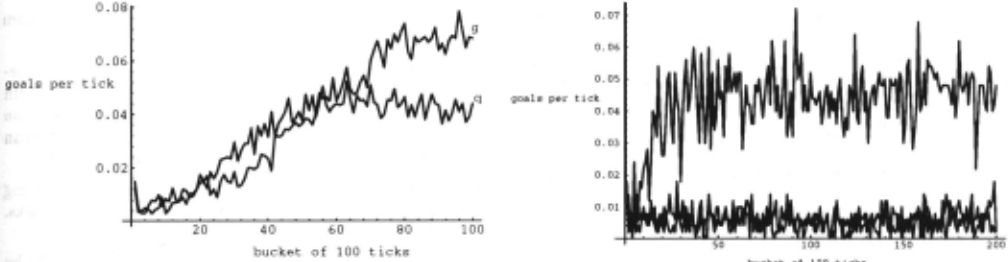
Figure 1 shows the learning curves of the two algo rithms. The Q learning algorithm is performing well until near the end of the run, where it seems to decrease in performance. It might be that a high learning rate or high temperature is responsible for this behavior; these parameter values were chosen on the basis of overall per formance for runs of this length, but not necessarily for asymptotic performance. The performance of the DG algorithm is steadily increasing, and is approaching the optimal performance of 0.09 goals per step.
5.3 Q and DG Learning For Dynamic Goals
In the second experiment, we compared Q learning and DG learning on dynamic goals. In order to apply Q learning to this problem, we simply took the run-time goal specification to be an additional aspect of the sit uation description. The Q learning algorithm can be applied directly to this augmented state space.
The world was changed so that whenever the agent reached the goal, the goal was "teleported" at random to a new location. Again, the measure of success was the number of goals achieved over a fixed-length run. The parameters were held at the same values.
Each of the algorithms was run for 5 runs of length 20,000. The Q learning algorithm generated an average number of goals per step of 0.00536. The DG algorithm without extra updating was only slightly better with an average number of goals per step of 0.00619. When all goals updating is added to the DG algorithm, we get a dramatic increase of performance, with an average num ber of 0.0427 goals per step. All of these differences are significant. The DG algorithm with all-goals updating learns how to achieve all goals simultaneously, making performance improve dramatically very early in the run. The learning curves are shown in figure 2.
5.4 Relaxation in DG Learning
Adding relaxation to DG learning with all-goals updat ing is difficult because of conflicting preferences of the basic DG learning method and the relaxation process. In general, methods like Q learning and DG learning bucket of 100 t icks work best when the initial values are optimistic (that is, high for Q learning and low for DG learning) ; this leads to extra exploration early in the run. On the other hand, relaxation requires that the DC values be pes simistic (too high), so that taking the minimum does not propagate errors.
Figure 2: Learning curves of Q learning and DG learn ing for dynamic goals. Each curve is an average of 5 runs; each point represents the average number of goals achieved per tick, averaged over all the runs and over temporal stretches of 100 ticks. The top curve shows the performance of DG learning with all-goals updat ing. The bottom two curves are largely indistinguish able; they show the performance of DG learning with regular updating and of Q learning.
It has proven difficult in practice to satisfy both of these constraints. In further studies, we will attempt to solve this problem through the use of the interval esti mation method. In this method, a confidence interval estimate is constructed for the underlying DC values. The action whose confidence interval has the highest up per bound is chosen for execution. This naturally causes exploration for actions that have not been chosen very often, but over time the exploration dies away. Having confidence intervals gives us a natural way of providing overestimates of the distances for use in the relaxation steps, as well.
6 Increasing Efficiency through Hierarchy
The DG learning algorithm shows increased performance as a function of the number of learning steps the agent performs in the world. This performance comes at a penalty in storage space and in computational time per learning step. The DC values require O(ISI 2 IAI) space, and all-goals updating requires O(ISIIAI) time per tick .
All of this work allows us to learn optimal paths be tween arbitrary points in our state space. It is rarely the case, however , that optimal behavior is actually neces sary, and it might be advantageous to trade some degree of performance for increased computational efficiency.
In work that builds upon the ideas in this paper, Kael bling [Kaelbling, 1993a] introduces a hierarchical model of goal achievement that allows efficient learning of ap proximately optimal paths. The hierarchical model can be informally described by analogy with our freeway sys tem: we plan a route from our current location to the nearest freeway on-ramp, plan a series of legs on freeway segments, then plan a route from the freeway off-ramp to our destination. Such a hierarchical structure requires learning of paths only between local states at the lowest level, and requires learning of the higher level structure. A preliminary implementation shows that this notion has considerable promise.
7 Conclusions
Many problems considered in AI and robotics have the nature of dynamically changing goals of achievement. A re-application of the ideas of on-line stochastic dynamic programming [Barto et al., 1991] to the problem of cal culating shortest paths results in DG learning, which is a very effective learning method. It is especially valuable for its ability to transfer knowledge between tasks
The studies reported on here used tables to repre sent the DG and Q values; there is even more oppor tunity to study between-task transfer by using function approximation methods that generalize over similar in stances. An interesting area for future work lies in the integration of DG learning with various artificial neural network models of association.
@inproceedings{ijcai1993p151,
  title     = {Learning to Achieve Goals},
  author    = {Kaelbling, Leslie Pack},
  booktitle = {Proceedings of the Thirteenth International Joint Conference on
               Artificial Intelligence, {IJCAI-93}},
  publisher = {International Joint Conferences on Artificial Intelligence},
  editor    = {Ruzena Bajcsy},
  pages     = {1094--1098},
  year      = {1993},
  note      = {Machine Learning},
  url       = {https://ijcai.org/proceedings/1993/151},
}
TY - CPAPER TI - Learning to Achieve Goals AU - Kaelbling, Leslie Pack T2 - Proceedings of the Thirteenth International Joint Conference on Artificial Intelligence, IJCAI-93 PB - International Joint Conferences on Artificial Intelligence PY - 1993 SP - 1094 EP - 1098 UR - https://ijcai.org/proceedings/1993/151 ER -Copied
Machine-readable versions of this paper, for tools and AI agents:





