
Integrating Model-Based Monitoring and Diagnosis of Complex Dynamic Systems
Proceedings of the Twelfth International Joint Conference on Artificial Intelligence. Qualitative Reasoning. Pages 1123-1127.
© 1991 International Joint Conferences on Artificial Intelligence
Abstract
We present a new approach to model-based monitoring and diagnosis of dynamic systems. The presented DIAMON algorithm 1 uses hierarchical models to monitor and diagnose dynamic systems. DIAMON is based on the integration of teleological parameter-based monitoring models and repair-oriented device-based diagnosis models. It combines consistencybased diagnosis with model-based monitoring and uses an extension of the QSIM-language for the representation of qualitative system models. Furthermore, DIAMON is able to detect and localize a broad range of non-permanent faults and thus extends traditional diagnosis which exclusively deals with permanent faulty behavior. The operation of DIAMON will be demonstrated on a real-world example in a multiple-faults scenario.
- [Davis, 1984] Randall Davis. Diagnostic reasoning based on structure and behaviour. Artificial Intelli- gence, 24:347-410, 1984.
- [de Kleer and Williams, 1989] Johan de Kleer and Brian C. Williams. Diagnosis with behavioral modes. In Proceedings of the International Joint Conference on Artificial Intelligence (IJCAI), pages 1324-1330, Detroit, August 1989. IJCAI
- [Dvorak and Kuipers, 1989] Daniel Dvorak and Ben- jamin Kuipers. Model-based monitoring of dynamic systems. In Proceedings of the International Joint Conference on Artificial Intelligence (IJCAI), pages 1238-1243, Detroit, August 1989. IJCAI
- [Franke, 1989] David W. Franke. Representing and ac- quiring teleological descriptions. In Proceedings of the Workshop on Model Based Reasoning, pages 62-67, Detroit, 1989.
- [Friedrich et al., 1990] Gerhard Friedrich, Georg Gott- lob, and Wolfgang Nejdl. Towards a theory of re- pair. Technical report, Technical University of Vi- enna, November 1990. Submitted for publication. [
- Greiner et a/., 198990]
- Russell Greiner, Barbara A. Smith, and Ralph W. Wilkerson. A correction to the algorithm in Reiter's theory of diagnosis. Artificial Intelligence, 41(1):79-88, 1989/90.
- [Hamscher, 1991] Walter Hamscher. Modeling digital circuits for troubleshooting. Artificial Intelligence, 1991. to appear.
- [Kuipers, 1985] Benjamin Kuipers. The limits of quali- tative simulation. In Proceedings of the International Joint Conference on Artificial Intelligence (IJCAI), pages 129-136, 1985. IJCAI
- [Kuipers, 1986] Benjamin Kuipers. Qualitative simula- tion. Artificial Intelligence, 29:289-388, 1986.
- [Lackinger and Haselbock, 1991] Franz Lackinger and Alois Haselbock. Qualitative models for simulation and control of dynamic systems. In AISB91, Leeds, U.K., April 1991. Springer-Verlag. to be published.
- [Ng, 1990] Hwee Tou Ng. Model-based, multiple fault diagnosis of time-varying, continuous physical sys- tems. In Proceedings of the IEEE Conference on Ar- tificial Intelligence Applications (GAIA), pages 9-15 . IEEE Computer Society Press, 1990.
- [Reiter, 1987] Raymond Reiter. A theory of diagnosis from first principles. Artificial Intelligence, 32:57-95, 1987.
References were extracted automatically from the PDF and may contain errors.
Full text extracted automatically from the PDF; figures, tables and equations may differ. The PDF is the version of record.
1 Introduction
Only a few model-based approaches trying to moni tor and/or diagnose dynamic systems have been pub lished in the past (e.g. [Dvorak and Kuipers, 1989; Ng, 1990]). Most of them resort to qualitative simu lation as an inference engine during the troubleshooting process to predict possible behavior patterns. Addition ally, the architecture of the used qualitative system mod els is either non-hierarchical or contains discrete layers of abstraction.
Unfortunately, all approaches concentrate either on monitoring (i.e. fault detection) or on diagnosis (i.e. fault localization) and therefore miss important aspects of effective and efficient troubleshooting. We present an integrated algorithm which performs both tasks and which can therefore be used as a widely applicable gen eral framework for troubleshooting dynamic systems.
We start in Section 2 with a discussion of the various problems that occur in the course of troubleshooting dy namic systems. In Section 3 we present our approach how to solve these problems and describe the important properties of DIAMON. The operation of DIAMON is shown on a real-world control problem- troubleshooting a central heating system. Section 4 discusses related re search work and compares it with our approach, closing with some comments on future work.
1 DIAMON means DIAgnosis and MONitoring Algorithm
2 Troubleshooting Dynamic Systems
In order to build an integrated control system doing both monitoring and diagnosis in dynamic environments, we have to be aware of the issues which are involved in such a task.
2.1 Dynamic vs. Static Diagnosis/Monitoring
While diagnosis of a faulty component in a static system is a comparatively straightforward sequential process of fault detection, measurement selection and fault local ization (e.g. [de Kleer and Williams, 1989]), this process grows more complex in a dynamic system.
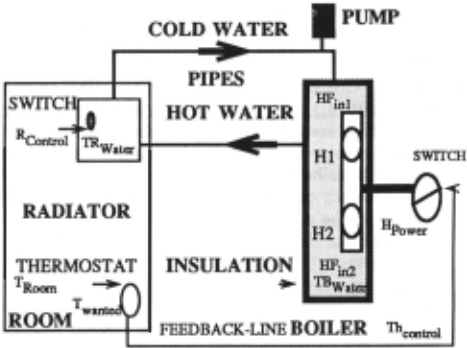
Example 1 [Central Heating System:] Consider the central heating system depicted in figure 1. The func tion of the central heating system is to guarantee that the actual room temperature TRoom equals the intended room temperature Twanted ·
In the course of monitoring and diagnosing this dy namic system, we have to solve the following problems:
- Multiple Layers of Detail: Due to the use of several layers of models (monitoring models, hierarchical di agnosis models), we must take a changing system description and component set into account . In or der to improve efficiency, real-time monitoring tends to minimize the amount of parameters under obser vation, and constraints are usually not component oriented. In our example, checking the thermostat and the room temperature is enough for most mon itoring purposes. Hierarchical diagnosis models use mostly component-oriented constraints at different abstraction levels. In our example, the most de tailed level includes all the components depicted in figure 1.
- Temporal Observations: Observations consist of sets of measurements at different time points, determin ing the value of a specified set of parameters at dif ferent times. As a consequence, taking measure ments sequentially is not feasible in a dynamic sys tem as all parameters in a measurement set have to refer to the same system state (which changes over time). Additionally, the observation rate has to be chosen such that all system states can be observed.
- Time Dependent Behavior: We have to take various modes of correct behavior and various system states into account. For example, after turning the ther mostat to a higher temperature, the temperature difference between room and thermostat tempera ture is perfectly normal. However, if they are not equal after a sufficient time period has elapsed, this difference leads to a conflict set.
- Intermittency of Faults: Static diagnosis ([Reiter, 1987]) assumes that the mode (ok or ab) of a com ponent does not change during the diagnosis process (non-intermittency of component modes). However, this may or may not be recognized in the different situations which are characterized by the parame ter sets. A dynamic diagnosis system has to handle this intermittency of faults. For example, if one of the heating elements is not working, we detect this fault only after a sufficient time period has passed and the room is still not warm enough.
- Intra State Consistency: Some diagnosis engines ([Davis, 1984]) use multiple test vectors (parameter sets) which are assumed to be independent and de scribe only one system state. In dynamic systems we have to describe the system in several system states. Therefore not only conflicts of a parameter set with respect to the correct system state are relevant, but also conflicts describing faulty transitions between these system states have to be included into diagno sis. In our example, assume two system states heat and cool. The transition from heat to cool takes place, if T,.00m > Thigh, while the system changes from cool to heat, if T,. 00m < 1/ow· If such a tran sition takes place too early (i.e., if the heater turns off too quickly), we get a conflict with the specified behavior.
The above discussion shows that the current state of-the-art of model-based diagnosis which is limited to static systems and permanently faulty behavior is un able to solve the discussed problems. It is the goal of our approach to extend model-based diagnosis with re spect to dynamic systems and to solve most of the above mentioned problems.
2.1.1 Monitoring- a Necessity in Dynamic Systems
Having designed a structural and behavioral model of a static device we can unambiguously derive predictions about its correct behavior. Therefore, we do not have to monitor a static system as its behavior is precisely deter mined. However, making predictions about the correct behavior of dynamic systems is a more complicated task.
If we resort to qualitative modeling techniques and use qualitative simulation for behavior prediction, we can usually predict more than one possible behavior pat tern. Consequently this requires a monitoring phase in the troubleshooting process to detect inconsistencies be tween sets of observations and possible correct behavior patterns.
On the other hand, we claim that it is not necessary to observe all possible correct behavior patterns. It is suffi cient to determine whether the device fulfills its function or not . For example, we will use a car long after some small deviations from its original behavior specification have occurred. In general this function of a device can be modeled according to its purpose TEL (which, for exam ple, is expressed in first order sentences) by a teleological monitoring model (denoted with TELM) following the condition
Note that in the above definition COMPTELM will be the dynamic system itself (i.e. we can use the abbrevi ation ok( device)). However, we can easily extend this general concept to allow subpurposes of subparts of the system.
In contrast to [Franke, 1989] who proposes the deriva tion of teleological models from an envisionment, we de rive such models heuristically. We claim that a teleologic model contains meta-knowledge about the purpose of the device which can only be determined by a human expert and which includes such knowledge as which faults can still be tolerated.
While monitoring, we have to check only the accor dance of the actual behavior with this teleological model under the assumption that the device works correctly.
Definition 1 (Monitoring) Monitoring is the process of testing whether
is consistent.
Usually fault detection alone is not sufficient and we need an additional diagnosis phase to provide sufficient information about fault localization for repair.
Additionally, we have to clarify how the choice of a qualitative model influences the monitoring and diagno sis process.
2.2 Different Types of Qualitative Models
2.2.1 Simulation Models
Doing simulation we are mainly interested in the be havior of the dynamic system over time. This behav ior is optimally deduced from a structural model which uses time-varying parameters as its model primitives and which does not necessarily have to contain component oriented knowledge.
Further we want to derive all behavior patterns with respect to the qualitative model no matter whether they describe faulty or correct behavior. Note that the term all refers to the chosen level of qualitative abstraction in the simulation model. The partial inclusion of models which describe physically impossible behavior is caused by the qualitative nature of the representation language and the problem-solving strategy of the simulation algo rithm ([Kuipers, 1985]).
2.2.2 Monitoring Models
We claim that the main task of monitoring is to check in real time if the purpose of the system is still fulfilled. A monitoring system observes under real-time constraints a small set of parameters and determines their correctness with respect to the system description.
Therefore, a monitoring model usually contains only a few parameters and constraints necessary to describe the teleological purpose of the device. Informally, we re strict the set of simulation models by adding teleology in accordance with the previous discussion about teleologic monitoring models.
Note that a monitoring model can be viewed as an instantiation of the system's teleology. In general, how ever, system teleology may cover a broader range of pur pose than the monitoring model actually expresses.
2.2.3 Diagnosis Models
Simulation and monitoring models are both built us ing parameters and constraints. This parameter-oriented view, however, is not suffid.ent for diagnosis. Parame ters can represent fault symptoms (e.g. the exceeding of thresholds), but faults are usually related to physical components. We assume here that the main aspect of diagnosis is to provide information for repair, and only mechanical devices (and not parameters) can be repaired 2 · We therefore have to relate purely parameter-oriented constraints (e.g. QSIM-constraints) to the device com ponents that we want to diagnose and to repair.
Diagnosis models include component-connection infor mation and are typically hierarchically structured. It is obvious that the lowest-level model has to contain only components which can be repaired, also called smallest replaceable units or SRUs. The choice of the SRUs de pends on the availability of a repair-technician as well as on cost considerations.
Diagnosis greatly benefits from hierarchical models. Complex real-world technical systems include intrinsic hierarchies which are related to the modularity or the purpose of the mechanism. Note that not only a device oriented structural model can be hierarchical; we use hi erarchical, parameter-oriented structural models as well to represent decomposable physical quantities (e.g. fluid flow) .
2 The adjustment of parameters is a struggle against fault symptoms, not against fault causes.
We have of course described extreme positions for these models. Sometimes it might be useful to express sub-purposes of sub-mechanisms. On the other hand, di agnosis coupled with repair is also often oriented towards reconstruction of a teleology which may be different from the one used for monitoring ([Friedrich et al., 1990]).
The above discussion shows that diagnosis models are more restricted than simulation models 3 but cover a broader range of expertise than monitoring models do.
3 The DIAMON System
The following section introduces the DIAMON sys tem, a qualitative reasoner for model-based diagnosis and monitoring, which incorporates the principles dis cussed in the previous section.
3.1 Example: Central Heating System
Figure 2 shows the constraint-network of the central heating system: the parameter model and the de vice model are connected by constraints. The device model contains three hierarchies consisting of 1 compo nent (Central Heating), 3 components (Room, Boiler, Pipe-System) and 8 components (Thermostat, Radiator, Heater1, Heater2, Switch, Insulation, Pipes, Pump) .
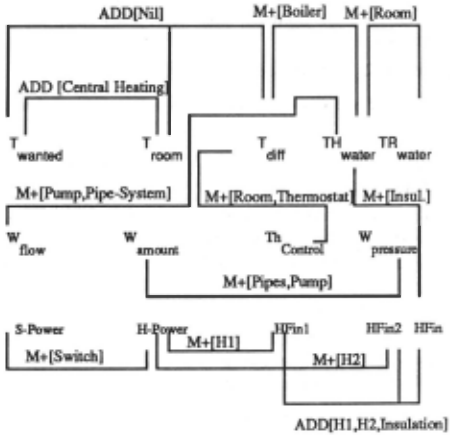
We use a flat monitoring model and a hierarchical di agnosis model which consists of two levels. The mon itoring level is modeled with 2 parameters and 1 con straint. The first diagnosis level (describing the 3 device components) uses 7 parameters and 5 constraints, the SRU-level (describing the 8 device-components) which is used for repair consists of 16 parameters and 13 con straints.
3 with respect to their qualitative expressiveness
Table 1 explains those parameters of our model that are used for monitoring and diagnosis.
| I PARAMETER- I | EXPLANATION· |
|---|---|
| wan. fed | mtenaea room-temperature tnermoetat |
| 1Room | a.ctua.l room-temperature |
| T1:1w•••• | a.ctua.J water-temperature m the boiler |
| TRw•••• | a.ctua.l water-temperature m the rachator |
| w/low | water-flow m the pipe-system |
| 'l'flconirol | con trot s1gna.J from the thermostat (feed back) |
| _!:'-Control | ••gnat tor tne ra.a•ator-swltch (exogenous) |
| sw.tch | signa.I for the water-heater sw1tch |
| HPower | Heatmg Power (tota.IJ |
| 111'';,.} | . Heatmg Power from Heater 1 |
| HF;,.2 | Heatmg Power from Heater 2 |
3.2 Qualitative Modeling using Device Constraints
We extend the QSIM-language of [Kuipers, 1986] by adding device-oriented knowledge to the constraints.
Definition 2 (Device Constraint) The syntax of a de vice constraint is grammatically defined as follows
where (constr) and (corresp.values) refer to the traditional QSIM definitions of (constraint) and (corresponding- values), and (l..of.comp) denotes the list of device components which are associated by the constraint.
Example 2 The device constraint
is interpreted as follows:
- parameter PB is a monotonic function of parameter PA
- the constrained parameters are associated to the device-components COMP1 and COMP2
- if the qualitative value of PA is landmark value lm1 (or 1m3), then PB simultaneously has the qualita tive value 1m2 (or lm4).
According to the introduced device-oriented exten sion, we distinguish between four classes of device con straints in our modeling language.
Teleologic Device Constraints: A teleologic device constraint contains parameters that are used during the monitoring cycle to detect a first fault symptom. It is obvious that the device itself (at its highest level of ab straction) is the device-oriented part in such a device constraint.
Example 3 In our example, the following teleologic de vice constraint states the desired relationship between the intended and the observed room temperature:
Tautologic Device Constraints: These constraints exclusively denote relations between parameters that cannot cause inconsistencies due to a component fail ure. We use them to denote laws of nature, for example energy-conservation, or to relate computation parame ters. In contrast to the other types of constraints a tau tologic device constraint is not associated to any com ponent as it can not provide any diagnostic information for troubleshooting.
Example 4 In our example, we use a tautologic device constraint to relate the intended room temperature, the actual room temperature and the temperature difference (which is a computation parameter) . NIL denotes the empty component set.
Singleton Device Constraints: Some device con straints are explicitly associated to only one component . They express restrictions on internal operations of the component which do not affect its surroundings. An in consistency between such a device constraint and the observed values is therefore explained by the assumption that the component is behaving abnormally.
Example 5 A singleton device constraint is associated to the radiator, that expresses a qualitative state of the radiator-signal:
Set Device Constraints: This class of device con straints associates at least two components. Although the included components are usually situated at the same level of abstraction, some set device constraints might as sociate components at different levels of abstractions as well.
Example 6 The monotonic functional relation (ex pressed by an M+ - constraint (see [Kuipers, 1986])) between the amount of water in the pipe-system and the pressure of water associates the pipes and the pump:
In this case, we use a set device constraint to avoid the introduction of additional parameters which are not ob servable. Additionally, set device constraints represent the behavior of connected groups of SRUs (we cannot replace an abstract component like PIPE-SYSTEM).
3.2.1 Layered Modeling Architecture
The modeling architecture of DIAMON consists of three layers:
Monitoring Layer: The monitoring layer of DIA MON contains a teleologic device constraint model which is used to check for faults in the system. All parame ters in the monitoring layer are continuously observed to guarantee fast fault detection. Note that if the moni toring layer contains enough parameters to pinpoint the failure of a specific part of the device, then this focusing is done on the first diagnosis level. In this case the first diagnosis level could actually consist of the same param eters as the monitoring level, but additionally include device components.
Diagnosis Layer: The diagnosis layer of DIAMON contains hierarchically structured device constraints which are used for the dynamic refinement of fault lo calization. It is obvious that the complexity of a device is represented in the hierarchical architecture of the di agnosis layer.
Repair Layer: The repair layer of DIAMON contains device constraints which exclusively relate SRUs. If the diagnosis process reaches the repair layer (i.e. all actual diagnoses only contain SRUs), it switches control to the repair process.
3.3 Algorithm
The following section introduces the algorithmic princi ples of DIAMON.
3.3.1 The Extended HS-DAG-algorithm
Previous approaches to monitoring have usually con centrated on the control of predefined thresholds. Con versely we view both monitoring and diagnosis from the consistency-preserving point of view which allows us to cover a broader range of detectable faults. The limits of detectability are due to the expressiveness of the underlying constraint language, not to the monitor ing/ diagnosis algorithm itself.
DIAMON is built on top of the HS-DAG-algorithm [Greiner et al., 198990] which is an improved version of the Reiter-algorithm [Reiter, 1987] for model-based di agnosis. The device constraints are checked for consis tency by a constraint-propagator. If an inconsistency in a constraint is detected, DIAMON adds the associated components to the conflict set.
We have extended the basic HS-DAG-algorithm to deal with dynamic systems similarly to the algorithm presented in [Ng, 1990].
3.3.2 Dynamic Model Zooming
We have developed a continuous strategy of dynamic model zooming for the diagnosis layer. Zooming denotes the process of focusing the diagnosis process to the rele vant parts of the model. In our current implementation we use a breadth-first zooming strategy which recursively zooms in the hierarchically deeper level for all compo nents which are part of a diagnosis. This strategy guar antees a diagnostic process which is optimal w.r.t. the amount of detectable faults.
We plan to develop an integration of heuristic knowl edge and a best-first zooming strategy if no safety-criteria are violated.
3.4 The Monitoring/Diagnosis Cycle
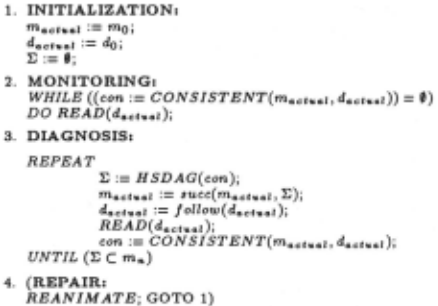
Continuing the above discussion we present a formal def inition of the DIAMON-algorithm.
Let M be the system description consisting of a se quence of qualitative models mo, m1, ... , mn, 'E denotes a set of diagnoses 6. (following [Reiter, 1987]).
According to our hierarchical modeling concepts, m0 is the monitoring layer, mn denotes the repair layer and mk with 0 < k < n are the models of the diagnosis layer. mactual E M denotes the current working model used for troubleshooting.
Let Pm, denote the set of parameters of model m, and let em, denote the set of components of model m, for 0 ~ i ~ n, m, = Pm; U em; ·
Let further succ be the binary relation M X (eM X eM) --+ M with succ(m,, 'E) = mi+l for i = 0 to n1. In our current implementation, succ is realized by a breadth-first zooming strategy which refines all device components of a dynamic diagnosis.
Let further D · denote a sequence of sets of measurements d0 , d1, ... , d, with cardinality( d.) < cardinality( d;) and d, ~ d; for j 2:: i. dactual E D, is the current working set of measurements.
Finally let follow be the unary relation D, --+ D, with follow(d,) = di+l for i = 0 to n-1. DIA MON's implemented follow-relation extends Pm«c<ul by P,uec(m 4 c<ul) = Pm 4 ctul U follow(dactual) ·
In the following description, eONSISTENT(m,d) denotes the call of the theorem prover which checks whether model m and measurement set dare consistent. The result of eONSISTENT(m, d) is either the empty set or the set of conflicts con. HSDAG(con) denotes the call of the HS-DAG algorithm which returns the set of diagnoses (i.e. the minimal hitting sets for con) and READ( d) describes the observation process of parame ter set d.
Accordingly the DIAMON-algorithm consists of four steps:
In this paper we concentrate on monitoring and di agnosis and do not discuss repair strategies. We are currently investigating and evaluating various strategies how to restore teleology in a dynamic system doing re pair (see also [Friedrich et al., 1990]).
3.5 Example: A Fault Scenario in the Central Heating System
Applying DIAMON to the on-line control of the central heating system yields the following results for the detec tion and localization of a double fault.
Assume that the radiator is switched off and one heating element (H2) is permanently faulty. DIAMON correctly detects that TRoom differs from Twanted and switches to the first diagnosis level. Additional param eters and constraints are zoomed in (state s2), i.e. the parameters are measured and the constraints are evalu ated. This is done again in state s3 to reach the SRU level. The diagnosis process finally localizes the double fault [RADIATOR, H2].
Table 2 summarizes the control process (sO- s3 denote the qualitative system states (see [Kuipers, 1986])).
| 1uuJn.tecl '1 Room TBwotor TRwoter "l"hco .. trol ltcordrof Switch HPower 11.1!';,.1 HF;,.2 | 'l'Room Std (;old std l (;Old 11U"1 I dec Cold std UN std | 'l'Room std (;old std . l c; old 11 UI.l_Cl_ec Cold std UN std u std CLOSED atd ON nll UN &!<I_ u sta |
| Layer. | D1agnos1a | Repair |
| 1 | [RADIATOR,H2] | |
| Actual Diagnoses | ||
| [ROOM], | ||
| I | ||
| [BOILER] |
4 Conclusion and Related Work
We have presented a new approach to model-based trou bleshooting dynamic systems which uses an extended constraint language for hierarchical system models and which is based on consistency-preserving algorithmic concepts for monitoring and diagnosis.
Our work is closely related to that of [Dvorak and Kuipers, 1989] and [Ng, 1990]. The DIAMON system differs from these approaches in some important ways.
First, we use a combined model-based algorithm which integrates both monitoring and diagnosis and which ad ditionally uses hierarchical models and a dynamic zoom ing strategy.
Second, DIAMON's fault coverage is more complete than those of [Dvorak and Kuipers, 1989] and [Ng, 1990] . In [Dvorak and Kuipers, 1989] faults can be missed due to the use of pre-simulated fault models which do not allow the detection and localization of unanticipated faults. The algorithm of [Ng, 1990] can miss faults if the heuristically chosen incomplete sets of measurable parameters do not represent the actual fault scenario.
The use of a hierarchical modeling architecture for troubleshooting is closely related to to the work of [Ham scher, 1991] who distinguishes between a functional and a physical (repair) model for diagnosis of digital circuits.
We differ from [Dvorak and Kuipers, 1989] in that we do not use fault models and inductively derived fault hy potheses for monitoring. Rather, we rely on the behav ior discrepancies to the correct behavior model, which allows us to handle unanticipated faults.
Acknowledgements
We especially thank Benjamin Kuipers who provided the Common LISP-implementation of QSIM (Q2). Brian Falkenhainer and anonymous referees have provided valuable comments on an earlier draft of this paper.
Alois Haselbock implemented most of the DIAMON sys tem as part of his M.S. Thesis [Lackinger and Haselbock, 1991].
@inproceedings{ijcai1991p165,
  title     = {Integrating Model-Based Monitoring and Diagnosis of Complex Dynamic Systems},
  author    = {Lackinger, Franz and Nejdl, Wolfgang},
  booktitle = {Proceedings of the Twelfth International Joint Conference on
               Artificial Intelligence, {IJCAI-91}},
  publisher = {International Joint Conferences on Artificial Intelligence},
  editor    = {John Mylopoulos and Ray Reiter},
  pages     = {1123--1127},
  year      = {1991},
  month     = {8},
  note      = {Qualitative Reasoning},
  url       = {https://ijcai.org/proceedings/1991/165},
}
TY - CPAPER TI - Integrating Model-Based Monitoring and Diagnosis of Complex Dynamic Systems AU - Lackinger, Franz AU - Nejdl, Wolfgang T2 - Proceedings of the Twelfth International Joint Conference on Artificial Intelligence, IJCAI-91 PB - International Joint Conferences on Artificial Intelligence PY - 1991 SP - 1123 EP - 1127 UR - https://ijcai.org/proceedings/1991/165 ER -Copied
Machine-readable versions of this paper, for tools and AI agents:





