
Integrating Knowledge-Based System and Neural Network Techniques for Robotic Skill Acquisition
Proceedings of the Eleventh International Joint Conference on Artificial Intelligence. Parallel and Distributed Processing. Pages 193-197.
© 1989 International Joint Conferences on Artificial Intelligence
Abstract
Thi s pa per describes an approach to robotic contr ol that is patterned after models of human skill acqulSlt.lOn. The intent is to develop robots ca pabl e oflearning how to accomplish complex tasks us ing designer-supplied instructions and se lf induced practice. A simulation is presented in which a rule-based system supervises the training of a n e ural network and controls the operation of the system during the learning process . Simulation results show the interaction between rul e -based and network-based system compon e nts during various phases of training and s up e rvision .
- REFEREN CF.S [Albus,1975]
- J. Albus, "ANew Approach to Manipulator Control: The Cerebellar Model Articulation Controller (CMAC) ",J. Dyn. Syst. Meas. Control, 97:270-277, 1975.
- [Anderson,1982] J. R. Anderson, "Acquisition of Cognitive Skill", Psychological Review, 89:369-406, 1982. 198 Parallel and Distributed Processing [Brooks,1986]
- V. Brooks, The Neural Basis of Motor Control, Oxford University Press, New York, 1986.
- [Chamiak and McDermott,1985] E. Charniak and D. McDer- mott, Introduction to Artificial Intelligence, Addison-Wesley Publishing Company, Reading, Mass., 1985.
- [Fahlman and Hinton,1987] S. Fahlman and G. Hinton, "Connectionist Architectures for Artificial Intelligence", IEEE Computer,Jan. 1987.
- [Handelman and Stengel,1987] D. Handelman and R. Stengel "An Architecture for Real-Time Rule-Based Control", Proc. 1987 American Control Conference, Minneapolis,June 1987.
- [Handelman and Stengel,1988] D. Handelman and R Stengel, "Perspectives on the Use of Rule-Based Control", Proc. IFAC Workshop on Artificial Intelligence in Real-Time Control, Swansea, UK, SepL 1988, Pergamon Press, London, 1989.
- [Handelman eL al.,1989] D. Handelman, S. Lane and J Gel- fand, "Integrating Neural Networks and Knowledge-Based Sys- tems for Robotic Control", Proceedings of the 1989 IEEE Con- ference on Robotics and Automation, Scottsdale, Arizona, May, 1989, IEEE Computer Society Press, Los Angeles, 1989.
- [Kupfermann,1985] L Kupfermann, "Learning", in E. Kandel, and]. Schwartz, Eds., Principles of Neural Science, Elsevier Science Publishing Co., Inc., New York,1985.
- [Rummelhart and McClelland,1986] D. Rumelhart and ]. McClelland, Eds., Parallel Distributed Processing: Explorations in the Microstructure of Cognition, Volume 1: Foundations, The MIT Press, Cambridge, Mass., 1986.
- Schneider,l985] W. Schneider, 'Toward a Model of Attention and the Development of Automatic Processing", in M. Posner and 0. Marin, Eds. Attention and Performance XI, Erlbaum, Hillsdale, NJ-,1985.
- [Schneider and Detweiller,1987] W. Schneider and M. Detweiler, "A Connectionist/Control Architecture for Working Memory", in G. Bauer, Ed., Vol. 21, Academic Press, New York, 1987.
- [Stein and Capady,1988] R. Stein and C. Capaday 'The Modu- lation of Human Reflexes during Functional Motor Tasks", Trends in Neural Science, VoL 11, No.7, 1988.
References were extracted automatically from the PDF and may contain errors.
Full text extracted automatically from the PDF; figures, tables and equations may differ. The PDF is the version of record.
INTEGRATING KNOWLEDGE-BASED SYSTEM AND NEURAL NE'IWORK TECHNIQUES FOR ROBOTIC SKILL ACQUISffiON
DavidA. Handelman, Stephen H. Lane, andjackj. Gelfand*
Human Information Processing Group Department of Psychology Princeton University Princeton, New Jersey 08544
ABSTRACT
This paper describes an approach to robotic con trol that is patterned after models of human skill acqulSlt.lOn. The intent is to develop robots capable oflearning how to accomplish complex tasks using designer-supplied instructions and self induced practice. A simulation is presented in which a rule-based system supervises the train ing of a neural network and controls the opera tion of the system during the learning process. Simulation results show the interaction between rule-based and network-based system compo nents during various phases of training and supervision .
INTRODUCTION
Neural ne tworks have been shown to be very efficient at learning from experience. However, there are a number of problems to be overcome before they become useful com ponents of truly autonomous learning systems. Presently, training da ta must be supplied by an outside operator who must closely supervise the learning process. Also, if the system containing the neural network is required to per fo rm its task during learning, a provision must be made to control its operation during this period. We have devel oped an automated approach to solving these problems in which a rule based system supervises the training of a neural network and controls the operation of the system during the learning process. The operation of this system exhibits properties which are similar to the stages of motor learning in humans in which control shifts from an explicit, verbally orien ted representation to an implicit reflexive represen ta tion and execution .
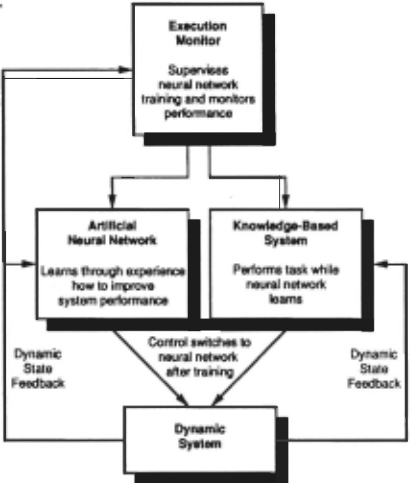
For a preliminary demonstration of these concepts, a simulation has been constructed in which a two link ma nipulator is taught how to make a tennis-like swing. A schematic of this approach is illustrated in Fig. 1. The control system first determines how to make a successful swing using rules alone. It then teaches a neural network how to accomplish this task by having the network observe and generalize on the rule-based task execution. Following initial training, a rule based execution monitor evaluates the neural network performance, and re-engages rule based swing-maneuver control whenever errors due to changes in the manipulator or its operating environment necessitate retraining of the network. The rule-based sys tem thereby ensures proper task completion while neural network re-learning takes place. The simulation shows the interaction betweeen rule-based and network based system components during various phases of training and supervi siOn
* This work was supported by the James S. McDonnell Foundation.
PHASES OF SKILL ACQUISffiON
It is well known that humans pass through various levels of competence as motor skills are acquired. Fitts and Posner [ 1967] define three phases of skill learning: 1) the cogni tive (early) phase, wherein a beginner tries to understand the task, 2) the associative (intermediate) phase, where patterns of response emerge and gross errors are elimi nated, and 3) the autonomous (final) phase, when task execution requires little cognitive control. Adams [1971] defines two stages of motor learning: 1) the verbal-motor stage, where corrections are based on verbal descriptions of how well the task is being accomplished, and 2) the motor stage, where conscious behavior eventually becomes automatic, and attentional mechanisms pick out only those channels of information relevant to learning. Brooks [1986] points out that there are numerous structures in the brain associated with motor learning. Centers involved in emotion, attention, memory and motor control all partici pate. Within this system the cerebellum is particularly concerned with coordination and skillacquisition.Although it is not well understood at this time whether control of motor learning specifically passes between various struc tures in the motor system it is known, however, that fine motor control cannot be learned or executed without the participation of the cerebellum.
The distinctions between various stages of motor learn ing and control are also found in more general cognitive skill acquisition and memory. Kupfermann [1985] differ entiates between reflexive and declarative memory and learning. Task execution based on reflexive memory and learning relate specific responses to specific stimuli. Learned functions appear automatic and require little or no thought. Declarative memory and learning can usually be expressed in verbal statements. Execution of tasks based on declara tive memory usually requires evaluation, comparison and inference. Most complex tasks attempted for the first time usually require some form of declarative reasoning.
Anderson [ 1982] has modelled the transition between the cognitive andassociativestagesofFittsandPosner[1967] as a knowledge compilation process whereby a more gen eral declarative form of task knowledge is converted into a specific procedural representation. During the transition from declarative to procedural processing, operational production rules become more condensed and task specific. In Anderson's model the final shift to the most autono mous form of processing is accomplished by fine tuning the selectivity of the problem solving search procedures.
A quasi-neural model for the development of automatic processing accompanying skill acquisition has been pro posed by Schneider [ 1985] and Schneider and Detweiler [1987]. In this model a shift in the control mechanism changes the gating of information vectors between visual, lexical, semantic, and motor processing units. In Schnei der's model the initial stage of cognitive processing in volves direct control of information between units. During practice, associative learning enables direct association of input/output vectors pairs and priority learning deter mines the transmission strength of these vectors between processing modules. A gradual transition from controlled to automatic processing occurs with practice. In the final and most automatic stage of skill acquisition, communica tion between processing units is not gated by the controller but is determined so ley by the transmission strengths learned during the priority learning process.
In the model presented by Anderson, knowledge repre sentations and functional architectures remain the same as the system goes through various stages of skill acquistion. In Schneider's model, the interconnections and process ing modules remain the same, but a change in the control of information flow between units cause.s the execution to shift from a serial to a more parallel processing mode. In this paper we explore the properties of a system in which both control and learning arc shifted between two differ ent functional architectures with different reprcsen tations of the control problem. We shall use the terminology, declarative and reflexive control, patterned after Kupfer mann [1985] to describe the shift between knowledge based system and neural network control because it most nearly represents the differences between these two ap proaches.
Because the rule base used for the control of the arm is quite task specific, the systein described here corresponds most closely in its operation to the shift in Anderson's procedural phase represented by the rule-based system to an automatic phase represented by the neural network. We plan to implement in the near future a more complex rule based system which also exhibits the shift from a declarative representation to procedural processing in Anderson's terminology. In the work reported here, we made no attempt to optimize the design or performance of the individual knowledge-based system or neural network components but rather used simplified versions of both to highlight the properties of the integrated system.
It is important to note that the shift of processing from controlled to automatic is a central component of tl1e allocation of resources in human processing. Tasks initially learned declaratively become reflexive through repeti tion. In this way tasks performed most often are processed in a way that requires the smallest allocation of processing resources. However, when familiar tasks are attempted in novel situations, there must be a shift back into a declara tive form of processing in order to accomplish the task. For example, although one may become adroit at tying one's own necktie, tying someone else's necktie requires some thought due the change in perspective. The intent of the present research is to endow robots with a similar capability, combining reflexive and declarative forms of information processing for highly adaptive and dexter ous robotic control.
INfEGRATING KNOWLEDGE-BASED SYSTEMS AND NEURAL NE'IWORKS
Artificial neural networks and knowledge-based systems represent the desired reflexive and declarative forms of processing, respectively. Artificial neural networks exhibit characteristics of associative memory, pattern matching, generalization, and learning by example [Rumelhartand McClelland,1986, Fahlman and Hinton,l987]. Insofar as they directly compute specific outputs in response to specific inputs, neural networks can be viewed as implementing reflexive task knowledge. Knowledge-based systems have demonstrated the ability to encode and exer cise expert knowledge within limited domains, provid ing a hierarchical software organization and explainable solutions [Charniak and McDermott,1985]. The infer encing capabilities of these systems effectively implement declarative task knowledge.
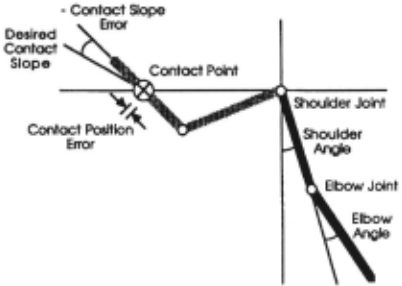
The control task chosen to illustrate the integration technique involves teaching a two-link manipulator how to make a tennis-like swing. The swing eventually will become part of a higher-level task that involves striking a ball to hit a specific place on a wall. Presently, only the swing is considered. The manipulator, shown in Fig. 2, is composed of two cylindrical links, each with a length of 1 m and a radius of0.1 m. The inner link, located between the shoulder and elbow joints, has a mass of I kg, and the outer link mass varies between 0.5 and 1 kg in the simulations described below. Rotation of the shoulder and elbow joints occurs in a vertical plane, against gravity. The overall task of the control system is to vary joint torques over time such that the outer link moves from its vertical resting position (pointing straight down) through an imaginary contact point. The outer link is to strike the contact point at the link's mid-point, and at a specified angle (slope). A swing is deemed successful when the two swing-maneuver performance measures "Contact Posi tion Error and Contact Slope Error" fall within specified bounds. A more complete description of the system and its performance is given by Handelman et. al. [1989).
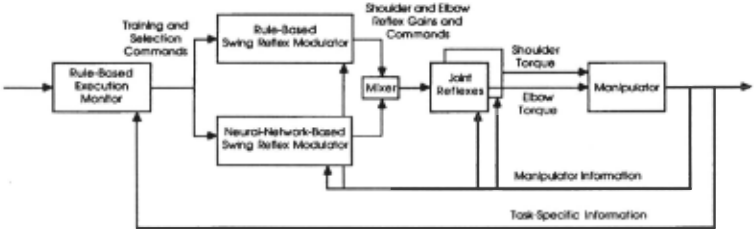
Figure 3 shows a block diagram of the controller used to accomplish this task. Three levels of a controller task hierarchy are defined: low-level reflexes, a reflex modulator, and an execution monitor. On the lowest level (the innermost loop in the block diagram), each joint is endowed with simple reflexes that command torque as a function of angular position and velocity. The term "reflex" is borrowed from human motor control and is meant to represent either a simple position or force servo system. It is believed .that many human voluntary motions involve the modulation of reflexes [Stein and Capady, 1988). Therefore the middle loop of Fig. 3 is used to provide the low-level reflex loops with time-varying gains and commands needed to carry out the swing maneuver. Finally, the execution monitor supervises various phases of reflex modulation learning.These levels of the controller hierarchy are described in detail below.
Rule-Based Swing Reflex Modulator
On the lowest level, each joint reflex acts as a hybrid position/torque servomechanism. The two available re flexes are 1) spring-like position control with joint angle and angular velocity feedback, and 2) constant torque control. Reflex gain and command modulation is used to generate the manipulator swinging motion. Implemented in the middle feedback loop ofFig. 3, modulation is accom plished using either rules, a neural network, or both, de pending on the mode of operation. Table 1 presents the rules used to execute a rule-based swing. The rules are invoked by a cyclic goal-directed search through a knowledge base of parameters, rules, and procedures in much the same way that aircraft emergency procedures are executed by Handelman and Stengel [1988,1989) . The rules were obtained by the control system designer through trial and error. No explicit knowledge of the dy namics was used in this process. A single base torque is used and is scaled for each joint by an appropriate parameter.
Network-Based Swing Reflex Modulator
Neural-network-based reflex modulation is performed with a CMAC (Cerebellar Model Articulation Controller) network module developed by Albus [1975) . A CMAC is used to encode implicitly, through learning, the sensorimotor relationships represented explicitly by the swing-maneuver rules of Table 1. The CMAC module is a
SWina Step 1
Stiffen shoulder about 20 deg with gain 0.5 and stiffen elbow about 0 de8 with gain 0.1 until shoulder angle >= 1 deg
Swjng Steo2
Torque shoulder with gain -1.0 until shoulder angle <= -65 deg
SWina S!ep 3
Torque shoulder with gain 0.5 and stiffen elbow about -8J deg with gain 0.2 until shoulder angle >= -45 deg
SWing step 4
Torque shoulder with gain -1.3 and stiffen elbow about 0 deg with gain 0. 1 until shoulder and elbow velocities are below 50 deg/sec
SWing Step 5
Stiffen shoulder and elbow about 0 deg with gain 1.0 until magniitudes of shoulder and elbow velocities are below 20 deg/sec
Table 1. Rule-Based Swing Maneuver Steps
perceptron-like table look-up technique for reproducing functions with multiple input and output variables over particular regions of the function space. A CMAC can learn by example, and its mapping scheme provides auto matic generalization (interpolation) between input states, so that similar inputs produce similar outputs.
The CMAC network modules are used to implement a reflexive swing maneuver. With the CMACproperly trained, input values representing the manipulator state cause the CMAC to output gains and commands to the low-level reflexes that ultimately move the manipulator in to the next task-dependent area of the manipulator state space. The resultantmanipulatorstate then defines new input values which, in turn, produce CMAC outputs that again "push" the manipulator in to the next desired state. Thus, after the CMAC network has been trained, rules initiate a network based swing by "throwing" the manipulator into an area of the manipulator state space recognized by the network. The network then reflexively executes the swing maneuver. When the manipulator finally enters a configu ration recognized by rules as concluding the swing maneu ver, the rules disengage the CMAC network and once again take over reflex modulation responsibility. Training and supervision ofCMAC reflex modulation are performed by the execution monitor.
Rule-Based Execution Monitor
The execution monitor is entirely rule-based, and imple ments three Swing Modes that correspond to various phases of reflex modulation learning. The Swing Modes are termed Rule-Based, Rule-and-Network-Based, and Network-Based. Under Rule-Based Swing Mode, reflex modulation is carried out by rules only. When certain conditions are met, the CMAC network modules concur rently attempt to duplicate the rule-based reflex modula tion commands, learning by example. Under Rule-and Network-Based Swing Mode, rule-based and CMAC-based reflex modulation suggestions are generated in parallel, and CMAC learning continues. CMAC-based outputs are fed directly to the reflexes when they are deemed close enough to the "optimal" rule-based command sugges tions. Finally, under Network-Based Swing Mode, CMAC learning ceases, and CMAC outputs directly modulate shoulder and elbow joint reflexes throughout the entire swing maneuver. Switching between Swing Modes is dic tated by the rules shown in Table 2.
SIMUlATION RESULTS
Operation of the integrated swing-maneuver controller of Fig. 3 was simulated on a personal computer equipped with a 1O-M Hz 80286 processor, an 8-MHz 80287 math coproces sor, and 640 K.Bytes of Random-Access Memory (RAM). Source code for the CMAC modules was written in Pascal, whereas the rule-based system components (including 77 rules) were translated automatically from LISP to Pascal as described Handelman and Stengel [1988]. Following a discussion of simulation results detailing the operation of the controller, real-time performance issues will be ad dressed.
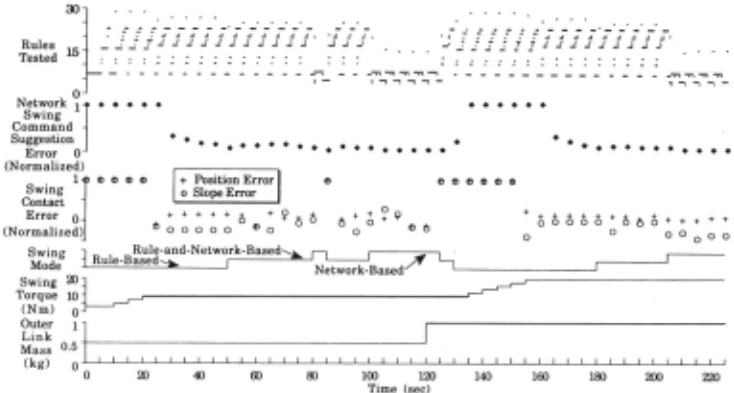
Figure 4 depicts the activity of the rule-based system components during various phases of the swing maneu ver. Each data point in the top plot corresponds to the num ber of rules tested by the controller inference engine during agoal-directed search cycle. Adjacent data points are separated by the amount of time required to complete a search cycle, in this case forced to coincide with a controller sample rate of 20 per sec. At the start of the simulation, the manipulator outer link mass is set at 0.5 kg, and the Base Torque command is set at 3 Nm.
The controller performs swings at 5 sec intervals. It begins swinging at t= 5 sec while in Rule-Based Swing Mode. Peaks and valleys in the number of rules tested reflect execution of the various swing steps of Table 1. As shown by the plot of Swing Contact Error in Fig. 4, errors associated with the first 3 swings remain high. The outer link never reaches the contact point because the applied torques do not overcome gravity by a sufficient amount, prompting successive increases in Base Torque. By t = 20 sec, a Base Torque commandof9Nm resultsinacceptable contact error, enabling training of the CMAC neural network modules.
During the 15 swings between t = 25 sec and t = 100 sec, the rule-based system components teach the CMAC net work how to modulate reflexes in order to accomplish a suc cessful swing. The first 5 swings are performed in Rule Based Swing Mode, with the CMAC network learning, but not contributing to, modulation of the shoulder and elbow joint reflexes. By t=50 sec, CMAC command suggestion errors have dropped low enough for the controller to enter Rule-and-Network-Based Swing Mode. At t = 80 sec, the controller momentarily switches to Network-Based Swing Mode, but the resulting swing falls short of the contact point. Finally, by t = 100 sec, four consecutive
Rule-Based Swing Mode
- If swing mode was rule-based and required base torque has not been found and adequate contact was not made then adjust base torque
- ~ swing mode was rule-based and required base torque has not been found and adequate contact was made then mark base torque as found and begin networl< training
- ~ swing mode was rule-based and required base torque has been found and adequate contact was made but networl<-based command suggestions were not consistent with n.Jie-based commands
then
make no swing mode change
- ~ swing mode was rule-based and required base torque has been found and adequate contact was made and network-based command suggestions were consistent with n.Jie-based commands
- then
set swing mode to n.Jie-aod-oetworl<-based Rule-god-Network-Based Swjog Mode
- If swing mode was rule-aod-oetworl<-based and adequate contact was not made then set swing mode to rule-based and marl< required base torque as not found and stop networl< training
- ~ swing mode was n.Jie-and-oetworl<-based and adequate contact was made but oetworl<-based command suggestions were not consistent with n.Jie-based commands
then
make no swing mode change
- ~ swing mode was rule-and-networl<-based and adequate contact was made and network-based command suggestions were consistent with n.Jie-based commands then
set swing mode to oetworl<-based
Networ!<-Bgsed Swjog Mode
- ~ swing mode was oetworl<-based and adequate contact was not made then set swing mode to rule-and-networl<-based
- If swing mode was network-based and adequate contact was made then make no swing mode change
Table 2. Sample of Execution Monitor Rules
network-based swings can be accomplished. Note in Fig. 4 that the number of rules tested during network-based swings drops considerably, reflecting a shift from a de clarative to a reflexive form of processing.
In order to demonstrate the inherent adaptability of the integrated controller, the outer link mass is increased from 0.5 kg to 1.0 kg at t = 120 sec. As shown in Fig. 4, insufficient Base Torque causes the manipulator to miss the contact point over the next 6 swings. During this time the Swing Mode regresses from Network-Based, to Rule and-Network-Based, to Rule-Based, and the Base Torque command is steadily increased. By t = 155 sec, a Base Torque of 19 Nm results in a successful rule-based swing. Between t = 160 sec and t = 205 sec, the CMAC network re-learns by rule-based example how to modulate properly the low-level joint reflex gains. By t = 205 sec, four success ful network-based swings once again can be performed.
Utilizing the personal computer hardware and software described earlier, processing requirements for the various controller operations included the following. While in Rule-Based Swing Mode with no CMAC learning, a typical controller goal-directed search cycle testing 23 rules required 0.014 sec. The CMAC network (4 inputs, 6 outputs) required approximately 64 KBytes of memory (RAM). The reading (recall) of a single set of CMAC network outputs required 0.023 sec, and the updating (learning) of a set ofCMAC input-output points required 0.04 7 sec. Although the present controller implementa tion configuration cannot support the simulated sample rate of 20 per sec, implementation of the integrated controller on multiple state-of-the-art microprocessor boards should achieve real-time performance.
CONCLUSIONS
Knowledge-based systems and artificial neural networks offer very different capabilities concerning control system design, implementation, and performance. The ap proach taken in this paper was to develop a robotic control system that utilizes the strengths of each processing technique where appropriate. A rule-based system initially finds acceptable first-cut solutions to the given control objective, then teaches a neural network how to accom plish parts of the task which are amenable to the network's learning and generalization abilities. The net work learns on-line by examples provided by rule-based task execution. The resulting integrated system enables a natural division of labor; strategies for task execution (embodied by the execution monitor ofthe swing maneu ver described above) remain within an expressive rule based representation, whereas specific tactics (such as reflex gain modulation) are delegated to the most appropriate form of processing. In addition, by replacing rule groups with neural networks in a modular fashion, integration of the two computational paradigms occurs within the convenient hierarchical software architecture provided by knowledge-based programming techniques.
When integrated, knowledge-based systems and artificial neural networks merge declarative and reflexive forms of information processing. For the swing-maneuver control ler described above, shifts between declarative and reflex ive processing are traced by variations in the number of rules being tested and the errors associated with the network outputs during learning. Furthermore, a shift from declarative to reflexive processing implies changes in the controller's focus of attention and allocation of computational resources. By integrating aspects of declarative knowledge-based systems and reflexive artificial neural networks in real time, the stage may be set for the development of highly adaptive and dexterous robotic control systems.
Many additional issues related to the integration of neural networks and knowledge based systems for autono mous control will be investigated in future research. These include: 1) If we were to use special purpose parallel archi tectures for the neural network and rule-based system control, would neural network control be significantly more efficient for the automatic control phase as in hu mans ? 2) How should optimal learning strategies used by the execution monitor be generated? 3) In the preliminary example we investigated, we were able to transfer control smoothly between the knowledge-based system and neural network. What stability problems might arise in more complex systems ? 4)Given a group of neural networks assigned to perform a complex, multi-faceted task, how should the execution monitor knowledge base be set up to optimally allocate knowledge among networks and deter mine their training order ? 5) Can the transfer of knowl edge among system components be bi-directional, that is, can the knowledge-based system infer new rules or modify existing ones based on neural network performance ?
Acknowledgements
The authors acknowledge many helpful discussions with Gregory Clark, Carl Olson and Paul Thagard of the Prince ton University Psychology Department.
REFEREN CF.S
[Albus,1975]J. Albus, "ANew Approach to Manipulator Control: The Cerebellar Model Articulation Controller (CMAC) ",J. Dyn. Syst. Meas. Control, 97:270-277, 1975.
[Anderson,1982]J. R. Anderson, "Acquisition of Cognitive Skill", Psychological Review, 89:369-406, 1982.
[Brooks,1986] V. Brooks, The Neural Basis of Motor Control, Oxford University Press, New York, 1986.
[Chamiak and McDermott,1985] E. Charniak and D. McDer mott, Introduction to Artificial Intelligence, Addison-Wesley Publishing Company, Reading, Mass., 1985.
[Fahlman and Hinton,1987] S. Fahlman and G. Hinton, "Connectionist Architectures for Artificial Intelligence", IEEE Computer,Jan. 1987.
[Handelman and Stengel,1987] D. Handelman and R. Stengel "An Architecture for Real-Time Rule-Based Control", Proc. 1987 American Control Conference, Minneapolis,June 1987.
[Handelman and Stengel,1988] D. Handelman and R Stengel, "Perspectives on the Use of Rule-Based Control", Proc. IFAC Workshop on Artificial Intelligence in Real-Time Control, Swansea, UK, SepL 1988, Pergamon Press, London, 1989.
[Handelman eL al.,1989] D. Handelman, S. Lane and J Gel fand, "Integrating Neural Networks and Knowledge-Based Sys tems for Robotic Control", Proceedings of the 1989 IEEE Con ference on Robotics and Automation, Scottsdale, Arizona, May, 1989, IEEE Computer Society Press, Los Angeles, 1989.
[Kupfermann,1985] L Kupfermann, "Learning", in E. Kandel, and]. Schwartz, Eds., Principles of Neural Science, Elsevier Science Publishing Co., Inc., New York,1985.
[Rummelhart and McClelland,1986] D. Rumelhart and ]. McClelland, Eds., Parallel Distributed Processing: Explorations in the Microstructure of Cognition, Volume 1: Foundations, The MIT Press, Cambridge, Mass., 1986.
[Schneider,l985] W. Schneider, 'Toward a Model of Attention and the Development of Automatic Processing", in M. Posner and 0. Marin, Eds. Attention and Performance XI, Erlbaum, Hillsdale, NJ-,1985.
[Schneider and Detweiller,1987] W. Schneider and M. Detweiler, "A Connectionist/Control Architecture for Working Memory", in G. Bauer, Ed., Vol. 21, Academic Press, New York, 1987.
[Stein and Capady,1988] R. Stein and C. Capaday 'The Modu lation of Human Reflexes during Functional Motor Tasks", Trends in Neural Science, VoL 11, No.7, 1988.
@inproceedings{ijcai1989p31,
  title     = {Integrating Knowledge-Based System and Neural Network Techniques for Robotic Skill Acquisition},
  author    = {Handelman, David and Lane, Stephen H. and Gelfand, Jack},
  booktitle = {Proceedings of the Eleventh International Joint Conference on
               Artificial Intelligence, {IJCAI-89}},
  publisher = {International Joint Conferences on Artificial Intelligence},
  editor    = {N. S. Sridharan},
  pages     = {193--197},
  year      = {1989},
  month     = {8},
  note      = {Parallel and Distributed Processing},
  url       = {https://ijcai.org/proceedings/1989/31},
}
TY - CPAPER TI - Integrating Knowledge-Based System and Neural Network Techniques for Robotic Skill Acquisition AU - Handelman, David AU - Lane, Stephen H. AU - Gelfand, Jack T2 - Proceedings of the Eleventh International Joint Conference on Artificial Intelligence, IJCAI-89 PB - International Joint Conferences on Artificial Intelligence PY - 1989 SP - 193 EP - 197 UR - https://ijcai.org/proceedings/1989/31 ER -Copied
Machine-readable versions of this paper, for tools and AI agents:





