
A Reactive Approach to Explanation
Proceedings of the Eleventh International Joint Conference on Artificial Intelligence. Speech and Natural Language. Pages 1504-1509.
© 1989 International Joint Conferences on Artificial Intelligence
Abstract
Explanation is an interactive process, requiring a dialogue between advice-giver and adviceseeker. Yet current expert systems cannot participate in a dialogue with users . In particular these systems cannot clarify misunderstood explanations, elaborate on previous explanations, or respond to follow-up questions in the context of the on-going dialogue. In this paper, we describe a reactive approach to explanation - one that can participate in an on-going dialogue and employs feedback from the user to guide subsequent explanations . Our system plans explanations from a rich set of explanation strategies, recording the system's discourse goals, the plans used to achieve them, and any assumptions made while planning a response . This record provides the dialogue context the system needs to respond appropriately to the user's feedback . We illustrate our approach with examples of disambiguating a follow-up question and producing a clarifying elaboration in response to a misunderstood explanation .
- [Appelt, 1981] Douglas E. Appelt. Planning Natural Language Utterances to Satisfy Multiple Goals. PhD thesis, Stanford University, 1981.
- [Carberry, 1983] Sandra Carberry. Tracking user goals in an information-seeking environment . In Proceedings of the Third National Conference on Artificial Intelli- gence, pages 59-63, Washingtion, D.C., August 22-26 1983.
- [Cohen and Levesque, 1985] Philip R. Cohen and Hec- tor J. Levesque. Speech acts and rationality. In Pro- ceedings of the Twenty-Third Annual Meeting of the Association for Computational Linguistics, pages 49- 60, University of Chicago, Chicago, Illinois, July 8-12 1985.
- [Grosz and Sidner, 1986] Barbara J. Grosz and Can- dace L. Sidner. Attention, intention, and the structure of discourse. Computational Linguistics, 12(3): 175- 204, 1986.
- [Hovy, 1988] Eduard H. Hovy. Planning coherent mul- tisentential text. In Proceedings of the Twenty-Sixth Annual Meeting of the Association for Computational Linguistics, State University of New York, Buffalo, New York, 7-10 June 1988.
- [Kass and Finin, 1989] Robert Kass and Tim Finin. Modeling the user in natural language systems. Com- putational Linguistics Journal, 14:5-22, 1989. Special Issue on User Modelling.
- [Litman, 1985] Diane Litman. Plan Recognition and Discourse Analysis: An Integrated Approach for Un- derstanding Dialogues. PhD thesis, University of Rochester, 1985. Published by University of Rochester as Technical Report TR 170.
- [Mann and Matthiessen, 1983] William C. Mann and Christian Matthiessen. Nigel: A systemic grammar for text generation. Technical Report RR-83-105, USC/Information Sciences Institute, February 1983 . 1510 Speech and Natural Language [Mann and Thompson, 1988]
- William C. Mann and Sandra A. Thompson. Rhetorical structure theory: Towards a functional theory of text organization. TEXT, 8(3):243-281, 1988.
- [McCoy, 1985] Kathleen F. McCoy. Correcting Object- Related Misconceptions. PhD thesis, University of Pennsylvania, December 1985. Published by Univer- sity of Pennsylvania as Technical Report MS-CIS-85- 57.
- [McKeown et a/., 1985] Kathleen R. McKeown, Myron Wish, and Kevin Matthews. Tailoring explanations for the user. In Proceedings of the Ninth International Joint Conference on Artificial Intelligence, pages 794- 798, Los Angeles, CA, August 1985. IJCAI. IJCAI
- [McKeown, 1982] Kathleen R. McKeown. . Generating Natural Language Text in Response to Questions About Database Structure. PhD thesis, University of Pennsylvania, 1982. Published by University of Penn- sylvania as Technical Report MS-CIS-82-5.
- [Moore and Paris, 1989] Johanna D. Moore and Cecile L. Paris. Planning text for advisory dialogues. In Proceedings of the Twenty-Seventh Annual Meet- ing of the Association for Computational Linguistics, Vancouver, B.C., Canada, June 26-29 1989.
- [Neches et a/. , 1985] Robert Neches, William R. Swartout, and Johanna D. Moore. Enhanced main- tenance and explanation of expert systems through explicit models of their development. IEEE Transac- tions on Software Engineering, SE-11(11), November 1985.
- Cecile L. Paris. Tailoring object descrip- tions to a user's level of expertise. Computational Linguistics Journal, 14(3), 1988.
- [Pollack et a/., 1982] Martha E. Pollack, Julia Hirschberg, and Bonnie Lynn Webber. User partic- ipation in the reasoning processes of expert systems. In Proceedings of the Second National Conference on Artificial Intelligence, Pittsburgh, Pennsylvania, Au- gust 18-20 1982.
- [Ringle and Bruce, 1981] Martin H. Ringle and Bertram C. Bruce. Conversation failure. In Wendy G . Lehnert and Martin H. Ringle, editors, Knowledge Representation and Natural Lan- guage Processing, pages 203-221.
- [Sidner, 1979] Candace L. Sidner. Toward a Computa- tional Theory of Definite Anaphora Comprehension in English Discourse. PhD thesis, Massachusetts Insti- tute of Technology, Cambridge, Mass., 1979.
- [Sparck Jones, 1984] Karen Sparck Jones. User models and expert systems. Technical Report No. 61, Univer- sity of Cambridge Computer Laboratory, December 1984.
References were extracted automatically from the PDF and may contain errors.
Full text extracted automatically from the PDF; figures, tables and equations may differ. The PDF is the version of record.
1 Introduction
Explanation requires a dialogue. Users need to be able to ask follow-up questions if they do not understand an explanation or want further elaboration. Answers to such questions must take into account the dialogue con text . Studies of advisory consultations between humans bear out this observation, showing that explanation is an interactive process between explainer and advice seeker [Pollack et al. , 1982]. Studying student-teacher interactions, we found that advice-seekers frequently did not fully understand the instructor's response. They frequently asked follow-up questions requesting clarifi cation, elaboration, or re-explanation. In some cases , follow-up questions took the form of a well-articulated query; in other cases, the follow-up was a vaguely artic ulated mumble or sentence fragment . Often the instruc- William R. Swartout USC /Information Sciences Institute 4676 Admiralty Way Marina del Rey, CA 90292-6695
*The research described in this paper was supported by the Defense Advanced Research Projects Agency (DARPA) under a NASA Ames cooperative agreement number NCC 2-520.
tor did not have much to go on, but still had to provide an appropriate response.
Unfortunately, current expert systems cannot partici pate in a dialogue with users. In particular these systems cannot clarify misunderstood explanations, elaborate on previous explanations, or respond to follow-up questions in the context of the on-going dialogue. In part, the explanation components of current expert systems are limited because they are quite simple. However, even the more sophisticated generation techniques employed in computational linguistics are inadequate for respond ing to follow-up questions. The problem is that both expert system explanation and natural language gener ation systems view generating responses as a one-shot process. That is, a system is assumed to have one op portunity to produce a response that the user will find satisfactory.
This one-shot approach is clearly inconsistent with analyses of naturally occurring advisory dialogues. Moreover, if a system has only one opportunity to pro duce a text that achieves the speaker's goals without over- or under-informing, boring or confusing the listener then that system must have an enormous amount of de tailed knowledge about the listener. This has led to a view that improvements in explanation will come from improvements in the user model and considerable effort has been expended in representing a detailed model of the user- including the user's goals, what the user knows about the domain, how information should be presented to that user, and so forth [Appelt, 1981, McCoy, 1985, Paris, 1988, Kass and Finin, 1989]. However, following Sparck Jones [Sparck Jones, 1984], we question whether it will be possible to build complete and correct user models. Further, by focusing on user models , researchers have ignored the rich source of guidance that people use in producing explanations, namely feedback from the lis tener [Ringle and Bruce, 1981]. By throwing out the one-shot assumption, we can make use of that guidance.
Thus, a reactive approach to explanation is required - one in which feedback from the user is an integral part of the explanation process. A reactive explanation fa cility should include the ability to: 1) accept feedback from the listener, 2) recover if the listener indicates he is not satisfied with the response, 3) answer follow-up questions taking into account previous explanations, not as independent questions, 4) offer further explanations even if the user does not ask a well-formulated follow-up question, and 5) use information in a user model if it exists, but not require it.
2 Limitations of Current Systems
There are three main reasons why current systems can not participate in a dialogue with their users. First, to be able to clarify a misunderstood explanation or respond to a follow-up question in context, a speaker must under stand the explanation he has produced. Unfortunately, current expert systems produce explanations by filling in templates or using canned text and thus have little or no "understanding" of their own explanations. They do not represent the goal of the explanation, what rhetori cal purposes are served by individual clauses in the text, or what assumptions about the listeners knowledge may have been made:
Second, current systems always interpret questions in the same way. For example, when a user types "why?" in response to a question, MYCIN assumes that the user is asking what higher domain goal gave rise to the cur rent one. Subsequent "whys" retrieve information about still higher level domain goals that posted the ones just described. As we describe later, this single interpreta tion fails to take into account the dialogue context and can be unnatural.
The third problem with current systems is that they typically have only a single response strategy associated with each question type. Making oneself understood of ten requires the ability to present the same information in multiple ways or to provide different information toil lustrate the same point. Without multiple strategies for responding to a question, a system cannot offer an al ternative response even if it understands why a previous explanation was not satisfactory.
We have built an explanation component for an expert system which addresses these problems. To provide the capabilities described above, we: 1) plan responses such that the intentional structure of the responses is explicit and can be reasoned about, 2) keep track of conversa tional context by remembering not only what the user asks, but also the planning process that led to an ex planation, 3) taxonomize the types of (follow-up) ques tions that are asked and understand their relationship to the current context, and 4) provide flexible explanation strategies with many and varied plans for achieving a given discourse goal.
3 System Description
Our explanation generation facility is part of the Ex plainable Expert Systems (EES) framework [Neches et a/., 1985]. When an expert system is built in EES, an extensive development history is created that records the domain goal structure and design decisions behind the expert system. This structure is available for use by the explanation facility.
We have used EES to construct a prototype expert sys tem, the Program Enhancement Advisor (PEA) [Neches eta/., 1985], which we are using as a testbed for our work on explanation generation. PEA is an advice-giving sys-
tern intended to aid users in improving their Common Lisp programs by recommending transformations that enhance the user's code. 1 The user supplies PEA with the program to be enhanced. PEA begins the dialogue with the user by asking what characteristics of the pro gram he would like to improve. The user may choose to enhance any combination of readability, maintainability, and efficiency. PEA then recommends transformations that would enhance the program along the chosen di mensions. After each recommendation is made, the user is free to ask questions about the recommendation.
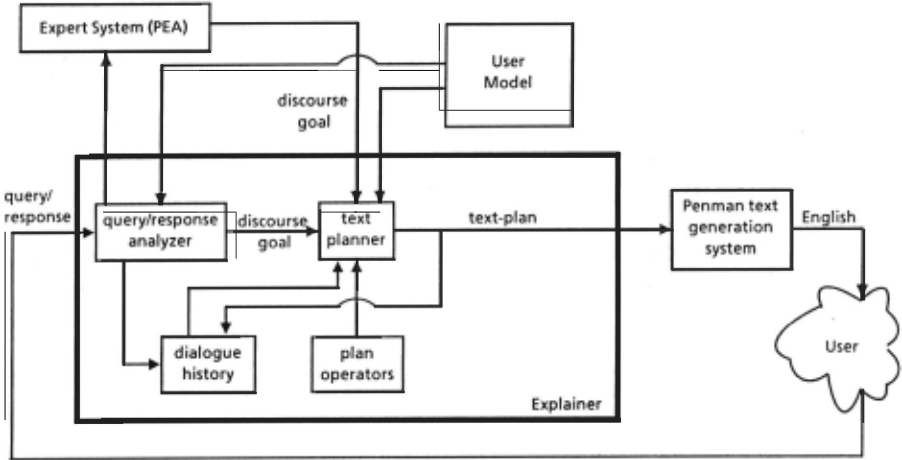
An overview of the explanation generation facility (and its relation to the PEA expert system) is shown in Figure 1. The text planner is central to the explana tion facility. The planner uses a top-down hierarchical expansion planning mechansism. When a discourse goal is posted, the text planner searches its library of expla nation strategies looking for strategies that can achieve it. A strategy is selected and may in turn post sub goals for the planner to refine. Planning continues in this fashion until the entire plan is refined into primitive operators, i.e., speech acts such as INFORM, RECOMMEND. As the system plans explanations, it keeps track of any assumptions it makes about what the user knows as well as alternative strategies that could have been used to achieve the discourse goals. The result is a text plan for achieving the original discourse goal. This text plan is recorded in the dialogue history and passed to the Penman text generation system [Mann and Matthiessen, 1983] for translation into English.
A discourse goal may be posted as a result of reasoning in the expert system or as a result of a query from the user. User queries must first be interpreted by the query analyzer. Even though we assume the user poses queries in a stylized notation, 2 ambiguities may still arise. An example of an ambiguous follow-up question and the pro cess we use to disambiguate it appears in Section 4.1.
Input to the query analyzer may be a follow-up ques tion (e.g. "Why?", "What is a generalized-variable?"), an indication that the user does not understand the system's response ("Huh?"), or an indication that the user understands and has no follow-up question ("Go Ahead"). The query analyzer interprets this feedback and either returns control to the expert system, or for mulates the appropriate discourse goal and passes it to the text planner to produce a response.
If the user asks a follow-up question or indicates that he does not understand the explanation, the system ex amines the dialogue history. The information contained there concerning the goal structure of the explanation, assumptions made during its generation, and alterna tive strategies, is necessary in disambiguating follow-up questions, selecting perspective when describing or comparing objects, and clarifying misunderstandings.
1 PEA recommends transformations that improve the "style" of the user's code. It does not attempt to understand the content of the user's program.
2 To avoid the myriad problems of parsing English-input, we require that the user's questions be posed in a stylized language. We have also provided a "mouse" interface that allows a user to point to parts of the system's explanations that he doesn't understand or has questions about.
4 Examples
Consider the sample dialogue with our system shown in Figure ·2. While enhancing maintainability, the sys tem recommends that the user perform an act, namely replace setq with setf . 3 The user, not immediately convinced that this replacement should be done, asks "why?". The query analyzer interprets this question and posts the goal: (PERSUADE S H (GOAL H Eventually(DONE H replace-1))) where S is the speaker, His the hearer, and replace-1 is the act of replacing setq with setf . This is a goal to persuade the user to perform replace-1. Dis course goals are represented in terms of the effects that the speaker intends his utterance to have on the hearer. 4
When a discourse goal is posted, the text planner searches for operators capable of satisfying it, i.e., all operators whose Effect matches the goal. Each plan op erator also contains a Constraint list, which limits the applicability of the operator; a Nucleus, which is a dis course goal for the main topic to be expressed; and op tionally, a list of Satellites which are discourse goals that express additional information needed to achieve the Ef fect of the operator.
One of the plan operators that matches the current goal is shown in Figure 3. 5 Informally, this plan operator states that if an act is a step in achieving some domain goal(s) that the hearer shares, then one way to persuade the hearer to do the act is to motivate the act in terms of those goals. More formally, this opera tor's constraints require that there be a ?domain-goal such that: ?domain-goal is a goal of the expert sys tem, replace-1 is a step in achieving ?domain-goal, and the speaker and hearer mutually believe that ?domain goal is a goal of the hearer. In order to bind ?domain goal, the text planner examines the expert system's goal structure. The system assumes that the user shares its top-level goal, enhance-program, since he is using the system to perform that task. Furthermore, since the system asks what characteristics the user would like to enhance, the system can assume that the user shares the goal of enhancing those characteristics; in this case, enhance-maintainability. The information that the user shares these two domain goals is included in the user model . In order to avoid explaining parts of the reason ing chain that the user is familiar with, the more specific goal is chosen. In this example, once the constraints have been satisfied, the only possible binding for the variable ?domain-goal is enhance-maintainability.
3ln many instances PEA is capable of performing the transformation. In such cases, while the actual replacement is done by the system, the user's approval is required.
4 Following Hovy [Hovy, 1988], we use the terminology for expressing beliefs developed by Cohen and Levesque in their theory of rational interaction [Cohen and Levesque, 1985]. Space limitations prohibit an exposition of their terminology in this paper. We provide English paraphrases where neces sary for clarity.
5 (BMB S H x) should be read as "S believes that S and
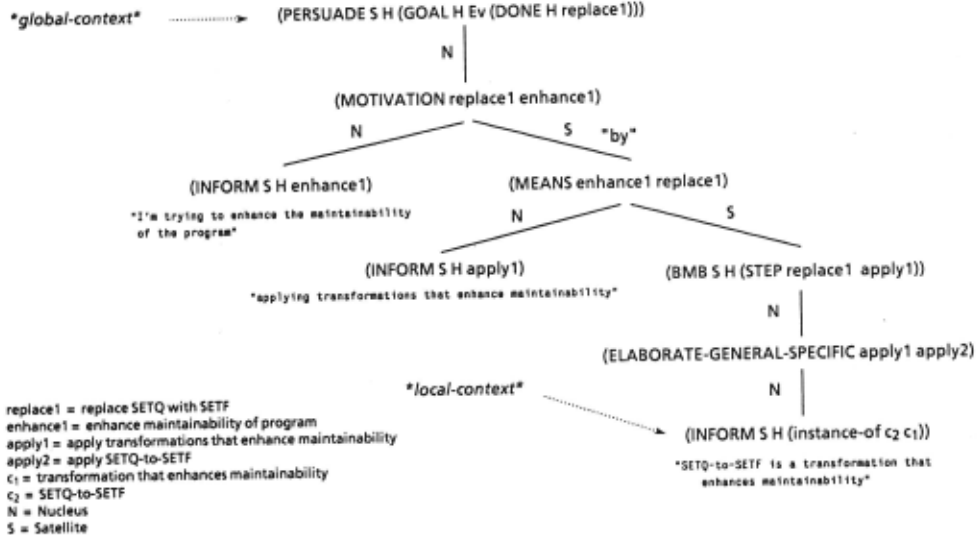
Once a plan operator has been selected, the planner instantiates it by posting its Nucleus and required Satel lites as subgoals to be refined. In this case, since there is only one binding for ?domain-goal, the single sub goal (MOTIVATION replace-1 enhance-maintainability) is posted. One strategy for satisfying this goal, shown in Figure 4, is to inform the hearer of the goal the system
H mutually believe x." Our plan language makes use of Rhetorical Structure Theory [Mann and Thompson, 1988], a descriptive theory characterizing text structure in terms of the relations (e.g. MEANS, MOTIVATION) that hold between parts of a text. A detailed description of the plan language is beyond the scope of this paper, see [Moore and Paris, 1989].
| SYSTEM | What characteristics of the program would you like to enhance? | [1] |
| USER | Maintainability. | [2] |
| SYSTEM | You should replace (setq x 1) with (setf x 1). | [3] |
| USER | Why? | [4] |
| SYSTEM | I'm trying to enhance the maintainability of the program by applying transformations that enhance maintainability. Setq-to-setf is a transformation that enhances maintainability. | [5] |
| USER | Why? | [6] |
| SYSTEM | Transformations that enhance maintainability are defined as transformations whose right-hand- side's use is more general than its left-hand-side's use. Setf can be used to assign a value to any generalized-variable. Setq can only be used to assign a value to a simple-variable. | [7] |
| USER | What is a generalized-variable? | [8] |
| SYSTEM | Simple-variables are storage locations named by symbols. This concept can be generalized to a storage location that can be named by any accessor function. These storage locations are called generalized-variables. | [9] |
| USER | Huh? | [10] |
| SYSTEM | For example, the car and cdr of a cons are generalized-variables, named by the accessor functions car and cdr. Other examples are an element of an array or a component of a structure. | [11] |
EFFECT: (PERSUADES H (GOAL H Ev(DONE H ?act))) CONSTRAINTS: (AND (GOAL S ?domain-goal) (STEP ?act ?domain-goal) (BMB S H (GOAL H ?domain-goal))) NUCLEUS: (FORALL ?domain-goal (MOTIVATION ?act ?domain-goal))EFFECT: (MOTIVATION ?act ?domain-goal) CONSTRAINTS: (AND (GOAL S ?domain-goal) (STEP ?act ?domain-goal)) NUCLEUS: (INFORM S H ?domain-goal) SATELLITES: (((MEANS ?domain-goal ?act)))is trying to achieve (the Nucleus) and then to establish that the act in question is part of the means for achiev ing the goal (the Satellite). These subgoals are eventu ally refined to speech acts. The final text plan, shown in Figure 5, is added to the dialogue history and passed to the generator which produces response (5) in the sample dialogue.
5 Disambiguating Follow-up Questions
After this response is presented, the user asks "why?" a second time. At this point, there are several possible interpretations of this question, including:
- 11: Why are you trying to enhance the maintainability of the program?
- 12: Why are you trying to enhance the maintainability of the program by applying transformations that enhance maintainability? (as opposed to enhancing the program via some other method)
- 13: Why are you applying transformations that enhance maintainability?
14: Why is setq-to-setf a transformation that en hances maintainability?
Recall that in cases such as this, MYCIN always as sumes that "why" is asking why the system is trying to achieve the higher-level domain goal, corresponding to interpretation 11. This interpretation is often inap propriate. Users are frequently asking for justification of factual statements made in the explanation, correspond ing to 14. Even if MYCIN could recognize the multiple interpretations, it could not decide among them because it does not maintain a dialogue history and does not understand the responses it generates.
Resolving ambiguity requires: 1) identifying candidate interpretations, and 2) choosing among them. While these tasks are conceptually distinct, our system inter leaves them to increase efficiency. It generates the most likely interpretations first, and then uses heuristics to rule them out. If an interpretation cannot be ruled out, it is chosen as the interpretation of the user's question and a response is generated. If the interpretation is in correct, the user can still recover by asking a follow-up question.
Our system uses the following heuristics to identify and choose among multiple interpretations:
HI: Follow immediate focus rules (continuing on the same topic is preferred over returning to a previously men tioned topic, [Sidner, 1979, McKeown, 1982] .)
H2: Don't tell the user things he already knows.
H3: Don't tell the user things you've already said.
We have found that focus of attention (Hl) is a pow erful heuristic for ordering the generation of likely in terpretations. In the current example, the most re cent focus of attention (indicated by the *local-context*) is the statement Setq-to-setf is a transformation that enhances maintainability. The system thus infers that the question concerns the rationale behind this statement (I4), unless H2 or H3 rules that inter pretation out. For example, that interpretation could be ruled out by H2 if the user model indicated that the user knew why setq-to-setf enhances maintainability. In our example, nothing rules out 14, so the system ex plains why setq-to-setf enhances maintainability.
If the first interpretation is ruled out, the system uses the next most recent focus of attention 6 to form the next possible interpretation. In this example, that focus refers to the method the system is applying to achieve a goal (i.e., applying transformations that enhance maintainability). This leads to interpretation 13. This interpretation will be ruled out by H3 because from the semantics of the rhetorical relation MEANS, we deter mine that we have just told the user that the system is using the method of applying transformations that enhance maintainability in order to achieve the goal enhance maintainability.
6 The text plan records the order in which topics appear in the explanation. This information is used to derive foci of attention in order. In choosing interpretations of "Why?", the system skips over certain rhetorical relations in the text plan that are considered to be purely presentational in na ture, e.g., ELABORATE, BACKGROUND.
The next most recent focus refers to ·the means by which the enhancement is being achieved (i.e., by applying transformations that enhance maintain ability). This leads to interpretation I2. If that inter pretation were also ruled out, the system would continue in this fashion until it found an acceptable interpretation or reached the global context, which, in this case, is the top node in the text plan.
It is interesting to note that the focus of the user's question is derived from the system's statement, not the user's. The user simply types "why?" in his first two queries in the dialogue; context comes from the response generated by the system. Until now, much work has con centrated on building discourse models that keep track of the user's goals and plans - both domain goals [Car berry, 1983, McKeown et a/., 1985] and discourse goals [Litman, 1985] . Little work has been done on keeping track of the system's discourse goals and the plans it uses to achieve them. 7 As our example illustrates, conversa tional context must include the system's statements.
7 Recent work by Grosz and Sidner addresses this issue for the purposes of analyzing dialogues [Grosz and Sidner, 1986].
EFFECT: (BMB S H (KNOW H ?concept)) CONSTRAINTS: (AND (SUBCLASS ?sub-concept ?concept) (BMB S H (KNOW H ?sub-concept)) (IMMEDIATE-SUBCLASS ?concept ?super-concept)) NUCLEUS: ((SETQ ?diffs (ESSENTIAL-DIFFERENCES ?sub-concept ?concept)) (BMB S H (DETAILS-OF ?subconcept ?super-concept ?diffs))) SATELLITES: (((ABSTRACTION ?sub-concept ?concept ?super-concept ?diffs)))
Figure 6: Plan Operator for Describing an Object by Abstraction
6 Answering a Vaguely Articulated Follow-Up Question
The user then asks the question, "What is a generalized-variable?". The query analyzer interprets the question and posts the discourse goal (BMB s H (KNOW H generalized-variable)), i.e., the speaker wishes to achieve the state where the speaker and hearer mutually believe that the hearer knows the concept generalized-variable.
The system has several plan operators for achieving such a goal. It may deicribe a concept by describing its attributes and its parts, by drawing an analogy with a similar concept, by giving examples of the concept, or by generalizing a concept the user is familiar with. The plan operator for the latter is shown in Figure 6.
To choose from among these candidate plan operators, the planner has several selection heuristics, including:
- SHI: Prefer operators that require making no assump tions about the hearer's beliefs.
- SH2: Prefer operators that make use of a concept the hearer knows.
- SH3: Prefer operators that make use of a concept men tioned in the dialogue history.
In this case, the user model indicates that the hearer knows the concept simple-variable. Hence the oper ator in Figure 6 requires making no assumptions about the hearer's knowledge, makes use of a concept the user knows, and uses a concept previously mentioned in the dialogue. Thus it is ranked highest by the plan selection heuristics. The final text plan for this example first de scribes simple-variables and then abstracts this con cept to introduce generalized-variables . This pro duces the response shown in the sample dialogue.
The user then indicates that he does not understand this explanation with the vaguely-articulated follow-up, "Huh?". From our analysis of naturally occurring di alogues, we devised a set of recovery heuristics for re sponding to such a question. These include:
- RHI: If the discourse goal is to describe a concept, give example(s).
- RH2: If the discourse goal is to describe a concept , and there is an analogous entity that the hearer knows, draw an analogy to the familiar concept.
- RH3: Expand any unexpanded optional satellites in pre vious plan operators. 8
- RH4: If another plan exists for achieving the discourse goal, try it.
8 Plan operators may contain optional satellites which the system may decide to leave unexpanded during planning.
RHl and RH2 apply in the context of a particular dis course goal, namely describing a concept, while the other heuristics are more general. The system tries to apply its most specific knowledge first. In this case, RHl applies and the explainer recovers by giving examples.
As illustrated in Figure 6, constraints on plan op erators often refer to the state of the hearer's knowl edge. The user model includes the domain concepts and problem-solving knowledge, i.e., domain goals and plans, assumed to be known to the current user. However, the system does not require that this model is be either com plete or correct . Therefore, the user model may contain concepts the user does not actually know or omit con cepts the user does know. To satisfy a constraint on an operator, the system may assume that a concept is known to the user even if it is not indicated in the user model. As described above, when such an assumption is made, the selection heuristics give the operator a lower rating. If the operator is selected, the fact that an as sumption was made is recorded in the plan structure. The system must keep track of such assumptions be cause these are likely candidates if a misunderstanding occurs later. This leads to another recovery heuristic:
RHS: If any assumptions were made in planning the last explanation, plan responses to make these assump tions true.
For example, in producing response (7) in Figure 2 the system assumed (erroneously) that the user knew what generalized-variables were and simply used it without defining it . In (8), the user asked explicitly for a defini tion. If he had just typed "Huh?" instead, the system would have examined it:> assumptions and used RH5 to plan a response defining generalized variables.
7 Current Status and Conclusions
The expert system and explanation facility described are implemented. There are approximately 75 plan opera tors, 5 plan selection heuristics, and 5 recovery heuris tics. The system can produce the text plans necessary to participate in the dialogue shown and several others that are similar.
In summary, current expert systems fail to support explanation as a dialogue. Their unnatural, one-shot approach to explanation depends critically on the qual ity of the user model and is seriously degraded if that model is incomplete or incorrect. Because they fail to support dialogue, these systems cannot clarify misunder stood explanations, elaborate on previous explanations, or respond to follow-up questions in the context of the on-going dialogue.
As an alternative, we proposed a reactive model of explanation - in which the system can employ feedback from the user and participate in a dialogue. Our ex planation generation facility plans explanations from a rich set of strategies, keeping track of the system's dis course goals, the plans used to achieve them, and any assumptions made while planning a response. Our sys tem maintains a recorded history of the text plans used in producing responses so that it can later reason about its own responses when feedback from the listener in dicates that an explanation was not understood. Our system can employ information in a user model when it is available, but is not critically dependent on that information.
Acknowledgements
The authors would like to thank Cecile Paris for collab oration on the plan language and Margot Flowers, Neil Goldman and Jasmina Pavlin for comments on earlier versions of this paper.
@inproceedings{ijcai1989p240,
  title     = {A Reactive Approach to Explanation},
  author    = {Moore, Johanna D. and Swartout, William R.},
  booktitle = {Proceedings of the Eleventh International Joint Conference on
               Artificial Intelligence, {IJCAI-89}},
  publisher = {International Joint Conferences on Artificial Intelligence},
  editor    = {N. S. Sridharan},
  pages     = {1504--1509},
  year      = {1989},
  month     = {8},
  note      = {Speech and Natural Language},
  url       = {https://ijcai.org/proceedings/1989/240},
}
TY - CPAPER TI - A Reactive Approach to Explanation AU - Moore, Johanna D. AU - Swartout, William R. T2 - Proceedings of the Eleventh International Joint Conference on Artificial Intelligence, IJCAI-89 PB - International Joint Conferences on Artificial Intelligence PY - 1989 SP - 1504 EP - 1509 UR - https://ijcai.org/proceedings/1989/240 ER -Copied
Machine-readable versions of this paper, for tools and AI agents:





