
Tailoring Explanations for the User
Proceedings of the Ninth International Joint Conference on Artificial Intelligence. Natural Language. Pages 794-797.
© 1985 International Joint Conferences on Artificial Intelligence
Abstract
In order for an . expert system to provide the most effect1ve explanat10ns, 1t sliould be al:ile to tailor 1ts responses to the concerns of the user. One way in wh1ch explanatJons may be ta!lored Js by point of v1ew . A method JS presented for representing the knowledg.e to support different points oT view in the current domain . In addition, we present a method for determmmg the pomt of v1ew to take by mferring the user's goal withm a brief discourse segment. The advising system 's response to the derived goal depends on the strength of its . belief in the inference for which a method of determmat10n Js also prov1ded This information enables the system to dec1de what answer to give to a q_uestion, which kind of justification is rele vant , and when to provide it . Some details of the current implementation are included.
Full text extracted automatically from the PDF; figures, tables and equations may differ. The PDF is the version of record.
1 Introduetion
While research on explanation for expert systems has addressed some important issues in identifying the kind of knowledge needed to provide acceptable explanat10ns (e .g., Swartout 81 ; Clancey ·79) one main problern witli existing systems is their 1nability to tailor an explanation adequately to the needs or perspective of a particular user. In this paper, we show how mformat10n about the current user can and should influence the type of explanation provided.
In past artificial intelligence research, there have been two main approaches to user modelling: classifying users accordmg_ to a priori types often oy direct interrogation (e.g., Rich 79 Swartout 81 Walhs 82) or deriving information ·about the current state of the user's goals, beliefs and desires from the ongoing discourse itself ( e g., Ä1len and Perrault 80; Carberry 83). Our work draws from the second of these two main approaches; . but while previous research has emphasized the denvat10n of a user's goal in order to mterpret an utterance correctly, we are interested in makmg use of denved goals to generate appropriate explanatJOns. This difference m emphasis has required the . development of techniques for handling. four speclfic tasli:s: representmg different pomts of v1ew m a knowledge ~ase to support different explanations, identifymg whtch of several possible goals underlying the current discourse should oe addressed, determining when the derived goal should be taken into account and specifying how a generation system can relate the denved goal to different pomts of View to determine explanation content. This extends Allen and Perrault 's (80) approach by showing how a goal can be derived to represent a sequence of utterances as opposed to a smgle utterance, and goes beyond Carberry's (83) approach by showing how a system can decide to respond to such goals.
1 The work described in this paper was partially supported by ONR grant N00014-82-K-0255 and by AT&T Bell Laboratories.
MA TT@COLUMBIA-20
This work is being clone within the context of an ongoing project to develop a dialogue facility for computer-a1ded . problern solving. A student advising system iS bemg developed wh1ch can provide information about courses and advice about whether a student . can or should take a particular course. The system JS currently structured as a question-answering system which invokes an underlying expert system on receiving "can" questions (e .g., "Can 1 take natural languag.e this semester?") and "should" questions (e.g. "Sliould I take data structures?"). This production system uses its rule base to determine the advice provided (i .. e., yes or no) and the trace of rule mvocat10ns iS used to provide a supportmg explanation of the adv1ce.
The Advisor sy~em consists of an ATN parser (Woods 70), a KL-ONE knowledge base (Brachman 79) w1th access functwns, a goal mferencer, an underlying productwn system, and a surface generator to produce responses and exflanations in natural language (Derr and McKeown 84 . Currently the system can produce responses to information questions by accessmg the knowledge base and to "can" questions by invoking the underlymg productwn system. Certain asJ>ects of response generation and mferencing for should" questions have been implemented.
In the following sections, we first different types of explanations required descnbe m some detail the techniques developed. show the and then we have
2 Difrerent Explanations
In this paper, we focus on how the content of an explanatwn must vary accordmg to the perspective or pomt . of View taken . on the underlying problern domam. For example,., m the student advisor domain there are a number 01 points of view the student can adopt for selecting courses. It can be viewed among others, as a process of meeting requirements (i e) "how do courses he in with re9.uirement sequencing?" as a state model process (i .e., 'what should be completed at each state in the process ?"), as a semester scheduling r,rocess (1.e ., "how can courses fit into schedule slots? '), or as a process of maximizing personal interests ~ as in "how will courses he/p me learn more about Al?'). Given these different pomts of View alternative explanations of the same piece of advice (i e yes) can be generated in response to the question "Should I take both discrete math and data structures this semester?"·
- Requirements: Yes, data structures is a requirement for all later Computer Science courses and discrete math is a Co
- requisite for data structures. 2. State Model: Yes, you usually take them both first semester, sophomore year .
- Semester Seheduling: Yes, they're offered next semester, but not in the spring
and you need to get them out of the way as soon as possible.
4. Personal Ioterests (e.g., Al:) Yes, if you take data structures this semester you can take Introducbon to AI next sem'ester and you must take discrete math at th~ same time as data structures.
One of these explanations may be more appropnate than others depending upon the user's goal 10 pursmng the d!alogue. For examrle we IDlght supply expfanation (1) above if the user s goal were to complete reqmrements as soon as possible and explanatwn (2) 1f the user's goal were to keep apace w1th the normal rate of progress. Thus to adcfress the problern . of selectmg a _perspectlve to use in an explanatwli, we must develop techniques that allow a system to mfer a. user g_oal from .a aiscourse segment as weil as techmques that can md1cate mformation that 1s relevant for any given perspective.
3 Knowledge Representatlon
In order to identify information that is relevant to a user's goal, we are using intersecting multiple h1erarch1es to re_present different points of v1ew in the underlymg kno~Iedge base. The hierarchies are cross lmked by ent1t1es or . processes (often courses in the student adv1sor domam) wh1ch can be viewed from d1fferent pers~ect1ves ( and thus occur in more than one h1erarchy . Hence to construct the content for explanatwn 1) above the system would extract mformatwn about the relation between data structures and dlscrete math from the requirements h1erarchy, and for explanatwn (2) extracts information from tlie state model. h1erarcliy. A . diagram of a port1on of these two hierarch1es contammg mformation for the two points of view is shown in Figure 1 below.
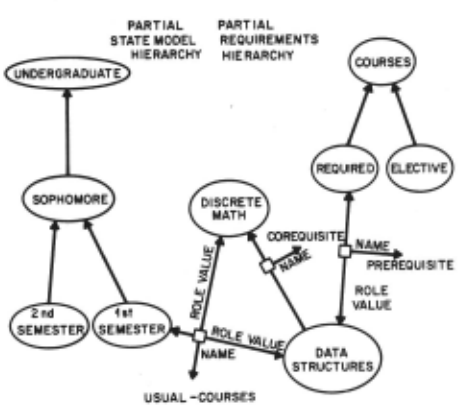
The partitiomng of the knowledge base by intersecting hierarchies allows the generatlon system to distinguish between different types of mformatwn that support the same fact . From th1s partltlomng the system can select the portion that contains' the information relevant to the current request and user goal.
4 Derlvlng the User Goal
The system must also be able to reason about the appropriateness of one perspective versus others. Since the perspective taken is related to the user's goal in pursuing the dialogue, the !arge body of work on goal inference techniques (Allen and Perrault 80; Caroerry 83; L1t,man and Allen 84) 1s apphcable for denvmg the user s ~oal. We have drawn heavily from Allen and . Perrault s (80) work, making use of their plausible mference rules, representation of domain p_l_ans, and representation of speech acts as plans. Whlle the1r work has been extremely useful it falls short for our purposes in several ways. For 'example, the1r mferencmg procedure denves a plausible goal for a user based on a single utterance, while we are interested in derivin~ a goal based on the current sequence of utterances .
Consider the discourse shown m (6) below. Assuming that a database of domain plans common to the stuqent advising domain is maintained, Allen and Perrault s techmques could be used to derive the domain goal shown following each question. But the explanatwn shown in (6c) addresses not the derived goal . of (6c), nor any of the derived goals of the prevwus utterances~ but mstead addresses the higher Ievel g_oal indicatea by the derived goals of (6a) and (6b ). The problern for res_ponding to such goa1s in an explanation, then, is to be able to derive a higher Ievel goal relating the goals of individual utterances.
- S: I've read about the field of AI and I'm interested in learning more about it eventually. Is natural language offered next semester?
- Plausible goar = take natural language A: Yes.
- S: Who is teaching artificial intelligence? Plausible goal = take Al
A: Lebewitz this semester.
- S: I haven't taken data structures yet . Should I take it this semester? Plausible goal = take data structures
- A: Yes, if you take data structures this semester you can take AI next semester which is necessary for all later AI courses.
We use Allen and Perrault's rules to derive the domain goal of each individual utterance which we term the current goal. We also identlfy a goal representmg the d1scourse sequence which we term the relevant goal since it will be used to generate later explanations. Intuitively, the relevant goaJ is a high er Ievel goal, if there is one, relating the goals of several utterances.
2 In this work, we restriet ourselves to a discourse segment that deals with a s!ngle or rel~ted set of goals. Over a Ionger sequence of d1scourse, top1cs may sh1ft and the user may reveal very different goals ac.ross suc.h bo!Jndaries. Detecting topic shifts and radical changes m goals 1s a d1fficult problern that we are not addressing.
The process of determining the relevant goal involves the following steps. The current goal is flrst derived from the initial utterance. All higher Ievel domain goals are then derived from the current goal using Allen and Perrault's body-action inference rule (i ed if the user wants a step in the body of a plan to hol ) It IS plausible that s/he wants the action to hold . Any one of these is a candidate for the relevant plan. A derivation of the higher Ievel plans for the utterance "Is natural lap.guage offered next semester?" is shown in Figure 2. Note that the action take natural language is a step in two separate plans, concentrate-on-ai and fultill electives, and thus two parent paths are formed.
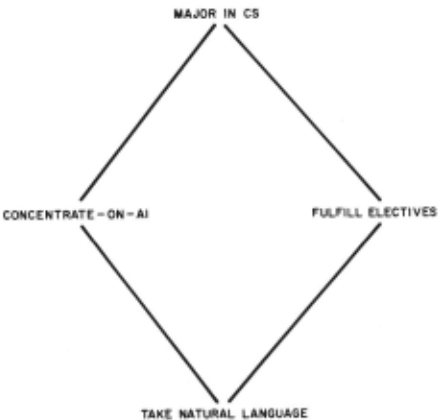
"Is natural language offered next semester?"
Figure 2: Current and Higher Level Goals for Utterance 1
When the second utterance "Who is teaching artificial intelligence?" is entered the current goal take ai is denved and all higher Ievel goals denved (see F1gure 3) from that using the body-action rule. The lowest Ievel node where the two paths intersect becomes the relevant plan ( concentrate-on-ai in this case). If the second utterance had been "When is operating systems offered?," the higher Ievel goal fultill electtves would have been inferred since th1s is the only relation between the goals take operating systems and take natural language.
This method is essentially a search for the lowest common ancestor of the current goals of two
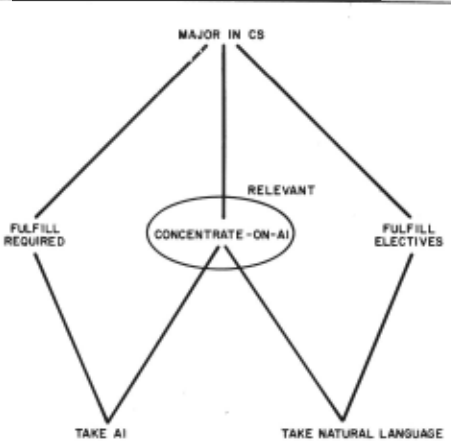
1: "Is natural language offered next semester?" current goal = take natural lan~age 2: "Who is teaching artificial intelligence?" current goal = take ai relevant goal = concentrate-on-ai
Figure 3: Relevant Goal for Utterances 1 and 2
consecutive utterances. When the third, or any subsequent utterances are encountered 1 the relevant goal IS determmed by performmg tne search for common ancestor using the previous relevant goal and the current goal of the new utterance.
Carberry (83) does present a method for tracking user goals over a sequence of discourse, building in the process a hierarchical model of user plans for the i:iiscourse. She uses this hierarchy and a set of focus heuristics to determine for the next incoming utterance which of several plausible plans the user could be focusing on. She i:ioes not specify which plan in the hierarchy best represents the overall discourse purpose and therefore sllould be addressed in succeei:iing explanations. Our model thus augments hers by providing this information.
6 When to Respond
The goal inference techniques just described allow the system to infer what a user's goal might be, but this mference may be so tentative that explanations which always address such goals will be as undesirable as those tliat never take a goal into account . Allen and Perrault themselves term their rules plausible inference rules since the goals they attribute to the user are only possibilities and not definite . However, goals derived from some discourse sequences seem mtuitively more definite than those derived from other sequences.
If the user directly asserts his/her go~l ( as in 7)
then it can be definitely . inferred. The plausible inference rules however, will mfer the same goal for an utterance like that shown in (8) . Unless we have further indication that the user actually has the goal take natural lan~uage, then on receiving a follow-up question such as a , a neutral explanat10n as. shown in (9b) is preferab e ~o the ta1lored explanat10n m (9c). One problern for a system that _generates ta1lored explanations then is bemg able to determme when to respond to a derived goal.
- S: I'm planning on taking nlp in the future . What are the prerequisites? plausible goal = take natural language
- S: Is natural language affered this semester? Ptausible goal = take natural language
- S I'm thinking of taking computability this semester. Would that be a good idea? plausible goal = take computability
- A: Yes, it's your last requirement and it's a good idea to get it out of the way before gomg on to electives.
- A: Yes, computability is particularly important for nlp since it covers grammars so 1t's a good idea to take it first .
To handle this problern we use three levels . of likelihood of derived user goals. If we can ~~~tmgmsh between derived user goals that can defamtely be attributed to the user, denved goals th!J.t are lakely, and derived goals that. are only plaustble, then we have a basis for determmmg when to generate ta1lored explanations. Tailored explanations can be generated for definite and likely goals and a neutral explanat10n generated for plausible goals.
A goal is de[,inite if a user states that s/he has that goal as in ' I want to concentrate in Al", "I' d like to concentrate in AI.", or "l'm interested m taking as much AI as possible. " . If not stated, it IS difficult to infer without doubt that a user has a g1ven goal but there are cases where it is more likely than othe'rs. Space prohibits _providing details, but we note that a goal is more likely if it has been repeatedly derived from consecutive utterances as weil as m cases where it is one st~ in a plan that the user has partially completed. The system 1s currently capable of aeriving current and relevant goals for a discourse se_gment and classifying them as plausible or de(imte. crassification of goals as likely has been designea, but must still be implemented.
We have ignored, in this paper, the possibility of responding in other ways than prov1dmg explanat10ns. In some cases in fact, it may be preferable for the system to ask' the user to clarify liis/her goal or to take the imt1ative in some other way. Determining when and how to take the mitiative as an alternative to providing explanations 1s a topic addressed elsewbere (see Matthews 85).
6 How to Respond
Finally, the system must be able to make use of the derived goal in constructing an explanation when a "should" question follows a d1alogue sequence. The underlying mini production system, consisting of working .memory, rule base, and inference engine, is mvoked m th1s process.
To construct the explanation, the hierarchy representing . the proper perspective is determinea directly from the relevant goal, an& information retrieved about the questJoned object from that hierarchy 1s placed m working memory. The production system uses th1s mformation to derive the response, that Is whether the user should or should not pursue the queried action. The trace of the reasoning IS then ava1lable to provide the basis for the explanation, as IS the case in traditional expert systems. Note that the information extracted from one liierarchy will allow a different set of rules to fire than will information extracted from another, thus producing different explanation content.
As an example, consider again the question "Should I take both data structures and discrete this semester?" . Assurne that the system has determined that the user's goal is take requlred and that the goal should be taken into account in the explanation. After deducing that the student can take these courses 4 , the production system will attempt to prove that the quened action helps the user ach1eve h1sjher goals. Tlie information shown in Figure 4, extracted from the requirements hierarchy (refer back to Figure 1), enables rules 1 and 2 to hre with rx instantiated as data struetures, !y as dlserete math, and !eourse as requlred. The extracted fact that diserete math is a co-requisite for data struetures enables rule 2 to fire . Its consequence and the extracted fact that data struetures is a prerequisite to required enables rule 1 to fire, which concludes that required can be taken. Thus, the advice is yes since take requlred is the user's goal and these two instantiated rules can then be used as the basis for the hypothetical explanation given earlier and reproduced in Figure 4. Other rules m the rule base (such as "A course should be taken if the student is at the right year to take it") do not fire since informat10n necessary to fire that rule does not exist in working memory. This processing is partially implemented, but much work is needed before the full explanation can be produced.
3 Th~ questioned object is the course the user is inquirin~ about (e.g., data struetures in "Should I take data structures!' ).
4 Regardless of whether the user's queried action helps hirn/her achieve the relevant ~oal, if it is not permissible or will prevent the student from completmg the major, the adv.ice is always negative. Rules encoding such absolute constraints include "a course cannot be taken before its prerequisite", or "a course should not be taken if it prevents the student from completing requirements by the time s/he 1s a senior". Here, we assume, for convenience, that the student has already taken the prerequisites to data structures and discrete math and is early enough in his/her program that s/he will be able to finish on time, and thus the absolute rules are sat1sfied.
Information Extracted:
(prerequi·ite required data-·tructure·)
(co-requilite data-·tructure· di·crete-aath)
Rule 1:
(tatea !x) aad (~rerequilite !cour·e !x) --> (caa-tate !cour·e)
Rule 2:
(co-requi·ite !x !J)
aad (tatiDI !J) --> (caa-tate !x)
Yes, data structures is a requirement for all later Computer Science courses and discrete math is a co requisite for data structures.
Figure 4: Constructing Explanation Content
7 Future Direetions
More research is needed on explanation, plan recognitiont and user modelling for our approach to be effective or a broad range of human-computer dialogue . As for exP.lanatwn, in the current implementation the proauction system needs to be developed further and its reasoning trace interfaced to the oparational surface generator for English output . On the theoretical side, we are investigating the use of discourse strategies to control the organization of the explanation. The plans in the current implementation were selected by examining transcripts of actual student advising sessions, but it would be desirable to have a much !arger set of plans knowledge about their base rates anil importance, and additional criteria for tracking their relevance and likelihood during the interaction. It seems likely, also, that oetter explanations will require a more complete user model incorporating static, global characteristics of the user as weil as those dynamic, local characteristics available from the ongoing dialogue itself. Additionally, while we have touched on one way of representing ana using point of view, others will doubtless be necessary. Such a comprehensive attack on the topics of explanation, plan recognition, and user modeHing offers promise from both a theoretical and practical perspective.
8 Coneluslon
We have demonstrated the need for tailoring explanations to users in consultative or problern solving dialogues with a computer, and have addressed this problern with a new approach integrating research in plan recognition, user modelling, and explanation generation. Derivation of goals 1 , or plansi is based on an extension of Perrault and rulen's (80 work which handles discourse se_gments rather t an isolated utterances. Our model and implementation provide mechanisms for assessing which goal is relevant to the user at any moment during_ the discourse, as weil as when that point of view should be addressed in an explanation. It also makes _progress toward the determination of how to tailor tlie explanation to the user's goal. In addition to enhancing previous work on goal inferencing, this report shows now research in natural language processing on goal derivation can be applied to generate explanations sensitive to the user's current perspective in expert system interactions.
Aeknowledgments
We would like to thank Michael Lebowitz for his suggestions on an earlier draft of this paper
Referenees
- (Allen and Perrault 80) Allen, l F . and C R Perrault, "Analyzing intention m utterances," Artificial Intelligence 15, 3, 1980.
- (Brachman 79). Brachman, R , "On the epistemological status of semantic networks." in N. Findler (ed .) Associative Networks: Representation and Use of Knowledge by Computer, Academic Press, N. Y., 1979.
- (Carberry 83) Carberry, S., Tracking user goals in an information-seeking environment, in Proceedings of the National Conference on Artificial Intelligence , Washington D.C., August 1983, pp. 59-63.
- (Clancey 79) Clancey, W J, Tutoring rules for guiding a case method dialogue, International Journal of Man-Machine Studies 11, 1979, pp. 25-49.
- (Derr and McKeown 84) Derr, MA and KR McKeown, Using focus to generate complex and simple sentences, Proceedings of COLING-8J: Tenth International Oonference on Computational Linguistics, Stanford, July 1984, pp. 319-26.
- (Litman and Allen 84) Litman, D l , and lF. Allen, A plan recognition model for clarification subdialogues, Proceedings of COLING-84: Tenth International Conference on Computational Linguistics, Stanford, July 1984, pp. 302-11 .
- (Matthews 85) Matthews, K, Initiatory and reactive system roles in human computer discourse, unpublished manuscript, AT&T Bell Laboratories, 1985.
- (Rich 79) Rich, EA, User modelling via stereotypes, Cognitive Science, Vol. 3, 1979, pp. 329-54.
- (Swartout 81) Swartout, W.R. , Producing explanations and justifications of expert consulting programs, Technical Report MIT/LCS/TR-251, MIT, Cambridge, Mass., January 1981.
- (Wallis 82) Wallis, JW. and EH. Shortliffe, Explanatory power for medical expert systems· studies in the representation of causal replationships for clinical consultation. Technical Report STAN-CS-82-923, Stanford University, 1982.
- (Woods 70). Woods, W. A., "Transition network grammars for natural language analysis." Communications of the ACM, Vol. 13, No. 10, October, 1970, pp. 591-606.
@inproceedings{ijcai1985p157,
  title     = {Tailoring Explanations for the User},
  author    = {McKeown, Kathleen R. and Wish, Myron and Matthews, Kevin},
  booktitle = {Proceedings of the Ninth International Joint Conference on
               Artificial Intelligence, {IJCAI-85}},
  publisher = {International Joint Conferences on Artificial Intelligence},
  editor    = {Aravind Joshi},
  pages     = {794--797},
  year      = {1985},
  note      = {Natural Language},
  url       = {https://ijcai.org/proceedings/1985/157},
}
TY - CPAPER TI - Tailoring Explanations for the User AU - McKeown, Kathleen R. AU - Wish, Myron AU - Matthews, Kevin T2 - Proceedings of the Ninth International Joint Conference on Artificial Intelligence, IJCAI-85 PB - International Joint Conferences on Artificial Intelligence PY - 1985 SP - 794 EP - 797 UR - https://ijcai.org/proceedings/1985/157 ER -Copied
Machine-readable versions of this paper, for tools and AI agents:





