
Phrasing a Text in Terms the User Can Understand
Proceedings of the Eleventh International Joint Conference on Artificial Intelligence. Speech and Natural Language. Pages 1511-1516.
© 1989 International Joint Conferences on Artificial Intelligence
Abstract
When humans use language, they show an essential, inbuilt responsiveness to their hearers/readers. When language is generated by machine, it is similarly necessary to ensure that that language is appropriate for its intended audience. Much of previous research on text generation and user modelling has focused on building a user model and selecting appropriate information from the knowledge base to present to the user. It is important, however, that the phrasing of a text be also tailored to the hearer - otherwise it may be just as ineffective as texts which wrongly direct attention or which rely on knowledge that the hearer does not have. This research proposes a new mechanism which allows the text planning process to specifically tailor syntactic phrasing to the hearer type . This is done in the context of an expert system explanation facility that needs to produce explanations of the expert system's behavior for a variety of different users - users who differ in goals, expectations, and expertise concerning both the expert system and its domain.
- [Appelt, 1985] Douglas E. Appelt. Planning Natural Language Utterances. Cambridge University Press, Cambridge, England, 1985.
- [Carberry, 1988] Sandra Carberry. Plan recognition and user modelling. Computational Linguistics, 14 (3), September 1988.
- [Grosz and Sidner, 1986] Barbara J . Grosz and Can- dace L. Sidner. Attention, intentions and the struc- ture of discourse. Computational Linguistics Journal, 12 (3), 1986.
- [Halliday, 1978] Michael A. K. Halliday. Language as social semiotic. Edward Arnold, London, 1978.
- [Halliday, 1985] Michael A. K. Halliday. An introduc- tion to functional grammar. Edward Arnold, London, England, 1985.
- [Hovy, 1988] Eduard H. Hovy. Generating natural lan- guage under pragmatic constraints. Lawrence Erl- baum, Hillsdale, New Jersey, 1988.
- [Jameson, 1987] Anthony Jameson. How to appear to be conforming to the 'maxims' even if you prefer to violate them. In G. Kempen, editor, Natural Lan- guage Generation: Recent Advances in Artificial In- telligence, Psychology, and Linguistics. Kluwer Aca- demic Publishers, Boston/Dordrecht, 1987.
- [Kasper, 1989] Robert Kasper. SPL: A sentence plan language for text generation. Technical report, USC/lSI, 1989.
- [Mann and Matthiessen, 1983] William C. Mann and Christian Matthiessen. Nigel: A systemic grammar tor text generation. Technical Report ISI/RR-85-105, USC/lSI, February 1983.
- [McKeown et al., 1985] Kathleen R. McKeown, Michael Wish, and Kevin Matthews. Tailoring explanations for the user. In Proceedings of IJCAI-85, Los Angeles, Ca., 1985. International Joint Conference on Artificial Intelligence. IJCAI
- [McKeown, 1985] Kathleen R McKeown. Te:r:t Gener- ation: Using Discourse Strategies and Focus Con- straints to Generate Natural Language Te:r:t. Cam- bridge University Press, Cambridge, England, 1985.
- [Moore and Swartout, 1989] Johanna D. Moore and William R. Swartout. A reactive approach to expla- nation. In Proceedings of the Eleventh International Joint Conference on Artificial Intelligence, Detroit, MI, August 20-25 1989. IJCAI. IJCAI
- [Morik, 1985] Katharina Morik. User modelling, dialog structure, and dialog strategy in HAM-ANS. In Pro- ceedings of EACL-85, Geneva, Switzerland, 1985. Eu- ropean Asso. ciation of Computational Linguistics. [Paris, 1988]
- Cecile L. Paris. Tailoring object descrip- tions to the user's level of expertise. Computational Linguistics, 14 (3), September 1988.
- [Patten, 1988] Terry Patten. Compiling the interface between text planning and realization, August 1988. Workshop on text planning and Natural Language Generation, Sponsored by AAAI.
- [Swartout and Smoliar, 1987] William R. Swartout and Steve W. Smoliar. Explaining the link between causal reasoning and expert behavior. In Proceedings of the Symposium on Computer Applications in Medical Care , November 1987.
References were extracted automatically from the PDF and may contain errors.
Full text extracted automatically from the PDF; figures, tables and equations may differ. The PDF is the version of record.
1 Tailoring - the importance of making language appropriate for its audience
Humans show an essential, inbuilt responsiveness to their hearers/readers in their use of language. It is simi larly necessary to ensure that the language generated by machine is appropriate for its intended audience. Much text generation research in the past has focused on the selection of text content and orpanization in or der to accomplish speakers' goals (e.g., lMcKeown, 1985, Hovy, 1988]). The presentation of that content is gener ally also made responsive to hearers' states of focus of attention (e.g., [Grosz and Sidner, 1986]). More recently, it has been recognized that it is necessary in addition to make generated text sensitive to the hearers' goals and knowledge about domains, that is to take a user model into consideration (e.g., [McKeown et al., 1985, Appelt, 1985, Jameson, 1987, Ilovy, 1988, Paris, 1988, Carberry, 1988]). These are all important factors if the text generated is to be both informative and understand able to the user.
·The research described in this paper was supported in part by the Defense Advanced Research Projects Agency (DARPA) under a NASA Ames cooperative agreement num ber NCC 2-520, by AFOSR contract F49620-87-C-0005, and by DARPA contract MDA903-87-C-641.
The language used by specific groups of people, how ever, often possesses syntactic patterns and lexical fea tures that are distinctive to those groups; question an swering systems can only be effective, therefore, if they appropriately customize their phrasing as well as their content and textual organization according to each dis tinctive group of users - otherwise generated texts may be just as ineffective as texts which wrongly direct at tention or which rely on knowledge that the hearer does not have. In contrast to most previous research, which has focused on the selection and organization of infor mation from the knowledge base for presentation to the user, this research addresses the issue of expressing the selected information in language specifically tailored to the hearer. 1 This is done in the context of an expert system explanation facility.
2 What is involved in 'tailoring'
In tailoring a response, whether it be to a user's goals for asking a question or to that user's level of exper tise in a domain, a generation system first has to choose which information from the knowledge base at hand is most appropriate and organize its overall text struc ture. The result of this phase is an organized collec tion of the particular propositions to be expressed in English. Most generation systems take these proposi tions as the inputs for the realization components of grammatical and lexical selection (e.g., [McKeown, 1985, Moore and Swartout, 1989]). However, the output of this phase is typically not detailed enough to control the many possibilities for expression that current grammar components provide. There is a large gap between the level of detail of the output of the text planner and the input required by a grammar.
1 This issue was partially addressed in the HAM-ANS sys tem [Morik, 1985], where, based on a user model, the system would decide whether to produce an anaphora. The work presented here is different as we are more concerned about sy.stematic linguistic differences that exist in the language used by various groups of users.
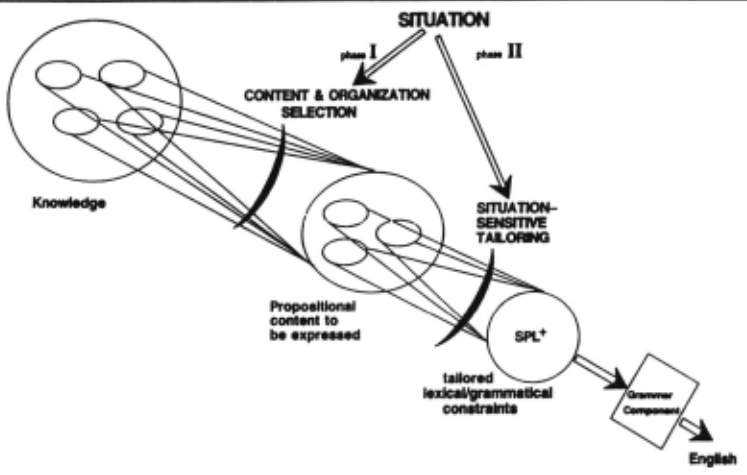
This is problematic for natural text generation for two reasons. First, generated texts could unintentionally be inappropriate in many contexts; second, a text planner's lack of control over the grammar could prevent it from producing the text it intends to generate. Because dif ferent classes of users have different ways of speaking, involving systematic differences in the phrasal and gram matical patterns that they employ, a generator needs to have theoretical control of phrasal organization just as it does of text organization. The generation of natural text requires a second phase of planning that bridges this gap. This paper presents a mechanism that achieves this.
Control of the phrasing task has mostly remained be low the level of detail that the text planning process has under theoretical control. Phrasing involves choos ing appropriate syntactic and lexical structures from all the available possibilities that express the same propo sitional content. The few attempts to gain control of phrasing in accordance with general text planning goals (e.g., [Appelt, 1985, Morik, 1985, Hovy, 1988]) have ei ther been restricted in the areas of phrasing they have examined, or have not maintained sufficient separation between text planning and realization. 2 In our work, we are constructing a general phrasing control component that interfaces between the output of the first phase of planning and the input to the grammar. (This is illus trated in Figure 1.) This component decides both which aspects of the output of phase one are most appropriate for each user type and how they are to be phrased for that user. It is only the result of this second phase of selection/organization that provides sufficient guidance to the grammar and lexical selection components.
2 1t is generally accepted tha.t a. text pla.nner should not ma.inta.in deta.iled knowledge of the gra.mma.tical possibilities offered by the gra.mma.r; to do so complicates the pla.nning process considerably by requiring the text pla.nner to con cern itself with deta.ils from a.n inappropriately low level of abstraction. Similarly, the gra.mma.r should not include deta.il at a.n inappropriately 'high' level of abstraction.
We use the notion of register [Halliday, 1978, Patten, 1988], which specifies the linguistic consequences of us ing language in particular situations. Registers may be seen as describing the 'argots' used by different classes of users. Our approach has been to restrict our atten tion to the particular kinds of language required in our domain. We have worked back from these to construct sets of 'terms' to be employed when generating language . for particular users. This is equivalent to a linguistic de scription of specifically the situation-specific aspects of some instances of language use. We can then define a phrasing algorithm which uses these sets to effectively constrain the second phase of the generation process.
3 The expert system explanation task
3.1 The expert system
The system for which we are generating language is an expert system constructed using the Explainable Expert System (EES) framework [Swartout and Smoliar, 1987]. In this framework, an expert system includes support knowledge for explanation. The support knowledge con tains, for example, terminology definitions, so that a user can ask for the definition of specific terms used by the system and conditions of evaluation for states of affairs within the domain (i.e., whether a particular state is good or bad).
We are using a particular instantiation of this frame work, an expert system designed to diagnose digital cir cuits. This system includes in its domain knowledge a variety of facts concerning objects in the domain of dig-
(define-type-attributes faulty-system :defining-conditions: ((and (E (o in (output-part self)) (not (equal (expected-value (signal-put o)) (actual-value (signal-part o))))) (A (i in (input-part self)) (equal (expected-value (signal-part i)) (actual-value (signal-pad i)))))))The systea is faulty, if there exists a 0 in the set of the output terainals of the systea such that the expected value of the signal part of 0 does not equal the actual value of the signal part of 0 and for all I in the set of the input terainals of the systea, the expected value of the signal part of I equals the actual value of the signal part of I.
The systea is faultr, if all of the expected values of its input terainals equal their actual values and the expected va ue of one of its output terainals does not equal its actual value.
Figure 3: Text generated from input shown previously, tailored to interaction group 1 Figure 4: Text generated from input shown previously, tailored to interaction group 2ital circuits, how they may be related, and what can go wrong with them. While explaining its reasoning, the system sometimes needs to provide a definition of some domain object, such as a faulty-system. To do so, the explanation routine first examines all the information contained in the knowledge base about faulty systems to determine what to include in the text; this is phase one of the generation process (cf. Figure 1). Suppose the gen eration routine decides to select only the conditions un der which a system is faulty (called defining conditions). This information (shown in Figure 2) is contained in one slot of the object frame. It is represented as predicate calculus and constitutes the basic propositional content that is to be expressed in the response. This information is highly structured. The structure is defined by the EES grammar which specifies the permissible predicate cal culus formulae. Such definitions are parsed according to this grammar so that specific tools, including a syntac tic matcher, can be used to traverse the parse tree and provide access to its constituents.
Given this propositional content, however, it is still possible to phrase this definition in several ways, each being appropriate for some different type of user.
3.2 The types of language and users required
This expert system is expected to support interactions with at least the following groups of users:
Group 1 : System developers who want to make sure that the knowledge base is correctly represented and that the system is working properly.
Group 2 : End-users who want to follow the system's reasoning, but who do not know much about ex pert system technology (or even about computer science).
Each of these groups demands rather different language to be employed in their interactions with the system. We call these groups interaction groups . 3
3 These two use~ types are being considered for the initial study. As the system is used further, it is likely that we will have to handle more interaction groups. The question of extensibility therefore becomes quite important.
For example, in response to the user question 'What is a faulty system?', while the first phase of the genera tion process gives rise to the internal predicate calculus form shown in Figure 2, a variety of significantly different phrasings are required. For users in group 1, a definition in an English form as close as possible to the exact defi nition expressed in predicate calculus is needed, as these users employ the explanation facility for debugging pur poses. There is therefore a need to be very precise and literal. The text generated by our current algorithm for group 1 is shown in Figure 3. For users in group 2, how ever, this text is likely to be confusing at best. Figure 4 shows the more appropriate text that is generated by our algorithm when tailoring phrasing for users in group 2. The next section describes how our generation com ponent is able to generate these two very different texts from the same internal content.
4 Description of the algorithm
4.1 The grammatical resources available and methods for controlling them
The grammar used in this work is Nigel [Mann and Matthiessen, 1983], a systemic-functional grammar [Hal liday, 1985] of English. Control of the selection of gram matical features in Nigel is achieved by employing a set of semantic inquiries that access grammar external sources of information, such as the knowledge base and the input to the grammar.
An interface language (the Sentence Plan Language or SPL) that provides for very flexible control over the grammar has recently been developed for Nigel [Kasper, 1989]. This language provides for the convenient con trol of all aspects of Nigel at a variety of levels of ab straction, including several that provide for direct re sponses to Nigel's inquiries. SPL can be seen as providing a set of constraints that must be met by the language generated. 4 Given a specification of propositional con-
4 This interpretation is compatible with general functional unification-based schemes of control and so is not particularly bound to the Nigel grammar as currently implemented.
(g1 I give :actor (p1 I Person :name Cecile) :actee (b1 I Book) :beneficiary (p2 I Person :name John) :speechact assertion) Figure 5: Simple example of SPL: input specification for: Cecile gives a book to John (e1 I existence :domain (b1 I Book :relations (g1 I give :actor (p1 I Person :name Cecile) :actee b1 :beneficiary (p2 I Person :name John))) :speechact assertion) Figure 6: SPL example: input specification for: there is a book that Cecile gives to John (define-register-terms ·register-for-system-developers· ((·mode· (RHETORICAL-RELATIONS ifthen iff and or)) (·field· (RELATIONS exist forall not equal object-relation-ascription material-property-ascription signal-part connected-to) (OBJECTS expected-value actual-value value signal output-terminal input-terminal systea variables) (OBJECT-MODIFIERS input-part output-part part-of)) (·tenor· nil))) (define-register-terms ·register-for-end-users· ((·mode· (RHETORICAL-RELATIONS ifthen iff and or)) (·field· (RELATIONS not equal connected-to material-property-ascription) (OBJECTS expected-value actual-value value signal output-terminal input-terminal system) (OBJECT-MODIFIERS exist forall input-part output-part part-of)) (·tenor· nil))) Figure 7: Head status definitions used for the two registers shown abovetent (such as that shown in Figure 2), our phrasing com ponent constructs SPL expressions that are then passed to the grammar.
SPL input specifications consist of a recursive struc ture of entities and their features to be expressed in En glish. Each entity needs to be allocated a type which is interpreted with respect to a knowledge base of gen eral conceptual categories called the upper model. The upper model is typically used to mediate between the organization of knowledge found in an application do main and the kind of organization that is most conve nient for implementing the grammar's inquiries. Upper model concepts possess specified roles that define the possible semantic relations that may appear in the SPL. An example of the SPL representation of a sentence is given in Figure 5. This specification states that there is a relation of type give to be expressed as an assertion, holding over three participants, an actor, an actee, and a beneficiary . These participant roles are drawn from those defined in the upper model for relations of type give. The fillers of these roles are themselves SPL ex pressiOns.
An important source of variation in phrasing occurs in the construction of the SPL specification. For example, in Figure 6, the existence of the book has been made salient. The SPL term for that book now occurs at a higher level within the structure than the process of giv ing it partipates in; we say that it is of a higher rank. The central typed terms at each level of the SPL struc ture (e.g., gl, pl, bl, and p2 in Figure 5) correspond to the heads of the linguistic expressions that realize them. 5 Any particular SPL expression commits the language that will be generated to expressing a single head-modifier or ganization.
5 The head of a linguistic expression is the 'independent
The allocation of heads and their respective rankings have a significant effect on phrasing. Our mechanism for controlling this allocation relies on the notion of register. A register defines the entity and relation types that are allowed to become heads in the language of that register; this is described in detail in Section 4.2.
Once the SPL expression is constructed, however, a number of distinct sentences satisfy its constraints, i.e., the expression is underspecified. Consider for example the SPL expression shown in Figure 5. At least three dis tinct sentences satisfy its constraints: Cecile gives John the book; Cecile is giving a book to John; to John, Cecile gave a book. If the text planner is to control these al ternative phrasings, then additional guidance is required; our mechanism for this is also defined using registers and is described in Section 4.3.
4.2 Constraint on head selection
Definitions 6 of the available heads and their relative rankings for the two registers used to generate the exam ples tailored to interaction groups 1 and 2 are shown in Figure 7. The terms used in these definitions are linked into Nigel's upper model; this guarantees their express ibility. They are also linked to the input specification language so that instances of their occurrence can be recognized.
variable' of that expression; it is often considered to be more salient than the other constituents of the expression. The head places constraints on those constituents (the head's modifiers) and thus constrains the expression's overall syntac tic structure. The head-modifier organization of a linguistic exp,ession is also recursive.
6 The definitions divide heads among three types, the field, mode, and tenor. This imposes a further dimension of rank ing in the search process drawn from the linguistic theory of register. We will not discuss these details here however.
| register term and: input constituents: | "(and !assertion#1 !assertion#2)" and, assertion!, assertion2 |
| register term exist: input constituents: | "(E (!variable-symbol in !set-valued-expression) !assertion)" exist, variable-symbol, set-valued-expression, assertion |
| Figure 8: Patterns linking register terms and and exiBt to the input specification language | |
| (a1 I conjunction | :conjunct1 <spl constructed for assertion1> :conjunct2 <spl constructed for assertion2>) |
| Figure 9: Constructed SPL fragment | |
The first definition establishes the relative importance of entities and relations according to the language used by system developers, the second according to the lan guage of other end-users. The definitions state that the terms labeled RHETORICAL-RELATIONS are to be pre ferred for higher ranking than those labeled RELATIONS, which are in turn to be preferred to those labeled OB JECTS, etc. Importantly, the groupings are labeled in terms of their linguistic realization, and not in terms of their status in the knowledge base. For example the predicate calculus term exist gets realized in English as a relation (process) in the register for system developers (giving rise to 'there exists a <entity> ... ') while it gets expressed as an object modifier in the register for end users (giving rise to ' ... each <entity>'). Thus, whereas in the register for system developers the relations exist and fora/1 are given high ranking, they are given the lowest ranking in the register for end-users. Moreover, whereas the term variables is available in the register for system developers, it does not occur in the register for end-users.
The same propositional content is phrased in various ways, depending on the entities and relations available in the register and their relative rankings. By choosing a register the text planner can systematically control the phrasing of a given propositional content. Phrasing is decided upon by successively finding the highest ranking head offered by the register at each level of structural decomposition of the input, as is illustrated below.
Given the input specification of Figure 2, for example, the program searches the list of register terms for the highest ranking available head whose pattern matches the structure of the input. In the register for system developers, one of the highest allowable heads is the rhetorical relation and. The recognition of terms in the input specification language is defined using structural patterns that may be matched against the input . Pat terns are expressed in terms of the input syntactic cat egories (specified by the EES grammar) that define the constituents of the input at that level; the pattern for the rhetorical relation and is shown in Figure 8. Continuing with our example, this pattern matches the top level of structure shown in Figure 2 and so offers an appropriate head for describing the input.
,
Accordingly, an SPL term is constructed that:
- specifies the register term found, namely and, as an appropriately ranking head,
- places the remaining input constituents in appropri ate modifier relationships. These relationships are drawn from the upper model definition of the type of the head which, in this case, are conjunctl and conjunct2.
This gives rise to the basic SPL fragment shown in Fig ure 9.
This process is then applied recursively for each con stituent, namely assertionl and assertion2, searching for permissible lower ranking heads. Both assertions in the definition of a faulty system are quantifier expres sions. (The pattern for exist is shown in Figure 8.) These expressions have a structural decomposition in terms of the quantifier type, the variable to which the quantifier applies, the variable range and the assertion about that variable. Therefore, for both assertionl and assertion2, patterns for predicate calculus quantifiers (there-exists for assertionl and for-all for assertion2) match. The SPL is grown accordingly, and the process recurses.
If no applicable head from the active register matches the input constituent at that level, the intrinsic struc turing of the input is used to select where to search next for an applicable head. Elements of the input that are not allocated to heads at that level are retained for pos sible consumption later in the process. Examples of this can be seen in the differential treatment of variables and relation-types in the two registers. Whereas variables may become heads in the system developer register and are ·expressed as noun phrases, there are no heads cor responding to variables in the end-user register and so they do not appear in the English of that register. Sim ilarly, some relation types, such as signal-part, do not appear in the end-user register and thus are not consum able in the construction of SPL for the generation of the English in that register.
4.3 Constraint on grammatical feature selection
As we saw in Figure 5, the straightforward propositional content specified in SPL head and modifier terms does not restrict the possible result to a single sentence. A vari ety of aspects of the phrasing will not be controlled and need to be constrained. We also provide this type of con straint in a register-driven way by associating particular sets of grammatical features with particular selections of register. This is implemented in terms of SPL 'default environments' within which the theoretically available grammatical alternatives are restricted to some specified subset. An example of a default environment activated when the system developer register is in force is shown in Figure 10.
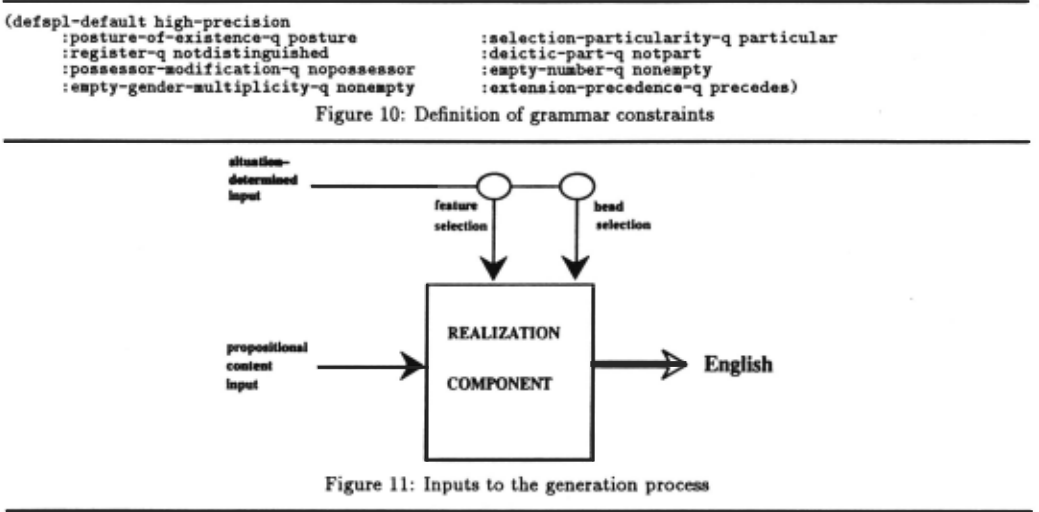
Default environments consist of a set of Nigel inquiries ( cf. Section 4.1) and the responses those inquiries are to be given if they are needed during generation. By predisposing inquiry responses, areas of the grammar as a whole can effectively be removed from consideration so that the alternatives they offer no longer appear relevant. This is equivalent to the dynamic construction of a 'sub grammar'.
The sub-grammar created by Figure 10 has the fol lowing properties: processes of existence will be lex icalized by the word exist rather than some more neutral word, such as be, as in there is a book (: posture-of-existence-q); when possible, selection of a member of a set will be made using spe cific expressions, e.g., one X rather than some X (: selection-particularity-q); since variables are generally refered to in the singular, the distinction between all and every is neutralized for variables ( :register-q); 'de-emphasizing' expressions such as the possessive modification of 'X's Y' are avoided in favor of the more equal emphasis of 'Y of X' ( :deictic-part-q and :possessor-modi:fication-q); pronominalization is not attempted (: empty-number-q and empty-gender-multiplicity-q); and the order of conjuncts and disjuncts in the input will not be al tered in the output by thematic planning of any kind (: extension-precedence-q). This sub-grammar is therefore oriented to language that is precise and explicit, and which is natural for system developers. This aspect of our approach is similar to the method employed by Patten (1988].
4.4 Summary of the constraints
Figure 11 summarizes the inputs to the generation process and the location of situation-specific constraints in t h <~.t. process. In addition to the basic propositional content input specification, we have experimented with two t'uriher sources of control. Feature constraints that hold sway whenever a text of a particular type is being generated, and head selection, which is specific for each specification of propositional content provided as input.
5 Generalizeability of this approach
Given the need to be able to expand the use of an expert system to users of different types, it is important that the tailoring techniques employed are readily extensible. We have shown here how the phrasing phase of tailoring can be controlled in terms of a set of entities that the type of language required uses and a set of restrictions on the general capabilities of the grammar. Both aspects would need to be addressed in any case when setting up an expert system to interact with a new user group since, otherwise, the language best suited to that group would not have been determined.
·we illustrate the ease of extensibility of the technique shown here by setting up a new user type and showing the language that is generated for that user type given the· input of Figure 2. Imagine a class of users who are not expert in the domain of digital circuit analysis and who just need to be presented with responses in as sim ple terms as possible. First, we do not need to invoke the grammatical feature restrictions that lead to pre-
(define-register-teras ·register-for-naive-users· ((·aode· (RHETORICAL-RELATIONS ifthen iff and or)) (·field· (RELATIONS material-property-ascription connected-to ) (OBJECTS output faulty input systea) (OBJECT-MODIFIERS input-part output-part part-of)) (·tenor· (EVALUATION fine vrong))))The systea is faulty, if the inputs are fine and the output is vrong.ciseness shown in Figure 10. Second, we provide a set of significant entities, shown in Figure 12, in which quanti fiers and variables do not appear, the space of available objects that may be referred to is reduced, and 'evalua tions' of domain states of affairs are permitted. The text generated when our algorithm runs with this register in force is also shown in the figure.
6 Conclusion and future work
In this paper we have described a mechanism which con trols the fine detail phrasing of generated language ac cording to a definition of the type of language that is required. In the short term, this work has already im proved the control of phrasing in a text planner; the mechanisms we have designed allow for a far more flex ible, and yet systematic, expression in English of single specifications of propositional content than has previ ously been possible. In the longer term, we are aiming towards a single, unified component module of the text planning/ generation process that adds flexible tailoring to the user during both the content selection and phras ing phases of text planning.
Acknowledgments
The authors would like to thank Eduard Hovy, Johanna Moore and William Swartout for comments on earlier versions of this paper.
@inproceedings{ijcai1989p241,
  title     = {Phrasing a Text in Terms the User Can Understand},
  author    = {Bateman, John A. and Paris, Cecile},
  booktitle = {Proceedings of the Eleventh International Joint Conference on
               Artificial Intelligence, {IJCAI-89}},
  publisher = {International Joint Conferences on Artificial Intelligence},
  editor    = {N. S. Sridharan},
  pages     = {1511--1516},
  year      = {1989},
  month     = {8},
  note      = {Speech and Natural Language},
  url       = {https://ijcai.org/proceedings/1989/241},
}
TY - CPAPER TI - Phrasing a Text in Terms the User Can Understand AU - Bateman, John A. AU - Paris, Cecile T2 - Proceedings of the Eleventh International Joint Conference on Artificial Intelligence, IJCAI-89 PB - International Joint Conferences on Artificial Intelligence PY - 1989 SP - 1511 EP - 1516 UR - https://ijcai.org/proceedings/1989/241 ER -Copied
Machine-readable versions of this paper, for tools and AI agents:





