
A Goal-Directed Intermediate Level Executive for Image Interpretation
Proceedings of the Tenth International Joint Conference on Artificial Intelligence. Perception. Pages 811-813.
© 1987 International Joint Conferences on Artificial Intelligence
Abstract
GOLDIE is a system that has been developed to provide the top-down control of the low and intermediate level processes that create and modify the intermediate-level descriptions of image data used in image interpretation. The basic control structure of GOLDIE is the schema, a declarative specification of control strategies invoked in response to a request (goaQ for a particular form of intermediate-level data. Using this control paradigm, high-level interpretation processes gain the ability to create or refine the intermediate-level data according to predefined goals and/or current hypotheses during interpretation. A variety of schemas for tasks such as region segmentation, line extraction, collinear line grouping, and line-based segmentation are currently implemented within the GOLDIE system.
- Rodney A. Brooks and Thomas 0 . Binford. Interpretive vision and restriction graphs. In Proceedings of The First Annual Na- tional Conference on Artificial Intelligence, pages 21-27, August 1980.
- B. Draper, R. Collins, J. Brolio, J. Griflit,h, A. Hanson, and E. Riseman. Tools and experiments in knowledge-based inter- pretation of road scenes, In Proceedings : DARPA Image Under- standing Workshop, pages 178-193, Morgan Kaufman , February 1987.
- B. Draper, A. Hanson, and E. Riseman . A Software Environ- ment for High Level Vision. Technical Report, Computer and Information Science Department, University of Massachusetts at Amherst, 1986. In preparation.
- Allen R. Hanson and Edward M. Riseman , VISIONS image understanding system -1986. In Christopher M. Brown, edi- tor, Advances in Computer Vision, Erlbaum Assoc., 1987. To appear.
- Vincent Shang-Shouq Hwang, Larry S. Davis, and Takashi Mat- suyama, Hypothesis Integration in Image Understanding Sys- tems. Technical Report TR-1137, Center for Automation Re- search, University of Maryland, College Park, Maryland 20742, June 1985.
- Charles Kohl, Allen Hanson, and Edward Riseman. Goal- directed control of low-level processes for image interpreta- tion. In Proceedings: DARPA Image Understanding Workshop, pages 538-551, Morgan Kaufman, February 1987 ,
- Charles A. Kohl. Goal-Directed Control for Computer Vision. PhD thesis, Computer and Information Science Department, Univer•ity of Massachusetts, Amherst, Massachusetts 01003, 1987. In Preparation.
- R. R. Kohler and A. R. Hanson. The VISIONS image operat- ing system . In Proceedings Sixth International Conference on Pattern Recognition, pages 71-74, Munich, October 1982.
- David Marr. Vi•ion. W. H. Freeman, San Francisco, CA, 1982.
- Cesare C. Parma, Allen R. Hanson, and Edward M. Riseman. Experiments in schema-driven interpretation of a natural scene. In R. Haralick and J. C. Simon, editors, NATO Advanced Study In•titute on Digital Image Proc .. •ing, Bonas, France, 1980.
- Edward M. Riseman and Allen R. Hanson. A Methodology for the Development of General Knowledge-Based Vi•i<>n Systems. Techni~al Report 86-27, C~mputer and Information Science Uni- versity of Massachusetts at Amherst, Amherst Massachusetts 01003, 1986.
- Terry E. Weymouth. Using Object De•criptions in a Schema Network for Machine Vi•ion. PhD thesis, University of Mas- sachusetts, Amherst, Massachusetts 01003, 1986.
References were extracted automatically from the PDF and may contain errors.
Full text extracted automatically from the PDF; figures, tables and equations may differ. The PDF is the version of record.
1. THE INTERMEDIATE LEVEL OF INTERPRETATION
Due to the complexity of the visual interpretation task and the inherent unreliability and ambiguity of image data, com pletely bottom-up (i.e. data-directed) approaches to inter pretation can not be expected to be generally effective. The local nature of the processes that extract descriptions of im age events typically leads to intermediate level descriptions of the image data in which individual semantic objects from the scene are either broken into a number of pieces (fragmentation), or are merged with other objects in the scene (overmerging) [4,11] . The use of expectations, or context, provided by the systems's knowledge-base and/or partial scene interpretation can be used to compensate for these factors to produce data descriptions that more closely match the semantic content of the scene. Such a methodology requires that control of pro cessing be bi-directional, shifting between data-directed and goal-directed methods in an opportunistic manner [1,5,9,11]. This implies that most of the proceS!Ies utilized by a vision system during the construction of an interpretation must be sensitive to high-level goals and constraints.
This concept of bottom-up and top-down control may be viewed in terms of the levels of abstraction used in the im age interpretation process. Within the VISIONS Image Un derstanding System [8,11], three such levels may be identified. Low-level processes are those which operate on pixel data to produce a set of intermediate-level symbolic tokens represent ing significant events contained in the raw image data (e.g. re gions, lines, or su.rfaces). Intermediate-level grouping processes manipulate this initial set of tokens to produce new tokens, and high-level processes provide the semantic interpretation of the image based on the full set of image tokens.
GOLDIE (Goal I!irected Intermediate-Level ;Exectutive) [6,7] is a system within the VISIONS environment that provides the mechanisms for the top-down control of the low and intermediate-level processes that create or modify tokens. The specification of a request for a particular type of image token is expressed as a goal, a data structure that defines the generic class of processing required (e.g. region segmentation, line extraction, grouping, etc.). Constraints, stored as attributes within the goal data structure, express the desired character istics of the tokens to be produced, and may be represented through either semantic or image-based criteria. Semantic con straints are defined in terms of semantic labels (e.g. "segment a specific portion of the image to separate Tree and Sky"), while the image-based constraints are expressed in terms of measur able image features (e.g. "produce regions that exhibit homoge neous texture measures") .
'This work was supported in part by the Air Force Office of Scientific Research Grant AFOSR-86-0021 and the National Science Foundation Grant DCR-8318776
The basic control structure of GOLDIE is the schema, a declarative specification of control strategies that may be used by the system to satisfy a specific goal. Schemas provide a flexible and extensible control structure that is currently used within VISIONS to direct the high-level semantic interpre tation processes [4,10,12] . GOLDIE extends this concept of schema-directed control to the intermediate and low·levels of processing. The power of this system lies not in the partic ular set of specific low and intermediate-level processes that have been integrated into the current system, but rather in the various representations for knowledge, data, and control .that implement goal-directed processing.
2. GOAL-DIRECTED CONTROL
GOLDIE supports both goal-directed and data-directed control of processing. Data-directed processing is controlled by sets of evaluation rules which associate hypotheses (e.g. "can didate for resegmentation", "candidate for merge", etc.) with tokens; the hypotheses are used to direct the subsequent activ ities of the system. Current goal constraints are used to deter mine the specific set of rules used to compute the value of the hypothesis. For example, if a particular set of goal constraints indicated that uniformly textured regions were of primary im portance, the rules used to establish the acceptability of region tokens would include measures of the homogeneity of both hue and short line density. Tokens representing large regions with high variance in either of these features would probably be con sidered unacceptable.
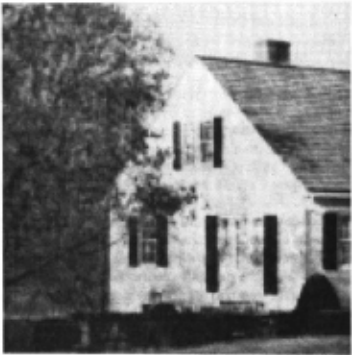
Various types of intermediate-level hypotheses may be es tablished in this manner. For example, the initialization schema, which provides a data-directed region segmentation for either the entire image (at system startup) or for an area defined by a (set of) region token(s), uses the rule mechanism to hy pothesize whether individual region tokens should be merged or resegmented. An instance of this schema first uses the region segmentation schema to select the image feature(s), segmenta tion algorithm, and parameters which will be used to produce an initial "best guess" for a set of region tokens. Using the set of rules selected according to the goal constraints; the initial ization schema instance then evaluates this set of tokens and continues to process those which have unacceptable values for region-merging-hypothesis or region-resegmentation hypothesis . As each of these tokens is processed, the schema is able to perform resegmentation or merging using algorithms and criteria appropriate to the characteristics of the particu lar region. This form of data- directed processing demonstrates intermediate- level control that uses knowledge of region char acteristics, as well as knowledge about the performance of the segmentation algorithms under varying conditions of the data; we call this non-semantic (or image-domain) knowledge. Fig ure 2 shows the segmentation produced by this schema for the image from Figure 1.
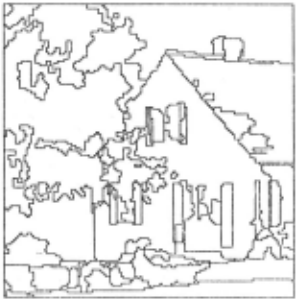
Although this form of intermediate- level control provides image tokens that appear to correlate reasonably well with im age content, this fact alone does not guarantee the suitability of the tokens for interpretation. The ultimate significance or qual ity of a particular token is dependent only upon its utility with respect to a set of interpretation goals and cannot be measured independent of the interpretation process. Therefore GOLDIE also supports goal-directed control in which a goal contains an explicit specification of the token characteristics which must be met by any potential set of results. This evaluation-constraint is expressed as a function value pair; the function is applied to each set of tokens produced by the contracting schema instance, and only if the return value of the function exceeds the value specified is the set of tokens judged to be potentially acceptable.
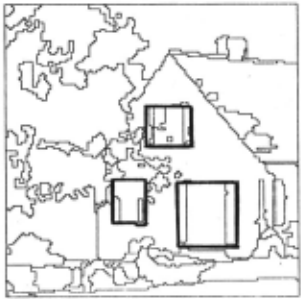
For example, if there has been an inference of the presence of a pair of shutters on tbe side of a house, an interpretation process might request a resegmentation of the area defined by that pair in an attempt to define tokens that could be un ambiguously labeled as either window or shutter. The goal specification for this request
Region-Segmentation
'((region-token . Region-000042)
(evaluation-constraint . ((shape-evaluation 'rectangular) 1.0))
(object-labels. (shutter))(region-characteristic . smooth))
includes an evaluation-constraint that indicates a preference for region tokens that are rectangular . Figure 3 shows the re sult of this goal specification over the three areas bounded by pairs of initially hypothesized shutters in the original segmen tation (Figure 2). The dark lines in this figure represent region boundaries which were constructed by GOLDIE in response to the definition of an "area of interest" by the interpretation process. Each of these newly defined regions was then reseg mented according to the specified goal. Note that although image noise, aliasing, and window reflections prevent a "per fect" segmentation of these areas, the resegmentation process has provided a set of tokens which are appropriate for interpre tation of windows and shutters. The tokens produced through the satisfaction of this goal can be labeled and precisely located, thereby making the information generated by this particular in terpretation process available to any other high-level processes that may be concerned with this data.
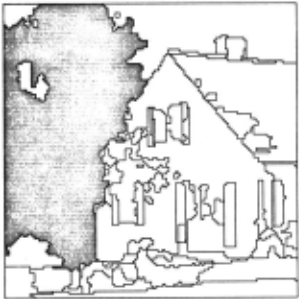
Conversely, if the intent of the interpretation process is to identify trees in the image, the interpretation system could specify a merge goal having an evaluation- constraint that indi cates a preference for large green textured areas (thereby pro ducing the region in Figure 4) .
3. ARCHITECTURE OF GOLDIE
The· GOLDIE system, represented by the modules within the large dashed rectangle of Figure 5, may be described in terms of four major functional components: the process con troller, the data structures for intermediate-level tokens and hypotheses (ISTM), the representation of explicit intermediate level knowledge (ILTM), and the representation of the control state of the system (Goal Blackboard and Schema Instantia tions) .
The set of low and intermediate-level processes that are utilized by GOLDIE to create, manipulate, or evaluate im age tokens are managed by the process controller. The con troller maintains a consistent protocol for the activation of both the low-level processing tasks that operate on pixels (e.g. threshold segmentation, one or two dimensional histogram based segmentation, feature calculation, line extraction, etc.) and the intermediate-level knowledge sources that operate on tokens (e.g. collinear line grouping, token evaluation, or region merging). This interface permits the schema representation of these processes to be expressed in a manner independent of the process implementation. Note that the processes themselves (both low-level image-based procedures and intermediate- level knowledge sources) are not considered to be an integral part of GOLDIE; rather they represent the set of tools available to the system.
The data structures of GOLDIE that are particular to a spe cific interpretation are the sets of tokens and hypotheses about tokens that are stored in ISTM (Intermediate-level ~hort ',[erm Memory) . The tokens are defined through the ISR (Inter mediate fumbolic Representation), a combination database and semantic network in which tokens are defined as graph nodes with associated bitmaps representing the spatial extent of the token in the image. Attributes of the tokens , such as in tensity or size, are computed on demand by the ISR and then stored in the database for efficient retrieval by any other process that may require the same data. Spe.cific relations between to kens, which have been requested by some high or intermediate level process (e.g. the boundary contrast between two adjacent region tokens), are represented as arcs that have values indi cating the nature of the relation. The sets of semantic (e.g. tree-object) non-semantic (e.g. region-merge) hypotheses are stored "in a similar database structure which is accessible from both the intermediate and high levels of processing.
ILTM (the Intermediate-level portion of the VISIONS Long Term Memory) encodes the image- independent intermediate level knowledge structures of GOLDIE which include schemas, object knowledge, and non-semantic image knowledge. Schemas are represented. declaratively as a set of strategies by which a particular goal, such as region segmentation or line extraction, may be satisfied. The execution of the strategies will typi cally involve a sequence of operations including the posting of subgoals, the execution of image processing tasks through the process controller, and the construction of hypotheses based on data represented in the ISTM. As an example, the region feature schema, which selects an image feature for a region segmentation, includes strategies for the selection of features based on frequency distributions of image data, on semantic hypotheses, and on textural characteristics. Message-passing constructs allow the various executing strategies to communi cate and . synchronize their activities within the context of a particular schema instance.
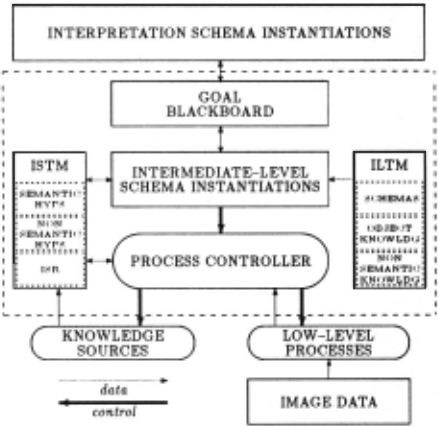
The object knowledge of ILTM encodes the intermediate level characterization (e.g. textured or smooth) of various se mantic objects as well as process specific information that can be useful in the specification of the processes that are to pro duce tokens corresponding to these objects (e.g. image fea tures or segmentation algorithms that have been shown to be useful in the discrimination of the object from other objects). Non-semantic knowledge includes a set of useful characteri zations for tokens (e.g. textured-region, smooth-region, high-contrast-line, etc.) as well as the set of rules, image features , segmentation algorithms, and segmentation parame ters appropriate to each of these token classes.
The goal black board and the set of intermediate-level schema instantiations are represented in a semantic network that en codes the control state of the system [2,3,12). The goal black board is a section of the network in which goal nodes, represent ing requests for intermediate-level processing, are created by the schema instance that requires the results of that processing. The control process of the GOLDIE system continually moni tors this goal blackboard for the existence of new goal nodes. As a new goal is observed, the control process creates a new in stance of the corresponding schema. The node for this schema instance is linked to the goal node by an arc that represents a contract by the instance to attempt to satisfy the goal.
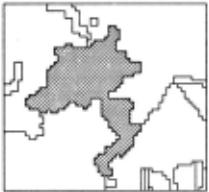
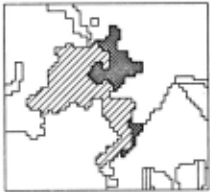
A typical scenario for the interaction between GOLDIE and the interpretation system is a situation where a high-level pro cess had formed two conflicting hypotheses regarding the se mantic label to be assigned to a particular region token (e.g. tree and sky for the cross-hatched region on the left of Fig ure 6) . Since this is a region in which sky is visible through the leaves of the tree, both hypotheses are reasonable. However, an interpretation process which was to unambiguously label the image tokens could post a goal for region- segmentation.
Region-Segmentation
'((region-token . Region-000017)(evaJuation-constraint . nil) (segmentation-sensitivity . high))(object-JabeJs. (tree sky)) (objective . object-hypothesis-conflict))
In response to the posting of this goal, the system would activate an instance of the region- segmentation schema. This schema instance would then select image features and algo rithms appropriate for the discrimination of the two objects and then initiate a segmentation process which would be ex pected to split the original region into a set of new regions, each corresponding to only one of the two objects. Tokens cor responding to these new regions would then be returned to the interpretation schema instance for evaluation (right side of Fig ure 6). If the interpretation schema instance were satisfied with the results, the goal and region-segmentation schema instance would be deleted. Otherwise, the interpretation schema in stance would send a continuation request to the segmentation instance so that additional region tokens could be produced and evaluated. In this case, the region-segmentation schema instance would continue processing until an acceptable segmen tation were found or until all of its strategies were exhausted.
4. CONCLUSION
A variety of schemas for tasks such as region segmentation, line extraction, collinear line grouping, and line segmentation are currently implemented within the GOLDIE system at the University of Massachusetts, and research is proceeding on the interface between this system and the high-level interpretation schemas being developed by other researchers in the VISIONS group [2]. As currently implemented, the GOLDIE system pro vides an evolving mechanism for the control of the processes that create or modify the intermediate-level data representa tion for the interpretation process.
There are four major aspects of GOLDIE that contribute to the utility of the system. Foremost is the fact that the system is goal-driven. This paradigm provides a coherent mechanism for top-down control in which low or intermediate-level processes may be tuned to produce tokens that meet the expectations of higher level processes. Secondly, the system makes use of a unified data representation that allows processes at any level of the interpretation hierarchy to access the token and hypothesis data which represents the current state of interpretation pro cessing. Thirdly, the system contains an explicit representation of knowledge about low-level processes and the ima~e domain which provides a flexibility that permits extension to additional processes or image domains. Finally, the GOLDIE system is capable of operating within a hypothesize- and- test protocol, exploring a variety of potential solutions to high-level requests rather than operating in a strictly deterministic manner.
@inproceedings{ijcai1987p168,
  title     = {A Goal-Directed Intermediate Level Executive for Image Interpretation},
  author    = {Kohl, Charles A. and Hanson, Allen R. and Riseman, Edward M.},
  booktitle = {Proceedings of the Tenth International Joint Conference on
               Artificial Intelligence, {IJCAI-87}},
  publisher = {International Joint Conferences on Artificial Intelligence},
  editor    = {John McDermott},
  pages     = {811--813},
  year      = {1987},
  note      = {Perception},
  url       = {https://ijcai.org/proceedings/1987/168},
}
TY - CPAPER TI - A Goal-Directed Intermediate Level Executive for Image Interpretation AU - Kohl, Charles A. AU - Hanson, Allen R. AU - Riseman, Edward M. T2 - Proceedings of the Tenth International Joint Conference on Artificial Intelligence, IJCAI-87 PB - International Joint Conferences on Artificial Intelligence PY - 1987 SP - 811 EP - 813 UR - https://ijcai.org/proceedings/1987/168 ER -Copied
Machine-readable versions of this paper, for tools and AI agents:





