
Measurement Interpretation in Qualitative Process Theory
Proceedings of the Eighth International Joint Conference on Artificial Intelligence. Knowledge Representation. Pages 315-319.
© 1983 International Joint Conferences on Artificial Intelligence
Abstract
Interpreting measurements of physical systems consists in part of constn1cting an account of "what's happening" in terms of our commonsense physical theories. Since most systems involve change, qualitative dynamics plays a central role in such deductions. This paper presents a theory of measurement interpretation at an instant, based on Qualita tive Process Theory. Appropriate notions of measurement and interpretation arc defined and the computational issues involved in constructing interpretations are examined. After describing an algorithm and illustrating its use by example, possible extensions to interpreting measurements over time will be discussed.
- Hayes, Patrick 1. "The Naive Physics Manifesto" in Expert Systems in the Microelectronic ~-edited by D. Michie, Edinburgh University Press, May 1979
- Hayes, Patrick 1. "Naive Physics 1 -Ontology for Liquids" Memo, Centre pour les etudes Semantiques et Cognitives, Geneva, 1979
- Forbus, K. "Qualitative Reasoning about Physical Processes" Proceedings of IJCAI-7, 1981 IJCAI
- Forbus, K. "Qualitative Process Theory" MIT AI Lab Memo No. 664, February 1982, Revised June, 1983
- Simmons, R. "Spatial and Temporal Reasoning in Geologic Map Interpretation" Proceedings of the National Conference on Artificial Intelligence, 1982
- Allen, James "Maintaining Knowledge about Temporal Intervals" TR86, Computer Science Department, University of Rochester, January 1981
- de Kleer. 1. "Causal and Teleological Reasoning in Circuit Recognition" TR-529, MIT AI Lab, Cambridge, Massachusetts, September 1979
- Davis, R., Shrobe, H .. Hamscher, W .. Wieckert, K., Shirley, M., and Po lit, S. "Diagnosis Based On Description of Structure and Function" Proceedings of the National Conference on Artificial Intelligence, 1982
- Brown, 1. S., Burton, R. R., and Bell, A. G., "SOPHIE:A Sophisticated lnstructutional Environment for Teaching Electronic Troubleshooting (An example of AI in CAl)" Final Report, BBN AI Report No. 12, BBN, Cambridge, Mass, 1974
References were extracted automatically from the PDF and may contain errors.
Full text extracted automatically from the PDF; figures, tables and equations may differ. The PDF is the version of record.
1. Introduction
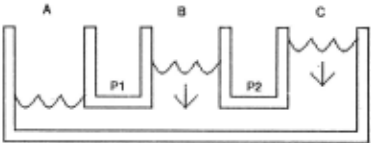
To understand what is happening in a physical system, we must explain what we observe in terms of our physical theories. Consider for example the situation illustrated in figure l. Given that the levels in s and c are decreasing, we would conclude that there was a flow from c to B and from s to A, and that if we could measure the level in A we would find it increasing because of water flowing into it. Measurement interpretation is an important problem in Naive Physics [1,2], and solving it will be necessary if we arc to build programs that help us explain, operate and repair. the complex physical systems that comprise much of our technology.
Our notion of "what is happening" in a system is intimately connected with what can be called qualitative dynamics. Qualitative Process theory [3,4] concerns the form of qualitative dynamics theories, postulating physical processes as the ultimate cause of changes. Thus QP theory provides a representational framework on which a domain-independent theory of measurement interpretation can be
Fig. 1. An Example of Measurement Interpretation
All three containers are· partially filled with water, and we see that the levels in B and c are decreasing. Why?
Ken Forbus The Artificial Intelligence Laboratory Massachusetts Institute of Technology 545 Technology Square Cambridge, Mass. 02139 USA
erected. The general problem of measurement interpretation can be split into two cases: figuring out what is happening in a system at a particular time (taking "one look") and describing what is happening over a span of timc. 1 This paper presents a theory for the first case. After a brief sketch of QP theory, we define notions of measurement and interpretation, including an account of error due to limited resolution. The design considerations for algorithms that construct interpretations are examined, along with a sample algorithm. After working through an example, the issues involved in extending the theory to the interpretation of measurements over time are disussed.
2. QP Theory in Brief
We will consider a physical situation as composed of objects and the relationships between them. The continuous parameters of an object, such as temperature and pressure, are represented by quantities. A quantity consists of two parts, an amount and a derivative, each of which are numbers. The functions A and D map from quantities to amounts and derivatives respectively. Every number has parts sign and magnitude. The functions s and m map from numbers to signs and magnitudes respectively. The parts of quantities are denoted by the selectors A 5 , Am, D 5 , and om which map from a quantity to the sign of its amount, the magnitude of its amount, and so forth.
Numbers, magnitudes, and signs take on values at particular times; when we wish to refer to the value of a quantity or some part of it Qat a particular time (either instant or interval) t, we write:
(M Q t)
which can be taken to mean "what God would measure for Q at t". Signs can take on the values -1, o, 1. For defining comparison and combination over numbers and magnitudes we will take values to be elements of IR, although in QP theory we will never know the actual numerical values.
In QP theory, the value of a numbe~ is defined in terms of its Quantity Space- a collection of inequalities which hold between it and other numbers. j::lements in a particular Quantity Space come from the conditionalized descriptions that involve that parameter. In general the value will be incomplete, which is r~flected by the Quantity Space being a partial instead of a total ordering. The Quantity Space is a useful qualitative representation because processes typically start and stop when inequalities between parameters change. 1
1. Simmons [5] explores the related problem of reconstructing a sequence of events which could lead to a static final state.
2. By convention, when we speak of the value of a quantity we are refering to the value of its amount.
A changing quantity is said to be influenced. 'lbcrc arc two kinds of influence which can occur. A quantity can be directly influenced by a process or processes. in which case we will write
according to whether n, some number defined within the process, is a positive or negative influence on the quantity Q. If a quantity is directly influenced, then its derivative is the sum of the direct influences. A quantity can also be indirectly influenced by its value being a function of other quantities which arc themselves influenced. We will specify functional dependencies between quantities by
Rl a:Q RZ
(read "Rt is qualitalively proportional to R2), meaning there exists a function which determines Rt and is increasing monotonic in its dependence on R2 . Note that the function implicitly specified by a: 0 may or may not depend upon other quantities or properties. The description of a contained liquid in figure 2, for example, uses a: 0 to describe the relationships between the parameters of a liquid in a container. a: 0 _ signifies the same, but with the implicit function being
Fig. 2. Describing Liquid in a Container
In Hayes' ontology of liquids the individuating criteria for a piece of liquid is being inside some piece of space. When we have some substance s in liquid form within a container c, we have an individual that is a contained liquid, as specified below.
individual-view contained-liquid Individuals : c a container s a substance Preconditions: ContainsSubstance(c, s) QuantityConditions: A[Amount-of-in(s , c)] > ZERO A[Temperature(s, c)] > TMelt(s, c) A[Temperature(s. c)] < TBoil(s. c) Relations: There is g.· a piece-of-stuff HasQuantity(g, Amount-of) Amount-of(g) · Amount-of- in(s, c) HasQuantity(g, level) Level(g) a: 0 Amount-of(g) HasQuantity(g, Pressure) Pressure(g) a: 0 Level(g) ;the notation will be explained shortly1. This is an application of the relevance principle of qualitative reasoning. Qualitative reasoning about a continuous thing requires quantization of some sort to induce a finite vocabulary of symbols. The choice of quantization must be chosen to draw the distinctions required by the kind of reasoning being performed. Ignoring this principle leads to ad hoc, inadequate, an.d uncxtendable representations.
decreasing monotonic in its dependence on R2.
lnflucnccs provide a means of partially specifying direct and indirect effects. Figuring out the sign of a derivative for a quantity from its influences will be called resolving its influences. If a quantity has no influences then its Ds value is o. If all influences arc of the san1e sign then the Ds value is just that sign. Inequality information can provide a resolution when direct influences have conflicting signs. Conflicting indirect influences cannot be resolved within QP theory due to the abstract nature of a: 0 . Domain- and situation- specific information is used instead. This information can take many forms, including quantitiative theories and "rules of thumb", depending on what the reasoner knows and the desired precision of answers.
A process is a tl1ing that acts through time to cause changes. A process is specified by five parts:
Individuals: Descriptions of the entities which participate in the process, Quantity Conditions: Inequality statements and status assignments to other conditionalized descriptions which must be true for the process to be active
Preconditions: Statements other than Quantity Conditions tllat must be true for the process to be active. Often Preconditions will not be deducible solely within QP theory.
Relations: The relationships between the individuals which hold when the process is active.
I njluences: Descriptions of what quantities of the individuals are directly influenced by the process.
Figure 3 provides an example. A collection of objects that matches the individual specifications of a process gives rise to a Process Instance (PI) that represents a potential occurance of that process. A Process Instance has a status, which is either Active or Inactive. A PI is active whenever both the Preconditions and Quantity Conditions are true.
Preconditions are distinct from Quantity Conditions becau3e some factors are external to the dynamics of a domain, e.g. a purciy physical theory cannot predict whether or not someone will walk by and turn on a stove, although it can predict that a result of this action
Fig. 3. Process Description of Fluid Flow
This process describes .one case of fluid flow (see [2] for a partial taxonomy of cases).
process fluid-flow Individuals: s a contained-liquid d a contained-liquid path a fluid-path, Fluid-Connection(s. d, path) Preconditions: aligned(path) QuantityConditions: A[Pressure(s)] > A[Pressure(d)] Relations: Let flow-rate be a quantity . flow-rate a:Q (A[Pressure(s)] - A[Pressure(d)]) Influences: !+(Amount-of( d), A[fl ow-rate]) 1-(Amount-of(s), A[flow-rate]) ;A fluid path is aligned only if either ;it has no valves or every valve is openwill be that the water sitting in a kettle on top of it will soon boil.
The statements in the Relations and Influences field hold whenever the process is active. The Relations field contains information about functional dependencies induced by the process as well as any new entities which it introduces by virtue of being active. The Influence field specifics direct influences, as discussed above.
A Process Vocabulary consists of the processes that form a domain's dynamics. The collection of active PI's at a particular time in a situation is called its Process Structure. A principle tenet ofQP theory is that QD]y processes directly influence quantities and that functional dependencies induced by processes (and other conditionalized descriptions, see below) are the causes of indirect changes. By making closed world assumptions over a Process Vocabulary and situation description, we are thus justified in reasoning by exclusion. I
Individual Views represent states of objects and objects whose existence depends on the values of quantities, such as the Contained-Liquid description introduced above. Individual Views are specified by their Individuals, Preconditions, Quantity Conditions, and Relations just as processes are. Similarly, the View Vocabulary describes the Individual Views of a domain, and the View Structure describes the collection of view instances actually true in a situation at a particular time.
3. Measurement Interpretation
A theory of measurement interpretation must specify what can be measured, what an interpretation of those measurements is, and how to compute them from measurements. We will examine each in turn.
3.1 Measurements
First we must specify what kinds of things can be observed in principle and then add further conditions to specify what can be observed in fact. We will start by assuming that a collection of individuals is known. The closed world assumption that these individuals are the only (relevant) individuals will be called the Annchair Assumption. We will also assume the existence of a partial decision procedure for determining whether or not relationships defined outside QP theory (such as FluidConnection) hold, in order to confirm Preconditions. To state that we have ascertained whether or not a fact is true via observation, we will write:
where AI is the instrument (such as our eyes) used in the observation.
Within the QP ontology, the kinds of facts that can be observed are occurances of processes, inequalities and the values of signs. The criteria for a type of process being observable reduces to the observability of a particular kind of quantity and the uniqueness of that process (with respect to the reasoner's Process Vocabulary) in influencing it. A change in position, for example, is by definition the result of motion. Thus whenever we see a change of position we are scemg the result of a motion process.
We will say
1. Hayes [1,2] provides convincing arguments and examples of the role of reasoning by exclusion in Naive Physics.
when quantity (or part of a quantity such as its o 5 ) Q of object B can (under some conditions) be observed with instrument M. For a process instance we will say
if PI can be observed to be active or inactive with instrument M. We will say
when measuring Q(8) with AI at (during) timet yields the value given. In keeping with the Quantity Space representation, measuring a number or magnitude yields an inequality and measuring a sign yields one of -1, o, or 1. Measuring derivatives will be discussed shortly.
We wish to consider a wide variety of instruments as measuring means, such as eyes and gauges. A comprehensive theory of error lies outside QP theory, but we can model the potential for error due to limited resolution .. The essence of the limitation is that when two things are "very close" a particular AI might not distinguish them (for signs, we arc seeing if the number is "very close" to the special value ZERO). For each measuring means, object, and quantity type, let there be a function Omin such that two values are considered distinguishable if and only if the magnitude of their actual difference is greater than Om in. In other words,
Om1n will be chosen according to the particular physics and instrument being modelled; this particular form is chosen for simplicity. 1 A measured equality might be wrong due to limited resolution:
and if we measure a difference, then there really is a difference:
A similar statement can be made for <. In measuring signs we are examining inequalities with Qt · ZERO, so lack of resolution will show up as a sign value of o.
Measuring change is particularly important. First consider changes in a quantity over an interval. We must distinguish the values of the·same quantity measured at two different times, so the relation we are looking for depends on the quantity type, the object, the measuring means, and an interval. We will say
(read "differentially distinguished") exactly when
I. In particular, this form of Om1 n is simpler than just noticab/e difference in psychophysics, because the latter also depends on the value of the quantity. A taxonomy of possible forms for Om1 n is outside the scope of this paper.
If we adopt Allen's ontology for time [6]. then an instant is simply a very short interval. Thus our criteria for observing changes over intervals can serve for measuring derivatives. However, capturing lack of resolution becomes more complicated:
Even when the measured value is non-zero, the sign may not have been constant over the interval:
This extension allows us to say, for example, that while we cannot immediately see the effect of evaporation on the level of water in a glass, if we looked longer we could.
3.2 Interpretations
An interpretation must explain what is causing the changes that are occuring (including the special case of nothing changing). In QP theory processes are the only causes of changes, so an interpretation will include assumptions about the status of the process instances (PI's) that occur between the individuals. Since more than one process can influence a quantity, interpretations must also include assumptions concerning influence resolutions. An interpretation must be internally consistent, externally consistent, and sufficient. Internally consistent means an interpretation assigns at most one status to any PI and at most one Ds value to any quantity. Externally consistent means that the status assignments and o s values assigned are consistent with the measurements. Sufficient means that every measured o 5 value is explained.l
Some additional structure on interpretations will prove useful. A Unit Cause Hypothesis (UCH) is a partial interpretation that forces the assignment of a Ds value consistent with a measurement. Any interpretation which satisfies the three criteria above will be a collection of UCHs, one for each Ds measurement, that is internally consistent. The P·injluencers of a quantity is the set of process instances that can possibly influence that quantity, directly or indirectly. The lnjluencers of a UCH is the subset of the P·influenccrs that arc active in that UCH. In addition to the status assumptions that determine the influencers, a UCH with conflicting influences must include an assumption about their resolution. As noted above. for direct influences this will take the form of an inequality between (perhaps sums of) the influences. To state the resolution of conflicting indirect influences we will say Resolved{<quantity> <influencers> <value>)
1. By contrast, an interpretation in deKleer's QUAL is a collection of device states and incremental changes in quantities, the latter assumed to occur sequentially in "mythical time" (7]. Despite profound ontological differences, the principles defining interpretations presented here are inspired by his work.
3.3 Computational Issues
There are two possible ways to organize the search for interpretations. One way is to search through the possible UCH's for each measurement to find a globally consistent collection. Finding the possible UCH's for a quantity is simple. The set of p-inQucncers can be computed from the process descriptions associated with the PI's, and each possible subset of influencers can be checked to see if it can be resolved consistently with the measured value. However, the number of UCH's can be quite large. Suppose we measure a quantity and find it is increasing. Then if we have p PI's that can provide a positive influence and N that can provide a negative influence, there are
possible UCHs. In practice this number will be much smaller, since the PI's are usually not independent. For example, a fluid path cannot have flows going in both directions at once because their Quantity Conditions would conflict (see figure 3). The number of consistent interpretations will almost always be.much smaller than the product of the number ofUCHs since processes typically influence more than one quantity, providing mutual constraint. These facts suggest that we organize the search around the space of status assignments to Pis instead. If we wish a total interpretation we can use the entire collection of Pis, but if we want a minimal interpretation to explain the measurements we can just use the union of the P-influencers for the measured o values Any collection of status assignments that cannot s . be consistently extended by assumptions about influence resolutions to provide a UCH for each Ds measurement can be thrown out, and each extension found is a valid interpretation.
Several kinds of knowledge can be used to prune the search space. Pis that correspond to observable processes could have their status detcnnined directly by observation, or indirectly by ascertaining the truth of their Preconditions and Quantity Copditions. For example, if we can see that a valve in a fluid path is closed, then that fluid path is not aligned and no flows can occur through it.
Once a collection of status assumptions is chosen, it must be extended to form a collection of UCHs. There are several ways to accept or rule out a UCH. If the set of influences can be resolved then the UCH will stand or fall according to whether or not the resolved Ds value and the measured value agree. Again, this can requir~ domain-specific information; we do not expect that evaporation will immediately cancel out the effect of pouring water into a cup. Distinguishability provides a means of ruling out small changes. For example, we can say:
which will rule out evaporation as the sole explanation for why we are seeing the level of water in a glass fa11. 1
What if no consistent interpretation exists? Following [8], we view the analysis as relying on simplifying assumptions that must be re-analyzed in such cases. The assumptions, ordered in increasing certainty, are:
- Any facts used in pruning are correct
- The measurements arc correct
- The Armchair Assumption is correct·
- The Process Vocabulary is complete and correct Other orderings are of course possible. 2
3.4 An Algorithm
The prescriptions above are combined into the algorithm in · figure 4. MH constructs all interpretations for a set of measurements, given a collection of individuals, relationships, and a Process Vocabulary. MI-l can easily be modified to produce just one interpretation by stopping the search after the first interpretation has been generated. To evaluate whether or not a proposed interpretation is consistent (as would be necessary for training, see (9]) the proposed interpretation can be included in the list of OF ACTS. Of course, there are other algorithms that are consistent with the theory. For example, the mix of search to information gathering will depend on the particular domain and available instruments. A version of MI-l has been implemented and successfully run.
4. Example
Let us remrn to the initial example to illustrate the ideas. Figure 5 provides the initial description of the situation. We assume that contained liquids (see figure 2) exist in the containers A, B, and C, called WA, WB, and WC respectively. The Process Vocabulary will consist of fluid flow (see figure 3). and Pl and P2 are assumed to be fluid paths that form fluid connections between W A and WB, WB and WC respectively. We want to find causes for the drop in the levels of WBandWC.
Following MI-l, there are 4 process instances of fluid flow, corresponding to flow in each direction of each fluid path. ML consists only of os values, so OBS = ML and OF ACTS is empty. Figure 6 summarizes the results so far. Assume we have no extra information about the domain or the situation. Since each set of P-influencers
- Informal observations indicate that people appear to use the following Ineffectuality heuristic - if a PI's result is not distinguishable, assume it isn't acting. The intuition appears to be that its effect won't make that much of a difference anyway (unless the physical structure of the situation leads you to believe there are alot of them!). This heuristic prunes the search space of Pis enormously, and it seems likely that. correct use of this assumption is a mark of an expert in a domain.
2. Ultimately a global order on catagories of facts will be inadequate, since our strength of belief seems to vary on items within a catagory. For example, when the measuring means is indirect and the domain familiar, we often trust our theories more than the measurements. The opposite is true if the measurements are direct (sensory) and the domain unfamiliar.
Fig. 4. Measurement Interpretation Algorithm
;Let ML be the list of measurements, ;IS be the set of individuals which comprise the situation, ;IV be the vocabulary of individual views ; PV be the Process VocabularyProcedure MI-1
- Compute all instances of Individual Views (!VI's) and Process Instances (PI's) for the individuals in IS by finding matches with elements of IV and PV .
- Partition ML into two sets , OBS for assertions of Ds values and OFACTS for all others. For each quantity in OBS compute the set of p-influencers .
- Make status assignments to PI's (and !VI's) wherever possible , using OFACTS and domain specific knowledge. For any quantity in OBS whose p- influencers set contains a single element,
- If the sign of the influence is consistent with the observed Ds value, the PI is ACTIVE.
- -If the sign of the influence is inconsistent with the observed Ds value, then there is a global inconsistency .
- Perform a dependency directed search over the set of status assignments rema1n1ng, using the following criteria to determine inconsistency :
- If inconsistent assumptions about Preconditions and Quantity Conditions result, or
- If no consistent UCH can be constructed for some quantity in OBS (either status assumptions force an incorrect Ds assignment or e i ther situation-specific or domain-specific knowledge rule out the correct assignment or the assumptions of another UCH rule it out), then the status assignments are inconsistent .
- If not ruled out, the collection of status assumptions along with th·e assumptions made in constructing the UCH's comprise a valid interpretation.
Fig. 5. Initial Facts
At time to Contained-Liquid{WA} ;the liquid in container A Contained-Liquid(WB) Contained-Liquid(WC) Fluid-Path(P1) Fluid-Path(P2) FluidConnection(WA. WB, . P1) ; assume no FluidConnection(WB, WA, P1); check v.alves FluidConnection(WB , WC, P2) FluidConnection(WC, WB, PZ) ML · (M Ds[Level(WB}] to) · -1, (M Ds[Level(WC)] to) · -1contains more than one PI, step 3 yields no results. We now must search over the status assignments for FF1-4. FF3 and FF4 cannot both be active because they presuppose different orderings between A[Pressure(WB)] and A[Pressure(WC}]. If FF3 alone is active then Ds[Level (WC}] would be 1, which contradicts the mc<:sured value. FF4 being active results· in an influence resolution consistent with the
Process Instances: FF 1: Fluid-Flow(I,.A, WB, Pl) FF2 : Fluid-Flow(WB, WA, Pl) FF3: Fluid·Flow(WB, we. P2) FF4 : Fluid-Flow(WC, WB, PZ) OBS · (M Ds[Level(WB)] to) · -1. (M Ds[Level(WC)] to) · -1 P-Influencers(Level(WB)) · FFl, FF2, FF3, FF4 P-Influencers(Level(WC)) · FF3, FF4measured value, providing the only consistent UCH for the measurement of Ds[Level(WC)] . Given that FF4 must be active, FFl cannot be, since it would result in Ds[Level (WB)] being 1, contradicting the measured value of -1. FF2 must be active, because if it wasn't the sole influence on Ds[Level(WB)] would be FF4, again contradicting the measured value. In addition, the flow rate of FF2 must be greater than the flow rate ofF F 4 to explain the measurement. So the only consistent interpretation is:
Status(Ffl, Inactive) Status(FF2, Active) Status(FF3, Inactive) Status(FF4, Active) flow-rate(FF2) > flow-rate(FF4)We would also predict that o s [ Leve 1 ( WA)] · 1, since F F 2 is the only influence on Amount-of(WA). Suppose however that we measure Ds[Level (WA)J to be -1. There is no consistent interpretation of these measurements, so one of the assumptions underlying the analysis is wrong and must be retracted. Pragmatically, the Armchair Assumption is the best candidate for retraction since tanks do leak - but that decision lies outside the range ofQP theory.
5. Discussion
A natural extension of this theory is interpreting measurements over time. An interpretation would be generalized to a history [2], and measurements would correspond to partial information about this history. The description of measurements remains unchanged, the only difference being that differential distinguishability will be used over significant intervals. There is an additional problem of segmentation, finding intervals where the Process Structure does not change. A heuristic is to use changes· in o 5 values as the boundaries, since these must correspond to changes in the resolving of influences. Additional divisions may be necessary, because changes in unobserved quantities may take time to propgate to distinguishable changes in observed quantities - for example, a stove may be on for some time before you deduce that fact by seeing steam pour out of a kettle on top of it. The theory described here could be used to build interpretations for what is occuring during each episode implied by the boundaries. Because the episodes are connected, the interpretation for any particular episode has to be consistent with the interpretations for the ones around it. The pruning constraints and heuristics described above still hold - even if we watch for five minutes, evaporation still won't empty a drinking glass. QP theory also imposes an additional constraint on the connected episodes: the interpretation for each episode has to correspond to a Process Structure implied by some Limit Hypothesis (sec [4]) for the Process Structure implied by the interpretation of the episode before it.
Interpreting observations in terms of physical theories is an important problem in Naive Physics, and the theory presented here is a first step towards solving that general problem. Using Qualitative Process Theory as the representational framework provides a fairly natural notion of what an interpretation is (what processes arc acting, with what net effect) and ensures t11at the theory and any algorithms based on it can be used in more than one domain. · While many domain-specific facts will be needed in any practical system that performs measurement interpretation, QP theory provides a common language in which to express at least part of the information, and provides a constrained role for other kinds of information (resolving conflicting influences, determining Preconditions, Quantity Conditions, and distinguishability). ·
6. Bibliography
- Hayes, Patrick 1. "The Naive Physics Manifesto" in Expert Systems in the Microelectronic ~- edited by D. Michie, Edinburgh University Press, May 1979
- Hayes, Patrick 1. "Naive Physics 1 - Ontology for Liquids" Memo, Centre pour les etudes Semantiques et Cognitives, Geneva, 1979
- Forbus, K. "Qualitative Reasoning about Physical Processes" Proceedings of IJCAI-7, 1981
- Forbus, K. "Qualitative Process Theory" MIT AI Lab Memo No. 664, February 1982, Revised June, 1983
- Simmons, R. "Spatial and Temporal Reasoning in Geologic Map Interpretation" Proceedings of the National Conference on Artificial Intelligence, 1982
- Allen, James "Maintaining Knowledge about Temporal Intervals" TR86, Computer Science Department, University of Rochester, January 1981
- de Kleer. 1. "Causal and Teleological Reasoning in Circuit Recognition" TR-529, MIT AI Lab, Cambridge, Massachusetts, September 1979
- Davis, R., Shrobe, H .. Hamscher, W .. Wieckert, K., Shirley, M., and Po lit, S. "Diagnosis Based On Description of Structure and Function" Proceedings of the National Conference on Artificial Intelligence, 1982
- Brown, 1. S., Burton, R. R., and Bell, A. G., "SOPHIE:A Sophisticated lnstructutional Environment for Teaching Electronic Troubleshooting (An example of AI in CAl)" Final Report, BBN AI Report No. 12, BBN, Cambridge, Mass, 1974
@inproceedings{ijcai1983p73,
  title     = {Measurement Interpretation in Qualitative Process Theory},
  author    = {Forbus, Kenneth D.},
  booktitle = {Proceedings of the Eighth International Joint Conference on
               Artificial Intelligence, {IJCAI-83}},
  publisher = {International Joint Conferences on Artificial Intelligence},
  editor    = {Alan Bundy},
  pages     = {315--319},
  year      = {1983},
  note      = {Knowledge Representation},
  url       = {https://ijcai.org/proceedings/1983/73},
}
TY - CPAPER TI - Measurement Interpretation in Qualitative Process Theory AU - Forbus, Kenneth D. T2 - Proceedings of the Eighth International Joint Conference on Artificial Intelligence, IJCAI-83 PB - International Joint Conferences on Artificial Intelligence PY - 1983 SP - 315 EP - 319 UR - https://ijcai.org/proceedings/1983/73 ER -Copied
Machine-readable versions of this paper, for tools and AI agents:





