
Qualitative Reasoning about Physical Processes
Proceedings of the Seventh International Joint Conference on Artificial Intelligence. INFERENCE and REASONING. Pages 326-329.
© 1981 International Joint Conferences on Artificial Intelligence
Abstract
Common sense reasoning about the physical world must include an understanding of physical processes and the changes they cause . For example, heating a liquid causes its temperature to rise and if continued long enough may cause it to boil. A style of analysis is presented that combines deKieer's Incremental Qualitative analysis wjth the Quantity Space idea from Naive Physics to reason about the effects of physical processes and their limits . The analysis is demonstrated on an example with practical importance, and further possibilities for applications are discussed .
- Haye$, Patrick J . The Naive Physics Manifesto in Expert System$ ill the Micro-Electronic ~. edited by D . Michie. Edinburgh Unh:ersity Press. 1979.
- deKieer. Johan Causal and Teleological Reasoning in Circuit Recognition MIT AI-TR-529, September. 1979
- Forbus, K. and Stevens, A. Using Qualitative Simulation to Generate Explanations Technical Note in press. Navy Personnel Research and Development Center, 1980 (4}Williams, M., Hollan, J . and Stevens. A. Human Reasoning about a Simple Physical System To appear in Mental Models, edited by D. Gentner and A. Stevens
- Hayes, Patrick J . Naive Physics 1 -Ontology for Liquids Memo. Centre pour les etudes Semantiques et Cognitives. Qeneva, 1979
- deKieer. Johan Qualitatil'e and Quantitative Knowledge in Classical Mechanics MIT AI-TR-352, December 1975
- Forbus, Kenneth D. A Study of Qualitative and Geometric Knowledge in Reasoning about Motion. MIT AI-TR -615, February, 1981
- Forbus, Kenneth D. Qualitative Reasoning about Space and Motion To appear in Mental Models, edited by D. Gentner and A. Stevens
References were extracted automatically from the PDF and may contain errors.
Full text extracted automatically from the PDF; figures, tables and equations may differ. The PDF is the version of record.
1. Introduction
An important component of a Naive Physics ( 1] is the representation of the kinds of things that can happen to an object, the processes described by the physics that act to change a situation. For example, we know that when heat flows from a flame to water in a container, the temperature of the water will rise and it may boil. We can also deduce that if the container is sealed there is some chance that the increased pressure caused by the boiling fluid can cause it to explode. These deductions are interesting both because they are so easy for us to make and because they are important for certain applications. A program that understood a steam plant in order to explain or operate it, for instance. should be able to make this particular inference. This pj!per introduces a new style of analysis (called Qualitative Process analysis) to be used in performing such inferences.
One part of the problem is to re.present how quan.tities change. deKieer's Incremental Qualitiative (IQ) calculus (2] can handle this. It represents the change in a quantity by one of four values (U. D. C. or ?, corresponding to "increasing", "decreasing", "constant", or "indeterminate") indicating knowledge of the sign of the derivative. While the IQ calculus is very useful for causal reasoning (see [2] and [J]). it cannot be used to deduce the limits of physical processes. This is because IQ analysis does not represent quantities, only changes in them. In the example above, we could deduce that the temperature of the water is rising, but not that it might boil. This problem has appeared .in studies of mental models of heat exchangers (4] as well. Qualitative Process analysis includes the IQ calculus, but also incorporates notions of rates and amounts.
The conceptualization of amounts in QP analysis comes from the notion of a quantity scale in Hayes' Naive Physics of liquids[5]. A quantity scale maps amounts in the physics to a measure space, such as amountlwh i sky, inside (jar II to I i ters 18.831 . In the analysis introduced here the property of real importance is the existence of an ordering among points in the scale. In determining whether or not a fluid will flow, for example, only the relative pressures need be known. The notion of a quantity space is introduct'<l to serve as a partition of the possible values for a quantity which correspond to different processes occuring.
In the pe.rspective of Naive Physics, Qualitative Process analysis corresponds to a clustt'r - a collection of knowledge and inference procedures which is sensible to consider as a module. While the axioms for liquids Hayes developt'd include some knowledge of process limits I they also include a particular choice for the representation of the effects of the processes over time and a particular geometry. I believe the kind of reasoning discussed here is independent of these particular choices and thus should be considered separately.
What follows are the basic definitions of QP analysis and an example of its use. The details have been worked out by hand on several examples; an implementation is underway.
II DEFINITIONS
A parameter of a physical system will be represented by a quantity. For purposes of QP analysis, a quantity will have three components: an amount, an !Q value, and a rate. Although an amount will be assumed to take on real values. the inferences discussed here do not require quantitative values. only knowledge of the ordering between two .quantities. The IQ and rate of a quantity specify how it is changing; the IQ value corresponds to the sign of the change and the rate corresponds ·to the amount of the change. Rates combine as do numbers and Figure I illustr:~·es how IQ values combine.
I . s~ ror example axioms 52 through 112
The quantities in a situation which represent a particular kind of parameter ar.e grouped together in a partial order called a quantity spaee. The quantity space for the levels of fluid in two tanks A and B connected by a pipe might be:
_.... Top-of IAI Bot tom Level IAI ___,. LeveiiBI-+ Top-ofiBI The arrow indicates that the quantity at the head is greater than the quantity at the tai.l. As drawn, LeveiiBI and Top-ofiAI are unordered. We will call two points which are ordered and with no points known between them in the ordering neighboring points. In the quanti tv space above. Leve I IAI has
Bot tom, Top-ofiAI, and Level IBI as neighbors, but not Top-of 181 .
Fig. l. Combining IQ Values
This table specifies how IQ values combine across addition and multiplication. Rates and amounts are used to disambiguate cases marked by "?" in deKieer's formulation.
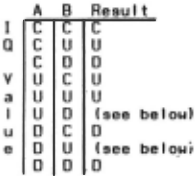
When equivocable,
if + then if RateiAI>RateiBI then IQIAI
if RateiAI<RateiBI then lOlBI
otherulse C
.
if* then if RateiAI*A·ountiBI > RateiBI*A·ountrAI then IQIAI
if RateiAI·A·ountiBI
< RateiBI*A·ountiAI then IQIBI otheruise C
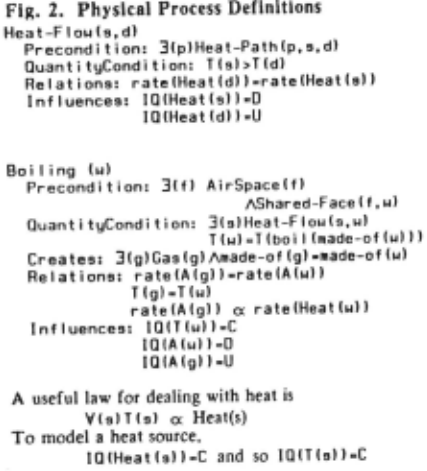
A continuous process acts through time to vary one or more quantities. 1 The specification of a process has four parts: preconditions. quantity conditions, relations. and influences. Both preconditions and quantity conditions must be true for a process to be acting. The preconditions are those factors that are external to the theory, such as someone opening or closing a val\'e. The quantity conditions are those limits that can be deduced within the present theory, such as requiring the temperature of two bodies to be unequal for heat flow to occur. Relations hold between quantities affected by the process. and influences are the .contributions to the way a quani1ity changes. Relations concern amounts and rates, while influences are assertions about the contribution to the IQ value for a quantity. To find out how a quantity is actually changing requires summing all of the influences on it, since several processes may be acting at once. Figure 2 shows the definition of two processes.
The physics of a situation determines the set of processes possible in it. The particular process(es) that are acting at some time can be determined by examining the preconditions and the orderings in the quantity spaces. Using the level quantity space above, if the pipe between A and B is unobstructed, then there will be a flow from B to A because a simple quantity condtion for fluid flow is that Levellsourcel is greater than Leve I I des tina t i on.l.
Discontinuous changes in processes occur at limit points, which serve as boundary conditions. The points are chosen according to the quantity conditions of the processes that can affect that parameter. For example, the temperature quantity space for a fluid could be:
Tllcel~ Tlboillngl where temperatures at Til ce I and below correspond to the solid state. temperatures of Tlbo i I i ngl and above correspond to the gaseous state. and any temperature in between to being a liquid.
I . A proc~ss is not ~quivalent to an ~pisode in Hayes' liquids th~ory . An ~pisode includes time specifications and a geometry, ··hile the part or a process ··e are considerina does not . While a geometry representa)ion is needed to set up the descriptions and a time representation to make use or the results, the inferences themselves are nearly separable.
III INFERENCES ABOUT PROCESSES
The definitions of quantities and processes above provide enough formal structure to deduce, given a physics and a very general description of a situation, what processes are occuring and the changes they will cause. The preconditions and quantity conditions can be used to determine what processes are operating within the situation. This information can in turn be used to deduce changes in the properties of the situation (such as a temperature nstng or an amount dropping) ·and the limits of the processes involved.
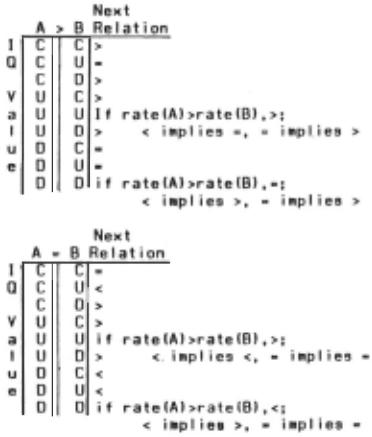
To infer the limits of a process, first find the influences on all affected quantities and determine the resulting IQ value. Then find the neighboring points within the quantity space. If there is no neighbor in a direction, then motion in that direction cannot affect the process. The ordering between each neighbor and the current amount of the quantity can be combined with the IQ values of each to determine if the relationship will change (see Figure 3). If the neighbor is a limit point, some process may end there and others begin. Thus the set of possible changes in orderings involving limit points becomes the ways the current processes might change. Tllis assumes that rates are non-infinitesimal, so that if a quantity is moving towards some point in its space (such as Leve I lA l and Leve 1 IBI above) it will actually reach that value in some finite time.
Fig. 3. Linking IQ analysis with Iaequalitles
This table summarizes how the ordering relationship between two quantities may change as a result of their IQ values.
More than one change is typically possible, as
will be illustrated below. There are three reasons for this. First, if the ordering within a quantity space is not total more than one nrighbor can exist . Second, a process can influence morr than one quantity. Finally, more than one process can be occuring at once. For some kinds of tasks just knowing the possible changes is enough (such as envisioning, in [6)) . If required, knowledgr outside the scope of this throry can be used to disambiguate the possibilities. Depending on the domain and thr style of rrasoning to be performrd thNe are several choicrs: simulation (7), algebraic manipulation [6], teleology [2), or possibly by default assumptions or observations (discussrd in [8]).
IV A DEMONSTRATION OF~ ANALYSIS
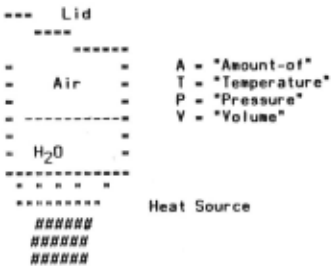
- To illustrate the use of this technique, let us consider the possible consequences of a situation, shown in Figure 4. The situa.tion consists of a container partially filled with water that can be heated by a flame; the container has a lid which can be sealed and is surrounded by air. The initial amounts are assumed to be those of standard temperature and pressure, all IQ values are initially C. At some point in time the heat source is turned on. We will stipulate that if boiling occurs, the lid will be closed and sealed . Some of the physics required for this problem is contained in Figure I . The rest of the details, and especially formalizing the geometry involved, will be ignored in this example.
When the heat source is actil'ated, there will be a heat path between the source and the container. Assuming standard temperature and pressure in th_e environment, and no unstated effects. af T!sourcel> Tlllaterl there will be a heat flow from the source to the water. Being a heat source, the influence of the loss on the temperature is ignored and 1 a IT 1 source I I ~c. The only influence on T (container! is ttut of the heat flow. so Ia IT lcontai .nterl I .u. This in turn will cause a heat flow to the air surrounding the cup, the air inside the container, and the water. Most of these temperatures will be ignored. The temperature quantity space looks like:
If T! source l> T lbo i I I and the process is unimpeaded, the next process that will occur is a boiling.
Before considering the boiling, we can examine what happens to the air inside the container. The relationship between the parameters of air due to its gaseous state can be expressed as:
pI air I ·V I air I ·A I air I · T I air I While the water is heating,
IaiVIairii·C and
I a IT I a i r I I ·U
·>IOIPiairii·IaiAiairll~
Changes in· pressure and amount of something usually result from a flow. If there is a flow then it must be either inward or outward. First assume no flow occurs. Then because the only way for Amount-of of the air to change is a flow,
laiAiairii·C, so IaiPiairii·U But initially Plair) · Ploutsid.el so the conditions for a flow are established, contradicting the assumption. Can the flow be inward? If .so, laiAialrii-U. This requires IQIPiairii-U, wh1ch enables an outward flow, again a contradiction. Finally. if there is an outward flow then 1 alA Ia i r 1 1:0, which is not inconsistent with what we know. By exclusion we accept it, realizing that some ambiguity still exists. I
Suppose the preconditions for the heat flow continue to be met and boiling occurs. The amount quantity space looks like:
The influence of the boiling on A luater J moves it towards . NONE . So one of the ways the process might end is that all of the water is converted to steam. However, we must deduce the effects of the change in A Is team I to be sure we have all of the possibilities.
Because the steam is still in contact with the water their temperatures will be the same. and under normal conditions fhe boiling point of water is constant. However, we assumed lhat the container would be sealed when the boiling began. The only influence on A Is team I is from boiling because the geometry of the situation makes steam flow impossible. So IQIAisteamii-U. If we think about what is happening in some particular instant of time we can first assume I a IT Is team II-C. and since Tlsteami-TIIlaterl, IQITisteamii-C. Steam is a gas, so its parameters are related by:
PIs team} ·V Is team) ~A Is team) ·Tisteaml and by substitution.
10 IP (steaM) I ·IQ IV I steam) I -U.
Since the container holds only the water and steam (ignoring the air), geometry tells us
Vllnsidelcontainerll -VIsteaMI+VIIlaterl
and because the contatner is rigid, IOIVIInsidelcontainerlll-C. Also, from physics we know V I ua t er I o:A I lla t er I and from the process description IQIAIIlaterll-0. Therefore IQIV lllaterl 1 -o and IQIV lsteaml I -U. Examining the combination table for IQ values reveals that for IQIVIInsidelcontainerlii·C to hold, it must be
that
rateiVIsteamll · rateiVIIlaterll What does this imply about the pressure? If lQIPisteaiiiii·C, then from physics we
know -
VlsteaMI » Ylllaterl for some amount of water boiled off. which means
rate{VIsteaml·l » rateiYIIlaterll which cannot be. The pressure must supply some influence on the volume, in order to make the rates equal. Suppose lQIPisteaMII-0. Then for a particular amount of steam at a particular pressure the gas law tells us the influence of pressure on volume:
JQIPisteamllo:IQIVIsteaMII · C
1. The details of how the prenure changes with time depend on more geometry than v.·e have here. For example, if the top is very small the pressure might build up for a v.·hile, but if it is very large then the pressure might be essentially constant . The important point is that each model for outv.·ard no ... · ss consislent .
This means the influence of the pressure change would result in IOIVIeteaMll·U, which does not help. On the other hand, IOIPistea·ll·U means 1 a IV 1 a team) l -0. which can cancel the difference in
rate. So IOIPisteaMll·IOIVIsteaMll-U.
Becau$e the steam touches the water and the container,
Plsteaml-Piuaterl·PIInside(container))
This means that JQIP!uaterli·U, and because physics tells us
Tlboi I) ex Pl11aterl
we conclude I Q IT lbo i I II -U. This means more heat can flow from the source and the boiling can continue at a higher temperature and pressure. Since the $ame conditions hold for the new temperature and pressure, the increase will be continuous.
How might all of this end? Unless there is some outside factor, either:
- A 1 ua t erl -NONE, ·boiling stops and steam heats up to T (source) .
2. Tluaterl. T.l so~o~rcel, boiling stops, thermal equilbrium achieved.
3. P II ns ide (container p .p !burs tl, container explodes!
To actually determine which of these occurs requires more information, but at least we have a warning of potential di$aster.
V CONCLUSIONS
In this paper it has been argued that a fairly weak formalization of quantities (partially ordered amounts, IQ values, and rate$) and a simple descript~on of phy$ical prOCe$ses are adequate for useful reasonm.g about the results and limits of these processes. It 1s evident that such inferences are a part of understanding cpmmon sense physics, so Qualitati:e Process analysis could be a useful component m program$ that need to reason about the physical wo~l~ . Even in programs which have acce$$ to more spec1f1c knowledge (such as numerical simulations or sensory data) than the very general sort used here might pro'fit from the ability to easily draw conclusions about the qualitatively di$tinct outcomes of a .situation.
A specific application for this kind of analysis is the construction of programs that understand feedback mechanisms in a sophisticated way. When u$ing only IQ analysis (as in (2] and (3]) phenomena such as damped oscillations and stability cannot be expressed or reasoned about. For example, Within QP analysis inertia could be considere~ .as a ~rocess spawned by matter in motion, with fnct1on .takmg the form of an influence which retards the veloc1ty.
It should be clear from the example that writing programs to perform this kind of analysis will not be trivial. While deducing the possible outcomes given a quantity space and the processes which oc~u~ is easy. setting up the quantity space and determmmg which parameters are indirectly affected (such as the boiling temperature being affected by the amount of steam in the example) requires fluent use of the domain physics. This is to be expected. It is hoped that separate consideration of reasoning about the limits of phy$ical prOCe$ses might make the construction of theories for specific domains easier.
ACKNOWLEDGEMENTS
Di$Cmsions with Gerald Sussman, Albert Stevens, and Dedre Gentner provided considerable influence. This report describes research done at the Artificial Intelligence Laboratory of the Massachusetts Institute of Technology and at the STEAMER project at Bolt Beranak, and ·Newman. Support for the laborat~ry's artificial intelligence research is provided in part by the Advanced Research Projects Agency of the Department of Defense under Office of Naval Research Contract number N00014-75-C-064l The STEAMER project is suppot ted by Navy Personnel Research and Development Center.
@inproceedings{ijcai1981p64,
  title     = {Qualitative Reasoning about Physical Processes},
  author    = {Forbus, Kenneth D.},
  booktitle = {Proceedings of the Seventh International Joint Conference on
               Artificial Intelligence, {IJCAI-81}},
  publisher = {International Joint Conferences on Artificial Intelligence},
  editor    = {Patrick J. Hayes},
  pages     = {326--329},
  year      = {1981},
  month     = {8},
  note      = {INFERENCE and REASONING},
  url       = {https://ijcai.org/proceedings/1981/64},
}
TY - CPAPER TI - Qualitative Reasoning about Physical Processes AU - Forbus, Kenneth D. T2 - Proceedings of the Seventh International Joint Conference on Artificial Intelligence, IJCAI-81 PB - International Joint Conferences on Artificial Intelligence PY - 1981 SP - 326 EP - 329 UR - https://ijcai.org/proceedings/1981/64 ER -Copied
Machine-readable versions of this paper, for tools and AI agents:





