
Time-Oriented Features for Medical Consultation Systems
Proceedings of the Seventh International Joint Conference on Artificial Intelligence. Medical Application. Pages 910-911.
© 1981 International Joint Conferences on Artificial Intelligence
Abstract
Medical consultation system is one of the major application of artificial intelligence research, and in this field, it is important to treat time-oriented data. The authors developed a system named MECS-AI(MEdical Consultation System by means of Artificial Intelligence), which is designed as a general purpose tool for constructing systems with capability to treat time-oriented data. The basic idea of this system is to describe the time flow as a chain of discrete events. As a general purpose tool, the system consists of an inference-engine and a knowledge-base editor, so that consultation systems in any field can be easily defined and tested.
- Shortliffe, E. "Computer-based Medical Consultation:MYCIN", American Elsevi er, (1976).
- Weiss, S. M. and Kulikowski, C. A. "EXPERT: A System f or Developing Consultation Models", Rutgers Univ. CBM-TR-97, (1979).
- Gorry, G. et al. "Captureing Clinical Expertise: A Computer Program that Cons iders Clinical Responses t o Digitalis", Amer. !!..,_ Med. 64, ( 1978) •
- Trigoboff, M. and Kulikowski, C. A. "IRIS: A System for the Propagation of Inferences in a Semantic Net", Proc. IJCAI-77, (1977).
- Fagan, L. M. "Representation of Dynamic Clinical Knowledge: Measurement Interpretation in the Intensive Care Unit", Proc. IJCAI-79, (1979). IJCAI
- Kaihara, S. et al., "A Rule-based Physicians' Consultation System for Cardiovascular Di s eases", Proc. ICCS, IEEE, (1978).
References were extracted automatically from the PDF and may contain errors.
Full text extracted automatically from the PDF; figures, tables and equations may differ. The PDF is the version of record.
TIME-ORIENTED FEATURES FOR MEDICAL CONSULTATION SYSTEMS
T.Koyama*, S.Kaihara**, T.Minamikawa***, and T.Kurokawa***
- *) Tokyo Metropolitan Institute of Gerontology
**) Hospital Computer Center, University of Tokyo Hospital
- ***)Information System Lab., Toshiba R&D Center
ABSTRACT
Medical consultation system is one of the major application of artificial intelligence research, and in this field, it is important to treat time-oriented data. The authors developed a system named MECS-AI(MEdical Consultation System by means of Artificial Intelligence), which is designed as a general purpose tool for constructing systems with capability to treat time-oriented data. The basic idea of this system is to describe the time flow as a chain of discrete events.
As a general purpose tool, the system consists of an inference-engine and a knowledge-base editor, so that consultation systems in any field can be easily defined and tested.
I INTRODUCTION
Medical consultation system is one of the maj or applications of artificial intelligence research. Experimental medical consultation systems are now widely constructed such as MYCIN[l) and ~XP~R'l'[2).
One of the problems to be solved about medical systems is the management capability for time-oriented data. It is well recognized that the time-oriented data management problem is one of the main characteristics of the medical consultation systems and that it is not an easy
problem to solve.
There are several attempt to handle the time-oriented data:
Gerry et al. 's Digitalis Therapy Adviser[3) can generate conclusions over time as to the next dose of digitalis. Trigoboff and Kulikowski's IRIS[4) system can attach time specifications to the conclusion. Fagan et al. 's Ventilator Management Program VM[5) can even handle
real-time data from the intensive care unit.
In this paper, the authors propose another method to handle the time-oriented data. This method enables the consultation system to give a
'!'his s tudy is partly supported by the Japan-US Cooperat ive Sciencs Program.
diagnostic judgement and treatment recommendations according to the treatment and to the patient's status in the past, as well as according to the current patient's status. This time-oriented feature is implemented and tested on revised MECS-AI(MEdical Consultation System by means of Artificial Intelligence), our experimental medical consultation system for cardiovascular diseases [6).
MECS-AI is currently implemented on two different LISP systems. One is INTERLISP, and
another is EPICS-LISP.
The whole mechanisms in MECS-AI are packaged so that they will be transfered to the other systems, as a part of general purpose tools for knowledge engineering systems. For this purpose, the authors implemented a knowledge-base editor to define and to modify the knowledge-base.
II REPRESENTATION OF TIME
The most characteristic feature of MECS-AI is the representation of time. In our approach, the progress of time is represented with a chain of discrete events. Each event corresponds to, in medical context, input data and conclusions given at the time of observation, for example, patient
visit etc.
Each event is called as a "time-chunk", and is associated to one Time-ID identifire such as
YESTERDAY, FIRST-VISIT etc.
In MECS-AI each datum is thus represented as a five tuple:
(Time-ID, Context, Attribute, Value, Certainty factor).
The last four elements are almost the same as those of MYCIN[l).
There is always one time-chunk referred to as "Current-Timechunk". Usually, it corresponds to the newest event.
In the inference process during the consultation, one time-chunk referred to as "Target-Timechunk" will indicate the event for which the inference rules are activated. From this time-chunk, inference rules can utilize past data in order to achieve the further inference.
Time-chunks are generated in the order corresponding to the real time flow. In MECS-AI, the inference process is initially activated for the newest time-chunk. Because the newest time-chunk is referred to as Current-Timechunk, Target-Timechunk is set to Current-Timechunk at the beginning of the inference process. Fig.l shows the representation scheme of time-oriented data in MECS-AI.
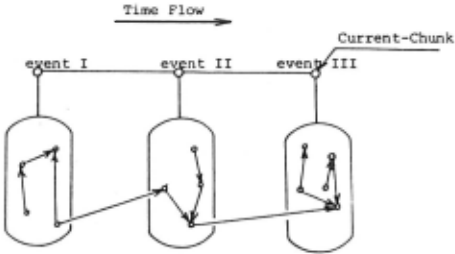
Fig.l Representation of Time-Oriented Data
In Fig.l, the newest time-chunk is EVENT-III. Therefor, inference rules originally applied for EVENT-III. In MECS-AI, inference rules can access to the data of past time-chunk. Data of EVENT-II or of EVENT-I may be referred to by rules which are applied for EVENT-III. If some data of EVENT-II or of EVENT-I do not have been known when it is referred to, the Target-Timechunk may be shifted temporary to EVENT-II or EVENT-I in order to infer the value first.
III REPRESENTATION OF RULES
In MECS-AI, rules are denoted in the following BNF syntax:
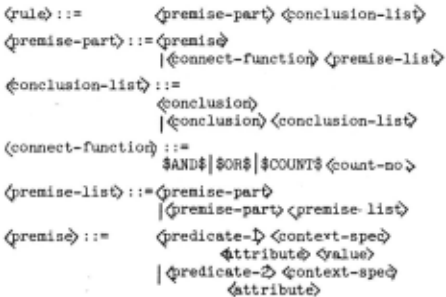
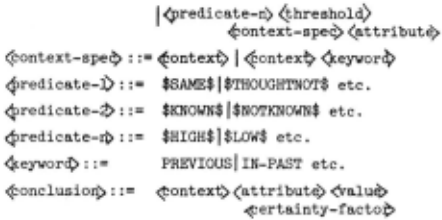
The time related information is given by the 4teywor~ part of the ¢ontext-spe~ · According to this syntax, rules which refer to the past data can be defined. Fig.2 shows an example of a rule which refers to the past data. Using this type of rules, the system is able to modify its conclusion according to the treatment or to the patient's status in the past. It is also possible to adopt "wait-and-see" strategy when diagnostic conclusion is not very clear.
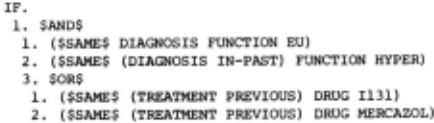
THEN.
1. (DIAGNOSIS !DENT WELL-TREATED-BASEDOW 0.7)
Fig.2 an Example of Rules referring past data
It is also noted that each attribute may be defined to have special datatype for its values, in MECS-AI. Datatype "UNIQUE" will be used for attributes which take only one valid value at one-time. Similarly, "MULTIPLE" is used for attributes which may take several values at one-time, and "NUMERICAL" is used for attributes which take numerical values. This kind of datatype definition is quite useful for data access, rule syntax check, and data inquery processes.
IV CONTROL STRUCTURES
In MECS-AI, as usual with the general knowledge engineering tools, the knowledge-base is separated from the inference-engine. Our system provides an inference-engine, but does not provide any knowledge-base by itself. Instead, it provides a knowledge-base editor to define and to modify knowledge-bases in any application field.
It is our special feature that the body of knowledge-base itself may be implemented as a collection of several number of knowledge-units, instead of one single knowledge-unit. Every knowledge-unit has an "apply-condition", and rules in a knowledge-unit are applied only when its apply-condition is satisfied. Fig.3 shows the whole structure of MECS-AI.
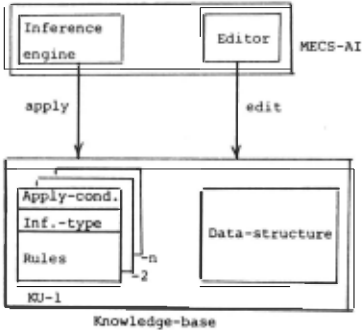
The user of MECS-AI can select "inference type" for each knowledge-unit. When "apply-all" is selected, rules in the knowledge-unit will be applied exorstively, while when a list of "(context at-ribute value)" is selected, rules in the knowledge-unit will be applied according to the backward chaining scheme to find out the (context attribute value) at the time of Target-Timechunk.
Adopting this control structure, rules belong t o certain knowledge-unit will never be applied if the apply-condition is not satisfied. And therefor mor e effective inference process can be realized.
This control structure is effective and adaptive for any inference systems.
V CONCLUDING REMARKS AND FUTURE PLANNING
We have descrived our approach to the time-oriented features for the medical consultation systems. We adopted a rather simple but efficient representat ion and management mechanism through the time-chunk and rule application scheme.
In MECS-AI, our features are cupsuled to be used as a general purpose tool for any knowledge engineering system that needs time-oriented capabilities. A knowledge-base editor is attached t o ease the application of MECS-AI to any field. Thi s editor is powerful in the sense that it can define or modify the data-structure, the knowledge-units, and their applicability.
The followings are known through the application of our method to a consultation system for thyroid diseases:
- The system can change the conclusion according to the treatments and patient's status in the past.
- The system can analyze the situation which cannot be handled only through the one-time consultation.
- (3 ) The system can adopt the powerful s trategy such as "wait-and-see".
Application of MECS-AI for other disease categories is now under cons ideration.
@inproceedings{ijcai1981p173,
  title     = {Time-Oriented Features for Medical Consultation Systems},
  author    = {Koyama, Teruo and Kaihara, Shigekoto and Minamikawa, Tadatoshi and Kurokawa, Toshiaki},
  booktitle = {Proceedings of the Seventh International Joint Conference on
               Artificial Intelligence, {IJCAI-81}},
  publisher = {International Joint Conferences on Artificial Intelligence},
  editor    = {Patrick J. Hayes},
  pages     = {910--911},
  year      = {1981},
  month     = {8},
  note      = {Medical Application},
  url       = {https://ijcai.org/proceedings/1981/173},
}
TY - CPAPER TI - Time-Oriented Features for Medical Consultation Systems AU - Koyama, Teruo AU - Kaihara, Shigekoto AU - Minamikawa, Tadatoshi AU - Kurokawa, Toshiaki T2 - Proceedings of the Seventh International Joint Conference on Artificial Intelligence, IJCAI-81 PB - International Joint Conferences on Artificial Intelligence PY - 1981 SP - 910 EP - 911 UR - https://ijcai.org/proceedings/1981/173 ER -Copied
Machine-readable versions of this paper, for tools and AI agents:
 Welcome
 Future Conferences
 AI Journal Division
 IJCAI Proceedings
 About IJCAI
 IJCAI Awards