
Layered Networks as a Tool for Software Development
Proceedings of the Seventh International Joint Conference on Artificial Intelligence. Programming Environments. Pages 913-918.
© 1981 International Joint Conferences on Artificial Intelligence
Abstract
Most software systems use simple text files to represent the current state of an evolving design . We propose that layered networks provide a much better medium to represent the design of a software system and its documentation . PIE is an experimental personal information environment which provides users with descriptive structures for documents and programs. In PIE, alternative designs for programs and documents can be examined and manipulated within the systems context structured database. This data base also facilitates cooperative design among several people.
- Birtwistle, G., Dahl, O.•J , Myhrhaug, B., and Nygaard, C., Simula Deg in, Auerb;Jch, Philadelphia, 1973.
- Coh en, 1975)
- Cohen, P., "Semantic Networks and the Generation of Context", Advance Papers of th e Fourth Interna tional Joint Conference on Artificial Intellig ence. Tsibilisi: (1975), 134-142. IJCAI
- Glasse r. 1978)
- Glasser, Alan l., "The Evolution of a Source Code Control System", in S. Jackson and J. Lockett (eds.), Proceedings of the Software Quality and Assurance Workshop, ACM, (1978) -pp . 122-125
- Goldstein & Bobrow, 1980)
- Goldstein, !.P. and Bobrow, D.G., "Descriptions for a Programming Environment", Proceedings of the First Conference of the American Association lor Artificial Intelligence, Stanford : (1980), 187 -189.
- Goldstein & Bobrow, 1981)
- Goldstein, I.P. and Bobrow, D.G.. "Browsing in a Programming Environment", Proceedings of the 14th Annual Hawaii International Conference on System Sciences, Honolulu: (1981) .
- Hendrix, 1975)
- Hendrix, Gary G., "Expanding the Utility of Semantic Networks Through Partitioning" , Advance Papers of the Fourth International Joint Conference on Artificial Intelligence, Tsibilisi: (1975), 115-121 . IJCAI
- Hewitt, 1971)
- Hewitt, C., "Description and Theoretical Analysis (Using Schemata) of PLANNER: A Language for Proving Theorems and Manipulating Models in a Robot" . Ph .D. Thesis (June, 1971) (Reprinted in AI-TR -258 MIT-AI Laboratory (April 1972.)
- Ingalls, 1978)
- Ingalls, Daniel H., "The Smalltalk-76 Programming System: Design and Implementation," Conference Record of the Filth Annual ACM Symposium on Principles of Programming Languages, Tucson, Arizona (January, 1978) pp 9-16.
- lvie, 77)
- lvie, E.L . "The Programmers Workbench .. A Machine for Software Development." Communications of the ACrvt, V. 20 No.10 (October 1977) pp 746-53
- Kay, 1974)
- Kay, A., SMALL TALK, "A Communication Medium for Children of All Ages". Palo Alto , California: Xerox Palo Alto Research Center, Learning Research Group (1974).
- Rochkind, 1975)
- Rochkind, Marc J., "The Source Code Control System", IEEE Transactions on Software Engineering (December 1975) pp 364 -370.
- Rulifson, 1971)
- Rulifson, J., Waldinger, R., and Derksen, J., "A Language for Writing Prohlem-Solving Programs", IFIP, 1971 .
- Sussman & McDermott, 1972)
- Sussman, G., & McDermott, D., " From PLANNER to CONNIVER • A Genetic Approach ". Fall Joint Computer Conference.
- Montvale, N. J.: AFIPS Press (1972).
References were extracted automatically from the PDF and may contain errors.
Full text extracted automatically from the PDF; figures, tables and equations may differ. The PDF is the version of record.
1. lnt roduction
The existence of a software problem is widely acknowledged: it is becoming progressively more costly to develop and maintain software systems. In this paper, we propose an application of AI technology, context sensitive databases, as a software development tool lor decreasing these costs. We argue that context sensitive databases provide a representation for the evolution of software that is superior to traditional file systems. We have explored th1s proposition by means of an experimental Personal Information Environment (PIE) that has been used to manage the evolut1on of various software designs in its host environment.
PIE stores software designs in networks whose nodes represent the modules, procedures and other entites of the design, and whose links represent relationships among them. Links are asserted in layers and retrieved with respect to a sequence of layers termed a context. A layer is therefore a set of <node,link,node> assertions and represents a set of related changes to a design, while a context represents a particular version . GoldsteinBobrowl30 provides a general introduction to the PIE system.
2. Previous Research in Artificial Intelligence
Various kinds of context sensitive databases have been explored in artificial intelligence research. They have primarily been used as a mechanism lor representing alternative world views. (See, lor example, Rulilson71 ; Hewitt71; SussmanMcDermott72; Hendrix 75; Cohen75). Generally the need to represent alternatives has arisen in planning programs. For example, a robot i~ analyzing alternative paths to reach some specified location. The terms contexts and layers are drawn directly from CONNIVER [SussmanMcDermott72).
Our application differs from previous AI research pnmarily in that previous applications focussed on the use of such databases by mechanical problem solvers. We are exploring the use of such databases in a mixed-initiative fashion with the user primarily responsible lor their creation and maintenance.
3. The Inadequacies of Files
Most computing environments use files to express alternative designs. Users record significant alternatives in files of different names; the evolution of a given alternative is recorded in files of the same name with different version numbers. We argue that this use of files provides an inadequate structure lor representing alternatives.
For example, consider how the development of the a software system consisting of several modules, where a module is a group of related procedures. Typically, the source code lor each module lor be stored m its own file .. say, files A, 1:3, .. . . II a programmer develops an alternative dr.sign that requires changes to several modules, how can he store this alternative? Typically, he would create files A', 8', ... .; ontaining the new definitions plus any unaltered coc;~ lor each module. The result is that the unaltered code is now stored redundantly. II subsequent development leads \o modifications to this unaltered code, then these modifications must be made in both sets of files. The need lor redundant editing becomes progressively worse as the number of alternatives grows.
How else might the programmer store his design if he wishes to avoid the need for redundant editing? One option is to place the common code into a separate file. Altering a given procedure common to more than one design would then take place in only one place. The cost of this storage strategy is that files would no longer serve to group related procedures of a design. Thus, to obtain design flexibility, the programmer would give up an equally important feature-modular representation.
Another option is to use conditional compilation statements in the original source code and avoid the need lor multiple files and the associated redundant storage. However, the problem of examining the set of changes common to a redesign is now complicated by the distribution of these changes across many files.
A related problem is coordinating change. The programmer must maintain descriptions of how various alternative designs are distributed among files. Sometimes this is done by adopting conventions in naming files, as we have implicitly done in naming the files lor our second design A', B', ... But such conventions are an impoverished means to describe a configuration and fail as the space of alternatives grows in complexity. Explicit descriptions of such configurations that do not depend on naming conventions are
preferable.
Finally, there is the problem that designs represented as configurations of files are not reflected in the operational software. The result is that it is cumbersome to examine the structure and performance of a design interactively w1thin the system. Switching from one design to another requires reading and writing the appropriate files.
Thus, the traditional use of files is unsuitable for representing alternative designs for three reasons. (1) Files are inflexible. Their utility to store modular parts of a design must be sacrificed to avoid redundant storage of shared structure. (2) File names are impoverished as a vehicle to encode the intended coordination between different files as part of a common design. (3) The representation of alternatives is not integrated into the running software environment.
4. Source Code Control Systems
To remedy the first of these deficiencies, editors have been developed that store changes of source code to a base file. The most extensively used of these is the Source Code Control System [Rochkind75; Glasser78] developed as part of the Programmer's Workbench for the UNIX system [lvie77]. In sees. changes are stored in terms of lines deleted and inserted in a file called a delta.
sees has the virtue that shared structured is not stored redundantly. A delta contains only changes. The description of a particular version of a system is specified by a delta sequence. The explanation for the differences between this version and earlier ones is stored in the comments associated with the new delta files. However the changes are still stored with respect to lines, and have no connection with units of the program as thought of by the programmer.
5. Smalltalk
PIE employs layered networks to manage software development for any project undertaken in its host environment, Smalltalk [lngalls76, Kay74]. To illustrate the system, we will briefly introduce Smalltalk, then describe a series of design exercises chosen to improve its implementation of the data structure for sets.
Smalltalk is an object-oriented language that extends the notion of class and instance found in Simula [Birtwistle73]. A class defines a group of procedures, termed methods, and a set of var;ables on which they operate. Each method is invoked by a message pattern. Every object is an instance of some class and stores particular assignments of values to the variables specified in the class.
Below is a partial listing of class Set. Message patterns are shown in boldface and their methods appear below and indented. The listing is incomplete: for example, the definition of the method for deleting elements from the set is not shown.
Class new tLtle: 'Set' Lnsta.nceVa.riables: 'a.rra.y n'
"Class Set employs a.n a.rra.y wlth. a. posi.ti.on polnter n to represent sets. Th.e objects of the set a.re stored ln th.e a.rra.y from positi.on 1 to n.'
lnLtLa.lLza.ti.on Protocol
ini.t
"This method is conuenti.onally execu.ted when a. new i-nstance of class Set is created. It LnLtia.l.i.zes the instance variabLes. The a.rra.y vari.a.bl.e is set to a.n array of size 6 and. n is set to O.''
[array f- Array init: 6. n f- 0.]
PubLLc ProtocoL
has: eLement
"TestLru;~ wh.eth.er an eLement belDn!)s to the set is accompliShed by LteratL_ru:J throuqh th.e fLrst n items i.n th.e array, checiHru:J for equalLty."
[forg i. from: 1 to: n dog . (i.fg eLement = (arra~:~tooku.p: L) th.eng [retu.rn: true]]. retu.rn: false J
insert: eLement
"A new eLement is added to th.e set Lf it is .not already present."
[ifg (self has: eLement) th.eng [retu.rn: false 1 elseg [self add: eLement]]
PrLva.te ProtocoL
aaa: eLement
"A new eLement is added by lDadLng it Lnto posLti.on n+l of th.e array _and. i-ncrementing th.e poLnter. Th.e array IS copLed mto a larger array Lf its free positi.ons are exhau.sted.''
(ifg n=(amu; Length.) th.eng [array f- array
growby: 10).
array insert: (nf-n+1) wLth.: eLement.]
PrLntLnq ProtocoL
"This method prints a set by prLntLng th.e strLng 'a. set'."
('a. set' prLnt.]
6. A Layered Redesign of Class Set
Our first design goal is to improve retrieval time by having the implementation convert from a sequential to a hashtable representation when the cardinality of the set exceeds some bound. The rationale for this redesign is that sequential access is less expensive in storage space and retrieval time when the set is small, but is not economic when the set is large.
We begin by generating a PIE description of the current implementation. PIE is able to generate a network describing any class in Smalltalk from the internal Smalltalk representation for the class. This network is stored as a collection of instances of class Node, a class we created to implement the behavior of a network database. The network generated from the initial implementation is stored in a new layer-say layer A. The layer is placed in a new context which we shall name the hashing context.
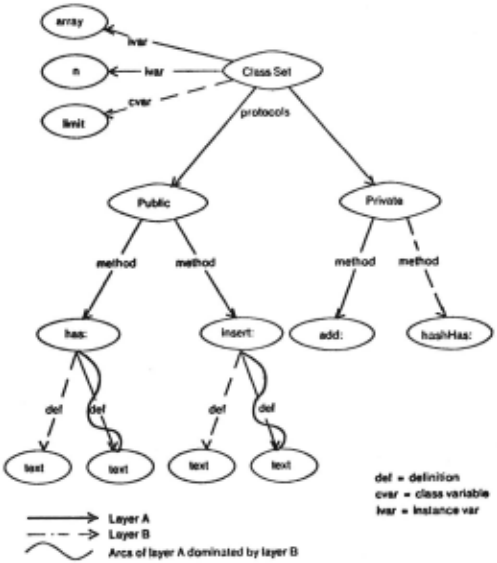
The next step in the design process is to define the changes to the present implementation. A layer is created and added to the context to store these changes. This is layer B in Figure 1.
Below is a PIE-generated listing of the redesigned class with respect to the hashing context . Only parts of the public and private protocols are shown and comments have been removed. PIE has been instructed to highlight new assertions, derived from layer 8, by printing them in boldface.
The listing shows a new type of variable in the class definition. limit is a class variable. The value of a class varia~le is available to all instances. limit is used to specify the s1ze at wh1ch the internal representation switches from sequential to hashed.
Class new rLrle: 'Set' in.sran.cevariables: 'arra\:1 n.' classVariables: 'Limit' Public Protocol has: element [if: n<llmlt then: [for: i trom: 1 to: n ao: lf: elerrumt = (array lookup: i) then: [return: true]]. return: false] else: [return: (self hashHas: element)]. insert: element [if: (self has: element) th£n:: [return: false]. i : n=ltmit th£n:: [self conuertf rom Seq uentiall oHash ]. if: n<Limlt then: [self add: element] eLse: [self hashActa: element].] Privare Prorocol ada: element [ifg n=<array length.) th£n: [array f- array growby: 10]. a.rra.y insert: (M-n+l) with.: element.] hashActa: element hashHas: elementThe user can test his design by installing the hashing context. Installation causes the Smalltalk interpreter to employ the definitions asserted in the specified context. These definitions are not immediately installed to prevent premature modification of the underpinnings of the system before a design is complete.
If further debugging is ·needed following installation, the programmer can create a new layer to store the changes to his design, then reinstall the context with this layer dominating the old layers. By placing the edits of each debugging session in a separate layer, the programmer can undo a set of changes that have proved unsatisfactory by removing the layer lrom the context and reinstalling.
Design exercises rarely consist of a single iteration through the design/debugging loop. In conducting this design exercise, a number of additional layers were added to the hashing context. For example, Layer C was added to correct the inconsistent treatment of the limit value. has: element treats limit as the lower bound of the hash representation while insert: element treats limit as the upper bound of the sequential representation. Layer C debugged the has: element procedure to use a ~ test for comparing the size of the set and the limit value.
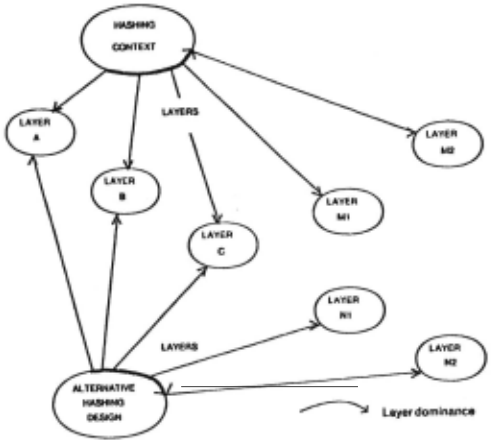
Layers facilitate the comparison of alternatives· For example, we considered different implementations of hashing in the redesign of class Set. Such analyses produced a network of ' '·Y~rs a:3 illustrated in Figure 2. The m and n layer sequences represent alternative designs.
E:asy switching facilitutcd our obtaining comparative pNformance measures for the oriyinal linear design and our mixed linear and hashing design for implementing set3. The parameters which determine performance of a set implementation arc: the number ot elements in a sel; the ratio of membership tests to insertion ond deletion; and the proportion of such tests which return false. With two tests for every onserllon, and 33'!1. returns of false, the choice of 7 for limit allowed the mixed design to dominate; with five tests for every insertion. limit should be 4 to provide overall better performance tor the mixed dcsigr
7. Redesigning the 1/0 Behavior of Sets
To illustrate the ability of layers to manage interacting designs, we continue our scenario by pursuing a second design goal. This goal is to improve the 1/0 behavior of sets. Specifically. the goal is for an instance of class Set to print showing its elements enclosed in braces, e.g. as {A,B} , if the size of the set is less than some bound. Presently all . instances of class set simply print as 'a set'. This redesign requires that we modify the printing method of class Set.
Before we make this change, we must decide where to store it. Since this is an independent modification of the code, our philosophy requires that we store these changes in a new layer, D. To make it easier to test and adopt the printing changes independently of the hashing changes, we create ~ new context, to be called the t.Jrinting context, lor these changes.
This context be(ns from the initial design of class Set and, therefore, its first layer should be the same as the first layer of the hashing context. If we examine or install this context, we get an implementation of class Set that only has the improved printing behavior. Layer D is added to the printing context to store the changes involved in this redesign. Below is the new method for printing sets stored in layer D.
[Lfg (self si.ze)<4 ttl£ n: [ '(' print. for: L from: 1. to: (self size) dog [(self element: L) print]. '}' print.] else: ['a. set' print.]]
This redesign becomes more interesting if we decide to include a modification to the Smalltalk reader that allows the string printed to be reread as a set. To accomplish this, we must modify the reader to recognize braces. We could put the required changes in layer D. Changes recorded in a layer can span module boundaries. But since the reader changes are independent of the altered printing behavior, it is better practice to put this set of modifications in a separate layer, say layer E. We can therefore test the two parts ol the design separately, i.e. we can first install layer D to examine the printing behavior, then install layer E to examine the reader.
Layer E could be placed in an entirely separate context, but since we presumably want to adopt both the changes to the reader and to the printing procedure, it makes sense to include this layer in the set printing contElxt. However, since the alterations are modularly stored in a layer, we leave open the option of creating a separate context to store changes to lhc readur that includes layer E.
The printing context now contains layers that make a coordinated set of changes to more than one module of the system: in this case, both the reader and a particular abstract datatype. This is not an unusual situation-despite a modular des1gn, some modifications inevitably cross module boundaries, since the modularity is based on a particular part1t1onong of the design space, and such partitionings are not un1que.
8 . Representing Contexts
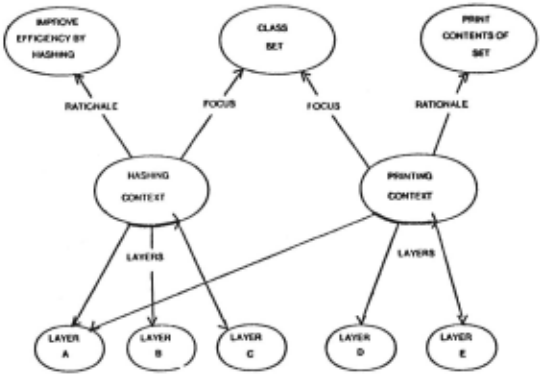
Layers and contexts are described by PIE in the same network as software is described. Figure 3 shows part of the network representing the hashing and printing contexts. The rationale attribute links a layer or context to a textual description of its purpose and the focus attribute points to the major classes being modified by the des1gn. The layers attribute of a contex· node points o a :;equence of nodes representing the layers.
Describing layers and contexts in the network has two advantages. First, the user can search for a layer or context using the general network match!n~ machinery provided by PIE. A search is initiated by spec1fymg a descnp!IOn of some node in terms of constraints on the values of its attributes. Thus a user can search for a node representing a context whos'e focus is class Set and whose rationale includes the subString 'hashing·. The network description escapes th_e limitation of file systems in which the name of a f1le IS burdened with the description of the file. Second, the user can manipulate layers and contexts using the same network operations used to manipulate code-i.e. the add1t1on, delet1on or modification of the attributes of nodes.
9. Composite Contexts
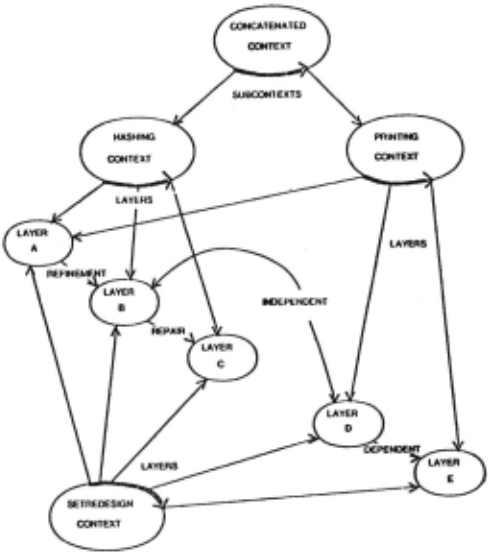
After we have debugged our two redesigns of class Set, we will want to combine them. We can do this by creating a composite context built from the layers of the ex1st1ng contexts. This is the Se/Redesign context shown m F1gure. 4. We have not simply concatenated the layers of the hashmg and printing contexts. This would produce the sequence: A, B, c, A, D, E. The second occurrence of layer A would inadvertently dominate the changes m layers B and C.
We may wish to impose the constraint that if new layers are added to the hashing or printing contexts, then they are automatically included in the composite context. This can . be accomplished by a capability that PIE prov1des for dehnmg procedures that are attached to nodes. These procedures are triggered by adding or deleting attributes of the node. By defining such a procedure and attaching it to the laye_rs attribute of the hashing and printing contexts, we can have 1t synchronize these contexts with the composite context.
Concatenating new layers of the printing context to the hashing context is justified by the independence of the pnn!lng and hashing refinements. This is therefore a useful comment to include in the network. Figure 4 illustrates various design comments. Layers B and D are commented as independent refinements, layers D and E as dependent refinements and layer e as a repair for layer B. When layers are combined into new contexts, these comments are checked and the user is alerted to questionable combinations such as adding a layer without its subsequent repairs. This description also allows other programmers to examine the network of contexts and layers and understand their relationships.
Interactions between design decisions can lead to confficting values in two layers. In sees, conflicts are noticed only to the extent that two modifications touch the same line of code. In PIE, the granularity of detected overlap is at the level of the method; if two layers have changed the same method, then there is a potential conflict. In addition, we have in PIE a mechanism for explicitly expressing dependencies among a number of methods. This allows us to find some potential interactions when there is no structural overlap.
To resolve conflicts between layers, a new layer could be added to the composite context that resolved any differences in design decisions. This layer would only apply to the composite design and not to the individual designs since it would not be include€! in their contexts.
Finally, we could have created a composite context. The concatenated context in Figure 4 is such a context . PIE treats the layer sequence of such a context as the concatenation of the layer sequences of its sub-contexts. This combination strategy is appropriate when the constituent contexts are independent. But here, the common use of layer A makes it inappropriate.
10. Communicating Contexts
We have discussed this design project so far from the standpoint of an individual programmer. But many projects are collaborative. Layers facilitate cooperative design by supporting on-line interaction that is analogous to two programmers scribbling on a common listing. · One programmer can transmit to another programmer a set of changes to the first programmer's design by sending a layer. PIE suppl ies comparison functions for identifying the changes between layers. Below is a PIE-generated listing of class Set with respect to the redesi~Jn context plus a layer transmitted by a collaborator. The collaborator's layer redefines the has: element procedure and includes an annotation stating the rationale for the change.
Class new title: 'Set' in.srancevariables: 'array n.' classVariables: 'limit'
P~tblic Fun.crion.s
hus: element
[ifg (self si.ze)<limit theng [return: (self seq Has: element)] elseg [return: (self nashHas: element)].
Annotation from Danny received 4/1/BO, 3:15pm: I think that a more_ subroutinized definition wtU pay off tn the IDntJ run.
The advantages of this level of intimacy in communication would not ordinarily be sufficient to offset the disadvantages that might arise from an unwanted intrusion by the sender mto the recipient's workspace. A programmer might be JUstlfmbly relucant to load a file from a collaborator dmxtly mto h1s workspace. Despite the appeal of being able to examiu~ ihe new software with design tools in the software enwonment, the software n1ay contain modifications that overlap and interfere with software developed by the programmer.
Layers avoid this problem. The sender's modifications are contained in a separate layer. Hence, they can be loaded without destroying changes stored in separate layers. The user can install then, examine their performance, then undo them if desired simply by deleting the layer from his context.
11. Complex Designs
Massive redesigns can involve changes to hundreds of nrocedures distributed over dozens of modules. We believe ihat the machinery described here for layers and contexts provides capabilities that are suitable for such complex real world software problems based on our analys1s of the deficiencies of present source control systems.
As with systems like Sees and unlike systems that store the entire source code lor a package in a sinule file. we store a set of chanyes modularly with very little redundant information. This allows forks in designs to b~ explored and facilitates the creation of specialized configurations from selected subsets of the layers.
Unlike SCCS, we represent sollware and design configurations in a network that has important structural advantages over textual descriptions. First, the network supports a representation in which there is a na'·Jral locus for all of the properties of a given object including both source and compiled code-such properties would typically have to be distributed across a textual listing or even across different files. A designer can readily examine all of the J.lropcrties of some object by interrouating the network. Second, a network allows us to move two ways across a link. Thus we can move from the nodes describing variables to thei r classes or vice versa. A designer can therefore traverse the network to explore some the consequences of a reclesiun. Third, the forrnalized descriplions of a network support search and matching operations to find desired objects of a design, including layers and contexts themselves. r-ourth, the network facilitates the formation of various kinds of composite designs. Hierarchical file directories provide some aid of this kind for file-based source code systems, but are less powerful than the network architecture of PIE. Finally, the network strictly dominates text since a node can have a source code attribute that points at text describing the software.
12. Conclusions
PIE's ability to represent alternative designs comes at the price of a more complex representation. For this price to be affordable, the user interface must simplify the presentation and manipulation of the database. In this paper however, we have not had the room to describe the display interlace we use. An extended discussion can be found in GoldsteinBobrow81 . In that paper, we also discuss the use of additional description provided in the network to specify reasonable default behavior for the interface.
PIE is currently running with excellent response time on a Dorado, a high speed micro-programmable personal computer that runs Smalltalk at approximately one million instructions/second [LampsonPier 80). The response time is perceived in terms of the time to refresh the display interlace following a new selection-a user perceives little or no delay. The criticial limitation of the present Smalltalk implementation is the size of its virtual memory. Smalltalk· 76 [lngalls78) supports an address space of only 48,000 objects. This includes all of the objects defining Smalltalk itself. As a result, there is insufficient space to build large PIE networks. No more than 1 ,000 nodes can be in the local address space at any one time. Since there are approximately 3,000 methods in Smalltalk, it has not been possible to build a PIE network describing the entire Smalltalk system. A new Smalltalk implementation soon to be available has a 31-bit virtual memory. Given this capacity, the possibility exists of transforming PIE from its present experimental status to a permanent part of Smalltalk's programming environment.
The techniques described in this paper have been tested in the context of the Smalltalk programming environment. However, they can be applied to any programming system that provides a layered network database and an interactive display interface. We believe that the payoff of such databases for software design and development will more than justify their cost in terms of retrieval time and storage.
19. Bibliography
- (Birtwistle, 1973) Birtwistle, G., Dahl , O.·J , Myhrhaug, B., and Nygaard,
C., Simula Degin, Auerb;Jch, Philadelphia, 1973.
[Cohen, 1975) Cohen, P., "Semantic Networks and the Generation of Context", Advance Papers of the Fourth International Joint Conference on Artificial Intelligence. Tsibilisi : (1975), 134-142.
- [Glasser. 1978)
Glasser, Alan l., "The Evolution of a Source Code Control System", in S. Jackson and J. Lockett (eds.), Proceedings of the Software Quality and Assurance Workshop, ACM, (1978) -pp. 122-125
[Goldstein & Bobrow, 1980) Goldstein, !.P. and Bobrow, D.G., "Descriptions for a Programming Environment", Proceedings of the First Conference of the American Association lor Artificial Intelligence, Stanford: (1980), 187-189.
- [Goldstein & Bobrow, 1981) Goldstein, I.P. and Bobrow, D.G.. "Browsing in a Programming Environment", Proceedings of the 14th Annual Hawaii International Conference on System Sciences, Honolulu: (1981) .
- [Hendrix, 1975)
Hendrix, Gary G., "Expanding the Utility of Semantic Networks Through Partitioning" , Advance Papers of the Fourth International Joint Conference on Artificial Intelligence, Tsibilisi: (1975), 115-121 .
- (Hewitt, 1971) Hewitt, C., "Description and Theoretical Analysis (Using Schemata) of PLANNER: A Language for Proving Theorems and Manipulating Models in a Robot" . Ph.D. Thesis (June, 1971) (Reprinted in AI-TR-258 MIT-AI Laboratory (April 1972.)
[Ingalls, 1978) Ingalls, Daniel H., "The Smalltalk-76 Programming System: Design and Implementation," Conference Record of the Filth Annual ACM Symposium on Principles of Programming Languages, Tucson, Arizona (January, 1978) pp 9-16.
[lvie, 77) lvie, E.L. "The Programmers Workbench .. A Machine for Software Development." Communications of the ACrvt, V. 20 No.10 (October 1977) pp 746-53
[Kay, 1974) Kay, A., SMALL TALK, "A Communication Medium for Children of All Ages". Palo Alto, California: Xerox Palo Alto Research Center, Learning Research Group (1974).
- [Rochkind, 1975)
Rochkind, Marc J., "The Source Code Control System", IEEE Transactions on Software Engineering (December 1975) pp 364-370.
- [Rulifson, 1971) Rulifson, J., Waldinger, R., and Derksen, J., "A Language for Writing Prohlem-Solving Programs", IFIP, 1971 .
- [Sussman & McDermott, 1972) Sussman, G., & McDermott, D., "From PLANNER to CONNIVER · A Genetic Approach ". Fall Joint Computer Conference. Montvale, N. J.: AFIPS Press (1972).
@inproceedings{ijcai1981p174,
  title     = {Layered Networks as a Tool for Software Development},
  author    = {Goldstein, Ira P. and Bobrow, Daniel G.},
  booktitle = {Proceedings of the Seventh International Joint Conference on
               Artificial Intelligence, {IJCAI-81}},
  publisher = {International Joint Conferences on Artificial Intelligence},
  editor    = {Patrick J. Hayes},
  pages     = {913--918},
  year      = {1981},
  month     = {8},
  note      = {Programming Environments},
  url       = {https://ijcai.org/proceedings/1981/174},
}
TY - CPAPER TI - Layered Networks as a Tool for Software Development AU - Goldstein, Ira P. AU - Bobrow, Daniel G. T2 - Proceedings of the Seventh International Joint Conference on Artificial Intelligence, IJCAI-81 PB - International Joint Conferences on Artificial Intelligence PY - 1981 SP - 913 EP - 918 UR - https://ijcai.org/proceedings/1981/174 ER -Copied
Machine-readable versions of this paper, for tools and AI agents:





