
Representation of Dynamic Clinical Knowledge: Measurement Interpretation in the Intensive Care Unit
Proceedings of the Sixth International Joint Conference on Artificial Intelligence. .
© 1979 International Joint Conferences on Artificial Intelligence
Abstract
This paper reports work in progress on a program to provide diagnostic and therapeutic suggestions about patients in the Intensive Care Unit (ICU). The Ventilator Manager program (VM) dynamically interprets the clinical significance of quantitative data from the !CU. This data is used to manage post-surgical patients receiving mechanical ventilatory assistance. An extension of a physiological monitoring system, VM (1) provides a summary of the patient's physiological status appropriate for the clinician, (2) recognizes untoward events in the patient/machine system and provides suggestions for corrective action, (3) suggests adjustments to ventilatory therapy based on a long-term assessment of the patient status and therapeutic goals, (4) detects possible measurement errors, and (5) maintains a set of patient-specific expectations and goals for future evaluation. The program produces interpretations of the physiological measurements over time, using a model of the therapeutic procedures in the ICU and clinical knowledge about the diagnostic implications of the data. These therapeutic guidelines are represented by a knowledge base of rules created by clinicians with extensive ICU experience.
- Davis, R. and King, J. "An Overview of Production Systems." in Machine Intelligence 8: Machine Representations of Knowledge, ed.
- Elcock, E. and Michie, D., John Wylie, 1977.
- Gorry, G., Silverman, H. and Pauker, S. "Capturing clinical expertise: a computer program that considers clinical responses to digitalis." Amer. J. Med 64 (1978) w. 452-460.
- Osborn, J., Beal.lllOnt, ,J., Raison, J. and Abbott R. "Computation for Quantitative On-Line Measurement in an Intensive Care Ward," Computers in Biomedical Research 3 1969.
- Shortliffe, E. Computer-based medical consultations: Mycin, American Elsevier, New York, 1976.
- Trigoboff, M. and Kulikowski, C: "IRIS: A System for the Propagation of of Inferences in a Semantic Net." In Proc. IJCAI-77. MIT, Cambridge, Mass., August, 1977.
- van Melle, W. "A Domain-Independent Production Rule System for Consultation Programs." In Proc. IJCAI-79. IJCAI
- Tokyv, Japan, August, 1979.
- Waterman, D. and Hayes-Roth, F. "An Overview of Pattern-Directed Inference Systems." In Pattern-Directed Inference Systems, ed.
- Waterman, D. and Hayes-Roth , F. Academic Press, 1978, pp. 3-22.
- Weiss, S., Kulikowski, C., a~ Safir, A. "A Model-Based Method for Computer-Aided Medical Decision-Making." Artif. Intel!. 11 (1978).
References were extracted automatically from the PDF and may contain errors.
Full text extracted automatically from the PDF; figures, tables and equations may differ. The PDF is the version of record.
1. 0 INTRX>UCTION
Many of the artificial intelligence approaches to medical decision making have concentrated on providing advice based on data available at one particular point in time. This formulation of the problem treats the diagnostic process as a static situation. In actual practice, the clinician receives additional information from tests and observations over time and must reevaluate hypotheses about the nature of the diagnosis and reevaluate the status and prognosis of the patient. The patient situation is affected by the progression of the disease process and the response to prior therapeutic interventions. Some of these aspects have been captured in current computer medicine work, particularly the digitalis therapy advisor [2]. This system generates conclusions over time pertaining to the size and timing of the next dose of digitalis. Both the MYCIN [4] and CASNET systems (8] allow the user to rerun a consultation as new patient information becomes available. The IRIS system [5] is capable of attaching a time specification to each conclusion created by the system, consisting of a m.meric or s}'l'l'bolic time range when the conclusion was applicable.
* This research is supported by the NIH under
GM-24669, and utilizes the SUMEX-AIM computing resource (NIH RR-00785) . We wish to thank Bruce Buchanan, Dianne ~Clung, Penny Ni i, and Josh Rubin for their help on this project.
One attempt to explore these issues is the development of the Ventilator Manager (VM) program, which provides diagnostic and therapeutic advice in the Intensive Care Unit. The input to VM are the values of 30 physiological measurements provided on a 2- or 10-minute basis by a automatic monitoring system [3]. The output is in the form of suggestions to clinicians and periodic
sumnaries.
The clinical situation being modeled is the post-surgical progress of a patient in the Intensive Care Unit, concentrating on the status of his mechanical breathing assistance. The mechanical ventilator provides total or partial assist of ventilation for seriously ill patients. The type and settings of the ventilator are adjusted to match the patient's intrinsic breathing ability. The "vol1..111e" mechanical ventilator provides a fixed vol1..111e of air under pressure through a tube to the patient. The ventilator can be adjusted to provide breaths at fixed intervals called "controlled mandatory ventilation" or in response to sucking by the patient, known as "assist mode." Adjustments to the respiration rate or output volume of the ventilator are
made to insure an adequate "minute volume" to the patient. When the patient·s status improves, the mechanical ventilator is disconnected arrl replaced by a "t-piece" that connects an oxygen supply with the tube to the patient's lungs. If the patient can demonstrate adequate ventilation then the tube is removed ("extubation"). Often many of these clinical states must be repeated until the patient can breathe on his own.
2.0 Knowledge representation
The availability of new measurement data requires updated interpretations based on the changing values and trends. As the patient setting changes--e.g., as a patient starts to breathe on his own during removal (weaning) from the ventilator--the same measurement values can lead to different interpretations. In order to properly interpret data collected during changing therapeutic contexts, the knowledge base inclooes a model of the stages that a patient follows from admission to the unit through the end of the critical monitoring phase. Recognition and utilization of the appropriate patient context is an essential step in determining the meaning of most physiological measurements. The goals for patient management are also stated in terms of these clinical contexts. The program maintains a description of the current and optUnal ventilatory therapies for any given tUne. Figure 1 shows a summary of conclusions generated by the program on a periodic basis (currently one hour).
Current conclusions: HYPC!I'ENSICN PRESEm' for 41 MINl1I'ES HYPERVENI'ILATION PRESEm' for 33 MINUTES SYSIDLIC BL(X)!) PRESSURE I..Dil for 46 M:rm_n:ES
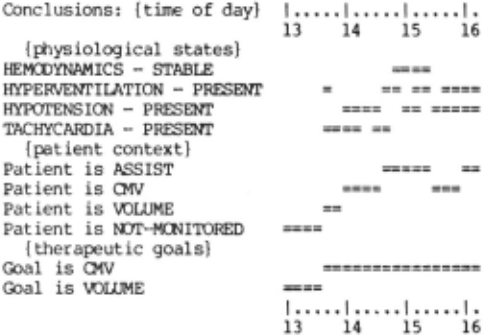
Figure 1. Summary prepared by VM based on data from a patient in the ICU. Comments are in {}, Knowledge is represented in VM by production rules [4,1,7]. The rules are of the form:
IF facts about measurements and/or previous conclusions are true
THEN
- Make a conclusion based on these facts;
- Make appropriate suggestions to c1 inicians; and
- Create new expectations about future acceptable ranges for measured variables.
Additional information associated with each rule inclooes: the symbolic name and type or rule group (e.g., instrument fault rules); main concept (definition) of the rule; and all of the therapeutic states in which it makes sense. Figure 2 shows a sample rule for determining hemodynamic stability,
STATUS RJLE: STABLE-HEMODYNAMICS
DEFINITION: Defines stable hemodynamics for most settings
APPLIES to patients on VOLUME, CMV, ASSIST, T-PIECE
COMMENT: Look at mean arterial pressure for changes in blood pressure and systolic blood pressure for maxUnum pr.essures,
IF
HEARl' RATE is ACCEPTABLE
PULSE RATE does NOT CHANGE by 2~ beats/minute in 15 minutes
MEAN ARI'ERIAL PRESSURE is ACCEPTABLE
MEAN ARI'ERIAL PRESSURE does NOT CHANGE by 15
torr in 15 minutes
SYSTOLIC BUX)[) PRESSURE is ACCEPTABLE THEN
The HEMODYNAMICS are STABLE
Fiqure 2. Sample VM Interpretation Rule.
2.1 Treating Measurement Ranges Symbolically
Most of the rQles represent the measurement values symbolically, using the terms "acceptable" or "ideal" to characterize the appropriate ranges. The actual meaning of "acceptable" changes as the patient moves from state to state, but the statement of the relation between the physiological measurements remains constant. The use of symbolic statements (e.g., "heart rate is acceptable") allows for a sUnple representation of common clinical practice and the exposition of common principles of physiological interpretation in different contexts. In addition, it minimizes the ni.Jllber of rules needed to describe t.he complexity of the diagnostic situation.
The meaning of the symbolic range is determined by rules that establish the context-dependent expectations about the value of measured data. For example, when a patient is taken off the ventilator, the upper limit of acceptability for the expired carbon dioxide measurement is raised. The actual nuneric calculation of "expired C02 high" in the premise of any rule will change when the context switches (removal from ventilatory support) , but the statement of the rules remains the same. An example rule that creates these expectations is shown in Figure 3.
IF PATIENT TRANSITIONED FI01 ASSIST 'ID CMV 'mEN EXPECT mE FOI...ILWING
| [ acceptable range 1 | ||||||
|---|---|---|---|---|---|---|
| very | [ ideal 1 | very | ||||
| low | low | min | max | high | high | |
| MEAN PRESSURE | 60 | 75 | 80 | 95 | 110 | 120 |
| HEART RATE | 60 | 110 | ||||
| EXPIRED C02 | 22 | 28 | 30 | 35 | 42 | 50 |
Figure 3. Portion of an Initializing Rule. This rule establishes initial expectations of acceptable and ideal ranges of variables. Not all ranges are defined for each measurement.
The VM knowledge base includes rules to support the following reasoning steps: (l) characterize measured data as reasonable or spurious: (2) determine therapeutic state of the patient (currently the mode of ventilation): (3) establish expectations of future values of measured variables: (4) check physiological status, including cardiac rate, hemodynamics, ventilation, oxygenation: and (5) check compliance with long-term therapeutic goals.
3. 0 RULE INI'ERPRETATION
The VM rule interpreter is based on the EMYCIN interpreter [6,41. The major changes are: forward chaining (data-driven) rule invocation as opposed to backward chaining, checking to see that information acquired in a previous time frame is still valid for making conclusions, and the ability to cycle through the rule set each time new information is available.
A data-driven awroach is used to take crlvantaqe of the snall set of measurement values available in each time frame. Because of the nature of the ICU environment, one can assume almost no dialogue will take place with clinicians when they are using the system. Thus, conclusions must be based on the available data. Each of the rule groups corresponding to the reasoning steps mentioned above are considered in order. It is necessary to separate out the reasoning steps since one part of the reasoning chain may conclude that the clinical context has changed, affecting the interpretation of the more "abstract" reasoning steps.
Identical conclusions made in contiguous time frames are represented by the interval specified by the times of the first and last assertion. A list of these intervals summarizes the history of a particular conclusion over time. The evaluation of a rule clause such as "Patient hyperventilating for the past 30 minutes" is merle by direct examination of the time intervals stored along with conclusions as OI=PC>sed to looking at the or ig ina 1 measurements. Expectations are associated with the awropriate measurement and are cl.assified by type-e.g. , the · upper 1 imi t of the acceptable range--and duration. Expectations can persist for a fixed interval, such as "for twenty minutes starting in ten minutes," or for the duration of one or more clinical contexts.
4. 0 REFERENCES
- [11 Davis, R. and King, J. "An Overview of Production Systems." in Machine Intelligence 8: Machine Representations of Knowledge, ed. Elcock, E. and Michie, D., John Wylie, 1977.
- (2] Gorry, G., Silverman, H. and Pauker, S. "Capturing clinical expertise: a computer program that considers clinical responses to
- digitalis." Amer. J. Med 64 (1978) w. 452-460. [31 Osborn, J., Beal.lllOnt, ,J., Raison, J. and Abbott R. "Computation for Quantitative On-Line Measurement in an Intensive Care Ward," Computers in Biomedical Research 3 1969.
- [41 Shortliffe, E. Computer-based medical consultations: Mycin, American Elsevier, New York, 1976.
- Trigoboff, M. and Kulikowski, C: "IRIS: A System for the Propagation of of Inferences in a Semantic Net." In Proc. IJCAI-77. MIT, Cambridge, Mass., August, 1977. [6] van Melle, W. "A Domain-Independent Production Rule System for Consultation Programs." In Proc. IJCAI-79. Tokyv, Japan,
- August, 1979.
- (71 Waterman, D. and Hayes-Roth, F. "An Overview of Pattern-Directed Inference Systems." In Pattern-Directed Inference Systems, ed. Waterman, D. and Hayes-Roth , F. Academic Press, 1978, pp. 3-22.
- [81 Weiss, S., Kulikowski, C., a~ Safir, A. "A Model-Based Method for Computer-Aided Medical Decision-Making." Artif. Intel!. 11 (1978).
@inproceedings{ijcai1979p58,
  title     = {Representation of Dynamic Clinical Knowledge: Measurement Interpretation in the Intensive Care Unit},
  author    = {Fagan, Lawrence M. and Kunz, John C. and Feigenbaum, Edward A. and Osborn, John J.},
  booktitle = {Proceedings of the Sixth International Joint Conference on
               Artificial Intelligence, {IJCAI-79}},
  publisher = {International Joint Conferences on Artificial Intelligence},
  editor    = {Bruce G. Buchanan},
  year      = {1979},
  month     = {8},
  url       = {https://ijcai.org/proceedings/1979/58},
}
TY - CPAPER TI - Representation of Dynamic Clinical Knowledge: Measurement Interpretation in the Intensive Care Unit AU - Fagan, Lawrence M. AU - Kunz, John C. AU - Feigenbaum, Edward A. AU - Osborn, John J. T2 - Proceedings of the Sixth International Joint Conference on Artificial Intelligence, IJCAI-79 PB - International Joint Conferences on Artificial Intelligence PY - 1979 UR - https://ijcai.org/proceedings/1979/58 ER -Copied
Machine-readable versions of this paper, for tools and AI agents:





