
Heuristics for Knowledge Acquisition from Maps
Proceedings of the Sixth International Joint Conference on Artificial Intelligence. .
© 1979 International Joint Conferences on Artificial Intelligence
Abstract
Acquiring knowledge from a map depends upon procedures for focusing attention, encoding information, and integrating diverse knowledge. This paper describes the heuristics people use to study and learn maps. Verbal protocols obtained from eight subjects suggested four categories of procedures that w~re invoked during learning: attention, encoding, evaluation, and control. The use of certain heuristics in each category was highly predictive of learning success. Good learners differed from poor learners in their ability to encode spatial information, to evaluate their learning progress, and to focus their attention in accordance with a learning plan. Many of the successful heuristics appear to be readily trainable.
- Ballard, D.H., Brown, C.M., & Feldman, J.A. "An Approach to Knowledge-Directed Image Analysis." Proc. IJCAI-77, Cambridge, Massachusetts, 1977, 664-670.-- IJCAI
- Hackworth, A.K. "On Reading Sketch Maps." Proc. IJCAI-77, Cambridge, Massachusetts, 1977, 598-60-6-. - --
- Marr, D. "Representing Visual Information." AIM 415, Massachusetts Institute of Technology, Artificial Intelligence Laboratory, May 1977.
- Norman, D.A. & Bobrow, D.G. "On Data- Limited and Resource-Limited Processes." Cognitive Psychology, 1975, z, 44-64.
- Thorndyke, P.W. & Stasz, C. Individual Differences in Knowledge Acquisition from Maps, R-2375-0NR, The Rand Corporation, Santa Monica, California, 1978.
- Thorndyke, P.W . & Stasz, C. Training Strategies for Map Learning. N-1018-0NR, The Rand Corporation, Santa Monica, California, 1979.
References were extracted automatically from the PDF and may contain errors.
Full text extracted automatically from the PDF; figures, tables and equations may differ. The PDF is the version of record.
1. INTRODUCTION
Any image processing system, whether human or machine, must translate the information in the sensory display into a meaningful internal description of the sensory image [1, 3]. This paper investigates how humans acquire knowledge from geographic maps. AI studies of map learning [2) have emphasized the use of cartographic knowledge to guide segmentation and interpretation of map features. The present study, in contrast, focuses on the high-level procedures that people use to select, combine, and encode map information in memory. I shall refer to these procedures as heuristics to emphasize the variety of available techniques and the lack of prescriptive learning methods. The research goal is to develop a theory of expertise in map learning by analyzing differences between good and poor learners in terms of differences in their learning heuristics.
~ - THE KNOWLEDGE ACQUISITION PROCESS
Figure 1 schematizes the knowledge acquisition process. The maps used in this study contain a variety of conceptual "elements" (e.g., buildings, roads, parks) . Each element has both spatial extent (shape and location relative to adjacent elements) and a linguistic label . Because map learning is an active, intentional process, it resembles a problem solving task. The goal state corresponds to a complete memory description of the map (shown at the top of the figure), and the problem solving operators are the heuristics the learner applies to produce the memory representation. These heuristics regulate the flow of information and determine how it wil l be encoded in memory.
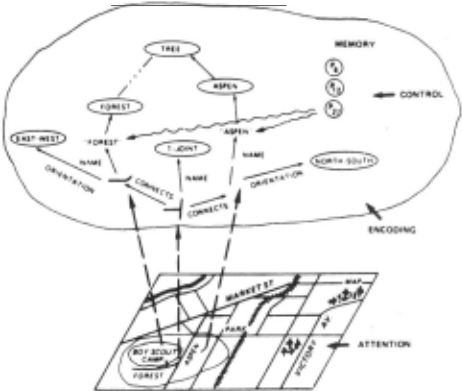
Attentional heuristics restrict the set of information on the map that the learner focuses on at any point in time, as illustrated in the lower portion of the figure. Encoding heuristics elaborate the information currently in focus and integrate it with other information from the map and knowledge already in memory. For example, one such procedure
(P27) might form a semantic association between the names Aspen Road and Forest Road using knowledge about their common property "trees."
Since the processing capacity (i.e., the upper bound on processing effort, size of working memo ry, communication channel capacity, etc.) is limi ted (4], only a subset of the available procedures are concurrently active . Therefore, contro l heuristics oversee the selection, activation , and scheduling of competing encoding and attentional procedures .
3. ANALYSIS OF LEARNING HEURISTICS
To identify the heuristics that people actually use, Cathy Stasz and I (5] collected verbal protocols from eight subjects attempting to learn rea l maps . On each of six trials, subjects would first study a map for two minu tes and then attempt to reconstruct the map from memory. During the study period subjects thought out loud, describing their attentional focus, their study heuristics, and their evaluations of their learning progress.
Four gene ral types of processes emerged from the protocols : attention, encoding, evaluation, and control . These processes and the heur istics subjects used to implement them are descri bed briefly below.
Attentional processes included those by which s ubjects restricted eye fixations to a par ticular subset of the map (focus of at tention) and shifted their focus of attention to a new location (attention switching). Two types of attentional heuristics were observed. The first of these, partitioning, was a procedure for focusing attention on a subset of the map information. Since a map contained too much information to be assimilated on any one tria l, partitioning the map enabled a learner to attend selectively to a well-defined aspect of the map . Subjects partitioned the map either by (a) spatial region (e.g., by at tending only to elements in the north of Market Street) or (b) by conceptual category (e. g., by attending only to the streets on the map) .
The second type of attentional process compri sed sampling heuristics. These procedures determined shifts in a subject's focus of at tention among various map elements . Systema tic sampling involved shifting attention according to a subject-defined algorithm (e . g., studying element~ from west to east). Stochastic sampling involved shifting the focus of attention to an immediately adjacent e lement, but in no systematic or consistent direction. In random sampling the focus of attention jumped haphazardly around the map, with the new focus seemingly independent of the previous focus in both location and content. Memory-directed sampling occurred when a subject decided to study particular elements that had not yet been learned. For example, at the beginning of a new study trial, a subject might study the location of a river because s/he could not remember it on the previous recall trial .
When information was in a subject's focus of attention, various heuristics could be used to elaborate and encode the information in memory. These heuristics may be divided into those that operated primarily on verbal or linguistic information and those that operated primarily on shapes and location information.
Three verbal learning heuristics were observed . Counting helped subjects to cluster several elements sharing a particular property (e.g., "there are two parks on Victory Avenue"). Mnemonics were used to generate easily memorable retrieval cues for a set of names, such as "BUD," the order of the three structures on Market Street: bank, undertakers, and ~epartment store. The -association heuristic involved the elaboration of the map information by association to or embellishment with some related prior knowledge. For example, one subject noted that Forest and Aspen Roads
were both names for "trees . "
Similarly, several heuristics for learning spatial information were observed. Visual imagery was a learning technique in which subjects constructed mental images of portions of the map . During study some subjects closed their eyes and attempted to draw shapes or name elements in a mental image and reported attempts to form a mental picture of some portion of the map. Labeling involved the generation of a verbal label for a complex spatial configuration. For example, a subject might notice that the three streets in the northwest corner of the map resembled the mathematical symbol pi. In pattern encoding a subject would notice a particular low-level shape or spatial feature of an element, such as Victory Avenue curving to the east. Finally, the relation encoding heuristic refers to the creation of a spatial relation between two or more elements. For example, one subject stated that Victory Avenue is "below the golf course" and is "parallel to Johnson. "
The third type of process evident in the protocols was evaluation. Subjects would monitor their learning progress by considering what they had already learned and what they still needed to study. In particular, they would focus on an element and then determine whether or not they had learned it well enough to recall it later. This evaluation required a search and retrieval of information from memory and a comparison of that information to the representation on the map of the target element. When subjects decided they had not learned the information, they might then decide to study the element using one of the elaboration heuristics.
Finally, presumably control or directed executive the overall processes flow of processing. Since processing capacity is limited . Only a subset of the processes can be active simultaneously. The control processes include a mechanism for selecting from a set of available heuristics those to be activated (selection) and a mechanism for deciding when to deactivate a heuristic and switch to a new one (switching). For example, several subjects began to study a map with an unrestricted random sampling heuristic and then switched to a more selective partitioning heuristic.
4. ANALYSIS OF INDIVIDUAL DIFFERENCES
For each subject, the accuracy of the maps reproduced after each of the six study trials was computed as the proportion of map elements whose name and location were correctly recalled. Performance ranged widely from 94% of the map elements correct after only four trials to 39% correct after six trials.
The protocols of the successful learners (three subjects who recalled at least 90% of the elements correctly) were directly contrasted with those of the other five learners. For each subject the number of occurrences of each heuristic in the subject's six study protocols was computed. While subjects did not vary in how many heuristics they used, they did vary in which heuristics they used. The major differences between good and poor learners' use of heuristics are summarized below for each processing category.
ATTENTION. When good learners used the partitioning heuristic, it was acccompanied by either systematic or stochastic sampling. Once they had decided to focus on a defined subset of the map information, they would sample only elements in the partitioned set. In contrast, poor learners either (a) did not use the partitioning strategy, (b) used random sampling to accompany partitioning, or (c) were unable to restrict attention to elements in the partitioned set.
On later trials, when the basic framework of the map had been learned, good learners relied on memory-directed sampling to determine their focus of attention. That is, good learners knew which details were as yet unlearned and searched for and focused on that particular information. Their heuristic for selecting attentional focus was thus goal-directed. Poor learners, on the other hand, rarely used this sampling heuristic.
ENCODING. All subjects successfully learned the linguistic information; however, subjects varied in their success at learning the spatial information. Effective learners used frequent and varied spatial learning heuristics, while poor learners did not. Good learners reported constructing in memory and rehearsing a visual image of the map. They would also refine their knowledge of spatial location by noticing and encoding explicit shapes (pattern encoding) or spatial relations (relation encoding) among two or more map elements. These heuristics were used significantly more often by good learners than by poor learners. Poor learners frequently reported that they could not think of a technique for learning the spatial information in their focus of attention.
EVALUATION. All learners extensively evaluated their learning progress after each recall trial, but both the accuracy and content of subjects' evaluations differed between good and poor learners. An evaluation resulted in a decision that the subject either did or did not "know" the evaluated information. Good learners evaluated primarily unlearned elements (82% of all evaluation statements), ignor i ng information they had already learned. Poor learners evaluated a significantly smaller proportion (62%) of unlearned elements, and instead spent some of their study time confirming that they knew certain information . As noted above, good learners appeared to be goal-directed during studying. They would bring to each new learning trial knowledge of what information they had not yet learned, find that information on the map, and then study it using an appropriate encoding strategy . Poor learners seemed more data-driven : they would first focus on a randomly-selected map element, and then evaluate the element in memory to
decide whether or not it had been learned .
When subjects assessed whether or not they knew an element, they could be either correct or incorrect in the evaluation. (Accuracy was assessed by comparing the subjects' statements about the elements with the accuracy of the reproductions on the previous trial.) Good learners were significantly more accurate in their evaluations (96% correct) than poor learners (82%). That is, good learners were superior at dete rmining their current state of learning and "knowing what they know . "
CONTROL. When good learners adopted a par ticular heuristic, they would continue to use it until it had achieved its purpose. For example, when good learners used partitioning, they would sample only information in the parti tioned set until all elements had been considered. In contrast, poor learners frequently abandoned this heuristic abruptly and prematurely. This typically occurred when subj ects could think of no heuristic for learning the sampled information.
Poo r learners also failed to effectively select and use heuristics following evaluations. When a decis ion had been made that an element had not yet been learned, good learners immediately studied the element. However, poor learners woul d frequently shift their focus of attention to a new element without studying the unlearned information.
5. CONCLUSIONS
These analyses suggest that the use of powerful heuris tics are principally responsible for differences in learning success. We have comp leted another study that demonstrates direct ly the utility of using these heuristics [6). Three groups of subjects, equivalent in map learning ability, were given differential training in the use of learning heuristics. One group learned six of the effective heuristics reported here: three spatial learning strategies (imagery, relation encoding, pattern encoding), two feedback moni toring strategies (evaluation, memory di rected sampling), and partitioning. A second group learned six heuristics that were uncorre lated with learning success. The third group received no instruction. Subjects trained ~o use effective heuristics improved their performance on a new map significantly more than subjects in the other two groups. Further, the magnitude of the improvement was a func tion of the frequency with which subjects
used the trained heuristics.
These studies exemplify a growing body of research in cognitive studies of expertise and individual differences. Psychologists are beginning to view expertise as a collection wel l-tuned, information processes that combine to produce complex task performance. This analytic approach has, of course, been successfully applied in the contruction of knowledge-based systems in artificial intelligence. Based upon the early successes of this approach in cognitive psychology, it would appear to have a promising future in that area as well.
ACKNOWLEDGMENTS
The research reported in this paper was supported by contract N00014-78-C-0042 from the Office of Naval Research. I gratefully acknowledge the contribution of Cathleen Stasz, whose collaboration on the experimental studies made this paper possible.
@inproceedings{ijcai1979p194,
  title     = {Heuristics for Knowledge Acquisition from Maps},
  author    = {Thorndyke, Perry W.},
  booktitle = {Proceedings of the Sixth International Joint Conference on
               Artificial Intelligence, {IJCAI-79}},
  publisher = {International Joint Conferences on Artificial Intelligence},
  editor    = {Bruce G. Buchanan},
  year      = {1979},
  month     = {8},
  url       = {https://ijcai.org/proceedings/1979/194},
}
TY - CPAPER TI - Heuristics for Knowledge Acquisition from Maps AU - Thorndyke, Perry W. T2 - Proceedings of the Sixth International Joint Conference on Artificial Intelligence, IJCAI-79 PB - International Joint Conferences on Artificial Intelligence PY - 1979 UR - https://ijcai.org/proceedings/1979/194 ER -Copied
Machine-readable versions of this paper, for tools and AI agents:





