
An Approach to Knowledge-Directed Image Analysis
Proceedings of the Fifth International Joint Conference on Artificial Intelligence. Vision. Pages 664-669.
© 1977 International Joint Conferences on Artificial Intelligence
Abstract
A vision system is described which uses a semantic network model and a distributed control structure to accomplish the image analysis process. In our view, the process of analyzing an image involves directing attention through geometrical constraints, and the application of procedures attached to different conceptual nodes in the network. Several procedures are typically provided for each conceptual node because, e.g., there may be a need to find the same object in the image in very different contexts. These procedures each have a description containing performance measures and pre- and post-conditions. The descriptions are examined by an executive procedure to determine the procedure that is most useful in a context. The result of analyzing a particular image is a sketchmap, which is an instantiation of the relevant part of the larger generic network model. The current system attempts to resolve several of the fundamental problems in vision. The semantic network facilitates the interplay between geometric and other relational constraints which are used to direct and limit search. The use of multiple attached procedures allows the modelling of objects under radically different conditions and levels of detail. This tends to make the system robust in that an object which could not be located initially may be found later when the knowledge about the image has increased.
- Barrow, H.G., Tenenbaum, J.M., Bolles, R.C., and Wolf, H.C. "Parametric Correspondence and Chamfer Matching; Two New Techniques for Image Matching," DARPA Conference, Minneapolis, MN, April 1977. IJCAI
- Bolles, R. "Verification Vision Within a Program- mable Assembly System," Stanford AI Memo, AIM-275, December 1975 .
- Feldman, J.A., Finkel, R., Taylor, R., Bolles, R., and Paul, R. "An Overview of AL, A Programming System for Automation," Proc. 4th IJCAI, Tbilisi, Russia, 1975. IJCAI
- Feldman, J.A. and Rovner, P.D. "An Algol-Based Associative Language," CACM, Vol. 12, No. 8, pp. 439-449, August 196g;--
- Feldman, J.A. and Sproull, R.F. "Decision Theory and Artificial Intelligence II: The Hungry Monkey," TR2, University of Rochester Computer Science Department, November 1975.
- Fischler, M.A. and Eschlager, R.A. "The Repre- sentation and Matching of Pictoral Patterns," IEEE Trans. on Computers, C-22, January 1973.
- Maleson, J. and Rashid, R. "The Rochester Image Protocol," University of Rochester Computer Science Department, Internal Memo, February 1977.
- Marr, D. "Analyzing Natural Images," M.I.T. AI Lab, AIM-334, June 1975.
- Newman, W.M. and Sproull, R.F. Principles of Interactive Computer Graphics, McGraw-Hill, Inc. , 1973.
- Taylor, R.H. "Generating AI Programs from High- Level Task Descriptions," Ph.D. Thesis, Stan- ford AI Lab, 1976.
- Weschler, H. and Sklansky, J. "Automatic Detec- tion of Rib Contours in Chest Radiographs," Proc. 4th IJCAI, Tbilisi, Russia, 1975. IJCAI
References were extracted automatically from the PDF and may contain errors.
Full text extracted automatically from the PDF; figures, tables and equations may differ. The PDF is the version of record.
1. Knowledge-Directed Image Analysis
Image analysis is the process of attaching meaning to an image. One way to do this is to use an explicit model of what the image can contain, and then construct a mapping between the model and the image. Since a particular image is only an in stance of the class of images that the model was intended for, the model must be in some sense "larger" than the image. That is, a useful model of the domain of an image will typically contain a large amount of information on possible image content. However, the mapping generated by the analysis process (if we have a good model), will typically use only a small portion of this model.
An even smaller portion of the model is used in specialized analyses, for example, analysis performed to look for particular objects in the image. These processes typically require that only a small portion of the image be mapped onto a small relevant part of the model that explains that image. For example, a request to analyze a radiograph for pneumoconiosis might use only a may or may not need to know where all parts of an object are if it has "found" the object at some coarse level of detail).
One of the problems in generating the mapping to satisfy a query is that the mapping is between very different structures. The natural elements of the model are objects which are represented symbolically, whereas the natural elements of the ima·ge are "picture elements," or pixels. To bridge this gap, we have structured our vision system in layers as shown in Figure 1.2. At one end of the structure is a semantic network representing our model. The model contains generic information en coded as idealized prototypes of structures from low level (such as edges) to high level (such as complex assemblages of objects in the world). In the middle we have a sketchmap. This is a data structure that is synthesized during image analy sis and provides associations between the model and the image. Like the model, the synthesized sketchmap is a network of nodes which, if the analysis is successful, turn out to be instantia tions of a subset of model nodes. Additionally, sketchmap nodes contain associations with image structures, such as edges and regions, specific to the particular image being analyzed.
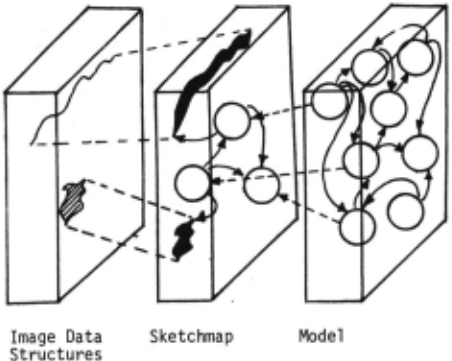
Structures
Figure 1. 2 Basic Layer Structure
At the other end of the vision system is a third structure termed the image data structure. This consists of the original image at different magnifications, spectra, resolutions, etc., to gether with various filtered versions of the image, texture images, edge images, etc. By "edge images" we mean "primal sketch-like" images [Marr 1975]. The parameters for generating all the image data structures are typically specialized to a particular model-image mapping context.
A successful analysis of an image contains two parts: the generation of the proper links between sketchmap nodes and image data structures and the generation of the proper links between sketchmap nodes and model nodes. We describe a as a mapping procedure. The construction of links between the relational world model and the sketch map is one of the functions of the executive pro cedure. The executive procedure embodies the over all strategy for achieving the goal(s) and is programmed in a high level language (currently SAIL). The problem of producing executive proce dures from non-procedural specifications is not addressed in this project.
Since the best procedures for finding struc tures in real-world images are special purpose, we have decided to hand-code the mapping proce dures in languages which produce efficient code. However, program autonomy is allowed in the choice of mapping procedures. Where different mapping procedures can generate the same links between sketchmap nodes and image data structures, the executive procedure can select the most appropri ate based on a description attached to each map ping procedure. Also, the executive procedure can use general geometric relational constraints to pin down the location of objects.
2. The Structure of the Model
2.1 The Concept of Template Nodes
The model holds different kinds of knowledge about the image domain. It includes a relational network of nodes which are identifiable with (pri mitive and complex) objects and concepts in the domain from which the scene is taken. The answer to a query is a synthesized sketchmap or descrip tion; this is an instantiation of a subset of the model. The model, therefore, contains knowledge in the form of all potential instantiable descrip tions. An example of this kind of knowledge is the assertion:
"the sternum is above the heart."
This can be readily included in the model network. It is potentially part of the model-image mapping ("the sternum" and "the heart" could be instanti ated with pointers to regions of the picture). The model also contains knowledge which is not in the form of a synthesized description, but which, for instance, could be used in generating a de scription. An example of this kind of knowledge is:
"ships are about 6 times as long as they are wide."
This knowledge can be included in the model net work and may help a program that is searching for a ship, but will not become part of the model image mapping. When it is meaningful to differ entiate between these two kinds of knowledge, we will refer to the parts of the network that repre sent the former kind as template nodes. Synthe sized descriptions will be directly related to these nodes and their arcs.
Each template node has a substructure which represents the sense in which that node is to be "understood." Prior to a query, the meaning of a node is defined in terms of a substructure of procedure that generates the image-sketchmap link mapping procedures and constraint relations. After a query has been satisfied, the template node is represented by instantiated nodes with attached specialized location descriptions as shown in Fig ure 2.1. Four basic types of links provide a sim ple syntax to the network structure. A powerful advantage to this syntax is that the executive procedure can direct the analysis in a more gene ral way.
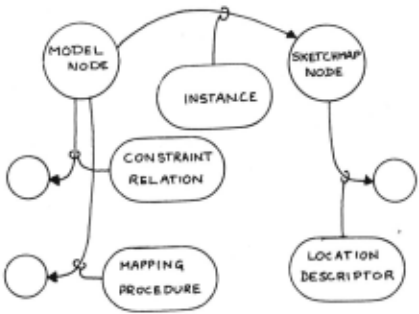
2.2 Constraints
Links to other model nodes encode {perhaps parametrized) constraint relations between model nodes. Links can encode:
- the probability that the relationship holds;
- a quantifier representing the expected value of the relationship;
- conditions under which the relationship holds.
For example, the relationship SHIP ADJACENT DOCK might have a certain probability of being true, an expected distance that the ship is from the dock, and conditions for the relation being true. We refer to the template nodes and geometric rela tions between them as the constraint network. This network may be interpreted like a program to find subsets of the model or the image that satis fy the constraints. Its results take account of partial or unspecified information, and it may be updated upon receipt of better data with a mini mal amount of work. It is much like the graph of variable dependencies in AL [Feldman et al. 1975]. In brief, each node has a "Constraint Operation," such as Intersection, Translation, Union, or indeed any function of up to two arguments; it has two operand nodes; a father node; a status that may be "Up-To-Date" or "Out-Of-Date"; and a value that is some data structure such as a num ber , a list of linear objects, a region, etc.
The constraint network for the prose: "The centroids of docked ships are on lines parallel to the intersection of coastlines with dock areas at a distance of one-half a ship width" is shown in Figure 2.2 .
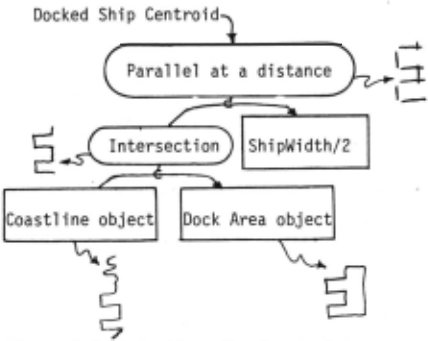
The network starts out with data (from the model or from previous scene analysis) as the values of the tip nodes, but no values at nonter minal nodes and all nonterminals marked Out-Of Date. Data at a tip node can have one of three statuses: it can be known that the object does not exist in the scene (so the value of the node is the null set), it can be known to some degree of accuracy where objects are in the scene (so the value of the node is a subset of image or world points), or perhaps nothing is known (in which case the object could be anywhere, and the value is implicitly the universe of image or world points).
When the constraint network is "run" to de termine what is known about the location of its object, each node recursively evaluates its Out-Of-Date operand nodes, performs its operation, and stores the result in its value. It marks its status Up-To-Date. Intersection and Union work properly with the definitions of partial informa tion of the last paragraph. When new (or better) information about an object at a tip of the graph comes in, all nodes on a path from the tip to the root are marked Out-Of-Date. Then when the graph is next run, (only) the necessary partial results are re-computed. In keeping with our philosophy, the graph is not self-activating, but is run on explicit user command.
2.3 Location Descriptors
A location descriptor provides information about where to find an entity. The part of the location descriptor which specifies a point set enclosing the region has been referred_ to as a tolerance region [Bolles 1975]. A shape location descriptor might have the structure shown in Figure 2.3.
This organization is suggestive of a frame like structure. However, not all the entries need exist; just the syntax islnecessary to allow the entries to be found. In practice only the properties relevant to a particular query will be generated. Such partial instantiations are easy in our implementation language LEAP [Feldman & Rovner 1969].
... } ][ ShapeLocationDescriptor nodetype: specialization prototype instance-of: a LocationDescriptor locates: OneOf {(a ShapeObject), (a ShapeFeature)} coordsystem: a CoordinateSystem centroid: a PointSet //allows for "fuzziness" orientation: an AngleRange // ... ditto tal. region: a PointSet J ... similarly for Point, Linear, and AreaLocationDescriptors [ CoordinateSystem nodetype: abstract prototype units: a LengthUnitSpecification scale: a NumberRange //length units I system unit transforms: SetOf {((a Coordinate Transform) (a Coordinate System)),There are many advantages to having a stand ard representation for object locations:
- If such descriptions are data types, their computations can be separated from the procedures that use them. If they can be passed as arguments, they provide a cer tain "common currency" between procedures, thus simplifying and modularizing the procedures that use them.
- Location descriptors can represent approx imate locations, which is useful for queries unconcerned with exact answers.
- Constraints between locations can propa gate knowledge throughout the model. Loca tion descriptors can be computed from other location descriptors via relations, or by union and intersection of the described point sets. A system which applied linear programming techniques to the problem of locating regions through constraints placed on their boundaries was developed in [Taylor 1976].
- Use of location descriptors is geared to an abandonment of the exhaustive segmenta tion paradigm wherein every region must correspond to some object. Different lo cation descriptors may refer to disjoint point sets or may overlap on the image, and different objects may have similar location descriptors.
3. Control
3.1 General Philosophy
Generally a query results in the synthesis of a sketchmap with instance nodes whose location descriptors are accurate enough for the purposes of the query. A query might also result in further refinement of location descriptors of the exten sion of an existing sketchmap to account for more image structure. A query-directed vision system should thus be able to use relevant information generated in successive queries. Most queries will take the form of user-written programs, since nontrivial tasks usually require fairly rigid recommendations about how the system should go about solving them. Initially the system will not attack the problem of automatically translating queries in some command language into programs. At the highest level control is embedded in the form of a user-written executive program. Figure 3.1 shows a fragment of the code used in the current executive procedure for selecting mapping procedures which identify instances of rib nodes in chest radiograph images. Each mapping procedure has pre-conditions, including an associ ated accuracy measure, which can depend on its neighbors, as well as a cost measure. The cheapest rib procedure which satisfies the pre-conditions is selected. The important point here is that the executive can have a relatively simple structure. This facilitates the experimentation of various control strategies other than the depth-first strategy shown in the example.
Recursive Procedure MatchRib(itemvar Node); begin itemvar x,v; integer Var; if INSTANCE of Node is ANY then begin Print( "rib ",Node, · already matched"); return; end else I run procedure that will do the Job with min cost; begin i temvar TempProc; integer MinCos t, TempCos t 1 MinCost := VeryLarge; foreach x such that RIBIPROCEDURE of Node is x do begin Var := GetConstraintsAndVarlance(Node,x) ; if Var < Tolerance then begin TempCost := FINDCost(Node,x); if TempCost < MinCost then begin end; end; TempCos t : = x; MinCos t : = TempCos t; end; if MinCost = VeryLarge then Print< "No procedure can do Job for ",Node) else ApplyProc(TempProc, Node); foreach v such that NEICHBOR of Node is v and TYPE of v is RIB do Ma tchRib( v); end; end; Figure 3.1 Executive Procedure for RibsVi~ion-7: Ballar~
3.2 Characterizations of Mapping Procedures
Mapping procedures have associated descrip tions which are used by executive procedures. The descriptions contain the following:
- the slots in the data object which must be filled for the procedure to run;
- the slots the procedure can fill in;
- the cost and accuracy of the procedure in some meaningful units;
- the a priori reliability of the procedure. Examples of the kinds of facts we expect to be able to encode in this structure are (for a straight-line structure) that a Hough transform cannot find the endpoints of a line but is more reliable than the cheaper Shirai tracker, which itself needs to know the direction of a line before it can track it, and that a Heuckel opera tor is more expensive, but can furnish many facts about the line with little known a priori, and can rate itself on reliability of its result.
There are several advantages to separating the executive procedure from the mapping proce dures and their descriptions:
- The executive procedure can be written without considering the implementation details of mapping procedures in great depth.
- Mapping procedures are similarly simpli fied without the burden of determining an appropriate context for their application.
- The executive procedure can automatically select alternative procedures in the event of mapping procedure failures.
- Descriptions allow a choice between methods (if several are available) based on capability, resource requirements, and a priori reliability. (Also , recovery from failure of individual routines can be automated through planning [Feldman and Sproull 1975].)
- If the mapping procedures can produce reliable a priori estimates of their success, the analytical results of [Bolles 1975] and [Taylor 1976] could be extended to select the procedure which produces sufficiently exact data objects.
4. Applications
4.1 Finding Docked Ships
Finding ships in a dock scene illustrates how high-level metrical knowledge about the image {such as provided by a topographic map) can make certain scene analysis problems easy.
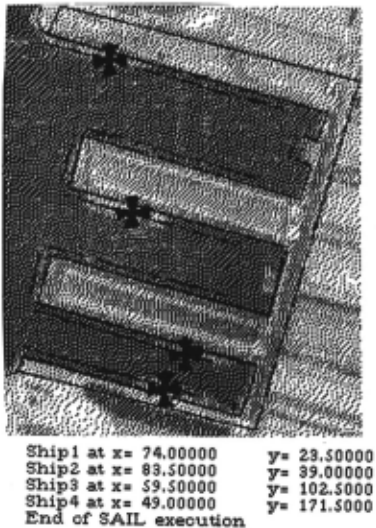
The model contains in a Constraint Graph form (see Section 2.2) the knowledge that docked ships are in the ocean adjacent to dock areas, parallel to the dock and with centroid a distance away related to the width of the ship. In a Shape Object Descriptor, some facts about the sorts of ships we are trying to find are stored, viz. a template for matching them (in our case, a rectangle of 1's in an array for template matching), their width, length, average bright ness, etc . Template-matching is among the simplest vision primitives. Only in a context having a great deal of structure could it be expected to work in scenes as complex as Figure 4.1.
The system, under direction of the user written query, begins by deciding where to look by satisfying a constraint network; the more infor mation provided, the narrower the focus of atten tion. In the case illustrated in this section, the constraint network looked as it does in Section 2.2. Figure 4.1 shows a halftoned version of the image, with the dock area and coastline overlaid as black lines. Recent work at SRI [Barrow and Tenenbaum 1977] has shown that map data may be automatically registered with images such as ours to within better than a pixel, so we felt comfortable about bypassing the registration problem in this study. Were the registration un certain, the constraints would produce a more fuzzy area to search than they did. Shown in the ocean are black lines indicating the areas of search which arise from the constraint tree; their linear nature makes a simple template-matching technique a possibility (in this exercise it was the only technique, but an executive procedure might well have chosen it as applicable). The ship template is rotated to be parallel to the midline as given by the constraint graph, and template matching is done along the line; note is taken of where the score for the match goes over threshold, and when it comes back down under threshold. The average of these two positions is taken as the location of a ship. The black crosses show the · results.
Our image data is a USGS mapping photograph provided by SRI, digitized to 256 grey levels on a .007" grid at USC. The image is stored on disk in RV format; and can be sampled at integral size reductions into an integer array in core for pro cessing (see [Maleson & Rashid 1977] re. RV format).
Linear objects are SAIL records making linked lists of (x,y) points. They can have four types at present: a list of points to be connected in order; a list of segments, or pairs of end points to be connected pairwise; and logically circular lists of points representing boundaries. A robust and general routine based on merging was written to compute the intersection of such linear features. Other useful geometric routines find the distance of a point from a segment (not a line), and compute a segment parallel to and some distance from another segment.
Regions (except for templates, which are arrays) are SAIL list items. A region is a list of y-lists; a y-list has a y-value followed by an even number of x-values. The first x-value is an "entering region" boundary point, the second is a "leaving region" boundary point, and so on alternately. The region : 001
101
011
would be represented as ((1 2 3)(2 1 1 3 3)(3 3 3)). Routines were written, again based on merging, to create the union and intersection of such regions, and to convert (via an as~etric DDA algorithm [Newman and Sproull 1973]) linear objects to regions. We find multiple representations of ob jects simplifies the work of routines such as the constraint primitives.
Template-matching utilities can produce an array containing a rotated and scaled version of a template and can compute the correlation of a template (at some rotation and translation) with the image array.
4.2 Finding Ribs in Chest Radiographs
The problem of finding ribs in chest radio graphs illustrates the use of multiple procedures attached to the same template node and the use of less precise geometric constraints arising from anatomy rather than cartography.
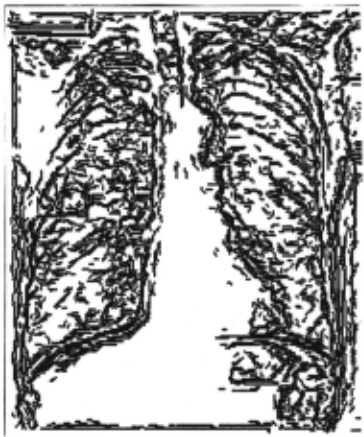
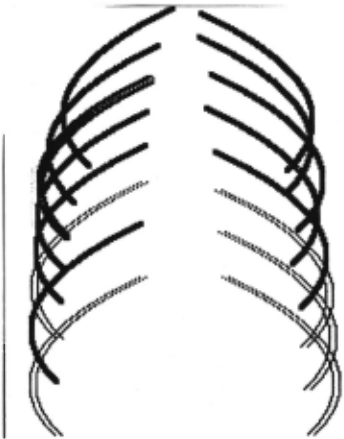
The model contains nine right and left ribs (the maximum amount normally visible on a chest film). Presently only the lower edge of each rib is detected. Each rib is modelled as a template node with offset parameters from itself to each immediate neighbor (above, below, opposite). Additionally, three kinds of procedures are attached to each rib node as shown in Table 4.1.
LookForARib uses the Weschler parabolic model [Weschler & Sklansky 1975] to find a rib segment.
AffirmARib translates that segment using the off set parameters and attempts to verify the presence of a rib by a correlation technique. Halluci nateARib instantiates a rib by translating a neighbor with no verification.
| Procedure | Precon- ditions | Cost | Var. | Postcon- ditions |
|---|---|---|---|---|
| LookForARib | none | 20 | 0 | instance of rib |
| AffirmARib | instance of neigh- bor in sketchmap | 4 | 1 | instance of rib |
| HallucinateARib | instance of neigh- bor in sketchmap | 1 | 5 | instance of rib |
Figure 4.2 shows the result of finding ribs on a particular chest film. The ribs are labelled with special symbols to denote the procedures which located them.
Legend: , Found by LookForARib


, Found by AffirmARib
<.::::: Found by HallucinateARib

5. Sunmary
The semantic network is a kind of lumped parameter model in the spirit of [Fischler and Eschlager 1973]. The geometric constraints in the network relate template nodes whose descriptions (the "lumped parameters") are generated by attached mapping procedures. The key difference is that information found during the analysis can change the way template nodes are located.
In analyzing an image it is crucial that the generating of abstract descriptions of parts of the image, segmentation, be intimately connected with the interpretation of those parts. In our system the former operation corresponds to gene rating sketchmap-image links whereas the latter corresponds to generating model-sketchmap links. Interpretation and segmentation are united through multiple mapping procedures and the executive, which can efficiently change the way a part of the image is analyzed as new information about the rest of the image develops.
Finally, we want the image analysis process to do as little work as possible to satisfy a given task or query. This is attempted through the specialization of all parameters to the given task, the inclusion of performance and accuracy measures in the mapping procedure descriptions, and the use of the constraint network. All of this is just the beginning of a long term effort to study what can be done in a general way for goal directed image understanding tasks.
@inproceedings{ijcai1977p159,
  title     = {An Approach to Knowledge-Directed Image Analysis},
  author    = {Ballard, Dana H. and Brown, Christopher M. and Feldman, Jay M.},
  booktitle = {Proceedings of the Fifth International Joint Conference on
               Artificial Intelligence, {IJCAI-77}},
  publisher = {International Joint Conferences on Artificial Intelligence},
  editor    = {Raj Reddy},
  pages     = {664--669},
  year      = {1977},
  note      = {Vision},
  url       = {https://ijcai.org/proceedings/1977/159},
}
TY - CPAPER TI - An Approach to Knowledge-Directed Image Analysis AU - Ballard, Dana H. AU - Brown, Christopher M. AU - Feldman, Jay M. T2 - Proceedings of the Fifth International Joint Conference on Artificial Intelligence, IJCAI-77 PB - International Joint Conferences on Artificial Intelligence PY - 1977 SP - 664 EP - 669 UR - https://ijcai.org/proceedings/1977/159 ER -Copied
Machine-readable versions of this paper, for tools and AI agents:





