
Case Structure Systems
Proceedings of the Third International Joint Conference on Artificial Intelligence. Natural Language; Semantics and Parsing. Pages 364-370.
© 1973 International Joint Conferences on Artificial Intelligence
Abstract
A logic for case structure systems is presented which allows variations in the order and number of terms in atomic formulas. This logic is used to describe and characterize four existing case systems. A computer program which allows flexible case structures is then described. Applications of the program to medical record analysis and disease modeling are used to illustrate important concepts about case systems. Several open problems are also discussed.
- Bobrow, Daniel. "Natural language input for a computer problem solving system" . In Semantic Information Processing (Ed : Marvin Minsky) MIT Press, 1968.
- Bruce, Bertram. "A model for temporal references and its application in a question answering program" . Artificial Intelligence 3, 1972 pp. 1-26.
- Bruce, Bertram, and Neil Singer. "CHRONOS II : the processing of incompletely specified data". Computer Science Department, Rutgers-NIH report CBM-TR-9, 1972.
- Celce-Murcia, M. English Comparatives. Ph.D. Thesis, UCLA, 1972.
- Chomsky, Noam. Aspects of the Theory of Syntax. MIT Press , 1964.
- Fillmore, Charles. "The case for case". In Universals in Linguistic Theory (Ed: Bach and Harms), Holt, Rinehart, and Winston, 1968.
- Green, Cordell, and B. Raphael. "Research on intelligent question answering systems"." Proc . ACM 23rd Nat . Conf., 1968.
- Green, B. F., A.K. Wolf, Carol Chomsky , & Kenneth Laughery. "Baseball: An Automatic Question Answerer". In Com~ters and Thought (Ed: Feigenbaum and Fel an), McGraw-Hill, 1963.
- Kaplan, R.M. "Augmented transition networks as psychological models of sentence comprehension". Artificial Intelligence 3, 1972. pp. 77-100. IJCAI
- Katz, J.J. The Philosophy of Language. 1965.
- Kulikowski, C. and S . Weiss. "Computer based models for glaucoma". Computer Science Depart- ment, Rutgers-NIH report CBM-TR-3, 1971.
- Lindsay, Robert K. "Inferential memory as the basis of machines which understand language". In Computers and Thought (Ed: Feigenbaum and Feldman), McGraw-Hill, 1963.
- Martin, William A., Rand B. Krumland, and Alex. Sunguroff. "More MAPL: Specifications and basic structures". Automatic Programming Group, Project Mac, MIT, Internal Memo 8, 1973 .
- Norman, Donald A. and David E. Rumelhart. "Active semantic networks as a model of human memory". Third International Joint Conf. on Artificial Intelligence, 1973 IJCAI
- Quillian, Ross. "The teachable language compre- hender : a simulation program and theory of language". Comm. ACM 12, 1969, pp. 459-476.
- Sandewall, Erik. "A programming tool for man- agement of a predicate-calculus-oriented data base". Second Int '1 Joint Conf. on Artificial Intelligence, 1971 . IJCAI
- Schank, Roger. "Finding the conceptual content and intention in an utterance in natural lang- uage conversation". Second Int'l Joint Conf. on Artificial Intelligence, 1971. IJCAI
- Schwarcz, R.M., J.F. Burger, & R.F. Simmons. "A deductive question answerer for• natural language inference". Comm. ACM 13, 1970, pp. 167-183.
- Shapiro, Stuart . "A net structure for semantic information storage, deduction and retrieval". Second Int'l Joint Conf. on Artificial Intelligence, 1971. IJCAI
- Simmons, R.F. "Semantic networks: their com- putation and use for understanding English sentences". Computer Science Depattment University of Texas at Austin-CAl • Lab report NL-6, 1972.
- Trigoboff, Mike. "A heuristic case structure parser" . Computer Science Department, Rutgers- NIH report CBM-TM-16, 1973.
- Woods, W.A. "Transition network grammars for natural language analysis". Comm. ACM 13, 1970, pp. 591-602.
References were extracted automatically from the PDF and may contain errors.
Full text extracted automatically from the PDF; figures, tables and equations may differ. The PDF is the version of record.
1. Introduction
Much of the research in natural language pro cessing has focused on the problem of storage structures, or the question, "How is the information or meaning of a sentence to be represented once a sentence has been parsed?" Some of the storage structures have been special purpose organizations such as the SAD SAM program of Lindsay 12, the BASEBALL program of Green, et al 8, or the STUDENT program of Bobrowl. Others have been semantic net works such as TLC by QuillianlS, PROTOSYNTHEX III by Simmons20, MEMOD by Norman and Rumelhartl4, or MENTAL by Shapirol9, Still others have been based on dependency grammar such as Schank's conceptual par serl7 or on predicate calculus, such as QA3 by Green and Raphael? or PCDB by Sandewa11l6.
A common feature of several of these natural language processors is a recognition of deep case relations as discussed by Fillmore6. Some systems which have not explicitly used a case structure have nevertheless used case-like mechanisms. In addition, case-like systems have been used in modeling in medicine and psychology, even without natural language.
It appears now that a formalization of case structure languages would be useful and feasible. On the one hand the large amount of data on case systems appears to be structured in similar ways and yet differences in terminology and approach have created serious communication problems. On the other hand, even if we admit that the usual first order logics somehow capture the essential nature of these systems, the simplifications imposed there for elegance and theoretical usefulness make them less useful as a means for examining and comparing case structure systems.
This paper presents (in section 2) a language for case structure systems which is built on first order logic and yet allows such things as omitted and rearranged terms in atomic formulas, prepositions, and the checking of case restrictions in the deter mination of well-formedness. The case logic should make it significantly easier to formulate, analyze or compare case structure systems.
his resea:r;ch. was supported by th.e Nationa,l , Institutes o£ lieal tli Resource on Computers 1n Biomedicine at Rutgers University C~rant RR 643).
CASE STRUCTURE SYSTEMS
*
Bertram Bruce Computer Science Department Rutgers University New Brunswick, New Jersey, U. S. A.
In section 3 a few representative systems with cases are expressed in the formalisms of case logic. Section 4 contains a description of the CHRONOS II program3. This program is unusual in having a flexible case structure. For example it has been used with one case structure for the analysis of medical records and with another as a model for glaucoma.
2. Case Logic
This section describes the essential character istics of a case structure system or case logic (CL) . · It appears that an adequate formalization can be made within a first order framework. The differences between this and a pure predicate calculus involve the introduction of some fixed, or constant pre dicates, some additional axioms, and some syntac tical changes to reflect the fact that certain languages of interest allow variations in the order and even omissions of some terms.
The axiom systern .for a case logic depends heavily on the specific cases which are used and, of course, on the interpretations we wish to allow. Because no axioms are given here it is perhaps more appropriate to call CL a "notational system" rather than a "logic". However, it should be remembered that in any particular CL one must include an axiom system as well as naming the various syntactic and semantic objects in the system.
We have all of the usual symbols found in first order logic:
(;! = {P ini)} is a countable set of ni -ary predicates,
~ = {xi} is a countable set of variables,
is a finite, complete set of n.-ary . 1 logical connect1ves,
plus the necessary punctuation, quantifier, and bracketing symbols. In addition, case logic has some new objects:
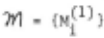


is a countable set of constant unary predicates, called features or (semantig markers (cf. ChomskyS, or KatzlO)
is a finite, non-empty set of~· There is a distinguished case, c 0 , which
is always in e
is a finite (possibly empty) set of prepositions.
The sets /11 and (; are sets of symbols in the meta language for CL. That is, they are used to determine such things as well-formedness rather than as symbols in the object language. When we consider a natural language, such as English, where the object language is its own meta-language then it is allowed, but not necessary, that )Y) be a subset (?. It is important to note that J.n consists of constant predicates. The interpretation of a feature is thus fixed to a simple unary relation, or attribute. In practice we might specify a given feature by simply checking off (as in a lexicon) the terms to which it applies.
Using these primitives we make several defini tions to give eventually the rules of formation for CL.
cate P~ni), .is a set of sequences of cases (C 1 , c 2 , Ck) such that for each sequence, K~ni.
The set of terms is the smallest set T such that:
The set of preposition terms is the smallest set 'fc such that:
Thus a preposition term is either a term in the usual first order sense or a term preceded by a preposition.
We assume that if case C. is not in one of the 1 sequences of the case structure for a predicate P then RC . (P,t) is false for each preposition term t. 1
The relational statement RC . (P,t) may be read 1
"the preposition term t is allowed to serve in the case Ci with respect to P". We normally require
that a case condition be defined in terms of features (?'Yl ) . Then this rather semantic-like property can be used to determine well-formedness without encount ering difficulties such as attempting to use deriv ability to· define well-formedness.
As an example of a case condition, suppose that "dative" is one of the cases in a case sequence in the case structure for "give". We might require that the preposition term which serves the dative position must be "animate" where "animate" is a feature. Then
Rdative (give, John) holds
while Rdative (give, ocean) does not.
The set of kernel strings is the smallest set such that if
In other words, a kernel string is formed by inserting an ni-ary predicate into a string of j~ni preposition terms.
(the power set of(!; ) . For each kernel string K,Si indicates a set of possible cases for the ith prepo sition term. The value of Si (K) may depend on
- the predicate in K
- the arrangement of all the preposition terms in K
- and (3) the prepositions, if any, in the preposition terms.
For example, using Fillmore's 10 case system, s 3
applied to the sentence "John broke the window with Mary" might give the set {agentive, instrumentaH indicating that the 3rd term ("Mary") may bear the agentive relationship to "broke" (if Mary assists John) or the instrumental relationship (if Mary is thrown by John). The distinguished case (C 0 ) may be
used as the image of k under Si if the predicate in k has an irrelevant case structure (see end of this section).
Let A be a kernel string with predicate P and preposition terms t 1 ,t 2 , ... ,tn. Then A is an atomic formula iff for each preposition term, tj, there is a case, Cj, such that:
The set of well-formed formulas,~, is then built up in the usual way out of atomic formulas, quantifiers, and logical connectives.
Thus an atomic formula in CL is a string con sisting of preposition terms and a predicate, subject to restrictions that (a) each term be assigned a case, (b) the case conditions (defined by features) are satisfied, and, (c) the sequence of cases is allowed by the predicate. If any of these restrictions fail the atomic formula (or simple sentence) is then ill-formed. As we have deliberately introduced some semantics into the syntax it may be that a so-called "grammatical but semantically anomalous" sentence would be unacceptable sytactically in CL. For example, the sentence "the book sold John" is well formed only if there is a word sense for "book" which satisfies a feature such as "animate" so that the agentive case condition can hold. In fact, we consi der such a sentence to be well-formed in exactly those cases where "the book" has been personified.
It is not surpriSing that other kinds of semantic anomaly are allowed. For instance "2 + 2 = 5" is well-formed in CL. Some semantic ambiguity can also be removed, but, again, many ambiguous sentences will have to be considered well-formed. For examp1e, in "Mary was seen by John", "John" may serve either an agentive or a locative relationship to "see" . How ever, in "Mary was seen by the river" we might expect a CL system to reject the agentive interpretation for "the river". Whenever ambiguity as to case does occur then there will be more than one case for one or more case terms in a formula. Thus for each "j" in the definition of well-formed formula, above, there may be more than one "C." satisfying the
definition . J
Case signals use purely syntactic information to select a set of possible cases. Case conditions also select possible cases but use more semantic informa tion. An interesting question, posed by William Fabens, is how these functions should be made to interact, It is not clear at this point whether one should apply case signals first or case conditions, or even whether there are situations where computa tional differences exist.
Corresponding to the syntactic development given above we need a semantics for CL:
A semantic structure for CL has the form:
®= cA. {R~ni)}, {O~ni)} where A is a set of I J indivi duals (objects), each Ri is an ni-ary relation, on A and each 0. is an n.-ary operation on A J J
An interpretation of the terms is a mapping ~ : T ---4 A which assigns (in the usual way) an object in A to each t" T. The interpretation of preposition terms is then a mapping .Q : T __, A which assigns an object in A to each pr~po~ition term, qt, as follows:
The denotation of a predicate P~ni) " <? for a given gives a of a. case sequence ae:,Z)Pfni) is a mapping D which relation R~ni) such that n.~n . = the length J 1 J We write D(P!ni) , a) 2 R~ni). I J
The valuation of the formulas in Yf is a mapping V: YV' +2 (where 2 is the Boolean a1gebra of two elements) defined as follows :
- if ~1:W' is atomic and ti'". ,tj are the preposi tion terms in ~. then V(~) = 1 iff
[D (P~ni), (C 1 , c 2 , ... , c;j ))] (,9- c (ti), ... , ~ c(tj)) holds where the Ck's are the cases of the preposition terms in ~.
- Otherwise V is computed in the usual way.
It is worthwhile noting that while CL has several unusual characteristics, appropriate restric tions allow the reproduction of· a standard first order language within CL. For example, leth'\ and Q be empty and let C' = {C 0 ,c 1 }. Assign the case
structure { (C 0 , ... , c 0 )} (a sequence of n c 0 ·s)
to each n-ary predicate. For case conditions let Rc = RC =@x't = @ x L (since Q is empty 0 1 c
T c-:: 't ) . For any kernel string K and any i, the case signal Si is defined as follows:
Then the set of atomic formulas is simply the set of those kernel strings which have n terms for an n-ary predicate, all in the usual order. The semantic structures and interpretations are unchanged, but the denotation of an n-ary predicate must necessarily be an n-ary relation and the case sequence is, of course, irrelevant.
This section presents a notation for a class of systems called "case logics". It is reasonable to ask how the case systems of linguists, psychologists, and computer scientists fit into this framework and particularly how the distinction between surface and deep case systems is handled.
It is often argued that a language has at least two case systems, one at the surface or syntactic level and the other at a deep or conceptual level. The notation presented here is designed for both levels. Of course, at the deep level, we no longer have prepositions in the usual sense, but we do have structures which can be considered to be atomic formulas of CL, with variability in the order and presence of terms. Part o·f the understanding process is then a translation from one case system to another.
Usually a deep case system has very few cases, each one justified in terms of its presence is basic semantic constructs. A surface system may have either a profusion of cases corresponding to the many differ ent syntactic possibilities or a small set of rather amorphous cases, such as "objective".
The translation from surface to deep cases often involves an expansion in storage structures wherein a single predicate with a few loosely defined argu ments becomes a complex of more primitive predicates with arguments often missing but always well defined conceptually. It is the nature of the missing argu ments which points out connections to other parts of the discourse.
In special situations this complex of primitive predicates can be simplified by elaborating the surface case system (see section 4). Positions of nodes in the semantic or conceptual network are in effect named by new surface cases whose case condi tions check to see if a term could fill the appro priate conceptual position. The result is a loss in information with a corresponding improvement in efficiency for the special situation . It appears that treating such things as causation and purpose as cases (rather than as second order predicates on sentences) is such a simplification.
The next section discusses some well known case systems in terms of CL . While space limitations make the descriptions rather spare, they should indicate at least how some of the essential parts of the systems would be expressed. The problems of sur face vs. deep and first order vs. second order for any particular system would need to be discussed at much greater length.
3. Some Representative Case Structure Systems
In this section we examine a variety of systems which appear suitable for description as case struc ture systems. For the sake of clarity, the special case c 0 , which is always assumed to be in ~ is not listed in the descriptions.
3.1 Fillmore- Natural Language Cases
The most persuasive argument for the universality of cases in the dee~ structures of natural languages is made by Fillmore He argues from evidence in many languages that every language, regardless of it~ surface structures, has a deep case system which gives the relationship of many nouns to a verb.
Fillmore's description of cases and their pur pose in language can be expressed directly in CL. He suggests a minimum of six cases.
Agentive (A) - the animate perceived instigator of an
action Instrumental (I) - the inanimate force or object which is causally involved. Dative (D) - the animate being affected. Factitive (F) - the object or being resulting from the action.Locative (L) - location or spatial orientation. Objective (0) -determined by verb (neutral case).
While other possible cases are mentioned we can say roughly that e = {-A, I, D, F, L, 0}. Fillmore notes that the cases A and D require animate nouns, that is, for a noun to serve in the agentive or dative case it must have the feature "animate". Other features making up the set fn can easily be imagined for the other cases.
Corresponding to features on nouns Fillmore says that verbs can be classified according to "sentence types" or "case frames". A case frame tells what case relationships may exist between a verb and its nouns. For example "open" may be used in four ways:
The door opened. (0) John opened the door. (A 0) The wind opened the door. (I 0) John opened the door with a chisel. (A 0 I
We can represent the case frame for "open" as [0 (A) (I)]. This says that when "open" is used its object must appear but the agent and instrument are optional. Clearly a case frame is a case structure CiJ ) in CL. p
Fillmore shows by example the case signals (S . ) of various languages. He also gives some tefitative rules for English. For example :
"The A preposition is £z; the I preposition is £r if there is no A, otherwise it is with; the 0 and F prepositions are typically zero; the B [benefactive case] preposition is for; the D preposition is typically to.... ---
"If there is an A it becomes the subject; otherwise, if there is an I, it becomes the subject; otherwise the subj ect is the 0."
3.2 Simmons - Semantic Networks
R.F. Simmons2° gives an extensive account of semantic networks and their use in processing natural language by computer. An essential feature of these networks is a set of deep case relations connecting nominal concepts (underlying noun phrases) to verbs. While a semantic network does not require any specific case structure Simmons ha~ chosen one which follows from work of Celce-Murcia and Fillmore6.
In his system there are five deep case relation~ so that ~ = { causal act ant, theme, locus, source, and goal}. The set of prepositions, or 02, is of course just the prepositions of English. Verbs are classified into paradigms according to the case sequences they allow. a paradigm, then, is a case structure ( ~ ) . For example, the ergative paradigm consists of thg sequences (for the active voice):
(causal-actant 1 , theme, causal-actant 2 ) (causal actant 1 , theme) (causal actant 2 , theme) (theme)Simmons gives "break" as an example of an ergative verb. Thus
John broke the window with a hammer. John broke the window The hammer broke the window The window broke
are all well-formed since in each case one of the case sequences is matched (where "John" is the causal actant1, "window" is the theme, and "hammer" is the causal-actant 2 ).
Another example is the "reflexive-deletion paradigm where the theme is deleted if it corresponds to the CAl [causal-actant 1 )". Thus "run" may be used
in several ways:
John ran to school John ran a machine The machine ran The brook ran
In each of the sentences there is a theme - John, machine, or brook. The paradigm allows the deletion of the theme if it is the same as the causal-actant .
In this the case structure is
(causal-actant, goal) (causal-actant, theme)(theme)
Simmons discusses other aspects of the case structure portion of semantic networks as well. He points out that a "semantic definition" of a verb can be given by describing the properties of the nominal concepts serving in each case relationship to the verb. It appears to be the case that these descrip tions can be adequately handled by means of our case conditions. If so then a parser for semantic networks would simply check the descriptions in the process of determining well-formedness.
3.3 Schank- Conceptual Parsers
Roger Schankl7 has developed a theory of dis course comprehension based on dependency grammar. In his system "conceptualizations" are the primitive objects underlying natural language utterances. These conceptualizations are inferred from the dis course as a whole in such a way that the syntactic structure of an individual sentence may bear only a secondary relationship to its conceptualization. For example the structure underlying "John grew plants" is
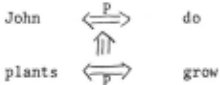
where "P" means "past", " ~ " means the actor action relation and "1/i'" means causation. A "concep tual parser" would have to know that John did an action and that that action caused the plants to grow.
Schank says that an action can have any of four "dependents" - object, recipient, direction, or instrument. The sentence "The man took the book" is represented

which indicated that the man is the recipient (R) of the object (0) book from someone (X). More generally we can think of a verb "trans" with the structure

"give" and "receive" are realized when z=x and "take" when z=y1
It seems clear that, for Schank, (! = {actor, object, recipient, direction, instrument} where the actor in an actor-action pair is considered to be a case. Schank has a large set, Jn, of features which are checked by the case conditions RC.. The case 1
structures, 1) , of predicates (verbs) in Schank's p system are sets of sequences composed of the five cases. The extensive checking of features coupled with the fact that the conceptual network marks holes for missing cases reduces the need for tight restrictions on the~ 's. p
3.4 Kulikowski - Medical Modeling
Another system which appears unlike the others and yet fits naturally into CL is the glaucoma model of Kulikowski and Weissll, In their model various primitive descriptors of physilogical condi tions or states (e.g. "pressure", "atrophy", "age", "adhesion", etc. ) are given attributes (e.g. "medium:, "location", "time", "agnitude", etc.). The specification of a state is an assignment of values to some or all of the various attributes for a descriptor.
Describing the medical model in CL, we would say that the primitive descriptors are predicates (elements of CY ) and the attributes are cases (elements of e,_). The restrictions on the objects which may fill attribute slots are the features
(elements of l1/) of CL. The case structure ( i) ) of a primitive descriptor, P, is the set of rulgs which determine whether of not an attribute may be omitted. For example, it seems necessary to state the location of pressure in every case put the medium may be unspecified.
It is interesting to note that the medical model introduces time and location, typically adverbial constituents, as attributes of descriptors. Fillmore6 suggests a similar collapsing of (many) adverbs to cases in English. In fact, a commitment to ca·ses often leads to a reduction in the number of grammatical categories - verbs, ad"j ectives and some nouns become predicates, and adverbs and other nouns fill the case positions.
The fact that the Kulikowski-Weiss model can be stated in CL is significant in two ways. First, it suggests that for convenient, efficient, or flexible implementation of such a model a computer program should be amenable to case structure systems. Second, by providing a connection to natural language it in dicates a direction to follow when adding a natural language interface to the model.

CHRONOS II is a natural language processor written in LISP 1.6 for a PDP-10 computer . The name and a small portiou of the program are derived from an earlier work which emphasized the time relations in language (Bruce2). The program is discussed more fully in Bruce and Singer3. Here we will mainly look at the case structure mechanisms.
The storage structures in CHRONOS II are essentially simp1e sentences (events, atomic formulas ) connected by logical connectives, causation links, and temporal relations . Each simple sentence has a verb (predicate) and a number of cases . These cases may include important adverbial modifiers and temporal indicators as well as the usual nominal cases.
The parser is basically an augmented transit i on network (Woods22, Kaplan9). Important states appear as separate LISP functions. The sentence generator is currently just a mapping from storage structures to stereotyped sentences, but in gross form it mirrors the parser. Deduction in CHRONOS II is also limited to specific areas which have been of interest in applications, such as time, causation, and certain summarizations. However, since the storage structures retain most of the information in a sentence in a form easily transformed to predicate calculus there is no reason why more general deductive powers could not be added.
The features (11/ ) on nouns and case structures (~p) of predicates are given by the lexicon. A noun entry includes the following information:
[word]
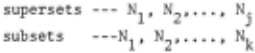
For example the noun human might have a property "state-of-mind" with allowed values being "happy", "sad", or "blue". · It could have the superset "animal" and the subset "woman". Naturally any noun will have the properties of its supersets in addition to those explicitly listed. A verb entry has the form:
[word]

The paradigm for a verb is an ordered set of cases. In a given simple sentence CHRONOS II will (currently) allow any or all of the cases to be missing. Thus the ease structure for a verb is a portion of the power set of paradigm subject to restrictions on features.
Case determination depends on syntactical infor mation (case signals) as well as feature checking (case conditions). Currently in CHRONOS II the de finitions of case signals and case conditions are com bined in one LISP function for each case. Someone who wishes to use CHRONOS II for a specific application must specify the list of cases, define each case, and modify the lexicon appropriately.
Each possible case function is called for every preposition term (noun phrase, prepositional phrase; or adverb) and returns a number giving the likelihood that the given preposition term serves that case re lationship to the main verb of the sentence, The case whose function returns the highest value is tem porarily assigned to the preposition term. A failure, consisting of values of 0 for all the cases, forces a backup to the previous term and a reassignment of the case for that term.
The case parser21 is essential-ly independent of the particular set of cases being used. Its speed and generality are of course directly dependent on the accuracy of the likelihood numbers returned by the case functions. There are various features which extend the simple heuristic value assignments, making the case functions easier to ·write or the parsing more efficient. For example, a variable number of "pre-emptive levels" can be created. Once a case function returns a value at a new and higher pre emptive level then only values at that level (or higher) are considered valid, This is especially use ful when one knows that a particular preposition, say, signals one and only one case. Then that case func tion returns a value which pre-empts any previous use of that case.
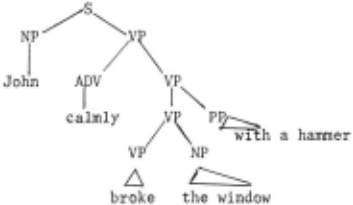
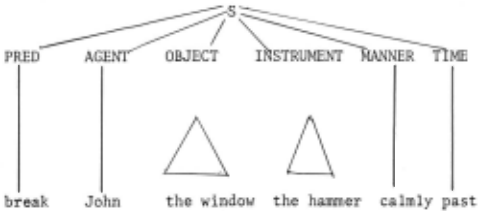
CHRONOS II has been used primarily with two case systems. One is for the analysis of medical records, i.e. nurse's notes, and is the more general of the two. In it ~ = {agentive, objective, dative, loca tive, instrumental, temporal, frequency, derivative, manner} where agentive, objective, dative, instru mental, and locative are as in FillmorelO, temporal points to the duration of an event, frequency is indicated by adverbs such as "rarely" and "often", derivative is indicated by words such as "increasing", and manner includes most other adverbs. The effect of such a case system can best be seen by comparison with a traditional e = {subject, object, indirect object} system. For example, the parse of "John calmly broke the window with a hammer" might, in the traditional system, be where the triangles (~) indicate possible fine struc ture of no importance to the example. Note that the traditional subject-predicate organization is main tained resulting in a rather opaque representation. In the system used by CHRONOS II the above sentence would be represented The latter structure is not only easier to understand but is also more efficient for the program.
The other case structure used in CHRONOS II is needed when CHRONOS II serves as a model for the eye disease, glaucoma (see Kulikowski-Weissll). In it ~ = {agentive, objective, locative, instrumental, temporal, frequency, derivative, medium} where medium indicates a fluid location. This allows a distinction between "in the blood" and "in the blood vessel". We are considering adding other cases as the need for finer distinctions arises. An example for this case system is the sentence "the pressure in the aqueous humor increased". Again, a traditional parse
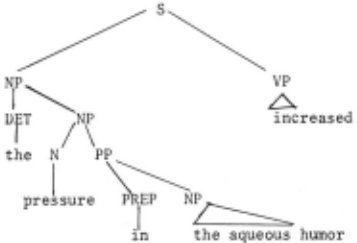
seems less useful than one which arises from cases suited to the problem,
~~~
PRED
I
pressure LOCATION MEDI~VATIVE TIME
I 6
eye
. r
I
aqueous humor 1ncrease past Note that in the second parse, "pressure" has become the predicate. It is an essential principle of CHRONOS II that the predicate of a simple sentence is the logical predicate (relative to the purpose of dis cussion) rather than the syntactical predicate (usually the verb).
5. Discussion
This report presents a notational system (CL) for case structure systems and examines a few existing systems in terms of the notation. CL is a first order system which appears useful in characterizing case systems and will hopefully lead to a better under standing of natural language storage structures.
Several observations about case structure systems follow from this study, observations which are actually open problems. For example, consider the sentence "John gave birth to a baby". The oddness of this sentence can be handled in at least three ways. First, we could say that "to give birth" is a predi cate which imposes the case condition on the agent that it be female. In that case the sentence is not a formula of CL. CHRONOS II could do that, or alter natively, raise its eyebrows by accepting the sentence at a lower pre-emptive level (see section 4). Second, we could say that "to give" is a predicate, that the sentence is well-formed, but its negation is provable from a set of usually accepted facts about life. Third, we could say that "to give" is the predicate but demand that the sentence be treated as ill-formed. The last approach is feasible as long as the condi tions on well-formedness can be stated as predicates on the single sentence (such as features) but is probably risky if it requires examination of other formulas.
An interesting problem, proposed in section 2, concerns the interaction of case· signals and case con ditions. In CHRONOS II these funct i ons mesh in a rather haphazard way. It should be interesting to examine situations where priorit i es in their use affect efficiency.
Case systems, since they emphasize a logical structure, rather than a purely syntactic one, lessen the importance of the syntactic predicate and of the sentence as a unit. Schankl7 and others have stressed the need to examine a discourse as an integrated whole rather as a collection of isolated sentences. It seems that the better a case system is, that is, the more relevant it is to the problem solving situa tion at hand, the easier it is to connect sentences in the discourse in meaningful ways.
Since many case systems are in use, a natural question arises, "What is the best case system?" My experience with CHRONOS II suggests that, at this stage in the development of intelligent programs, one can only speak of the goodness of a case system re lative to a problem situation. The finely distin guished cases which are arising in the medical model version of CHRONOS II would probably only clutter the program which analyzes nurse's notes. Conversely, certain cases which one would need in discussing ~veryday life would be unnecessary in a medical model. ~n important problem then is to decide what cases to use in a particular application. Even more inter esting might be a study of transformations between various case representations. Problems of summari zation and analogical reasoning will probably be more tractable with a better understanding of case structure transformations.
Acknowledgements
Many people have contributed to this work. Discussions with Robert Simmons first interested me in case logics. William Fabens, Richard Orgass, and Ann Yasuhara made useful suggestions on case logic. Neil Singer, Santosh Chokhani, Nanette Yaskin, and Mike Trigoboff all worked on CHRONOS II and con tributed to discussions on case systems. I also want to thank the referees for their comments and suggestions which I have incorporated.
@inproceedings{ijcai1973p47,
  title     = {Case Structure Systems},
  author    = {Bruce, Bertram C.},
  booktitle = {Proceedings of the Third International Joint Conference on
               Artificial Intelligence, {IJCAI-73}},
  publisher = {International Joint Conferences on Artificial Intelligence},
  editor    = {Nils J. Nilsson},
  pages     = {364--370},
  year      = {1973},
  month     = {8},
  note      = {Natural Language; Semantics and Parsing},
  url       = {https://ijcai.org/proceedings/1973/47},
}
TY - CPAPER TI - Case Structure Systems AU - Bruce, Bertram C. T2 - Proceedings of the Third International Joint Conference on Artificial Intelligence, IJCAI-73 PB - International Joint Conferences on Artificial Intelligence PY - 1973 SP - 364 EP - 370 UR - https://ijcai.org/proceedings/1973/47 ER -Copied
Machine-readable versions of this paper, for tools and AI agents:





