
A Net Structure for Semantic Information Storage, Deduction and Retrieval
Proceedings of the Second International Joint Conference on Artificial Intelligence. Pages 512-522.
© 1971 International Joint Conferences on Artificial Intelligence
Abstract
This paper descri be s a data structure, ME~S (ME mory Net St ructure), that is useful for storin g se rr. antic information stemming fro m a natural lan gu age, an d a S )• sterr., MENTAL (MEmor y !\et That Answers and Learns) that interacts with a user (human or progra rr. ), stores information into and retrie v es infor ma tio n fro::: MENS and interprets some information in MENS as rules telling it how to deduce new information fro m what is already stored. MENTAL can be used as a question-answering system with formatted input /o utput, as a vehicle for experimenting with various theories of semantic structures or as the memory management portion of a natural language question-answering system .
- Bach, E . Nouns and noun phrases . Universals in Linguistic Theory, Bach , E . and Harms, R. T. (Eds.), Holt, Rinehart and Winston, New York, 1968, 90-122 .
- Carnap, R. Empiricism, semantics, and ontology. in[IO], 205-221. Originall y in Revue Intern. de Phil. 4 (1950) 20-40.
- Elliott, R. W. A model for a fact retrieval system. unpublished Ph. D . dissertation , UniversityofTexas, Austin, Texas, 196 5 .
- Fillmore, C. J. The case for case. Universals in Linguistic Theory, Bach , E. and Harms, R. T . (Eds.), Holt, Rinehart and Winston, New York, New York, 1968 , 1-88 .
- Lexical entries for verb s. Foundations of Language, 4, 4 (N ov . 1 968 ) . 373-393.
- Green, C. C . , Raphael, B. Research on intelligent question-answering systems. AFCRL-67-0370, Stanford Research Institute, Menlo Park, Calif. , May, 196 7.
- Kaplan, R. M . The MIND system: a grammar-rule language . RM-6265/I-PR , The RAND Corporation, Santa Monica, Calif., April, I 970.
- Kay, M . The MIND system: a powerful parser. (forthcoming) .
- Martins, G. R. The MIND (I 0 ) s ystem: the morphological-analysis program. RM-6265/2-PR, The RAND Corp . , Santa Monica , Calif., April, I970. _ _ _ _ , Su , S. Y. W. The MIND system: the structure of the semantic file . RM-6265/3-PR, The RAND Corp., Santa Monica, Calif. , June, I 970.
- Quillian , M. R. Semantic memory. Semantic I nformation Processing, Minsk y , M. (Ed.), MIT Press , Cambridge, Mass. , I968, 227-270.
- The teachable language comprehender: a simulation program and theory of language. Comm. ACM I2, 8 (Aug., I969), 459-476.
- Quine, W. V. 0. Notes on existence and necessity. L...E.!:li!• 40 (1943) 113-12 7.
- Schwarcz, R. M, Burger, J. F., Simmons, R. F. A deductive question-answerer for natural language inference. Comm. ACM 13, 3 (March, 1970), 167-183.
- Shapiro , S. C . The list set generator: a construct for evaluating set expressions . Comm. ACM 13, I2 (Dec . , 1970), 741-744.
- A data structure for semantic information, processing. Unpublished Ph.D . dissertation, University of Wisconsin, Madison, Wisconsin, 1971.
- and Woodmansee, G. H . A net structure based relational question answerer: description and examples. Proc. Int. It. Conf. Art. Intel., Walker, D . E. and Norton, L . M. (Eds.), Washington, D. C., 1969, 325-345 . 523 IJCAI
- Shapiro, S . C. , Woodmansee, G. H., Krueger, M. W. A semantic associational memory net that learns and answers ques- tions (SAMENLAQ). Technical Report #8, Computer Sciences Department, University of Wisconsin, Madison, Wisconsin, Jan., 1968.
- Simmons, R. F., Burger, J. F. A semantic analyzer for English sentences. SP-2 987, System Development Corporation, Santa Monica, Calif. , Jan. , I968 .
- Schwarcz, R. M. A computational model of verbal understanding. SP-3132, System Develop- ment Corporation, Santa Monica, Calif . , April, 1968.
- Woods, W. A. Semantics for a question- answering system. Mathematical Linguistics and Automatic Translation Report No. NSF-19 to the National Science Foundation, The Aiken Computation Laboratory, Harvard University, Cambridge , Mass . , September, 1967.
References were extracted automatically from the PDF and may contain errors.
Full text extracted automatically from the PDF; figures, tables and equations may differ. The PDF is the version of record.
1. Introduction
In order to develop machines capable of "understanding" natural language, it is extremely valuable, if not necessary, to design a method of organizing a corpus of data to facilitate the storage and retrieval of information on many subjects, some in depth, some in breadth; to facilitate the storage, retrieval and use of the many complex relationships among real-world concepts; to facilitate the storage, retrieval and use of information which tells how other informa tion in the corpus rna y be used to further explicate implied relationships among concepts; and to facilitate the identification from the vast corpus of data of those pieces of information most directly relevant to any given topic.
This paper describes a data structure (MENS) and procedures for manipulating it
* The research reported herein was partially supported by a grant from the National Science Foundation (GJ-583) and partially by USAF Proj. RAND (project #1116). Use of the University of Wisconsin Computing Center was made possible through support, in part, from the National Science Foundation and the Wisconsin Alumni Research Foundation (WARF) through the University of Wisconsin Research Committee.
(MENTAL) that have been designed to meet the requirements outlines above. This system is intended to be used as the memory of a natural language question answering machine (see [7;8;9;10]) and could also be used as the memory of a general theorem prover or problem solver . Since the system allows its user (either a human or an outside program) to specify the relations that will be used for the basic structuring of information, the system can be used for experi menting with data structures suitable for .various contents and purposes. The major features of the data structure are:
It is a net whose nodes represent con ceptual entities and whose edges repres ent relations that hold between the entities.
A distinction is made between n-ary rela tions about which information and deduc tion rules are to be stored and strictl y binary relations that are used onl y to structure information about other entities. The former are represented by nodes in the net, just like any conceptual entit y . The latter relations are the ones used as the edges of the net.
Some nodes of the net are varia bles, and are used in constructing general statements and deducation rules.
Each conceptual entity is represented by exactly one node in the net from which all information concerning that entity is re trievable.
Nodes can be identified and retrieved either by name or by a sufficient (though not necessarily complete) description of their connections with other nodes, likewise identified.
The system and data structure described here follow along the general lines laid out by such systems as Semantic Memory [I 1], TLC [ 12], Protosynthex II and III [ 14, 1 9, 2 o], GRAIS [3] and SAMENLAQ [17, 18], but differ mainl y in the clear separation of the two levels of relations and in the ability to store and use general deduc tion rules.
All the procedures for storing information into the data structure, as well as all those for explicit retrieval and some of those for implicit retrieval have been programmed in PL/ 1 and are running interactively on an IBM System/ 36 0. All the research reported herein has proceeded both theoretically and by writing, checking out, revising and improving programs in PL/ 1, SNOBOL3 and Burroughs Extended ALGOL.
A more detailed discussion of MENS and MENTAL which also shows their applicability as an experimental vehicle is given in [16].
2. Basic Concepts of the Structure
To explain the MENS structure, it is first necessary to explain what is meant by a concep tual entity . A conceptual entity is anything about which information can be given. That is, anything about which one can know, think, or believe some thing; anything we can describe or discuss or ex perience. Individual objects, both concrete and abstract, are conceptual entities, as are classes of objects, actions and classes of actions. Con ceptual entities are really relative to individual intelligent beings. My concept of a given person, named John Q . Smith, may be different from yours. Therefore, "John Q. Smith" names a different conceptual entity for me than it does for you. Naturally, a word is not a conceptual entity, but ma y designate or refer to zero or more conceptual entities for each intelligent hearer. MENS has been designed to store information about con ceptual entities.
The information that is stored about a con ceptual entity is semantic information, in that that meaning of a given conceptual entity for a given being is whatever that being can say about the conceptual entity. This includes everything that being can infer from any further piece of in formation about the conceptual entity.
The basic goal under! ying the design of MENS has been generality. It was desired to be a ble to store any conceptual entity, regardless of its field of knowledge, and any information about the conceptual entity. O( course, stored in formatjon is useless unless it can be retrieved, so ease and efficiency of retrieval was a major goa l along with adequacy of representation.
Assuming the above discussion, the basic moti vating factors for the design of MENS were:
- Unified representation: All conceptual entitie s about which information might be given a nd que stions might be asked should be stored and rna ni pula ted in the same way.
- Single file: All the information about a given conceptual entity should be reachable from a common place.
- 3 . Multientried, converging search: A search of the file should start from as many places as possible and proceed in parallel, converging on the desired information.
- Storage of deduction rules: Rules determining how deductions rna y be made validly, even when specific to certain areas or relations, should be stored in the memory file just like other information, and the system should be able to use them in directing its deductive searches.
- Direct representation of n-ary relations: N-ary relations, for any n, should be as natural for the system as binary relations.
- Experimental vehicle : The file should be designed without any commitment to a particular semantic theory, i.e. the memory system should be a research vehicle for experimentation on various ways of structuring the information in it.
In the rest of this section, we will describe how these motivating factors led to the particular structure decided upon.
Unified representation requires that every conceptual entity have a memory structure repre sentation which can be put into relationships with representations of other conceptual entities. It further requires that all conceptual entities be represented in the same way regardless of their exact relationships to other conceptual entities. We will refer to a conceptual entity or to the logical representation of a conceptual entity as an item. When referring to the computer structure used to implement the representation of a con ceptual entity, we will use the term item block. In illustrations, we will picture an item block as a rectangle within which we will place an Engli sh word to indicate what concept the item block represents. If no such word exists some other symbol may appear so that the item block ma y be referred to. The full implication of unified representation is that every word sense, every fact and event, every relationship that is to be a topic of discussion between the s ystem and its human discussant will be represented by an item. Therefore, the items must be tied together by relationships that are not conceptual entities. The reasoning for this is as follows. Statements (e.g. , "Brutus killed Caesar.", "The sk y is green.") are conceptual entities since we may sa y things about them such as someone believes them or they are false. Therefore, the y must be represented by items, and such an item must bear some relation to the items (Brutus, kill, green) that make up the statement. If this latter relation is a conceptual relation, the fact of this rela tionship's holding between two items may be dis cussed and thus must be represented by an item which then must have some relationship to that relation , etc. Eventuall y there must be some relation which is not conceptual, but merely structural , used by the system to tie a fact-like item to the terms partaking in it. We will refer to a conceptual relation as an item relation or simply a relation and to a nonconceptual relation as a system relation, link, or pointer. The MENS structure is, thus, a collection of items tied to gether by system relations into a directed graph with labelled edges. The nodes of the graph are the items and the edges are system relations. The edges are directed to indicate the order of the arguments of the system relation. The edges are labelled to allow for several different system relations. The distinction between item relations and system relations is very important and must be kept in mind.
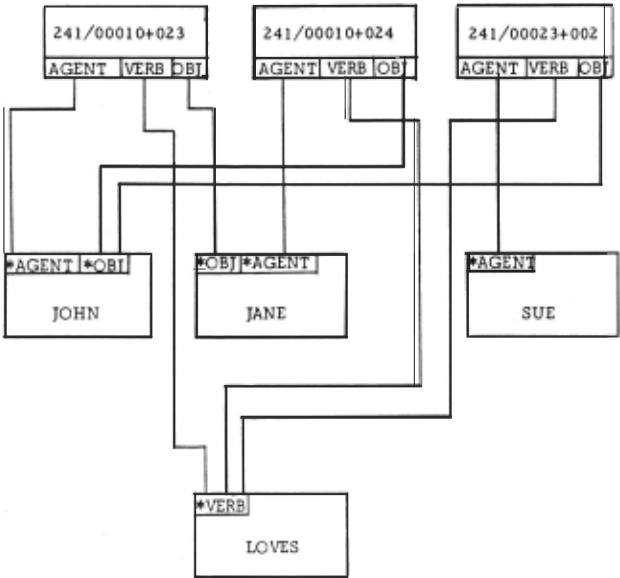
Single file means that there will be exactly one item for each conceptual entity. Therefore, all the information about the conceptual entity will involve its item and be retrievable from its item block. Since the system relations are the links that tie items together and thus provide the information, this means that whenever a link goes from one item to another, there is an associ ated link in the reverse direction. Looking at the fact and event items as records in a record oriented file and at the links going from partici pating items to fact and event items, MENS is an inverted file and may be searched as one. How ever, it is more than an inverted file, since links go the other way also. In illustrations, a link pair is represented by a line connecting two item blocks. The name of the system relation appears in the item block where the line emanates, from it. For example in Figure 2 the system relation AGENT goes from item 241 / 00010+023 to the item representing JOHN.
Multientried, converging search implies that items equally identifiable by the human conversant should be equally identifiable by the system. By this is meant that any item named by an English word can be located as quickly (by the same lookup procedure) as any other item so named, rather than some being locatable by lookup while others require an extensive search. Items that do not have English names, but must be identified by description will be located via searches that are quick or involved depending on the complexity of the description. The lookup is done through a dictionary which gives the internal names for the items which represent each of the senses of each natural language word used in the conversations. The internal name of an item is its address in secondary storage, so once looked up the item block is easily found. Items are connected to facts (which do not have English names) as mentioned above and when two items are connected in the memory structure, each is reachable from the other since every l ink between two item blocks is stored in both directions. Another implication of multientried, converging search is that searching the file is done by start ing at an arbitrary number of item blocks (all those that can be looked up directly) and converging to the desired information structures. This involves repeated intersections of sets of i terns as will be explained in section 3. Special care has been taken to make this search process as efffcient as possible and special constructs have been developed for this purpose.
Storage of deduction rules implies that de duction rules* should be capable of being stored in and retrieved from the memory structure in the same way that specific information is stored and retrieved. This implies that the structures used to store deduction rules must be basicall y the same as those used to s.tore specific information . It further implies that the executive routines must include a very general deduction rule interpreter that is capable of initiating searches of the memory and generating appropriate consequences based on any stored deduction rule.
Direct representation of n-ary relations implies that an item representing a relational statement based on an n-ary relation should ha ve links to each of its n arguments directly , re gardless of the value of n. This means that an y item must be capable of having an arbitrary number of pointers emanating from it. This number may even change throughout the life of a n item a s the types of system relationships it has with other items change.
There are several reasons for representing n-ary relations directly. It makes searching more efficient than if n-ary relations were stored as nested binary relation. If nested binary relations were used, item blocks would be introduced that were not true conceptual entities. Also Fillmore's case grammar theory [ 4, 5] in which the deep structure of a sentence contains a predica te of a verb and n cases is a satisfying theory for a semantic deep structure and representing n-ary relations directly in MENS allows for a direct representation of Fillmore's deep structures.
* By "deduction rule" is meant any statement which, properly interpreted, provides informa tion as to what statement(s) may be concluded from what other statement(s) . Deduction rules include (among others) rules of inference of symbolic logic, general statements and disjunc tive statements (any clause may be the conclu sion if the negation of all the others holds) .
Experimental vehicle implies that the user must be given the capability of declaring what and how many system relations he will use rather than ha ving a maximum number imposed on him. He mu st be a ble to decide what will be his conceptual entities rather than be provided with a closed set of them. He must be able to decide how items and pointers will be combined into structures to represent the information he wishes to work with. He must, finally, not be restricted as to what deduction rules the system may store and use.
3. Explicit Storage and Retrieval
Both storage into and retrieval from MENS are accomplished by describing how an item is (or is to be) connected to other items in the net. The storage instruction in effect says, "Create an item and connect it into the net in this way." The retrieval instruction in effect says, "Tell me all items that are connected in the net in this way ." Both instructions are expressed in a state ment, called a spec, which des c ri bes the i tem by describing the paths in the net that lead away from the item. These paths may be quite complicated, but the edges along the paths must be explicitly named system relations.
A subset of the input language sufficient for discussing the main points of MENS and MENTAL is defined in fig. 1 in modified BNF notation. Underlined words in lower case letters are non terminal characters. Strings enclosed in square brackets are optional. Strings arranged vertically and surrounded by braces are alternatives--one must be chosen. Strings followed by an asterisk rna y appear one or more times. Strings surrounded by broken brackets are informal English descrip tions of object language strings. ~ represents a required blank; additional blanks may be in serted anywhere. The following characters are delimiters in the language: , - ., ) ( ? . : ' = fa . A "character" is any legal character except a de limiter.
A relspec is used to declare a system rela tion. For example the relspec
SAGENT S *AGENT M
decla res a system relation whose forward pointer is na :r. ed AGENT and whose reverse pointer is named *AGENT. It further declares that an item
rna y po int to at most one other via the AGENT
pointer, but to an arbitrary number of other items via the *AGENT pointer. AGENT is there fore said to be a singular pointer and *AGENT, a multiple pointer.
After several such relspecs, a user might input the following buildspecs:
( .AGENT:J0HN, VERB:LOVES ,OBJ:JANE) ( ,AGENT:JANE, VERB:LOVES ,OBJ:JelHN) ( .AGENT:SUE, VERB:LOVES ,OBJ:J0HN)
This would cause the structure shown in figure Z to be built. Symbolic names are shown on those item blocks that have them. Three item block s were built to represent the three facts. The se are shown with their internal names. The Sig nificance of the internal name Z41 /000 I 0+023 is that the block is stored on disk track I 0 at an offset of Z3 within the track and that the calcu lated specificity measure is 241. The soecificit/ measure is used in deducti ve processing and will be discussed later.
Item blocks are stored on disk tra cks as consecutive blocks ofrecords. Each record con tains the coded name of a pointer name and, if the pointer is singular, the internal name of the i tern block pointed to. If the pointer is mu ltiple, the other field of the record is a link to a mulUple pointer list which contains the internal names of all the item blocks being pointed to. Each multiple pointer list is ordered on the internal
names it contains (largest first) and is kept on the same disk tracks as the item block it is for.
Returning to the discussion of explicit storage and retrieval, items may be described as well as named in specs. For example the builds pee
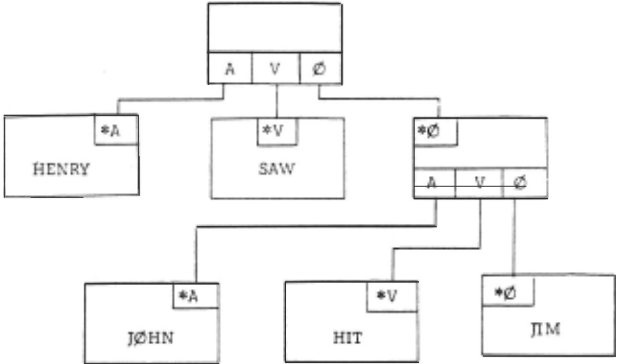
( .A:HENRY, V:SAW ,el:(.A:JOHN, V:HIT ,O:JIM))
(assumming the proper relspecs had been given) would result in the building of the structure of figure 3 . In this case, both the blocks shown unlabelled in the figure would have been created in response to the buildspec as well as all the pointers. If we had already input the information that John hit Jim and wanted to say that Henry saw that act, we would use the following builds pee:
( .A:HENRY, V:SAW ,0:(? 1, 1 ,A:JOHN, V:HIT ,O:JIM)) which uses an imbedded findspec.
The findspec causes a lis t of items to be found that satisfy the given description. In . this case the *A multiple pointer list from the block named JOHN, the *V list from HIT and the *0 list
FIGURE 1: SYNTAX OF THE USER'S LANGUAGE
from JIM would be intersected to find the names of all item blocks fitting the description. The findprefix, 11 ? 1, I, 11 , specifies that there should be at least 1 and at most 1 items found. That is, this find prefix declares the finds pee to be a definite description. To retrieve all instances of Henry's seeing John's hitting of Jim , the finds pee
could be used. The imbedded finds pee could here return a list of zero or more items. The union of the *0 lists from these items would be intersected with the *A list from HENRY and the *V list from SAW to satisfy the full request. Thus, the unioning and intersecting of ordered lists is the basic mechanism for explicit retrieval from MENS.
It was thus necessary to develop efficient methods for taking unions and intersections. These methods are described in [15}.
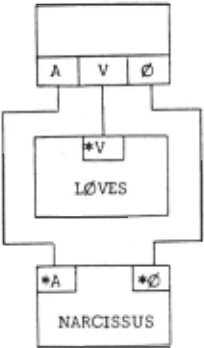
A more complicated retrieval mechanism is needed for structures in which there are two or more separate paths to one unknown item. For example the structure in figure 4 represents the information that Narcissus loves himself. To find all items such as the top one, i.e. all items representing the fact that someone loves himself, the findspec
could be used. Here N is a variable of the users language. The items on the *V list from L~VES will be retrieved and from each one the item pointed to via A will be checked for equality with the item pointed to via 0. The list formed as a result of the findspec will contain only those i terns for which the check succeeded and for each one, it will be recorded which item was found to su bstitute for N. This is done so that in case the findspec is embedded in another that also contains N as a variable, checks will continue to be made to insure that for each structure retrieved, N represents exactly one item. ·A complete analysis of how these checks should be made and how the union and intersection operations can be modified to handle them is given in [16].
4. Representation of Deduction Rules
In section 3 it was shown how the MENS structure is used for explicit storage and retrieval. In this section we will explain how it can be used for deduction. Since storage of deduction rules is a motivating factor of this project, the deduction method wi ll involve the storing of general deduc tion rules and the use of fairl y simple theorem proving techniques. The reason for this is that we want the system to be as general as possible and we want to concentrate on the data structure rather than the executive routines. It would be possible to build a complex and sophisticated theorem prover which uses MENS for its data storage, but this is not our current interest.
In order to allow for complete generality in what deduction rules could be stored, including arbitrary orderings of arbitrarily many quantifiers, it was decided to represent quantifiers and vari ables directly in the structure, and build executive routines to interpret the deduction rules. These routines would operate, upon being given a deduc tion rule, by carrying out searches required by the rule and building consequences justified by the rule. Representing quantifiers and variables directl y seems to be a compromise of the motivating factor of unified representation since they will require special routines to deal with them and their status as conceptual entities is questionable. However, dealing with the order of quantification implied by some English sentences is enough of a problem that at least one linguist believes that quantifiers and variables might profitably be com prehended by the base rules of English grammar [I , P. 112]. Besides, including this capability extends the use of the system as an experimental vehicle, another motivating factor.
The decision to allow direct representation of variables leads to the questions of how to repre sent them and what will be allowed to subs titute for them. Considering the second question, the conclusion is that a variable should be able to stand for any item but not for any system relation. This is supported by the discussion in section 2 that anything about which information could be given should be represented by an item, that all items should be equally able to have information stored about them, and that system relations could not have information given about them since they are not conceptual entities. As Quine sa ys, "The ontol ogy to which one's use of language commits him com prises simply the objects that he treats as falli ng .. . within the range of values of his variables." [13, p. 118 quoted in 2, p. 214] . Since the ontology of the data structure comprises the se t of items (by definition o( item), the values of the variables must be allowed to range over all the items, and since the system relations are to be excluded from the ontology, not allowing therr. to substitute for a variable reinforces their exclusion. Allowing the variables to range over all the items, however, brings up the possibility of stori ng the paradoxes that were eliminated from formal languages only with the introduction of t ypes of variables or restrictions on assertions of existence (of sets) . This possibility will be accepted . We make no type distinctions among the items and impose no restraints on item existence , lea v1nc the avoidance of paradoxes the responsi bilitv ;f the human informant. We will do the same \~ i th the variables. However, we do use restricted quantification. What is meant by this is that with each quantifier in a deduction rule will be included, not only the variable it binds, but also an indication of the set of items over which the variable ranges. Woods [21] uses restricted quantification to reduce the time needed to handle a request by including in the restriction a class name and a predicate. The class name must be of a class for which there exists a generator that enumerates all the members of the class one at a time. Each member is tested with respect to the predicate. Those for which the predicate is true are acted on by the main body of the request. Our restrictions may be more general. We will allow any statement, however complex, about the variable. This statement will be used as a search specification to find all items in the structure for which the statement is true. The set of such items will comprise the range of the variable. Thus , even omega ordered type theory may be represented in the structure by entering a statement about every item giving its type and including type specifications in the restrictions on each variable.
We now return to the question of how variables should be represented. Each variable will be represented by its own item block. All occurrences of the same variable within a given deduction rule will be represented by the same item and no such item will be used in mae than one deduction rule. The same item is used for all occurrences of a variable in a deduction rule so that a substitution made for the variable in one occurrence will at the same time be made in the others and so that all the information about what items can substitute for the variable will be reachable from one place. Different items are used in different deduction rules to eliminate the possibility of information about a variable in one deduction rule becoming associated with a variable in another. The specification measure field of the internal name of an item is used to distinguish variable items from constant items so that an item can be recognized as a variable when it is pointed to from another item.
Besides quantifiers and variables, the connectives NOT, AND, CR, IMPLIES, IFF and MUTIMP* are also represented as item relations in the structure and the executive routines that interpret the deduction rules are designed to
handle them.
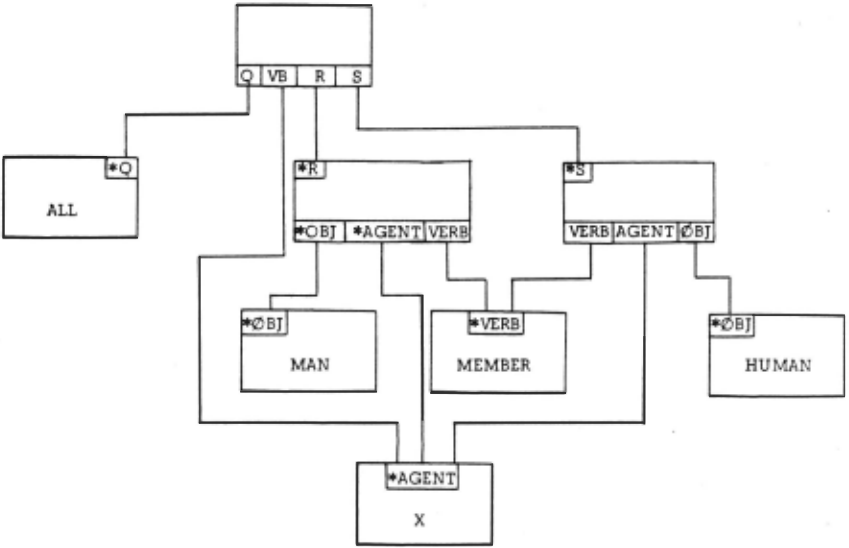
Deduction rules are stored using two types of items that will be recognized by the executive routines. We will call them quantifier clauses and connective clauses. A quantifier clause is the head of a quantified general statement and has four special system relations emanating from it. They are:
- (i) Q points to the quantifier
- (ii) VB points to the variable being bound
- (iii) R points to the restriction on the variable
- (iv) S points to the scope of the quantifier
* MUTIMP stands for mutual implication. It is a predicate with an arbitrary number of arguments and says that its arguments mutually imply each other by pairs (are pairwise equivalent). Looked on as a binary connective, MUTIMP, like AND and OR and unlike IMPLIES and IFF is idempotent as well as .associative and commutative. A possible
That is if MUTIMP (P 1 , ... , P n) is true and Pi is true (false) for some i, 1 ~ i ~ n, then Pi is true (false) for all i, 1 ~ i ~ n. For two arguments MUTIMP is equivalent to IFF.
A connective clause is the head of a construction formed of several clauses joined by one of the connectives mentioned above. It has an OP system relation to the connective and one of the following sets of argument relations:
- (i) ARG to the argument if the connective is unary (NOT)
- (ii) ARG1 to the first argument and ARGZ to the second argument if the connective is binary (IMPLIES, IFF)
- (iii) MARG to all the arguments if the connective is associative, commutative and idempotent (AND,OR, MUTIMP)
The clauses forming the arguments of a connective clause and those forming the restriction and scope of a quantifier clause may be any net sub-structure with the requirement that a clause may contain a free variable only if a path of converse argument pointers, converse restriction pointers and con verse scope pointers leads to a quantifier clause in which that variable is bound.
Examples of deduction rules are given below. Each deduction rule is given first as an English language statement and then as a buildspec. ~such as 'X represent variable items.
- Every man is human. ( .Q:ALL, VB:'X, R:( .AGENT:'X, VERB:MEMBER, OBJ:MAN) ,S:( .AGENT:'X, VERB:MEMBER, OBJ:HUMAN))
- Every car has-as-part an engine. (. Q:ALL, VB:'X, R:( .AGENT:'X, VERB:MEMBER, OBJ:CAR), S:( .Q:EXISTS, VB:'Y, R:( .AGENT: 'Y, VERB:MEMBER,OBJ:ENGINE), S:( .AGENT: 'X, VERB:HAS_AS_PART, OBJ:'Y)))
- If a male is the child of someone, he is the son of that person. ( .Q:ALL, VB:'X, R:( .AGENT:'X, VERB:MEMBER, OBJ:MALE), S:(. Q:ALL, VB:'Y ,R:( .AGENT:'X, VERB:CHILD_OF ,OBJ:'Y)S:( .AGENT:'X, VERB: SON_OF ,OBJ:'Y)))
- John is at home, at SRI or at the airport.* ( .OP:OR, MARG:( .AGENT:JOHN, VERB:AT,
- OBJ:JOHNS_HOME), MARG:( .AGENT:JOHN, VERB:AT ,OBJ: SRI), MARG:( .AGENT:JOHN, VERB:AT ,OBJ: AIRPORT_4))
The structure for rule 1 is shown in figure 5.
5. Use of Deduction Rules
There are six operations that can be per formed with respect to a deduction rule in MENS. They are:
* This sentence taken from Green and Raphael [6].
- (i) It ma y be used for generating con sequences .
- (ii) It may be confinned by exhaustive induction , i.e . proved F-true in the universe of the data structure at an y given time.
- (iii) It may be deduced from other deduction rules.
- (iv) It may be refuted by finding a counter instance in the data structure.
- (v) Its negation may be deduced.
- (vi) It may be treated as a specific state ment, which includes its use as an assumption in the deduction or nega tion of other rules as in (iii) or (v).
We will be mainly interested in using a de duction rule for generating consequences. In this process, there are two ways of using a restriction . They are:
- (i) A possible substitution for the variable may be checked to see if it fulfills the restriction.
- (ii) The data structure may be searched to find all items that fulfill the restric tion.
The amount of infonnation that may be de duced with any deduction rule depends on more than the quantifiers and the number of items fou nd that are able to fulfill the restrictions. It also de pends on the structure of the logical connectives In the deduction rule. For example, a deduction rule might have a consequent that was the conjunction of several substructures. Thus , several inde pendent substructures might be deduced from ea ch choice of items to substitute for the variables. There are, therefore, several different ways we may use a deduction rule for generating con sequences. We may instantiate over all items that satisfy the restrictions or just over those we are interested in. Similarly, we may generate all the consequences justified by the deduction rule or just those needed to answer a particular que s tion.
In the following sections, we will first dis cuss how a deduction rule useful for answering a particular question is found, and then discuss how the executive routines interpret the deduction rules and generate consequences.
6. Finding Deduction Rules
A deduction rule is needed when the number of items found to satisfy a findspec (see section 3) is less then the minimum number required . The problem then, is to find a deduction rule capable of generating an item that satisfies the finds pee. Say the finds pee is
where L 1 , .·· , Ln are system relations and I 11 , .·. ,Inm are specific items (we will assume n
at first that a substructure only one level deep is required and consider the case of several level structures later). In order for a deduction rule to generate the desired item, it must be headed by a quantification clause that is connected through a path of scope and argument pointers to an item
which contains the labels L 1 , ..· , Ln one or
more of which point to variable items and the rest of which point to some i tern in the appropriate list in (i). We can, therefore, locate the deduction rule by searching for any item that satisfies the find spec:
where V is a list of all variable items in the data structure. For the sake of efficiency, we maintain an item which we shall call VBL. No other item in the structure contains a pointer to VBL, but whenever a variable item contains a pointer L to an item I . VBL also contains a pointer L to the item I. Thus, the findspec (ii) is equivalent to:
Note that any item that satisfies (i) must be an instantiation of any item that satisfies (iii) and, further, it is possible to deduce an item that satisfies (i) only if an item satisfying (iii) exists
in the data structure.
For each item, I, found satisfying (iii) we may record what substitutions we are interested in for the variables pointed to from I. If I has a pointer . L. to a variable item X., we record l 1
that the only items we are interested in submitting for X. are r. 1 , ... ,I. by putting them 1 1 1m. l
in a "possible substitution" list for\· They will later be checked against the restriction on \.
For each item I satisfying (iii), we then follow the paths of reverse scope and argument
pointers until coming to an item D that is the head of a deduction rule. This will be a deduction rule capable of generating the consequence we are interested in. While following this path a ~ list is created. This is a list (S 1 , ··· , Sk) where Sk is I, S 1 is pointed to by a scope or argument pointer from D, and Si' 2 ~ 1 ~ k, is pointed to by a scope or argument pointer from Si-l. The trace list will be used to limit the consequences generated to the ones desired.
In the case of failing to find items matching a findspec involving several levels, the same process is carried out, but we must be sure to allow for all possibilities of variables replacing constants. That is, each level is handled as above for progressively higher levels, and the reverse scope and argument pointers are not
followed until the highest level has been done.
7. Generate
The routine to generate consequences from a deduction rule is a recursive procedure that is initially given the internal name of an item that heads a substructure with no free variables. It returns a list of items (internal names) that head substructures representing the consequences that have been generated. These substructures might then either be left in the data structure or be erased. The Generate routine is written to gen erate consequences according to the author's understanding of the meanings of the quantifiers and logical connectives. It is not designed to prove theorems, but to use deduction rules and other data that have been stored and are assumed to be valid by generating consequences of them.
For example, when generating a consequence headed by a universal quantifier, the restriction is used to direct a search of the data base which results in a list of items that can substitute for the bound variable and then the scope is generated. When generating a consequence headed by a connective clause, the action taken depends on the connective. For example with a disjunction, if all but one of the disjuncts can be refuted, the
remaining one is genera ted.
8. Confirm and Refute
The Confirm and Refute routines are used by the Generate routine to determine if a fact repre sented by a structure is true or false in the data base. It is, of course, possible for an expression to be neither confirmed nor refuted. For example, the statement "All men have two arms" would be
neither confirmable nor refutable if we knew of exactly 100 men, of whom 99 had two arms, but we had no information about the hundredth.
The Confirm and Refute routines also use the author's knowledge of the quantifiers and connectives. For example a disjunction is con firmed . if and only if any argument is confirmed and is refuted if and only if all the arguments are refuted.
9. Substructure Directed Searching
Using a restriction to find all the items that satisfy it and finding an instantiation of a sub structure containing free variables in order to con firm or refute it require a process similar to the one used to find an item described by some find spec. Such general substructures rna y contain some items which are connected to the head item by several different paths. If these items are constant items, any instantiation of the general substructure will contain them at the end of similar paths from the head item. If, however, they are variable items or items heading sub structures containing variable items, the instan tiation substructures will have different items in their place and we must be sure that no item in the general substructure is substituted for by more than one item in any instantiation sub structure . This is done in the say way as eval uating a findspec which contains vnarnes which originally appeared preceded by " ~·" or in the find prefix .
I 0. Summary
In retrospect, we can see several signifi cant facets of the MENS structure and the MENTAL system. First, the work has been developed with a unified viewpoint grounded in the theoretical basis represented by the six motivating factors discussed in section 2, Underlying these have been the desires to maintain complete generality and to keep the executive routines as simple and general as possible. Thus the number of ad hoc features have been kept to a minimum. The only departure from building just a structure and those routines necessary to manipulate the structure ignoring what information might be stored in the structure was the establishment of the system relations and item relations used to store deduc tion rules and the executive routines to interpret them. Once that was done, however, no further constraints were placed on the deduction rules so that generality was maintained to a large degree,
Another significant facet of MENS is the two levels of relations --system relations and item relations. System relations are the basic organizational mechanism of the structure, yet the user is allowed to define the ones he wants to use and thus may experiment with different semantic structures. Item relations are the con ceptual, meaningful relations that hold between other concepts, yet the fact that they are relations is preserved only by the way they are connec ted in the structure, which is determined and inter preted by the user. Item relations, as conceptual entities, may have stored information a bout them as well as information using them.
A very important facets of MENS and MENTAL is the ability to enter, retrieve and manipulate deduction rules the same way specific facts are entered, retrieved and manipulated, yet deduction rules are used by the system to deduce information that was not previously explicitly stored in the structure. Thus one may explain to the s ystem what a concept means by giving, in general terms, the implications of the concept' and one rna y give this explanation just like he gives the system any other information.
The system and structure as presented in this paper provide an environment in which im portant problems in question-answering and com puter understanding may productively be investi gated. Also MENS and MENTAL may be used as an experimental vehicle for further research in semantic structures.
@inproceedings{ijcai1971p54,
  title     = {A Net Structure for Semantic Information Storage, Deduction and Retrieval},
  author    = {Shapiro, Stuart C.},
  booktitle = {Proceedings of the Second International Joint Conference on
               Artificial Intelligence, {IJCAI-71}},
  publisher = {International Joint Conferences on Artificial Intelligence},
  editor    = {D.C. Cooper},
  pages     = {512--522},
  year      = {1971},
  url       = {https://ijcai.org/proceedings/1971/54},
}
TY - CPAPER TI - A Net Structure for Semantic Information Storage, Deduction and Retrieval AU - Shapiro, Stuart C. T2 - Proceedings of the Second International Joint Conference on Artificial Intelligence, IJCAI-71 PB - International Joint Conferences on Artificial Intelligence PY - 1971 SP - 512 EP - 522 UR - https://ijcai.org/proceedings/1971/54 ER -Copied
Machine-readable versions of this paper, for tools and AI agents:





