
Active Semantic Networks as a Model of Human Memory
Proceedings of the Third International Joint Conference on Artificial Intelligence. Psychology and A.I. Pages 450-456.
© 1973 International Joint Conferences on Artificial Intelligence
Abstract
A general system to simulate human cogn1t1ve processes is described. The four-part system comprises a nodespace to store the network structure; a supervisor; a transition network parser; and an interpreter. The method by which noun phrases operate and tpe process for the determinj!r "the" is presented. An analysis of verb structures illustrates how network structures can be constructed from primitive verb definitions that get at the underlying structures of particular verbs. The paper concludes with an illustration of a problem in question-asking.
- Rumelhart, D. E., Lindsay, P.H. & Norman, D.A. A process model for long-term memory. In E. Tulving and W. Donaldson (Eds.), Organization of Memory. New York: Academic Press, 1972.
- Norman, D.A. Memory, knowledge, and the answering of questions. In R.L. Solso (Ed.), Contemporary Is- sues in Co nitive Ps cholo : The Lo ola Sym osium. Wash1ngton, DC: inston, 1973. Distributed y Wile~
- Kaplan, R.M. Augmented transition networks as psy- chological models of sentence comprehension. Arti- ficial Intelligence, 1972, 3, 77-100. IJCAI
- Woods, W.A. Transition network grammars for natural language analysis. Communications of the ACM, 1970, 13, 10, 591-631.
- Woods, W.A. & Kaplan, R.M. The Lunar Sciences Natu- ral Language Information System. Cambridge, MA: Bolt Beranek and Newman, Inc., Report No. 2265, 19~.
- Fillmore, C.J. The case for case. In E. Bach and R.T. Harms (Eds . ), Universals in Linguistic Theory. New York : Holt, Rinehart and Winston, 1968.
- Schank, R.C. Conceptual dependency: A theory of natural language understauding. Cognitive Psycholo- _gr_, 1972, 3, 4, 552-631.
- Chafe, W.L. Discourse structure and human knowledge. In J.B. Carroll and R.O. Freedle (Eds.), Language Comprehension and the Acquisition of Knowledge. Washington, DC: Winston, 1972. (Distributed by Wile~
- The general representational format for verbs sug- gested in the current paper was developed in a work- ing seminar attended by Adele Abrahamson, Dedre Gentner, ~im Levin, Steve Palmer and David Rumelhart which met weekly from January through July, 1972 .
- Abelson, R.P & Reich, C.M. Implication modules: A method for extracting meaning from input sentences . Proceedings of the International Joint Conference on Artificial Intelligence. Washington, DC, 1969, 641- 647.
- Eisenstadt, M. & Kareev, Y. Towards a model of hu- man game playing. Proceedings of the Third Inter- national Joint Conference on Artificial Intelligence. Stanford, CA, 1973.
References were extracted automatically from the PDF and may contain errors.
Full text extracted automatically from the PDF; figures, tables and equations may differ. The PDF is the version of record.
ACTIVE SEMANTIC NETWORKS AS A MODEL OF HUMAN MEMORY 1
David E. Rumelhart Donald A. Norman Department of Psychology University of California, San Diego
La Jolla, California 92037
made it reasonably general and readily extendable so that any of the psychological hypotheses under study can be simulated and tested in its own specialized
and Conce ts. The representat1on to e escri e ere is presented in more detail and with more justification in the papers by Rumelhart, Lindsay & Norman3 and Norman4. Basically we use a network representation with nodes connected to other nodes by labeled, directed relations. Because each relation also has an inverse, the network is bi directional .
Events are specified in a similar way, except that actions require arguments. Thus, the node that repre sents an action may have obligatory relations leading from it, specifying such things as the agent, location, and object of that action.
Most actions and concepts in the network have a single ~rimary node (or _type node) that encodes its definit1on, and numerous secondary nodes (or token nodes) that represent specific instances of the primar one . Almost all encodings of specific scenes are done by means of secondary nodes.
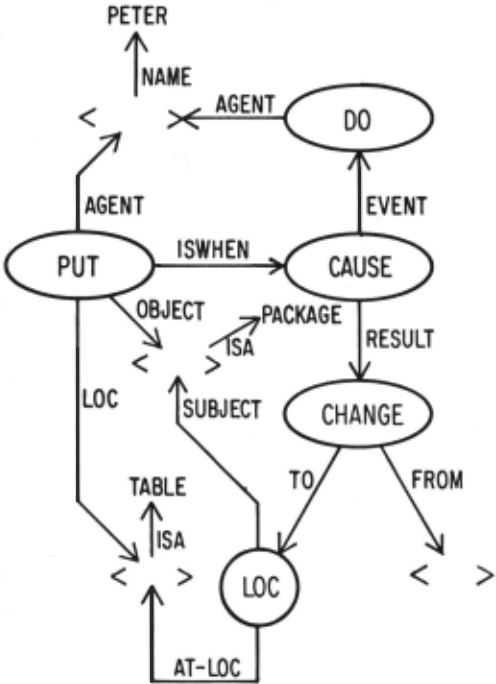
The basic unit in the memory space is the scenari an action that consists of events, agents, locations, and objects. TO illustrate the representational syste consider the sentence
Peter put the package on the table. Figure 1 shows a possible simple encoding for this sen tence which includes some of the underlying structures of the action.
Figure 1. Peter put the package on the table.
The SOL Language
The parsing process is based on three independent ly motivated principles. First, the parsing procedure are represented as an augmented recursive transition network (following the work of Woods and Kaplan5,6,7). Second, the parser is based around a "case grammar" (after Fillmore8) and has "case frames" and "argument constraints" associated with many lexical items. (Here some of the methods suggested by Schank9 can be used.) Third, the parsing is based on the idea that it is the task of each noun phrase to find its own referent in memory if it exists or else to create a new structure in the data base. Thus, certain lexical items such as determiners, adjectives, and pronouns are defined by the strategies for finding the proper referent.
Argument Frames. Associated with every predicate word is an argument frame which indicates which and how many arguments must exist. For example, associat ed with the verb move might be the following set of arguments: 1) a causal move.r (called here an AGENT); 2) a moved object (OBJ); 3) an initial location (FROM LOC); 4) a terminal location (TO-LOC); S) a means of moving (METHOD); and 6) a time of occurrence (AT-TIME). We denote the argument frame as follows:
AGENT X MOVES Y (FROM-LOC Ll TO-LOC
L2 METHOD M AT-TIME T) .
Those arguments enclosed in parentheses are taken to be optional; the others are required. Associated with each case name (e.g., FROM-LOC or METHOD) is a list of prepositions which can occur at the surface level to indicate or mark that argument. Each label also is
Abstract
A general system to simulate human cogn1t1ve pro cesses is described. The four-part system comprises a nodespace to store the network structure; a supervisor; a transition network parser; and an interpreter. The method by which noun phrases operate and tpe process for the determinj!r "the" is presented. An analysis of verb structures illustrates how network structures can be constructed from primitive verb definitions that get at the underlying structures of particular verbs. The paper concludes with an illustration of a problem in question-asking.
A Model of Human Memory
We have constructed a large general simulation of human language and long-term memory on the premise that the study of the inter-relationships among psychologi cal processes will lead to more insight into human cog nition and memory. The general implementation is_ba sically complete, and a variety of users are starting to study specific psychological tasks (language under standing; children's development of language; primitive verb structure; reading; inference; game playing--Go and Gomoku; visual representation and memory; learning; and question answering). It is still too early tore port on the results of the psychological investigatio~. Therefore, this paper is a progress report on the sys tem and the underlying psychological principles.
The major guidelines have come from our attempts to represent long--term memory structures. We know that people rapidly forget the details about the surface structure of an experience but retain the meaning or interpretation of that experience indefinitely. We al so know that retrieval of an experience from memory is usually a reconstruction which is heavily biased by the person's general knowledge of the world. Thus, general world knowledge should interact with specific event knowledge in such a way that distinction between the two is not possible. The representation should allow paraphrase. Finally, the limitations of human working storage (or short-term memory) probably comprise a fun damental property of the system, one that should be viewed as an essential, positive component, not as sim ply a performance limitation.
The Computer System
The basic system consists essentially of four fixed components: 1) a nodespace in which our network structures are stored; 2) a supervisor which allows us direct access to various portions of the nodespace; 3) a parser which converts strings of words into network structures; 4) an interpreter which processes sections of the nodespace and carries out any strategies which were stored in that portion of the nodespace. The sys tem is written in ALGOL on the Burro~ghs 6700 at the University of California, San Diego. The simulations are done in our own English-like language, with all statements entered through the parser. The language is ·called SOL (for Semantic Operating Language--pronounced "soul") and it is specifically designed for manipulat ing and traversing the network structures of the data base. Because we wish many different psychological simulations to be handled by the one system, we have associated with a set of semantic characteristics which can be interrogated during the parse. The prepositions and the semantic characteristics can be used together to disambiguate which of the variety of concepts a giv en noun phrase is representing.
Certain verbs, particularly those talking about ideas, sometimes take whole sentences as arguments. Such arguments are referred to in our system as prop ositional arguments (PROPOSITION) . Thus, the argument frame for one sense of the verb make (as in the sen tence "Freddy made his brother come home") takes a propositional argument and has the argument frame
AGENT X MAKE PROPOSITION Y (METHOD
M AT-TIME T)
where Y stands for some transformed version of an en
tire sentence.
At every point during the parse the goal is to find and correctly fill the argument slots of the pred icate word in question. If some arguments do not fit into the frame of the sense of the predicate word in question, a new sense of the predicate word is tried until either a fit occurs, or no more senses exist (in which case, the parse fails).
Operators. One important class of words in our language analysis is the class we call operators. Operators are nouns that take arguments (usually prep ositional phrases) and thus have associated case frames. Operators can be verb based nouns such as destruction in the destruction of the city by the enemy--destruc tion is an operator with its two arguments filled by the following noun phrases. An operator is also a re lational noun such as father, as in the sentence "Bill is the father of Henry~re, father is analyzed as an operator with one argument. The existence of case frames for these nouns as well as verbs reduces sub stantially the ambiguity of prepositional modification.
Disambiguating the Referent
One of the major problems in the analysis of natu ral language is determining the exact referents of a phrase. Most of the complexities of such words as the come from the difficulties of determining just what-- concept is being referred to. In the SOL system the parser automatically invokes the procedural definition of the which, in turn, performs an active search through the data base to determine the referent as each noun phrase is analyzed. We illustrate here how this is done by going through the strategies that comprise the procedural definition for the. In rough form, the process is this: first, if the-phrase is an operator, then it contains the procedures for its own disambigua tion which should be performed before doing anything else. If that is not the case, then we determine whether the object being referred to is unique within the data base, for if it is, no particular problem exists. If these two strategies fail, then we see whether or not immediate context helps, and if that fails, we look to see whether or not there is a rela tive clause that can do the job. Now look at this in detail.
Operators. If the unknown phrase is an operator, then it is necessary to determine whether or not to perform the operation or to refer to the value of the operation. Thus, with the phrase the father of John the operator father has not been evaluated, so first we execute the routine for father (passing John to it as an argument) and then return to the parser with the re sult of that operation (presumably, the name of the person who is John's father). If father is being used in its nominal sense, however, as ~told the father to give the toothbrush to the daughter," then we are referring to 'the value that a previous execution of the operator had returned.
Unique Instances. If a given concept is unique to
the data base, then it can be unambiguously found whenever referred to with a determiner. Thus, if the memo ry system knows of only one ocean, to tell it "The sun set over the ocean" is completely unambiguous, not be cause the system is intelligent, but rather because it doesn't know enough to be confused. Tell it about the existence of a second ocean (or a second sun) and this strategy will not work (but the fQllowing ones might).
Foregrounding. ChafelO suggests that many prob
lems in disambiguation are handled by context in a man ner that he calls "foregrounding." If the recent con text has been about "Fred's kitchen," then the objects in that particular kitchen are foregrounded even though they have never been mentioned specifically. Fore ground establishes local context. In our system each concept that can be brought to the foreground has as sociated with it a specific list of items. As new sen tences pass through the parser, they initiate the ap propriate foreground lists.
Note that foreground has several hierarchical levels, for the context includes the general overall topic under discussion, the specific details, and the environmental setting of the speakers. Thus, in this paper we could now talk of "this conference" or "this parser," both of which would be disambiguated by fore ground-like operations, but each would be at different levels.
Short-term Memory. We can also look back in short-term memory to determine if any of the recent sentences help disambiguate the referent. At the mo ment, we look back over the last five sentences. Even tually, we intend to have a more reasonable simulation of human short-term memory processes, so that only top ics that could reasonably be expected still to remain in active short-term memory could be disambiguated this way.
Search. If all this fails, it is still possible that an 1ntelligent search among the concepts discussed recently (or foregrounded recently) could disambiguate the referent. This strategy .has not yet been imple mented, primarily because its use depends upon the op eration of a search routine that is not yet fully oper ational. (The search routine is a simultaneous breadtir first search emanating from as many nodes as are speci fied, returning with a path that links all the nodes in the search space. That path is evaluated for its logi cal properties and the search process is either termi nated or continued.)
Clauses. A common method of disambiguation is by the use of clauses, as in the phrase the girl (whom) I saw in the ~ark. This method of disambiguation is clearly an 1mportant part of normal English. It has been deleted from the existing the routines because the search routines do not yet work-.--But it is an impor tant enough process to warrant further discussion here.
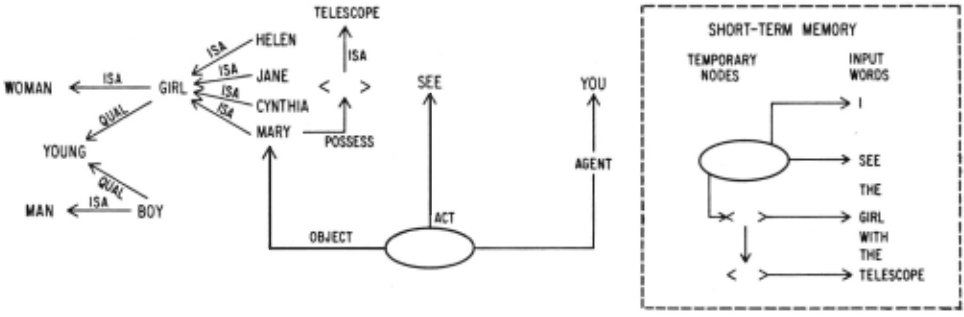
Consider the sentence "I see the girl with the telescope." As it now stands the sentence is incom plete and, therefore, ambiguous: we need some context. Suppose that the following information is known by the
system.
Jane, Mary, Cynthia, and Helen are girls. Mary has a telescope.
These data are represented in the left part of Figure
2.
Pigure 2.
The analysis of the sentence "I see the girl with the telescope" is simple until we reach the phrase the gir~. Thus, we can recognize I as the subject of the see. (The model has only-one person with whom it converses, namely you. The change in designation of the subject to the-zase relation of a~ent occurs with the construction of the deep parse an construction of a permanent memory segment.) The analysis of the is complex because all the strategies di scussed so-far would fail. We need to look at the clause with the telescope. A search of the data base reveals that on ly one girl possesses a telescope; now we have dis ambiguated the referent (see Figure 2) .
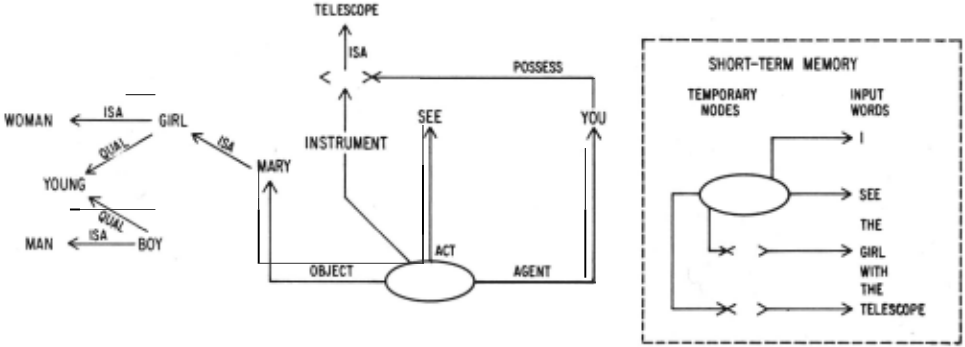
A different result would occur had the contextual information in the data base been the following.
Mary is a girl.
I got a telescope on Tuesday. The resulting analysis is shown in Figure 3.
Figure 3.
The major difference between the analyses shown in Figures 2 and 3 is that in the latter the phrase with the telescope is neither needed to help disambig uate the referent for the girl nor is it consistent with the known information about Mary. Hence, the referent program completes its action with one phrase left unanalyzed. When control returns to the parser, this phrase is still left. The parser then checks it against the possible frame for the verb see and, in this case, finds that it can be used as the instrument of seeing. Again, the sentence is analyzed. with no difficulty and with no recognition by the parser that an alternative analysis was possible.
Defining Verbs
At this point the general description of the sys tem is complete. One more specific point is appropri ate to discuss here, however. The basic premise un derlying the linguistic analysis is that we can repre sent the meaning of verbs as network structures built from a limited set of semantic primitives. Here we wish to illustrate one analysis of verbs and ltheir un derlying primitives, both to show how we believe the linguistic structures should b'e represented and also to demonstrate several features of the SOL language.
At least three different aspects of verb meanings can be distinguished: states; changes of states; and causes of these changes . The stative component of a verb conveys that fixed relationship which holds among its arguments for a specified period of time. The change component of a verb tells that a change in state has occurred. The causative component communi cates the source of, or reason for, the change. These different verb components are not all present in all verbs, but all components may appear in a single lexi
cal item.
In the remainder of this section we show how we represent these various semantic components and how we can express the definitions of particular lexical items in such a way that the primitive representation for that.item is automftically computed whenever it appears 1n a sentence.
Statives. The simplest semantic component of verbs is the stative component. This component merely communicates the information that a particular state of the world holds from some initial time to some final time. The simple locative is an example of a verb which seems to have only stative components. For ex ample:
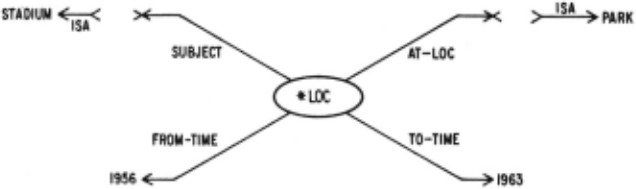
A stadium was located in the park from 1956 until 1963.
(1)
Sentence (1) presumably communicates nothing more than that a particular relationship held between a stadium and a park for some period of time. We represent this meaning by an underlying locative primitive called *LOC (the names of our primitive predicates are pre ceded with asterisks in order to differentiate them from surface lexical items). Figure 4 illustrates the network representation we give to sentence (1) .
Figure 4.
We want to define *LOC and locate in such a way that when the meaning of locate is computed (i.e., the definition is executed), we have the structure given in Figure 4 generated in the nodespace and associated with sentence (1). To accomplish that, we first define *LOC so that it generates the· appropriate structure. Then we define locate in terms of *LOC. First the defini tion of *L~
Define as predicate *LOC. X *LOC AT-LOC L (FROM-TIME Tl TO-TIME T2). Return with newtoken for "*LOC" "SUBJ" X "AT-LOC" L "FROM-TIME" Tl "TO-TIME" T2.
In this definition, the initial line calls the special defining mode of the parser which sets up the basic node structure for the definition of a new concept. It also accepts the sentences that follow as instructions for processes which are executed each time the newly defined structure is actually used. The term predicate is the syntactic class to which *LOC is being assigned. This class includes all relational terms which can stand as the main relational term of a sentence, The second line of the definition gives the argument frame for the definition. In this example, the structure that *LOC returns is a newly constructed token node (secondary node) for the primitive with the appropriate argument values inserted in place.
Now we can define the stative sense of the verb locate:
X LOCATE AT-LOC L (FROM-TIME Tl TO-TIME T2) .
Define as predicate LOCATE. Iswhen X *LOC at L from Tl to T2.
(Other senses of locate can also be defined, but they are not shown in ~xample.) Note here that when the definition of locate is invoked, a statement in volving *LOC is asserted. Whenever this happens, the definition of *LOC is invoked and a structure similar to that in Figure 4 is generated. This structure is then passed back through the definition of locate and in this case returned back to be associated~the surface proposition from which it was invoked . Thus, the structure generated by *LOC becomes associated with the use of the verb locate. The term iswhen is an ac tion of SOL which carries out the details of passing back the newly constructed structures.
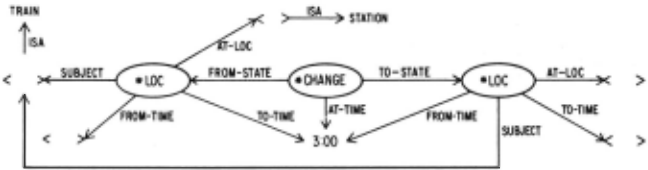
Change-of-States. The next simplest type of verb component is that of the change of state where no par ticular causative component is specified or implied. For example:
The train moved out of the station at 3 o'clock.
(2)
In this sentence the subject, train, is the object of moved, not the causative agent~tting *CHANGE be the underlying primitive indicating change of state, we il lustrate the network structure for sentence (2) in Fig ure 5.
Figure 5.
We want to define *CHANGE in such a way that it constructs structures like those shown in Figure 5. The features of these structures are: 1) indicate that the former state (FROM-STATE) terminated at the time of the change; 2) indicate that the final state (TO-STATE) was initiated at the time of the change; 3) construct and return with a new token node for change with each of the arguments filled with the appropnate structures. The SOL definition of *CHANGE is this:
Define *CHANGE as operator. *CHANGE FROM-STATE Sl TO-STATE S2 AT-TIME T. Understand that Sl ended at T, Understand that S2 started at T. Return with newtoken for "*CHANGE" "FROM
STATE" Sl "TO-STATE" S2 "AT-TIME" T.
We are now ready to define the intransitive (i.e~ non-causative) sense of the verb move. We call this sense MOVE! to distinguish it from the general sense of move which contains a causative component. The non causative sense simply indicates a change from one loc ative state to another one. The SOL definition for MOVE! is this:
Define as predicate MOVEl. X MOVE! (FROM-LOC Ll TO-LOC L2 AT-TIME T). Iswhen a *CHANGE from the state that X is located at Ll to the state that X is located at L2 occurs at T.
Note that when this definition is evaluated, it in vokes *LOC twice (through the two uses of locate) and passes the structures built by *LOC to *CHANGE where the final structure of the form in Figure 5 is put to gether and then associated with the current invocation
of MOVE.
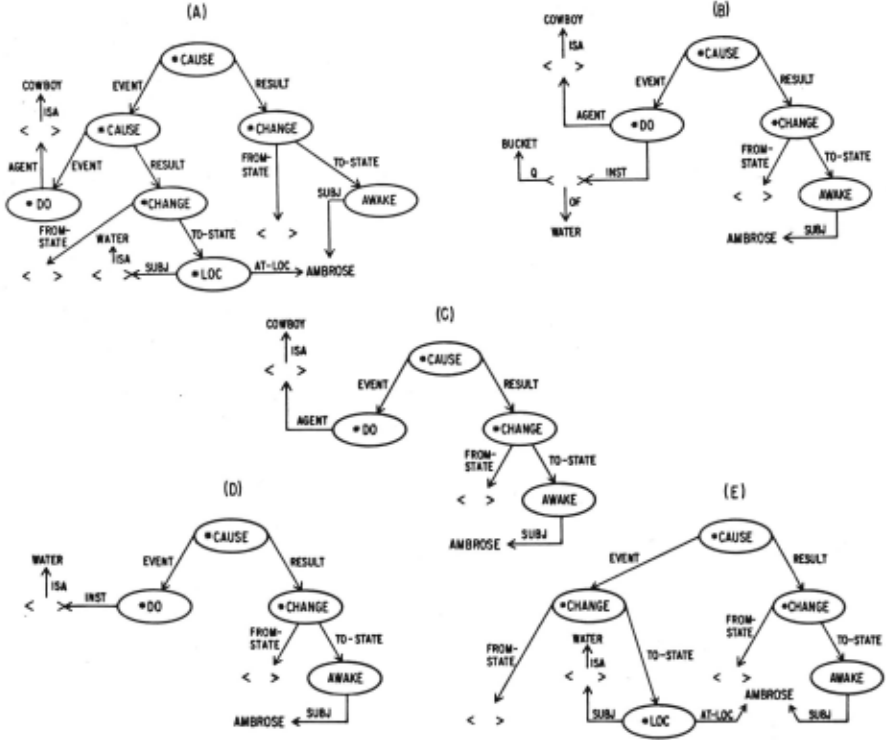
Causatives. The prototypica l causal verb is, of course, the verb cause itself. The complexity of the causal component of verbs stems from the fact that there are at least three qualitatively different sorts of causes of events. As an illustration, consider the following five sentences:
The cowboy caused Ambrose to wake by putting water on him.
- (3a)
The cowboy caused Ambrose to wake with
a bucket of water . (3b)
The cowboy caused Ambrose to wake. (3c)
The water caused Ambrose to wake. (3d)
Ambrose was awakened by water being put on him.
(3e)
Sentence (3a) illustrates the specification of all three types of causes: 1) the agentive cause (the cow boy); 2) the instrumental cause (the water); 3) the method (the putting of the water) . Sentences (3b) (3e) illustrate some of the surface forms in which these causes can appear . We hold the basic underlying model of causatives to be that "someone does something with some instrument." If the event is fully speci fied, then that event is taken to be the cause; other wise a dummy act, *DO, is inserted into the structure. Figure 6A-E gives thl 1 network representations for the
sentences (3a)-(3e).
Figure 6A-E
Note in 6A that the structure for ~ (from Figure 1) is the event causing Ambrose to wake. When the event is not known it is replaced by *DO with the agent or
instrument properly filled in.
We are now in a position to define cause in such a way that the proper causative structure will be gen erated whenever the definition of cause is executed:
Define as predicate CAUSE. AGENT X CAUSE PROPOSITION Y (METHOD M INSTRUMENT I AT-TIMET).
If M is specified, understand that M started at T, evaluate M, call M "ACT",
else call (newtoken for "*DO" "AGENT" X "INSTRUMENT" I) ACT.
Understand that Y started at T. Evaluate Y.
Return with a newtok en for "*CAUSE" "EVENT" ACT "RESULT" Y.
In this definition we first check to see whether the method is specified; if so, we say that it was initi ated at the time of the cause, compute the structure associated with the method (by evaluating the proce dure M), and save that structure in a variable called ACT. In case the method is unspecified, we build a dummy action and store it in ACT. We then compute the structure for Y, the caused event (by evaluating the procedure for Y). Using the predicate for the primi tive sense o£ cause, we now link the causative event to the resultant event. Finally, the procedure re turns with a structure that represents the entire definition.
Now that we have defined the primitives for the three basic types of components, we can use these as building blocks to define ever broader classes of verbs with increasingly natural definitions. We can, for example, define the verb MOVE as it appears on the surface. The SOL definition of MOVE is this:
Define as predicate MOVE. (AGENT X) MOVES Y (FROM-LOC Ll TO-LOC L2 METHOD MAT-TIMET) .
If X is not specified,
iswhen Y movel from Ll to L2 at T, else
iswhen X caused Y to movel from Ll to L2 by M at T.
Here move is defined only in terms of the intransitive move (MOVEl) and CAUSE. Similarly, we can define the verb ~ in terms of MOVE so that the structure illus trated in Figure 1 is produced:
Define as predicate PUT. ASENT X PUTS Y AT-LOC L (AT-TIMET).
Iswhen X moves Y to L at T.
Note that these definitions do more than simply rewrite one verb in terms of another. The important point about the entire memory model is the type of re presentational structure that is constructed with the network. With these verb definitions, the primitives build new structures and modify old information. Thus, in the definition of MOVE, the last line performs the processes for CAUSE and also ·the processes defined for MOVEl. CAUSE both builds a structure for the causal factors and also performs whatever processes are repre sented by M, the method. The process for M is passed as an argument down from the original sentence that was entered through the parser, through the definitional structure for MOVE, and finally to the definitional structure for CAUSE. There it is finally executed, building whatever network structure the method M repre sents.
The Three Drugstores Problem
In this section we give an example of one problem being analyzed by our research group. A major feature of the way that a person views the events of the world is in terms of their causal factors. That is, we tend to disbelieve that an event could simply happen by it self; rather, we tend to believe that an event must have a cause. The tendency to give causal reasons for events is important because it affects the ways in which people make use of information. To illustrate the point, we analyze the three drugstores problem.
The basic probli~ before us was eloquently posed by Abelson and Reich. We paraphrase their version of the problem in this way:
Suppose an individual says a sentence such as,
"I went to three drugstores." (4)
A response based on syntax only might be,
"How did you go to three drugstores?" (5)
A response based on some semantics might be,
"What useful things did you buy in three drugstores?" (6)
But the most natural response ought to be,
"How come the first two drugstores didn't have what you wanted?" (7)
Solving the Drugstore Problem. Just what must the required processes look like to be able to solve the drugstore problem? To solve the first few levels all that is needed is a pattern-match program that examines the structure of the verb of the sentence and compares the allowable arguments with those actually presented. Thus, in the sentence, "I went to a drugstore," we see that the to-location is provided but not the from-loca tion, the method, or the time. Thus, it is really a simple mat~ construct questions like (5).
To be more intelligent a basic decision must be made: Should the missing information be requested? The answer is usually no. In normal conversation informa tion is omitted either because it is assumed to be pro vided by the preceding or following context or because it is unimportant to the conversation. The pattern match routines ~nside a procedure called comprehend) fill in information by examining the structure of pre ceding sentences. Sometimes the information in prior sentences might be appropriate to later ones, and some times the information given in the present sentence might fill in missing arguments from previous sentences. When missing arguments are noticed, an attempt is made to answer the implicit question provided by their ab sence through an examination of the data base. In ad dition, the present input is examined to see whether it can fill arguments missing in the data base being con structed from the conversation.
So far, we have simply investigated a simple means for filling out the syntactic pattern for verbs, albeit with some sophistication in determining when to ask for more information. The next step is more complex. Sup pose we wish to determine why someone has gone to the drugstore. Again, we should not simply have to ask why, but rather determine the general reasons for going to the stores. For this point the comprehend routine must be intelligent enough to examine a more general data base. Now a fair amount of inference is required: we need to match the basic paradigm with the specific information given by the parsed sentence. This is not easy when one considers that many different paradigms will probably be stored. If the sentence had been, "John went to a shoestore," then the same analysis should clearly not yield the query, "What did John buy at the shoestore?IT The comprehend routine must be flex ible enough to solve this part of the problem by itself. A large amount of world knowledge is needed to solve the general problem.
This brief analysis shows that in order to have in telligent conversation it is necessary to be able to generate internal questions and their answers. Whenever information is missing some attempt must be made to fill in the gap, sometimes by asking appropriate questions, but usually by internal problem solving. In general, information should not be requested by means of a ques tion unless there is some actual need for it at the mo ment. Moreover, it would appear that the information should be asked from the very highest level down. Thus, the first question asked should refer to the motive and results of the operations being described. Only later should specific details of the method be asked .
In the implementation of the memory model system at the time of this writing, all the levels of analysis can not yet be performed. Basically, the implementation is complete up to the level of the sophisticated internal answering of questions. Thus, it has been an easy mat ter to implement a question answering routine to ask questions like the following for the input sentence: How did John go to the drugstore? What did he do after wards? With whom did he go? At the moment, the basic routines to ask such questions as "What did he buy at the drugstore?" are close to operation, but the con struction of the system that can ask the question ori ginally posed, "How come the first two drugstores didn't have what you wanted?" still remains some distance away.
The memory representation provides a rich environment for simulating human cognitive processes. The major ideas have been implemented, yielding an active network representation with an English parser that al lows interaction with the network and ready extendabil ity. Actual simulations of human cognitive tasks have just begun, and although work is in progress in a vari ety of areas, no large system has yet been completed . However, for a description of the use of this system in human P1~blem solving, see the paper by Eisenstadt and Kareev.
Notes and References
- This research was 1nitially supported by Grant NS 07454 from the National Institutes of Health. Con tinuing work is supported by the National Science Foundation Grant GB 32235X. We would like to thank Dan Bobrow for his critical comments on an earlier draft of this paper. Requests for reprints or more information may be addressed to either of the au thors at: Department of Psychology; University of California, San Diego; La Jolla, California, 9L037.
- The system programming was performed by Robert Olds and Robert Schudy. The parser and the means by which it interacts with the data base and interpre ter were developed by David Rumelhart and originally programmed by Chris Murano. Dennis Bell has assist ed in later developments along with Olds and Schudy.
- Rumelhart, D.E., Lindsay, P.H. & Norman, D.A. A process model for long-term memory. In E. Tulving and W. Donaldson (Eds.), Organization of Memory. New York: Academic Press, 1972.
- Norman, D.A. Memory, knowledge, and the answering of questions. In R.L. Solso (Ed.), Contemporary Is sues in Co nitive Ps cholo : The Lo ola Sym osium. Wash1ngton, DC: inston, 1973. Distributed y Wile~
- Kaplan, R.M. Augmented transition networks as psy chological models of sentence comprehension. Arti ficial Intelligence, 1972, 3, 77-100.
- Woods, W.A. Transition network grammars for natural language analysis. Communications of the ACM, 1970, 13, 10, 591-631.
- Woods, W.A. & Kaplan, R.M. The Lunar Sciences Natu ral Language Information System. Cambridge, MA: Bolt Beranek and Newman, Inc., Report No. 2265, 19~.
- Fillmore, C.J. The case for case. In E. Bach and R.T. Harms (Eds . ), Universals in Linguistic Theory. New York : Holt, Rinehart and Winston, 1968.
- Schank, R.C. Conceptual dependency: A theory of natural language understauding. Cognitive Psycholo _gr_, 1972, 3, 4, 552-631.
10. Chafe, W.L. Discourse structure and human knowledge.
In J.B. Carroll and R.O. Freedle (Eds.), Language
Comprehension and the Acquisition of Knowledge.
Washington, DC: Winston, 1972. (Distributed by Wile~
- The general representational format for verbs sug gested in the current paper was developed in a work ing seminar attended by Adele Abrahamson, Dedre Gentner, ~im Levin, Steve Palmer and David Rumelhart which met weekly from January through July, 1972.
- Abelson, R.P & Reich, C.M. Implication modules: A method for extracting meaning from input sentences . Proceedings of the International Joint Conference on Artificial Intelligence. Washington, DC, 1969, 641647.
- Eisenstadt, M. & Kareev, Y. Towards a model of hu man game playing. Proceedings of the Third Inter national Joint Conference on Artificial Intelligence. Stanford, CA, 1973.
@inproceedings{ijcai1973p57,
  title     = {Active Semantic Networks as a Model of Human Memory},
  author    = {Rumelhart, David E. and Norman, Donald A.},
  booktitle = {Proceedings of the Third International Joint Conference on
               Artificial Intelligence, {IJCAI-73}},
  publisher = {International Joint Conferences on Artificial Intelligence},
  editor    = {Nils J. Nilsson},
  pages     = {450--456},
  year      = {1973},
  month     = {8},
  note      = {Psychology and A.I},
  url       = {https://ijcai.org/proceedings/1973/57},
}
TY - CPAPER TI - Active Semantic Networks as a Model of Human Memory AU - Rumelhart, David E. AU - Norman, Donald A. T2 - Proceedings of the Third International Joint Conference on Artificial Intelligence, IJCAI-73 PB - International Joint Conferences on Artificial Intelligence PY - 1973 SP - 450 EP - 456 UR - https://ijcai.org/proceedings/1973/57 ER -Copied
Machine-readable versions of this paper, for tools and AI agents:





