
A Linguistics Oriented Programming Language
Proceedings of the Third International Joint Conference on Artificial Intelligence. Natural Language; Semantics and Parsing. Pages 372-381.
© 1973 International Joint Conferences on Artificial Intelligence
Abstract
A programming language for natural language processing programs is described. Examples of the output of programs written using it are given. The reasons for various design decisions are discussed. An actual session with the system is presented, in which a small fragment of an English-to-French translator is developed. Some of the limitations of the system are discussed, along with plans for further development.
- Aho, A.V. and J. Ullman, 1972. The Theory of Parsing, Translation and Compiling, Vol.l, Prentice-Hall, Inc., New Jersey.
- Bobrow, D.G., 1964. "METEOR -A LIST Interpreter for String Transformations," in Berkeley, E.D. and D.G. Bobrow (eds.) The Programming Language ~P: Its Operation and Application, Information International, Inc. Cambridge, Massachusetts.
- Bobrow, D. G. and J. B. Frazer, 1969. "An Augmented State Transition Network Analysis Procedure," Proceedings of IJCAI, 1969, 557-568. IJCAI
- Charniak, E.C., 1972. "Toward a Model of Chil,. dren's Story Comprehension," AI TR-266, MIT, Cambridge, Massachusetts.
- Farber, D.J., R.E. Griswold and I.P. Polonsky, 1964. "SNOBOL, A String Manipulation Language," Journal of the ACM, 11, 2, 21-30.
- Fillmore, C.J., 1968.-"The Case for Case," in Bach and Harms (eds.) Universals in Linguistic Theory, Holt, Rinehart & W1nston, 1-90.
- Green, P.F . , A.K. Wolf, C. Chomsky and K. Laugher- ty, 1961. "BASEBALL: An Automatic Question Answerer," in Feigenbaum and Feldman (eds,) Computers And Thought, 207-2ln
- Hays, D.G., 1964. "Dependency Theory: A Forma- lism and some Observations," Language, 40, 4, 511-525.
- Katz, J. J. and J .A. Fodor, 1964. "The Structure of a Semantic Theory," in Fodor and Katz (eds.), The Structure of Langua~e, 479-518.
- Klima, E., 1964. "Negat10n in English," in Fodor and Katz (eds.), The Structure of Language, 246- 323.
- Knuth, D.E., 1968. "Semantics of Context-Free Languages," Math Systems Theory, 2, 127-145.
- Lewis, P.M. and R. E. Stearns, 1968. "Syntax- directed Transduction," Journal of the ACM, 15, 3' 465-488. -
- Narasimhan, R., 1969. "Computer Simulation of Natura 1 Language Behavior," Invited paper, Con- ference on Picture Proc. Mach., Canberra, Australia.
- Schank, R., L. Tesler and S. Weber, 1970. "Spino- za II -Conceptual Case Based Natural Language Analysis," AI-109, Sta,nford University, Stanford, California.
- Simmons, R.F., S. Klein and K. McConlogue, 1964. "Indexing and Dependency Logic for Answering English Questions, Amer. Doc., 15, 3, 196.
- Thorne, J., P. Bratley and H. Dewar, 1968. "The Syntactic Analysis of English by Machine," in Michie, D. (ed.) Machine Intelligence 3.
- Warshall, S. and R. M. Shapiro, 1964. "A general purpose tab 1 e driven compiler," Proc. AFI PS SJCC, 25, 59-65. Spartan, New York.
- Winogra"Cr";"" T., 1971. "Procedures as a Representa- tion for Data in a Computer Program for Under- standihg Natural Language," Project MAC TR-84, MIT, Cambridge, Massachusetts.
- Woods, W.A., 1967. "Semantics for a Question- Answering System," Report no. NSF-19, Aiken Computation Laboratory, Harvard University, Cambridge, Massachusetts.
- Woods, W.A., 1969. "Augmented Transition Networks for Natural Language Analysis," Report No. CS-1 to the NSF, Aiken Computation Laboratory, Harvard University, Cambridge, Massachusetts.
- Yngve, V .H • ., 1963. "COMIT," Communications of the ACM, ~. 3, 83-84.
References were extracted automatically from the PDF and may contain errors.
Full text extracted automatically from the PDF; figures, tables and equations may differ. The PDF is the version of record.
1. Overview
This paper presents some aspects of work done at odd intervals over the past two years, first at Stan ford and then at MIT, on a project to develop a pro gramming language suitable for writing natural language processing programs. The relevant acronym is LINGOL, for Linguistics Oriented Language. Similar projects such as COMIT21 and its successors METEOR 2 and SNOBOL5 no longer reflect the state of the art of computational linguistics; indeed, they do not rise above the remark that computational linguistics is concerned with pro cessing text strings. The issue addressed in these pages is that of the programming technology appropriate to the syntax-semactics interface, an artifice that arises in the phrase-structure paradigm for natural languages. A secondary issue, to be dealt with else where, ~oncerns the relative merits of various parsing strqtegles for phrase-structure oriented grammars, and the development of a parsing algorithm superior to both the Earley and Cocke-Kasami-Younger procedures. (See Aha and Ullman 1 , p. ~14).
Following Winograd's 1 lead, we begin bY giving some examples of the output of programs written in LINGOL. The point of having a programming language is to make programming less painful for all concerned. The interesting property of these programs is that two of them were written in quite a short space of time by students with no experience in either LINGOL or lin guistics. Another program (the French translator) was designed, written and debugged from scratch for demon stration purposes by the author from 3:00a.m. to 8:00 a.m. of the morning he was scheduled to give a talk on it.
The first program was written in September 1970, to test out the first version of LINGOL. It was a sort of "deep structure" analyzer which attempted to make syntactic remarks about sentences (Figure 1). The gram mar used in it served as the basis for the next two programs.
The system languished for six months until a grad uate student, Bill Faught, took advantage of it for a project in an A.I. workshop. He took two weeks to write an English-to-German translator (Figure 2).
Later, Faught decided to do some serious work on questioning-answering systems, and soon produced a com prehension program (Figure 3) that relied on a rela tional model of the world in which all related concepts were represented in a graph as vertices linked by two way labeled edges. Recently he has produced considera bly more impressive results, but it is more appropriate that Faught himself report on them .
The French translator (Figure 4) was written by the author early in 1972, for demonstration purposes. The program consisted of a page of grammar and seman tics, a page of dictionary and a page of useful func tions for conjugating verbs, arranging agreements of ~rticles and adjectives, performing liason and so on, so 1t was not particularly large. The point of it was
A LINGUISTICS ORIENTED PROGRAMMING LANGUAGE Vaughan R. Pratt Massachusetts Institute of Technology Cambridge, Massachusetts
(i) it was easy to write;
- (ii) it was sufficiently succinct to be suitable for
exhibition; and
(iii) it dealt competently with that part of English fo which it nas defined.
It is easy to claim that, since this is a toy translator, it says nothing about the real world. This is certainly true with respect to polysemy. However, it is false with respect to extensibility of grammati cla rules; we shall later demonstrate the striking ef fects obtained on adding very simple rules. More recently, another four hours of work gave a self-tutor ing capacity to the program (Figure 5). Notice how unknown words are correctly classified as to part of speech before the program requests information.
We have been basking in these examples so~ewhat vicariously. It is very much like explaining the advantages and disadvantages of FORTRAN by exhibiting the output of some FORTRAN programs. Thus the reader should only infer from these examples the existence of LINGOL, and a lower bound on what can be achieved with it; he should infer its quality or lack of it not from here but from the following.
Z. Terminology and Perspective
Let us set the stage preparatory to giving some definitions. We need a paradigm for computational linguistics programs, and we choose the translation paradigm as best describing the LINGOL system. The tranlation paradigm characterizes natural language processing programs as translators from the natural source language to some natural or formal target language, whether French, LISP, structural descrip tions, predicate calculus, conceptual dependency diagrams or what have you. No loss of generality is entailed here, for by simply making the target 1 anguage· a programming 1 anguage, any other paradigm may be conveniently emulated. The obvious . competitor is the stimulus-response paradigm, in which the input isseen as a stimulus that elicits an action. Again no loss of generality can occur, since a possible action is to emit an utterance. The main advocate of this paradigm is Narasimhan 13 although it appears to be the implicit paradigm in many extant programs. We prefer th~ . Jgrmer paradigm for no very good reason, although we· do find it easier conceptually to mani pulate and characterize utterances rather than actions. In particular, in the programming methodology to be described, large items are gradually built up from smaller ones, and it is tricky to cast this in a stimulus-response format.
Within the translation paradigm we shall identify two main phases, cognitive and generative. The cog nitive phasg is parsing, in which the input is pre processed until it is in a form convenient for opera tion on by the generative phase, which then produces the translation as output. The paradigm itself does not require that one phase run to completion before the other can start. Indeed, Winograd's program makes effective use of feedback from the partial re sults of his generative routines in guiding the cog nitive routines, by attempting to build a semantic structure for, say, a Noun Group, before continuing with the parsing.
We are now prepared for the definitions. By syntax is meant all aspects of the source language involved in t~e cognitive phase, including such things as phrase structure rules and semantic markers. By semantics we refer to what is involved in going from
NONE OF MY FRIENDS WERE EATEN BY A LION . AS:S:ERT I Ot-l : FAL:S:E
ACTOR: LION ACT: EAT DILit:CT: FR I Ettn:s: F'ORTIOt-l: 5:Dt-1E Dl.o.l i'·lEP: I
THE AUTHORS OF t-lOt-lE OF THESE BOOKS ARE FRIENDS OF PETER . A:S::S:EfH I Ot"l :
FALSE
EAT A HORSE CDt-1t·1A~lD:
SUBJECT: AUTHORS :S:PEC IF'/ : THE
AUTHORS OF: BOOKS POF.'T I Ot"l : :s:m1E PLACE: HEF.'E
BE: FF.'IEt·ms:
FRIEt-lDS OF: PETEF.'
IF A MAr-l CAr-l EAT A DOG A HOF.'SE CAN EAT A SMALL CAT .
A:S: :SERTI Ot"l:
ACTOR : HDR:S:E ACT: EAT OBJECT: CAT :S:t·1ALI-t"lE:S::S: : ·s:t·1AI.. L
IMMEDIACY : POTENTIAL cmmrnm1:
ACTOF.: : t·1At·~ ACT: Efn OBJECT: DOG IMMEDIACY: POTEt-lTIAL
HOW QU ICKLY CAN YOU SWIM . OUE S:TIOt"l: :S:FEED:
ACTOR : \'01_· ACT: SI·.IH1 IMMEDIACY: POTEt-lTIAL
ACTOP: \'DU ACT: EAT OBJECT: HORSE
DO YOU LIKE ICECREAM . QUE :S:TIDt-l:
ACTOP: \'OU ACT: LIKE OBJECT: ICECREAM
WHERE DO YOU COME FROM G·UE :S.TIOt-l:
F'LACE:
ACTOP: \ 'OU A·::T: Cot-1E FRot-1: ?
Fi'lure 1. "Deep Structure" Anal.vzer.
SHE LOVES THE MEN WHO CAN GI VE HER HOUSE FLOWERS . SIE LIEBT DIE MAENNER DIE IHREM HAUS BLUMEN GEBEt-l f<OEt·H·iHl
THE APPLES THAT THE HOF.'SE EATS WI LL BE BETTER TOt'10RF.:OI.d . DIE AEPFEL DIE DRS PFERD !SST WEF.'DEN BESSER t·10RGAt·i SE I t"l
THAT THE DOG THAT EATS FLOWERS CAN COME E BAD. DASS DER HUND DEF.' BLUMEN !SST KOMMEN KANN ET :s:CHLECHT
MEN THAT APE OLD CAN SLEEP BETTEF.'. MAENNEF.' DIE ALT SIND KOENNEN BESSEF.' SCHLAFEN
HE SLEEPS BETTEF.' WHILE HI S DOGS EAT. ER SCHLAEFT BESSER WAHF.'END SEINE HUNDE ESSEN
HE LI '·/E:S: '·'·' ITH HE F.' BECAUSE I.JHEn HE EAT:: APPLE:S: SHE EATS WITH HIM . EF.' LEBT MIT IHF.' WElL WEt-lN ER AEPFEL ! SST :s: IE ~1IT IHt·1 E :S T
SHE SLEEPS WITH HIM BECAUSE SHE LOVES HI S CAT. SIE SCHLAEFT MIT IHM WElL SIE SEINE KATZE LIEBT
HE IS lN THE HOUSE. ER IST It-l DEM HAUS
HE HITS THE BALL TO THE DOG.
ER SCHLAEGT DAS BALL ZU DEM HUND
THE CAT IS IN THE TF.'EE BY THE HOUSE. DIE KATZE IST IN DEM BAUM NEBEN DEM HAUS
THE STUDENT WILL SLEEP BETTER WHEN HE UNDEF.'STANDS THE IDEA. DER STUDEt-lT WIRD BESSER SCHLAFEN WENN EF.' DIE IDEE VERSTEHT
THE LITTLE OLD MAN LOVES THE F.'ED HOUSE BECAUSE HE CAN SEE THE HORSES . DEF.' KLEINE ALTE MANN LI EBT DRS F.'OTE HAUS WElL EF.' DIE PFERDE SEHEN KANN
WHILE THE FLOWER IS OLD THE APPLE IS YOUNG. WAHREND DIE PLUME ALT IST IST DEF.' APFEL JUNG
SHE WILL GI VE HIM A FLDWEF.' IF HE EATS THE APPLE TODA'r'. SIE WIRD IHM EINE BLUME GEBEN WENN ER DEN APFEL HEUTE E :S:T
THE HOF.'SE THAT EATS BAD APPLES IS A SICK HORSE. DRS PFERD DRS SCHLECHTE AEPFEL !SST IST Elt-l KRANKES PFERD
IF A HORSE CAN EAT A DOG A MAN CAN EAT A S~1ALL CAT. WENN EIN PFEF.'D EINEN HUND ESSEN KANN KANN EIN MANN EINE KLEit-lE KATZE ESSEN
Figure 2. The German Translator of W. Faught.
JACK BUILT A RED HOUSE. HE LOVED RATS. MORTIMER WAS JACK 'S RAT. HE LIVED IN THE HOUSE THAT JACK BUILT JILL BUILT A BLUE HOUSE. SHE LOVED CATS. SPOT WAS A CAT WHO ATE MORTIMER. JACK HATED JILL BECAUSE SPOT ATE MORTIMER. FIDO WAS A BROWN DOG. HE CHASED SPOT.
SPIKE WAS A BLACK DOG. HE CHASED JILL.
dHAT IS THE COLOR OF THE DOG THAT CHASED THE CAT. BROI.o.IN
DID JACK LOVE MORTIMER. YES
WHO ATE MORTIMER. SPOT
WHAT IS THE COLOR OF THE HOUSE IN WHICH THE RAT THAT THE CAT ATE LIVED. RED
WHY DID JACK HATE JILL. BECAUSE SPOT EAT MORTIMER
WHO DID THE BLACK DOG CHASE. JILL
DID JILL LOVE ANY ANIMALS . '·r'ES
WOMEN HATE RATS. DID JILL DI SLIKE MORTIMER. VES
Figure 3. Faught's Question-Answering System.
I LD'v'E ~1'1' t,J I FE . ._t ··· AH1E MA FEMME
SHE LOVES ME. ELLE W RIME
WE HAVE SOME BIG RED DOGS . NDUS AVDNS QUELQUES GRANDS CHIENS ROUGES
WE LOVE OUR DOGS . NDUS AIMONS NOS CHIENS
OUR DOGS LOVE US . NOS CHIENS NOUS AIMENT
BIG DOGS LOVE BEAUTIFUL RED TABLES. LES GRANDS CHIENS AIMENT LES BELLES TABLES ROUGES
SMALL DOGS LIKE PRETTY LITTLE TABLES. LES PETITS CHIENS AIMENT LES JOLIES PETITES TABLES
VOU HAVE A PRETTV LITTLE WIFE. TU AS UNE JDLIE PETITE FEMME
THE WIFE OF THE MAN KISSES HIM. LA FEMME DE L' HOMME L' EMBRASSE
A BLUE TABLE IS A BEAUTIFUL TABLE. UNE TABLE BLEUE EST UNE BELLE TABLE
THE MAN LOVES HI S DOGS . L' HOMME RIME SES CHIENS
\'OU LOVE DOGS . TU RIMES LES CHlENS
WE HAVE THE TABLE OF MV WIFE. NOUS AVONS LA TABLE DE MA FEMME
Figure 4. The 5-Hour French Translator.
THE POLICEt·lAt·i GIVES THEt1 A TICI ET.
t.o.IHAT E "THE O:OF.: A> POLICEt·1AW'> LE GEt·mAF.:t·1E r,_IHAT I ::; "TO GIVE" ·? DDt-H-iE F.: t .· JHAT IS: "THE O: DP A) TICKET"? LE BILLET LE GENDARME LEUR DONNE UN BILLET. 1945. MILLISECONDS.
THE LITTLE GIRLS WANT A F.:ED PIG.
WHAT IS "THE O:DP A> GIRL"? LA FILLE WHAT IS "TO ~ANT"? '·/uULOIF.: CDt-UUGATE IT VEUX VEUX VEUT VDULONS VOULEZ VEULENT t,JHAT E "THE (OR A) PIG" ? LE CDCHDt-i LES PETITES FILLES VEULENT UN COCHON ROUGE. 1561. MILLISECONDS.
PIGS IS PIGS.
LES COCHDNS SONT DES COCHDNS. 773. MILLISECONDS.
I HAVE THE PEN OF MY AUNT.
l.o.IHAT E "THE ( OF.: A) PEN"? LA PLUt·1E t .. JHAT IS "THE (DR A) AU~iT"? TAt"iTE WHAT IS ITS GENDER (MASC OR FEM)? FEI·l J ' AI LA PLUME DE MA TANTE.
1157. MILLISECONDS .
I WANT THE BUREAU OF MY ONCQUIT · (HELLO> T'/PE :::ENTaiCE FOLLOI.o.IED B\' . ! DR ?
I WANT THE BUREAU OF MY UNCLE.
I,JHAT E "THE (OF.: A> BUREAU"? LE BUREAU t,Jf-iAT IS "THE <DR A) UtKLE"? L ··· Dt-iCLE WHAT IS ITS GENDER O::MASC DR FEM)? t·1ASC
JE VEUX LE BUREAU DE MDN ONCLE. 1225. MILLISECONDS.
l?igure 5. The 9-Hour French Translator.
the source language (after the syntactic preproces sing} to the target language during the generative phase. By pragmatics we mean knowledge about the universe of discourse, and the local context, that may be consulted by both the cognitive and generative phases as they make decisions.
Each of these three concepts has been used many times in the literature, with varying shades of mean ing and precision, so we are not redefining previously well-defined terms. Rather, we see three main aspects to the programs written in LINGOL, and found three reasonably uncorrmitted terms with which to label them. (The first two definitions coincide more or less with those of Winogradl 8 , so we are not too far afield.)
(It may seem paradoxical to include semantic markers in syntax, but this is just the consequence of our usage of the word semantics as opposed to that of, say, Katz and Fodor9. With respect to .our usage, semantic markers represent an attempt to encode a tiny fragment of pragmatics into syntax (or into linguistics, to use the Katz and Fodor terminology, and their equation SEMANTICS= LINGUISTICS- SYNTAX). We do not want to make value judgments about such an encoding; the example simple serves to illustrate the perspective induced by our definition.)
3. Design Philosophy
There is not one philosophy in LINGOL, but three, each tuned to the requirements of the three concepts defined above. In the current version of LINGOL, the philosophies are roughly as follows.
3.1 Syntax
Although this paper is concerned mainly with the semantic component of LINGOL, it behoves us to con sider syntax since the cognitive phase's output is the generative phase's input. The central decision to be made here is the choice of representation for this output. It seems to be necessary to discover the re lations between the words of the sentence, or the phrases of the sentence, or the entities denoted by those words or phrases. Corresponding to each of thqse possibilities are dependericy ~tructurps~ 15 phnase structures (almost everybody) and conceptual dependency networks.l 4 Actually the first two are not mutually exclusive, since it is perfectly rea sonable to construct structures which contain all the information of both techniques. We shall use the term syntactic structure to refer to such a coalition, to distinguish it from a concept structure.
LINGOL is meant to be a pract1cal system suitable for export and immediate use by practising computa tional linguists. The technology for phrase struc ture is far advanced over ·any other technology, and every successful program for the past eight years or so has unashamedly used it. Also, it is fairly easy to convert a phrase structure system to a syntactic structure system, by tagging each phrase with the corresponding governing word together with pointers to the dependent phrases (and hence words).
For these reasons, the decision was made to use phrase structure as the output of the cognitive phase, leaving the other representations as projects to be experimented with in the future. It is worth noting at this point that the idea of a concept structure is a very powerful one, especially in combination with Fillmore's6 notion of case, as suggested by Shankl4. The notion of phrase concatenation is nowhere near as fich as that o~ case-based relations between concepts. On the other hand, this does not make phrase-structure a hopeless loser; in principle it is possible to con struct these relations during the generative phase. However, Shank's point is that the information so discovered is vital to the cognitive phase. More re cent phrase-structure systems, including those of Bobrow and Frazer3, Woods2D , Winogradl S and the sys tem described here make provision for discovering this sort of information while building the phrase struc ture. This immediately raises the question, why not build the concept structure anyway, since this infor mation is being discovered? This point seems un anwerable, and is an excellent area for more research. In the case of LINGOL, we have a half-answer, in that we have developed what we feel is very nice program ming methodology for dealing with phrase structures during the generative phrase. An avenue for research is to see if this methodology carries over to concept structures.
Given that LINGOL is based on phrase structure, the next issue is that of the user's language for des cribing how that phrase-structure is to be .built. The two criteria here are expressive power and ease of use. For our first iteration of LINGOL, since we were more interested in rapidly developing the semantics tech nology, we opted to sacrifice expressive power for ease of use if necessary. This corresponds in a way to Woodsl9 and Charniak~ assuming the existence of some sort of parser and continuing from there. The differences are firstly that both addressed pragmatic issues while we address semantic, and secondly that whereas they made up their own parsed output, LINGOL is equipped with a parser, on the philosophy that it is easier to type unparsed than parsed sentences, and that no harm is done when the parser gangs agley, which in practice occurs satisfactorily infrequently anyway.
The user's language for the cognitive component was therefore chosen to be context-free rules, since these are very easy to write. They have exactly the same expressive capacity as Wood's transition net"· works 2D . Moreover, just as Woods extended the capaci ty of these networks by allowing the user to specify operations on registers, so do we permit the user to supply code to give hints to the parser whenever it is about to apply a rule. This code has access to the part of the tree built so far by the parser and re levant to the.rule in question, and also to the user's data base, or pragmatics (which seems to make semantic markers unnecessary as a special feature of LINGOL). The form of the hint is a grunt of approval or disap proval, at a ·volume appropriate for the particular hint, and in this respect is just like Winograd's numerical treatment of ambiguityl 8 . So far, however, none of the p~ograms written in LINGOL have made more than trivial use of this feature, in sharp contrast to the use made of the features in the semantics stage.
With respect to 'the actual parser used, the syn tax philosophy is that the parser should be transparent to the user, to within the representation of the parts of the tree to which the user's code has access during the cognitive phase. This philosophy has enabled us to run without alteration each of a number of different LINGOL programs in conjunction with various parsing algorithms. The details of these parsers and experi ments are beyond the scope of this paper.
3.2 Semantics
In programming his semantics, t he user shoul d b~ able to work without the distracting detail of pa rsing , tree representation, and ambiguity. The point of identifying the cognitive and generative phases is to isolate these issues logically in order to achieve this division of labor. Whether writing an English to-French translation program or a question-answering system, there are many details to worry about that have absolutely no relevance to the cognitive phase ; the myriad idiosyncrasies of French grammar and style , the various searching algorithms and inference rules that are tightly coupled in a QA system to the sur face structure information, and so on. Without some method in this large-scale madness, progress is bound to be slow.
Furthermore, we believe that a high level of performance will be forthcoming from the cognitive phase of, say, machine translation programs, long be fore a similarly impressive level is attained by the generative phase. This is partly because comparative ly little work is being done on generative aspects of MT, but more because it is inherently harder to say something with good grammar and style than it is sim ply to understand what is being said (at least expli citly!). The cognitive phase can ignore most details of style, and many details of grammar. In every program written so far with LINGOL, the generative component has been about three times the size of the cognitive component, and our prediction is that this ratio will increase as each phase is improved.
In taking this point of view, we are following a different philosophy from that of Winograd 18 , who makes use of strong interaction between the syntax and semantics components, which is one of the more notable features of his program. However, the result has been to produce a program whose details are lost in the richness .of this interaction, and I have heard Winograd mutter when looking at a part of the program for "BE", "I don't remember writing that".
For the moment we are willing to sacrifice what ever additional power this approach has to offer for the sake of being able to write clean, modular, trans parent semantic code. However, we do not believe that in order to restore this power we need to restore this interaction. Instead, we plan to rely eventually on strong interaction between syntax and pragmatics, leaving semantics as the cognition-independent arena. This is not just passing the buck; since we see seman tics as being more complex than syntax, we are trying to divide the work-load more evenly to keep all mod ules reasonably small. How syntax is to consult prag matics is material for future research. Our point is that the bulk of semantics is irrelevant to syntax.
The issue now is simply, how does one write pro grams that operate on trees(the output of LINGOL's cognitive phase)? This issue has been addressed by computer scientists in connection with compiling for the past ten years, and the discipline of syntax directed translation has gradually emerged. An early syntax directed translator is that of Warshall and Shapirol7, They used the tree-walk paradigm, in which the semantics consists of programs that tell a pointer to move up, down or across the tree and occasionallv output information. Floyd (conversatio(l) has coTTJTieotetl that the technique was much too clumsy for practical applications when compared with techniques that tied the semantics to the syntax rather than to tne outpuT of the syntax. It is alarming to find Winograd using this approach in his program, which we conjecture would be made more transparent by adopting a more rule oriented and less tree-oriented approach.
Some theoretical work has been done on syntax directed translation, notably by Lewis and Stearns 12 , Knuthll, and Aho and Ullman!. Knuth's paper is of interest in that it deals with the problem of passing information up and down a tree, using the notions of inherited (from above) and synthesized (from below) attributes. All 6f these studies suffer, from the computational linguist's point of view, in that they deal with the microcosm of computer source and target languages, in which the former can be made a compro mjse between the user's needs and the syntax-directed technology, and the latter is a relatively well-de fined, reference-poor language when compared with, say, French.
Knuth 's inherited and synthesized attributes come closest to meeting our needs. The problem with these attributes lies with his mechanism for moving them around a tree. Every node through which information is passed must make explicit provision for forwarding it, even if it is irrelevant to that node.
For example, consider:
No mother of such twins has time to relax. The mother of no such twins has time to relax.
The mother of such twins does not have time to relax.
The mother of such twins has no time to relax.
(The second sentence is inspired by a study of negation by KlimalO, It should be said in a tone of horror, with the emphas.is on "no", before it sounds correct .)
In each case, what is being negated is the whole sentence, yet the negation marker can be almost any where in the sentence. This implies that a large num ber of rules will have to make provision for passing a negation marker up the tree.
This problem can be circumvented by using global variables instead of Knuth's attributes. Now all that is needed is for the negation marker to set a negation variable, and for the semantics at the syntactic clause level to read it.
However, consider the following:
The mother who has no twins has time to relax.
This sentence makes a positive claim (as distinct from the negative one of the previous example) in that it says that there actually are people who do have time to relax, namely those mothers who have no twins. (moreover, it.does not explicitly say what happens to mothers of twins.) This seems to be a situation where synthesized attributes outperform global variables, since the rule at the relative clause level can simply refuse to pass on the negation marker.
Negation is not the only such troublemaker. Ar ranging subject-verb, adjective-noun and determiner noun agreement also requires passing information around the tree, especially when translating into French, where word-for-word translation does not necessarily result in correct agreement. Again, having more than one clause makes difficult the use of global variables, particularly when a plural relative clause is separating a singular subject from its verb. Consider the five subject-verb agreements in:
As I walked into the saloon, the three men whom Jim talked to after I left him yesterday grt up and slowly walked towards me.
All of these problems are "marker" type problems. Even worse is passing stylistic information from a word at the bottom of a tree to a clause node higher up, where this information is to be used to alter the whole structure of the translated clause. Again it is important that the appropriate clause get this information.
The mechanism we want here is that of the local variable, whose scope is the clause with which~ associated. With many clauses we will associate many more local variables corresponding to the various markers and other messages that each clause may want. Similarly, we will associate other local variables with noun phrases, to achieve adjective-noun and determiner noun agreement . In the case of the subject, some of these markers (person and number, but not gender) must be shared with the clause as well, to ensure subject-verb agreement, but we do not ~1ant the clause to share the object's variables. Also, a relative clause such as "who sleeps" needs the same information from its govenor as does the principal clause. More over, we will want to pass not only markers, but also word-specific programs written at the dictionary lev el . (Winogradl Bmakes use of this technique for put ing the right programs in the right places.) The implementation of local variables must be able to handle these combinations.
The first version of LINGOL implemented all of this in an unimaginative and not very general way. Eventually, we saw the light and came up with the program paradigm for syntax-directed translation.
The program paradigm says that the surface struc ture tree is a program. At each node of the tree there is a function, and the subtrees of that node are the arguments of that function. For example, if we have a tree labelled
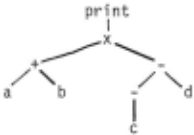
this corresponds to the program "print (a+ b)x((-c)-d)".
Since LISP has a mechanism for local variables (two, in fact- PROG variables and LAMBDA variables), by adopting the program paradigm we automatically get local variables. Moreover, because we can write the code for each function separately, we attain a very high level of modularity, which we have found pays off handsomely when one tries to add new rules to an already operational LINGOL program.
The mechanism we use for running these programs differs slightly from LISP's usual EVAL operator. The main difference is that it evaluates the function at each node first, giving the function the responsibili ty for evaluating subtrees at its leisure, and con trolling the scopes of variables for different sub trees.
To illustrate all of this, we shall develop a small French translator. Imagine we are seated at a computer console. The following session has all typing errors and stupid mistakes edited out, since they rapidly become boring and obscure the main is sues. The user input is underlined .
First we load the syste~.
LtK! LISP 229CX ALLOC?_ READY-TO-READ-GRAMMAR:
We are now talking to LISP. To get to talk to LINGOL, type (HELLO).
(HELLO) FIRST ENTER YOUR GRAMMAR. THEN SAY HELLO AGAIN. TOP-LEVEL:
So LINGOL is not yet educated. We could tell LISP to read in our dictionary and grammar from a file, but since we don't have such a file we will simply type it in at the terminal.
First, let us give LISP a few words.
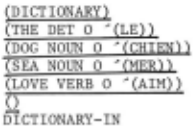
Each entry has four items, a word, its part of speech, the cognitive program and the generative program.
The cognitive part is a LISP s-expression (or program) that should evaluate to a number to indicate to LINGOL our satisfaction or otherwise with this choice of interpretation for this word. It is rele vant only when a given word has two dictionary entries corresponding to two parts of speech . Under these circumstances, we might write a program for each entry to inspect the environment to see how reasonable the corresponding interpretation is. These programs would be executed if and when both interpretations were found to make sense given the context to the left, e.g., it would be executed in "the scout flies ... " but not in "the big flies ... ", where "flies" is 1 isted as both a noun and a verb. This component of the entry need not concern us further here; we will remain neutral by writing 0 everywhere, unless we happen to dislike the entry itself, in which case we will write -1, or -2 if we are in a bad mood.
The generative part is a function destined to be tacked onto the surface structure. Since words are at the leaves of the tree, they have no arguments. In the case of "the", when the tree is evaluated, the corre sponding leaf will return a list of one element (LE) as its value. The symbol ' is a quotation mark, and means "1 iterally", so as LINGOL will not think (LE) is a program to be executed. The other entries are all similarly structured. The reason we use a list of one word rather than the word itself is that we are going to APPEND these lists together to form longer lists.
Now we want a grammar to make sense out of the words in combination.
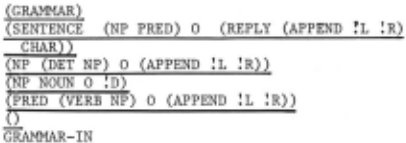
Each rule is of the form (LEFT RIGHT COG GEN). The first two items should be interpreted as a context free rule LEFT -+RIGHT, where RIGHT is either one category or a list of them if more are needed. At present LINGOL only permits RIGHT to have at most two categories; to get more, one should use extra names and rules in the standard way.
The item COG is exactly as for the corresponding dictionary item, except that it may be invoked for more complex types of ambiguity, usually structural. As with the dictionary, we shall write no non-trivial programs here, although we may occasionally use a negative number when we write a rule which we do not expect to need very often.
The item GEN is a more complex item than its dic tionary counterpart, since it can take arguments, which are written !D (down) if RIGHT is a syntactic category, and !L (left) or !R (right) if RIGHT is a list of two categories. These are not variables but programs which run the program for the corresponding subtree.
The first rule takes the translation of the NP and the PRED and appends them into a single list. For example, if the NP were (LE CHIEN) and the PRED were (AH1E LE MER), then (APPEND ! L ! R) would produce (LE CHIEN AIME LE MER). The function (REPLY L T) is a LINGOL function which allows the generative phase to type out on the console the words in L, followed by the value ofT. The variable CHAR is a LINGOL variable which makes available to the generative phase the character used to terminate the input string. (In the near future we shall give this to the cognitive phase instead, where it belongs.) In this case, we simply echo CHAR back to the console.
The other rules are similar, but without the REPLY Hopefully they are all self-explanatory. Let us try again to start LINGOL.
(HELLO)
TYPE SENTENCE FOLLOWED BY . ! OR
So far so good. Now for some sentences.
DOG LOVE SEA. CHIEN AIM MER.
242. MILLISECONDS.
THE DOG LOVE THE SEA. LE CHIEN AIM LE MER. 391. MILLISECONDS.
THE SEA LOVE DOG? LE MER AIM CHIEN? 317. MILLISECONDS.
There is nothing to say here except to comment on the timing. This includes reading in the sentence and performing morphemic analysis (a feature to be des cribed later), requiring about 30 milliseconds per word, or more if it is not in the dictionary. Parsing takes from 50 to 100 msecs per word depending on the complexity of the surface structure being produced, rather than on the size of the grammar. Parsing speed is essentially linear in the number of words in the sentence, given a reasonably intelligently written grammar of English. The timing of the generative phase varies enormously, as a function of the complex ity of the user's semantic programs. In these examples we are probably spending about 10 milliseconds per word. The slowness is due to LINGOL's being written in LISP.
It would be nice if we could inspect the tree on which we are operating. We can do this by telling LISP to set the flag TREE. To get LINGOL to pass on a message to LISP, precede it with a slash.
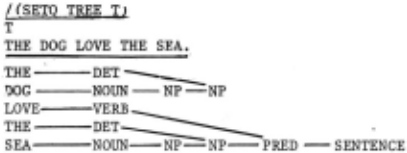
(We have filled in the lines to show the con nections.) This device is one of several debugging aids. It is also possible to monitor the activity of the parser as it discovers phrases, to see why it is not finding the right ones. The start and end po sitions of each discovered phrase are given, along with the rule used to discover it.
/(SETQ SHOWFOUND T)
T
THE
1.1.. DET THE
DOG
~2. NOUN DOG
2. 2. NP NOUN
1. 2. NP (DET · NP)
LOVE
3.J. VERB LOVE
THE
4:'4. DET THE
SEA
5.""""5. NOUN SEA
5. 5. NP NOUN
4. 5. NP (DET . NP)
3. 5. PRED (VERB . NP)
1. 5. SENTENCE (NP . PRED)
LE CHIEN AIM LE MER.
682. MILLISECONDS.
We can also watch the EVAL mechanism for the se mantics (called SEVAL) returning values up the tree, with the help of the LISP debugging aid TRACE:
(2. EXIT SEVAL (AIM LE MER)) LE CHIEN AIM LE MER.
I (TRACE (SEVAL VALUE)) (SEVAL) THE DOG LOVE THE SEA. (1. ENTER SEVAL) (2. ENTER SEVAL) (3. ENTER SEVAL) (3. EXIT SEVAL (LE)) (3. ENTER SEVAL) (4. ENTER SEVAL) (4. EXIT SEVAL (CHIEN)) (3. EXIT SEVAL (CHIEN)) (2. EXIT SEVAL (LE CHIEN)) (2. ENTER SEVAL) (3. ENTER SEVAL) (3. EXIT SEVAL (AIM)) (3. ENTER SEVAL) (4. ENTER SEVAL) (4. EXIT SEVAL (LE)) (4. ENTER SEVAL) (5. ENTER SEVAL) (5. EXIT SEVAL (MER)) (4. EXIT SEVAL (MER)) (3. EXIT SEVAL (LE MER)) (1. EXIT SEVAL NIL) . 925. MILLISECONDS.
The numbers indicate the depth in the parse tree (q.v. above). This routine is extremely helpful for verifying that all functions are producing the correct output, and also for discovering where in the tree SEVAL runs into trouble.
We are not yet ready to translate the Canadian Hansard. Let us put in a variable to denote gender. The appropriate scope for the variable is an NP, since gender does not affect the verb. We need to tell LISP to change the grammar (our grammar is not yet elaborate enough to get LINGOL to do this for us).
LISP will now have replaced our old lule with the new one. (Only the components LEFT and RIGHT are used to identify and delete the old rule.)
We have used LAMDBA rather than PROG to declare our new variable. Had we used PROG we would have said
(PROG ·(GEND) (SETQ GEND 'M) (RETURN (APPEND !L !R)))
By using LAMDBA we save a SETQ and a RETURN. This is handy when there are a lot of variables to be SETQ'd.
The scope of GEND is just the NP, i.e., those functions which are called directly or indirectly by !L and !R here. GEND is set to "M" (masculine) as the default value (to enable us to eliminate specifying it in the dictionary), and will retain this value through out its scope unless some function lower on the tree changes it, which we arrange now.

PROG2 evaluates each of its arguments, but only returns the value of the second.
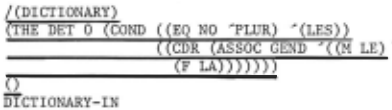
We still have no way of using this information. Suppose we want determiner-noun agreement.
L(DICTIONARY)
(THE DET 0 (CDR (ASSOC GEND '((M LE)(F LA)))))
DICTIONARY -IN
ASSOC is a LISP table-lookup funct1on, and CDR deletes the indicator in the discovered table entry (recall that we want (LE), not LE).
Hopefully we will find that the sea is LA MER.
THE DOG LOVE THE SEA. LE CHIEN AIM LE MER. 3 9 8 · MILLIS ECONffi ·
There is a problem here with timing - we are trying to test GEND before it is set. The fault can be corrected from the NP rule, by doing ! R before ! L -, on the grounds that the noun will never have to con sult the determiner. This can be done by first as signing !R to R. (For clarity, we revert to a PROG.)
/(GRAMMAR)
(NP ( DET NP) 0 ( PROG ( GEND R)
(S ETQ GEND '11)
(SETQ R !R)
()
GRAMMAR-IN
Now we can try again.
THE DOG LOVE THE SEA. LE OiiEN AIM LA MER. 436. MILLIS ECONOO ·
THE SEA LOVE THE DOG. LA MER AIM LE Qi IEN. 436. MILLISECONOO.
So it now seems to work. Had both the DET and the NOUN depended on one other for various features, in· stead of doing one before the other we would have ignored the order and done the appropriate table look up higher up in the tree - the dictionary would simply have passed the whole table up instead of doing the lookup itself. This would work because the table lookup would be carried out with "complete informa tion", i . e. , after both !Land !R had terminated exe cution.
Verb conjugation seems to be next.
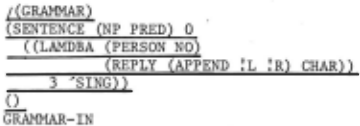
The default value for PERSON is 3, and for NO it is SING.
To use these variables we need some dictionary entries.
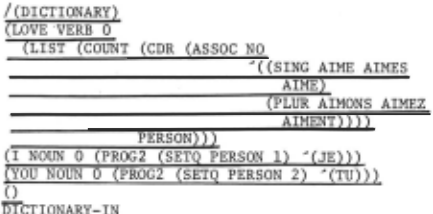
(COUNT L N) yields the Nth element of L. This now gives:
(RETURN (APPEND !L R))))
THE DOG LOVE THE SEA. LE CHIEN AIME LA MER. 448. MILLISECONDS.
YOU LOVE THE SEA. TU AIMES LA MER. 363. MILLISECONDS.
It seems silly to have to write so much in a dic tionary entry for a regular verb Why not just have a function REG which adds the right ending to the stem? We will define it by using DEFUN.
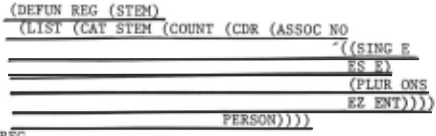
REG
(CAT concatenates two strings.) Now we can make most effective use of it.
(DICTIONARY)
(LOVE VERB 0 (REG 'AIM))
(HUNT VERB 0 (REG 'CRASS))
(HIT VERB 0 (REG 'FRAPP))
(CLIMB VERB 0 (REG 'MONT))
()
DICTIONARY-IN
We can still enter irregular verbs the old way, or better, we can define another function whose six argu ments are the si~ , conjugations. We leave this to the reader.
It would be nice to be able to distinguish singu lar and plural. This raises the morphological prob lem of detecting an "s" at the end of plural wonds. One solution is to make a dictionary entry for each plural word. But we can do better than this. LINGOL allows the user to identify suffixes by saying
(DEFPROP S T SUFFIX)
s
This says that it is True that S is a SUFFIX. The same can be done for PREFIX. If LINGOL fails to find a word in the dictionary, it tries to remove a suffix. If it succeeds, it looks in the dictionary for the stem. For as long as it keeps failing to find anything in the dictionary it keeps removing suffixes, and after that prefixes. When it is done the effect is as if the original word had been made several words, e.g., UN KINDNESSES becomes UN KIND NESS ES if UN is a prefix· and NESS and ES are suffixes. All information that these words were once one word is discarded, which could conceivably create unwanted ambiguities, although it seems unlikely for most affixes.
The word is eventually reassembled by the user's grammar, e.g. ,
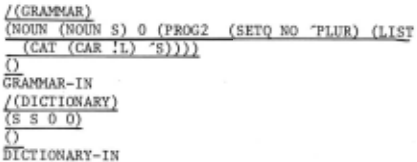
THE DOGS LOVE THE SEA. LE CHIENS AIMENT LA MER. 712. MILLISECONDS.
Ah, the determiner rule is no longer valid.
THE DOGS LOVE THE SEA.
LES CHIENS AIMENT LES MER.
918. MILLISECONDS.
Also we need a new PERSON and NO for the object, although GENDER is all right because it is in the NP rule.
/(GRAMMAR)
(PRED (VERB NP) 0 (APPEND !L ((LAMBDA (PERSON NO) !R) 3 'SING)))
()
GRAMMAR-IN
THE DOGS LOVE THE SEA. LES CHIENS AIMENT LA MER. 561. MILLISECONDS.
The reason we keep finding errors is because we a~e writ~ng the pro~ram as though we were beginners. W1th a l1ttle exper1ence, the user can learn to anti cipate most of '',these problems at the start.
This scheme has the advantage that the user is not constrained to any one morphological system but can write his own in the same language as he writes his semantics. It has another advantage in that morphological processing can be interleaved with se mantic processing. For example, when LINGOL gives up on a word altogether, it assigns it the category UN KNOWN and supplies the word in the generative phase . If we want to implement Thorne's closed-class dic tionary16, in which unknown words are parsed as nouns, verbs or adjectives depending on which interpretation makes the best syntactic sense, then we could write rules such as
I (GRAMMAR) (NOUN UNKNOWN 0 (LIST !D)) (VERB UNKNOWN 0 (REG ! D)) ()
GRAMMAR-IN
THE DOGS PREFER THE CATS. LES CHIENS PREFERENT LES CATS. 787. MILLISECONDS.
Notice how the issue of deciding what part of speecn the word is dealt with independently of e.g. making "CAT" plural. Also notice that the pars~r cor~ rectly guessed the parts of speech, and went on to con jugate "correctly" the unknown verb, However, "cats" is a bi~ of an Anglicism. Our program is starting to look qu1~e clever already without our having done very much to 1t yet. We have only seven grammar rules, one function (REG) and a few dictionary entries .
In the example of Figure 5 (section· l),the rules involving UNKNOWN have for their generative component a program that queries the user about the translation.
These examples could go on indefinitely. To see what can be achieved with a few more hours work, re fer back to Figure 5. That example still has very ~ittle grammar- approximately twenty rules. However, 1t has a page of LISP functions for doing liason, vari ous agreements, and handling tricky things like LES versus DES in the object position.
These examples bring this section to an end. There is no section 3.3 on Pragmatics - this is en tirely the user's problem. Figure 3 (section 1) gives examples from a LINGOL program in which the user successfully interfaced his semantics to quite non-tri vial pragmatics. It is not yet clear whether LINGOL should ever address pragmatic issues.
4. Conclusions
We have described a programming language for natural language processing programs. We discussed the reasons for each of the major design ·decisions. We presented a session with the system in which we developed a trivial fragment of an English-to-French translator. With adequate imagination, the reader shou~d be able to project at least some of the po tentlal of LINGOL. What may be more difficult to see are the present limitations of the system.
We have already suggested that our separation of semantics from the syntax does not present serious problems. Whether this is true we leave to further experiments with LINGOL. It should be noted that LINGOL is still in its infancy; so far the author has invested approximately three months' work in it, over the two and a half years of its existence.
At present, conjunction is not handled at all by LINGOL, except in so far as one may supply context free rules for each syntactic category to be conjoined (which is most). This is tedious at best, and is not even always possible. One wants to deal not only with "The ~hin~se have sho~t names and the Japanese long" but w1th He eloped w1th and married the farmer's daughter." Neither of these are at all well handled by context-free grammars, regardless of what we write in the cognitive component of our rules. Winograd's sy~tem deals with these sorts of problems simply by be1ng more procedure-oriented. This provides the necessary flexibility to deal with pathological cases.
Another difficult area is that of adverbs, which may appear in many places in a sentence, but which always modify the verb of the clause they appear in (unless they modify an adjective). It should not be necessary to give rules for each of the places an adverb may appear. It suffices to rely mainly on semantic connections to establish the role of the ad verb, and this is one place where concept structures (Schan~ 14 ) are of value. It is perhaps significant that W1nograd18 makes no attempt to deal with adverbs.
Both of these problems will be studied in the near future, to see how best to change LINGOL to deal with t~em without losing the attractive programming conven1ence afforded by context-free rules in con junction with LISP semantics. In the meantime the system as it stands at present is available fr~m the author for experimental use. A LISP environment is required, with at least 20K words of memory. An ob ~ious application for LINGOL is as a pedagogical tool 1n a computational linguistics course, for introduc ing students painlessly to one method of writing actu al programs that do something useful with English other than parsing it for the sake of the parse tree. We have used it for this purpose during the Independ ent Activities Period at MIT this January. One stu dent wrote an English-to-unpainted-Hebrew translator! We ask only that users keep us up-to-date with the uses to which they put LINGOL.
@inproceedings{ijcai1973p48,
  title     = {A Linguistics Oriented Programming Language},
  author    = {Pratt, Vaughan R.},
  booktitle = {Proceedings of the Third International Joint Conference on
               Artificial Intelligence, {IJCAI-73}},
  publisher = {International Joint Conferences on Artificial Intelligence},
  editor    = {Nils J. Nilsson},
  pages     = {372--381},
  year      = {1973},
  month     = {8},
  note      = {Natural Language; Semantics and Parsing},
  url       = {https://ijcai.org/proceedings/1973/48},
}
TY - CPAPER TI - A Linguistics Oriented Programming Language AU - Pratt, Vaughan R. T2 - Proceedings of the Third International Joint Conference on Artificial Intelligence, IJCAI-73 PB - International Joint Conferences on Artificial Intelligence PY - 1973 SP - 372 EP - 381 UR - https://ijcai.org/proceedings/1973/48 ER -Copied
Machine-readable versions of this paper, for tools and AI agents:





