
Towards Streamlined Learning and Search for Multi-Agent Optimization
Proceedings of the Thirty-Fifth International Joint Conference on Artificial Intelligence. Early Career Spotlight. Pages 8179-8184.
https://doi.org/10.24963/ijcai.2026/909
Keywords
- AI: Machine Learning
- AI: Constraint Satisfaction and Optimization
- AI: Planning and Scheduling
- AI: Agent-based and Multi-agent Systems
Abstract
Many real-world problems can be modeled as cooperative multi-agent systems (MAS), such as fleet management, industrial operations, and communication networks, where multiple agents collaborate to optimize a shared objective. Optimizing cooperative MAS is difficult due to the combinatorial nature of joint actions and environmental factors. Thus, many practical multi-agent optimization approaches specialize in particular problem classes to exploit structural properties for effective and efficient optimization. Unfortunately, such specializations can lead to complex and inflexible methods that cannot be seamlessly combined or transferred to novel domains without substantial engineering effort. In this paper, we advocate an approach towards streamlined learning and search for multi-agent optimization. Focusing on multi-agent path finding as an exemplary problem, we propose to simplify two popular approaches to MAPF, namely multi-agent reinforcement learning and adaptive search. Through these simplifications, we aim to enable seamless combination and transferability of our methods without substantial engineering.
- [Alkazzi and Okumura, 2024] Jean-Marc Alkazzi and Keisuke Okumura. A Comprehensive Review on Lever- aging Machine Learning for Multi-Agent Path Finding. IEEE Access, 12:57390-57409, 2024.
- [Altmann et al., 2026] Philipp Altmann, Maximilian Zorn, Sven Koenig, and Thomy Phan. Dynamic Reward Incen- tives for Emergent Cooperation under Changing Rewards. Transactions on Machine Learning Research (TMLR), 2026. To appear.
- [Andreychuk et al., 2025] Anton Andreychuk, Konstantin Yakovlev, et al. MAPF-GPT: Imitation Learning for Multi- Agent Pathfinding at Scale. AAAI Conference on Artificial Intelligence, 2025.
- [Bareinboim et al., 2015] Elias Bareinboim, Andrew Forney, and Judea Pearl. Bandits with Unobserved Confounders: A Causal Approach. In Advances in Neural Information Processing Systems (NeurIPS), volume 28.
- [Barer et al., 2021] Max Barer, Guni Sharon, Roni Stern, and Ariel Felner. Suboptimal Variants of the Conflict- Based Search Algorithm for the Multi-Agent Pathfind- ing Problem. International Symposium on Combinatorial Search (SoCS), pages 19-27, 2021.
- [Boutilier, 1996] Craig Boutilier. Planning, Learning and Coordination in Multiagent Decision Processes. In 6th Conference on Theoretical Aspects of Rationality and Knowledge, pages 195-210, 1996.
- [Cai et al., 2025] Junyang Cai, Serdar Kadioglu, and Bistra Dilkina. Balans: Multi-Armed Bandits-based Adaptive Large Neighborhood Search for Mixed-Integer Program- ming Problems. In International Joint Conference on Ar- tificial Intelligence (IJCAI), pages 2566-2574, 2025. IJCAI
- [Cohen and Koenig, 2016] Liron Cohen and Sven Koenig. Bounded Suboptimal Multi-Agent Path Finding Using Highways. In International Joint Conference on Artificial Intelligence, pages 3978-3979, 2016. IJCAI
- [Fioretto et al., 2018] Ferdinando Fioretto, Enrico Pontelli, and William Yeoh. Distributed Constraint Optimization Problems and Applications: A Survey. Journal of Artifi- cial Intelligence Research, 61:623-698, 2018.
- [Foerster et al., 2018] Jakob Foerster, Gregory Farquhar, Triantafyllos Afouras, Nantas Nardelli, and Shimon Whiteson. Counterfactual Multi-Agent Policy Gradients. AAAI Conference on Artificial Intelligence, 32(1), 2018.
- [Huang et al., 2022] Taoan Huang, Jiaoyang Li, Sven Koenig, and Bistra Dilkina. Anytime Multi-Agent Path Finding via Machine Learning-Guided Large Neighbor- hood Search. In 36th AAAI Conference on Artificial In- telligence (AAAI), pages 9368-9376, 2022.
- [Jennings et al., 1997] James Jennings, Greg Whelan, and William Evans. Cooperative Search and Rescue with a Team of Mobile Robots. In 1997 8th International Confer- ence on Advanced Robotics. Proceedings. ICAR'97, pages 193-200, 1997.
- [Jiang et al., 2025] He Jiang, Yutong Wang, Rishi Veerapa- neni, et al. Deploying Ten Thousand Robots: Scalable Im- itation Learning for Lifelong Multi-Agent Path Finding. In IEEE International Conference on Robotics and Automa- tion (ICRA), pages 1-7, 2025.
- [Li et al., 2021a] Jiaoyang Li, Zhe Chen, Daniel Harabor, Peter J. Stuckey, and Sven Koenig. Anytime Multi-Agent Path Finding via Large Neighborhood Search. In Inter- national Joint Conference on Artificial Intelligence, pages 4127-4135, 2021. IJCAI
- [Li et al., 2021b] Jiaoyang Li, Daniel Harabor, Peter J. Stuckey, et al. Pairwise Symmetry Reasoning for Multi- Agent Path Finding Search. Artificial Intelligence, page 103574, 2021.
- [Li et al., 2021c] Jiaoyang Li, Wheeler Ruml, and Sven Koenig. EECBS: A Bounded-Suboptimal Search for Multi-Agent Path Finding. In AAAI Conference on Arti- ficial Intelligence, volume 35, pages 12353-12362, 2021.
- [Li et al., 2021d] Jiaoyang Li, Andrew Tinka, Scott Kiesel, Joseph W Durham, TK Satish Kumar, and Sven Koenig. Lifelong Multi-Agent Path Finding in Large-Scale Ware- houses. In AAAI Conference on Artificial Intelligence, vol- ume 35, pages 11272-11281, 2021.
- [Li et al., 2022] Jiaoyang Li, Zhe Chen, Daniel Harabor, Pe- ter J. Stuckey, and Sven Koenig. MAPF-LNS2: Fast Re- pairing for Multi-Agent Path Finding via Large Neighbor- hood Search. AAAI Conference on Artificial Intelligence, 36(9):10256-10265, Jun. 2022.
- [Li et al., 2025] Mingxuan Li, Junzhe Zhang, and Elias Bareinboim. Confounding Robust Deep Reinforcement Learning: A Causal Approach. In Advances in Neural In- formation Processing Systems, volume 38, pages 138292- 138325.
- Curran Associates, Inc., 2025.
- [Lowe et al., 2017] Ryan Lowe, Yi Wu, Aviv Tamar, Jean Harb, Pieter Abbeel, and Igor Mordatch. Multi-Agent Actor-Critic for Mixed Cooperative-Competitive Environ- ments. In Advances in Neural Information Processing Sys- tems, pages 6379-6390, 2017.
- [Moldagalieva et al., 2026] Akmaral Moldagalieva, Keisuke Okumura, Amanda Prorok, et al. db-LaCAM: Fast and Scalable Multi-Robot Kinodynamic Motion Planning with Discontinuity-Bounded Search and Lightweight MAPF. In International Conference on Automated Planning and Scheduling (ICAPS), volume 36, pages 738-746, 2026.
- [Nagai and Okumura, 2026] Hiroki Nagai and Keisuke Oku- mura. From Gridworlds to Warehouses: Adapting Lightweight One-Shot Multi-Agent Pathfinding for AGVs. In International Joint Conference on Artificial Intelligence (IJCAI), 8 2026. IJCAI
- [Okumura et al., 2022] Keisuke Okumura, Manao Machida, et al. Priority Inheritance with Backtracking for Iterative Multi-Agent Path Finding. Artificial Intelligence, page 103752, 2022. IJCAI
- [Okumura, 2023] Keisuke Okumura. LaCAM: Search- Based Algorithm for Quick Multi-Agent Pathfinding. AAAI Conference on Artificial Intelligence, pages 11655- 11662, 2023.
- [Oliehoek and Amato, 2016] Frans A Oliehoek and Christo- pher Amato. A Concise Introduction to Decentralized POMDPs. Springer, 2016.
- [Phan and Koenig, 2026] Thomy Phan and Sven Koenig. Spatially Grouped Curriculum Learning for Multi-Agent Path Finding. In AAAI Conference on Artificial Intelli- gence, pages 29642-29650, 2026.
- [Phan et al., 2018] Thomy Phan, Lenz Belzner, Thomas Ga- bor, et al. Leveraging Statistical Multi-Agent Online Plan- ning with Emergent Value Function Approximation. In International Conference on Autonomous Agents and Mul- tiagent Systems, pages 730-738, 2018.
- [Phan et al., 2020] Thomy Phan, Thomas Gabor, Andreas Sedlmeier, et al. Learning and Testing Resilience in Coop- erative Multi-Agent Systems. In 19th International Con- ference on Autonomous Agents and MultiAgent Systems, AAMAS '20, page 1055-1063, Richland, SC, 2020.
- [Phan et al., 2021] Thomy Phan, Fabian Ritz, Lenz Belzner, Philipp Altmann, et al. VAST: Value Function Factoriza- tion with Variable Agent Sub-Teams. In Advances in Neu- ral Information Processing Systems (NeurIPS), volume 34, pages 24018-24032, 2021.
- [Phan et al., 2023] Thomy Phan, Fabian Ritz, Philipp Alt- mann, Maximilian Zorn, Jonas Nüßlein, Michael Kölle, Thomas Gabor, and Claudia Linnhoff-Popien. Attention- Based Recurrence for Multi-Agent Reinforcement Learn- ing under Stochastic Partial Observability. In International Conference on Machine Learning (ICML), 2023.
- [Phan et al., 2024a] Thomy Phan, Taoan Huang, Bistra Dilk- ina, and Sven Koenig. Adaptive Anytime Multi-Agent Path Finding Using Bandit-Based Large Neighborhood Search. AAAI Conference on Artificial Intelligence, 2024.
- [Phan et al., 2024b] Thomy Phan, Felix Sommer, Fabian Ritz, Philipp Altmann, Jonas Nüßlein, et al. Emergent Cooperation from Mutual Acknowledgment Exchange in Multi-Agent Reinforcement Learning. Autonomous Agents and Multi-Agent Systems, 2024.
- [Phan et al., 2024c] Thomy Phan, Benran Zhang, Shao- Hung Chan, and Sven Koenig. Anytime Multi-Agent Path Finding with an Adaptive Delay-Based Heuristic. In arXiv preprint arXiv:2408.02960, 2024.
- [Phan et al., 2025] Thomy Phan, Timy Phan, and Sven Koenig. Generative Curricula for Multi-Agent Path Find- ing via Unsupervised and Reinforcement Learning. Jour- nal of Artificial Intelligence Research (JAIR), pages 2471- 2534, 2025.
- [Phan et al., 2026a] Thomy Phan, Shao-Hung Chan, and Sven Koenig. Truncated Counterfactual Learning for Any- time Multi-Agent Path Finding. In AAAI Conference on Artificial Intelligence, 2026.
- [Phan et al., 2026b] Thomy Phan, Joseph Driscoll, Justin Romberg, and Sven Koenig. Confidence-Based Curricula for Multi-Agent Path Finding via Reinforcement Learn- ing. Autonomous Agents and Multi-Agent Systems, 40(23), 2026.
- [Rashid et al., 2018] Tabish Rashid, Mikayel Samvelyan, Christian Schroeder de Witt, et al. QMIX: Monotonic Value Function Factorisation for Deep Multi-Agent Rein- forcement Learning. In International Conference on Ma- chine Learning (ICML), pages 4295-4304, 2018.
- [Sartoretti et al., 2019] Guillaume Sartoretti, Justin Kerr, Yunfei Shi, Glenn Wagner, TK Satish Kumar, Sven Koenig, and Howie Choset. PRIMAL: Pathfinding via Re- inforcement and Imitation Multi-Agent Learning. IEEE Robotics and Automation Letters, 4(3):2378-2385, 2019.
- [Sharon et al., 2015] Guni Sharon, Roni Stern, Ariel Felner, et al. Conflict-Based Search for Optimal Multi-Agent Pathfinding. Artificial Intelligence, pages 40-66, 2015.
- [Skrynnik et al., 2024] Alexey Skrynnik, Anton Andrey- chuk, Maria Nesterova, Konstantin Yakovlev, and Alek- sandr Panov. Learn to Follow: Decentralized Lifelong Multi-Agent Pathfinding via Planning and Learning. In AAAI Conference on Artificial Intelligence, volume 38, pages 17541-17549, 2024.
- [Son et al., 2019] Kyunghwan Son, Daewoo Kim, Wan Ju Kang, et al. QTRAN: Learning to Factorize with Trans- formation for Cooperative Multi-Agent Reinforcement Learning. In International Conference on Machine Learn- ing (ICML), pages 5887-5896, 2019.
- [Stern et al., 2019] Roni Stern, Nathan Sturtevant, Ariel Fel- ner, Sven Koenig, Hang Ma, Thayne Walker, Jiaoyang Li, Dor Atzmon, Liron Cohen, TK Kumar, Roman Barták, and Eli Boyarski. Multi-Agent Pathfinding: Definitions, Variants, and Benchmarks. In International Symposium on Combinatorial Search, volume 10, pages 151-158, 2019.
- [Veerapaneni et al., 2025] Rishi Veerapaneni, Arthur Jakob- sson, Kevin Ren, Samuel Kim, et al. Work Smarter Not Harder: Simple Imitation Learning with CS-PIBT Out- performs Large-Scale Imitation Learning for MAPF. In IEEE International Conference on Robotics and Automa- tion (ICRA), pages 10229-10236, 2025.
- [Zhang et al., 2023] Hejia Zhang, Shao-Hung Chan, Jie Zhong, Jiaoyang Li, et al. Multi-Robot Geometric Task-and-Motion Planning for Collaborative Manipulation Tasks. Autonomous Robots, 47(8):1537-1558, 2023.
References were extracted automatically from the PDF and may contain errors.
Full text extracted automatically from the PDF; figures, tables and equations may differ. The PDF is the version of record.
1 Introduction
Many real-world problems can be modeled as cooperative multi-agent systems (MAS), such as fleet management, industrial operations, and communication networks, where N ≥ 2 agents collaborate to optimize a shared objective [Foerster et al., 2018; Oliehoek and Amato, 2016].
Optimizing cooperative MAS is difficult due to the combinatorial nature of joint actions and environmental factors (e.g., obstacles and communication channels), in particular constraints (e.g., deadlines and collision avoidance) [Boutilier, 1996; Oliehoek and Amato, 2016; Sharon et al., 2015]. Thus, for practical feasibility, many multi-agent optimization approaches use learning and/or search methods to find suboptimal solutions that satisfy all constraints [Fioretto et al., 2018; Oliehoek and Amato, 2016; Stern et al., 2019].
Decentralized POMDPs (Dec-POMDPs) represent a general framework for multi-agent optimization [Oliehoek and Amato, 2016]. However, Dec-POMDP solvers based on learning and/or search do not scale to large numbers of agents in practice due to the black box nature of Dec-POMDPs, which ignores important structural properties of the underlying problem, such as spatial relationships between agents [Fioretto et al., 2018; Phan et al., 2021]. Thus, many practical solvers focus on special cases to exploit such structures for better efficiency and scalability [Fioretto et al., 2018].
Unfortunately, such specializations can lead to complex and inflexible learning or search approaches that cannot be seamlessly combined or transferred to novel domains without substantial engineering effort [Phan et al., 2025; Phan et al., 2026b]. We argue that simplifying common learning and search approaches could mitigate tight specialization, while improving the combination and transferability of multi-agent optimization methods [Phan et al., 2024a; Cai et al., 2025]. Furthermore, they can improve the overall usability of these methods without requiring substantial tuning or a deep understanding of hyperparameters.
In this paper, we advocate an approach towards streamlined learning and search for multi-agent optimization. Focusing on multi-agent path finding (MAPF) as an exemplary optimization problem, we propose to simplify two popular approaches to MAPF, namely multi-agent reinforcement learning and adaptive search. In the former, we will introduce methods to scale and simplify learning in MAPF with hierarchical value factorization and auto-curricula for structured exploration. In the latter, we will introduce methods to simplify search-based MAPF solvers with adaptive mechanisms, substantially improving their effectiveness and efficiency. Through these simplifications, we aim to enable seamless combination and transferability of our methods without substantial engineering [Cai et al., 2025].
2 Background: Multi-Agent Path Finding
We focus on multi-agent path finding (MAPF) as an exemplary optimization problem. The goal in MAPF is to find collision-free paths for N ≥ 2 agents with assigned start and goal locations [Stern et al., 2019; Sharon et al., 2015]. Solving MAPF is highly relevant to various applications, including warehouse operations [Li et al., 2021d], smart manufacturing [Phan et al., 2020], multi-robot systems [Zhang et al., 2023], and search & rescue missions [Jennings et al., 1997]. However, finding optimal solutions, i.e., feasible paths with
(a) CACTUS training scheme
minimal costs, i.e., agent travel times, is NP-hard and thus intractable for large-scale instances [Sharon et al., 2015].
State-of-the-art MAPF solvers are search-based, using information about all agents to find collision-free plans [Sharon et al., 2015]. The search algorithms can be optimal or bounded suboptimal (e.g., CBS, ECBS, and EECBS), with guarantees about the travel time (sub-)optimality, but exponential time scaling [Sharon et al., 2015; Barer et al., 2021; Li et al., 2021c], or unbounded suboptimal (e.g., LaCAM, MAPF-LNS, MAPF-LNS2), with polynomial time scaling but arbitrarily high solution costs [Okumura, 2023; Li et al., 2021a; Li et al., 2022]. Search-based MAPF solvers commonly depend on handcrafted guidance [Okumura et al., 2022; Li et al., 2021a; Li et al., 2022] for domain-specific aspects, e.g., 4-neighbor grid worlds [Li et al., 2021b] and corridor maps [Cohen and Koenig, 2016], which do not generalize to other scenarios [Phan et al., 2024c].
3 Multi-Agent Reinforcement Learning (RL)
Most search-based MAPF solvers are centralized due to their dependence on global information, i.e., the paths and constraints of all agents. This dependence requires reliable, centralized communication with substantial bandwidth for largescale systems, which is a limiting factor in practice for scalability and robustness [Oliehoek and Amato, 2016]. Even fast unbounded suboptimal solvers like LaCAM and MAPF-LNS suffer from this limitation, which impedes their large-scale deployment beyond spatially confined applications such as warehouses [Moldagalieva et al., 2026; Nagai and Okumura, 2026; Phan et al., 2026b].
Multi-agent reinforcement learning (RL) has become popular for learning decentralized policies via trial-and-error from rewards, enabling scalable control under partial observability and limited communication [Foerster et al., 2018]. We focus on cooperative settings, where all agents obtain a team reward rt ∈ R for executing a joint action at in state st at time step t, without further indication of their individual contributions [Oliehoek and Amato, 2016]. The state of the art in cooperative multi-agent RL is based on the centralized training for decentralized execution (CTDE) paradigm, where all policies are trained in a controlled environment, such as a laboratory or simulator, to exploit global information for learning coordinated behavior. After training, the policies can be executed independently in a decentralized manner, requiring no (or just limited) communication [Foerster et al., 2018].
3.1 DeepMulti-Agent RL
Deep multi-agent RL uses neural networks to learn policies for high-dimensional state and observation spaces [Lowe et al., 2017; Foerster et al., 2018; Rashid et al., 2018]. Multiagent credit assignment is a major challenge in cooperative settings due to the lack of explicit indication of individual agents' contributions to the team's success or failure [Foerster et al., 2018; Rashid et al., 2018]. Value factorization is a popular credit assignment approach, where a value function Qtot(st, at) = E[∑Tt rt], learned from the shared rewards rt, is decomposed into agent-wise utilities ⟨Qi⟩1≤i≤N using some factorization operator Ψ(⟨Qi⟩1≤i≤N) = Qtot. The factorization operator is often implemented as constrained neural network that enforces consistency between the optimization of Qtot and the separate optimization of the individual utilities Qi [Rashid et al., 2018; Son et al., 2019]. The resulting utilities can be directly used for decentralized execution [Rashid et al., 2018] or to train policies via actor-critic techniques [Lowe et al., 2017; Foerster et al., 2018].
Despite value factorization representing a theoretically general method, its effectiveness has been demonstrated only in domains with a handful of agents [Rashid et al., 2018; Phan et al., 2023]. In large-scale domains with hundreds or thousands of agents, which are common in the MAPF literature [Okumura, 2023; Li et al., 2021a; Li et al., 2022], the factorization operator Ψ can become a bottleneck, where flat credit assignment schemes are insufficient for effective coordination, falling short compared to unbounded suboptimal search-based solvers like LaCAM and MAPF-LNS.
To this end, we devised the hierarchical factorization method VAST [Phan et al., 2021], which uses a bi-level decomposition scheme, where the factorization operator Ψ decomposes the value function Qtot into group-wise utilities Qk = ∑i Qk,i, which are then further decomposed into agent-wise utilities Qk,i for the respective members i of group k. The agent-wise decomposition is done with a linear operator, enabling group variability across time steps to adapt to different situations. VAST can provably maintain the consistency between optimizing Qtot and Qi, regardless of the sub-team definition, supporting its flexibility and adaptability. The groups or sub-teams can be assigned using domain-specific methods, such as spatial clustering, or learned via meta-gradient methods to optimize effectiveness in an outer loop [Phan et al., 2021]. We evaluated VAST in MAPF-related domains, such as a warehouse and a battle domain, demonstrating better scalability, sample efficiency, and effectiveness than state-of-the-art value factorization methods [Rashid et al., 2018; Son et al., 2019].
3.2 Curricula for Structured Exploration
The state of the art in multi-agent RL is primarily designed for Dec-POMDPs, which are more general but also more complex than MAPF, as they ignore structural properties, such as spatial relationships among agents. This lack of structural consideration severely limits sample efficiency with random exploration, requiring a considerable number of trials, which is computationally expensive [Phan et al., 2026b].
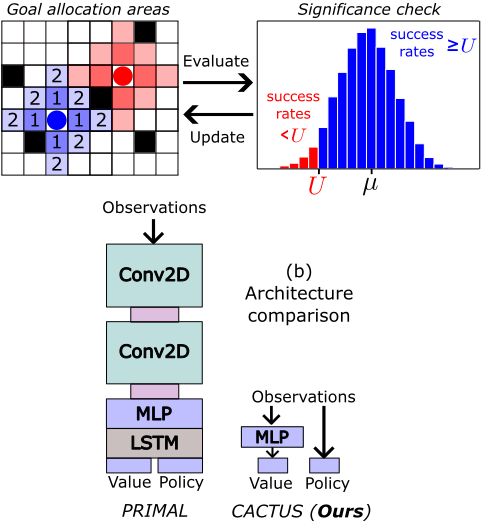
To mitigate this exploration problem, most prior work relies on additional support from search-based solvers [Sartoretti et al., 2019; Skrynnik et al., 2024], e.g., for imitation learning of path finding or collision avoidance. However, due to the combinatorial space of MAPF w.r.t. the number of joint actions, potential paths, and environments, the learned models must have sufficient capacity to memorize all important aspects of MAPF. This has led to unreasonably large neural networks with complex architectures [Sartoretti et al., 2019] (Figure 1b), compared with simpler architectures that are common in the multi-agent RL literature [Foerster et al., 2018; Rashid et al., 2018]. Another way to shape learning is to use handcrafted reward functions [Alkazzi and Okumura, 2024], which may work in specific scenarios but could lead to unintended side effects when transferred to another domain [Foerster et al., 2018]. [Alkazzi and Okumura, 2024] and [Phan et al., 2025] provide overviews of various aspects of machine learning that are often engineered substantially to achieve empirical success of multi-agent RL-based MAPF.
The extensive engineering confirms the difficulty of exploiting the structural properties of MAPF to improve exploration efficiency and learning of multi-agent RL. To this end, we devised MAPF curricula for structured exploration that enable efficient exploration and learning while simplifying the overall multi-agent RL approach to MAPF (Figure 1b).
CACTUS is the first auto-curriculum approach to MAPF. It uses a reverse curriculum scheme by controlling the goal allocation radius for all agents [Phan et al., 2026b]. Starting with a radius of 1, CACTUS gradually increases the goalallocation area around each agent by incrementing the radius (Figure 1a) if the success rate of all agents reaching their respective goals improves significantly based on a statistical test. CACTUS substantially simplifies multi-agent RL for MAPF w.r.t. the training scheme, the model architecture (Figure 1b), and the reward definition, which simply penalizes each time step for each agent that has not yet reached its goal. CACTUS significantly improves effectiveness and efficiency, requiring less than 5% of the training effort of prior engineering-focused works, like PRIMAL [Sartoretti et al., 2019], in terms of data, compute, and parameters.
We conducted preliminary analyses, proving that CACTUS improves the sample efficiency over other multi-agent RL methods that rely on naive random exploration, and devised an extension to CACTUS, called C3LARA, which incentivizes goal allocations at intersecting allocation areas for more robust collision avoidance, without requiring additional support of a search-based solver [Phan et al., 2026b].
We also explored curricula based on environment generation using variational autoencoders and cross-entropy optimization [Phan et al., 2025], as well as dynamic agent grouping based on the intersection of goal-allocation areas [Phan and Koenig, 2026], inspired by VAST.
Our work on curriculum learning demonstrates how simplification can advance the state of the art in RL-based MAPF in terms of effectiveness and efficiency, as well as usability due to fewer tunable hyperparameters. This insight is important for investigating further algorithmic aspects of multiagent RL to provide a basis for transferring our methods to novel domains without substantial engineering.
4 Adaptive Search-Based Solvers
Search-based solvers are the state of the art in MAPF in terms of effectiveness [Sharon et al., 2015; Barer et al., 2021; Li et al., 2021c] and efficiency [Okumura, 2023; Li et al., 2021a; Li et al., 2022]. These solvers are often enhanced with structural knowledge through handcrafted guidance, which can improve their effectiveness and efficiency for specific MAPF scenarios, such as 2D grid worlds [Stern et al., 2019].
In practice, unbounded suboptimal solvers are preferred to meet real-time requirements and to enable fast replanning in the event of unexpected changes. More recently, these solvers have become popular to quickly provide "expert" data for supervised machine learning of policies or guidance/heuristic functions [Huang et al., 2022; Veerapaneni et al., 2025; Jiang et al., 2025; Andreychuk et al., 2025].
MAPF-LNS, based on large neighborhood search (LNS), is one example of an unbounded suboptimal solver that can find solutions for instances with hundreds of agents [Li et al., 2021a; Huang et al., 2022]. Given an initial solution and a set of destroy heuristics, MAPF-LNS iteratively destroys and replans a fixed number of paths, replacing the current solution if the new plan has a lower cost. Since MAPF-LNS creates a collision-free plan at each iteration, it can be used in an anytime manner and terminated once a time budget runs out. The original MAPF-LNS from [Li et al., 2021a] employs three handcrafted heuristics, focusing on the most-delayed agent, the most-occupied location, and a random neighborhood, respectively. An adaptive selection mechanism chooses one of these destroy heuristics at each iteration (Figure 2a).
In the following, we will focus on MAPF-LNS, since LNS is used to solve related NP-hard problems like vehicle routing, scheduling problems, and mixed-integer linear programming [Phan et al., 2024a; Cai et al., 2025]. Thus, by simplifying and improving MAPF-LNS, we hope to lay the foundation for seamless transfer of our methods to other problems.
Due to the handcrafted destroy heuristics, MAPF-LNS
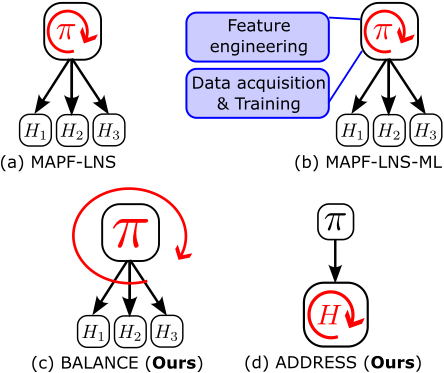
lacks generality, limiting its transferability to other domains. MAPF-LNS-ML is a machine-learning-enhanced version of MAPF-LNS, which selects neighborhoods via a scoring model, predicting their solution improvement potential [Huang et al., 2022]. The scoring model is trained on data generated by the original MAPF-LNS from a selected set of instances. While machine learning seems appealing due to its generalizing capability, the overall approach is still handcrafted and labor-intensive due to feature engineering and manual selection of training instances, as well as expensive and inflexible due to hyperparameter tuning and offline training of the scoring model without further adaptation [Phan et al., 2024a; Phan et al., 2024c] (Figure 2b).
We devised an adaptive variant, called BALANCE, which uses a bi-level multi-armed bandit to optimize the destroy heuristic and neighborhood size selection (Figure 2c). The bandits are trained online to minimize the total costs of the current MAPF-LNS solution, without any feature engineering, hyperparameter tuning, or offline (pre-)training. BALANCE demonstrated delay improvements by at least 50% compared with MAPF-LNS and MAPF-LNS-ML across common benchmark instances [Stern et al., 2019].
ADDRESS further simplifies BALANCE by employing a single adaptive destroy heuristic that depends on a seed agent selected via a multi-armed bandit [Phan et al., 2024c]. A neighborhood is generated by randomly selecting agents in close proximity to the seed agent. Despite the substantial simplification, ADDRESS was shown to further reduce delays by at least 50% in large-scale instances with N = 1000 agents.
Similar to our work on curriculum learning, our adaptive search approaches also demonstrate that simplification can advance the state of the art in search-based MAPF in terms of effectiveness, efficiency, and usability. This is important for further investigating suboptimal MAPF solvers and for providing a basis for seamless combination and transferability of our methods without substantial engineering. Our adaptive search could also provide high-quality data to machine learning approaches, improving their effectiveness.
5 Conclusion and FutureWork
We advocate an approach to streamlined learning and search for multi-agent optimization, focusing on MAPF as an exemplary problem. We proposed to simplify two popular approaches to MAPF, namely multi-agent RL and adaptive search. In the former, we introduced methods to scale and simplify learning in MAPF with hierarchical value factorization for scalable training and auto-curricula for efficient structured exploration. In the latter, we introduced methods to simplify search-based MAPF solvers with adaptive mechanisms, substantially improving their effectiveness and efficiency. Through these simplifications, we aim to enable seamless combination and transferability of our methods without substantial engineering, as demonstrated by the transfer of our adaptive solver BALANCE [Phan et al., 2024a] to mixed-integer linear programming [Cai et al., 2025].
In the future, we plan to pursue the following directions:
- Combining learning and search: So far, combining learning and search required substantial engineering effort, largely due to incompatibilities between the methods. Given our simplified machinery, we plan to identify adequate connecting points for more principled and straightforward combinations.
- Addressing information asymmetry: Centralized and decentralized optimization approaches operate with different information views. This information asymmetry can lead to emergent side-effects, which may occur in CTDE-based multi-agent RL and decentralized policy learning from centralized MAPF solvers. We plan to address this issue with recurrence-based multi-agent RL [Phan et al., 2023] and counterfactual reasoning [Bareinboim et al., 2015; Li et al., 2025; Phan et al., 2026a] for multi-agent RL and adaptive search-based solvers.
- Decentralized learning and search: We plan to investigate decentralizing our current CTDE schemes and adaptive search-based solvers. In multi-agent RL, we will consider peer-incentivization methods for decentralized learning of cooperative behavior [Phan et al., 2024b; Altmann et al., 2026]. For adaptive search, we will consider enhancing decentralized search algorithms with factorized utilities as heuristics [Phan et al., 2018].
- Robustness: Most multi-agent optimization methods focus on idealized scenarios, in which agents and environments do not change adversarially. However, in realworld applications, failures, manipulations, and environmental changes are expected and thus must be considered. We plan to leverage adversarial and adaptive learning for robust decentralized policies [Phan et al., 2020] and fast but effective replanning [Phan et al., 2024c].
Acknowledgments
The research was supported by the National Science Foundation (NSF) under grant numbers 2112533 and 2321786. The views and conclusions contained in this document are those of the author and should not be interpreted as representing the official policies, either expressed or implied, of the sponsoring organizations, agencies, or the U.S. government. Special thanks go to Sven Koenig (University of California, Irvine) for his substantial guidance and support.
@inproceedings{ijcai2026p909,
  title     = {Towards Streamlined Learning and Search for Multi-Agent Optimization},
  author    = {Phan, Thomy},
  booktitle = {Proceedings of the Thirty-Fifth International Joint Conference on
               Artificial Intelligence, {IJCAI-26}},
  publisher = {International Joint Conferences on Artificial Intelligence Organization},
  editor    = {Diego Calvanese},
  pages     = {8179--8184},
  year      = {2026},
  month     = {8},
  note      = {Early Career Spotlight},
  doi       = {10.24963/ijcai.2026/909},
  url       = {https://doi.org/10.24963/ijcai.2026/909},
}
TY - CPAPER TI - Towards Streamlined Learning and Search for Multi-Agent Optimization AU - Phan, Thomy T2 - Proceedings of the Thirty-Fifth International Joint Conference on Artificial Intelligence, IJCAI-26 PB - International Joint Conferences on Artificial Intelligence Organization PY - 2026 SP - 8179 EP - 8184 DO - 10.24963/ijcai.2026/909 UR - https://doi.org/10.24963/ijcai.2026/909 ER -Copied
Machine-readable versions of this paper, for tools and AI agents:





