
Human-Centred Trustworthy AI for Digital Health: Sensing, Understanding, and Empowerment
Proceedings of the Thirty-Fifth International Joint Conference on Artificial Intelligence. Early Career Spotlight. Pages 8185-8190.
https://doi.org/10.24963/ijcai.2026/910
Keywords
- AI: AI Ethics, Trust, Fairnes
- AI: Humans and AI
- AI: Machine Learning
Abstract
The rapid advancement of Artificial Intelligence (AI) has accelerated the development of personalised healthcare. However, the clinical adoption of deep learning remains constrained by a persistent “trust gap” surrounding model transparency, security, and data privacy. This talk presents a research vision for building trustworthy human-centred AI in computer audition and biosignal processing by integrating signal processing, machine learning, and healthcare. This vision is structured around three interconnected pillars: Sensing, Understanding, and Empowerment. The Sensing pillar focuses on enabling machines to perceive clinically relevant information from biosignals, transforming body sounds and physiological signals into non-invasive, accessible, and cost-effective windows into human health and well-being. The Understanding pillar addresses the black-box nature of modern AI systems, with the goal of ensuring transparency, efficiency, robustness, and security in clinical deployment. This is achieved through the development of explainable AI methods, knowledge distillation techniques, and defences against adversarial attacks, fostering AI systems that clinicians can trust and interpret. The Empowerment pillar seeks to restore natural communication for individuals with speech impairments, such as laryngectomy patients. By developing Silent Speech Interfaces (SSIs) that translate facial muscle activity (EMG) directly into audible speech, this research advances speech intelligibility, naturalness, real-time causal architectures, and multi-speaker speech synthesis. Collectively, these research directions aim to establish a foundation of trustworthy, human-centred AI that is not only accurate and secure, but also empathetic, accessible, and impactful, ultimately enhancing healthcare, communication, and quality of life.
- [Amadi and Ojo, 2025] Chimaobi Amadi and Adegboyega Ojo. Building trustworthy AI in healthcare. IEEE Access, 14:1182-1212, 2025.
- [Basso et al., 2023] Leonie Basso, Zhao Ren, and Wolfgang Nejdl. Towards efficient ECG-based atrial fibrillation de- tection via parameterised hypercomplex neural networks. In Proc. EUSIPCO, pages 1375-1379, Helsinki, Finland, 2023.
- [Chambres et al., 2018] Gaëtan Chambres, Pierre Hanna, and Myriam Desainte-Catherine. Automatic detection of patient with respiratory diseases using lung sound analy- sis. In CBMI, 2018. 6 pages.
- [Chang et al., 2022] Yi Chang, Zhao Ren, Thanh Tam Nguyen, Wolfgang Nejdl, and Björn W Schuller. Example-based explanations with adversarial attacks for respiratory sound analysis. In Proc. INTERPSEECH, pages 4003-4007, Incheon, Korea, 2022.
- [Chang et al., 2024] Yi Chang, Zhao Ren, Zixing Zhang, Xin Jing, Kun Qian, Xi Shao, Bin Hu, Tanja Schultz, and Björn W Schuller. STAA-Net: A sparse and trans- ferable adversarial attack for speech emotion recognition. IEEE Transactions on Affective Computing, 16(2):861- 874, 2024.
- [Chang et al., 2025] Yi Chang, Zhao Ren, Zhonghao Zhao, Thanh Tam Nguyen, Kun Qian, Tanja Schultz, and Björn W Schuller. Breaking resource barriers in speech emotion recognition via data distillation. In Proc. INTER- SPEECH, pages 141-145, Rotterdam, The Netherlands, 2025.
- [Chang et al., 2026] Yi Chang, Sofiane Laridi, Zhao Ren, Gregory Palmer, Björn W. Schuller, and Marco Fisichella. A two-stage defence for robust federated speech emotion recognition. In Proc. INTERSPEECH, Sydney, Australia, 2026.
- [Cummins et al., 2020] Nicholas Cummins, Yilin Pan, Zhao Ren, Julian Fritsch, Venkata Nallanthighal, Heidi Chris- tensen, Daniel Blackburn, Björn W Schuller, Mathew Magimai.-Doss, Helmer Strik, and Aki Härmä. A com- parison of acoustic and linguistics methodologies for Alzheimer's dementia recognition. In Proc. INTER- SPEECH, pages 2182-2186, Shanghai, China, 2020.
- [Dong et al., 2019] Fengquan Dong, Kun Qian, Zhao Ren, Alice Baird, Xinjian Li, Zhenyu Dai, Bo Dong, Florian Metze, Yoshiharu Yamamoto, and Björn W Schuller. Ma- chine listening for heart status monitoring: Introducing and benchmarking HSS -the heart sounds shenzhen cor- pus. IEEE Journal of Biomedical and Health Informatics, 24(7):2082-2092, 2019.
- [Gerczuk et al., 2023] Maurice Gerczuk, Andreas Tri- antafyllopoulos, Shahin Amiriparian, Alexander Kathan, Jonathan Bauer, Matthias Berking, and Björn W Schuller. Zero-shot personalization of speech foundation models for depressed mood monitoring. Patterns, 4(11):1-15, 2023.
- [Jiang et al., 2024] Zifan Jiang, Salman Seyedi, Emily Griner, Ahmed Abbasi, Ali Bahrami Rad, Hyeokhyen Kwon, Robert O Cotes, and Gari D Clifford. Multimodal mental health digital biomarker analysis from remote in- terviews using facial, vocal, linguistic, and cardiovascular patterns. IEEE Journal of Biomedical and Health Infor- matics, 28(3):1680-1691, 2024.
- [Juhn and Liu, 2020] Young Juhn and Hongfang Liu. Arti- ficial intelligence approaches using natural language pro- cessing to advance EHR-based clinical research. Jour- nal of Allergy and Clinical Immunology, 145(2):463-469, 2020.
- [Komeiji et al., 2024] Shuji Komeiji, Takumi Mitsuhashi, Yasushi Iimura, Hiroharu Suzuki, Hidenori Sugano, Koichi Shinoda, and Toshihisa Tanaka. Feasibility of de- coding covert speech in ECoG with a Transformer trained on overt speech. Scientific Reports, 14(1):11491 (1-13), 2024.
- [Nasr et al., 2026] Seham Nasr, Zhao Ren, Sudi Murindanyi, and David S. Johnson. TempA: Temporal alignment of hu- man expert-referenced with model-inferred acoustic con- cepts for speech emotion recognition. In Proc. IJCAI Workshop EI-MiGA, Bremen, Germany, 2026.
- [Nguyen et al., 2025] Thanh Tam Nguyen, Thanh Trung Huynh, Zhao Ren, Phi Le Nguyen, Alan Wee-Chung Liew, Hongzhi Yin, and Quoc Viet Hung Nguyen. A survey of machine unlearning. ACM Transactions on Intelligent Sys- tems and Technology, 16(5):108 (1-46), 2025.
- [Peng et al., 2024] Liyizhe Peng, Zixing Zhang, Tao Pang, Jing Han, Huan Zhao, Hao Chen, and Björn W Schuller. Customising general large language models for specialised emotion recognition tasks. In Proc. ICASSP, pages 11326- 11330, Barcelona, Spain, 2024.
- [Pistrosch et al., 2026] Simon Pistrosch, Kleanthis Avramidis, Zhao Ren, Tiantian Feng, Jihwan Lee, Monica Gonzalez-Machorro, Anton Batliner, Tanja Schultz, Shrikanth Narayanan, and Björn W Schuller. Affect decoding in phonated and silent speech production from surface EMG. arXiv preprint arXiv:2603.11715, 2026.
- [Rammohan et al., 2025] Rathi Adarshi Rammohan, Zhao Ren, Aleksandra Swiderska, Dennis Küster, and Tanja Schultz. Unveiling deep speech embeddings: Acoustic insights into hatespeech detection. In ITG, pages 16-20, Berlin, Germany, 2025.
- [Ren et al., 2019] Zhao Ren, Jing Han, Nicholas Cummins, Qiuqiang Kong, Mark Plumbley, and Björn W Schuller. Multi-instance learning for bipolar disorder diagnosis us- ing weakly labelled speech data. In Proc. DPH, pages 79- 83, Marseille, France, 2019.
- [Ren et al., 2020a] Zhao Ren, Alice Baird, Jing Han, Zixing Zhang, and Björn W Schuller. Generating and protecting against adversarial attacks for deep speech-based emotion recognition models. In Proc. ICASSP, pages 7184-7188, Barcelona, Spain, 2020.
- [Ren et al., 2020b] Zhao Ren, Jing Han, Nicholas Cummins, and Björn W Schuller. Enhancing transferability of black- box adversarial attacks via lifelong learning for speech emotion recognition models. In Proc. INTERSPEECH, pages 496-500, Shanghai, China, 2020.
- [Ren et al., 2022] Zhao Ren, Kun Qian, Fengquan Dong, Zhenyu Dai, Wolfgang Nejdl, Yoshiharu Yamamoto, and Björn W Schuller. Deep attention-based neural networks for explainable heart sound classification. Machine Learn- ing with Applications, 9:1-9, 2022.
- [Ren et al., 2023a] Zhao Ren, Thanh Tam Nguyen, Yi Chang, and Björn W Schuller. Fast yet effective speech emotion recognition with self-distillation. In Proc. ICASSP, pages 1-5, Rhodes, Greece, 2023.
- [Ren et al., 2023b] Zhao Ren, Kevin Scheck, and Tanja Schultz. Self-learning and active-learning for electromyography-to-speech Conversion. In Proc. ITG, pages 245-249, Achen, Germany, 2023.
- [Ren et al., 2024a] Zhao Ren, Yi Chang, Thanh Tam Nguyen, Yang Tan, Kun Qian, and Björn W Schuller. A comprehensive survey on heart sound analysis in the deep learning era. IEEE Computational Intelligence Magazine, 19(3):42-57, 2024.
- [Ren et al., 2024b] Zhao Ren, Kevin Scheck, Qinhan Hou, Stefano van Gogh, Michael Wand, and Tanja Schultz. Diff-ETS: Learning a diffusion probabilistic model for electromyography-to-speech conversion. In Proc. EMBC, pages 1-4, Orlando, FL, 2024.
- [Ren et al., 2025] Zhao Ren, Simon Pistrosch, Buket Cos ¸kun, Kevin Scheck, Anton Batliner, Björn W Schuller, and Tanja Schultz. An introduction to silent paralinguis- tics. arXiv preprint arXiv:2508.18127, 2025.
- [Ringeval et al., 2019] Fabien Ringeval, Björn W Schuller, Michel Valstar, Nicholas Cummins, Roddy Cowie, Leili Tavabi, Maximilian Schmitt, Sina Alisamir, Shahin Amiri- parian, Eva-Maria Messner, Siyang Song, Shuo Liu, Zip- ing Zhao, Adria Mallol-Ragolta, Zhao Ren, Mohammad Soleymani, and Maja Pantic. AVEC 2019 workshop and challenge: State-of-mind, detecting depression with AI, and cross-cultural affect recognition. In Proc. AVEC, pages 3-12, Nice, France, 2019.
- [Scheck et al., 2023] Kevin Scheck, Darius Ivucic, Zhao Ren, and Tanja Schultz. Stream-ETS: Low-latency end- to-end speech synthesis from electromyography signals. In Proc. ITG, pages 200-204, Achen, Germany, 2023.
- [Scheck et al., 2024] Kevin Scheck, Zhao Ren, Tom Dombeck, Jenny; Sonnert, Stefano van Gogh, Qinhan Hou, Michael Wand, and Tanja Schultz. Cross-speaker training and adaptation for electromyography-to-speech conversion. In Proc. EMBC, pages 1-4, Orlando, FL, 2024.
- [Scheck et al., 2025] Kevin Scheck, Tom Dombeck, Zhao Ren, Peter Wu, Michael Wand, and Tanja Schultz. DiffMV-ETS: Diffusion-based multi-voice electromyography-to-speech conversion using speaker- independent speech training targets. In Proc. INTER- SPEECH, pages 5573-5577, Rotterdam, The Netherlands, 2025.
- [Schuller and Batliner, 2013] Björn Schuller and Anton Bat- liner. Computational paralinguistics: emotion, affect and personality in speech and language processing. John Wi- ley & Sons, 2013.
- [Schuller et al., 2018] Björn W Schuller, Stefan Steidl, Anton Batliner, Peter Marschik, Harald Baumeister, Fengquan Dong, Simone Hantke, Florian Pokorny, Eva- Maria Rathner, Katrin Bartl-Pokorny, Christa Einspieler, Dajie Zhang, Alice Baird, Shahin Amiriparian, Kun Qian, Zhao Ren, Maximilian Schmitt, Panagiotis Tzirakis, and Stefanos Zafeiriou. The INTERSPEECH 2018 computa- tional paralinguistics challenge: Atypical & self-assessed affect, crying & heart beats. In Proc. INTERSPEECH, pages 122-126, Hyderbad, India, 2018.
- [Schultz et al., 2017] Tanja Schultz, Michael Wand, Thomas Hueber, Dean J. Krusienski, Christian Herff, and Jonathan S. Brumberg. Biosignal-based spoken commu- nication: A survey. IEEE/ACM Transactions on Audio Speech and Language Processing, 25:2257-2271, 2017.
- [Wand and Schultz, 2014] Michael Wand and Tanja Schultz. Towards real-life application of EMG-based speech recog- nition by using unsupervised adaptation. In Proc. INTER- SPEECH, pages 1189-1193, Singapore, 2014.
- [Wang et al., 2026] Yishan Wang, Tsai-Ning Wang, Mathias Funk, and Aaqib Saeed. StethoLM: Audio language model for cardiopulmonary analysis across clinical tasks. Trans- actions on Machine Learning Research, 2026.
- [Xu et al., 2026] Yiwen Xu, Tariq M Khan, Yang Song, and Erik Meijering. Edge deep learning in computer vision and medical diagnostics: A comprehensive survey. arXiv preprint arXiv:2605.06714, 2026.
- [Yeung et al., 2023] Andy Wai Kan Yeung, Ali Torkamani, Atul J Butte, Benjamin S Glicksberg, Björn Schuller, Blanca Rodriguez, Daniel SW Ting, David Bates, Eva Schaden, Hanchuan Peng, et al. The promise of digi- tal healthcare technologies. Frontiers in public health, 11:1196596, 2023.
- [Zhang et al., 2026] Yuwei Zhang, Kumar Ayush, Siyuan Qiao, A. Ali Heydari, Girish Narayanswamy, Max Xu, et al. SensorLM: Learning the language of wearable sen- sors. In Proc NeurIPS, Sydney, Australia, 2026.
References were extracted automatically from the PDF and may contain errors.
Full text extracted automatically from the PDF; figures, tables and equations may differ. The PDF is the version of record.
1 Introduction
Digital health is undergoing a profound transformation driven by recent advances in Artificial Intelligence (AI) [Yeung et al., 2023]. Rather than relying on one-size-fits-all approaches, AI enables healthcare solutions that adapt to the characteristics and needs of individual patients. This progress is made possible by the ability of AI to learn from heterogeneous data sources, ranging from structured clinical information (e. g., patient demographics and medical records) [Juhn and Liu, 2020] to unstructured modalities such as medical images, clinical narratives, speech, and physiological signals [Xu et al., 2026; Jiang et al., 2024]. For instance, among the many data modalities used in digital health, speech, audio, and physiological biosignals offer unique advantages. They can be acquired non-invasively, frequently, and often using low-cost wearable or consumer devices, making them particularly attractive for continuous monitoring of physical, cognitive, and mental health. Recent studies have demonstrated their potential for detecting neurological disorders [Cummins et al., 2020], cardiovascular diseases [Ren et al., 2024a], respiratory conditions [Chambres et al., 2018], emotional well-being [Schuller and Batliner, 2013], and other healthrelated states. At the same time, the widespread adoption of wearable technologies, including smart watches and smart glasses, has created unprecedented opportunities for continuous, real-world health monitoring from these biosignals. By integrating these diverse data streams, AI is paving the way for more proactive, personalised, and data-driven healthcare, with applications spanning disease screening, diagnosis, patient monitoring, treatment planning, and clinical decision support.
While AI has demonstrated remarkable potential in digital health, its translation into routine clinical practice remains constrained by concerns over reliability, transparency, and user trust. Clinical decisions often involve high-stakes scenarios where inaccurate, biased, or poorly understood predictions can have serious consequences. Unlike many consumer AI applications, errors in healthcare may directly affect patient safety and clinical decision-making. Consequently, healthcare AI should satisfy stricter requirements for reliability, robustness, explainability, privacy protection, and fairness before it can be trusted in real-world practice. Moreover, the growing complexity of deep learning models, together with the diverse and noisy nature of healthcare data, makes it increasingly difficult to understand how these systems arrive at their conclusions. Recent advances [Gerczuk et al., 2023; Zhang et al., 2026] in foundation models and multimodal large language models are creating unprecedented opportunities for digital health by enabling knowledge transfer across diverse data modalities and clinical tasks. However, their increasing complexity further amplifies the need for trustworthy AI principles. Addressing these challenges requires AI that is not only accurate, but also interpretable, robust, fair, privacy-preserving, and secure. Building such trustworthy AI systems is essential for ensuring safe clinical adoption and fostering confidence among healthcare professionals and patients.
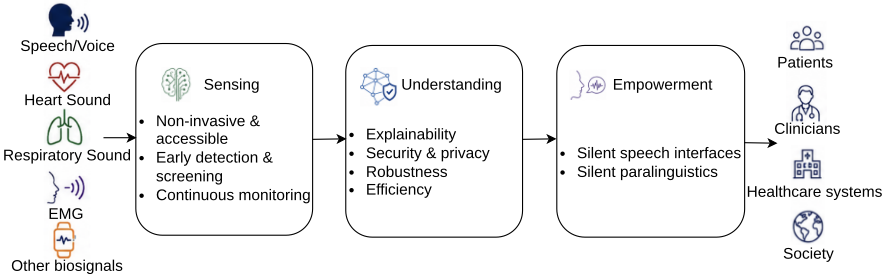
The overarching objective is to advance trustworthy AI for human-centred digital health by developing intelligent systems that transform biosignals into reliable, explainable, and actionable health insights through non-invasive, accessible, and affordable sensing technologies. Rather than replacing clinicians, our goal is to develop AI systems that augment human expertise by providing reliable evidence, transparent reasoning, and actionable recommendations while keeping clinicians and patients at the centre of the decision-making process. Our long-term vision is to bridge sensing technologies and clinical decision support, enabling AI systems that are transparent, robust, secure, and human-centred, thereby supporting informed clinical decisions and improving patient care. This paper presents a research vision for trustworthy AI in digital health through the lens of the authors' research. Rather than surveying the entire field, we organise our contributions into a unified framework consisting of three complementary pillars: Sensing, Understanding, and Empowering (see Figure 1). Together, these three themes provide a roadmap toward human-centred AI systems that are clinically reliable, widely accessible, and capable of improving healthcare outcomes across diverse real-world settings.
2 Sensing
The first pillar of our research vision focuses on enabling AI systems to perceive clinically relevant information from biosignals. Advances in sensing technologies have made it possible to acquire diverse physiological and behavioural signals non-invasively and continuously using wearable and consumer devices. These biosignals provide rich biomarkers of human health, supporting applications ranging from disease screening and diagnosis to continuous monitoring. In the following, we highlight our research on speech for mental healthcare and body sounds for cardiovascular and respiratory health.
2.1 Speech-basedMental Healthcare
Speech is a rich source of information that conveys not only what is spoken through linguistic content but also how it is spoken through paralinguistic cues. These cues capture long-term characteristics, such as personality, age, and gender, as well as short-term affective states, including emotion [Schuller and Batliner, 2013]. Recent advances in AI, ranging from conventional machine learning approaches to self-supervised speech foundation models and large speechlanguage models, have substantially advanced automatic speech emotion recognition [Schuller and Batliner, 2013; Ren et al., 2023a; Peng et al., 2024].
Beyond emotion recognition, speech has emerged as a promising digital biomarker for mental and neurological health. In our research, speech has been investigated for recognising mental disorders, including depression [Ringeval et al., 2019] and bipolar disorder [Ren et al., 2019], as well as neurological disorders such as Alzheimer's disease [Cummins et al., 2020]. These studies demonstrate the potential of speech-based AI to support early screening and objective assessment of cognitive and mental health conditions through non-invasive and accessible sensing.
2.2 Body Sounds for Cardiovascular and Respiratory Health
Compared with physiological biosignals such as electrocardiograms (ECGs), body sounds offer a non-invasive, lowcost, and easily accessible means of assessing human health. Our research explores the "acoustic dissection" of body sounds, demonstrating that heart and respiratory sounds contain rich biomarkers for cardiovascular and respiratory conditions [Ren et al., 2024a].
Our work includes the development and benchmarking of the Heart Sounds Shenzhen (HSS) Corpus, which has provided a benchmark for AI-based cardiovascular health monitoring [Dong et al., 2019; Schuller et al., 2018]. Beyond conventional abnormality detection, we investigated automated assessment of heart disease severity using the HSS corpus. For respiratory sound analysis, our research has focused on improving the explainability of AI models to enhance their transparency and facilitate clinical trust. These explainable AI approaches are discussed in detail in Section 3.1.
3 Understanding
The second pillar of our research vision addresses the "blackbox" nature of AI by developing models that are transparent, robust, secure, privacy-preserving, and efficient for trustworthy clinical deployment.
3.1 Explainability
The complexity of deep learning models often limits their interpretability, particularly in healthcare applications where transparent decision-making is essential. Our research therefore focuses on explainable AI to improve the understanding of model predictions.
Our early work investigated local explanations using attention mechanisms that highlight clinically relevant timefrequency regions for heart sound analysis, providing intuitive visualisations of model decisions [Ren et al., 2022]. We subsequently extended this idea to global explanations through prototype and criticism learning for respiratory sound analysis [Ren et al., 2023b; Chang et al., 2022]. Instead of explaining individual predictions, these methods identify representative and atypical examples, enabling clinicians to better understand model behaviour and compare new cases with clinically meaningful reference samples.
More recently, we have explored concept-based explanations by linking intermediate representations of speech foundation models to physically meaningful acoustic cues [Rammohan et al., 2025]. We further validated explainable AI methods by analysing the acoustic characteristics of regions highlighted by explanation models [Nasr et al., 2026]. Together, these studies advance explainable AI from predictionlevel interpretation towards a more comprehensive understanding of learnt representations.
3.2 Security and Privacy
Ensuring the security and privacy of AI systems is essential for trustworthy healthcare applications. Deep learning models are vulnerable to adversarial attacks, where imperceptible perturbations can cause incorrect predictions, potentially leading to inappropriate clinical decisions. Our research has therefore investigated both the vulnerability of AI models and effective defence strategies.
On the offensive side, we developed methods to improve the transferability and sparsity of adversarial attacks, including lifelong learning-based attack generation [Ren et al., 2020b] and the STAA-Net framework [Chang et al., 2024]. On the defensive side, we proposed adversarial training that improves model robustness by jointly optimising model predictions and intermediate representations using adversarial samples [Ren et al., 2020a]. More recently, we extended these ideas to federated learning and introduced a two-stage defence combining adversarial training with inference-time randomisation [Chang et al., 2026].
Beyond model robustness, our research emphasises privacy-preserving AI for healthcare. We investigated federated learning to enable collaborative model training without sharing sensitive patient data [Chang et al., 2026], and contributed a comprehensive survey on machine unlearning and privacy-preserving explanations, highlighting approaches for removing sensitive information from trained models while reducing the risk of data leakage [Nguyen et al., 2025].
3.3 Model Efficiency
Efficient AI models are essential for deploying digital health applications on resource-constrained devices, such as smartphones and wearable sensors. Our research has therefore focused on improving model efficiency while maintaining high predictive performance.
We proposed a self-distillation framework that transfers knowledge from large speech foundation models to compact student models, enabling efficient speech emotion recognition with minimal performance degradation [Ren et al., 2023a]. To further reduce storage requirements, we investigated dataset distillation, generating compact synthetic datasets that preserve representative characteristics of the original data while reducing memory consumption and mitigating privacy risks [Chang et al., 2025].
In addition, we developed lightweight neural architectures based on parameterised hypercomplex neural networks to reduce model complexity for physiological signal analysis [Basso et al., 2023]. These studies facilitate real-time AI on edge devices, bringing trustworthy digital health applications closer to everyday clinical and personal use.
4 Empowerment
The third pillar of our research vision focuses on empowering individuals through AI-enabled communication technologies. Speech is fundamental to human interaction, yet effective communication can be compromised in many situations. Patients with speech impairments, such as those who have undergone a laryngectomy, may lose the ability to communicate using their natural voice. In addition, healthy individuals may prefer silent communication to protect privacy in public environments or to communicate effectively in noisy surroundings where audible speech is difficult.
Silent Speech Interfaces (SSIs) offer a promising solution by enabling communication without audible articulation [Schultz et al., 2017]. Instead of relying on acoustic speech, SSI technologies recognise or synthesise speech from alternative biosignals, such as electrocorticography (ECoG), electromagnetic articulography (EMA), and surface electromyography (EMG) [Komeiji et al., 2024; Schultz et al., 2017; Wand and Schultz, 2014]. Among these sensing modalities, our research primarily focuses on EMG because it is non-invasive, wearable, and well suited for practical daily use.
4.1 EMG-based Silent Speech Communication
Benefiting from its non-invasive and wearable nature, surface EMG has become the primary sensing modality in our research on Silent Speech Interfaces. Our work focuses on translating facial muscle activity directly into natural and intelligible speech.
To advance this field, we developed two publicly available EMG speech corpora, EMG-Vox [Scheck et al., 2024] and EMG-VCTK [Scheck et al., 2025], which support research on cross-speaker adaptation, multi-speaker speech synthesis, and zero-shot voice generation. These datasets provide a foundation for developing more generalisable EMGto-speech systems capable of synthesising speech for both seen and unseen speakers.
Beyond improving intelligibility, our research has focused on enhancing the naturalness and practicality of synthesised speech. We proposed Diff-ETS, which employs diffusion probabilistic models to generate more natural speech and significantly improves subjective speech quality over conventional EMG-to-speech models [Ren et al., 2024b]. To enable real-world deployment, we further developed the StreamETS causal architecture, achieving real-time EMG-to-speech conversion with processing latencies as low as 7.72 ms on GPU for 10 ms EMG segments [Scheck et al., 2023]. Together, these advances move EMG-based silent speech communication closer to practical daily use.
4.2 EMG in Silent Paralinguistics
Existing EMG-to-speech research has primarily focused on improving speech intelligibility by recovering linguistic content from biosignals. However, speech also conveys rich paralinguistic information, such as emotion, speaking style, and social intent. To bridge this gap, we introduced the concept of Silent Paralinguistics [Ren et al., 2025], which extends Silent Speech Interfaces beyond speech reconstruction to the recognition of paralinguistic information from biosignals and expressive speech synthesis.
As an initial step, we developed multimodal recording protocols incorporating both reading and Wizard-of-Oz interaction tasks, and demonstrated that AI models can reliably recognise affective states, including politeness and frustration, directly from EMG signals [Pistrosch et al., 2026]. This research opens new opportunities for more expressive, natural, and human-centred silent communication systems.
5 Future Insights
The next generation of digital health will be characterised by continuous, personalised, and human-centred healthcare enabled by trustworthy AI. Rather than developing isolated models for individual diseases or sensing modalities, future research should focus on intelligent systems that integrate multimodal biosignals, including speech, body sounds, physiological signals, and wearable sensor data, to provide a holistic understanding of human health. Such systems should be capable of lifelong learning from longitudinal data while adapting to individual users and evolving clinical conditions.
From the perspective of sensing, future AI systems should move beyond analysing a single modality toward multimodal biosignal foundation models that learn transferable representations across diverse healthcare tasks [Zhang et al., 2026]. Combined with advances in wearable sensing technologies, these models could enable continuous monitoring of physical, cognitive, and mental health in everyday environments, facilitating earlier disease detection and more personalised interventions.
From the perspective of understanding, trustworthy AI should extend beyond predictive accuracy to encompass explainability, robustness, fairness, privacy preservation, and uncertainty awareness. Future research should develop AI systems that not only provide accurate predictions but also communicate reliable confidence estimates, explain their reasoning in clinically meaningful ways, and remain robust against distribution shifts, adversarial attacks, and heterogeneous real-world data [Wang et al., 2026]. Integrating these capabilities will be essential for establishing trustworthy AI that can be safely deployed in clinical practice.
From the perspective of empowerment, intelligent healthcare technologies should increasingly function as collaborative partners that assist both clinicians and patients. In addition to restoring communication through silent speech interfaces, future systems should recognise richer physiological and behavioural information, including emotion, stress, fatigue, and cognitive states, enabling more natural humanAI interaction and personalised healthcare support. Ultimately, trustworthy AI [Amadi and Ojo, 2025] should augment rather than replace human expertise, providing timely, transparent, and actionable recommendations while keeping clinicians and patients at the centre of decision making.
Collectively, these research directions point toward a future in which trustworthy AI forms a bridge between multimodal sensing technologies and clinical decision support. By combining reliable sensing, transparent understanding, and human-centred empowerment, AI has the potential to become an intelligent lifelong healthcare companion that improves accessibility, quality of care, and quality of life.
6 Conclusion
This paper has presented a research vision for advancing trustworthy AI in human-centred digital health through three interconnected pillars: Sensing, Understanding, and Empowerment. By enabling machines to perceive clinically relevant information from biosignals, developing AI systems that are transparent, robust, efficient, secure, and privacypreserving, and empowering individuals through intelligent assistive communication technologies such as EMG-based Silent Speech Interfaces, these research directions collectively address key challenges that hinder the clinical adoption of AI. Looking ahead, advances in multimodal foundation models, wearable sensing technologies, trustworthy machine learning, and human-AI collaboration will further accelerate the integration of AI into everyday healthcare. Ultimately, the goal is to establish trustworthy AI as a bridge between multimodal sensing technologies and clinical decision support, enabling intelligent systems that are reliable, explainable, accessible, and human-centred, thereby improving healthcare delivery, communication, and quality of life.
Ethical Statement
Generative AI tools (ChatGPT, OpenAI) were used solely to assist with language editing and improving the readability of the manuscript. The author reviewed and verified all generated text and takes full responsibility for the accuracy, originality, and integrity of the work.
Acknowledgments
This work is partially funded by the DFG, German Research Foundation, through the project "Silent Paralinguistics" with grant number 514018165.
@inproceedings{ijcai2026p910,
  title     = {Human-Centred Trustworthy AI for Digital Health: Sensing, Understanding, and Empowerment},
  author    = {Ren, Zhao},
  booktitle = {Proceedings of the Thirty-Fifth International Joint Conference on
               Artificial Intelligence, {IJCAI-26}},
  publisher = {International Joint Conferences on Artificial Intelligence Organization},
  editor    = {Diego Calvanese},
  pages     = {8185--8190},
  year      = {2026},
  month     = {8},
  note      = {Early Career Spotlight},
  doi       = {10.24963/ijcai.2026/910},
  url       = {https://doi.org/10.24963/ijcai.2026/910},
}
TY - CPAPER TI - Human-Centred Trustworthy AI for Digital Health: Sensing, Understanding, and Empowerment AU - Ren, Zhao T2 - Proceedings of the Thirty-Fifth International Joint Conference on Artificial Intelligence, IJCAI-26 PB - International Joint Conferences on Artificial Intelligence Organization PY - 2026 SP - 8185 EP - 8190 DO - 10.24963/ijcai.2026/910 UR - https://doi.org/10.24963/ijcai.2026/910 ER -Copied
Machine-readable versions of this paper, for tools and AI agents:





