
Distance Between CP-theory Preferences
Proceedings of the Thirty-Fifth International Joint Conference on Artificial Intelligence. Main Track. Pages 4008-4015.
https://doi.org/10.24963/ijcai.2026/446
Keywords
- Knowledge Representation and Reasoning: Preference modelling and preference-based reasoning
- Knowledge Representation and Reasoning: Qualitative, geometric, spatial, and temporal reasoning
Abstract
Qualitative preferences specified in CP-theory define a partial order over outcomes based on induced dominance relations. We investigate the problem of measuring divergence between such induced orders. We introduce two formally equivalent distance metrics, each leveraging a distinct computational strategy based on different types of normalization. Preliminary empirical results support the soundness of the proposed methodologies and offer comparative insights into their computational properties. To the best of our knowledge, this is the first study to compute distance measures between qualitative preferences that jointly accounts for conditional dependencies and relative importance statements.
- [Ali et al., 2021] Abu Mohammad Hammad Ali, Howard J Hamilton, Elizabeth Rayner, Boting Yang, and Sandra Zilles. Aggregating preferences represented by conditional preference networks. In International Conference on Al- gorithmic Decision Theory, pages 3-18. Springer, 2021.
- [Allen et al., 2017] Thomas E. Allen, Judy Goldsmith, Hay- den Elizabeth Justice, Nicholas Mattei, and Kayla Raines. Uniform random generation and dominance testing for cp- nets. Journal of AI Research, 2017.
- [Boutilier et al., 2004] C. Boutilier, R. I. Brafman, C. Domshlak, H. H. Hoos, and D. Poole. CP-nets: A tool for representing and reasoning with conditional ceteris paribus preference statements. Journal of Artificial Intelligence Research, 21:135-191, 2004.
- [Brafman and Domshlak, 2009] Ronen Brafman and Carmel Domshlak. Preference handling-an introductory tutorial. AI magazine, 30(1):58-58, 2009.
- [Brafman et al., 2006] R. I. Brafman, C. Domshlak, and S. E. Shimony. On graphical modeling of preference and importance. Journal of Artificial Intelligence Research, 25:389-424, 2006.
- [Diaconis and Graham, 1977] Persi Diaconis and Ronald L Graham. Spearman's footrule as a measure of disarray. Journal of the Royal Statistical Society Series B: Statistical Methodology, 39(2):262-268, 1977.
- [Kendall, 1938] Maurice G Kendall. A new measure of rank correlation. Biometrika, 30(1-2):81-93, 1938.
- [Kendall, 1948] Maurice George Kendall. Rank correlation methods. Griffin, 1948.
- [Loreggia et al., 2018] Andrea Loreggia, Nicholas Mattei, Francesca Rossi, and K. Brent Venable. On the dis- tance between cp-nets. In Proceedings of the 17th Inter- national Conference on Autonomous Agents and MultiA- gent Systems, AAMAS '18, page 955-963, Richland, SC, 2018. International Foundation for Autonomous Agents and Multiagent Systems.
- [Rossi et al., 2004] F. Rossi, K. B. Venable, and T. Walsh. mcp nets: Representing and reasoning with preferences of multiple agents. In Proceedings of the 19th National Con- ference on Artificial Intelligence, AAAI'04, pages 729- 734. AAAI Press, 2004.
- [Santhanam et al., 2016] Ganesh Ram Santhanam, Samik Basu, and Vasant Honavar. Representing and reasoning with qualitative preferences: Tools and applications, vol- ume 10 of Synthesis Lectures on Artificial Intelligence and Machine Learning. Morgan and Claypool Publishers, United States, 2016.
- [Wilson, 2004] Nic Wilson. Extending CP-nets with stronger conditional preference statements. In Proceedings of the 19th National Conference on Artifical Intelligence, AAAI'04, page 735-741. AAAI Press, 2004.
References were extracted automatically from the PDF and may contain errors.
Full text extracted automatically from the PDF; figures, tables and equations may differ. The PDF is the version of record.
1 Introduction
Qualitative reasoning with preferences have made significant progress in real-world decision-making processes in recent years [Brafman and Domshlak, 2009; Santhanam et al., 2016]. Such preferences are typically expressed over properties or attributes of outcomes using well-studied graphical languages like CP-nets and TCP-nets [Boutilier et al., 2004; Brafman et al., 2006], which collectively fall under the category of CP-theory languages [Wilson, 2004]. The semantics of these languages induce a partial order over outcomes, enabling the resolution of queries related to dominance (i.e., whether one outcome is better than another) and optimality (i.e., whether an outcome is not dominated by any other).
A key challenge in this context is reasoning with the preferences of multiple stakeholders. One approach is to merge all preferences and attempt to identify an outcome that aligns with everyone's (or majority's) interests [Rossi et al., 2004]. However, in real-world scenarios, achieving consensus on optimality is often impractical. A more feasible strategy is to reach a compromise solution, where each stakeholder adjusts their preferences to reduce contradictions, thereby enabling a mutually acceptable consensus. Yet, this process may fail if stakeholders' preferences are fundamentally incompatible. Consequently, it becomes important to quantify the degree of difference between the preferences of various stakeholders. For example, if stakeholder A's preferences are more conflicting with stakeholder B's preferences than with stakeholder C's, then it is reasonable to infer that A and C are more likely to reach a consensus than A and B.
Driving Problem. The difference between preferences expressed by A and B is quantified in terms of the difference between the partial orders induced by the pair's preferences. For CP-net qualitative preferences, one of the notable works on distance measures is due to Loreggia et al. [2018], where the distance is an estimate of distance between partial orders as measured by their Kendall tau (KT) distance. Another relevant measure is the cumulative swap disagreement introduced by Ali et al. [2021] in the context of aggregating CP-nets. This function counts the number of swaps (outcome pairs differing in exactly one attribute) on which a candidate consensus network disagrees with the input preferences. Ali et al. utilize the distance as an objective function to be minimized for finding an optimal consensus CP-net.
Our Solution. We address the problem of distance measure in the general setting of CP-theory qualitative preferences. We demonstrate that our distance function realizes a metric space over partial orders induced by CP-theory preferences. We present a semantically equivalent alternate syntactic construct for CP-theory preferences (referred to as ACP-theory language) that facilitates the computation of distance between preferences. We propose different computational strategies for our distance function and experimentally validate the viability of these strategies. To the best of our knowledge, our proposed distance computation is the first effective strategy for computing the distance between qualitative preferences that involve both conditional dependencies and set-based relative importance between attributes.
2 Qualitative Preferences
CP-theory. We present a brief overviewof CP-theory preferences. For details we refer to [Santhanam et al., 2016]. Preference statements in CP-theory express the desirability between a pair of values of a (preference attribute) variable optionally conditioned on the values of some other variables and in the context of relative importance between variables. Our focus, in this paper, is on binary domain variables. For instance, X = x ∧ Y = y : Z = z ≻ Z = ¯ z [U, V ] is a statement that expresses the desirability of value z over ¯ z when the valuation of variables X and Y are x and y respectively and the variables U and V are relatively less important compared to Z. Semantically, this statement induces a dominance between a pair of outcomes o and o′ . We will conclude that o ≻ o′ as per the above preference statement if and only if the following holds:
- valuations of Z in o and o′ are z and ¯ z, respectively (preference variable valuations).
- valuations of X and Y in both o and o′ are x and y, respectively (conditional variable valuations).
- valuations of all variables other than X, Y,Z,U, V in o and o′ are identical (all else being equal). We will refer to these variables as ceteris paribus variables [Boutilier et al., 2004] and denote the set of these variables as V cp .
Observe that, the valuations of U and V can be anything in o and o′ as they are relatively less important variables compared to Z. Further observe that, a preference statement can induce dominance between multiple pairs of outcomes.
Notations. The general syntax of CP-theory preference statements over a set of variables V is
where ϱ captures the conjunction of conditions over variables in V ar(ϱ), and Ω represents the set of variables relatively less important than Z such that V ar(ϱ), Ω and {Z} are pairwise disjoint sets. Whenever necessary, we use the subscript p to denote the conditions, relatively less important sets and ceteris paribus variables associated with the preference statement p. We denote the valuation of a conditional variable X ∈ V ar(ϱ) as ϱ(X).
If o ≻ o′ as per p in CP-theory, then we denote o ≻p o′ . The dominance relation induced by p is denoted by
Given a set of preferences P , the dominance relation induced by P is ≻P = ⋃ p∈P ≻p . The semantics of P is captured by
the transitive closure of ≻P , denoted by ≻∗ P . The semantics, therefore, induces a partial order over the outcomes. In the proceeding, we will consider the set of preferences to be in irreducible or in minimal format; one where there are no redundancies in the conditionalities and relative importance.
Example 1. Consider a CP-theory preference statement p:
defined over the variable set {X, Y,Z}. There are 16 different dominance pairs (o, o′ ) induced by the statement. The valuations of Z in o and o′ are z and ¯ z, respectively, with no restrictions on the valuations of X and Y .
3 Distance Between CP-theory Preferences
The distance between a pair of CP-theory preferences can be measured as the difference between the partial order induced by each element in the pair. For instance, KTdistance [Kendall, 1938] is measured as the cardinality of the set ≻∗ P1 ∆≻∗ P2 . That is,
Here ∆ denotes symmetric difference: for any sets A and B, A∆B = (A \ B) ∪ (B \ A).
Definition 1. A metric space is a pair (M, d), where M is a set of elements and dist is a function (distance or metric) dist : M ×M → R, which satisfies the following axioms for all A, B, C ∈ M:
- dist(A,B) ≥ 0;
- dist(A, B) = 0 if and only if A = B;
- dist(A,B) = dist(B,A);
- dist(A,B) ≤ dist(A,C) +dist(C,B).
We present a distance function over CP-theory preferences which computes the difference between the dominance relations induced by preference statements P1 and P2. While this characterization of distance does not align with the difference between partial orders (transitive closure is not considered), it still realizes a metric space over the CP-theory preferences.
Theorem 1. For any two CP-theory preference-sets A and B, a distance function defined as
realizes a metric space (P, dD), where any CP-theory preference set belongs to P.
Proof. It is immediate that ∀A,B ∈ P
Next consider the relationship dD(A,B) ≤ dD(A,C) + dD(C,B). We prove that for any pair (o, o′ ) ∈≻A ∆ ≻B , the pair either belongs to ≻B ∆ ≻C or ≻A ∆ ≻C .
WLOG, let (o, o′ ) ∈≻A \ ≻B . That is, (o, o′ ) contributes to the dD(A,B). If (o, o′ ) ∈≻C then (o, o′ ) ∈≻C \ ≻B . On the other hand, if (o, o′ ) ̸∈≻C then (o, o′ ) ∈≻A \ ≻C . Thus (o, o′ ) contributes to the either dD(C, B) or dD(A, C), which implies dD(A, B) ≤ dD(B, C) + dD(A, C).
Computation of dD requires generation of the dominance relations induced by the CP-theory preferences. We present an overestimate of dD that can be computed from the syntactic structure of CP-theory statements. We conjecture (following [Loreggia et al., 2018]) that distance functions defined using the syntactic difference between CP-theory preferences incur less execution time overhead compared to the computation of distance functions defined over the underlying dominance relations induced by the preferences. We experimentally validate this conjecture. To facilitate such a distance computation, we propose an alternate syntactic representation of CP-theory preferences.
ACP-theory. Recall that the CP-theory preference statement: ϱ : Z = z ≻ Z = z′ [Ω] induces dominance between pairs of outcomes o and o′ , where there is no relationship between the valuation of elements of Ω in o and o′ (these variables are relatively less important compared to Z). Our alternate syntactic form for CP-theory preference statements explicitly captures this lack of relationship between valuations of variables in Ω. We refer to this syntactic form as ACP-theory. Specifically, ϱ : Z = z ≻ Z = ¯ z (Γ) captures the dominance between o and o′ where the o has the preferred valuation of Z, the conditions expressed in ϱ are satisfied in o and o′ , the valuations of variables ∈ Γ differ in o and o′ and all other variable valuations are identical in o and o′ . We refer to the variables in Γ as the difference variables. As before, we use the subscript p to denote the conditions, the preference variable, and the difference variables associated to the preference statement p.
For a preference statement p in ACP-theory, we denote the dominance relation induced by p as ≻a p and for a set A of preferences in ACP-theory, we denote the dominance relation induced by A as ≻a A .
Proposition 1. Given a CP-theory statement p of the form ϱ : Z = z ≻ Z = ¯ z [Ω], the set of statements in ACPtheory that are semantically equivalent to p is
For any set A of CP-theory preferences, there is a set A′ of ACP-theory preferences such that A′ is the union of semantically equivalent ACP-theory statements corresponding to each p ∈ A, thus ensuring ≻A =≻a A′ .
We denote the function that transforms CP-theory preferences in A to ACP-theory preferences as Ca (A).
3.1 Distance by Overestimating Dominance Difference
We apply normalization to preference statements in ACPtheory in a fashion similar to that discussed by Loreggia et al. [2018]. Normalization amounts to augmenting each preference statement p with additional conditions over variables in V \ (Zp ∪Γp) without altering the semantics of p. In short, all possible valuations of ceteris paribus variables ∈ V cp p are added as conditions resulting in 2|V cp p | different preference statements corresponding to p. For instance, consider the following preference statement p over V = {X, Y, Z, W}
where the V cp p = {W}. By normalization process, we obtain
The process of normalization (adding redundant conditions) results in preference statements such that there are no Ceteris Paribus variables associated with them. We will refer to this normalization operation as standard normalization and denote its application on an ACP-theory preference set as the function Ns(A). We denote the dominance induced by a normalized ACP-theory preference statement p by ≻an p .
In order to estimate the distance, we first compute | ≻an p |. The valuation depends on the cardinality of Γp as the pair of outcomes related by the ≻an p must differ in the valuations of each variable in Γp. It is immediate that
Proposition 2. Given a set A of CP-theory statements, let A′ = Ns(Ca (A)) be the set of normalized ACP-theory statements. Then,⋃
Therefore, for any two sets A and B of CP-theory statements, if A′ = Ns(Ca (A)) and B′ = Ns(Ca (B)) then
Example 2. For the CP-theory statement in Example 1, the corresponding ACP-theory preferences are
Subsequent normalization results in the preferences
Observe that the preference statement p1,i induces 20 = 1 dominance relationship for each i. Preference statement p2i as well as p3i induces 21 = 2 dominance relationships. Finally, statement p4i induces 22 = 4 relations.
Definition 2. Given sets A and B of CP-theory statements, let A′ = Ns(Ca (A)) and B′ = Ns(Ca (B)). We define
We establish the following properties of the distance measure d.
Theorem 2. Given sets A and B of CP-theory statements, dD(A, B) ≤ d(A, B).
Proof. Let A′ = Ns(Ca (A)) and B′ = Ns(Ca (B)) be the sets of normalized ACP-theory statements corresponding to CPtheory preferences in sets A and B. Note that, dD(A,B) = dD(A′ ,B′ ) due to Proposition 2. For any (o, o′ ) ∈ ≻an A′ \≻an B′ , there exists some p ∈ A′ \ B′ such that (o, o′ ) ∈≻an p . Therefore,
Proceeding further,
(3) Simliarly, we have | ≻an B′ \ ≻an A′ | ≤ ∑p∈B′ \A′ | ≻an p |. Therefore,
Theorem 3. The function d(A,B) realizes a metric space (P, d) where any CP-theory preference set belongs to P.
Proof. ∀A,B ∈ P the following properties hold.
d(A,B) ≥ 0 as dD(A,B) ≥ 0 (due to Theorem 2) and dD(A, B) ≤ d(A, B).
Next consider, dD(A, B) = 0. Due to Theorem 1, ≻A =≻B . Let A′ = Ns(Ca (A)) and B′ = Ns(Ca (B)). Translation and normalization do not alter the semantics of dominance. Hence ≻an A′ =≻an B′ and there exists no p ∈≻an A′ ∆ ≻an B′ . Therefore dD(A,B) = 0 implies d(A,B) = 0. The converse d(A,B) = 0 implies dD(A,B) = 0 is immediate as d(A, B) ≥ dD(A, B) due to Theorem 2.
The symmetric relationship d(A,B) = d(B,A) follows from the definition d.
Finally, let A,B,C be three sets of CP-theory statements and let A′ ,B′ ,C ′ be the corresponding normalized sets in ACP-theory. Let p ∈ A′∆B′ and WLOG consider p ∈ A′ \ B′ . Therefore, | ≻an p | contributes to d(A,B).
If p ∈ C ′ , then p ∈ C ′ \ B′ and hence | ≻an p | contributes to d(C,B). If instead p ̸∈ C ′ , then p ∈ A′ \ C ′ and | ≻an p | contributes to d(A,C). Therefore, in either case, if | ≻an p | contributes to d(A,B), then it also contributes to d(A,C) + d(C,B). It follows that, d(A,B) ≤ d(A,C) +d(C,B).
Example 3. Consider a set A
of ACP-theory preferences over variables {X1,X2,X3,X4,X5}. Normalizing the preference statements results in the following statements for the set A
a11 X1 = x1 ∧X2 = x2 ∧X3 = x3 : X4 = x4 ≻X4 = ¯x4 (X5) a12 X1 = x1 ∧X2 = ¯x2 ∧X3 = x3 : X4 = x4 ≻X4 = ¯x4 (X5) a13 X1 = x1 ∧X2 = x2 ∧X3 = ¯x3 : X4 = x4 ≻X4 = ¯x4 (X5) a14 X1 = x1 ∧X2 = ¯x2 ∧X3 = ¯x3 : X4 = x4 ≻X4 = ¯x4 (X5) a21 X2 = x2 ∧X3 = x3 ∧X5 = x5 : X4 = x4 ≻X4 = ¯x4 (X1) a22 X2 = x2 ∧X3 = ¯x3 ∧X5 = x5 : X4 = x4 ≻X4 = ¯x4 (X1) a23 X2 = x2 ∧X3 = x3 ∧X5 = ¯x5 : X4 = x4 ≻X4 = ¯x4 (X1) a24 X2 = x2 ∧X3 = ¯x3 ∧X5 = ¯x5 : X4 = x4 ≻X4 = ¯x4 (X1)Normalizing the preference statements results in the following statements for the set B
b1 X1 = x1 ∧X2 = x2 ∧X3 = x3 : X4 = x4 ≻X4 = ¯x4 (X5) b2 X1 = ¯x1 ∧X2 = x2 ∧X3 = x3 : X4 = x4 ≻X4 = ¯x4 (X5) b3 X1 = x1 ∧X2 = ¯x2 ∧X3 = x3 : X4 = x4 ≻X4 = ¯x4 (X5) b4 X1 = ¯x1 ∧X2 = ¯x2 ∧X3 = x3 : X4 = x4 ≻X4 = ¯x4 (X5)The symmetric difference set of the above two sets of preference statements is {a13, a14, a21, a22, a23, a24, b2, b4}, so the distance is d(A, B) = 16.
3.2 Distance Overestimation with Context-Uniform Normalization
Recall that we have applied standard normalization where each preference statement p is normalized with respect to V cp p . We present here another normalization strategy. As before, the preferences are translated to ACP-theory, resulting in new sets A′ and B′ corresponding to CP-theory preference sets A and B. Let PaA′(X) be the set of conditional variables that appear in some preference statement in A′ which expresses preferences over the variable X. Each ACP-theory preference statement p is then normalized with respect to PaA′ (Zp) \ (V ar(ϱp) ∪ Γp). We refer to this normalization as Context-uniform normalization, and the dominance relation induced by preference p post normalization is denoted by ≻ancu p .
We denote the function realizing the normalization operation as Ncu(.), which takes as input a set of ACP-theory preferences and outputs a resultant set where preferences are context-uniform normalized. Before presenting the distance computation strategy using context-uniform normalization, we introduce the concept of compatible preferencespreferences that induce some common set of dominance relationship. Formally,
Definition 3. Given two context-uniform normalized ACPtheory preference statements p ∈ A′ and q ∈ B′ , we say that they are compatible, denoted by p ⋊⋉A′B′ q (or (p, q) ∈⋊⋉A′B′ ), iff the following conditions hold:
Definition 4. Given sets A and B of CP-theory statements, let A′ = Ncu(Ca (A)) and B′ = Ncu(Ca (B)). We define
Example 4. Consider the same sets of ACP-theory preferences A and B in Example 3. The context-uniform normalization of A results in the following set A′ of statements
The context-uniform normalization for the set B is B′ = B. Note that ⋊⋉A′B′= {(a11, b), (a12, b)} and
So we have
Hence the distance is dcu = 16 + 8 - 2 × 4 = 16.
Theorem 4. For any pair A and B sets of CP-theory statements, d(A, B) = dcu(A, B).
Proof. Given sets A and B, let A′ ,B′ be their contextuniform forms and Astd,Bstd be their standard normalized forms. We define the weight of a set of standard statements S as w(S) = ∑s∈S | ≻an s |. From Definition 2, d(A,B) = w(Astd∆Bstd) = w(Astd) + w(Bstd) - 2w(Astd ∩ Bstd).
First, consider Astd. It partitions into disjoint sets S(q) for each q ∈ A′ , where S(q) contains all standard statements derived from q. The set S(q) consists of all statements matching q's structure (same Z, z, ¯ z, Γ) but with full assignments to variables not in {Z} ∪ V ar(ϱq) ∪ Γq. The number of such statements is 2|V|-1-|V ar(ϱq)|-|Γq| , and each has dominance size 2|Γq| . Thus, the weight is w(S(q)) = 2|V|-1-|V ar(ϱq)| . Summing over A′ , we get w(Astd) = ∑q∈A′ 2|V|-1-|V ar(ϱq)| . Similarly for B′ .
Next, consider the intersection Astd ∩ Bstd. A standard statement s is in the intersection if and only if it is derived from some p ∈ A′ and q ∈ B′ . This implies that p and q must share the same preference structure and their conditions must be consistent. Thus, (p, q) must be a compatible pair. Thus, the intersection partitions into disjoint sets S(p)∩S(q) for each compatible pair (p, q) ∈⋊⋉A′B′ . The set S(p) ∩ S(q) contains standard statements consistent with ϱp ∧ ϱq. Using the same counting argument as before, the number of such statements is 2|V|-1-|V ar(ϱp∧ϱq)|-|Γ| , and the weight is:
Substituting these terms into the distance equation yields dcu(A, B).
Corollary 1. Given any sets A and B of CP-theory preferences, dD(A, B) ≤ d(A, B) = dcu(A, B).
Corollary 2. The function dcu(A, B) realizes a metric space (P, dcu) where any CP-theory preference set belongs to P.
Complexity analysis. The computations are polynomial in the size of the normalized ACP-theory representation, although this representation may be exponentially larger than the compact CP-theory input in the worst case. This is due to the normalization over multiple difference-variables resulting from relatively less important variables. The benefit of dcu is therefore not the elimination of this worst-case expansion, but the avoidance of explicit construction of the outcomelevel dominance graph, which may also contain exponentially many outcome pairs. Moreover, context-uniform normalization is performed independently for each preference set, so normalized representations can be precomputed once and reused across all pairwise comparisons. Given these precomputed representations, evaluating dcu reduces to linear summations over the normalized sets and compatibility checks between statements with matching preference structure.
4 Experimental Evaluation
Data Set. We generate a collection of 100 CP-theory sets and compute the distance measures between all pairs of these sets. We first generate CP-net statements, by adopting the strategy outlined in [Allen et al., 2017]. We then randomly introduce relatively less important variables into selected statements. These variables are chosen from the set V cp p , which denotes the ceteris paribus attributes for the original preference statement p. Each set of CP-theory statements generated in this way is parameterized by the following: (a) the number
(n) of attributes, (b) the maximum number (c) of conditional attributes per statement, (c) the maximum number (mli) of relatively less important attributes per statement, and (d) the probability (rli) that a statement includes relatively less important attributes.
Evaluation Objective. The primary objective of our experimental study is to assess the execution time of the distance measure and quantitatively evaluate the differences between dD and the proposed distance measure.
All experiments are conducted on an Apple M2 CPU with 16 GB memory running macOS 15.5 and Python 3.13.5.
4.1 Runtime Performance
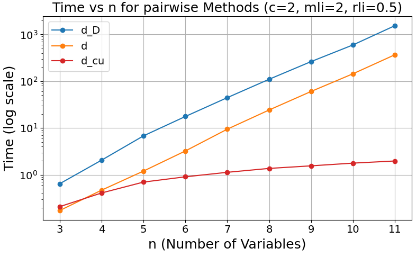
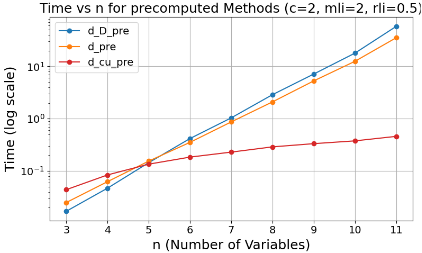
All execution time plots report time in seconds. Figure 1 and Figure 2 show how runtime changes with n under pairwise and precomputed implementations. In the pairwise approach, normalization and computation are performed individually for each pair of CP-theories. In contrast, the precomputed approach first normalizes all CP-theories in the dataset and then performs pairwise comparisons based on these normalized representations. This strategy substantially reduces redundancy in normalization and improves efficiency, especially for large datasets. Notably, pre-computing the contextuniform normalization (Figure 2) makes dcu extremely efficient. With 10 binary preference variables describing 1024 outcomes, precomputed dcu completes (100 2 ) = 4950 pairwise distance computations within a few seconds.
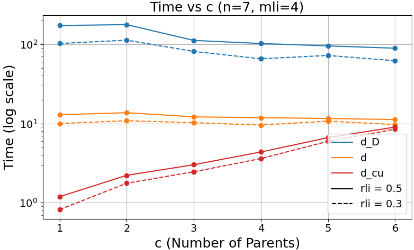
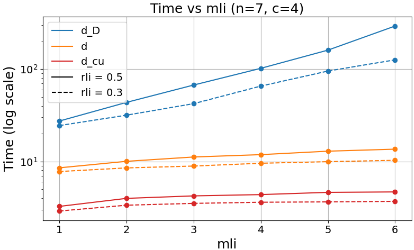
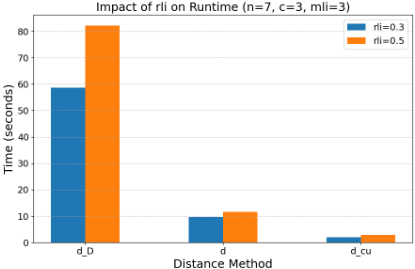
Figures 3-5 show the effects of c, mli, and rli. As c approaches n, the overhead gap between d and dcu narrows. The reason is that less conditional attributes in statements result in less normalized statements for dcu, which leads to less computation overhead. Larger mli and rli generally increase runtime for all measures.
4.2 Approximation Quality
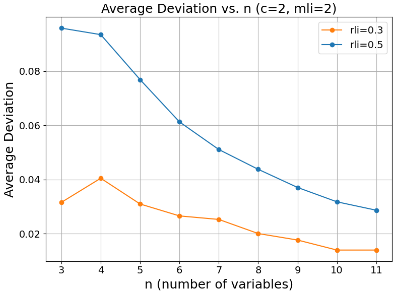
We have proposed an overestimating distance metric d that is computed efficiently from the syntactic structure of preferences rather than the induced preference graphs. We evaluate the quality of this approximation relative to the reference metric dD. For our dataset, the average relative deviation, d-dD dD , is 5.46%. Figure 6 shows how the average deviation between d and dD changes as the number of variables n increases, with fixed values of c and mli. As n grows, the deviation decreases for both values of rli, indicating that the approximation d becomes more aligned with the reference distance dD in larger CP-theories. The higher deviation observed for rli = 0.5 suggests that a greater proportion of relatively less important variables amplifies the mismatch between d and dD.
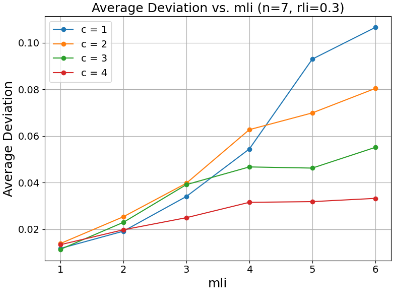
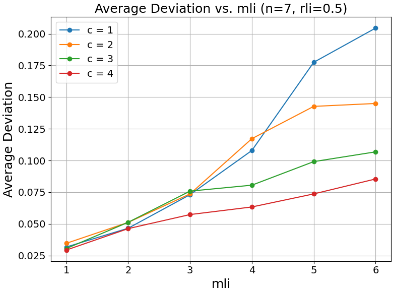
Figure 7 and Figure 8 plot the average relative mismatch between d and dD as mli increases, for fixed n and rli = 0.3 and 0.5, respectively. Each line represents a different value of c. The results show that the deviation of the overestimate from the reference value increases with both mli and c. Moreover, deviation levels are consistently higher for rli = 0.5 than for rli = 0.3, consistent with earlier observations that a greater presence of relatively less important variables amplifies the mismatch between d and dD.
4.3 Comparison with ExistingMeasures
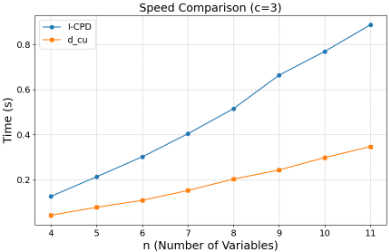
We compare the computational performance of our dcu implementation with I-CPD, a distance measure for CP-nets defined by [Loreggia et al., 2018]. To handle the potential exponential complexity of preference comparison, our library employs a high-performance bitmasked evaluation architecture. This architecture provides a unified foundation for both metrics, ensuring the experimental comparison is fair and focuses on the inherent efficiency of the algorithms themselves.
The core idea shared by both metrics is the need to rapidly identify overlapping contexts between preference statements. While they leverage this information differently, with dcu using it to find agreements for the intersection term | ≻A ∩ ≻B | and I-CPD using it to find disagreements for counting swaps, the underlying computational bottleneck is identical. To handle this efficiently, we represent the fixed variables (parents) of each statement as a mask m (where the i-th bit is 1 if the i-th variable is fixed) and their assignments as a value vector v (representing 0 or 1 valuations). We can then determine the compatibility of any two statements s1 and s2 using a highly efficient bitwise expression:
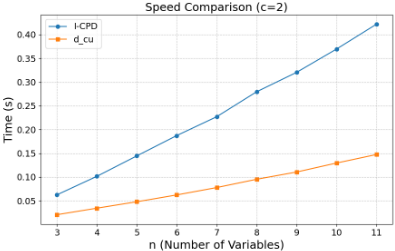
where ∧ is bitwise AND, and ⊕ is bitwise XOR. If compatible, the size of the overlapping context (the number of flippable edges affected) is computed as 2n-1-|m1∪m2| using a population count (popcount) operation. This value serves as the base weight; it is incorporated directly into the calculation of dcu, whereas for I-CPD, it is adjusted by metric-specific scaling factors to determine the final contribution to the distance. As illustrated in Figures 9 and 10, this bitmasked approach allows our library to process thousands of statement comparisons in a fraction of a second. By isolating implementation efficiency within a shared optimization framework, our results accurately reflect the comparative scaling characteristics of dcu and I-CPD.
5 RelatedWork
The problem of quantifying similarity or distance between partial orders arises naturally in various contexts such as rank aggregation, social choice theory, and hierarchy comparison. Classical distance measures such as Spearman's footrule and Kendall's tau [Kendall, 1948; Diaconis and Graham, 1977] were initially developed for total orders and have since been extended to accommodate partial rankings.
Related to our context is the distance computation between CP-nets proposed by [Loreggia et al., 2018]. They define the distance as a function of the Kendall-tau distance between the induced partial orders, an extension of the classical metric that counts the number of pairwise disagreements between orders. Given the exponential size of the outcome space, directly computing Kendall-tau distances is inefficient. To address this, the authors propose two polynomial-time approximations: the O-legal CP-net Distance (O-CPD) and the Induced CP-net Distance (I-CPD). O-CPD assumes a shared variable ordering between CP-nets, enabling efficient comparison via conditional preference tables. I-CPD generalizes this by removing the ordering constraint, offering broader applicability while retaining computational tractability. In contrast, our proposed distance measure strategies is applicable in more generalized settings, preferences expressed in CPtheory languages.
Figure 10: Comparison between our bitmasked dcu implementation and the I-CPD approach (c = 3).
6 Conclusion
This paper introduces a new framework for measuring distance between outcome orders induced by CP-theories that account for both conditional dependencies and relative importance, thus addressing a gap in existing preference comparison approaches. Our preliminary experiments highlight the validity and show its practical viability. As part of future work, we plan to apply the distance measures to strategize effective aggregation of multi-agent preferences.
Acknowledgments
This work is supported in part by NSF grant IIS 2225823.
@inproceedings{ijcai2026p446,
  title     = {Distance Between CP-theory Preferences},
  author    = {Qi, Zihao and Rauer, Erik and Basu, Samik},
  booktitle = {Proceedings of the Thirty-Fifth International Joint Conference on
               Artificial Intelligence, {IJCAI-26}},
  publisher = {International Joint Conferences on Artificial Intelligence Organization},
  editor    = {Diego Calvanese},
  pages     = {4008--4015},
  year      = {2026},
  month     = {8},
  note      = {Main Track},
  doi       = {10.24963/ijcai.2026/446},
  url       = {https://doi.org/10.24963/ijcai.2026/446},
}
TY - CPAPER TI - Distance Between CP-theory Preferences AU - Qi, Zihao AU - Rauer, Erik AU - Basu, Samik T2 - Proceedings of the Thirty-Fifth International Joint Conference on Artificial Intelligence, IJCAI-26 PB - International Joint Conferences on Artificial Intelligence Organization PY - 2026 SP - 4008 EP - 4015 DO - 10.24963/ijcai.2026/446 UR - https://doi.org/10.24963/ijcai.2026/446 ER -Copied
Machine-readable versions of this paper, for tools and AI agents:





