
Acceptability Semantics for Weighted Argumentation Frameworks
Proceedings of the Twenty-Sixth International Joint Conference on Artificial Intelligence. Main track. Pages 56-62.
https://doi.org/10.24963/ijcai.2017/9
Keywords
- Agent-based and Multi-agent Systems: Agreement Technologies: Argumentation
- Knowledge Representation, Reasoning, and Logic: Computational models of Argument
Abstract
The paper studies semantics that evaluate arguments in argumentation graphs, where
each argument has a basic strength, and may be attacked by other arguments. It starts
by defining a set of principles, each of which is a property that a semantics could
satisfy. It provides the first formal analysis and comparison of existing semantics.
Finally, it defines three novel semantics that satisfy more principles than existing ones.
- [Amgoud and Ben-Naim, 2013] Leila Amgoud and Jonathan Ben-Naim. Ranking-based semantics for argumentation frameworks. In SUM'13, pages 134-147, 2013.
- [Amgoud and Ben-Naim, 2016a] Leila Amgoud and Jonathan Ben-Naim. Axiomatic foundations of accept- ability semantics. In KR'16, pages 2-11, 2016.
- [Amgoud and Ben-Naim, 2016b] Leila Amgoud and Jonathan Ben-Naim. Evaluation of arguments from support relations: Axioms and semantics. In IJCAI'16, pages 900-906, 2016. IJCAI
- [Amgoud and Cayrol, 2002] Leila Amgoud and Claudette Cayrol. A reasoning model based on the production of ac- ceptable arguments. Annals of Mathematics and Artificial Intelligence, 34(1-3):197-215, 2002.
- [Amgoud et al., 2017] Leila Amgoud, Elise Bonzon, Marco Correia, Jorge Cruz, Jérôme Delobelle, Sébastien Konieczny, João Leite, Alexis Martin, Nicolas Maudet, and Srdjan Vesic. A note on the uniqueness of models in social abstract argumentation. CoRR, abs/1705.03381, 2017.
- [Baroni and Giacomin, 2007] Pietro Baroni and Massim- iliano Giacomin. On principle-based evaluation of extension-based argumentation semantics. Artificial Intel- ligence, 171(10-15):675-700, 2007.
- [Baroni et al., 2015] Pietro Baroni, Marco Romano, Francesca Toni, Marco Aurisicchio, and Giorgio Bertanza. Automatic evaluation of design alternatives with quan- titative argumentation. Argument & Computation, 6(1):24-49, 2015.
- [Bench-Capon, 2003] Trevor Bench-Capon. Persuasion in practical argument using value-based argumenta- tion frameworks. Journal of Logic and Computation, 13(3):429-448, 2003.
- [Benferhat et al., 1993] Salem Benferhat, Didier Dubois, and Henri Prade. Argumentative inference in uncertain and inconsistent knowledge bases. In UAI'93, pages 411- 419, 1993.
- [Besnard and Hunter, 2001] Philippe Besnard and Anthony Hunter. A logic-based theory of deductive arguments. Ar- tificial Intelligence, 128(1-2):203-235, 2001.
- [Bonzon et al., 2016] Elise Bonzon, Jérôme Delobelle, Sébastien Konieczny, and Nicolas Maudet. A com- parative study of ranking-based semantics for abstract argumentation. In AAAI'16, 2016.
- [Cayrol et al., 2010] Claudette Cayrol, Caroline Devred, and Marie-Christine Lagasquie-Schiex. Acceptability seman- tics accounting for strength of attacks in argumentation. In ECAI'10, pages 995-996, 2010.
- [da Costa Pereira et al., 2011] Célia da Costa Pereira, An- drea Tettamanzi, and Serena Villata. Changing one's mind: Erase or rewind? In IJCAI'11, pages 164-171, 2011.
- [Dubois and Prade, 1995] Didier Dubois and Henri Prade. Possibility theory as a basis for qualitative decision theory. In (IJCAI'95), pages 1924-1930, 1995. IJCAI
- [Dubois et al., 2008] Didier Dubois, Hélène Fargier, and Jean-Franc ¸ois Bonnefon. On the qualitative comparison of decisions having positive and negative features. Jour- nal of Artificial Intelligence Research, 32:385-417, 2008.
- [Dung, 1995] Phan Minh Dung. On the Acceptability of Arguments and its Fundamental Role in Non-Monotonic Reasoning, Logic Programming and n-Person Games. Ar- tificial Intelligence, 77:321-357, 1995.
- [Dunne et al., 2010] Paul Dunne, Diego Martinez, Alejandro Garcia, and Guillermo Simari. Computation with varied- strength attacks in abstract argumentation frameworks. In COMMA'10, pages 207-218, 2010.
- [Dunne et al., 2011] Paul Dunne, Anthony Hunter, Peter McBurney, Simon Parsons, and Michael Wooldridge. Weighted argument systems: Basic definitions, algo- rithms, and complexity results. Artificial Intelligence, 175(2):457-486, 2011.
- [Gabbay and Rodrigues, 2015] Dov M. Gabbay and Odi- naldo Rodrigues. Equilibrium states in numerical argu- mentation networks. Logica Universalis, 9(4):411-473, 2015.
- [Hunter, 2013] Anthony Hunter. A probabilistic approach to modelling uncertain logical arguments. International Journal of Approximate Reasoning, 54(1):47-81, 2013.
- [Leite and Martins, 2011] João Leite and João Martins. So- cial abstract argumentation. In IJCAI'11, pages 2287- 2292, 2011. IJCAI
- [Li et al., 2011] Hengfei Li, Nir Oren, and Timothy J. Nor- man. Probabilistic argumentation frameworks. In TAFA'11, pages 1-16, 2011.
- [Modgil, 2009] Sanjay Modgil. Reasoning about prefer- ences in argumentation frameworks. Artificial Intelli- gence, 173(9-10):901-934, 2009.
- [Rago et al., 2016] Antonio Rago, Francesca Toni, Marco Aurisicchio, and Pietro Baroni. Discontinuity-free deci- sion support with quantitative argumentation debates. In KR'16, pages 63-73, 2016.
- [Shapley, 1953] Lloyd Shapley. A values for n-person games. H.W. Kuhn and A.W. Tucker, eds., Contributions to the theory of games, vol. II. Annal of Mathematics Stud- ies, (28), 1953.
- [Thimm, 2012] Matthias Thimm. A probabilistic semantics for abstract argumentation. In ECAI'12, pages 750-755, 2012.
References were extracted automatically from the PDF and may contain errors.
Full text extracted automatically from the PDF; figures, tables and equations may differ. The PDF is the version of record.
1 Introduction
In an argumentation setting, an argument may be attacked by other arguments. It may also have a basic strength, which may represent various issues like its probability [Hunter, 2013; Thimm, 2012; Li et al., 2011], certainty degree of its premises [Benferhat et al., 1993], votes provided by users [Leite and Martins, 2011], importance degree of a value it promotes [Bench-Capon, 2003], trustworthiness of its source [da Costa Pereira et al., 2011]. In all these disparate cases, the basic strength may be expressed by a numerical value, leading to weighted argumentation graphs. The question of evaluating the overall strength or overall acceptability of an argument in such graphs raises naturally.
Two families of semantics were proposed in the literature for answering this question. The first family, studied in [Amgoud and Cayrol, 2002; Bench-Capon, 2003; Modgil, 2009; Li et al., 2011; Thimm, 2012; Hunter, 2013], extends the semantics proposed by Dung [1995], which compute extensions of arguments. The second family, investigated in [da Costa Pereira et al., 2011; Leite and Martins, 2011; Gabbay and Rodrigues, 2015; Baroni et al., 2015; Rago et al., 2016], computes the overall strengths of arguments.
The two families of semantics have never been formally compared and their foundational principles not investigated. This is mainly due to the absence of formal properties that serve as guidelines for such analysis. In case of flat (i.e. non-weighted) graphs, there are few attempts in defining such properties. Baroni and Giacomin [2007] defined some principles that extension semantics `a la Dung would satisfy. Those principles are mainly properties of extensions and not of overall acceptability of arguments. Amgoud and Ben-Naim
[2013] proposed another set of principles for ranking semantics. The set was used in [Bonzon et al., 2016] for comparing some semantics devoted to flat graphs. It was also recently extended, and refined in [Amgoud and Ben-Naim, 2016a] by decomposing some principles into more elementary ones.
The first contribution of this paper consists of extending the recent set of principles to account for basic strengths of arguments. We also introduce four novel principles, one of them deals with basic strengths, and the others describe three strategies that a semantics may use when it faces a conflict between the quality of attackers and their quantity. The three strategies are: i) privileging quality (QP), ii) privileging cardinality (CP), or iii) simply allowing compensation.
The second contribution of the paper consists of providing the first formal analysis and thorough comparison of most of the above cited semantics. These shed light on underpinnings, strengths and weaknesses of each semantics, as well as similarities and differences between pairs of semantics. The results also reveal three limitations in the literature. First, there is no semantics satisfying (CP), which is unfortunate since (CP) is a viable choice in (multiple criteria) decision making [Dubois et al., 2008]. Second, there is only one semantics satisfying (QP), however, it may return counter-intuitive results (see Section 5). Third, several semantics satisfy compensation, however, none of them satisfies all the principles that are compatible with the compensation principle.
The third contribution consists of filling the previous gaps by introducing three novel semantics, one for each strategic option. The new semantics satisfy all the principles that are compatible with their strategic principle. They thus enjoy more desirable properties than existing semantics.
2 Basic Concepts
A weighted argumentation graph is a set of arguments and an attack relation between them. Each argument has a weight in the interval [0, 1] representing its basic strength (the smaller the weight, the weaker the argument).
Definition 1 (WAG) A weighted argumentation graph (WAG) is an ordered tuple G = 〈A,w,R〉, where A is a non-empty finite set of arguments, w is a function from A to [0, 1], and R ⊆ A × A.
Intuitively, w(a) is the basic strength of argument a, and (a, b) ∈ R (or aRb) means argument a attacks argument b.
An isomorphism between WAGs is defined as follows.
Definition 2 (Isomorphism) Let G = 〈A, w, R〉 and G′ = 〈A′ ,w′ ,R′ 〉 be two WAGs. An isomorphism fromG to G′ is a bijective function f from A to A′ such that: i) ∀ a ∈ A, w(a) = w′ (f(a)), ii) ∀ a, b ∈ A, aRb iff f(a)R′ f(b).
An acceptability semantics is a function assigning a value, called acceptability degree, to every argument in a weighted argumentation graph. This value represents the overall strength of an argument, and is issued from the aggregation of the basic strength of the argument and the overall strengths of its attackers. The greater this value, the more acceptable the argument. Unlike extension semantics where arguments are either accepted or rejected, we consider graded semantics, which may assign various acceptability degrees to arguments. Thus, a rich scale of acceptability degrees is needed. Throughout the paper, we consider the scale [0, 1].
Definition 3 (Semantics) A semantics is a function S transforming any WAG G = 〈A,w,R〉 into a vector DegSG in [0, 1]n , where n = |A|. For a ∈ A, DegSG(a) is called acceptability degree of a.
We present next the list of all notations used in the paper.
Notations: Let G = 〈A,w,R〉 be a WAG and a ∈ A. AttG(a) denotes the set of all attackers of a in G (i.e. AttG(a) = {b ∈ A | bRa}). For G = 〈A,w,R〉 and G′ = 〈A′ , w′ ,R′ 〉 such that A∩A′ = ∅, G⊕G′ is the WAG 〈A∪A′ ,w′′ ,R∪R′ 〉 where for any x ∈ A (resp. x ∈ A′ ), w′′ (x) = w(x) (resp. w′′ (x) = w′ (x)).
3 Foundations of Semantics
This section discusses principles, which are important for i) a better understanding of semantics, ii) the definition of reasonable semantics, iii) comparing semantics, iv) choosing suitable semantics for applications.
3.1 Principles
We propose 15 principles, which describe the role and impact of attacks and basic strengths in the evaluation of arguments, and how these two elements are aggregated. Some of the principles extend those proposed by Amgoud and Ben-Naim [2016a] for flat (i.e. non-weighted) graphs. The first principle, called anonymity, can be found in almost all axiomatic studies including those in cooperative games [Shapley, 1953]. In the argumentation literature, anonymity is called abstraction in [Amgoud and Ben-Naim, 2013] and language independence in [Baroni and Giacomin, 2007].
Principle 1 (Anonymity) A semantics S satisfies anonymity iff, for any two WAGs G = 〈A, w, R〉 and G′ = 〈A′ , w′ , R′ 〉, for any isomorphism f fromG to G′ , the following property holds: ∀ a ∈ A, DegSG(a) = DegSG′ (f (a)).
The second principle, called independence, states that the acceptability degree of an argument should be independent of any argument that is not connected to it.
Principle 2 (Independence) A semantics S satisfies independence iff, for any two WAGs G = 〈A,w,R〉 and G′ = 〈A′ ,w′ ,R′ 〉 such that A ∩ A′ = ∅, the following holds: ∀ a ∈ A, DegSG(a) = DegSG⊕G′(a).
The next principle states that the acceptability degree of an argument a in a graph can depend on argument b only if there is a path from b to a, i.e., a finite non-empty sequence 〈x1, . . . , xn〉 s.t. x1 = b, xn = a and ∀i < n, xiRxi+1. This principle is more general than the Circumscription axiom presented in [Amgoud and Ben-Naim, 2016a] even when the arguments have the same basic strengths.
Principle 3 (Directionality) A semantics S satisfies directionality iff, for any two WAGs G = 〈A,w,R〉, G′ = 〈A,w,R′ 〉 s.t. R′ = R ∪ {(a, b)}, it holds that: ∀x ∈ A, if there is no path from b to x, then DegSG(x) = DegSG′ (x).
The next principle, called neutrality, states that an argument, whose acceptability degree is 0, is lifeless and thus has no impact on the arguments it attacks.
Principle 4 (Neutrality) A semantics S satisfies neutrality iff, for any WAG G = 〈A,w,R〉, ∀a, b ∈ A, if i) w(a) = w(b), and ii) AttG(b) = AttG(a) ∪ {x} with x ∈ A \ AttG(a) and DegSG(x) = 0, then DegSG(a) = DegSG(b).
The condition w(a) = w(b) ensures that the attacks from AttG(a) have the same effect on both arguments a and b.
Equivalence principle ensures that the overall strength of an argument depends only on the basic strength of the argument and the overall strengths of its (direct) attackers.
Principle 5 (Equivalence) A semantics S satisfies equivalence iff, for any WAG G = 〈A,w,R〉, ∀a, b ∈ A, if i) w(a) = w(b), and ii) there exists a bijective function f from AttG(a) to AttG(b) s.t. ∀x ∈ AttG(a), DegSG(x) = DegSG(f(x)), then DegSG(a) = DegSG(b).
Maximality principle states that an unattacked argument receives an acceptability degree equal to its basic strength.
Principle 6 (Maximality) A semantics S satisfies maximality iff, for any WAGG = 〈A,w,R〉, ∀a ∈ A, if AttG(a) = ∅, then DegSG(a) = w(a).
The role of attacks is weakening their targets. Indeed, when an argument receives an attack, its overall strength decreases whenever the attacker is "alive".
Principle 7 (Weakening) A semantics S satisfies weakening iff, for any WAG G = 〈A, w, R〉, ∀a ∈ A, if i) w(a) > 0, and ii) ∃b ∈ AttG(a) s.t. DegSG(b) > 0, then DegSG(a) < w(a).
Weakening leads to strength loss as soon as an argument is attacked by at least one alive attacker. Counting principle states that each alive attacker has an impact on the overall strength of the argument. Thus, the more numerous the alive attackers of an argument, the weaker the argument. Even reasonable semantics may violate this principle, namely those that look for particular attackers (e.g., the strongest ones) as we will see later. It is however, very useful for formal comparisons of different semantics.
Principle 8 (Counting) A semantics S satisfies counting iff, for any WAG G = 〈A, w,R〉, ∀a, b ∈ A, if i) w(a) = w(b), ii) DegSG(a) > 0, and iii) AttG(b) = AttG(a)∪{y} with y ∈ A \ AttG(a) and DegSG(y) > 0, then DegSG(a) > DegSG(b).
Weakening soundness principle goes further than weakening by stating that attacks are the only source of strength loss.
Principle 9 (Weakening Soundness) A semantics S satisfies weakening soundness iff, for any WAG G = 〈A,w,R〉, ∀a ∈ A such that w(a) > 0, if DegSG(a) < w(a), then ∃b ∈ AttG(a) such that DegSG(b) > 0.
The next two principles are about the intensity of an attack. Intensity depends on the strength of the source of the attack as well as that of the target. Reinforcement principle states that the stronger the source of an attack, the greater its intensity.
Principle 10 (Reinforcement) A semantics S satisfies reinforcement iff, for any WAG G = 〈A,w,R〉, ∀a, b ∈ A, if i) w(a) = w(b), ii) DegSG(a) > 0 or DegSG(b) > 0, iii) AttG(a) \ AttG(b) = {x}, iv) AttG(b) \ AttG(a) = {y}, and v) DegSG(y) > DegSG(x), then DegSG(a) > DegSG(b).
Example 1 Consider the WAG G1 made of four arguments a, b, c, d whose basic strengths are respectively 0.50, 0.25, 0.90, 0.25, and a attacks b and c attacks d. Let S satisfy Maximality, so DegSG1 (a) = 0.5 and DegSG1 (c) = 0.9. Reinforcement ensures DegSG1 (b) > DegSG1 (d).
Resilience principle states that an attack cannot completely kill an argument. To motivate it, consider debates deprived of formal rules, like those on societal issues (e.g. capital punishment, abortion). In such debates, an argument cannot use a formal rule to kill another argument, which is perhaps why there is still no consensus on the above issues. This principle is thus optional, and its use depends on the application at hand. Finally, it is worth recalling that in case of flat argumentation graphs, it was shown by Amgoud and Ben-Naim [2016a] that Resilience is one of the main principles, which distinguishes Dung's semantics from those proposed in [Amgoud and Ben-Naim, 2013; Besnard and Hunter, 2001].
Principle 11 (Resilience) A semantics S satisfies resilience iff, for any WAG G = 〈A, w,R〉, ∀a ∈ A, if w(a) > 0, then DegSG(a) > 0.
Remark: If the basic strength of any argument in a given graph is equal to 1, then the previous principles coincide with those proposed in [Amgoud and Ben-Naim, 2016a] except Directionality, which is more general than Circumscription.
Proportionality states that the stronger the target of an attack, the weaker its intensity.
Principle 12 (Proportionality) A semantics S satisfies proportionality iff, for anyWAGG= 〈A,w,R〉, ∀a, b ∈ As.t. i) AttG(a) = AttG(b), ii) w(a) > w(b), and iii) DegSG(a) > 0 or DegSG(b) > 0, then DegSG(a) > DegSG(b).
Example 2 Consider the WAG G2 made of the three arguments a, b, c whose basic strengths are respectively 0.30, 0.70, 0.20, and a attacks both b and c. From Proportionality, it follows that DegSG2 (b) > DegSG2 (c).
The three last principles concern possible choices offered to a semantics when it faces a conflict between the quality and the number of attackers as shown by the following example.
Example 3 Consider the WAG G3 depicted below, and whose arguments have all a basic strength equal to 1.
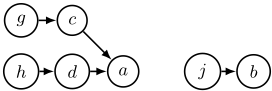
The argument a has two weak attackers (each attacker is attacked). The argument b has only one attacker, but a strong one. The question is which of a and b is more acceptable?
The answer to the previous question depends on which of quantity and quality is more important. Cardinality precedence principle states that a great number of attackers has more effect on an argument than just few. For an example of application, consider a debate on the best YouTuber. An argument against YouTuber A is typically that viewer X follows B, but not A. That argument is stronger if X is a celebrity (or a strong YouTuber itself), but ignoring this fact (in a first step) and just counting the number of such arguments is a good strategy, because big numbers of followers is particularly appreciated in social networks.
Principle 13 (Cardinality Precedence) A semantics S satisfies cardinality precedence (CP) iff, for any WAG G = 〈A,w,R〉, ∀a, b ∈ A, if i) w(a) = w(b), ii) DegSG(b) > 0, and iii) |{x ∈ AttG(a) | DegSG(x) > 0}| > |{y ∈ AttG(b) | DegSG(y) > 0}|, then DegSG(a) < DegSG(b).
Quality precedence principle gives more importance to the quality. It is important, for instance, in debates requiring expertise. If a Fields medal says P, whilst three students say ¬P, we probably believe P. It is worth mentioning that this principle is similar to the Pessimistic rule in decision under uncertainty [Dubois and Prade, 1995].
Principle 14 (Quality Precedence) A semantics S satisfies quality precedence (QP) iff, for any WAG G = 〈A,w,R〉, ∀a, b ∈ A, if i) w(a) = w(b), ii) DegSG(a) > 0, and iii) ∃y ∈ AttG(b) s.t. ∀x ∈ AttG(a), DegSG(y) > DegSG(x) then DegSG(a) > DegSG(b).
Compensation says that several weak attacks may compensate the quality. In the graph G3, the two attackers of a compensate the strong attacker of b, thus a is as acceptable as b.
Principle 15 (Compensation) A semantics F satisfies compensation iff, there exists a WAG G = 〈A,w,R〉 such that for two arguments a, b ∈ A, i) w(a) = w(b), ii) DegSG(a) > 0, iii) |{x ∈ AttG(a) | DegSG(x) > 0}| > |{y ∈ AttG(b) | DegSG(y) > 0}|, iv) ∃y ∈ AttG(b) s.t. ∀x ∈ AttG(a), DegSG(y) > DegSG(x) and DegSG(a) = DegSG(b).
Two axioms, similar to CP and QP, were proposed for the first time by Amgoud and Ben-Naim [2013] for flat graphs and ranking semantics. Recall that ranking semantics do not compute acceptability degrees, but rather define a preference relation between arguments. Thus, the equivalent axiom of QP uses that preference relation while the one corresponding to CP counts simply the number of attackers even the lifeless ones. Our principles are finer since they do not consider lifeless attackers. The three previous principles (CP, QP, Compensation) were also investigated by the same authors in [2016b] for weighted argumentation graphs where arguments may only support each other. Our principles are much simpler since they capture with less constraints the dilemma between quality and quantity of attackers.
3.2 Properties
Some of the principles are incompatible, that is they cannot be satisfied all together by a semantics. This is particularly the case of the last three principles. Quality Precedence is also incompatible with another subset of principles.
Proposition 1 The three following properties hold.
- CP, QP and Compensation are pairwise incompatible.
- Independence, Directionality, Equivalence, Resilience, Reinforcement, Maximality and QP are incompatible.
- CP (respectively Compensation) is compatible with all principles 1-12.
The following result shows some dependencies between the principles. Namely, Weakening, Weakening Soundness, and Counting follow from other principles.
Proposition 2 Let S be a semantics which satisfies Directionality, Independence, Maximality, Neutrality. Then:
- S satisfies Weakening Soundness.
- If S satisfies Reinforcement, then it also satisfies Counting and Weakening.
Arguments that are attacked only by lifeless attackers keep their basic strength in case the semantics satisfies Independence, Directionality, Neutrality and Maximality.
Proposition 3 If a semantics S satisfies Independence, Directionality, Neutrality, and Maximality, then for any WAG G = 〈A, w, R〉, for any a ∈ A such that AttG(a) ̸= ∅, if for any x ∈ AttG(a), DegSG(x) = 0, then DegSG(a) = w(a).
A semantics satisfying Independence, Directionality, Proportionality, Neutrality, Weakening and Maximality, assigns to each argument a degree between 0 and its basic strength.
Theorem 1 If a semantics S satisfies Independence, Directionality, Neutrality, Proportionality, Weakening and Maximality, then for any WAGG = 〈A,w,R〉, for any argument a ∈ A, it holds that DegSG(a) ∈ [0, w(a)].
Another property which follows from a subset of principles is Counter-Transitivity. It was introduced in [Amgoud and Ben-Naim, 2013] for ranking semantics in case of nonweighted graphs. It states that: "if the attackers of an argument b are at least as numerous and strong as those of an argument a, then a is at least as strong as b".
Theorem 2 If a semantics S satisfies Independence, Directionality, Equivalence, Reinforcement, Maximality, and Neutrality, then for any WAG G = 〈A,w,R〉, ∀a, b ∈ A, if w(a) = w(b), and there exists an injective function f from AttG(a) to AttG(b) such that ∀x ∈ AttG(a), DegSG(x) ≤ DegSG(f(x)), then DegSG(a) ≥ DegSG(b).
4 Three Novel Semantics
This section introduces three novel semantics: one for each of the three last principles.
4.1 WeightedMax-Based Semantics
The first semantics satisfies quality precedence, thus it favors the quality of attackers over their cardinality. It is based on a scoring function which follows a multiple steps process. At each step, the function assigns a score to each argument. In the initial step, the score of an argument is its basic strength. Then, in each step, the score is recomputed on the basis of the basic strength as well as the score of the strongest attacker of the argument at the previous step.
Definition 4 (fm) Let G = 〈A, w,R〉 be a WAG. We define the weighted max-based function fm from A to [0,+∞) as follows: for any argument a ∈ A, for i ∈ {0, 1, 2, . . .},
By convention, maxb∈AttG(a) f i m (b) = 0 if AttG(a) = ∅.
The value f i m (a) is the score of the argument a at step i. This value may change at each step, however, it converges to a unique value as shown in the next theorem.
Theorem 3 f i m converges as i approaches infinity.
Weighted max-based semantics is based on the previous scoring function. The acceptability degree of each argument is the limit reached using the scoring function fm.
Definition 5 (Mbs ) The weighted max-based semantics is a function Mbs transforming any WAG G = 〈A, w,R〉 into a vector Deg Mbs G in [0, 1]n , with n = |A| and for any a ∈ A, Deg Mbs G (a) = limi→∞ f i m (a).
Example 3 (Cont) Deg Mbs G3 (a) = 0.66 and Deg Mbs G3 (b) = 0.5. Mbs privileges quality to quantity.
We show next that the limit scores of arguments satisfy a nice property, namely the equation of Definition 4.
Theorem 4 For any WAG G = 〈A, w, R〉, for any a ∈ A,
The next result states that equation (1) is not just a property of weighted max-based semantics, but also its characterization. Indeed, it is the only function satisfying the equation. Due to this characterization, equation (1) represents an alternative definition of weighted max-based semantics.
Weighted max-based semantics satisfies Quality Precedence as well as all the principles which are compatible with it. It violates, however, Counting since by definition, this semantics focuses only on the strongest attacker of an argument, and neglects the remaining attackers.
Theorem 6 Weighted max-based semantics violates Cardinality Precedence, Compensation, Counting and Reinforcement. It satisfies all the remaining principles.
We show next that an attacked argument cannot lose more than half of its basic strength with this semantics. This is reasonable since only one attacker has effect on the argument.
Theorem 7 For any WAG G = 〈A,w,R〉, for any a ∈ A, Deg Mbs G (a) ∈ [ w(a) 2 ,w(a)].
4.2 Weighted Card-Based Semantics
The second semantics, called weighted card-based, favors the number of attackers over their quality. It considers only arguments that have a basic strength greater than 0, called founded. This restriction is due to the fact that unfounded arguments are lifeless and their attacks are ineffective.
Definition 6 (Founded Argument) Let G = 〈A,w,R〉 be a WAG and a ∈ A. The argument a is founded iff w(a) > 0. It is unfounded otherwise. Let AttFG(a) denote the set of founded attackers of a.
This semantics is based on a recursive function which assigns a score to each argument on the basis of its basic strength, the number of its founded attackers and their scores.
Definition 7 (fc) Let G = 〈A, w,R〉 be a WAG. We define the weighted card-based function fc from A to [0,+∞) as follows: for any argument a ∈ A, for i ∈ {0, 1, 2, . . .},
The value f i c (a) is the score of the argument a at step i. This value converges to a unique value as i becomes high.
Theorem 8 f i c converges as i approaches infinity.
The acceptability degree of each argument is the limit reached using the scoring function fc.
Definition 8 (Cbs) The weighted card-based semantics is a function Cbs transforming any WAG G = 〈A, w,R〉 into a vector Deg Cbs G in [0, 1]n , with n = |A| and for any a ∈ A, Deg Cbs G (a) = limi→∞ f i c (a).
Example 3 (Cont) Deg Cbs G4 (a) = 0.3 while Deg Cbs G4 (b) = 0.33. Cbs clearly privileges quantity to quality.
We show next that the limit scores of arguments satisfy the equation of Definition 7.
Theorem 9 For any WAG G = 〈A, w, R〉, for any a ∈ A,
We also show that equation (2) represents an alternative definition of weighted card-base semantics, i.e., Deg Cbs G is the only function which satisfies the equation.
Weighted card-based semantics satisfies CP as well as all the principles that are compatible with it.
Theorem 11 Weighted card-based semantics satisfies all the principles except Quality Precedence and Compensation.
Corollary 1 For any WAG G = 〈A, w,R〉, for any a ∈ A, Deg Rbs G (a) ∈ (0, w(a)].
4.3 Weighted h-Categorizer Semantics
This semantics extends h-categorizer, initially proposed by Besnard and Hunter [2001] for non-weighted and acyclic graphs. We extend its definition to account for varying degrees of basic strengths, and any graph structure.
Definition 9 (fh) Let G = 〈A, w,R〉 be a WAG. We define the weighted h-categorizer function fh from A to [0, +∞) as follows: for any argument a ∈ A, for i ∈ {0, 1, 2, . . .},
Like the two previous scoring functions, fih converges.
Theorem 12 fih converges as i approaches infinity.
The acceptability degree of each argument in a weighted graph is the limit reached using the function fh.
Definition 10 (Hbs ) The weighted h-categorizer semantics is a function Hbs transforming any WAG G = 〈A, w, R〉 into a vector Deg Hbs G in [0, 1]n , with n = |A| and for any a ∈ A, Deg Hbs G (a) = limi→+∞ fih (a).
Example 3 (Cont) It can be checked that Deg Hbs G4 (a) = Deg Hbs G4 (b) = 0.5. Thus, compensation is applied.
We now show that the limit scores of arguments satisfy the equation of Definition 9.
Theorem 13 For any WAG G = 〈A, w, R〉, for any a ∈ A,
The following theorem states that equation (3) is a characterization of weighted h-categorizer semantics.
Finally, we show that this semantics satisfies compensation as well as all the principles that are compatible with it.
Theorem 15 Weighted h-categorizer semantics satisfies all the principles except CP and QP.
We implemented the three semantics from this section. The degrees can be calculated in 1 or 2 seconds even for complex/large graphs.
5 Formal Analysis of Existing Semantics
This section analyses and compares for the first time existing semantics, thanks to the principles from Section 3. The first family of semantics for weighted argumentation graphs extends Dung's semantics with preferences between arguments [Amgoud and Cayrol, 2002; Bench-Capon, 2003; Modgil, 2009], or with weights on attacks [Cayrol et al.,
| Grounded | Stable | Preferred | Complete | IS | (DF-)QuAD | TB | Mbs | Cbs | Hbs | |
|---|---|---|---|---|---|---|---|---|---|---|
| Anonymity | • | • | • | • | • | • | • | • | • | • |
| Independence | • | × | • | • | • | • | • | • | • | • |
| Directionality | • | × | • | • | • | • | • | • | • | • |
| Neutrality | • | • | × | × | • | • | • | • | • | • |
| Equivalence | × | × | × | × | • | • | • | • | • | • |
| Maximality | × | × | × | × | × | • | • | • | • | • |
| Weakening | × | × | × | × | × | • | × | • | • | • |
| Counting | × | × | × | × | × | • | × | × | • | • |
| Weakening soundness | • | × | × | × | • | • | • | • | • | • |
| Proportionality | × | × | × | × | × | • | × | • | • | • |
| Reinforcement | × | × | × | × | × | • | × | × | • | • |
| Resilience | × | × | × | × | × | × | × | • | • | • |
| Cardinality Precedence | × | × | × | × | × | × | × | × | • | × |
| Quality Precedence | × | × | × | × | • | × | × | • | × | × |
| Compensation | • | • | • | • | × | • | • | × | × | • |
2010; Dunne et al., 2010; 2011]. In case of preferences, the idea is to get rid of attacks whose source is weaker than the target before computing the extensions. In a weighted graph G = 〈A, w, R〉, the preference relation privileges arguments with the highest basic strength. Indeed, for a, b ∈ A, a is preferred to b iff w(a) ≥ w(b). A new flat graph 〈A, R′ 〉 is then generated, where aR′ b iff aRb and b is not strictly preferred to a. Dung's semantics are applied to 〈A, R′ 〉. Finally, an acceptability degree is assigned to each argument as proposed by Amgoud and Ben-Naim [2016a]: An argument gets acceptability degree 1 iff it belongs to all extensions; value 0.5 if it belongs to some but not all extensions; value 0.3 if it does not belong to and is not attacked by any extension; value 0 if it does not belong to any extension and is attacked by an extension. Table 1 shows that weakening is violated by Dung's semantics in this setting. Indeed, an argument may not lose weight even when attacked by an alive attacker. Maximality is also violated since those semantics manipulate only a preference relation issued from the basic strengths.
Like preferences, weights on attacks may also come from the basic strengths of arguments. Moreover, when all attacks are assigned weight 1, the formalism coincides with Dung's one, which was already investigated in [Amgoud and BenNaim, 2016a]. Thus, since Dung's formalism is a particular case of the weighted formalism, every principle violated in Dung's framework is also violated by the corresponding semantics in the weighted framework.
The second family of semantics directly deals with basic strengths, and defines scoring functions assigning a numerical value to each argument in an iterative way. Da Costa et al. [2011] proposed the semantics TB, where basic strengths express degrees of trustworthiness of arguments' sources. TB violates the key principle of weakening. Indeed, an argument may not lose weight even if it has a strong attacker.
It was shown recently in [Amgoud et al., 2017] that the social semantics of Leite and Martins [2011] may assign more than one acceptability degree to an argument, which contradicts the uniqueness conjecture.
Baroni et al. [2015] developed QuAD, which evaluates arguments in bipolar acyclic graphs. QuAD was extended to DF-QuAD by Rago et al. [2016] but for the same family of graphs. The two semantics coincide in case of empty support relation. To analyze them against our principles, we assume acyclic graphs and empty support relations.
Gabbay and Rodrigues [2015] developed "Iterative Schema" (IS). Basic strengths are used as initial labels of arguments. Value 1 corresponds to label in, value 0 to out, and any other value to und. If this labeling is legal, then IS returns a single extension (arguments with value 1). Otherwise, it modifies the values until reaching a legal labeling. IS and Mbs are the only semantics that satisfy QP principle. However, IS violates key principles like Maximality, and thus may return counter-intuitive results. Assume a graph made of a single argument a, which is not attacked and whose basic strength is 0 (meaning that the argument is worthless). IS returns a single extension, {a}, declaring thus a as accepted.
Table 1 shows that Cbs is the first semantics that satisfies CP. However, several semantics satisfy compensation, but Hbs is the only one that satisfies all the principles compatible with compensation, and for any graph structure.
6 Conclusion
For the purpose of evaluating arguments in weighted argumentation graphs, the paper proposed the first: i) principles that serve as guidelines for defining and comparing semantics, ii) semantics that satisfies CP, iii) reasonable semantics that satisfies QP, iv) semantics that satisfies compensation as well as all the other compatible principles, and that deals with any graph structure, and v) formal analysis and comparison of all existing semantics, except those dealing with probabilities.
Future work consists of analyzing the semantics developed in probabilistic argumentation settings [Hunter, 2013; Thimm, 2012; Li et al., 2011]. Another natural line of research consists of characterizing families of semantics that satisfy all or subsets of the proposed principles.
Acknowledgments
This work was supported by ANR-13-BS02-0004 and ANR11-LABX-0040-CIMI.
@inproceedings{ijcai2017p9,
  title     = {Acceptability Semantics for Weighted Argumentation Frameworks},
  author    = {Amgoud, Leila and Ben-Naim, Jonathan and Doder, Dragan and Vesic, Srdjan},
  booktitle = {Proceedings of the Twenty-Sixth International Joint Conference on
               Artificial Intelligence, {IJCAI-17}},
  publisher = {International Joint Conferences on Artificial Intelligence Organization},
  editor    = {Carles Sierra},
  pages     = {56--62},
  year      = {2017},
  month     = {8},
  note      = {Main track},
  doi       = {10.24963/ijcai.2017/9},
  url       = {https://doi.org/10.24963/ijcai.2017/9},
}
TY - CPAPER TI - Acceptability Semantics for Weighted Argumentation Frameworks AU - Amgoud, Leila AU - Ben-Naim, Jonathan AU - Doder, Dragan AU - Vesic, Srdjan T2 - Proceedings of the Twenty-Sixth International Joint Conference on Artificial Intelligence, IJCAI-17 PB - International Joint Conferences on Artificial Intelligence Organization PY - 2017 SP - 56 EP - 62 DO - 10.24963/ijcai.2017/9 UR - https://doi.org/10.24963/ijcai.2017/9 ER -Copied
Machine-readable versions of this paper, for tools and AI agents:





