
Simultaneous Abstraction and Equilibrium Finding in Games
Proceedings of the Twenty-Fourth International Joint Conference on Artificial Intelligence. Main Track. Pages 489-495.
© 2015 International Joint Conferences on Artificial Intelligence
Abstract
A key challenge in solving extensive-form games is dealing with large, or even infinite, action spaces. In games of imperfect information, the leading approach is to find a Nash equilibrium in a smaller abstract version of the game that includes only a few actions at each decision point, and then map the solution back to the original game. However, it is difficult to know which actions should be included in the abstraction without first solving the game, and it is infeasible to solve the game without first abstracting it. We introduce a method that combines abstraction with equilibrium finding by enabling actions to be added to the abstraction at run time. This allows an agent to begin learning with a coarse abstraction, and then to strategically insert actions at points that the strategy computed in the current abstraction deems important. The algorithm can quickly add actions to the abstraction while provably not having to restart the equilibrium finding. It enables anytime convergence to a Nash equilibrium of the full game even in infinite games. Experiments show it can outperform fixed abstractions at every stage of the run: early on it improves as quickly as equilibrium finding in coarse abstractions, and later it converges to a better solution than does equilibrium finding in fine-grained abstractions.
- [Billings et al., 2003] Darse Billings, Neil Burch, Aaron Davidson, Robert Holte, Jonathan Schaeffer, Terence Schauenberg, and Duane Szafron. Approximating game- theoretic optimal strategies for full-scale poker. In Pro- ceedings of the 18th International Joint Conference on Ar- tificial Intelligence (IJCAI), 2003.
- [Brown and Sandholm, 2014] Noam Brown and Tuomas Sandholm. Regret transfer and parameter optimization. In AAAI Conference on Artificial Intelligence (AAAI), 2014.
- [Brown et al., 2015] Noam Brown, Sam Ganzfried, and Tuo- mas Sandholm. Hierarchical abstraction, distributed equi- librium computation, and post-processing, with applica- tion to a champion no-limit Texas Hold'em agent. In In- ternational Conference on Autonomous Agents and Multi- Agent Systems (AAMAS), 2015.
- [Burch et al., 2014] Neil Burch, Michael Johanson, and Michael Bowling. Solving imperfect information games using decomposition. In AAAI Conference on Artificial In- telligence (AAAI), 2014.
- [Ganzfried and Sandholm, 2013] Sam Ganzfried and Tuo- mas Sandholm. Action translation in extensive-form games with large action spaces: Axioms, paradoxes, and the pseudo-harmonic mapping. In Proceedings of the In- ternational Joint Conference on Artificial Intelligence (IJ- CAI), 2013. IJCAI
- [Ganzfried and Sandholm, 2014] Sam Ganzfried and Tuo- mas Sandholm. Potential-aware imperfect-recall abstrac- tion with earth mover's distance in imperfect-information games. In AAAI Conference on Artificial Intelligence (AAAI), 2014.
- [Gibson, 2014] Richard Gibson. Regret Minimization in Games and the Development of Champion Multiplayer Computer Poker-Playing Agents. PhD thesis, University of Alberta, 2014.
- [Gilpin and Sandholm, 2006] Andrew Gilpin and Tuomas Sandholm. A competitive Texas Hold'em poker player via automated abstraction and real-time equilibrium com- putation. In Proceedings of the National Conference on Artificial Intelligence (AAAI), pages 1007-1013, 2006.
- [Gilpin and Sandholm, 2007] Andrew Gilpin and Tuomas Sandholm. Lossless abstraction of imperfect information games. Journal of the ACM, 54(5), 2007.
- [Hawkin et al., 2011] John Hawkin, Robert Holte, and Du- ane Szafron. Automated action abstraction of imperfect information extensive-form games. In AAAI Conference on Artificial Intelligence (AAAI), 2011.
- [Hawkin et al., 2012] John Hawkin, Robert Holte, and Du- ane Szafron. Using sliding windows to generate action ab- stractions in extensive-form games. In AAAI Conference on Artificial Intelligence (AAAI), 2012.
- [Jackson, 2014] Eric Griffin Jackson. A time and space effi- cient algorithm for approximately solving large imperfect information games. In AAAI Workshop on Computer Poker and Imperfect Information, 2014.
- [Johanson et al., 2013] Michael Johanson, Neil Burch, Richard Valenzano, and Michael Bowling. Evaluating state-space abstractions in extensive-form games. In International Conference on Autonomous Agents and Multi-Agent Systems (AAMAS), 2013.
- [Johanson, 2013] Michael Johanson. Measuring the size of large no-limit poker games. Technical report, University of Alberta, 2013.
- [Kroer and Sandholm, 2014a] Christian Kroer and Tuomas Sandholm. Extensive-form game abstraction with bounds. In Proceedings of the ACM Conference on Economics and Computation (EC), 2014.
- [Kroer and Sandholm, 2014b] Christian Kroer and Tuomas Sandholm. Extensive-form game imperfect-recall abstrac- tions with bounds, 2014. arXiv.
- [Lanctot et al., 2012] Marc Lanctot, Richard Gibson, Neil Burch, Martin Zinkevich, and Michael Bowling. No-regret learning in extensive-form games with imperfect recall. In International Conference on Machine Learning (ICML), 2012.
- [Sandholm and Singh, 2012] Tuomas Sandholm and Satin- der Singh. Lossy stochastic game abstraction with bounds. In Proceedings of the ACM Conference on Electronic Commerce (EC), 2012.
- [Sandholm, 2010] Tuomas Sandholm. The state of solving large incomplete-information games, and application to poker. AI Magazine, pages 13-32, Winter 2010. Special issue on Algorithmic Game Theory.
- [Shi and Littman, 2002] Jiefu Shi and Michael Littman. Ab- straction methods for game theoretic poker. In CG '00: Revised Papers from the Second International Conference on Computers and Games, pages 333-345, London, UK, 2002. Springer-Verlag.
- [Southey et al., 2005] Finnegan Southey, Michael Bowling, Bryce Larson, Carmelo Piccione, Neil Burch, Darse Billings, and Chris Rayner. Bayes' bluff: Opponent mod- elling in poker. In Proceedings of the 21st Annual Confer- ence on Uncertainty in Artificial Intelligence (UAI), pages 550-558, July 2005.
- [Tammelin, 2014] Oskari Tammelin. Solving large imper- fect information games using CFR+. arXiv preprint arXiv:1407.5042, 2014.
- [Waugh and Bagnell, 2015] Kevin Waugh and Drew Bag- nell. A unified view of large-scale zero-sum equilibrium computation. In Computer Poker and Imperfect Informa- tion Workshop at the AAAI Conference on Artificial Intel- ligence (AAAI), 2015.
- [Waugh et al., 2009a] Kevin Waugh, Nolan Bard, and Michael Bowling. Strategy grafting in extensive games. In Proceedings of the Annual Conference on Neural Infor- mation Processing Systems (NIPS), 2009.
- [Waugh et al., 2009b] Kevin Waugh, David Schnizlein, Michael Bowling, and Duane Szafron. Abstraction pathologies in extensive games. In International Con- ference on Autonomous Agents and Multi-Agent Systems (AAMAS), 2009.
- [Waugh et al., 2015] Kevin Waugh, Dustin Morrill, Drew Bagnell, and Michael Bowling. Solving games with func- tional regret estimation. In AAAI Conference on Artificial Intelligence (AAAI), 2015.
- [Zinkevich et al., 2007] Martin Zinkevich, Michael Bowl- ing, Michael Johanson, and Carmelo Piccione. Regret minimization in games with incomplete information. In Proceedings of the Annual Conference on Neural Infor- mation Processing Systems (NIPS), 2007.
References were extracted automatically from the PDF and may contain errors.
Full text extracted automatically from the PDF; figures, tables and equations may differ. The PDF is the version of record.
1 Introduction
A central challenge in solving imperfect-information games is that the game may be far too large to solve with an equilibrium-finding algorithm. For example, two-player NoLimit Texas Hold'em poker, a popular game among humans and a leading testbed for research on solving imperfectinformation games, has more than 10165 nodes in the game tree and 10161 information sets [Johanson, 2013]. For such games, abstraction has emerged as a key approach: a smaller, more tractable version of the game that maintains many of its strategic features is created [Shi and Littman, 2002; Billings et al., 2003; Gilpin and Sandholm, 2007; 2006; Lanctot et al., 2012; Johanson et al., 2013; Kroer and Sandholm, 2014a; Ganzfried and Sandholm, 2014; Brown et al.,
Tuomas Sandholm
Computer Science Department Carnegie Mellon University sandholm@cs.cmu.edu
2015]. In the abstract game, a player is constrained to behaving identically in a set of situations. The abstract game is then solved for (near-) equilibrium, and its solution (i.e., the strategies for all players) mapped back to the full game. Intuitively, an abstraction should retain "important" parts of the game as fine-grained as possible, while strategically similar or unimportant states could be grouped together. However, the key problem is that it is difficult to determine which states should be abstracted without knowing the equilibrium of the game. This begets a chicken-and-egg problem.
One approach is to solve for equilibrium in one abstraction, then use the equilibrium strategies to guide the generation of the next abstraction, and so on. Such strategy-based abstraction has been applied by going around that loop twice in Texas Hold'em, and within each iteration of the loop manually setting the abstraction (for the first betting round of the game) based on the equilibrium that was found computationally in the previous abstraction [Sandholm, 2010].
Another issue is that even if an equilibrium-finding algorithm in a given abstraction could determine what parts of the game are (un)important, the equilibrium-finding algorithm would have to be run from scratch on the new abstraction.
A related issue is that a given abstraction is good in the equilibrium-finding process only for some time. Coarse abstractions yield good strategies early in the run while larger, fine-grained abstractions take longer to reach reasonable strategies but yield better ones in the long run. Therefore, the abstraction size is typically hand crafted to the anticipated available run time of the equilibrium-finding algorithm using intuition and past experience with the approach.
There has been a great deal of research on generating good abstractions before equilibrium finding. Most of that work has focused on information abstraction, where a player is forced to ignore certain information in the game. Less research has gone into action abstraction (restricting the set of actions available to a player). Action abstraction has typically been done by hand using domain-specific knowledge (with some notable recent exceptions [Sandholm and Singh, 2012; Kroer and Sandholm, 2014a; 2014b]).
Beyond the manual strategy-based abstraction mentioned above, there has been a very limited amount of work on interleaving abstraction and equilibrium finding. Hawkin et al. [2011; 2012] proposed algorithms that adjust the sizes of some actions (some bet sizes in no-limit poker) in an abstraction during equilibrium finding, without convergence guarantees. Brown et al. [2014] presented an algorithm that adjusts action sizes during equilibrium finding in a way that guarantees convergence if the player's equilibrium value for the game is convex in the action-size vector. Those approaches seem to work for adjusting a small number of action sizes. A recent paper uses function approximation, which could be thought of as a form of abstraction, within equilibrium finding [Waugh et al., 2015]. None of those approaches change the number of actions in the abstraction and thus cannot be used for growing (refining) an abstraction.
We present an algorithm that intertwines action abstraction and equilibrium finding. It begins with a coarse abstraction and selectively adds actions that the equilibrium-finding algorithm deems important. It overcomes the chicken-and-egg problem mentioned above and does not require knowledge of how long the equilibrium-finding algorithm will be allowed to run. It can quickly-in constant time-add actions to the abstraction while provably not having to restart the equilibrium finding. Experiments show it outperforms fixed abstractions at every stage of the run: early on it improves as quickly as equilibrium finding in coarse abstractions, and later it converges to a better solution than does equilibrium finding in fine-grained abstractions.
2 Setting, Notation, and Background
This section presents the notation we use. In an imperfectinformation extensive-form game there is a finite set of players, P. H is the set of all possible histories (nodes) in the game tree, represented as a sequence of actions, and includes the empty history. A(h) is the actions available in a history and P (h) ∈ P ∪c is the player who acts at that history, where c denotes chance, which plays an action a ∈ A(h) with a fixed probability σc(h, a) that is known to all players. The history h′ reached after an action is taken in h is a child of h, represented by h → a = h′ , while h is the parent of h′ . More generally, h′ is an ancestor of h, represented by h′ ⊏ h, if there exists a sequence of actions from h′ to h. Z ⊆ H are terminal histories for which no actions are available. For each player i ∈ P, there is a payoff function ui : Z → ℜ. If P = {1, 2} and u1 = -u2, the game is a zero-sum game. We define ∆i = maxz∈Z ui(z) - minz∈Z ui(z) and ∆ = maxi ∆i.
Imperfect information is represented by information sets for each player i ∈ P by a partition Ii of h ∈ H : P(h) = i. For any information set I ∈ Ii, all histories h, h′ ∈ I are indistinguishable to player i, so A(h) = A(h′ ). I(h) is the information set I where h ∈ I. P(I) is the player i such that I ∈ Ii. A(I) is the set of actions such that for all h ∈ I, A(I) = A(h). |Ai| =maxI∈Ii |A(I)| and |A| =maxi |Ai|. A strategy σi(I) is a probability vector over A(I) for player i in information set I. The probability of a particular action a is denoted by σi(I, a). Since all histories in an information set belonging to player i are indistinguishable, the strategies in each of them must be identical. For all h ∈ I, σi(h) = σi(I) and σi(h, a) = σi(I, a). We define σi as a probability vector for player i over all available strategies Σi in the game. A strategy profile σ is a tuple of strategies, one for each player. ui(σi, σ-i) is the expected payoff for player i if all players play according to the strategy profile 〈σi, σ-i〉. If a series of strategies are played over T iterations, then ¯σT i = ∑t∈T σt i T
πσ (h) = Πh′→a⊑hσP(h)(h, a) is the joint probability of reaching h if all players play according to σ. πσ i (h) is the contribution of player i to this probability (that is, the probability of reaching h if all players other than i, and chance, always chose actions leading to h). πσ-i (h) is the contribution of all players other than i, and chance. πσ (h, h′ ) is the probability of reaching h′ given that h has been reached, and 0 if h ̸⊏ h′ . In a perfect-recall game, which we limit our discussion to in this paper, ∀h, h′ ∈ I ∈ Ii, πi(h) = πi(h′ ). Therefore, for i = P(I) we define πi(I) = πi(h) for h ∈ I.
We define the average strategy to be ¯σT i (I) = ∑t∈T πσt i i σt i (I) ∑t∈T πσt i (I) .
In perfect-information games, a subgame is a subtreerooted at some history-of the game tree. For convenience, we define an imperfect information subgame (IISG). If a history is in an IISG, then any other history with which it shares an information set must also be in the IISG. Moreover, any descendent of the history must be in the IISG. Formally, an IISG is a set of histories S ⊆ H such that for all h ∈ S, if h ⊏ h′ , then h′ ∈ S, and for all h ∈ S, if h′ ∈ I(h) for some I ∈ IP(h) then h′ ∈ S. The head of an IISG Sr is the union of information sets that have actions leading directly into S, but are not in S. Formally, Sr is a set of histories such that for all h ∈ Sr, either h ̸∈ S and ∃a ∈ A(h) such that h → a ∈ S, or h ∈ I and for some history h′ ∈ I, h′ ∈ Sr. We define the greater subgame S∗ = S ∪ Sr.
For equilibrium finding we use counterfactual regret minimization (CFR), a regret-minimization algorithm for extensive-form games [Zinkevich et al., 2007]. Recent research that finds close connections between CFR and other iterative learning algorithms [Waugh and Bagnell, 2015] suggests that our techniques may extend beyond CFR as well.
Our analysis of CFR makes frequent use of counterfactual value. Informally, this is the expected utility of an information set given that player i tries to reach it. For player i at information set I given a strategy profile σ, this is defined as
The counterfactual value of an action a is
Let σt be the strategy profile used on iteration t. The instantaneous regret on iteration t for action a in information set I is rt(I, a) = vσt P(I) (I, a) - vσt P(I) (I). The regret for action a in I on iteration T is
Additionally, RT+(I, a) = max{RT (I, a), 0} and RT (I) = maxa{RT+(I, a)}. Regret for player i in the entire game is
In CFR, a player in an information set picks an action among the actions with positive regret in proportion to those regrets (and uniformly if all regrets are nonpositive). If a player plays according to CFR on every iteration, then on iteration T, RT (I) ≤ ∆i√|A(I)|√T. Moreover, RT i ≤ ∑I∈Ii RT (I) ≤ |Ii|∆i√|Ai|√T . So, as T →∞, RT i T → 0. In two-player zero-sum games, CFR converges to a Nash equilibrium, i.e., a strategy profile σ∗ such that ∀i, ui(σ∗ i , σ∗-i ) = maxσ′i∈Σi ui(σ′i , σ∗-i ). An ϵ-equilibrium is a strategy profile σ∗ such that ∀i, ui(σ∗ i , σ∗-i ) + ϵ ≥ maxσ′i∈Σi ui(σ′i , σ∗-i ). If both players' average regrets RT i T ≤ ϵ, their average strategies 〈¯σT 1 , ¯σT 2 〉 form a 2ϵ-equilibrium.
3 Adding Actions to an Abstraction
A central challenge with abstraction is its inflexibility to change during equilibrium finding. After many iterations of equilibrium finding, one may determine that certain actions left out of the abstraction are actually important. Adding to an abstraction has been a recurring topic of research [Waugh et al., 2009a; Gibson, 2014]. Prior work by Burch et al. [2014] examined how to reconstruct a Nash equilibrium strategy for an IISG after equilibrium finding completed by storing only the counterfactual values of the information sets in the head of the IISG. Jackson [2014] presented a related approach that selectively refines IISGs already in the abstraction after equilibrium finding completed. However, no prior method has guaranteed convergence to a Nash equilibrium if equilibrium finding continues after actions are added to an abstraction. The algorithm we present in this section builds upon these prior approaches, but provides this key theoretical guarantee.
In this section we introduce a general approach for adding actions to an abstraction at run time, and prove that we still converge to a Nash equilibrium. We discuss specifically adding IISGs. That is, after some number T0 of CFR iterations in a game Γ, we wish to add some actions leading to an IISG S, forming Γ′ . A trivial way to do this is to simply restart equilibrium finding from scratch after the IISG is added. However, intuitively, if the added IISG is small, its addition should not significantly change the optimal strategy in the full game. Instead of restarting from scratch, we aim to preserve, as much as possible, what we have learned in Γ, without weakening CFR's long-term convergence guarantee.
The key idea to our approach is to act as if S had been in the abstraction the entire time, but that the actions in Sr leading to S were never played with positive probability. Since we never played the actions in Sr, we may have accumulated regret on those actions in excess of the bounds guaranteed by CFR. That would hurt the convergence rate. Later in this section we show that we can overcome this excess regret by discounting the prior iterations played (and thereby their regrets as well). The factor we have to discount by increases the higher the regret is, and the more we discount, the slower the algorithm converges because it loses some of the work it did. Therefore, our goal is to ensure that the accumulated regret is as low as possible. The algorithm we present can add actions for multiple players. In our description, we assume without loss of generality that the added actions belong to Player 1 (P1).
We now discuss how to "fill in" what happened in IISG S during those T0 iterations. Since the actions leading to S were never played, we have that for any history h ̸∈ S and any leaf node z ∈ S, πσt (h, z) = 0 for all t ∈ T0. By the definitions of counterfactual value (2) and regret (3) this means that regret for all actions in all information sets outside the greater subgame S∗ remain unchanged after adding S. We therefore need only concern ourselves with S∗ .
From (2) and (3) we see that Rt (I, a) ∝ πσt -i (h) for h ∈ I. Since S was never entered by P1, for every history in S and every player other than P1, πσt -i (h) = 0 and therefore Rt (I, a) = 0, regardless of what strategy they played. Normally, an information set's strategy is initialized to choose an action randomly until some regret is accumulated. This is obviously a poor strategy; had P1's opponents played this way in S for all T0 iterations, P1 may have very high regret in Sr for not having entered S and taken advantage of this poor play. Fortunately, they need not have played randomly in S. In fact, they need not have played the same strategy on every iteration. We have complete flexibility in deciding what the other players played. Since our goal is to minimize overall regret, it makes sense to have them play strategies that would result in low regret for P1 in Sr.
We construct an auxiliary game to determine regrets for one player and strategies for the others. Specifically, similar to the approach in [Burch et al., 2014], we define a recovery game Sσ1..T Γ i for an IISG S for player i of a game Γ and sequence of strategy profiles σ1..T . The game consists of an initial chance node leading to a history h∗ ∈ Sr with probability 1
If this is undefined, then all information sets in S∗ have zero regret and we are done. In each h ∈ SH, Pi has the choice of either taking the weighted average counterfactual value of the information set I = I(h), ∑t∈T vσt i (I) ∑t∈T πσt -i (I) , or of taking the action leading into S, where play continues in S until a leaf node is reached. We play TS = ∑h∗∈Sr ∑t∈T πσt -i (h∗ ) iterations of CFR (or any other regret-minimization algorithm) in the recovery game.
We now define the combined game Γ + S of a game Γ and an IISG S following play of a recovery game Sσ1..T Γ i as the union of Γ and S with regret and average strategy set as follows. For any action a belonging to I such that I → a ̸∈ S, RΓ+S(I, a) = RΓ(I, a). Otherwise, if P(I) ̸= i then RΓ+S(I, a) = 0. If P(I) = i and I ⊆ S then RΓ+S(I, a) = RS(I, a). In the case that I → a ∈ S but I ̸⊆ S, then RΓ+S(I, a) = ∑t∈TS vσtS i (I, a) - ∑t∈T vσtΓ i (I).
If I ∈ Γ then ¯σT Γ+S (I) = ¯σT Γ (I). Otherwise, if P(I) = i then ¯σT Γ+S (I) =⃗0, and if P(I) ̸= i then ¯σT Γ+S (I) = ¯σT S (I).
1 In two-player games without sampling of chance nodes, ∑t∈T πσt -1(h) is easily calculated as the product of ∑t∈T πσt 2 (I) for the last information set I of P2 before h, and multiplying it by σc(a′ |h′ ) for all chance nodes h′ ⊏ h where h′ → a′ ⊑ h.
The theorem below proves that this is equivalent to having played a sequence of iterations in Γ + S from the beginning. The power of this result is that if we play according to CFR separately in both the original game Γ and the recovery game Sσ1..T Γ i , then the regret of every action in every information set of their union is bounded according to CFR (with the important exception of actions in Sr leading to S, which the algorithm handles separately as described after the theorem).
Theorem 1. Assume T iterations were played in Γ and then TS iterations were played in the recovery game Sσ1..T Γ i and these are used to initialize the combined game Γ + S. Now consider the uninitialized game Γ′ identical to Γ+S. There exists a sequence of T ′ iterations (where |T ′ | = |TS||T|) in Γ′ such that, after weighing each iteration by 1 |TS| , for any action a in any information set I ∈ Γ′ , RT ′ Γ′ (I, a) = RTΓ+S (I, a) and ¯σT ′ Γ′ (I) = ¯σT Γ+S (I ).
Proofs are presented in an extended version of this paper.
As mentioned earlier, if we played according to CFR in both the original abstraction and the recovery game, then we can ensure regret for every action in every information set in the expanded abstraction is under the bound for CFR, with the important exception of actions a in information sets I ∈ Sr such that for h ∈ I, h → a ∈ S. This excessive regret can hurt convergence in the entire game.
Fortunately, Brown and Sandholm [2014] proved that if an information set I exceeds a bound on regret, then one can discount all prior iterations in order to maintain CFR's guarantees on performance. However, their theorem requires all information sets to be scaled according to the highest-regret information set in the game. This is problematic in large games where a small rarely-reached information set may perform poorly and exceed its bound significantly. We improve upon this in the theorem below.
We will find it useful to define weighted regret
and weighted average strategy
Theorem 2. Suppose T iterations were played in some game. Choose any weight wi such that
If we weigh the T iterations by wi, then after T ′ additional iterations of CFR, Rwi T+T ′ ,i ≤ |Ii|∆i√|Ai|√wiT + T ′ , where T ′ > max{T, maxI ∑a∈A(I) RT+(I,a)2 ∆2 |A| }.
Corollary 1. In a two-player zero-sum game, if we weigh the T iterations by w = mini{wi}, then after T ′ additional iterations, the players' weighted average strategies constitute a 2ϵ-equilibrium where
While using the largest w that our theory allows may seem optimal according to the theory, better performance is achieved in practice by using a lower w. This is because CFR tends to converge faster than its theoretical bound. Say we add IISG S to an abstraction Γ using a recovery game to form Γ+S. Let Si, Γi, and (Γ+S)i represent the information sets in each game belonging to player i. Then, based on experiments, we recommend using
where the numerator uses the regret of I ⊆ Sr before adding the IISG, and the denominator uses its regret after adding the IISG. This value of wi also satisfies our theory.
3.1 Adding Actions with Regret Transfer
In certain games, it is possible to bypass the recovery game and add subtrees in O(1). We accomplish this with an approach similar to that proposed by Brown and Sandholm [2014], who showed that regret can be transferred from one game to another in O(1) in special cases.
Suppose we have an IISG S1 in Γ and now wish to add a new IISG S2 that has identical structure as S1. Instead of playing according to the recovery game, we could (hypothetically) record the strategies played in S1 on every iteration, and repeat those strategies in S2. Of course, this would require huge amounts of memory, and provide no benefit over simply playing new strategies in S2 through the recovery game. However, it turns out that this repetition can be done in O(1) time in certain games.
Suppose all payoffs in S1 are functions of a vector ⃗ θ1. For example, in the case of ⃗ θ1 being a scalar, one payoff might be ui(z1) = αi,zθ1 + βi,z. Now suppose the payoffs in S2 are identical to their corresponding payoffs in S1, but are functions of ⃗ θ2 instead of ⃗ θ1. The corresponding payoff in S2 would be ui(z2) = αi,zθ2 + βi,z. Suppose we play T iterations and store regret in S∗ 1 as a function of ⃗ θ1. Then we can immediately "repeat" in S2 the T iterations that were done in S1 by simply copying over the regrets in S1 that were stored as a function of ⃗ θ1, and replacing ⃗ θ1 with ⃗ θ2.
Unlike the method of Brown and Sandholm [2014], it is not necessary to store regret in the entire game as a function of ⃗ θ1, just the regret in S∗ 1 . This is because when we transfer to S2, the "replaying" of iterations in S2 has no effect on the rest of the game outside of S∗ 2 . Moreover, if ⃗ θ1 is entirely determined by one player, say P1, then there is no need to store regret for P2 as a function of ⃗ θ, because P2's regret will be set to 0 whenever we add an IISG for P1.
This can be extremely useful. For example, suppose whenever P1 takes an action that sets ⃗ θ1, that in any subsequent information set belonging to P1, all reachable payoffs are multiplied by ⃗ θ1. Then subsequent regrets need not be stored as a function of ⃗ θ1, only the information sets that can choose ⃗ θ1. This is very useful in games like poker, where bets are viewed as multiplying the size of the pot and after P1 bets, if P2 does not immediately fold, then every payoff is multiplied by the size of the bet. In that case, regret for an action need only be stored as a function of that action's bet size.
It is also not strictly necessary for the structure of the IISGs to be identical. If S2 has additional actions that are not present in S1, one could recursively add IISGs by first adding the portion of S2 that is identical to S1, and then adding the additional actions either with regret transfer internally in S2, or with a recovery game. However, if S2 has fewer actions than S1, then applying regret transfer would imply that illegal actions were taken, which would invalidate the theoretical guarantees.
Typically, slightly less discounting is required if one uses the recovery game. Moreover, regret transfer requires extra memory to store regret as a function of ⃗ θ. However, being able to add an IISG in O(1) is extremely beneficial, particularly for large IISGs.
4 Exploitability Computation in Games with Large or Continuous Action Spaces
In two-player zero-sum games, we can quickly evaluate how close a strategy profile is to a Nash equilibrium by calculating the exploitability of the strategy for each player. If v∗ i is the value of a Nash equilibrium solution for player i, then exploitability of player i is ei(σi) = v∗ i - minσ′-i∈Σ-i ui(σi, σ′-i ). In order to calculate the exploitability in the full game of a player's abstraction strategy, it is necessary to define the player's strategy in situations that do not arise in the abstraction-because the opponent(s) (and perhaps also chance) may take actions that are not included in the abstraction. Typically, this is accomplished by mapping an action not in the abstraction to one that is. This is referred to as action translation, and empirical results have shown that the randomized pseudo-harmonic mapping [Ganzfried and Sandholm, 2013] performs best among techniques developed to date.
To calculate exploitability in a game, it is typically necessary to traverse the entire game. This is infeasible in large and infinite games. However, in situations where a player maps a range of actions to a single abstract action, it may be possible to express the exploitability of each action as a function whose maximum is easy to find. With that we can calculate exploitability in the original (unabstracted) game by traversing only the abstraction.
We now define one class of such games. Consider the case of an abstraction that maps a range of full-game actions [LI,UI] ⊂ R in I to a single abstract action a, and suppose an action θ ∈ [LI,UI] is taken. Suppose further that for every information set I ′ in the abstraction belonging to P(I) and reachable from I following a, any payoff z that can be reached from I ′ has a payoff that is multiplied by θ. That is, for any history h′ ∈ I ′ and z ∈ Z such that π(h′ , z) > 0, we have uP(I)(z) = θu′P(I) (z). Since the abstraction maps all actions θ ∈ [LI , UI ] to the same state, the abstraction will play identically regardless of which θ is chosen. With that in mind, since every reachable payoff is scaled identically, each choice of θ results in a strategically identical situation for P(I). Thus, rather than choosing a specific θ, we can instead choose the entire range [LI , UI ]. Our traversal will then return the entire expected payoff as a function of θ, and we can then choose the value that would maximize the function.
We use this approach in our full-game exploitability calculation, allowing us to calculate exploitability in a full game of infinite size.
5 Where andWhen to Add Actions?
In previous sections we covered how one can add actions to an abstraction during equilibrium finding. In this section, we discuss where in the game, and when, to add actions.
Each iteration of CFR takes O(H) time. If useless IISGs are added, this will make each iteration take longer. We therefore need some method of determining when it is worthwhile to add an action to an abstraction. Generally our goal in regret-minimization algorithms is to keep average overall regret low. Thus, the decision of where and when to add an information set will depend on how best we can minimize overall regret. Regret in information sets where we play CFR is O(√T ), while regret in information sets not played according to CFR is O(T). So, intuitively, if an information set has low regret, we would do a better job of minimizing average regret by not including it in the abstraction and doing faster iterations. But as it accumulates regret in O(T), eventually we could better minimize average regret by including it in the abstraction.
Following this intuition, we propose the following formula for determining when to add an action. Essentially, it determines when the derivative of summed average regret, taken with respect to the number of nodes traversed, would be more negative with the IISG added. It assumes that regrets for actions not in the abstraction grow at rate ∼ T while all other regrets grow at rate ∼ √T .
Proposition 1. Consider a game Γ + S consisting of a main game Γ and IISG S. Assume a player i begins by playing CFR only in Γ, so that each iteration takes O(|Γ|), but at any time may choose to also play CFR in S (after which each iteration takes O(|Γ| + |S|)). Assume that when playing CFR on an information set I, squared regret for an action a where ∀h ∈ I, h → a ∈ Γ grows by a fixed amount every iteration: (RT+1 (I, a))2 = (RT (I, a))2 + CI for some constant CI. Assume that for others actions (RT (I, a))2 = CIT 2 . Then the optimal point to begin playing CFR in S is on the earliest iteration T where
This proposition relies on two important assumptions: 1) we know how fast regret will grow (and that it grows at the rate specified in the proposition), and 2) we can calculate regret for information sets outside the abstraction. Generally, it is not possible to precisely know the growth rate of regret. In our experiments, we use the rate of growth in regret up to the current iteration as an estimate of future growth. It is possible that better heuristics can be constructed depending on the domain. For example, using the rate of growth over only the most recent iterations, or some weighted average of that form, may provide a more accurate measurement. In our experiments, we found that the speed of our algorithm can be enhanced by making the condition in Proposition 1 slightly stronger by increasing the left hand side by a small amount (1% was a good value in our experiments, as we will discuss).
We can estimate regret for information sets outside the abstraction. Suppose we want to calculate ∑t∈T vσt i (I, a) for some action a leading to an IISG not in our abstraction. The opponents must have some defined strategies following this action. We can calculate a best response against those strategies. Since we could have played that best response on each iteration, we can calculate an upper bound on regret for a by multiplying the counterfactual value from the best response by the number of iterations. This approach can be applied to any finite game, and can even be used to evaluate all actions in some infinite games, such as those defined in Section 4. In special cases, we can also use regret transfer to provide an instantaneous measure of regret using the approach described in Section 3.1.
In general, games exhibit abstraction pathology: a Nash equilibrium computed in a finer-grained abstraction can be further from the full-game Nash equilibruim than a Nash equilibrium computed in a coarser abstraction [Waugh et al., 2009b]. Since the method described in this section examines regret in the full game when considering adding actions, it ensures eventual convergence to a Nash equilibrium in the full game! Any full-game action experiencing linear growth in regret would, by design, eventually be added to the abstraction. Thus, any "weak points" of the abstraction in the full game are quickly addressed by including them in the abstraction.
6 Removing Actions from an Abstraction
One potential problem with adding many actions to the abstraction is that some may later turn out to not be as important as we thought. In that case, we may want to remove actions from the abstraction in order to traverse the game faster. In general one cannot remove actions because they have positive probability in the average strategies in CFR.
However, there are situations where we can remove actions (from the abstraction and from the average strategy).
First, in some variants of CFR, such as CFR+, the final strategies have been shown empirically to converge [Tammelin, 2014], so one does not need to consider average strategies. In such algorithms we can simply choose to no longer traverse the IISG that we want to remove. Then, if our heuristic later suggests that the IISG should be played, we can add it back in and use the recovery game to "fill in" the iterations it skipped.
Second, CFR converges (in practice and in theory) even if we eliminate any finite number of past iterations. If we decide to discard some number of iterations, perhaps the first portion of a run, and an IISG is only reached in that portion, then we can remove the IISG from the abstraction.
Third, even in vanilla CFR, there are situations where we can effectively remove IISGs. If for every player i, the probability on iteration t of reaching history h, πσt i (h), equals zero, then regret and average strategy will not be updated for any player. In that case, there is no need to traverse the descendants of h. If the path leading to a given IISG has, for each player, an action belonging to that player with sufficiently negative regret, then it may make sense to "archive" the IISG by removing it from memory and storing it on disk. If CFR updates the regrets on that path so that at least one player has positive probability of reaching the IISG, then we can bring the IISG back into memory. In the experiments we use only this third action removal method (and we actually do not use disk but RAM).
7 Experiments
We tested our algorithm on a game we coin continuous Leduc Hold'em (CLH), a modification of regular Leduc Hold'em [Southey et al., 2005], a popular testbed for research due to its small size and strategic complexity. In CLH, there is a deck consisting of six cards. There are two suits, with each suit having three cards: Jack, Queen, and King. There are a total of two rounds. In the first round, each player places an ante of 1 chip in the pot and receives a single private card. A round of betting then takes place with a two-bet maximum, with Player 1 going first. A player may bet or raise any real amount between 1% of the pot and 100% of the pot. (There are no "chip stacks" in this game.) In the second round, a single public shared card is dealt, and another round of betting takes place. Again, Player 1 goes first, and there is a two-bet maximum following the same format. If one of the players has a pair with the public card, that player wins. Otherwise, the player with the higher card wins.
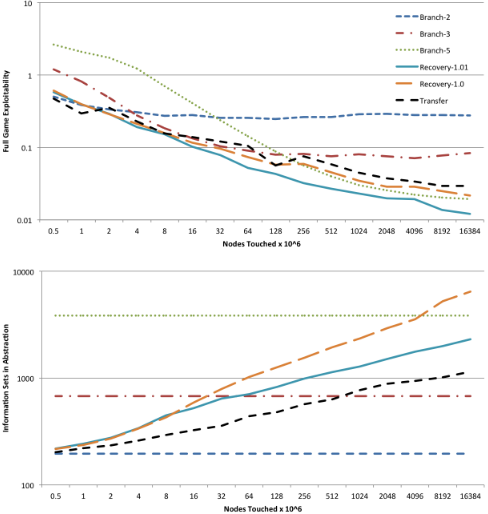
We created three fixed abstractions of CLH. All bet sizes were viewed as fractions of the pot. All abstractions contained a fold and call action. Abstraction Branch-2 included a min bet and max bet at every information set. Branch-3 additionally contained a bet size of 13 , selected according to the pseudo-harmonic mapping. Branch-5 further contained 1 7 and 35 , again selected by the pseudo-harmonic mapping.
We initialized the abstraction that was used in automated action addition to contain only the minimum and maximum possible bet at each information set (in addition to fold and call). We ran vanilla CFR on each abstraction. The automated abstractions considered adding actions every 5 iterations according to the heuristic presented in Section 5 using regret transfer to estimate regret. As mentioned in that section, the heuristic cannot exactly predict how regret will grow. We therefore also tested automated abstraction refinement with slightly stronger conditions for adding actions to the abstraction: Recovery-1.01 and Transfer both multiply the left term in the condition by 1.01. Such changes to the heuristic, of course, retain our theoretical guarantees. Recovery-1.0 and Recovery-1.01 use a recovery game to add IISGs as described in Section 3, while Transfer uses regret transfer as described in Section 3.1.
We calculated exploitability in the full continuous game assuming the randomized pseudo-harmonic action translation is used. Figure 1 shows that Recovery-1.01 outperformed all the fixed abstractions at every point in the run. Moreover, while the fixed abstractions leveled off in performance, the automated abstractions continued to improve throughout the run.
We also tested a threshold of 1.1, which performed comparably to 1.01, while a threshold of 2.0 performed worse.
Although regret transfer allows adding an IISG in O(1) time, that method performed worse than using a recovery game. This is due to the regret from adding the IISG being higher, thereby requiring more discounting of prior iterations. The "bump" in the Transfer curve in Figure 1 is due to a particularly poor initialization of an IISG, which required heavy discounting. However, our heuristic tended to favor adding small IISGs near the bottom of the game tree. It is possible that in situations where larger IISGs are added, the benefit of adding IISGs in O(1) would give regret transfer an advantage.
8 Conclusions
We introduced a method for adding actions to an abstraction simultaneously with equilibrium finding, while maintaining convergence guarantees. We additionally presented a method for determining strategic locations to add actions to the abstraction based on the progress of the equilibrium-finding algorithm, as well as a method for determining when to add them. In experiments, the automated abstraction algorithm outperformed all fixed abstractions at every snapshot, and does not level off in performance.
The algorithm is game independent, and is particularly useful in games with large action spaces. The results show that it can overcome the challenges posed by an extremely large branching factor in actions, or even an infinite one, in the search for a Nash equilibrium.
9 Acknowledgment
This work was supported by the NSF under grant IIS1320620.
@inproceedings{ijcai2015p75,
  title     = {Simultaneous Abstraction and Equilibrium Finding in Games},
  author    = {Brown, Noam and Sandholm, Tuomas},
  booktitle = {Proceedings of the Twenty-Fourth International Joint Conference on
               Artificial Intelligence, {IJCAI-15}},
  publisher = {International Joint Conferences on Artificial Intelligence},
  editor    = {Qiang Yang and Michael Wooldridge},
  pages     = {489--495},
  year      = {2015},
  month     = {7},
  note      = {Main Track},
  url       = {https://ijcai.org/proceedings/2015/75},
}
TY - CPAPER TI - Simultaneous Abstraction and Equilibrium Finding in Games AU - Brown, Noam AU - Sandholm, Tuomas T2 - Proceedings of the Twenty-Fourth International Joint Conference on Artificial Intelligence, IJCAI-15 PB - International Joint Conferences on Artificial Intelligence PY - 2015 SP - 489 EP - 495 UR - https://ijcai.org/proceedings/2015/75 ER -Copied
Machine-readable versions of this paper, for tools and AI agents:





