
Raising Expectations in GDA Agents Acting in Dynamic Environments
Proceedings of the Twenty-Fourth International Joint Conference on Artificial Intelligence. Main Track. Pages 2241-2246.
© 2015 International Joint Conferences on Artificial Intelligence
Abstract
Goal-driven autonomy (GDA) agents reason about goals while introspectively examining if their course of action matches their expectations. Many GDA agents adopt a hierarchical planning model to generate plans but limit reasoning with expectations to individual actions or projecting the expected state. In this paper we present a relaxation of this limitation. Taking advantage of hierarchical planning principles, our GDA agent elicits expectations that not only validate the next action but the overall plan trajectory without requiring validation against the complete state. We report on (1) a formalization of GDA's expectations that covers trajectories, (2) an implementation of these ideas and (3) benchmarking on two domains used in the GDA literature.
- [Amarel, 1968] Saul Amarel. On representations of problems of reasoning about actions. Machine intelligence, 3(3):131-171, 1968.
- [Bäckström and Nebel, 1995] Christer Bäckström and Bernhard Nebel. Complexity results for sas+ planning. Computational Intelligence, 11(4):625-655, 1995. IJCAI
- [Baxter and Richards, 2010] Jeremy Baxter and Dale Richards. Whose goal is it anyway? user interaction in an autonomous sys- tem [c]. In Proc. of the workshop on Goal Directed Autonomy, AAAI2010, Atlanta, 2010.
- [Birnbaum et al., 1990] Lawrence Birnbaum, Gregg Collins, Michael Freed, and Bruce Krulwich. Model-based diagnosis of planning failures. In AAAI, volume 90, pages 318-323, 1990.
- [Bouguerra et al., 2007] Abdelbaki Bouguerra, Lars Karlsson, and Alessandro Saffiotti. Active execution monitoring using plan- ning and semantic knowledge. ICAPS Workshop on Planning and Plan Execution for Real-World Systems, 2007.
- [Choi, 2011] Dongkyu Choi. Reactive goal management in a cog- nitive architecture. Cognitive Systems Research, 12(3):293-308, 2011.
- [Cox, 2007] Michael T Cox. Perpetual Self-Aware Cognitive Agents. AI magazine, 28(1):32, 2007.
- [Currie and Tate, 1991] Ken Currie and Austin Tate. O-plan: the open planning architecture. Artificial Intelligence, 52(1):49-86, 1991.
- [Dannenhauer and Muñoz-Avila, 2013] D. Dannenhauer and H. Muñoz-Avila. LUIGi: A Goal-Driven Autonomy Agent Reasoning with Ontologies. In Advances in Cognitive Systems (ACS-13), 2013.
- [Finestrali and Muñoz-Avila, 2013] Giulio Finestrali and Héctor Muñoz-Avila. Case-based learning of applicability conditions for stochastic explanations. In Case-Based Reasoning Research and Development, pages 89-103. Springer, 2013.
- [Fritz and McIlraith, 2007] Christian Fritz and Sheila A McIlraith. Monitoring plan optimality during execution. In ICAPS, pages 144-151, 2007.
- [Hanheide et al., 2010] Marc Hanheide, Nick Hawes, Jeremy Wy- att, Moritz Göbelbecker, Michael Brenner, Kristoffer Sjöö, Alper Aydemir, Patric Jensfelt, Hendrik Zender, and Geert-Jan Kruijff. A framework for goal generation and management. In Proceed- ings of the AAAI workshop on goal-directed autonomy, 2010.
- [Jaidee et al., 2011] Ulit Jaidee, Héctor Muñoz-Avila, and David W Aha. Integrated Learning for Goal-Driven Autonomy. In Pro- ceedings of the Twenty-Second international joint conference on Artificial Intelligence-Volume Volume Three, pages 2450-2455. AAAI Press, 2011. IJCAI
- [Jaidee et al., 2013] Ulit Jaidee, Héctor Muñoz-Avila, and David W Aha. Case-based goal-driven coordination of multiple learning agents. In Case-Based Reasoning Research and Development, pages 164-178. Springer, 2013.
- [Klenk et al., 2013] Matthew Klenk, Matt Molineaux, and David W Aha. Goal-driven autonomy for responding to unexpected events in strategy simulations. Computational Intelligence, 29(2):187- 206, 2013.
- [Laird, 2012] John E. Laird. The Soar Cognitive Architecture. The MIT Press, 2012.
- [Langley et al., 2004] Pat Langley, Kirstin Cummings, and Daniel Shapiro. Hierarchical skills and cognitive architectures. In Pro- ceedings of the twenty-sixth annual conference of the cognitive science society, pages 779-784. Citeseer, 2004.
- [Meneguzzi and Luck, 2007] Felipe Meneguzzi and Michael Luck. Motivations as an abstraction of meta-level reasoning. In Multi- Agent Systems and Applications V, pages 204-214. Springer, 2007.
- [Minsky, 1975] Marvin Minsky. A framework for representing knowledge. 1975.
- [Mitchell et al., 1986] Tom M Mitchell, Richard M Keller, and Smadar T Kedar-Cabelli. Explanation-based generalization: A unifying view. Machine learning, 1(1):47-80, 1986.
- [Molineaux and Aha, 2014] Matthew Molineaux and David W Aha. Learning unknown event models. Technical report, DTIC Document, 2014. [
- [Molineaux et al., 2010] Matthew Molineaux, Matthew Klenk, and David W Aha. Goal-Driven Autonomy in a Navy Strategy Sim- ulation. In AAAI, 2010.
- [Molineaux et al., 2012] Matthew Molineaux, Ugur Kuter, and Matthew Klenk. Discoverhistory: Understanding the past in plan- ning and execution. In Proceedings of the 11th International Conference on Autonomous Agents and Multiagent Systems- Volume 2, pages 989-996, 2012.
- [Muñoz-Avila et al., 2010] Héctor Muñoz-Avila, David W Aha, Ulit Jaidee, Matthew Klenk, and Matthew Molineaux. Apply- ing Goal Driven Autonomy to a Team Shooter Game. In FLAIRS Conference, 2010.
- [Murdock and Goel, 2008] J William Murdock and Ashok K Goel. Meta-case-based reasoning: self-improvement through self- understanding. Journal of Experimental & Theoretical Artificial Intelligence, 20(1):1-36, 2008.
- [Myers, 1999] Karen L Myers. Cpef: A continuous planning and execution framework. AI Magazine, 20(4):63, 1999.
- [Nau et al., 1999] Dana Nau, Yue Cao, Amnon Lotem, and Hector Muñoz-Avila. SHOP: Simple hierarchical ordered planner. In Proceedings of the 16th international joint conference on Arti- ficial intelligence-Volume 2, pages 968-973. IJCAI
- [Ontañón and Ram, 2011] Santiago Ontañón and Ashwin Ram. Case-based reasoning and user-generated artificial intelligence for real-time strategy games. In Artificial Intelligence for Com- puter Games, pages 103-124. Springer, 2011.
- [Paisner et al., 2013] Matt Paisner, Michael Maynord, Michael T Cox, and Don Perlis. Goal-driven autonomy in dynamic envi- ronments. In Goal Reasoning: Papers from the ACS Workshop, page 79, 2013.
- [Powell et al., 2011] Jay Powell, Matthew Molineaux, and David W Aha. Active and Interactive Discovery of Goal Selection Knowledge. In FLAIRS Conference, 2011.
- [Shivashankar et al., 2013] Vikas Shivashankar, UMD EDU, Ron Alford, Ugur Kuter, and Dana Nau. Hierarchical goal networks and goal-driven autonomy: Going where ai planning meets goal reasoning. In Goal Reasoning: Papers from the ACS Workshop, page 95, 2013.
- [Sussman, 1975] Gerald Jay Sussman. A Computer Model of Skill Acquisition. Elsevier Science Inc., New York, NY, USA, 1975.
- [Van Der Krogt and De Weerdt, 2005] Roman Van Der Krogt and Mathijs De Weerdt. Plan repair as an extension of planning. In ICAPS, volume 5, pages 161-170, 2005.
- [Virmani et al., 2008] Suhas Virmani, Yatin Kanetkar, Manish Mehta, Santiago Ontanón, and Ashwin Ram. An intelligent ide for behavior authoring in real-time strategy games. In AIIDE, 2008.
- [Warfield et al., 2007] Ian Warfield, Chad Hogg, Stephen Lee- Urban, and Héctor Munoz-Avila. Adaptation of hierarchical task network plans. In FLAIRS Conference, pages 429-434, 2007.
- [Weber et al., 2010] Ben George Weber, Michael Mateas, and Ar- nav Jhala. Applying Goal-Driven Autonomy to StarCraft. In AIIDE, 2010.
- [Weber et al., 2012] Ben George Weber, Michael Mateas, and Ar- nav Jhala. Learning from demonstration for goal-driven auton- omy. In AAAI, 2012.
References were extracted automatically from the PDF and may contain errors.
Full text extracted automatically from the PDF; figures, tables and equations may differ. The PDF is the version of record.
1 Introduction
Goal-driven autonomy (GDA) is a goal reasoning model where an agent interacts in its environment through introspectively examining its own decisions to decide which goal to achieve next [Mu˜noz-Avila et al., 2010; Weber et al., 2010; Molineaux et al., 2010]. One of the key steps of GDA is discrepancy detection: discerning if the agent's own expectations are met in the current state of the environment. When expectations are not met (i.e., a discrepancy occurs), GDA agents trigger a process that leads to the selection of a new goal for the agent to fulfill. Hence, the agent reasoning about its own expectations is a crucial step in the GDA process.
Despite this, not much effort is reported on how the GDA agents infer their own expectations. Most research on GDA focuses on other aspects of the GDA process such as: explaining why the expectations were not met [Molineaux et al., 2012; Finestrali and Mu˜noz-Avila, 2013], the procedure by which a new goal is selected [Paisner et al., 2013], and automated learning of GDA knowledge [Jaidee et al., 2011; Weber et al., 2012].
Inferring the expectations of a GDA agent can have a significant impact on the performance of the agent. If the expectations are too narrow, then relevant discrepancies might be missed. As a result, the agent will not change its course of action (by choosing a new goal) in situations where it should have done so. If the expectations are too broad, the agent might unnecessarily trigger the process to generate a new goal. This could lead to the agent taking unnecessary actions that negatively affect the agent's overall performance [Mu˜noz-Avila et al., 2010].
Research on GDA agents has explored two kinds of expectations thus far [Mu˜noz-Avila et al., 2010; Molineaux et al., 2010]. The first approach is to check if the preconditions of the next action are satisfied before it is executed and to check that its effects are satisfied after it is executed. We refer to these expectation as immediate expectations. This ensures the validity of the actions and the rapid evaluation of their applicability. An argument can be made that since previous actions are already committed, there is no point in validating them. However, such evaluation ignores if the trajectory of the plan is still valid (i.e., if its overarching objectives will be fulfilled). Consider an agent that is navigating in an environment activating beacons. In this environment external factors cause beacons to be disabled which cause plan failure. The immediate expectations will only check a particular beacon immediately after it is activated. In the event that the beacon becomes disabled later, the agent will not detect this discrepancy.
The second approach explored is to annotate every action with the expected state after the action is executed. We refer to these expectations as state expectations. This ensures that the system not only validates that the next action is valid but it also validates that the overall trajectory of the plan being executed will fulfill its overarching goals. Continuing our example the agent will detect beacons which it had previously switched on but were later disabled, unlike an agent using immediate expectations. Yet discrepancies in the state do not necessarily imply that the plan trajectory or even individual actions are no longer valid. For example, beacons unrelated to the agent's goal might activate or deactivate as a result of the environment. These changes do not affect the agent's current plan. However an agent using state expectations will flag this as a discrepancy and may trigger a process to correct the false discrepancy.
In this paper we introduce a new kind of expectation: informed expectations. Taking advantage of hierarchical task network (HTN) representations, which many GDA agents already adopt, our agents elicit expectations that not only validate the next action but the overall plan trajectory without requiring validation against the complete state.
Our contributions are the following:
- A formalization of GDA's expectations that covers the validation of, both, the next action and the plan trajectory without requiring to check the complete state.
- AGDA agent implementing this formalization. This implementation is based on HTN representations. Hence, our research can be applicable to other GDA agents without the need to encode additional knowledge.
- An empirical validation in two variants of domains used in the GDA literature. We evaluate our GDA agent versus alternative GDA agents that either check immediate effects or check for expected states. Our experiments demonstrate improved performance of our GDA agent.
2 Goal-driven Autonomy
Goal Driven Autonomy is a goal reasoning method for problem solving in which autonomous agents dynamically identify and self-select their goals throughout execution. The objective of goal-driven autonomy is to enable autonomous agents to direct the focus of their activities, and thus become more self-sufficient. GDA has been shown to be amenable to many application areas including cognitive architectures [Choi, 2011], goal generation [Hanheide et al., 2010], goal selection in a mixed initiative [Baxter and Richards, 2010], and meta-reasoning [Cox, 2007]. Reports on potential applications include simulated [Meneguzzi and Luck, 2007] and physically-grounded [Hanheide et al., 2010] robots, realtime strategy games [Weber et al., 2010; Jaidee et al., 2013; Dannenhauer and Mu˜noz-Avila, 2013], first-person shooter games [Mu˜noz-Avila et al., 2010], and Navy training simulators [Molineaux et al., 2010; Powell et al., 2011], among others.
GDA agents monitor execution and check if the outcomes of the agent's actions match the agent's own expectations. When discrepancies occur (i.e., when the outcomes do not meet expectations), a GDA monitor will suggest alternative goals. GDA agents generally follow a four-step cycle: discrepancy detection (i.e., check if the outcome of the agent's actions match expectations), explanation (i.e., explain the reasons for discrepancies), goal formulation (i.e., formulate new goals based on the explanations) and goal management (i.e., managing two or more goals that the agent is tasked with pursuing).
The GDA model makes no commitments to the choice of algorithms and representation for these four tasks. Although most GDA systems adopt standard planning formalisms including notions of state and action, which we also adopt.
3 Formalization
3.1 Preliminaries
We use HTN task decomposition as in the SHOP planner [Nau et al., 1999] and implemented in the Python version, PyHop. PyHop uses the state-variable representation [B¨ackstr¨om and Nebel, 1995]. Informally, a variable can take one of several values (e.g., one may write above(x)=y to indicate that block x is on top of block y) and a state S indicates specific values for each variable (we also use a generic undefined value when variables have not been instantiated). A task is a symbolic representation of an activity in the world. Tasks can be primitive or compound. Primitive tasks are accomplished by operators, which have the form o = (h, pre, eff ), where h is a primitive task, and pre, eff are the preconditions and the effects of the operator. Actions are grounded instances of operators.
An action a is applicable to a state S if its preconditions hold in that state. The result of applying a to S is a new state S′ = result(a, S), that changes the variables' values as indicated in the effects. A plan π is a sequence of actions.
A compound task is a symbolic representation of a complex activity. An HTN method describes how and when to decompose compound tasks into simpler tasks. A method is a triple m = (h, pre, subtasks), where h is a compound task, pre are the preconditions of the method, and subtasks is a totally-ordered sequence of tasks.
A method m is applicable to a state S and task t if h matches t and its preconditions are satisfied in S. The result of applying method m on state S to decompose task t are the subtasks (subtasks are said to be a reduction of t in state S).
An HTN planning problem is a 3-tuple (S, T, D), where S is a state, T = (t1, ..., tn) is a sequence of tasks, and D is the domain consisting of a set of operators and a set of methods.
A plan π = (a1...am) is a solution for the HTN planning problem (S,T,D) if the following are true:
Case 1. If T = ∅ then π = () (i.e., m = 0)
Case 2. If T ̸= ∅ (i.e., m ≥ 1)
Case 2.1 If t1 is primitive and a1 is applicable in S and (a2...am) is a solution for (result(a1, S), (t2, ..., tn),D)
Case 2.2 If t1 is compound and (r1, ..., rd) is a reduction of t1 in state S and π is a solution for ((r1, ..., rd, t2, ..., tn), S, D).
3.2 Expectations
The first form of expectations are immediate expectations. Given a plan π = (a1...am), the immediate expectation, EXimm(S, π) = (pre(am), eff (am)). That is, EXimm(S, π) consists of the preconditions and effects of the last action in π. The same definition can be applied to any prefix of the plan. Immediate expectations check the validity of the next action to be executed.
The second form of expectations are state expectations. Given a state S and a plan π = (a1...am), Result(π, S), applying a plan to a state, extends the notion of applying an action to a state, Result(a, S), as follows:
We assume that action a1 is applicable in S and that every action ak (k ≥ 1) in π is applicable to state Result((a1, ..., ak-1), S). Otherwise, Result(π, S) = nil. This recursive definition computes the resulting state for any prefix of the plan and checks the complete state after each action is executed.
Given a state S, a collection of tasks T = (t1, ..., tn), and a plan π = (a1...am) solving an HTN planning problem
(S, T, D), we define informed expectations, the third form of expectation, EXinf (T, S), and the focus of this paper. To define it, we first define Result(T, S), the state resulting after applying tasks to states:
Case 1. If T = ∅, then Result(T, S) = S Case 2. If T ̸= ∅ Case 2.1 If t1 is primitive then: Result(T, S) = Result((t2, ..., tn), Result(a1, S))Case 2.2 If t1 is compound then:
Result(T, S) = Result((t2, .., tn), S′ ) where S′ = Result((r1, ..., rd), S) and (r1, ..., rd) is the reduction of task t1 on state S generating π.
Let φ denote the state where every variable is undefined. Let ξ denote the expectation, which is a placeholder for EXinf We can now define informed expectations, EXinf (T, S) = Resultinf (T, φ, S), as follows:
Case 1. If T = ∅, then Resultinf (T, ξ, S) = ξ Case 2. If T ̸= ∅ Case 2.1 If t1 is primitive then:Resultinf(T, ξ, S) = Resultinf((t2, ..., tn), ξ ′ , S′ ), where ξ ′ = (ξ ▷ pre(a1)) ▷ eff (a1) and S′ = Result(a1, S). Given two states A and B, A ▷ B denotes the state in which each variable v is instantiated as follows: (1) v is undefined if v is undefined in A and B, or (2) v takes the non-undefined value c if v = c in B, or (3) v takes the non-undefined value c if v = c in A and v is undefined in B.
Case 2.2 If t1 is compound then:
Resultinf(T, ξ, S) = Resultinf((t2, ..., tn), ξ ′ , S′ ), where ξ ′ = Resultinf((r1, .., rd), ξ, S), S′ = Result((r1, ..., rd), S) and (r1, ..., rd) is a reduction of task t1 on state S.EXinf(T, S) represents an intermediate point between checking the action's effects and checking for a complete state after each action in the plan is executed. In general, for the two cases above, ξ will have variables that are undefined whereas the corresponding state S will have no undefined variables. An agent using informed expectations only needs to check in the environment for the values of those variables that are not undefined. In contrast, an agent using state expectations must check the values for all variables. EXinf (T, S) is a recursive definition and, hence, defines the expectation not only for the top level tasks T but for any task sequence in the task hierarchy decomposing T .
4 Computing Expectations in HTN Planning
4.1 Immediate and State Expectations
Immediate expectations and state expectations are straightforward to compute within the SHOP planning algorithm (due to space limitations and because of their simplicity we describe them verbally here). Immediate expectations are computed by building a list of expectations as the plan (i.e., list of actions) is generated. Each time a new action is appended to the plan, that action's definitions (i.e., preconditions and effects) are added as an expectation to the expectations list. State expectations are generated in an analogous manner; namely, a list of expectations is generated alongside the plan. The next state is stored after the current action is applied to the previous state (like any forward state-search planner, SHOP maintains the current state).
4.2 Informed Expectations
The pseudocode for calculating informed expectations is described in Algorithm 1. For any task sequence (t1, ..., tn) occurring during the HTN planning process, ex stores the expectations, including the expectation of the last task, tn, of that sequence. Our algorithm extends the SHOP planning algorithm [Nau et al., 1999]. The extensions to the SHOP algorithm presented here are underlined for easy reference. This algorithm computes the following: (1) a plan π solving the HTN planning problem (S, T,D), (2) a dictionary, ex, mapping for each task t its expectation ex[t], (3) another dictionary, sub, mapping for a task t its children subtasks, sub[t].
The auxiliary procedure SEEK-EX is called with the HTN planning problem (S, T, D), the plan π computed so far (initially empty) and the informed expectation exprev of the previous action in the current plan (initially empty) (Lines 3 and 4). Because informed expectations are cumulative, the planner must maintain the previous expectation throughout the recursion.
Algorithm 1 Informed Expectations
1: Global ex, sub 2: procedure FIND-EX(S, T,D) 3: return SEEK-EX(S, T, D, (), ()) 4: procedure SEEK-EX(S, T,D, π, exprev) 5: if T = nil then return ((),exprev) 6: t as the first task in T ; R = the remaining tasks 7: if t is primitive then 8: if there is an action q achieving t then 9: if this is the first action then 10: ex[start] = pre(q) 11: ex[t] ← (exprev ▷ pre(q)) ▷ eff (q) 12: sub[t] ← () 13: π ← append(π, q) 14: return SEEK-EX(result(q, S), π, R, D, ex[t]) 15: else 16: return Fail 17: else 18: for every reduction r of t in S do 19: sub[t] ← r 20: (πt, ex[t]) ← SEEK-EX(S, r, D, (), exprev) 21: π′ ← append(π, πt) 22: S′ ← result(πt, S) 23: t′ ← last task of T 24: (π, ex[t′ ]) ← SEEK-EX(S′ , R, D, π′ , ex[t]) 25: if π ̸= Fail then 26: return (π, ex[t′ ]) 27: return FailIf the first task t in T is primitive (Lines 6 and 7), then it finds an action q that achieves t (Line 8). If this is the first action in the plan, then the preconditions of that action are stored as the very first expectation (Line 10). This expectation is stored in the dictionary with a key value of a special start symbol and not a task (Lines 9 and 10). All other key values of the dictionary are task names.
Line 11 produces the informed expectation for the primitive task t. Since t is primitive, it has no children (Line 12). The expectation for task t, ex[t] becomes the previous expectation and it is then passed into the recursive call of SEEK-EX (Line 14).
Line 18 handles the case that t is not primitive, and therefore may have one or more reductions for t in state S. There are two recursive calls. First, a call is made on the reduction r; the resulting expectation is stored as the informed expectation of t (Line 20). The current plan, π′ is obtained by appending the subplan πt to the end of the previous plan π (Line 21). The current state, S′ is obtained by applying the subplan πt to state S (Line 22). Second, a call is made on the remaining tasks R (Line 24). The resulting expectation is the expectation for the last task, t′ in T.
5 Experimental Setup
Each of the three different kinds of expectations (immediate, state, informed) are implemented in otherwise identical GDA agents. Specifically, all agents use the same goals, HTN planning domain, explanations, and goal formulation knowledge. For the explanation knowledge, we have simple rules assigning discrepancies to explanations (i.e., if the agent is not moving then it must be stuck). Analogously, for the goal formulation we have simple rules assigning explanations to new goals (i.e., if stuck then achieve unstuck goal). The simplicity of our GDA agents is designed so we can adjudicate performance differences among the agents to the different kinds of expectations.
We use two domains from GDA literature. The first domain, which we call Marsworld, is inspired from Mudworld from [Molineaux and Aha, 2014]. Mudworld is composed of a discrete grid and every tile can either have mud or no mud; mud is randomly generated with a 40% chance probability per tile at the beginning of each scenario. The agent can only observe its current and adjacent locations. The goal of the agent is to navigate from its starting position to another tile at least 4 tiles away.
In Mudworld mud is an obstacle that causes the speed of the agent to be halved; in our domain Marsworld mud causes the agent to be stuck. This difference allows us to examine obstacles that require choosing new goals. The other difference between Marsworld and Mudworld is the addition of a second task and a new obstacle. The new task is a beaconplacing perimeter construction task in which the agent must place and activate three beacons in locations at least two spaces from any other beacon. The new obstacle is a magnetic radiation cloud which may appear on tiles and if sharing the same tile as a deployed beacon, deactivates the beacon from transmitting its signal. Unlike mud which is visible to the agent when it is in an adjacent tile, magnetic radiation clouds are not visible. While deployed and activated, the beacons broadcast a signal. The agent may generate a goal to reactivate a beacon by sending a signal to the beacon, which will then become active unless another radiation cloud disables it again. These additions to the original Mudworld were designed to add more complexity to the domain by having the agents facing obstacles which affect some goals but not others. Mud affects both navigation and perimeter-construction whereas radiation clouds only affect the perimeter goal.
Execution cost of a plan in Marsworld is calculated as follows: moving from one tile to another has a cost of 1 and placing a beacon has a cost of 1. The 'unstuck' action has a cost of 5 (can be used when the agent finds itself in mud) and the 'reactivate' beacon via signal action has a cost of 1. The following parameters were used in the Marsworld setup: the grid was 10 by 10, the probability of mud was 10%, all distances from start to destination were at least 5 tiles, and magnetic radiation clouds had a 10% probability per turn per tile to appear.
The second domain is a slight variant of the Arsonist domain from Paisner et al [Paisner et al., 2013]. This domain uses the standard operators and goals from blocksworld domain, except the Arsonist domain features an arsonist who randomly lights blocks on fire. The variation in our model is the addition of a precondition to the stacking operator prohibiting for the block underneath to be on fire so plans can fail if the fire is not extinguished. In the original Arsonist domain, the effect of a fire that was not extinguished was undefined in the planning domain. Originally fires that were not put out would cause the score of the agent to decrease. Since our work focuses on how different expectations affect plan completion, adding this precondition causes execution failure when fires are ignored. Execution cost of a plan in our modified Arsonist domain is computed as follows: normal blocksworld operations (pickup, stack, unstack, etc) cost 1 and the action to extinguish a fire costs 5. The following parameters were used in the Arsonist domain: the domain contained 20 blocks, the start state had every block on the table, each goal was randomly generated where there were 3 towers each with 3 blocks, and the probability of fire was 10%. In both domains, if there are no obstacles then the execution cost is the length of the plan.
6 Results
Figure 1 shows the average results of 5 runs from the GDA agents on Marsworld and Arsonists domains respectively. The x-axis is the number of plans the agent has executed thus far and the y-axis is the cumulative execution cost (every data point is the execution cost of the plan plus the previous execution cost). The solid red line presents the results for the agent using immediate expectations, the blue dashed line is for the agent using state expectations, and the green dot dashed line is for the agent with informed expectations. As a reference, the execution cost of plans with no obstacles is included: this is the purple dotted line.
In the first domain (Figure 1 (a)), Marsworld, during navigation goals the informed expectations agent and immediate expectations agent performed equally and took slightly longer to execute than an agent facing no obstacles (Figure 1 (a)). However, the state agent ended up taking much longer because it triggered false anomalies. This is due to mud obstacles that were not directly in its path but still counted as discrepancies since the expected and actual states were not the same. This is the result seen from the left half of the graph (plans 1 to 1000). The right hand side of the graph measures execution cost of plans from perimeter construction. Here, the immediate expectations agent falls below the perfect agent (no obstacles) because it's execution starts failing when it fails to detect beacons are missing/unavailable. These failures result in a plan execution cost of 0 causing the line to fall below the baseline. We also see that both, informed and state agents, are able to succeed in completing the plan although the informed expectations costs significantly less.
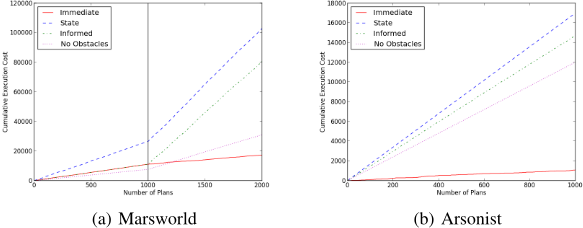
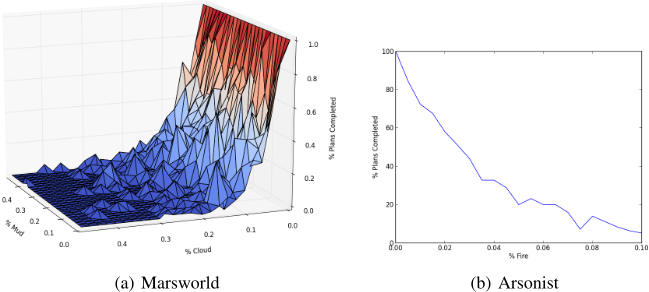
Figure 2 (a) shows the percentage of completed plans for the immediate expectations agents since this was the only agent that fail to complete plans. Each data point in this graph represents the percentage of plans that were successful (i.e. did not fail), averaged over 5 runs. The x-axis is the probability per tile per turn that a magnetic radiation cloud will appear. The y-axis is the probability per tile of mud occurring. The y-axis is the percentage of plans that were successful after executing 20 perimeter plans with the corresponding probabilities of mud and clouds. We conclude that clouds are the only causes of failure (as opposed to mud). In the arsonist domain we see analogous behavior (Figure 2 (b)). As the probability of fire increases (x-axis) the immediate expectations agent fails to complete more plans (y-axis).
7 RelatedWork
Plan-execution monitoring systems check if the current state satisfies the effects of the action just executed and the preconditions of the actions to be executed next. When this does not happen and as a result the action is inapplicable, this is called an expectation failure [Cox, 2007], which are the kinds of failures we are focusing in this work. Other kinds of failures have been proposed where even though they are not execution failures, the current execution exhibits some conditions that are not desirable [Myers, 1999]. Others have suggested failures associated with explicit quality conditions [Fritz and McIlraith, 2007].
The study of expectation failures have been long-standing particularly in the context of cognitive systems. Mechanisms to enhance a domain description when planning failures occur have been designed for cognitive systems (e.g., [Birnbaum et al., 1990; Sussman, 1975]). In contrast to this research, GDA systems generate new goals as a result of expectation failures.
Hierarchical representations have been a central topic in many cognitive architectures (e.g., [Laird, 2012]). Part of the motivation is the principle that Humans learn complex skills by first acquiring simple skills, which then are combined to learn more complex ones [Langley et al., 2004]. As a result, many cognitive architectures use hierarchical models to represent relations between skills of different complexity. Hierarchical modeling has led to a number of representation and reasoning formalisms including frames [Minsky, 1975], reasoning by abstraction [Amarel, 1968], and hierarchical task network (HTN) planning [Currie and Tate, 1991]. These formalisms have in common the use of certain kinds of constructs (i.e., objects, goals, and tasks) that represent knowledge of varying degrees of complexity and that are connected through hierarchical relations. In our work we adopt the HTN planning formalism because of its clear semantics.
Our work is related to plan repair, which aims at modifying the current plan when changes in the environment make actions in the plan invalid [Van Der Krogt and De Weerdt, 2005]. Plan repair has also been studied in the context of HTN planning [Warfield et al., 2007]. The main difference between plan repair and GDA is that in the latter the goals might change whereas plan repairs stick with the same goals while searching for alternative plans.
Some GDA systems do not assume planning knowledge to be given. For example, in [Virmani et al., 2008], a sequence of code calls (i.e., headings of actions) is collected as observed while a user is playing a computer game. The user is then asked to annotate the code calls with literals that must be valid in the state. Alternatively, learning of the planning model in the context of GDA has been studied [Jaidee et al., 2011]. For GDA systems that assume the actions model (i.e., preconditions and effects) to be given, the expectations are the state, as determined by the previously observed state and the model of the actions executed [Cox, 2007]. In our work, we use HTN plan representations, adopted by many GDA systems [Mu˜noz-Avila et al., 2010; Shivashankar et al., 2013; Molineaux et al., 2010; Klenk et al., 2013]. Alternatives include using description logics to infer expectations after executing a plan [Bouguerra et al., 2007] and Petri nets to follow the execution of the program [Onta˜n´on and Ram, 2011].
Each code call is one edge in the Petri net and states connect edges of the net. A token "jumps" from state to state as the code calls software routines are executed. If the state is not reached, this is a discrepancy and it can be represented by a Boolean variable. So this is akin to what we call state expectations.
Unlike STRIPS representations where the outcome of a plan is directly related to whether the literals in the final state reached satisfy the goals, HTN representations must, in principle, consider if the pursued task is accomplished regardless of the literals in the state reached. This is due to the semantics of HTN planners where the state that is reached is not necessarily linked to the task being accomplished. TMK and TMKL2 have a similar characterization of expectations presented here but support debugging and adaptation in the context of meta-reasoning [Murdock and Goel, 2008] while GDA uses it for goal formulation. Informed expectations check literals in the space by projecting the informed state across tasks at all levels of the HTN.
The notion of informed expectations is related to goal regression [Mitchell et al., 1986]. Goal regression is the process of finding the minimal set of literals in the initial state required to generate a plan achieving some goals. This process traverses a plan to collect all literals that are not added by actions in the plan. In contrast, in our work we are identifying the literals in the final state that are expected to hold. The most important difference, however, is that we are computing the expectations for tasks at all levels of the HTN.
8 Final Remarks
Over the last few years we have seen a significant increase in research and applications of systems with increasing autonomous capabilities. As these systems become more common, concerns have been raised about how we can design autonomous systems that are robust. That is, a system that reliably operates within expected guidelines even when acting in dynamic environments. Research about agent's expectations can be seen as a step towards addressing this difficult problem; reasoning about the agents' own expectations enables agents to check if the expectations of the course of action are currently met. In this paper, we re-visit two kinds of expectations discussed in the GDA literature: immediate and state expectations. We formally define and implement a third kind, informed expectations. Informed expectations capture what is needed for plan trajectory (unlike immediate expectations) while ignoring changes in the environment irrelevant to the current plan (unlike an agent using state expectations). Our experiments demonstrate improved performance for GDA agents using informed expectations on two metrics: execution costs and percentage of execution failures.
In future work, we will like to explore how informed expectations combine with sophisticated failure explanation mechanisms such as DiscoverHistory [Molineaux et al., 2012], which learns new explanation over time. Such combination could enable, for example, meta-reasoning on failure reasons, whereby the explanation module discovers flaws in the domain knowledge. For instance, the explanation module might identify a missing condition in the informed expectation and introspectively examine the HTN and suggest necessary changes to methods and/or operators to add the missing condition. The key insight is that we know informed expectations compute the exact expectations for the current HTN and hence missing conditions hypothesized by the explanation module as necessary would imply a flaw in the HTN knowledge base.
Acknowledgements: This work was supported in part by the National Science Foundation Grant #1217888.
@inproceedings{ijcai2015p317,
  title     = {Raising Expectations in GDA Agents Acting in Dynamic Environments},
  author    = {Dannenhauer, Dustin and Muñoz-Avila, Héctor},
  booktitle = {Proceedings of the Twenty-Fourth International Joint Conference on
               Artificial Intelligence, {IJCAI-15}},
  publisher = {International Joint Conferences on Artificial Intelligence},
  editor    = {Qiang Yang and Michael Wooldridge},
  pages     = {2241--2246},
  year      = {2015},
  month     = {7},
  note      = {Main Track},
  url       = {https://ijcai.org/proceedings/2015/317},
}
TY - CPAPER TI - Raising Expectations in GDA Agents Acting in Dynamic Environments AU - Dannenhauer, Dustin AU - Muñoz-Avila, Héctor T2 - Proceedings of the Twenty-Fourth International Joint Conference on Artificial Intelligence, IJCAI-15 PB - International Joint Conferences on Artificial Intelligence PY - 2015 SP - 2241 EP - 2246 UR - https://ijcai.org/proceedings/2015/317 ER -Copied
Machine-readable versions of this paper, for tools and AI agents:





