
SHOP: Simple Hierarchical Ordered Planner
Proceedings of the Sixteenth International Joint Conference on Artificial Intelligence. Planning and Scheduling. Pages 968-974.
© 1999 International Joint Conferences on Artificial Intelligence
Abstract
SHOP (Simple Hierarchical Ordered Planner) is a domain-independent HTN planning system with the following characteristics. • SHOP plans for tasks in the same order that they will later be executed. This avoids some goalinteraction issues that arise in other HTN planners, so that the planning algorithm is relatively simple. • Since SHOP knows the complete world-state at each step of the planning process, it can use highly expressive domain representations. For example, it can do planning problems that require complex numeric computations. • In our tests, SHOP was several orders of magnitude faster than Blackbox and several times faster than TLplan, even though SHOP is coded in Lisp and the other planners are coded in C.
- [Bacchus and Kabanza, 1996] F. Bacchus and K. Kabanza. Using temporal logic to control search in a forward chaining planner." In M. Ghallab and A. Milani (Eds.), New Directions in Planning, lOS Press, 141-153, 1996.
- [Bacchus and Kabanza, 1998] F. Bacchus and K. Kabanza. Using temporal logic to express search control knowledge for planning. <ftp:tnogos.uwaterloo.calpublbacchus/BKTlplan.ps>. Submitted to Artificial Intelligence, 1998.
- [Currie and Tate, 1991] K. Currie and A. Tate. 0-Plan: The open planning architecture. Artificial Intelligence, 52:49-86, 1991.
- [Erol et al., 1994] K. Erol, K, J. Hendler, and D. Nau. UMCP: A sound and complete procedure for Hierarchical Task-Network planning. Proc. 2nd lnt'l Conf. AI Planning Systems (AIPS-94 ), 249-254, 1994.
- [Fink and Veloso, 1995] E. Fink and M. Veloso. Formalizing the Prodigy planning algorithm. In Proc. European Workshop in AI Planning ( EWSP-95 ), 1995.
- [Gupta and Nau, 1992] N. Gupta and D. Nau. On the complexity of blocks-world planning. Artificial Intelligence 56(2-3), 223-254, 1992.
- [Kautz and Selman, 1998] H. Kautz and B. Selman. Blackbox: A SAT-technology planning system. <http://www .research .att.com/-kautzlblackbox>, 1998. Link
- [Koehler et al., 1997] J. Koehler, B. Nebel, J. Hoffmann, and Y. Dimopoulos. Extending planning graphs to an ADL subset. In ECP-97, 273-285, 1997.
- [Korf, 1987] R. Korf. Planning as search: A quantitative approach. Artificial Intelligence 33:65-88, 1987.
- [McAllester et al., 1991] D. McAllester and D. Rosenblitt. Systematic nonlinear planning. In Proc. AAAI-91, 1991.
- [McDermott, 1998] D. McDermott. AIPS-98 Planning Competition Results. <http://ftp.cs.yale.edu/pub/ mcdermott/aipscomp-results.html>, 1998. Link
- [Nau et al., 1998] D. Nau, S. J. Smith, and K. Erol. Control Strategies in HTN Planning: Theory versus Practice. AAA/-98/IAA/-98, 1127-1133, 1998.
- [Mui'ioz-Avila et al., 1999] H. Mui'ioz-Avila, D. Aha, J. Ballas, L. Breslow, and D. Nau. Using guidelines to constrain interactive case-based HTN planning. Tech. Report AIC-99-004, Naval Center for Applied Research on AI, Naval Research Lab., Washington, DC, 1999.
- [Penberthy and Weld, 1992] J. S. Penberthy and D. Weld, D. 1992. UCPOP: A sound, complete, partial order planner for ADL. In Proc. KR-92, 1992.
- [Sacerdoti, 1977] E. Sacerdoti. A Structure for Plans and Behavior. American Elsevier, 1977.
- [Smith et al., 1997] S. J. Smith, K. Hebbar, D. Nau, and I. Minis. Integrating electrical and mechanical design and process planning. In Martti Mantyla, Susan Finger and Tetsuo Tomiyama (ed.), Knowledge Intensive CAD, Volume 2, pp. 269-288, 1997.
- [Smith et al., 1998] S. J. Smith, D. Nau, and T. Throop. Computer bridge: a big win for AI planning. AI Magazine 19(2), 93-105, 1998.
- [Tate, 1977] A. Tate. Generating project networks. In Proc. /JCAI-77, 888-893, 1977. IJCAI
- and Blythe] M. Veloso and J. Blythe. Linkability: Examining causal link commitments in partial-order planning . In Proc. AIPS-94, 1994.
- [Wilkins, 1990] D. Wilkins. Can AI planners solve practical problems?. Computational Intelligence 6 (4): 232-246, 1990.
- [Yang et al., 1992] Q. Yang, D. Nau, and J. Hendler. Merging separately generated plans with restricted interactions. Computational Intelligence 8(2):648-676, February 1992.
References were extracted automatically from the PDF and may contain errors.
Full text extracted automatically from the PDF; figures, tables and equations may differ. The PDF is the version of record.
1 Introduction
"Conventional wisdom" in AI planning holds that total order forward search is a bad idea because it causes excessive backtracking. However, several groups of researchers have begun to argue that the opposite is true: that total-order forward-search allows planners to use a more expressive domain representations, which can be used to encode domain knowledge to make the planners highly efficient. More specifically:
- Prodigy [Veloso and Blythe, 1994; Fink and Veloso, 1995] does a forward state-space search that is guided by a means-end analysis made by backward chaining on the goals. Veloso and Blythe [1994] showed that causal link commitments can affect the performance of partial-order planners when the goals have a property called linkability. In their experiments, Prodigy ran many times faster than SNLP [McAllester et al., 1991].
- TLplan [Bacchus and Kabanza, 1996, 1998] does a forward state-space search, using modal-logic axioms to prune unpromising search paths. In Bacchus and Kabanza's tests, TLplan ran several orders of magnitude faster than Blackbox [Kautz and Selman, 1998 ], IPP [Koehler et al., 1997], SatPlan [Kautz and
Selman, 1996], Prodigy [Veloso and Blythe, 1994], and UCPOP [Penberthy and Weld, 1992]. ·
- Smith et al. [1997, 1998] developed an approach that combines HTN-style problem reduction with left-to right backtracking to produce a search strategy similar to Prolog's. They used this approach successfully in domain-specific planners for several practical applications, including manufactu'ring planning [Smith et al., 1997] and the game of bridge [Smith et al., 1998]. They argued for the advantages of their approach by analyzing the reasons for its success in real-world applications ·[Nau et al. 1998]. However, they could not compare their approach head-to-head against domain-independent planning algorithms, because their implementations were domain-specific.
In order to test the performance of Smith et al.' s approach in a domain-independent setting, we have created a domain-independent formalization of the approach, and have implemented it in a planner called SHOP (Simple Hierarchical Ordered Planner). SHOP is available at <http://www .cs.umd.edu/projects/shop>, under the terms of the GNU General Public License. SHOP has the following characteristics:
- SHOP plans for tasks in the same order that they will be executed. By avoiding some task-interaction issues, this makes SHOP simpler than HTN planners such as such as NONLIN [Tate, 1977], SIPE-2 [Wilkins, 1990], 0-PLAN [Currie and Tate, 1991], and UMCP [Erol et al., 1994] . It also makes it easier to prove soundness and completeness results.
- Since SHOP always knows the complete world-state at each step of the planning process, it can use considerably more expressivity in its domain representations than most AI planners. For example, SHOP has the ability to do Horn-clause inferencing, numeric computations, and interactions with external agents and external information sources.
- SHOP's expressive power can be used to create highly efficient domain representations. In our tests on blocks-world and logistics problems, SHOP was several orders of magnitude faster than Blackbox and several times faster than TLplan, even though SHOP
is coded in Lisp and the other planners are in C.
2 Formal Definitions
This section defines the syntax and semantics used in SHOP, as well as the SHOP planning algorithm. For brevity, the definitions below are for a somewhat simplified version of SHOP's syntax and semantics. Section 3 gives an informal overview of the additional features that appear in the full syntax and semantics. For a formal description of those features, see <www .cs.umd.edu/projects/shop/documentation.html>.
2.1 Syntax
We use the usual first-order-logic definitions of variable and constant symbols, function and predicate symbols, terms, atoms, conjuncts, most-general unifiers (mgu's), and Horn clauses; with the notation adapted for Lisp. For example, here are two Horn clauses, first in Prolog notation and then in our notation:
p(f(X) :- q(X,c), r(Y,d), s(d). q(b,c). ( : - ( p ( f ?x) ) ( ( q ?x c) ( r ?y d) ( s d) ) ) (:- (q b c) nil)A state is a set of ground atoms, and an axiom set is a set of Horn clauses. If S and is a state and X is an axiom set, then SuX satisfies a conjunct C if there is a substitution u (called a satisfier) such that SuX entails C'. u is a most general satisfier (or mgs) if there is no other satisfier v more general than u. In contrast to mgu's (which are unique modulo lexical renaming), there may be several distinct mgs's for C from S and X.
A task is a list of the form (s t1 t2 · · · t"), where s (the task's name) is a task symbol, and t 1, t2, ··· , t" (the task's arguments) are terms. The task is primitive if s is a primitive task symbol (a symbol whose first character is an exclamation point) and it is compound if s is a compound task symbol (a symbol whose first character is not a special character). A task list is a list of tasks.
An operator is a expression ( :opera tor h D A), where h (the head) is a primitive task, and D and A (the deletions and additions) are sets of atoms containing no variable symbols other than those in h. For example, here is an operator to put a block on the table:
(:operator (!putdown ?block) ( (holding ?block) ) ( (ontable ?block) (handempty) ))A method is an expression that has the form ( :method h C Tl, where h (the method's head) is a compound task, C (the method's precondition) is a conjunct, and T (the method's tail) is a task list. For example, here is a pair of methods for clearing the top of a block:
(:method (make-clear ?y) ((clear ?y)) nil) (:method (make-clear ?y) ((on ?x ?y)) ((make-clear ?x) (!unstack ?x ?y) (!putdown ?x))The first method says that if y is already clear we should do nothing; the second says that if another block x is on y, we should make x clear and then move x to the table.
2.2 Semantics
The intent of an operator o = (:operator h D A c) is to specify that h can be accomplished by modifying the current state of the world to remove every atom in D and add every atom in A. More specifically, if t is a primitive task and there is an mgu u for t and h such that h" is ground, then o is applicable to t, and the list (h") is a simple plan for t. If we execute this plan in some state S, it produces the state h"(S) = o"(S) = (S - D") U A".
The intent of a method m = (:method h C T) is to specify that if the current state of the world satisfies C, then h can be accomplished by performing the tasks in T in the order given. More specifically, let S be a state, X be an axiom set, and t be a task atom. Suppose there is an mgu u that unifies t with h, and suppose SuX satisfies C'. Then m is applicable to t in SuX, and the result of applying m to t is the set of task lists R = { (TT : v is an mgs for C' from S}. Each task list r in R is a simple reduction oft by m in SuX.
A plan is a list of heads of ground operator instances. If p is a plan and S is a state, then p(S) is the state produced by starting with S and executing the operator instances in the order that their heads appear in p.
A planning problem is a tuple P = (S,T,D), where S is a state, T is a task list, and D is a set of axioms, operators, and methods. If (S,T,D) is a planning problem, then n(S,T,D), the set of all plans forT from Sin D, is defined recursively as follows.
If Tis empty, then 11(S,T,D) contains exactly one plan, namely the empty plan. Otherwise, let t be the first task atom in T, and R be the remaining task atoms. There are three cases. (l) If t is primitive and there is a simple plan p for t, then I1(S,T,D) = { append{p,q) : q e ll{p(S),R,D)}. (2) If t is primitive and there is no simple plan for t, then I1(S,T,D) = 0. (3) If t is compound, then ll(S,T,D) = u{ll(S,append(r,R),D) : r is a simple reduction oft}.
2.3 Soundness and Completeness
The SHOP planning procedure is as follows:
procedure find-plan(S,T,D) return seek-plan(S, T,D, nil) end find-plan procedure seek-plan(S, T,D, p) if T = nil then return the list (p) t =the first task in T; R =the remaining tasks if t is primitive then if there is a simple plan q for t then return seek-plan(q(S),R,D,append(p,q)) else return FAIL else for every simple reduction r for t in S ans = seek-plan(S, append(r, R),D,p) if ans -:1- FAIL then return ansend for return FAIL end if end seek-plan
Since find-plan is a straightforward implementation of the definition of Il(S,T,D), it is easy to show it is sound. For finite search spaces, find-plan is also complete. For infinite search spaces, it is incomplete for the same reason Prolog is incomplete: if the leftmost unexplored path is infinite, it will never return from that path. It is straightforward to make find-plan complete for infinite search spaces, by doing an iterative-deepening search of find-plan's search space. Our implementation can do iterative deepening (at the user's option), but in practice we have found it more efficient not to use it.
3 Example Planning Domain
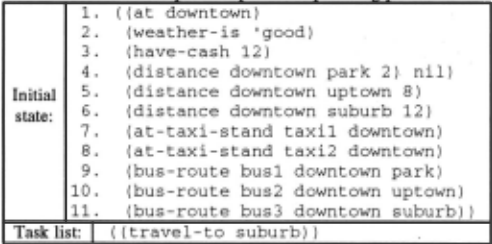
To illustrate how SHOP works, we now describe a simple transportation-planning domain. Table 1 defines the domain, Table 2 shows a specific problem in that domain, and Table 3 shows plans found by SHOP on several problems in that domain.
The scenario for the domain is that we want to travel from one location to another in a city. There are three possible modes of transportation: taxi, bus, and foot. Taxi travel involves hailing the taxi, riding to the destination, and paying the driver $1.50 plus $1.00 for each mile traveled. Bus travel involves hailing the bus, paying the driver $1.00, and riding to the destination. Foot travel just involves walking, but the maximum feasible walking distance depends on the weather. Thus, different plans are possible depending on what the layout of the city is, where we start, where we want to go, how much money we have, and what the weather is like.
As mentioned earlier, SHOP incorporates several extensions to the syntax and semantics described in this paper. To illustrate those extensions, the transportation planning domain uses most of them. In particular:
- Axioms' tails and methods' preconditions can include negations (which are evaluated using the closed-world assumption) and calls to the Lisp evaluator. For example, Axiom A1 of Table 1 says that the taxi fare is $1.50 plus $1 for each mile traveled; and Method M1 's precondition says that to pay the driver, we need sufficient money for the fare.
- If a method's precondition is satisfied, then its entire tail is passed to the Lisp evaluator. Lisp's quote, backquote, and comma constructs can be used to prevent evaluation (see Method M2) or to do conditional evaluation (see Method Ml , which does subtraction to create set-cash's second argument).
- Axioms can have multiple tails, to be used in an "if then-else" fashion. For example, the axiom " ( : head tail I tail2 tail3 )" says head is true if taill is true, or if taill is false but tail2 is true, or if taill and tail2 are false but tail3 is true. This gives
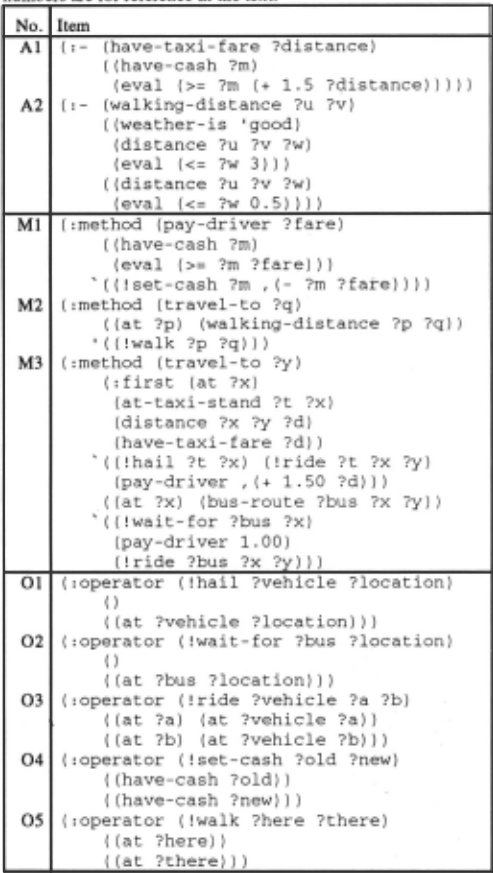
expressivity similar to a restricted version of Prolog's "cut," but in a way that is easier to understand. For example, Axiom A2 says that walking distance is ~ 3 miles in good weather, and ~ 1 mile otherwise.
| Problem | Plan(s) found by SHOP |
| Go to park, good weather, no cash | ( (!WALK DOWNTOWN PARK)) |
| Go to park, bad weather, no cash | None (can't afford a taxi or bus, and it's too far to walk). |
| Go to park, good weather, have $12 | 1 ((!WALK DOWNTOWN PARK)) 2 ((!HAIL TAXI1 DOWNTOWN) (!RIDE TAXI1 DOWNTOWN PARK) ( ! SET-CASH 12 8. 5)) |
| Go to park, good weather, have $80 | 1 ((!WALK DOWNTOWN PARK)) 2 ((!HAIL TAXI1 DOWNTOWN) (!RIDE TAXI1 DOWNTOWN PARK) (!SET-CASH 80 76.5)) |
| Go uptown, good weather, no cash | None (can't afford a taxi or bus, and it's too far to walk). |
| Go uptown, good weather, have $12 | ((!HAIL TAXI1 DOWNTOWN) (!RIDE TAXI1 DOWNTOWN UPTOWN) (!SET-CASH 12 2.5)) |
| Go uptown, good weather, have $80 | ((!HAIL TAXI1 DOWNTOWN) (!RIDE TAXI1 DOWNTOWN UPTOWN) (!SET-CASH 80 70.5)) |
| Go to suburb, good weather, have $12 | ((!WAIT-FOR BUS3 DOWNTOWN) ( ! SET-CASH 12 11.0) (!RIDE BUS3 DOWNTOWN SUBURB)) |
| Go to suburb, good weather, have $80 | ((!HAIL-TAXI DOWNTOWN) (!RIDE-TAXI DOWNTOWN SUBURB) (!SET-CASH 80 66.5)) |
- If the first element of a method's precondition or an axiom's tail is :first, SHOP's theorem prover returns after finding the first satisfier Uust as Prolog would do), rather than looking for all satisfiers. As an example, in Method M3 this is used to tell SHOP that it should only consider hailing the first taxi at the taxi stand, rather than hailing all of them.
- A method can have multiple pairs of preconditions and tails, to be used in an "if-then-else" fashion. For example, " ( :method head prel taill pre2 tail2)" says that the reduction of head is taill if prel is true, or tail2 if prel is false and pre2 is true. Method M3 uses this to specify that we won't consider bus travel unless we don't have enough money for taxi travel.
- Operators have numeric costs (the default cost is 1), and the cost of a plan is the sum of its operator costs. The transportation domain does not illustrate this.
Although the transportation-planning domain is easy to represent · in SHOP, we believe that most other AI planners would not have sufficient expressive power to represent it fully, because of the numeric computations that need to be done as part of the planning process.
4 Experiments
We have tested SHOP against two other planners: Blackbox [Kautz and Selman, 1998], which was one of
Table 4: Performance of Blackbox, TLplan, and SHOP on blocks-world roblems in the Blackbox software distribution.
*
*
| CPU time (seconds) | No. of actions in plan | |||||
|---|---|---|---|---|---|---|
| Problem | Black- box | TLplan | SHOP | Black- box | TLplan | SHOP |
| bw-simple | .00 | .00 | .00 | 2 | 2 | 2 |
| bw-sussman | .06 | .10 | .10 | 6 | 6 | 6 |
| bw-reversal4 | .08 | .10 | .20 | 8 | 12 | 8 |
| bw-12step | .74 | .20 | .60 | 12 | 12 | 12 |
| bw-large-a | 2.67 | .50 | .40 | 12 | 20 | 12 |
| bw-large-b | 1915.30 | 1.00 | .90 | 18 | 28 | 18 |
| bw-large-c | * | .26 | .20 | * | 44 | 28 |
| bw-large-d | .55 | .36 | 58 | 36 | ||
* Blackbox ran out of memory on bw-large-c and bw-large-d after about six minutes and 40 minutes, respectively.
the two fastest planners in the AIPS-98 planning compe tition [McDermott, 1998]; and 1Lplan [Bacchus and Kabanza, 1998], which outperformed Blackbox by several orders of magnitude in Bacchus and Kabanza's tests.
4.1 Blocks-World Planning
To run SHOP in the blocks world, we encoded the blocks-world planning algorithm of [Gupta and Nau, 1992] as a set of axioms, operators, and methods. We tested SHOP, 1Lplan and Blackbox on the blocks-world problems in the Blackbox software distribution. We ran SHOP and 1Lplan on a 167-MHz Sun Ultra, and Blackbox on a 143-MHz Sun Ultra. Both machines had 64MB of RAM. The results are shown in Table 4.
Blackbox did worst: its time requirements increased far more quickly with problem size than SHOP's and 1Lplan's. This was to be expected, because SHOP and 1Lplan are guaranteed to run in low-order polynomial time on blocks-world problems, whereas Blackbox does an exponential-time search. Blackbox could not solve the two largest problems at all, because it ran out of memory.
On the larger problems, 1Lplan took more time than SHOP, and found longer plans. We should run more tests to establish statistical significance, but the results clearly are algorithmically significant: 1Lplan found some non-optimal plans that the blocks-world algorithm that encoded into SHOP's methods and operators [Gupta and Nau, 1992] had been designed to avoid.
4.2 Logistics Problems
To run SHOP in the logistics domain, we encoded the following procedure into methods, operators, and axioms.
- First remove from the current world-state all "useless objects" that will not contribute to the plan. These include packages not mentioned in the goal, and empty trucks and airplanes in the same city with other trucks and airplanes. Then do the following steps repeatedly until every package is at its final destination:
- If there is a truck or airplane at the same location as some packages that need to be picked up or dropped off, then pick them tip or drop them off.
| Problem | CPU time (seconds) | No. of actions in plan | ||||
|---|---|---|---|---|---|---|
| Blackbox | TLplan | SHOP | Blackbox | TLplan | SHOP | |
| log001 | 0.58 | 0.23 | 0.24 | 25 | 25 | 25 |
| log002 | 95.98 | 0.3 | 0.19 | 31 | 27 | 24 |
| log003 | 99.00 | 0.29 | 0.29 | 28 | 27 | 27 |
| log004 | 130.75 | 1.09 | 0.46 | 71 | 51 | 51 |
| log005 | 231.94 | 0.95 | 0.66 | 69 | 42 | 42 |
| log006 | 321.27 | 1.48 | 0.71 | 82 | 51 | 50 |
| log007 | 264.05 | 3.61 | 1.66 | 96 | 70 | 66 |
| log008 | 317.42 | 4.79 | 1.67 | 110 | 70 | 66 |
| log009 | 1609.46 | 2.73 | 1.66 | 121 | 70 | 66 |
| log010 | 84.05 | 1.95 | 0.5 | 71 | 41 | 39 |
| log011 | 137.93 | 1.54 | 0.54 | 68 | 46 | 44 |
| log012 | 136.30 | 1.53 | 0.41 | 49 | 38 | 34 |
| log013 | 165.84 | 4.54 | 1.32 | 85 | 66 | 63 |
| log014 | 77.75 | 6 | 2.23 | 89 | 73 | 69 |
| log015 | 424.37 | 3.9 | 1.37 | 91 | 63 | 62 |
| log016 | 926.97 | 0.92 | 0.67 | 85 | 39 | 39 |
| log017 | 758.47 | 0.84 | 0.48 | 83 | 43 | 43 |
| log018 | 152.35 | 5.08 | 1.19 | 105 | 46 | 46 |
| log019 | 149.22 | 2.12 | 0.64 | 78 | 45 | 43 |
| log020 | 538.22 | 6.86 | 1.47 | 113 | 89 | 84 |
| log021 | 190.49 | 4.04 | 1.16 | 87 | 59 | 58 |
| log022 | 846.84 | 4.19 | 1.72 | 111 | 75 | 70 |
| log023 | 173.97 | 3.45 | 1.43 | 85 | 62 | 58 |
| log024 | 74.83 | 3.23 | 1.38 | 87 | 64 | 60 |
| log025 | 74.00 | 2.68 | 1.01 | 84 | 57 | 53 |
| log026 | 233.41 | 2.35 | 0.95 | 80 | 55 | 49 |
| log027 | 145.16 | 3.36 | 1.28 | 97 | 70 | 65 |
| log028 | 867.40 | 7.26 | 2.47 | 118 | 74 | 71 |
| log029 | 89.52 | 3.42 | 1.67 | 84 | 45 | 44 |
| log030 | 495.37 | 2.26 | 0.74 | 92 | 51 | 47 |
| Problem | CPU time (seconds) | No. of actions in plan | ||
|---|---|---|---|---|
| TLplan | SHOP | TLplan | SHOP | |
| log-x-1 | 0.83 | 0.33 | 26 | 26 |
| log-x-2 | 3.2 | 2.18 | 33 | 33 |
| log-x-3 | 34.89 | 4.84 | 55 | 55 |
| log-x-4 | 95.36 | 8.87 | 59 | 59 |
| log-x-5 | 0.66 | 0.64 | 22 | 24 |
| log-x-6 | 156.33 | 20.28 | 72 | 72 |
| log-x-7 | 10.13 | 3.47 | 34 | 36 |
| log-x-8 | 180.64 | 9.55 | 41 | 41 |
| log-x-9 | 398.61 | 16.81 | 85 | 76 |
| log-x-10 | 317.04 | 37.27 | 105 | 103 |
| log-x-11 | 10.38 | 0.46 | 31 | 30 |
| log-x-12 | 528.16 | 20.32 | 41 | 43 |
| log-x-13 | 2026.3 | 49.49 | 67 | 69 |
| log-x-14 | 1577.6 | 17.05 | 94 | 90 |
| log-x-15 | 49.04 | 2.55 | 94 | 90 |
2. Else if there is a package p in some city c, and p's destination is a city other than c, then choose any airplane, and let d be the city that it is in. Use the truck in city d to collect all packages in city d that need to be moved. Bring to the airport all packages that need to go to the airport, and load them onto the airplane. Then fly the airplane to city c.
- Else if there is an airplane with at least one package on board, then fly it to the destination of one of the packages on board.
- Else if there are one or more packages that need to be picked up, then drive a truck to the location of any one of them.
- Else if there is a truck that is carrying one or more packages, then drive it to the final destination of one of the packages in the truck.
We ran SHOP and TLplan on logistics problems in the Blackbox and TLplan distributions, on a 167-MHz Sun Ultra with 64 MB of RAM. Because of . Blackbox's memory requirements, we did not run it ourselves. Instead, we used published data for Blackbox on a machine that is faster than ours and has 8 GB of RAM. 1 Tables 5 and 6 show the results.
Again Blackbox did worst and SHOP did best. Blackbox was several orders of magnitude slower than both SHOP and TLplan, and it found significantly larger plans. SHOP and TLplan found plans of comparable size, but on most of the problems SHOP ran several times faster than TLplan (more than an order of magnitude faster on the more difficult problems).
5 Discussion and Conclusions
It did not surprise us that SHOP did so much better than Blackbox, for SHOP's methods and axioms contained sophisticated domain knowledge that could not be represented in Blackbox's operators. However, it did surprise that SHOP did so much better than TLplan. Here, we think, are the primary reasons why it did so:
- Although TLplan's modal-logic representation capabilities are quite sophisticated, their use (at least in the examples we have seen) has been limited to writing pruning heuristics rather than actual planning algorithms. SHOP's use of HTN methods makes it easy to write efficient planning algorithms, as we did for both the blocks world and the logistics domain.
- TLplan's planning algorithm is basically a state space search, whereas SHOP uses HTN-style problem reduction. Problem reduction can be much more efficient than state-space search (even by an exponential amount in some cases [Korf, 1987; Yang et al., 1992]).
Our results support the contention that total-order forward search, combined with HTN-style problem reduction, can "scale up" to complex planning problems better than partial-order action-based planning. Our results also illustrate the impact that planning applications can have on planning theory: SHOP is a domain-independent formalization and implementation that evolved from our previous domain-specific work on manufacturing planning and computer bridge.
1 We got the Blackbox performance data from Table 11 of [Bacchus and Kabanza 1998]. According to Fahiem Bacchus, the data came originally from the Blackbox distribution, and the machine was a Silicon Graphics with 8 GB of RAM, running at around 200 MHz.
Our ongoing and future work is as follows:
- We are doing additional experiments and analyses in order to get a better understanding of the efficiency issues discussed above.
- SHOP appears to be powerful enough to be of use in complex applications such as noncombatant evacuation operation planning [Mui'ioz-Avila et al., 1999]. To make it easier to embed SHOP in such applications, we are creating an implementation of SHOP in Java.
- It is straightforward to prove soundness and completeness using the definitions in Section 2, but it is more difficult to prove soundness and completeness in the presence of some of the extensions discussed in Section 3 (such as the calls to the Lisp evaluator). We have begun working with others who have experience in these issues, to put this aspect of SHOP on a more solid formal footing.
- We are developing a general way to handle some partial-order-planning operations while preserving SHOP's expressivity and left-to-right control strategy. We intend to describe this in a forthcoming paper.
Acknowledgements
This work was supported in part by the following grants and contracts: Army Research Laboratory DAAL01-97K0135, Naval Research Laboratory N00173981G007, Air Force Research Laboratory F306029910013, and NSF DMI-9713718.
@inproceedings{ijcai1999p138,
  title     = {SHOP: Simple Hierarchical Ordered Planner},
  author    = {Nau, Dana S. and Cao, Yue and Lotem, Amnon and Muñoz-Avila, Héctor},
  booktitle = {Proceedings of the Sixteenth International Joint Conference on
               Artificial Intelligence, {IJCAI-99}},
  publisher = {International Joint Conferences on Artificial Intelligence},
  editor    = {Thomas Dean},
  pages     = {968--974},
  year      = {1999},
  note      = {Planning and Scheduling},
  url       = {https://ijcai.org/proceedings/1999/138},
}
TY - CPAPER TI - SHOP: Simple Hierarchical Ordered Planner AU - Nau, Dana S. AU - Cao, Yue AU - Lotem, Amnon AU - Muñoz-Avila, Héctor T2 - Proceedings of the Sixteenth International Joint Conference on Artificial Intelligence, IJCAI-99 PB - International Joint Conferences on Artificial Intelligence PY - 1999 SP - 968 EP - 974 UR - https://ijcai.org/proceedings/1999/138 ER -Copied
Machine-readable versions of this paper, for tools and AI agents:





