
Bounded Intention Planning
Proceedings of the Twenty-Second International Joint Conference on Artificial Intelligence. Pages 2039-2044.
https://doi.org/10.5591/978-1-57735-516-8/IJCAI11-340
© 2011 International Joint Conferences on Artificial Intelligence
Abstract
We propose a novel approach for solving unary SAS+ planning problems. This approach extends an SAS+ instance with new state variables representing intentions about how each original state variable will be used or changed next, and splits the original actions into several stages of intention followed by eventual execution. The result is a new SAS+ instance with the same basic solutions as the original. While the transformed problem is larger, it has additional structure that can be exploited to reduce the branching factor, leading to reachable state spaces that are many orders of magnitude smaller (and hence much faster planning) in several test domains with acyclic causal graphs.
- [Bäckström and Nebel, 1995] Christer Bäckström and Bern- hard Nebel. Complexity Results for SAS+ Planning. Com- putational Intelligence, 11:625-655, 1995.
- [Bäckström, 1992] Christer Bäckström. Equivalence and Tractability Results for SAS+ Planning. In KR, pages 126- 137.
- Morgan Kaufmann, 1992.
- [Brafman and Domshlak, 2003] Ronen I. Brafman and Carmel Domshlak. Structure and Complexity in Planning with Unary Operators. JAIR, 18:315-349, 2003.
- [Chen and Yao, 2009] Yixin Chen and Guohui Yao. Com- pleteness and optimality preserving reduction for plan- ning. In IJCAI, pages 1659-1664, 2009. IJCAI
- [Chen et al., 2008] Yixin Chen, Ruoyun Huang, and Weix- iong Zhang. Fast Planning by Search in Domain Transition Graphs. In AAAI, pages 886-891, 2008.
- [Chen et al., 2009] Yixin Chen, You Xu, and Guohui Yao. Stratified Planning. In IJCAI, pages 1665-1670, 2009.
- [Coles and Coles, 2010] Amanda Coles and Andrew Coles. Completeness-Preserving Pruning for Optimal Planning. In ECAI, pages 965-966, 2010.
- [Fox and Long, 1999] M. Fox and D. Long. The Detection and Exploitation of Symmetry in Planning Problems. In IJCAI, pages 956-961, 1999. IJCAI
- [Haslum, 2007] Patrik Haslum. Reducing Accidental Com- plexity in Planning Problems. In IJCAI, pages 1898-1903, 2007. IJCAI
- [Helmert and Röger, 2008] Malte Helmert and Gabriele Röger. How good is almost perfect? In AAAI, pages 944- 949, 2008.
- [Helmert, 2006] Malte Helmert. The Fast Downward Plan- ning System. JAIR, 26:191-246, 2006.
- [Jonsson and Bäckström, 1998] Peter Jonsson and Christer Bäckström. State-variable planning under structural re- strictions: Algorithms and complexity. Artificial Intelli- gence, 100:125-176, 1998.
- [Jonsson, 2009] Anders Jonsson. The Role of Macros in Tractable Planning. JAIR, 36:471-511, 2009.
- [Knoblock, 1994] Craig Knoblock. Automatically Gener- ating Abstractions for Planning. Artificial Intelligence, 68:243-302, 1994.
- [Mcallester and Rosenblitt, 1991] David Mcallester and David Rosenblitt. Systematic Nonlinear Planning. In AAAI, pages 634-639, 1991.
- [Richter and Westphal, 2010] Silvia Richter and Matthias Westphal. The LAMA Planner: Guiding Cost-Based Any- time Planning with Landmarks. JAIR, 39:127-177, 2010.
- [Valmari, 1990] Antti Valmari. Stubborn sets for reduced state space generation. In ICATPN, pages 491-515, 1990.
- [Wolfe et al., 2010] Jason Wolfe, Bhaskara Marthi, and Stu- art J. Russell. Combined Task and Motion Planning for Mobile Manipulation. In ICAPS, 2010.
References were extracted automatically from the PDF and may contain errors.
Full text extracted automatically from the PDF; figures, tables and equations may differ. The PDF is the version of record.
1 Introduction
State-space planners based on forward search have emerged as the overall winners in recent planning competitions. Their success is due in part to cheap and accurate domainindependent heuristics, and in part to easy elimination of repeated states (i.e., transpositions) in the state space. Nevertheless, state-space planners-especially optimal ones-can fail spectacularly on simple problems that allow for many possible interleavings of independent subplans, or contain many actions irrelevant to achieving the goal, which are trivial for alternative approaches such as partial-order planning.
Recent work by Helmert and R¨oger [2008] has shown that improvements in heuristic technology alone are unlikely to improve this situation, highlighting the need for new techniques in state-space planning to detect and exploit symmetries. Especially vital are techniques to limit the interleaving of independent parts of a solution. Unfortunately, Helmert and R¨oger conclude that existing such techniques are "difficult to integrate into algorithms that prune duplicates such as A*," and that more generally, "clean, general ideas for exploiting symmetries in planning tasks are still few."
Our key contribution is the observation that a bounded set of future intentions is sufficient to capture much of the power of hierarchical and partial-order planning. By representing these intentions within the problem state, we enable statespace planners that avoid interleaving independent subplans and prune irrelevant actions throughout the search space.
Stuart Russell
Computer Science Division University of California, Berkeley
russell@cs.berkeley.edu
Specifically, we extend a unary SAS+ planning problem (in which every operator affects a single state variable) with new state variables representing intentions about how each original state variable will be used or changed next: for each variable v, we allow a commitment to a next action that will change v, and a next child variable that will causally depend on v. Then, the execution of each original action a becomes a multi-step process: first we intend to do a to change v next, then we intend to use v as the next child of each prevail condition of a, and finally we fire a, applying its original effects as well as clearing the above intentions. These steps can be interleaved with the steps of actions affecting other variables (e.g., steps achieving prevail conditions of a).
The output of this process is a new SAS+ instance, which essentially augments the original state with a flat, bounded representation of a partially-ordered hierarchical plan. The set of basic optimal solutions to this augmented instance (after dropping non-fire actions) is identical to the set of optimal solutions to the original instance. However, due to the much larger state space, naive search in this formulation (e.g., using uniform-cost search) would be much slower than in the original SAS+ formulation. To achieve speedups, we exploit the special structure of the augmented instance to heavily prune the set of actions that need to be considered from each state, without sacrificing optimality.
We first show that the set of applicable actions can be partitioned based on their type and the original variable affected, so that search only needs to branch over actions in a single (arbitrarily chosen) partition at each state. The remaining branching comes in two types: choosing a next intended action, or next intended child, for a single variable (cf. choosing an achiever for an open condition in partial-order planning). Action intentions commit to what to do next, but since they are unordered they do not rule out necessary interleavings with other variables. Child intentions constrain when these intended actions can be fired, only generating branching when necessary to interleave usage of shared variables relevant to operators affecting multiple other variables.
Next, we propose a heuristic for choosing an action partition, which favors discharging existing commitments over creating new ones. This leads to our Bounded Intention Planner (BIP), which automatically breaks symmetries between equivalent interleavings, providing provably exponential speedups on independent subproblems, and huge empirical speedups even without them, in several test domains with acyclic causal graphs. BIP also leverages intentions in other ways; for example, intended actions' preconditions provide subgoals, which can be used to prune irrelevant actions throughout search.
We conclude with a brief discussion of potential improvements and applications to general planning problems.
2 Background
2.1 Unary SAS+ Representation
Following B¨ackstr¨om and Nebel [1995], a unary SAS+ planning problem is defined by a tuple Π = (V, O, s0, s⋆):
- V = {v1, ..., vm} is the set of multi-valued state variables. Each variable v ∈ V has values chosen from a domain Dv. A state is a total assignment of variables to domain values, so the state space is SV = Dv1 ×...×Dvm . The value of variable v in state s is written s[v].
- We also consider partial states, in which variables can take on the undefined value u, and let Vs+ be the set of variables defined (̸=u) in partial state s+. s+ is satisfied by a state s, written s+ ⊑ s, if ∀v ∈ Vs+, s+[v] = s[v].
- O is the set of operators (a.k.a. actions), each of which is defined by a tuple o = (preo, posto, prvo) of partial states, called the pre-, post-, and prevail-conditions respectively. We assume unary operators that affect a single variable v, i.e., Vpreo = Vposto = {v}, with prevail conditions allowed on the remaining variables. An operator o is applicable in a state s if preo ⊑ s and prvo ⊑ s. o can then be be executed in s, producing a new state o(s) with v set to posto[v]. This incurs a cost ≥ 0, which we assume is 1 unless otherwise mentioned.
Denote the partition of operators affecting v by O[v].
- s0 ∈ SV is the initial state (we assume it is complete)
- s⋆ is the (typically partial) goal state
Finally, a solution is a sequence of applicable operators (o1, ..., ok) that transforms s0 to a state that satisfies s⋆.
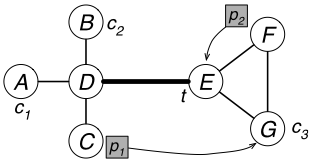
As a running example, we consider a transportation planning task (see Figure 1) due to Helmert [2006]. The objective is to deliver a set of packages (pi) from their current locations to their destinations using a fleet of vehicles. Cars (ci)
can drive along roads within a city, and the truck (t) can drive between the cities; all vehicles can hold any number of packages. A SAS+ encoding of this problem has six state variables: one for the location of each vehicle, and one for the status of each parcel (either "at location l" or "in vehicle v"); and three basic operator types: LOAD, DRIVE, and UNLOAD. For example, operator LOAD(p2, c3, F ) loads package p2 into car c3 at location F; it has prevail condition c3 = at F, precondition p2 = at F, and postcondition p2 = in c3. The optimal solution to the example problem delivers p2 using c3, and p1 using c1 or c2, then t, then c3. These subplans can be interleaved arbitrarily, except that c3 must be used to deliver p2 first in an optimal solution.
2.2 Causal Graphs and Independence
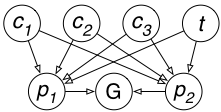
The causal graph CG of an SAS+ instance captures the causal relationships between its variables [Helmert, 2006]. Formally, CG is a directed graph over the state variables V, where there is an edge from s to t iff there exists an operator o ∈ O with a prevail condition on s and postcondition on t (see Figure 2). Denote the children of s by CG(s). In our example, the causal graph contains an edge from each vehicle variable v to each package variable p, generated by the LOAD(p, v, ·) and UNLOAD(p, v, ·) operators that have a prevail condition on v and a postcondition on p.
A first observation is that only ancestors of v in CG (including v itself) are relevant for changing v. Define a subproblem as the task of achieving a particular value for some variable. If the ancestors of two variables are disjoint, subproblems on these variables are independent: they do not interact, and so any interleaving of their optimal solutions is an optimal solution to the combined task. In our example, only subproblems involving different vehicles are independent.
More commonly, subproblems can exhibit partial dependence, where solutions only interact via one or more shared ancestor variables. The more frequently two subproblems require different values for a shared variable, the stronger the dependence. Our approach capitalizes on these structures, avoiding all interleaving of independent subproblem solutions, and only generating interleaving to multiplex the use of shared variables for partially dependent subproblems.
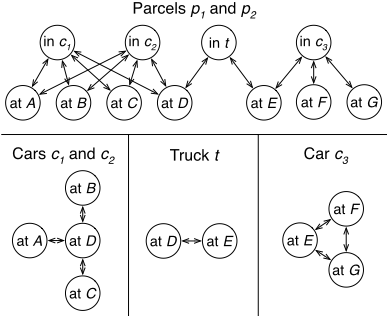
The domain transition graphs (DTGs) complement the causal graph. For each variable v ∈ V, DTGv is a directed graph over its domain Dv. Each operator o ∈ O[v] generates an edge from preo[v] to posto[v]; thus, paths in DTGv correspond to operator sequences affecting v. Figure 3 shows DTGs for our example; the parcel transitions are generated by LOAD and UNLOAD operators, and the vehicle transitions by DRIVE operators.
3 RelatedWork
Various researchers have studied the unary/acyclic problems that are our primary focus, often with an emphasis on complexity and identifying tractable subclasses (e.g., [B¨ackstr¨om, 1992; B¨ackstr¨om and Nebel, 1995; Jonsson and B¨ackstr¨om, 1998; Jonsson, 2009]). A particularly relevant result by Brafman and Domshlak [2003] is that planning remains PSPACEcomplete even when restricted to unary effects and acyclic causal graphs (and binary-valued variables).
The intentions in our approach are closely related to commitments in hierarchical planning (e.g., [Knoblock, 1994]) and partial-order planning (e.g., [Mcallester and Rosenblitt, 1991]). A key difference is that we retain the advantages of state-space search, including cheap domain-independent heuristics and easy repeated-state checking.
Numerous works have explored related planning algorithms that work directly on the causal graph. However, these proposals have been suboptimal (e.g., [Haslum, 2007]), incomplete (e.g., [Chen et al., 2008]), or limited to more restricted problem classes (e.g., [Jonsson, 2009]).
Within the state-space setting, Coles and Coles [2010] present several optimizations that prune action choices based on the stated goals of a problem; while powerful, these optimizations can also be fragile (sensitive to problem formulation). Intentions allow us to apply similar optimizations hierarchically throughout search, using subgoals provided by the preconditions of intended actions. Other pruning methods include exploiting symmetric objects and tunnel macros (e.g., [Fox and Long, 1999; Coles and Coles, 2010]), which should complement our approach.
Most closely related to our approach are techniques for pruning symmetric action interleavings in state-space search. Stratified planning [Chen et al., 2009] is a small modification of state-space search, in which the applicable operators from a state s are pruned based on the last operator o executed to reach s, effectively avoiding some equivalent interleavings. Variables are first assigned numeric levels from a topological ordering of the causal graph. Then, from state s, only operators that either (1) affect ≥-level variables than o, or (2) were enabled by doing o are considered next; all other actions are pruned.
The Expansion Core (EC) method [Chen and Yao, 2009] is another recent approach for pruning symmetric action interleavings. From each state s, the EC planner builds a potential dependency graph on the state variables of the problem, which contains an edge from variable u to v iff u is a potential precondition or potential dependent of v. Roughly speaking, a potential precondition u's current value satisfies a pre(vail) condition of an operator affecting v that lies on a path from the current value of v to its goal value (if applicable); and a potential dependent u can be changed next by an operator that needs a value for v that lies on a path from its current value to its goal value (if applicable). Given this graph, a subset of variables V called a dependency closure is selected, which has no outgoing edges, and contains at least one variable v ∈ V s.t. s[v] ̸= s⋆[v] ̸= u. Only actions affecting V are considered from s, without sacrificing optimality.
Both the EC method and the "operator partitions" used by BIP can be understood as applications of the "stubborn set" method [Valmari, 1990], which identifies subsets of actions that can be greedily focused on at a given state without sacrificing global optimality.
Despite the connections, there are many important differences between BIP, stratified planning, and the EC approach. Perhaps most importantly, whereas BIP only branches over actions that affect a single variable at each step, both the stratified planner and EC must branch over a (potentially large) set of such partitions. A first consequence is that the stratified planner explores an exponential number of interleavings (in n) given n independent subproblems (it can do any number of actions in subproblem 1 before moving to subproblem 2, and so on). Both BIP and EC are linear in n.
A key difference between EC and BIP arises with weakly dependent subproblems. In such cases, BIP makes and maintains commitments to how shared variables will be used next, temporarily decomposing the subproblems so that independence can be exploited (by not switching subproblems until these commitments are discharged). This ability is enabled by the addition of intentions; put simply, the stratified planner and EC do not have enough memory to generate such behaviors. Moreover, intentions enable additional advantages, such as goal-directed behavior, which are not available to the other approaches. These claims are borne out by empirical results in several domains, in Section 5.
4 Bounded Intention Planning
4.1 Representation
As summarized above, the first step in our approach is to transform an "original" unary SAS+ instance Π to an "augmented" instance ¯Π with additional state variables and a modified set of operators. As a precursor to this transformation, we add to Π a Boolean goal variable G, initially false, and an operator GOAL that sets G to true, with prevail condition s⋆. Now, ¯Π = (¯ V, ¯O, ¯ s0, ¯ s⋆) is defined as follows:
State Variables
For each original variable v ∈ V, ¯ V contains three variables: v itself, plus two new intention variables (see Figure 4):
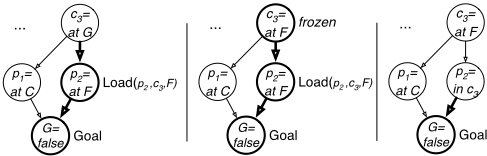
First, Ov (next operator on v), with domain O[v] ∪ {free, frozen}, representing an intention that the next operator to change v will be Ov. frozen represents an intention to not change v until its current value is used to satisfy a prevail condition of some operator, and free represents no intention.
Second, Cv (next child of v), with domain CG(v)∪{free}, representing an intention to use v to satisfy a prevail condition of an operator that affects Cv next (or no such intention). Child intentions can be thought of as abstracted versions of the causal links used in partial-order planning.
Operators
Each original operator is split into stages, while preserving the semantics of the original variables. Specifically, to execute an original operator o that affects v: (1) o must be intended next on v, (2) each prevail variable of o must intend v as its next child, (3) each prevail variable must be frozen at the value required by o, and (4) o is executed, and the previous intentions are cleared. For example, Figure 4 shows states where LOAD(p2, c3, F) is ready to fire (center) and has just fired (right). The operators ¯O that accomplish this are:
- For each v ∈ V and o ∈ O[v], an operator SETO(o) with pre[Ov]=free, post[Ov]=o, and prv[v]=preo[v]. SETO(o) adds an intention to change v next by doing o; it requires that no operator is currently intended for v and that v's current value matches the precondition of o, but does not check the prevail conditions of o yet.
- For each v ∈ V and child c ∈ CG(v), an operator SETC(v, c) with pre[Cv]=free and post[Cv]=c that adds an intention to use v to change c next.
- For each v ∈ V and domain value x ∈ Dv, an operator FREEZE(v, x) with pre[Ov]=free, post[Ov]=frozen, and prv[v]=x that freezes the value of v to x until used.
- For each v ∈ V and o ∈ O[v], an augmented "fire" operator ¯ o with the same conditions as o, plus additional
pre- and post-conditions on the intentions:
Finally, the cost of each o ∈ O is assigned to SETO(o); all other operators in ¯O (including ¯ o) are assigned cost 0.
Initial State and Goal
The initial state ¯ s0 of the transformed problem extends s0, setting all new O· and C· variables to free, except OG, which is set to GOAL. The goal ¯ s⋆ of the transformed problem is G=true ∧ (∀v ∈ V) Ov ∈ {free, frozen}. 1
4.2 Solutions to ¯Π
The projection P(o) of an operator sequence o ∈ ¯O∗ replaces each operator ¯ o by o, and drops all other operators.
Theorem 1. There is a 1-1 correspondence between solutions o to Π with cost c, and non-empty sets of solutions to ¯Π with projection o and cost c.
Proof. A solution to Π can be extended to a solution to ¯Π by expanding each operator o into the sequence SETO(o), then for each prevail variable p in Vprvo , SETC(p, v), FREEZE(p, prvo[p]), and finally ¯ o. Conversely, the projection of a solution to ¯Πmust be a solution to Π, because only the operators ¯ o affect the original state variables, and each retains the semantics of o thereupon. Moreover, projection preserves cost, since SETO(o) and ¯ o operators are in 1-1 correspondence in solutions to ¯Π.
4.3 Operator Partitions
Consider the following partitioning ¯ P of the operators ¯O:
- For each v ∈ V and x ∈ Dv, a partition SetOv=x = {SETO(o)|o ∈ O[v] ∧ preo[v]=x} ∪ {FREEZE(v, x)} that chooses to freeze v, or intend a next operator on v.
- For each v ∈ V, a partition SetCv = {SETC(v, c)|c ∈ CG(v)} that chooses a next intended child for v.
- For each o ∈ O, a partition Fireo = {¯ o} that fires o.
All operators in each partition have identical pre- and prevail-conditions. Define the subset of applicable partitions in state s as ¯ Ps. Only operators from a single, arbitrary partition in ¯ Ps need to be considered to preserve optimality.
Theorem 2. For every state s and operator partition p in ¯ Ps there exists an optimal solution for s that begins with an operator in p.
Proof. First note that every applicable operator o ∈ p ∈ ¯ Ps is independent of every applicable operator o′ ∈ p′ ∈ ¯ Ps \ {p} outside its partition: no variable appears in any condition of both o and o′ . Independence ensures that if we do o on this step, we can always still do o′ on the subsequent step; and moreover, o(o′ (s)) = o′ (o(s)).
1 ¯ s⋆ is not a true partial state, because of the disjunction in the O· conditions. These conditions are added to simplify the analysis, but are not actually needed to preserve correctness.
To conclude, we argue that no partition is "harmful"-that is, it is always the case that some operator o in each partition p ∈ ¯ Ps begins an optimal solution from s. This is straightforward: Fireo cannot be harmful, since every intended action must eventually be fired; SetCv branches on all possible values for Cv (except free), and no other operators have conditions requiring Cv = free; and likewise for SetOv=x and Ov (the FREEZE(v, ·) actions preserve a zero-cost option, in case v's current value is needed next, or v is not needed again).
To see how this partitioning can avoid generating unnecessary interleavings, consider the example in Figure 4. From the state at left, we can alternate between choosing partition SetOc3=· and firing the intended operator on c3 until the state at the center is reached (assume that we do not freeze variables to the wrong values, an issue we address shortly). Then, we can fire LOAD(p2, c3, F) to reach the state at right. In this process, we need not consider interleaving actions involving other packages or vehicles. Optimality is preserved because in reaching the state at left, we would have considered SETC(c3, p1), which covers the possibility that c3 might need to pick up p1 first instead. In short, committing to a first child for c3 up front temporarily decomposes the state of c3 from the rest of the problem, allowing us to avoid an exponential number of potential interleavings with operators affecting other parts of the state.
4.4 Action Partition Pruning
When selecting from a partition SetOv=x in state s, if Cv = c, Oc = o, and prvo[v] = x′ ̸= u, we can use this value as a subgoal, and prune the options as follows (without sacrificing optimality). If x = x′ , greedily do FREEZE(v, x′ ). Otherwise, prune all operators that do not lie on an acyclic path through the domain transition graph of v from x to x′ . In our running example, this pruning eliminates all branching over paths for the cars in the left city, since their domain transition graphs only admit a single acyclic path from each initial value to each subgoal value. For instance, if we have intended LOAD(p1, c1,C) and SETC(c1, p1) and c1 is at D, we can prune the partition SetOc1=D to the singleton {SETO(DRIVE(c1,D,C))} because after driving to A or B, c1 would have to return to D before reaching C (see Figure 3). This optimization generalizes the irrelevant-action pruning of [Coles and Coles, 2010].
4.5 Child Partition Pruning
When selecting from a partition SetCv in state s, if any child c has an intended operator o s.t. forall p ∈ Vprvo , s[p] = prvo[p], Op ∈ {free, frozen}, and Cp ∈ {free, v}, operator SETC(v, c) can be greedily executed (discarding alternatives in SetCv). Allowing o to fire leads to a strictly less constrained state, and so optimality is not compromised. For instance, suppose there are ten parcels at F to be LOADed into c3, which is also at F . This optimization eliminates branching over which parcel(s) to load (first); all ten are greedily picked up in sequence before c3 is moved. As a further improvement, we also prune children from SetCv that are not ancestors of any unachieved precondition of GOAL. For instance, once p1
has been delivered, we can greedily assign SETC(v, p2) for any vehicle v without considering p1 as a child.
4.6 Partition Selection
This section describes a heuristic for selecting an operator partition that focuses effort on resolving existing commitments necessary for reaching the goal, while maximizing the applicability of the above pruning rules.
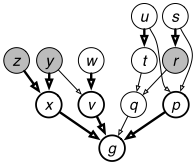
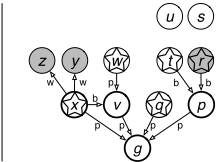
To compute this heuristic, given a state s of ¯Π, we first define a variable precedence graph VPGs over the variables V. An edge from u to v in VPGs indicates that an intention on u must change before the intended action on v can fire. There are three types of edges (see Figure 5):
- Wait: For each v ∈ V s.t. Ov=frozen ∧ Cv̸=free, a wait edge Cv → v. This captures the fact that v cannot become unfrozen until an operator fires on its intended child Cv .
- Block: For each v ∈ V s.t. Ov /∈ {free, frozen}, and each prevail variable p ∈ Vprv Ov s.t. Cp /∈ {free, v}, a block edge Cp → v. This captures that the prevail variable p of operator Ov is currently reserved for another variable Cp, and Ov cannot fire until an operator fires on Cp.
- Prevail: For each v ∈ V s.t. Ov /∈ {free, frozen}, and each prevail condition variable p ∈ Vprv Ov s.t. Cp∈{free, v} ∧ (Op̸=frozen ∨ Cp̸=v ∨ s[p]̸=prvOv [p]), a prevail edge p→v. This captures the conditions on p for Ov to fire. We skip the prevail edge when Cp /∈{free, v}, since the block edge captures a stronger condition in this case.
If the component of VPGs with G contains a cycle, state s is deadlocked and can be pruned immediately. Otherwise, we restrict our attention to the set of source variables S in VPGs, which are places where immediate progress can be made towards the goal. If an intended operator can be fired. that is always our first choice. Otherwise, we must add new intentions that work towards achieving the prevail and "intentional" conditions of existing intended operators. Specifically, we select an operator partition as follows.
(A) If any partition FireOv for v ∈ S is applicable, choose one arbitrarily. (B) Otherwise, if any partition SetOv=s[v] is applicable where the action pruning conditions are met, select one arbitrarily. (C) Otherwise, if any partition SetCv is applicable where at least one child has an intended operator with prevail condition on v, select the last one according to a depth-first topological sort of the causal graph CG. (D) Finally, if none of (A-C) are applicable, select an arbitrary applicable partition on a source variable. See Section 6 for discussion and analysis of this heuristic.
| baseline | ∞-strat | EC | BIP | BIP - action pruning | BIP - child pruning | ||||||
|---|---|---|---|---|---|---|---|---|---|---|---|
| inst | cost | states | ms | states | states | states | ms | states | ms | states | ms |
| 5-2 | 8 | 27104 | 593 | 20423 | 2014 | 42 | 38 | 58 | 42 | 292 | 217 |
| 6-1 | 14 | 385484 | 7065 | 226446 | 161014 | 104 | 151 | 236 | 148 | 1523 | 1170 |
| 4-2 | 15 | 600382 | 11840 | 341105 | 352896 | 141 | 102 | 609 | 342 | 371 | 263 |
| 5-1 | 17 | 1302034 | 28884 | 610240 | 625680 | 101 | 98 | 263 | 158 | 5006 | 4614 |
| 4-0 | 20 | 2628508 | 56441 | 1566447 | 1710618 | 132 | 290 | 2175 | 1721 | 19013 | 15704 |
| 6-3 | 24 | 5451635 | 129786 | 2747824 | 3476092 | 292 | 226 | 4856 | 4130 | 56598 | 50117 |
| 5-0 | 27 | 7066822 | 177433 | 3968054 | 4706820 | 493 | 885 | 25099 | 18091 | 456532 | 537575 |
| 9-1 | 30 | 1738 | 1912 | ||||||||
| 10-0 | 45 | 169168 | 300603 | ||||||||
5 Results
We report empirical results examining the runtime and number of states generated to optimally solve LOGISTICS instances from the second International Planning Competition (IPC), 2 and several variants of a taxi domain.
Our implementation uses the LAMA preprocessor [Richter and Westphal, 2010] to convert STRIPS instances into SAS+. Search is carried out by a Clojure implementation of uniformcost search. Our BIP has not been optimized (e.g., VPGs are computed naively from scratch for each state), and is currently a constant factor of about 50 times slower than baseline (per state examined); we estimate that this constant could be brought down to 5 or less with some simple optimizations.
Table 1 shows runtimes and states generated to optimally solve LOGISTICS instances, for baseline, stratified, EC, and BIP planners. On the hardest problems solved by all algorithms, BIP examines four orders of magnitude fewer states and finds a solution more than 200 times faster than baseline. Moreover, BIP was able to solve nine more instances than baseline (two shown). In contrast, on all but the smallest problem instance, both the stratified planner and EC beat the baseline by less than a factor of three.
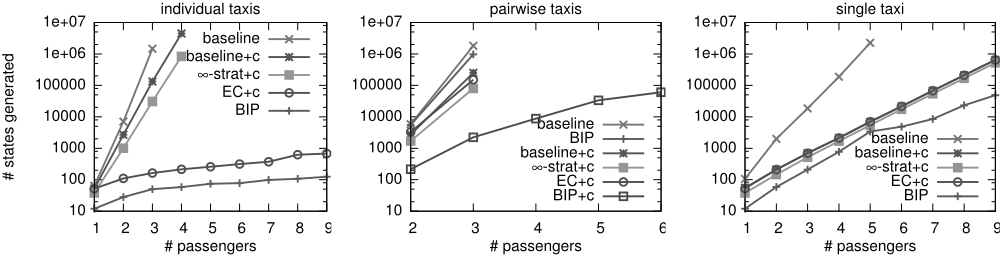
Figure 6 shows results in several taxi domains, wherein a fleet of taxis must deliver passengers from randomly chosen sources to randomly chosen destinations on a 3x3 grid. We experiment with three formulations: individual, where each passenger has their own taxi, and the causal graph is an inverted tree; pairwise, where each i of n taxis can pick up passenger i or i + 1 mod n, and the causal graph is a DAG; and single, where a single taxi must deliver all passengers, so the passenger subproblems are most tightly coupled. In all but the pairwise case, the action pruning of BIP infers that passengers should not be put down at intermediate locations; we help level the playing field by giving other algorithms this constraint explicitly (designated by "+c"); in the pairwise case, this constraint actually changes the set of optimal solutions, which we discuss later. In all settings, we see at least an order of magnitude improvement using BIP over baseline, with the advantage increasing as the passenger subproblems become less dependent. As expected, the stratified planner and EC are a small constant factor better than baseline, except on the individual setting where EC is able to exploit the complete independence of passengers.
2 LOGISTICS is one of only two previous IPC domains we have identified with unary operators (in their most natural SAS+ formulation). The other is MICONIC, for which our algorithm evaluates roughly twice the states of baseline (results not shown).
6 Conclusion
Our bounded intention planner (BIP) brings some of the benefits of hierarchical and partial-order planning to a forward state-space setting. We have proven its optimality for general unary domains, and empirically demonstrated orders of magnitude reduction in reachable state spaces and optimal planning times compared to a standard state-space search, in several domains with acyclic causal graphs. BIP is guaranteed to avoid all interleaving of actions from completely independent subproblems, and minimizes interleaving in the presence of weakly dependent subproblems.
The performance of BIP depends on two main factors. First, performance improves with the amount of (weak) independence available to exploit. In domains like MICONIC and the pairwise taxi domain with no constraint, subproblems are so tightly coupled that no advantage is seen (after picking up a passenger, we have to consider handing them off to every other vehicle at every possible intermediate location). Second, good performance depends on our partition heuristic (see Section 4.6) using cases (A-C) as much as possible.
In this case, BIP works hierarchically, reserving variables as prevail conditions, adding intended operators to help achieve those conditions, and so on, like the example given in Section 4.3. This happens often; in fact, the final case (D) was not actually executed in any problem tested above.
Many interesting extensions of the approach are possible, including: exploiting symmetric objects; further pruning of operator partitions (e.g., using action costs); solving augmented instances hierarchically using state abstraction [Wolfe et al., 2010]; and adding techniques for efficient state-space planning such as heuristics and landmarks, which will be at least as informative as in the original state space (in the worst case, one can just drop the intention variables).
Most important, of course, will be generalizations to nonunary problems. We are currently investigating several approaches, ranging from clustering variables co-occurring in postconditions, to more direct generalizations of BIP to handle multiple postconditions. Preliminary results on several domains are encouraging, but further study is needed to see how and to what degree the observed speedups can carry over to general planning problems.
7 Acknowledgements
We thank the anonymous reviewers for many helpful suggestions. This research was supported by the National Science Foundation, award #0904672.
@inproceedings{ijcai2011p340,
  title     = {Bounded Intention Planning},
  author    = {Wolfe, Jason Andrew and Russell, Stuart J.},
  booktitle = {Proceedings of the Twenty-Second International Joint Conference on
               Artificial Intelligence, {IJCAI-11}},
  publisher = {AAAI Press/International Joint Conferences on Artificial Intelligence},
  editor    = {Toby Walsh},
  pages     = {2039--2044},
  year      = {2011},
  month     = {7},
  doi       = {10.5591/978-1-57735-516-8/IJCAI11-340},
  url       = {https://doi.org/10.5591/978-1-57735-516-8/IJCAI11-340},
}
TY - CPAPER TI - Bounded Intention Planning AU - Wolfe, Jason Andrew AU - Russell, Stuart J. T2 - Proceedings of the Twenty-Second International Joint Conference on Artificial Intelligence, IJCAI-11 PB - AAAI Press/International Joint Conferences on Artificial Intelligence PY - 2011 SP - 2039 EP - 2044 DO - 10.5591/978-1-57735-516-8/IJCAI11-340 UR - https://doi.org/10.5591/978-1-57735-516-8/IJCAI11-340 ER -Copied
Machine-readable versions of this paper, for tools and AI agents:





