
Trading Off Solution Quality for Faster Computation in DCOP Search Algorithms
Proceedings of the Twenty-First International Joint Conference on Artificial Intelligence. Pages 354-359.
© 2009 International Joint Conferences on Artificial Intelligence
Abstract
Distributed Constraint Optimization (DCOP) is a key technique for solving agent coordination problems. Because finding cost-minimal DCOP solutions is NP-hard, it is important to develop mechanisms for DCOP search algorithms that trade off their solution costs for smaller runtimes. However, existing tradeoff mechanisms do not provide relative error bounds. In this paper, we introduce three tradeoff mechanisms that provide such bounds, namely the Relative Error Mechanism, the Uniformly Weighted Heuristics Mechanism and the Non-Uniformly Weighted Heuristics Mechanism, for two DCOP algorithms, namely ADOPT and BnB-ADOPT. Our experimental results show that the Relative Error Mechanism generally dominates the other two tradeoff mechanisms for ADOPT and the Uniformly Weighted Heuristics Mechanism generally dominates the other two tradeoff mechanisms for BnB-ADOPT.William Yeoh, Xiaoxun Sun, Sven Koenig
- [Ali et al., 2005] S. Ali, S. Koenig, and M. Tambe. Preprocessing techniques for accelerating the DCOP algorithm ADOPT. In Pro- ceedings of AAMAS, pages 1041-1048, 2005.
- [Bacchus et al., 2002] F. Bacchus, X. Chen, P. van Beek, and T. Walsh. Binary vs. non-binary constraints. Artificial Intelli- gence, 140(1-2):1-37, 2002.
- [Bowring et al., 2008] E. Bowring, J. Pearce, C. Portway, M. Jain, and M. Tambe. On k-optimal distributed constraint optimization algorithms: New bounds and algorithms. In Proceedings of AA- MAS, pages 607-614, 2008.
- [Burke and Brown, 2006] D. Burke and K. Brown. Efficiently han- dling complex local problems in distributed constraint optimisa- tion. In Proceedings of ECAI, pages 701-702, 2006.
- [Hart et al., 1968] P. Hart, N. Nilsson, and B. Raphael. A formal ba- sis for the heuristic determination of minimum cost paths. IEEE Transactions on Systems Science and Cybernetics, SSC4(2):100- 107, 1968.
- [Junges and Bazzan, 2008] R. Junges and A. Bazzan. Evaluating the performance of DCOP algorithms in a real world, dynamic problem. In Proceedings of AAMAS, pages 599-606, 2008.
- [Maheswaran et al., 2004] R. Maheswaran, M. Tambe, E. Bowring, J. Pearce, and P. Varakantham. Taking DCOP to the real world: Efficient complete solutions for distributed event scheduling. In Proceedings of AAMAS, pages 310-317, 2004.
- [Marinescu and Dechter, 2005] R. Marinescu and R. Dechter. AND/OR branch-and-bound for graphical models. In Proceed- ings of IJCAI, pages 224-229, 2005. IJCAI
- [Modi et al., 2005] P. Modi, W. Shen, M. Tambe, and M. Yokoo. ADOPT: Asynchronous distributed constraint optimization with quality guarantees. Artificial Intelligence, 161(1-2):149-180, 2005.
- [Pearce and Tambe, 2007] J. Pearce and M. Tambe. Quality guaran- tees on k-optimal solutions for distributed constraint optimization problems. In Proceedings of IJCAI, pages 1446-1451, 2007. IJCAI
- [Pohl, 1970] I. Pohl. First results on the effect of error in heuristic search. Machine Intelligence, 5:219-236, 1970.
- [Pohl, 1973] I. Pohl. The avoidance of (relative) catastrophe, heuristic competence, genuine dynamic weighting and compu- tational issues in heuristic problem solving. In Proceedings of IJCAI, pages 12-17, 1973. IJCAI
- [Yeoh et al., 2008] W. Yeoh, A. Felner, and S. Koenig. BnB- ADOPT: An asynchronous branch-and-bound DCOP algorithm. In Proceedings of AAMAS, pages 591-598, 2008.
- [Yokoo, 2001] M. Yokoo, editor. Distributed Constraint Satis- faction: Foundation of Cooperation in Multi-agent Systems. Springer, 2001.
- [Zhang et al., 2005] W. Zhang, G. Wang, Z. Xing, and L. Witten- berg. Distributed stochastic search and distributed breakout: Properties, comparison and applications to constraint optimiza- tion problems in sensor networks. Artificial Intelligence, 161(1- 2):55-87, 2005.
References were extracted automatically from the PDF and may contain errors.
Full text extracted automatically from the PDF; figures, tables and equations may differ. The PDF is the version of record.
1 Introduction
Many agent coordination problems can be modeled as Distributed Constraint Optimization (DCOP) problems, including the scheduling of meetings [Maheswaran et al., 2004], the allocation of targets to sensors in sensor networks [Ali et al., 2005] and the coordination of traffic lights [Junges and Bazzan, 2008]. Complete DCOP algorithms, such as ADOPT [Modi et al., 2005], find globally optimal DCOP solutions but have a large runtime, while incomplete DCOP algorithms, such as DBA [Zhang et al., 2005], find only locally optimal DCOP solutions but have a significantly smaller runtime. Because finding optimal DCOP solutions is NP-hard [Modi et al., 2005], it is important to develop mechanisms for DCOP algorithms that trade off their solution costs for smaller runtimes. Some complete DCOP algorithms, for example, allow users to specify an error bound on the solution cost. ADOPT is an example. Some incomplete DCOP algorithms allow users to specify the size k of the locally optimal groups. These DCOP algorithms partition the DCOP problem into groups of at most k agents and guarantee that their DCOP solution is optimal within these groups. The class of k-optimal algorithms [Pearce and Tambe, 2007] is an example. However, efficient implementations for k-optimal algorithms are so far known only for k ≤ 3 [Bowring et al., 2008].
∗This material is based upon work supported by, or in part by, the U.S. Army Research Laboratory and the U.S. Army Research Office under contract/grant number W911NF-08-1-0468 and by NSF under contract 0413196. The views and conclusions contained in this document are those of the authors and should not be interpreted as representing the official policies, either expressed or implied, of the sponsoring organizations, agencies, companies or the U.S. government. An earlier version of this paper without the Non-Uniformly Weighted Heuristics Mechanism and with many fewer experimental results appeared in AAMAS 2008 as a short paper.
We therefore seek to improve the tradeoff mechanisms of a subclass of complete DCOP algorithms, namely complete DCOP search algorithms. ADOPT is, to the best of our knowledge, the only complete DCOP search algorithm with such a tradeoff mechanism. Its Absolute Error Mechanism allows users to specify absolute error bounds on the solution costs, for example that the solution costs should be at most 10 larger than minimal. The downside of this tradeoff mechanism is that it is impossible to set relative error bounds, for example that the solution costs should be at most 10 percent larger than minimal, without knowing the optimal solution costs. In this paper, we therefore introduce three tradeoff mechanisms that provide such bounds, namely the Relative Error Mechanism, the Uniformly Weighted Heuristics Mechanism and the Non-Uniformly Weighted Heuristics Mechanism, for two complete DCOP algorithms, namely ADOPT and BnB-ADOPT [Yeoh et al., 2008]. BnB-ADOPT is a variant of ADOPT that uses a depth-first branch-and-bound search strategy instead of a best-first search strategy and has been shown to be faster than ADOPT on several DCOP problems [Yeoh et al., 2008]. Our experimental results on graph coloring, sensor network scheduling and meeting scheduling problems show that the Relative Error Mechanism generally dominates the other two tradeoff mechanisms for ADOPT and the Uniformly Weighted Heuristics Mechanism generally dominates the other two tradeoff mechanisms for BnBADOPT.
2 DCOP Problems
A DCOP problem is defined by a finite set of agents (or, synonymously, variables) X = {x1, x2, ..., xn}; a set of finite domains D = {D1,D2, ...,Dn}, where domain Di is the set of possible values of agent xi ∈ X; and a set of binary constraints F = {f1, f2, ..., fm}, where constraint fi : Dij × Dik → R+ ∪ ∞ specifies its non-negative constraint cost as a function of the values of distinct agents xij , xik ∈ X that share the constraint. 1 Each agent assigns itself repeatedly a value from its domain. The agents coordinate their value assignments via messages that they exchange with other agents. A complete solution is an agentvalue assignment for all agents, while a partial solution is an agent-value assignment for a subset of agents. The cost of a complete solution is the sum of the constraint costs of all constraints, while the cost of a partial solution is the sum of the constraint costs of all constraints shared by agents with known values in the partial solution. Solving a DCOP problem optimally means to find its cost-minimal complete solution.
3 Constraint Graphs and Pseudo-Trees
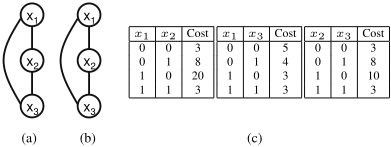
DCOP problems can be represented with constraint graphs whose vertices are the agents and whose edges are the constraints. ADOPT and BnB-ADOPT transform constraint graphs in a preprocessing step into pseudo-trees. Pseudotrees are spanning trees of constraint graphs with the property that edges of the constraint graphs connect vertices only with their ancestors or descendants in the pseudo-trees. For example, Figure 1(a) shows the constraint graph of an example DCOP problem with three agents that can each assign itself the values zero or one, and Figure 1(c) shows the constraint costs. Figure 1(b) shows one possible pseudo-tree. The dotted line is part of the constraint graph but not the pseudo-tree.
4 Search Trees and Heuristics
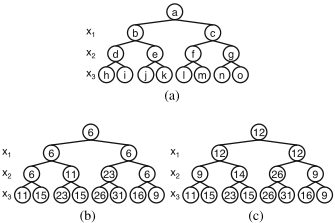
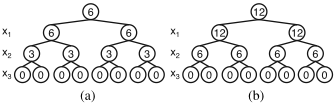
The operation of ADOPT and BnB-ADOPT can be visualized with AND/OR search trees [Marinescu and Dechter, 2005]. We use regular search trees and terminology from A* [Hart et al., 1968] for our example DCOP problem since its pseudotree is a chain. We refer to its nodes with the identifiers shown in Figure 2(a). Its levels correspond to the agents. A left branch that enters a level means that the corresponding agent assigns itself the value zero, and a right branch means that the corresponding agent assigns itself the value one. For our example DCOP problem, the partial solution of node e is (x1 = 0, x2 = 1). The f ∗ -value of a node is the minimal cost of any complete solution that completes the partial solution of the node. For our example DCOP problem, the f ∗ -value of node e is the minimum of the cost of solution (x1 = 0, x2 = 1, x3 = 0) [=23] and the cost of solution (x1 = 0, x2 = 1, x3 = 1) [=15]. Thus, the f ∗- value of node e is 15. The f ∗ -value of the root node is the minimal solution cost. Since the f ∗ -values are unknown, ADOPT and BnB-ADOPT use estimated f ∗ -values, called f - values, during their searches. They calculate the f-value of a node by summing the costs of all constraints that involve two agents with known values and adding a user-specified h-value (heuristic) that estimates the sum of the unknown costs of the remaining constraints, similarly to how A* calculates the fvalues of its nodes. For our example DCOP problem, assume that the h-value of node e is 3. Then, its f -value is 11, namely the sum of the cost of the constraint between agents x1 and x2 [=8] and its h-value. The ideal h-values result in f -values that are equal to the f ∗ -values. For our example DCOP problem, the ideal h-value of node e is 15-8 = 7. Consistent h-values do not overestimate the ideal h-values. ADOPT originally used zero h-values but was later extended to use consistent h-values [Ali et al., 2005], while BnB-ADOPT was designed to use consistent h-values. We thus assume for now that the h-values are consistent.
1 Formulations of DCOP problems where agents are responsible for several variables each can be reduced to our formulation [Yokoo, 2001; Burke and Brown, 2006]. Similarly, formulations of DCOP problems where constraints are shared by more than two agents can be reduced to our formulation [Bacchus et al., 2002].
5 ADOPT and BnB-ADOPT
We now give an extremely simplistic description of the operation of ADOPT and BnB-ADOPT to explain their search principles. For example, we assume that agents operate sequentially and information propagation is instantaneous. Complete descriptions of ADOPT and BnB-ADOPT can be found in [Modi et al., 2005; Yeoh et al., 2008].
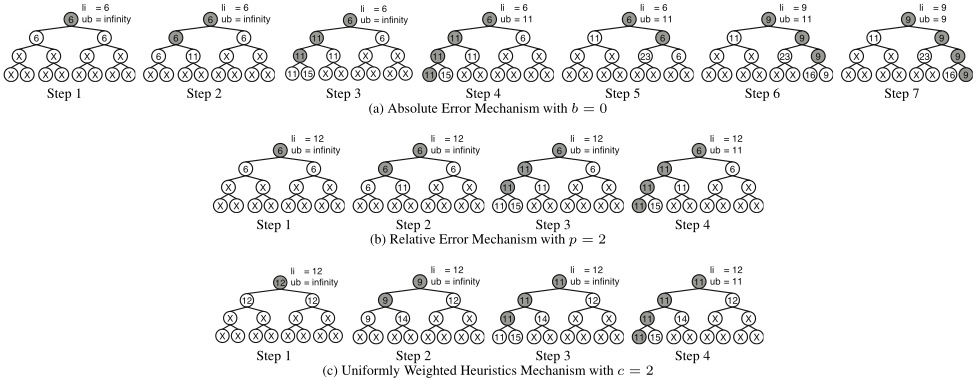
We visualize the operation of ADOPT and BnB-ADOPT on our example DCOP problem with the search trees shown in Figures 4 and 5. Unless mentioned otherwise, we use the consistent h-values from Figure 3(a), which result in the fvalues from Figure 2(b). The nodes that are being expanded and their ancestors are shaded grey.
ADOPT and BnB-ADOPT maintain lower bounds for all grey nodes and their children, shown as the numbers in the nodes. ADOPT and BnB-ADOPT initialize the lower bounds with the f-values and then always set them to the minimum of the lower bounds of the children of the nodes. Memory limitations prevent them frommaintaining the lower bounds of the other nodes, shown with crosses in the nodes. ADOPT and BnB-ADOPT also maintain upper bounds, shown as ub. They always set them to the smallest costs of any complete solutions found so far. Finally, ADOPT maintains limits (usually expressed as the thresholds of the root nodes), shown as li. It always set them to b plus the maximum of the lower bounds lb(r) and the f-values f(r) of the root nodes r [li := b + max(lb(r), f(r))], where b ≥ 0 is a userspecified absolute error bound. For consistency, we extend BnB-ADOPT to maintain these limits as well.
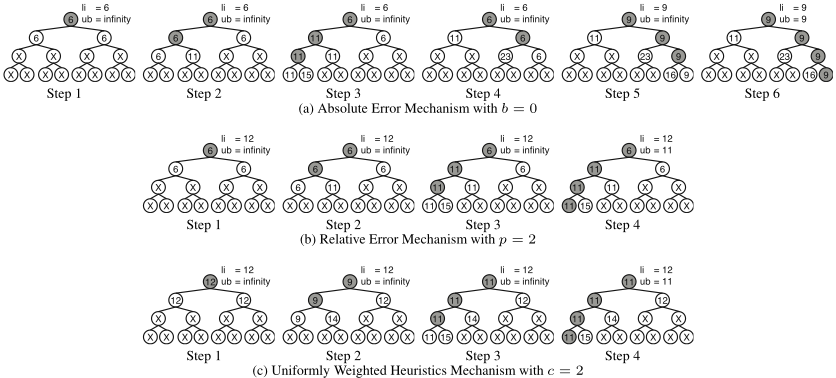
ADOPT expands nodes in a depth-first search order. It always expands the child of the current node with the smallest lower bound and backtracks when the lower bounds of all unexpanded children of the current node are larger than the limits. This search order is identical to a best-first search order if one considers only nodes that ADOPT expands for the first time. BnB-ADOPT expands nodes in a depth-first branchand-bound order. It expands the children of a node in order of their f-values and prunes those nodes whose f-values are no smaller than the upper bounds.
ADOPT and BnB-ADOPT terminate once the limits (that are equal to b plus the tightest lower bounds on the minimal solution costs) are no smaller than the upper bounds [li ≥ ub]. 2 Thus, ADOPT and BnB-ADOPT terminate with solution costs that should be at most b larger than minimal, which is why we refer to this tradeoff mechanism as the Absolute Error Mechanism. Figures 4(a) and 5(a) show execution traces of ADOPT and BnB-ADOPT, respectively, with the Absolute Error Mechanism with absolute error bound b = 0 for our example DCOP problem. Thus, they find the costminimal solution.
2 The unextended BnB-ADOPT terminates when lb(r) = ub.
6 Proposed Tradeoff Mechanisms
We argued that it is often much more meaningful to specify the relative error on the solution costs than the absolute error, which cannot be done with the Absolute Error Mechanism without knowing the minimal solution costs. In this section, we introduce three new tradeoff mechanisms with this property, namely the Relative Error Mechanism, the Uniformly Weighted Heuristics Mechanism and the NonUniformly Weighted Heuristics Mechanism.
6.1 Relative Error Mechanism
We can easily change the Absolute Error Mechanism of ADOPT and BnB-ADOPT to a Relative Error Mechanism. ADOPT and BnB-ADOPT now set the limits to p times the maximum of the lower bounds lb(r) and the f-values f(r) of the root nodes r [li := p ×max(lb(r), f(r))], where p ≥ 1 is a user-specified relative error bound. ADOPT and BnBADOPT still terminate once the limits (that are now equal to p times the tightest lower bounds on the minimal solution costs) are no smaller than the upper bounds. Thus, although currently unproven, they should terminate with solution costs that are at most p times larger than minimal or, equivalently, at most (p - 1) × 100 percent larger than minimal, which is why we refer to this tradeoff mechanism as the Relative Error Mechanism. The guarantee of the Relative Error Mechanism with relative error bound p is thus similar to the guarantee of the Absolute Error Mechanism with an absolute error bound b that is equal to p-1 times the minimal solution cost, except that the user does not need to know the minimal solution cost.
Figures 4(b) and 5(b) show execution traces of ADOPT and BnB-ADOPT, respectively, with the Relative Error Mechanism with p = 2 for our example DCOP problem. For example, after ADOPT expands node d in Step 3, the lower bound [=11] of unexpanded child h of node e is no larger than the limit [=12]. ADOPT thus expands the child [=h] with the smallest lower bound in Step 4. The limit is now no smaller than the upper bound and ADOPT terminates. However, after ADOPT in Figure 4(a) expands node d in Step 3, the lower bounds of all unexpanded children of node d are larger than the limit. ADOPT backtracks repeatedly, expands node c next and terminates eventually in Step 6. Thus, ADOPT with the Relative Error Mechanism with relative error bound p = 2 terminates two steps earlier than in Figure 4(a) but with a solution cost that is 2 larger.
6.2 UniformlyWeighted Heuristics Mechanism
The h-values should be as close as possible to the ideal h-values to minimize the runtimes of ADOPT and BnBADOPT. We therefore multiply consistent h-values with a user-specified constant weight c ≥ 1, which can result in them no longer being consistent, similar to what others have done in the context of A* where they could prove that A* is then no longer guaranteed to find cost-minimal solutions but is still guaranteed to find solutions whose costs are at most c times larger than minimal [Pohl, 1970]. ADOPT and BnB-ADOPT use no error bounds, that is, either the Absolute Error Mechanism with absolute error bound b = 0 or the Relative Error Mechanism with relative error bound p = 1. They terminate once the lower bounds of the root nodes (that can now be at most c times larger than the minimal solution costs and thus, despite their name, are no longer lower bounds on the minimal solution costs) are no smaller than the upper bounds. Thus, although currently unproven, ADOPT and BnB-ADOPT should terminate with solution costs that are at most c times larger than minimal. Therefore, the Uniformly Weighted Heuristics Mechanism has similar advantages as the Relative Error Mechanism but achieves them differently. The Uniformly Weighted Heuristics Mechanism inflates the lower bounds of branches of the search trees that are yet to be explored and thus makes them appear to be less promising, while the Relative Error Mechanism prunes all remaining branches once the early termination condition is satisfied.
Figures 4(c) and 5(c) show execution traces of ADOPT and BnB-ADOPT, respectively, with the Uniformly Weighted Heuristics Mechanism with constant weight c = 2 for our example DCOP problem. Figure 3(b) shows the corresponding h-values, and Figure 2(c) shows the corresponding f-values. ADOPT terminates two steps earlier than in Figure 4(a) but with a solution cost that is 2 larger.
6.3 Non-Uniformly Weighted Heuristics Mechanism
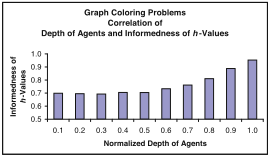
The h-values of agents higher up in the pseudo-tree are often less informed than the h-values of agents lower in the pseudotree. The informedness of h-values is defined as the ratio of the h-values and the ideal h-values. We run experiments using the same experimental formulation and setup as [Maheswaran et al., 2004; Yeoh et al., 2008] on graph coloring problems with 10 agents/vertices, density 2 and domain cardinality 3 to confirm this correlation. We use the preprocessing framework DP2 [Ali et al., 2005], that calculates the h-values by solving relaxed DCOP problems (that result from ignoring backedges) with a dynamic programming approach. DP2 was developed in the context of ADOPT but applies unchanged to BnB-ADOPT as well. Figure 6 shows the results. The y-axis shows the informedness of the h-values, and the x-axis shows the normalized depth of the agents in the pseudo-tree. The informedness of the h-values indeed increases as the normalized depth of the agents increases. Pearson's correlation coefficient shows a large correlation with ρ > 0.85. Motivated by this insight, we multiply consistent h-values with weights that vary according to the depths of the agents, similar to what others have done in the context of A* [Pohl, 1973]. We set the weight of agent xi to 1+(c-1)×(1-d(xi)/N), where c is a user-specified maximum weight, d(xi) is the depth of agent xi in the pseudo-tree and N is the depth of the pseudo-tree. This way, the weights decrease with the depth of the agents. Everything else is the same as for the Uniformly Weighted Heuristics Mechanism. The resulting weights are no larger than the weights used by the Uniformly Weighted Heuristics Mechanism with constant weight c. Thus, although currently unproven, ADOPT and BnB-ADOPT should terminate with solution costs that are at most c times larger than minimal.
| ADOPT | BnB-ADOPT | ||||||||||||||||||||
|---|---|---|---|---|---|---|---|---|---|---|---|---|---|---|---|---|---|---|---|---|---|
| Relative Error Bound | 1.0 | 1.2 | 1.4 | 1.6 | 1.8 | 2.0 | 2.2 | 2.4 | 2.6 | 2.8 | 3.0 | 1.0 | 1.2 | 1.4 | 1.6 | 1.8 | 2.0 2.2 | 2.4 | 2.6 | 2.8 | 3.0 |
| AE Mechanism | 508 | 515 | 547 | 568 | 571 | 577 | 577 | 577 | 577 | 577 | 577 | 508 | 518 | 545 | 569 | 573 | 579 579 | 579 | 579 | 579 | 579 |
| RE Mechanism | 508 | 513 | 543 | 558 | 571 | 572 | 577 | 577 | 577 | 577 | 577 | 508 | 515 | 544 | 559 | 572 | 573 579 | 579 | 579 | 579 | 579 |
| UWHMechanism | 508 | 514 | 535 | 555 | 593 | 607 | 622 | 644 | 654 | 675 | 704 | 508 | 515 | 533 | 558 | 594 | 609 630 | 663 | 705 | 724 | 727 |
| NUWHMechanism | 508 | 513 | 540 | 559 | 596 | 605 | 618 | 651 | 660 | 663 | 663 | 508 | 514 | 541 | 559 | 596 | 605 620 | 648 | 660 | 669 | 669 |
| ADOPT | BnB-ADOPT | ||||||||||||||||||||
|---|---|---|---|---|---|---|---|---|---|---|---|---|---|---|---|---|---|---|---|---|---|
| Relative Error Bound | 1.0 | 1.2 | 1.4 | 1.6 | 1.8 | 2.0 | 2.2 | 2.4 | 2.6 | 2.8 | 3.0 | 1.0 | 1.2 | 1.4 | 1.6 | 1.8 | 2.0 2.2 | 2.4 | 2.6 | 2.8 | 3.0 |
| AE Mechanism | 116 | 119 | 124 | 130 | 133 | 134 | 133 | 135 | 135 | 136 | 136 | 116 | 118 | 124 | 130 | 133 | 136 138 | 138 | 138 | 139 | 139 |
| RE Mechanism | 116 | 118 | 122 | 127 | 131 | 133 | 133 | 133 | 133 | 135 | 135 | 116 | 117 | 122 | 127 | 131 | 133 135 | 135 | 137 | 138 | 138 |
| UWHMechanism | 116 | 119 | 124 | 130 | 139 | 144 | 148 | 154 | 153 | 155 | 160 | 116 | 118 | 126 | 134 | 142 | 148 153 | 158 | 156 | 160 | 165 |
| NUWHMechanism | 116 | 118 | 125 | 133 | 141 | 144 | 148 | 152 | 159 | 162 | 165 | 116 | 118 | 126 | 135 | 143 | 148 151 | 156 | 162 | 163 | 166 |
| ADOPT | BnB-ADOPT | ||||||||||||||||
|---|---|---|---|---|---|---|---|---|---|---|---|---|---|---|---|---|---|
| Relative Error Bound | 1.0 1.2 | 1.4 | 1.6 | 1.8 | 2.0 | 2.2 2.4 | 2.6 | 2.8 | 3.0 | 1.0 | 1.2 | 1.4 | 1.6 1.8 | 2.0 2.2 | 2.4 2.6 | 2.8 | 3.0 |
| AE Mechanism RE Mechanism UWHMechanism NUWHMechanism | 54207 54256 54207 54284 54207 54207 54207 54207 | 56819 54771 54944 54697 | 61326 57381 57423 58071 | 64204 60146 62344 62022 | 64380 62754 64391 64342 | 64539 64539 63998 64525 64792 66488 66065 66987 | 64539 64539 67411 68216 | 64539 64539 67913 68010 | 64539 64539 68473 68481 | 54207 54207 54207 54207 | 54221 54207 54207 54207 | 56018 54454 54733 54639 | 63149 67681 56088 61277 58410 62636 58443 63105 | 69326 69732 64515 67271 66160 66812 66156 67878 | 69863 69863 68891 69231 68253 69541 69483 70120 | 69863 69601 70389 70143 | 69863 69863 70840 70942 |
| BnB-ADOPT | ||||||||||||||||||||
|---|---|---|---|---|---|---|---|---|---|---|---|---|---|---|---|---|---|---|---|---|
| Relative Error Bound | 1.0 1.2 | 1.4 | 1.6 | 1.8 | ADOPT 2.0 | 2.2 | 2.4 | 2.6 | 2.8 | 3.0 | 1.0 | 1.2 | 1.4 | 1.6 | 1.8 | 2.0 | 2.2 | 2.4 | 2.6 | 2.8 3.0 |
| AE Mechanism | 67675 67795 | 71744 | 78149 | 79322 | 79591 | 79591 | 79591 | 79591 | 79591 | 79591 | 67675 | 67705 | 71566 | 78770 | 82645 | 83439 | 83768 | 83768 | 83768 | 83768 83768 |
| RE Mechanism | 67675 67700 | 68894 | 73059 | 77387 | 78556 | 79197 | 79591 | 79591 | 79591 | 79591 | 67675 | 67691 | 68705 | 72027 | 77020 | 80160 | 82223 | 82845 | 83439 | 83768 83768 |
| UWHMechanism | 67675 67795 | 68868 | 73084 | 76433 | 77808 | 79632 | 80747 | 80889 | 82046 | 83452 | 67675 | 67675 | 68543 | 71864 | 76812 | 80605 | 81947 | 82578 | 82824 | 82509 82509 |
| NUWHMechanism | 67675 67689 | 69055 | 72684 | 75716 | 77863 | 78658 | 79431 | 80787 | 82109 | 82580 | 67675 | 67675 | 67675 | 67683 | 67878 | 69296 | 69613 | 70676 | 72036 | 72983 73926 |
| ADOPT | BnB-ADOPT | |||||||||||||||||||||
|---|---|---|---|---|---|---|---|---|---|---|---|---|---|---|---|---|---|---|---|---|---|---|
| Relative Error Bound | 1.0 | 1.2 | 1.4 | 1.6 | 1.8 | 2.0 | 2.2 | 2.4 | 2.6 2.8 | 3.0 | 1.0 | 1.2 | 1.4 | 1.6 | 1.8 | 2.0 2.2 | 2.4 | 2.6 | 2.8 | 3.0 | ||
| AE Mechanism | N/A | 76669 | 80699 | 89978 | 92415 | 93095 | 93095 | 93095 | 93095 93095 | 93095 | 76465 | 76465 | 80231 | 91334 | 96922 | 99717 | 99717 99717 | 99717 | 99717 | 99717 | ||
| RE Mechanism | N/A | N/A | 77411 | 82443 | 87841 91373 | 92907 | 93095 | 93095 93095 | 93095 | 76465 | 76465 | 77401 | 80865 | 87210 | 93726 97048 | 98925 | 99166 | 99717 | 99717 | |||
| UWHMechanism | N/A | N/A | 77285 | 81422 | 86407 91124 | 91881 | 92713 | 94694 95195 | 96683 | 76465 | 76465 | 77064 | 80848 | 87589 | 92584 95716 | 97479 | 97701 | 97992 | 97958 | |||
| NUWHMechanism | N/A | N/A | 77648 | 81513 | 86780 89816 | 91509 | 93413 | 94263 94455 | 95422 | 76465 | 76465 | 76465 | 76479 | 76837 | 77334 78424 | 79773 | 81234 | 82661 | 84266 | |||
Table 1: Experimental Results on the Solution Costs
7 Experimental Results
We compare ADOPT and BnB-ADOPT with the Absolute Error Mechanism, the Relative Error Mechanism, the Uniformly Weighted Heuristics Mechanism and the NonUniformly Weighted Heuristics Mechanism. We use the DP2 preprocessing framework to generate the h-values. We run experiments using the same experimental formulation and setup as [Maheswaran et al., 2004; Yeoh et al., 2008] on graph coloring problems with 10, 12 and 14 agents/vertices, density 2 and domain cardinality 3; sensor network scheduling problems with 9 agents/sensors and domain cardinality 9; and meeting scheduling problems with 10 agents/meetings and domain cardinality 9. We average the experimental results over 50 DCOP problem instances each. We measure the runtimes in cycles [Modi et al., 2005] and normalize them by dividing them by the runtimes of the same DCOP algorithm with no error bounds. We normalize the solution costs by dividing them by the minimal solution costs. We vary the relative error bounds from 1.0 to 4.0. We use the relative error bounds both as the relative error bounds for the Relative Error Mechanism, the constant weights for the Uniformly Weighted Heuristics Mechanism and the maximum weights for the Non-Uniformly Weighted Heuristics Mechanism. We pre-calculate the minimal solution costs and use them to calculate the absolute error bounds for the Absolute Error Mechanism from the relative error bounds.
Tables 1 and 2 tabulate the solution costs and runtimes of ADOPT and BnB-ADOPT with the different tradeoff mechanisms. We set the runtime limit to be 5 hours for each DCOP algorithm. Data points for DCOP algorithms that failed to terminate within this limit are labeled 'N/A' in the tables. We did not tabulate the data for all data points due to space constraints.
Figure 7 shows the results on the graph coloring problems with 10 agents. We do not show the results on the graph coloring problems with 12 and 14 agents, sensor network scheduling problems and meeting scheduling problems since they are similar. Figures 7(a1) and 7(b1) show that the normalized solution cost increases as the relative error bound increases, indicating that the solution quality of ADOPT and BnB-ADOPT decreases. The solution quality remains significantly better than predicted by the error bounds. For example, the normalized solution cost is less than 1.4 (rather than 3.0) when the relative error bound is 3.0.
| ADOPT | BnB-ADOPT | ||||||||||||||||||||
|---|---|---|---|---|---|---|---|---|---|---|---|---|---|---|---|---|---|---|---|---|---|
| Relative Error Bound | 1.0 | 1.2 | 1.4 | 1.6 | 1.8 | 2.0 | 2.2 | 2.4 | 2.6 2.8 | 3.0 | 1.0 | 1.2 | 1.4 | 1.6 | 1.8 2.0 | 2.2 | 2.4 | 2.6 | 2.8 | 3.0 | |
| AE Mechanism | 5069 | 74 | 37 | 14 | 13 | 13 | 13 | 13 | 13 13 | 13 | 431 | 102 | 38 | 14 | 13 | 13 | 13 | 13 | 13 | 13 | 13 |
| RE Mechanism | 5069 | 96 | 42 | 15 | 14 | 13 | 13 | 13 | 13 | 13 13 | 431 | 123 | 49 | 15 | 14 | 13 | 13 | 13 | 13 | 13 | 13 |
| UWHMechanism | 5069 | 255 | 39 | 18 | 14 | 14 | 14 | 13 | 12 | 12 12 | 431 | 95 | 38 | 19 | 14 | 14 | 14 | 13 | 12 | 12 | 12 |
| NUWHMechanism | 5069 | 444 | 70 | 19 | 15 | 15 | 14 | 14 | 14 12 | 12 | 431 | 118 | 49 | 20 | 17 | 16 | 14 | 14 | 14 | 12 | 12 |
| ADOPT | BnB-ADOPT | ||||||||||||||||||||
|---|---|---|---|---|---|---|---|---|---|---|---|---|---|---|---|---|---|---|---|---|---|
| Relative Error Bound | 1.0 | 1.2 | 1.4 | 1.6 | 1.8 | 2.0 | 2.2 | 2.4 | 2.6 2.8 | 3.0 | 1.0 | 1.2 | 1.4 | 1.6 | 1.8 2.0 | 2.2 | 2.4 | 2.6 | 2.8 | 3.0 | |
| AE Mechanism | 8347 | 525 | 66 | 28 | 18 | 17 | 18 | 17 | 18 17 | 17 | 1180 | 578 | 94 | 39 | 24 | 19 | 18 | 17 | 17 | 17 | 17 |
| RE Mechanism | 8347 | 1022 | 350 | 58 | 26 | 20 | 21 | 20 | 18 17 | 18 | 1180 | 644 | 348 | 100 | 41 | 28 | 24 | 24 | 21 | 19 | 19 |
| UWHMechanism | 8347 | 1482 | 160 | 29 | 25 | 20 | 19 | 19 | 18 18 | 18 | 1180 | 344 | 133 | 41 | 28 | 24 | 23 | 21 | 19 | 18 | 18 |
| NUWHMechanism | 8347 | 2573 | 522 | 50 | 26 | 20 | 22 | 20 | 19 19 | 18 | 1180 | 485 | 265 | 68 | 34 | 26 | 27 | 22 | 20 | 20 | 17 |
| ADOPT | BnB-ADOPT | ||||||||||||||||||||
|---|---|---|---|---|---|---|---|---|---|---|---|---|---|---|---|---|---|---|---|---|---|
| Relative Error Bound | 1.0 | 1.2 | 1.4 | 1.6 | 1.8 | 2.0 | 2.2 | 2.4 | 2.6 | 2.8 3.0 | 1.0 | 1.2 | 1.4 | 1.6 | 1.8 2.0 | 2.2 | 2.4 | 2.6 | 2.8 | 3.0 | |
| AE Mechanism | 17566 | 2606 | 152 | 31 | 26 | 21 | 18 | 18 | 18 | 18 18 | 703 | 665 | 269 | 47 | 21 | 19 | 19 | 19 | 19 | 19 | 19 |
| RE Mechanism | 17566 | 3819 | 1496 | 291 | 51 | 26 | 22 | 19 | 19 | 18 18 | 703 | 677 | 578 | 304 | 67 | 44 | 23 | 19 | 19 | 19 | 19 |
| UWHMechanism | 17566 | 8625 | 2284 | 87 | 30 | 20 | 18 | 17 | 17 | 17 17 | 703 | 523 | 318 | 102 | 38 | 21 | 18 | 18 | 17 | 17 | 17 |
| NUWHMechanism | 17566 | 13804 | 5665 | 808 | 44 | 22 | 18 | 18 | 17 | 17 17 | 703 | 636 | 487 | 177 | 48 | 23 | 18 | 18 | 18 | 18 | 17 |
| ADOPT | BnB-ADOPT | ||||||||||||||||||||
|---|---|---|---|---|---|---|---|---|---|---|---|---|---|---|---|---|---|---|---|---|---|
| Relative Error Bound | 1.0 | 1.2 | 1.4 | 1.6 | 1.8 | 2.0 | 2.2 | 2.4 | 2.6 2.8 | 3.0 | 1.0 | 1.2 | 1.4 | 1.6 | 1.8 | 2.0 | 2.2 | 2.4 | 2.6 | 2.8 | 3.0 |
| AE Mechanism | 42256 | 6499 | 820 | 36 | 21 | 21 | 21 | 21 | 21 21 | 21 | 1007 | 959 | 424 | 51 | 22 | 21 | 21 | 21 | 21 | 21 | 21 |
| RE Mechanism | 42256 | 7857 | 3557 | 1255 | 201 | 36 | 32 | 21 | 21 21 | 21 | 1007 | 983 | 793 | 476 | 173 | 64 | 40 | 27 | 21 | 21 | 21 |
| UWHMechanism | 42256 | 18507 | 4556 | 831 | 84 | 30 | 21 | 20 | 19 19 | 19 | 1007 | 745 | 436 | 206 | 68 | 35 | 24 | 22 | 21 | 21 | 21 |
| NUWHMechanism | 42256 | 34009 | 13226 | 3222 | 558 | 29 | 28 | 20 | 19 19 | 19 | 1007 | 834 | 692 | 536 | 412 | 315 | 244 | 185 | 150 | 117 | 93 |
| ADOPT | BnB-ADOPT | |||||||||||||||||||||
|---|---|---|---|---|---|---|---|---|---|---|---|---|---|---|---|---|---|---|---|---|---|---|
| Relative Error Bound | 1.0 | 1.2 | 1.4 | 1.6 | 1.8 | 2.0 | 2.2 | 2.4 | 2.6 | 2.8 | 3.0 | 1.0 | 1.2 | 1.4 | 1.6 | 1.8 | 2.0 | 2.2 | 2.4 | 2.6 | 2.8 | 3.0 |
| AE Mechanism | N/A | 29983 | 712 | 53 | 29 | 24 | 24 | 24 | 24 | 24 | 24 | 2048 | 1956 | 861 | 85 | 28 | 24 | 24 | 24 | 24 | 24 | 24 |
| RE Mechanism | N/A | N/A | 16234 | 2687 | 102 | 30 | 25 | 24 | 24 | 24 | 24 | 2048 | 1994 | 1678 | 883 | 204 | 41 | 25 | 24 | 24 | 24 | 24 |
| UWHMechanism | N/A | N/A | 8710 | 956 | 54 | 27 | 23 | 22 | 22 | 22 | 22 | 2048 | 1355 | 683 | 254 | 73 | 30 | 24 | 23 | 23 | 23 | 23 |
| NUWHMechanism | N/A | N/A | 49484 | 6712 | 79 | 32 | 22 | 22 | 22 | 21 | 21 | 2048 | 1581 | 1197 | 879 | 618 | 442 | 332 | 230 | 187 | 151 | 124 |
Table 2: Experimental Results on the Runtimes
Figures 7(a2) and 7(b2) show that the normalized runtime decreases as the relative error bound increases, indicating that ADOPT and BnB-ADOPT terminate earlier. In fact, their normalized runtime is almost zero when the relative error bound reaches about 1.5 for ADOPT and 2.0 for BnBADOPT.
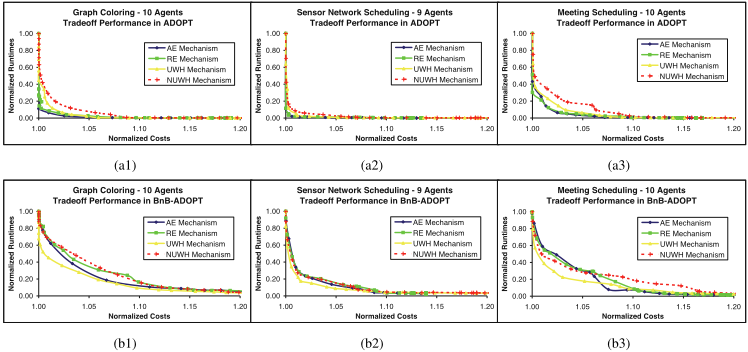
Figure 8 plots the normalized runtime needed to achieve a given normalized solution cost. It compares ADOPT (top) and BnB-ADOPT (bottom) with the different tradeoff mechanisms on the graph coloring problems with 10 agents (left), sensor network scheduling problems (center) and meeting scheduling problems (right). For ADOPT, the Absolute Error Mechanism and the Relative Error Mechanism perform better than the other two mechanisms. However, the Relative Error Mechanism has the advantage over the Absolute Error Mechanism that relative error bounds are often more desirable than absolute error bounds. For BnB-ADOPT, on the other hand, the Uniformly Weighted Heuristics Mechanism performs better than the other three mechanisms. For example, on graph coloring problems with 10 agents, the normalized runtime needed to achieve a normalized solution cost of 1.05 is about 0.25 for the Uniformly Weighted Heuristics Mechanism, about 0.30 for the Absolute Error Mechanism, about
0.35 for the Relative Error Mechanism and about 0.40 for the Non-Uniformly Weighted Heuristics Mechanism. This trend is consistent across the three DCOP problem classes. Thus, the UniformlyWeighted Heuristics Mechanism generally dominates the other proposed or existing tradeoff mechanisms in performance and is thus the preferred choice. This is a significant result since BnB-ADOPT has been shown to be faster than ADOPT by an order of magnitude on several DCOP problems [Yeoh et al., 2008] and our results allow one to speed it up even further.
8 Conclusions
In this paper, we introduced three mechanisms that trade off the solution costs of DCOP algorithms for smaller runtimes, namely the Relative Error Mechanism, the Uniformly Weighted Heuristics Mechanism and the Non-Uniformly Weighted Heuristics Mechanism. These tradeoff mechanisms provide relative error bounds and thus complement the existing Absolute Error Mechanism, that provides only absolute error bounds. For ADOPT, the Relative Error Mechanism is similar in performance to the existing tradeoff mechanism but has the advantage that relative error bounds are often more desirable than absolute error bounds. For BnB-ADOPT, the Uniformly Weighted Heuristics Mechanism generally dominates the other proposed or existing tradeoff mechanisms in performance and is thus the preferred choice. In general, we expect our tradeoff mechanisms to apply to other DCOP search algorithms as well since all of them perform search and thus benefit from using h-values to focus their searches.

@inproceedings{ijcai2009p67,
  title     = {Trading Off Solution Quality for Faster Computation in DCOP Search Algorithms},
  author    = {Yeoh, William and Sun, Xiaoxun and Koenig, Sven},
  booktitle = {Proceedings of the Twenty-First International Joint Conference on
               Artificial Intelligence, {IJCAI-09}},
  publisher = {International Joint Conferences on Artificial Intelligence},
  editor    = {Craig Boutilier},
  pages     = {354--359},
  year      = {2009},
  url       = {https://ijcai.org/proceedings/2009/67},
}
TY - CPAPER TI - Trading Off Solution Quality for Faster Computation in DCOP Search Algorithms AU - Yeoh, William AU - Sun, Xiaoxun AU - Koenig, Sven T2 - Proceedings of the Twenty-First International Joint Conference on Artificial Intelligence, IJCAI-09 PB - International Joint Conferences on Artificial Intelligence PY - 2009 SP - 354 EP - 359 UR - https://ijcai.org/proceedings/2009/67 ER -Copied
Machine-readable versions of this paper, for tools and AI agents:





