
Multi-Step Multi-Sensor Hider-Seeker Games
Proceedings of the Twenty-First International Joint Conference on Artificial Intelligence. Pages 159-165.
© 2009 International Joint Conferences on Artificial Intelligence
Abstract
We study a multi-step hider-seeker game where the hider is moving on a graph and, in each step, the seeker is able to search c subsets of the graph nodes. We model this game as a zero-sum Bayesian game, which can be solved in weakly polynomial time in the players' action spaces. The seeker's action space is exponential in c, and both players' action spaces are exponential in the game horizon. To manage this intractability, we use a column/constraint generation approach for both players. This approach requires an oracle to determine best responses for each player. However, we show that computing a best response for the seeker is NP-hard, even for a single-step game when c is part of the input, and that computing a best response is NP-hard for both players for the multi-step game, even if c = 1. An integer programming formulation of the best response for the hider is practical for moderate horizons, but computing an exact seeker best response is impractical due to the exponential dependence on both c and the horizon. We therefore develop an approximate best response oracle with bounded suboptimality for the seeker. We prove performance bounds on the strategy that results when column/constraint generation with approximate best responses converges, and we measure the performance of our algorithm in simulations. In our experimental results, column/constraint generation converges to near-minimax strategies for both players fairly quickly.Erik Daniel Halvorson, Vincent Conitzer, Ronald Parr
- [Adler et al., 2003] M. Adler, H. Racke, N. Sivadasan, C. Sohler, and B. Vocking. Randomized pursuit-evasion in graphs. Combinatorics, Probability and Computing, 12:225-244, 2003.
- [Bertsimas and Tsitsiklis, 1997] Dimitris Bertsimas and John N. Tsitsiklis. Introduction to Linear Optimization. Athena Scientific, 1997.
- [Fowler et al., 1980] R. J. Fowler, M. S. Paterson, and S. L. Tanimoto. Optimal packing and covering in the plane are NP-complete. Information Processing Letters, 12(3):133- 137, 1980.
- [Isaacs, 1965] R. Isaacs. Differential Games: A Mathemati- cal Theory with Applications to Warfare, Pursuit, Control and Optimization. Wiley, 1965.
- [Isler et al., 2004] V. Isler, S. Kannan, and S. Khanna. Ran- domized pursuit-evasion with limited visibility. In ACM- SIAM Symposium on Discrete Algorithms, pages 1060- 1069, 2004.
- [Kohli et al., 1994] R. Kohli, R. Krishnamurti, and P. Mir- chandani. The minimum satisfiability problem. SIAM Journal on Discrete Mathematics, 7(2):275-283, 1994.
- [Koller and Megiddo, 1992] D. Koller and N. Megiddo. The complexity of two-person zero-sum games in extensive form. Games and Economic Behavior, 4(4):528-552, 1992.
- [McMahan et al., 2003] H. B. McMahan, G. Gordon, and A. Blum. Planning in the presence of cost functions con- trolled by an adversary. In International Conference on Machine Learning (IMCL), 2003.
- [Megiddo et al., 1988] N. Megiddo, S. Hakimi, M. Garey, D. Johnson, and C. Papadimitriou. The complexity of searching a graph. JACM, 35(1):18-44, 1988.
- [Parsons, 1976] T. Parsons. Pursuit-evasion in a graph. In Y. Alavi and D. Lick, editors, Theory and Applications of Graphs, pages 426-441. Springer-Verlag, 1976.
- [von Stengel, 1996] B. von Stengel. Efficient computation of behavior strategies. Games and Economic Behavior, 14(2):220-246, 1996.
References were extracted automatically from the PDF and may contain errors.
Full text extracted automatically from the PDF; figures, tables and equations may differ. The PDF is the version of record.
1 Introduction
Consider a sensor network (the seeker) that has been tasked with locating a single, mobile target (the hider) given a probability distribution over initial hider locations. How should the hider move to avoid being located? How should the seeker sensors be aimed to maximize the probability of locating the target? These questions are linked: depending on the aims chosen by the seeker, the hider should move differently, and vice versa. Consequently, solving this problem requires using techniques from game theory. This paper models this hiderseeker problem as a two-player, zero-sum Bayesian game, and then searches for an equilibrium.
Zero-sum games can be formulated as linear programs. However, this requires enumerating all of the actions for both players, which can be difficult for our hider-seeker game if the seeker has many sensors or if the game consists of multiple steps of searching. We address this difficulty by using the classical techniques of column and constraint generation. As presented by McMahan et al., [2003], this can be viewed as a "double oracle" algorithm. The algorithm starts with a small set of actions available to each player, solves a restricted game where the players can use only actions in the set, generates new actions for the players by computing best responses to the equilibrium strategies in the restricted game, and repeats until convergence. This algorithm is sound and complete, and is often capable of computing the minimax solution after generating only a small subset of the full action spaces.
The double oracle approach requires best response oracles for both players. While in many games best responses can be computed quickly, we show that, in our hider-seeker game, computing such responses is NP-hard for both players for the multi-step case, and NP-hard for the seeker even for the single-step case. An integer programming formulation of the best response for the hider is practical for moderate horizons, but computing an exact seeker best response is impractical due to the exponential dependence on both the number of sensors available to the seeker and the horizon. Consequently, we develop an approximation algorithm for the seeker best response problem, and use this algorithm in conjunction with the double oracle algorithm to generate an approximate minimax solution.
2 Previous Work
Pursuit-evasion games were first proposed by Isaacs [1965] as a continuous-space problem. Parsons [1976] introduced a discrete formulation which takes place on a graph, and considered the problem of computing the number of pursuers necessary to capture an arbitrarily quick evader who is aware of the locations of the pursuers. Megiddo et al. [1988] proved that computing the smallest number of pursuers (the search number) required to clear a general graph is NP-hard, but can be computed in linear time on a tree. Adler et al. [2003] study the pursuit-evasion problem on a graph where the evader can move arbitrarily, but is unaware of the location of the pursuer.
They develop pursuit strategies which give the pursuer a high probability of capture in a bounded number of steps. Isler et al. [2004] consider a pursuit-evasion problem where both the pursuer and the evader have a limited sight range. They demonstrate that a single pursuer is not sufficient to capture such an evader, but give an algorithm directing two pursuers which provably captures the evader in finite time.
The hider-seeker game discussed in this paper differs from the classical graph-based pursuit-evasion games in two ways. First, the seeker is not constrained to move on the graph, but rather chooses to search c elements from a discrete set of possible observations, each of which is a subset of the vertices. Another difference is that our hider-seeker game has a fixed length. An example of such a game would be a fugitive hider moving through a 2-dimensional grid while a seeker directs several cameras on unmanned aerial vehicles with finite fuel supplies to search for the hider. In this example, the graph would be a regular grid and the observations would correspond to aim points for the cameras on the UAVs. This is a reasonable abstraction of how a group of UAVs could monitor an area by flying in a circular pattern over an area of interest and using pan/tilt cameras to quickly focus on small regions of the larger area.
3 Preliminaries
Our hider-seeker game takes place on a directed graph G = (V,E). In each step, the hider can move from a vertex v to a vertex v′ ∈ N(v), where N(v) = {v′ ∈ V |(v, v′ ) ∈ E)}. Let Φ be the set of aims available to the seeker, each of which sees some subset φ ⊂ V of vertices. In each step, the seeker chooses a subset φc ⊂ Φ, with |φc | = c, of aims to search. Φc will denote the set of φc , i.e., the set of size c subsets of Φ. We assume that there is a prior π (known to both players) over the hider's starting location. The seeker has captured the hider in step t if the hider moves into a vertex v′ during time step t such that v′ ∈ φ for one of the seeker's chosen aims in the step t. The length of the game is T steps.
We model this game as a two-player zero-sum Bayesian game. Bayesian games give a general framework representing the players' uncertainty about the availability of actions and/or the payoffs of actions. In general, these each depend on the player's type, which is privately held information. Formally, a two-player zero-sum Bayesian game is described by a tuple (Θ1, Θ2, A1, A2, α1, α2, Π, u), where: Θ1 and Θ2 are the type spaces of the players; A1 and A2 are the sets of actions available to each player; and α1 : Θ1 → 2A1 and α2 : Θ2 → 2A2 indicate which subsets of actions are available to each player given his type. Π : Θ1 × Θ2 → [0, 1] is a prior over types, and u : Θ1 × Θ2 × A1 × A2 → ℜ is the game's payoff function (since the game is zero-sum, we only specify player 1's utility function). At the beginning of the game, each player is revealed his own type, which is drawn randomly according to Π. Each player is uncertain of the other player's type.
Our hider-seeker game is a special case of this general framework in which just one player, the hider, has multiple types. Hider types correspond to starting vertices (the only private information that the hider has is his starting vertex), so we use v ∈ V to denote the hider's type, and the prior Π
over types is the same as the prior π over hider starting locations. For each hider type v ∈ V , the available actions to the hider are the set of length T paths starting in v; the full action space for the hider (denoted Ah) is then the set of all length T paths, regardless of starting location. We denote the set of actions available to the hider given his type v as αh(v). We use the notation ah = (v0, v1, . . . , vT ) to refer to paths explicitly. The action space for the seeker (denoted As instead of αs, since the seeker has only one type) is equal to Φc × Φc × . . . × Φc = (Φc)T . We use as(t) ∈ Φc to denote the aims searched by the seeker in step t if he follows as. Similarly, we use ah(t) to denote the vertex occupied by the hider in step t if he follows action ah. 1 The utility function u (representing the seeker's utility) is defined as:
In a Bayesian game, a pure strategy (denoted ss or sh) maps types to actions. Rather than computing mixed strategies, which are probability distributions over pure strategies, we will compute a special kind of mixed strategy called a behavioral strategy. In a Bayesian game, a behavioral strategy gives the conditional probability that the player plays an action given his type. For the hider, the behavioral strategy σh(ah|v) denotes the probability that the hider plays ah given that his type is v. Since the seeker has only a single type, we will omit the conditional notation for his behavioral strategy and use σs(as) to denote the probability that he plays action as. The expected utility (to the seeker) is then computed as the expectation over both types and actions. More formally:
Note that with the utility function defined previously, the expected seeker utility is simply the probability that the seeker captures the hider. A best response to a mixed strategy is a strategy which maximizes the player's expected utility, given that the other player's strategy is held fixed. Since there are potentially many strategies which maximize a player's expected utility, best responses are generally sets. More formally, the best response sets for the seeker and the hider are:
Although best responses are defined as mixed strategies, it is a known fact that there exists at least one best response which is a pure strategy, i.e., a single action for the seeker and a single mapping from starting locations to actions for the hider. We wish to find a minimax solution to this game (in two-player zero-sum games, minimax solutions and Nash equilibria are equivalent). That is, we wish to find a pair of mixed strategies (σ∗ s , σ∗h ) such that:
3.1 Solving Zero-SumBayesian Games
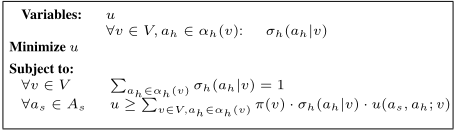
Since the hider-seeker game is zero-sum, a minimax solution can be discovered directly using linear programming. An optimal solution to the LP in Figure 1 gives a minimax solution to the hider-seeker game. This program has |As| + |V | constraints and ∑v∈V |αh(v)| + 1 variables. Although there are techniques (such as the Ellipsoid algorithm) which can solve this LP in time which is weakly polynomial in the number of constraints and variables, both |As| and |Ah| are exponential in T (and |As| is also exponential in c), so solving this program straightforwardly (without column/constraint generation) does not scale well in T and c. 2
1 We assume that the seeker cannot capture the hider before the hider can move, so that as(0) = ∅ and ah(0) is the starting vertex for the path ah. This assumption is not essential for our techniques.
4 Algorithms and Complexity Analyses
This section presents the double oracle algorithm for our hider-seeker game, establishes the computational complexity of determining best responses, presents exact best response oracles for both players, and presents an approximate best response oracle with bounded suboptimality for the seeker.
4.1 Double oracle algorithm
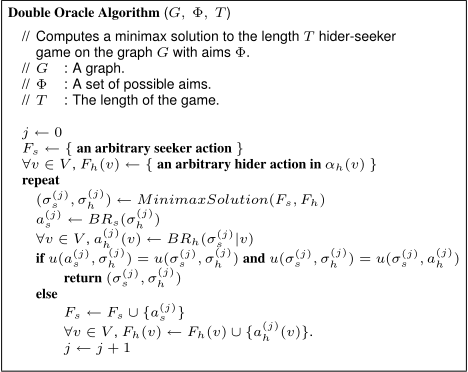
Figure 2 presents the double oracle algorithm for the general hider-seeker game. BRs(σ(j) h ) is an oracle that generates a seeker best response to the hider's behavioral strategy σ(j) h and BRh(σ(j) s |v) is an oracle which generates a hider best response to the seeker's mixed strategy σ(j) s , given that the hider's type is v. MinimaxSolution(Fs, Fh) is a subroutine which computes a minimax solution to the restricted game where the seeker can mix only over Fs and the hider can mix only over Fh.
For a two-player, zero-sum game, the double-oracle algorithm corresponds to column and constraint generation, a standard technique for solving large linear programs. See, for example, Bertsimas and Tsitsiklis [1997]. As with generic column and constraint generation techniques, there is no guarantee that this will avoid enumerating all rows and columns (actions for the hider and the seeker, respectively). Empirically, however, such algorithms often converge or produce near-optimal solutions with only a small fraction of the total rows and columns generated.
2 For two-player zero-sum extensive-form games, there are linear programming techniques that operate directly on the game tree (extensive-form representation), e.g., Koller and Megiddo [1992] or von Stengel [1996]. These techniques are generally much more efficient, but they are not helpful for our hider-seeker game, because neither player ever learns anything about what the other player did previously; the players are essentially making their choices simultaneously. Our linear program has exponential size strictly because the extensive form itself has exponential size.
4.2 Complexity of the seeker BR problem
In this subsection we show that the general seeker bestresponse problem is intractable for two different cases, when T = 1 and c is part of the problem input, and when T > 1 and c = 1.
Definition Given G, T, rational z, Φ, c, π (represented as a list of rational numbers), and a hider behavioral strategy σh(ah|v) over the actions in Ah, SeekerBR asks whether there exists a seeker strategy giving an expected utility of at least z against σh. σh is represented as a list of only the paths which receive positive probability (representing each path as a list of vertices) and the probabilities they receive as rational numbers. OptSeekerBR is the optimization version of SeekerBR which, given the same input (without z), computes an optimal seeker best-response to σh(ah|v).
Theorem 1 SeekerBR is NP-hard with T = 1, even when G is a grid and Φ is the set of all k × k squares.
Proof The problem is in NP because checking whether a seeker action as gives the seeker expected utility at least z can be done in time polynomial in |V | and |σh| by computing:
Thus, SeekerBR is in NP.
To prove NP-hardness on a grid, we reduce from a special case of the rectilinear p-center problem. The p-center problem is defined as: Given a set of n points P in ℜd , is it possible to place p (closed) "balls" of radius r (in some metric space) such that all the points in P are contained in at least one ball? This problem is NP-complete (so long as p is part of the input) even when d = 2 and the metric is L∞ [Fowler et al., 1980]. 3 The problem remains intractable even if the points are required to have integer coordinates. We will reduce this version of p-center to SeekerBR.
3 Note that a ℜ2 "ball" in L∞ is a square in the plane.
Given a set P of n points which are on an integer lattice, translate the points so that they have positive x and y coordinates (note that this cannot change the answer to the original instance of p-center) and that the minimum x and y coordinates are zero. Now compute the maximum x and y coordinates and create a xmax × ymax grid. In this grid, every node (x, y) is connected to itself, (x ± 1, y) and (x, y ± 1) (except on the boundary). This grid is guaranteed to be polynomial in size for instances of the rectilinear p-center problem generated by the original reduction from 3-SAT [Fowler et al., 1980]. Define the prior to be:
The set of aims Φ consists of all (2r + 1) × (2r + 1) squares which fit completely in the grid and contain a grid square (x, y) with π(x, y) > 0. Therefore, k = 2r + 1. Let c = p and z = 1. Define αh(v) to be the set of pairs (v, v′ ) in the grid such that v′ is adjacent to v and σh((v, v)|v) = 1. In other words, the hider's mixed strategy is to stand still with probability 1.
Suppose there exists a solution the original problem. Thus it is possible to place p balls of radius r in the plane to cover all the points in P. Each of these balls is a closed square of radius r and, since the points in P have integer coordinates, each ball can cover at most the points contained by a k × k square. Thus each ball can be converted into a square covering at least the same points, and since Φ contains all squares of size k × k, there exists a subset capturing the hider with probability 1. Thus there is a "yes" solution to the instance of SeekerBR, as this subset corresponds with a seeker strategy giving expected utility 1.
Now suppose that there is a seeker strategy giving expected utility 1. This strategy will search c = p squares of size k ×k and each grid square (x, y) with π(x, y) > 0 will be contained in one of the searched squares. Since each of the grid squares with π(x, y) > 0 corresponds to a point in P , placing radius r balls at the centers of the searched aims will cover the exact same points. Thus, if there is a "yes" solution to the instance of SeekerBR, there is also a "yes" solution to the original instance of p-center. □
We now show that SeekerBR is intractable even with a single sensor if T > 1.
Theorem 2 SeekerBR is NP-complete, even if c = 1, and all aims are of size 1.
Proof The reduction is from SAT. Given a CNF boolean formula over n literals and clauses Q, construct the graph G as follows: For each literal xi, create the nodes xi, ¯xi and Hi. Connect each of xi, ¯xi and Hi to each of xi+1, ¯xi+1 and Hi+1. Additionally, create a starting node S which is connected to x1, ¯x1 and H1. See Figure 3 for an example graph.
The set of hider actions is then built from the clauses. For each clause q ∈ Q, create a path starting at S and gradually moving through the xi, ¯xi and Hi nodes in the following manner. In step 1, if x1 appears in clause q, the path follows the edge from S to the vertex x1. If ¯x1 appears in q, the path instead follows the edge between S and ¯x1. If neither literal appears in q, then the path follows the edge from S to H1. Similarly, at time i, the path will move to xi+1 if xi+1 appears in clause q, ¯xi+1 if ¯xi+1 appears in q, or Hi+1 if neither appears in q. The hider's behavioral strategy is then to pick a clause uniformly at random and follow the corresponding path. Set π(S) = 1, z = 1, c = 1 and Φ to be the sets of size 1 containing only xi or ¯xi (for any i). 4
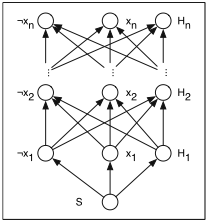
This instance of SeekerBR has a seeker strategy capturing the hider with probability 1 if and only if the original boolean formula is satisfiable. Suppose that the formula is satisfiable and ⃗x is a satisfying assignment. This assignment can be converted into a seeker pure strategy; the strategy will search the vertex xi in step i if xi is set to true in ⃗x and ¯xi if xi is set to false in ⃗x. Since ⃗x is a satisfying assignment, searching the corresponding vertices will capture each hider path in the graph, as at least one of the path's vertices will be searched.
Now suppose that there exists a seeker strategy that captures the hider with probability 1. This strategy can be converted into a satisfying assignment by performing the opposite conversion: If the seeker searches xi in step i, then set xi to true, otherwise (if the seeker searches ¯xi) set xi to false. Suppose (for contradiction) that the assignment does not satisfy the formula and q is a clause that is unsatisfied. Since this clause was converted directly into a hider path, and the hider has some probability of choosing this path, the seeker strategy must search a node on this path to capture the hider with probability 1. Suppose that a hider following the path corresponding to q is captured in step k; the corresponding assignment to xk must then satisfy the clause q, showing the contradiction.
Also note that SeekerBR is in NP because it is easy to verify that a seeker strategy gets utility of at least z. Specifically, given the seeker strategy as = (as(1), as(2), . . . , as(T)),
4 The set Φ can be extended to include all the vertices in the graph by creating two hidden nodes H1 i and H2 i for each literal. In this new graph, the hider would decide (randomly) to go to either H1 i or H2 i every time he moved to Hi in the old graph. This new set of paths can still be represented compactly by representing the randomized transitions as a set of possible successor vertices and the probabilities of moving to each successor. For example, x1, ¯x2, {[H1 3 , 1/2], [H2 3 , 1/2]}, x4, x5, . . . would be one such path with a random transition in step 3.
Variables: ∀v ∈ V ∀1 ≤ t ≤ T : searchedt (v) ∀ah ∈ Ah : cover(ah) ∀φ ∈ Φ, 1 ≤ t ≤ T : aimt (φ) (binary) Maximize Pv∈V Pah∈αh(v) π(v) · cover(ah) · σh(ah|v) Subject to: ∀ah ∈ Ah cover(ah) ≤ P1≤t≤T searchedt (ah(t)) ∀1 ≤ t ≤ T, v ∈ V searchedt (v) ≤ Pφ∈Φ:v∈φ aimt (φ) ∀1 ≤ t ≤ T Pφ∈Φ aimt (φ) ≤ c ∀1 ≤ t ≤ T, v ∈ V 0 ≤ searchedt (v) ≤ 1 ∀ah ∈ Ah 0 ≤ cover(ah) ≤ 1 ∀1 ≤ t ≤ T, φ ∈ Φ aimt (φ) ∈ {0, 1}one can verify that:
This can be computed in time O(T |V ||σh|), where |σh| is the size of σh on the input tape. Note that T, although exponential in |T| (the size of T in the input), is bounded by the size of a single path in the input tape, thus ensuring that this verification can be accomplished in time polynomial in the size of the input. Thus, SeekerBR is in NP, and the problem is NP-complete. □
4.3 MIP for the seeker BR problem
The seeker BR optimization problem (OptSeekerBR) can be formulated as a mixed integer program. Any optimal solution to the MIP in Figure 4 is a solution to OptSeekerBR. The MIP has three variable types. The aimt (φ) variables are explicitly binary, but the MIP solver will also assign binary values to searchedt (v) and cover(ah) even when they are declared as continuous variables. This is because increasing these variables further will never decrease the objective, and if they can be increased beyond 0, then they can be increased all the way to 1.
4.4 Approximate seeker BR
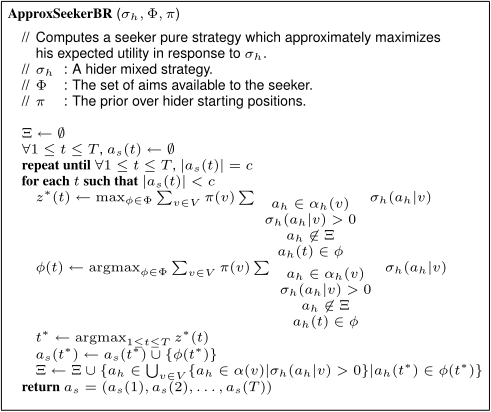
The MIP for the true seeker BR takes considerable run time in practice, motivating the development of an approximate BR. We present a greedy BR algorithm in Figure 5. The algorithm greedily picks the aim that captures the most hider probability mass. All the paths covered by the chosen aim (and the mass on them) are then removed from consideration, and the process repeats until no more aims are possible.
Theorem 3 ApproxSeekerBR is a 2-approximation to OptSeekerBR.
Proof Let Gi be the ith aim chosen by ApproxSeekerBR and let Ξi be the set of new hider paths captured by Gi (i.e. those not captured by G1 . . .Gi-1). Let O be an optimal solution and let Oi be the ith aim in O (ordered such that Oi is a view in the same step as Gi). Let Ξ∗i be the set of new hider paths captured by Oi (again, those not captured by O1 . . .Oi-1). Let Z G be the expected seeker utility from following the approximate strategy and Z ∗ be the expected seeker utility of the optimal BR. In this proof, we will use the shorthand σh(Ξi) (and σh(Ξ∗i )) to mean:
σh(Ξi) gives the marginal probability (marginalizing out the hider's starting location) that the hider chooses a path in Ξi. Clearly:
Define the loss to be the difference between Z ∗ and Z G:
Now consider some k such that σh(Ξ∗k ) ≥ σh(Ξk); in other words, an aim contributing to the final summation in the previous statement. When the aim Gk was chosen by ApproxSeekerBR, there was no other aim φ which had a larger contribute to σh(Ξk), despite the fact that Ok was available. Thus, enough paths in Ξ∗k were viewed by G1, . . .Gk-1 that Gk appeared as good of an option as Ok. In other words, σh(Ξk) ≥ σh(Ξ∗k - (⋃j<k Ξj )). Let Δk = Ξ∗k ∩ (⋃j<k Ξj ), i.e. Δk is the set of paths in Ξ∗k that were viewed by previous aims in the greedy algorithm. Now, since σh(Ξk) ≥ σh(Ξ∗k - (⋃j<k Ξj )),
Now the second quantity in the max is exactly equal to σh(Δi). Inserting this:
In the above equation, the max disappears because σh(Δi) is strictly positive. Since each Ξ∗i is disjoint (from the other Ξ∗j ), Δi is also disjoint from the other Δj. Thus each hider path appears in at most one Δi and, since each is a subset of ⋃i Ξi, we have the following:
Rearranging terms:
Thus, ApproxSeekerBR is a 2-approximation.
□
4.5 Complexity of the hider BR problem
The previous several subsections studied the seeker BR problem for the hider-seeker game. This subsection considers the BR problem for the hider. Recall that a hider action is a single path of length T through the graph, and a hider pure strategy is a mapping sh from hider types (vertices) to actions (paths). A hider best response is a pure strategy which, given a seeker mixed strategy σs, minimizes the seeker's expected utility. We show that deciding if there exists a hider strategy that results in less than a given utility for the seeker is NP-complete.
Definition Given a graph G = (V,E), rational z, T, a hider starting location v0, and a seeker mixed strategy σs : As → [0, 1] over the set of seeker actions As (with c sensors), HiderBR asks whether there exists a pure hider strategy starting in v that gives the seeker expected utility at most z. σs is represented as a list of only the seeker strategies which receive positive probability in σs, each of which consists of T size c lists of searches. OptHiderBR is the optimization version of HiderBR which, given the same input (without z), computes an optimal hider best-response to σs starting in v0.
Theorem 4 HiderBR is NP-complete, even if c = 1, and Φ contains only sets of size 1.
Proof The reduction is from MINSAT, which is defined as: Given a set of m boolean clauses Q over the set of literals X = {x1, x2, . . . , xn}, does there exist an assignment to the literals in X such that at most k clauses are satisfied? Kohli et al. [1994] demonstrated that this problem is NP-complete.
Our reduction is fairly similar to the reduction for the seeker best response problem. Given an instance of MINSAT, create two graph nodes for each literal: x+i and x-i , corresponding to setting the literal xi to true and false. Connect both of the nodes for xi-1 to both nodes for xi. Additionally, create a starting node v0 = S, which is connected to x+1 and x-1 . See Figure 6 for an example graph.
Now convert the clauses into seeker actions. For each clause q ∈ Q, construct an action as(q) which searches the assignments to literals which would satisfy the clause. For example, if xi appears negated in the clause q, as(q) would search x-i at time i. Note that not all seeker actions will search a vertex at each time step, and also that Φ is the set of vertices in the graph. The seeker's mixed strategy σs is to pick a clause uniformly at random and perform the associated search action. Set z = k/m.
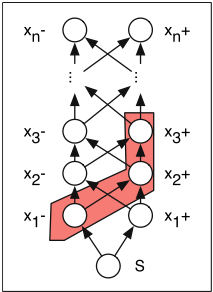
These two problems are now equivalent for the following reasons. Suppose there exists a solution to this instance of HiderBR; this path will, at each time step i, visit either x+i or x-i , and the seeker's probability of capture for this path is at most k/m. Since the seeker's mixed strategy selects actions uniformly at random (i.e., each with probability 1/m), this path is "caught" by less than k distinct seeker actions. Thus, the corresponding assignment to the literals will satisfy at most k clauses in the set Q. Now suppose that there is an assignment to the literals which satisfies at most k clauses. This assignment can be converted directly into a hider path: Starting at S, go to vertex x+1 if x1 is true in the assignment or x-1 if x1 is false, then proceed similarly for the remaining time steps. Since this assignment satisfies at most k clauses in Q, this path will be captured by at most k seeker actions, thus giving the seeker expected utility of at most k/m. Thus, HiderBR is NP-hard.
HiderBR is in NP because it is easy to determine whether a given hider strategy gives the seeker expected utility less than z against σs. To verify this, given the hider strategy sh, simply verify:
This can be checked in time O(Tc|V ||σs|), where |σs| is the size of the representation of σs on the input tape. Since even a single seeker strategy in |σs| is larger than T and c, this can be done in time polynomial in the size of the problem input. Thus, HiderBR is also in NP and is NP-complete. □
4.6 MIP for the hider BR problem
This subsection describes a mixed integer program which can be used for the optimization version of the hider BR problem for the specific case where the hider's starting location is known a priori. Recall that, in the hider-seeker game, a hider pure strategy is a mapping from starting vertices to length T paths. This subsection considers the problem of generating a single element of this mapping - the path corresponding to starting in v0. Solving this problem for all v ∈ V would yield the full best-response strategy for the hider.
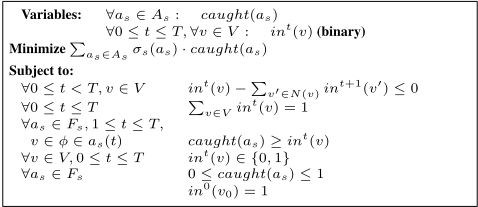
Figure 7 presents a MIP for OptHiderBR. The first constraint ensures that the path follows the graph's connectivity (i.e., the hider can only go from v to some v′ ∈ N(v)), and the second constraint ensures that the hider must be in exactly one location in each time step. The third constraint enforces the relationship between the int (v) variables and the caught(as) variables. As in the seeker BR MIP, the caught(as) variables can be continuous: the mechanics of the MIP will ensure that they always take on binary values. In practice, this MIP solves quite quickly for reasonable values of T .
4.7 Final planning algorithm
Even though the hider BR problem is intractable, the MIP for the hider BR solves quickly enough in practice that it can be used in the double oracle algorithm. For the seeker BR problem, however, we use the approximate algorithm. Figure 8 presents a modified version of the double oracle algorithm that uses these algorithms as subroutines. Using these subroutines as oracles, the double-oracle algorithm converges when the hider's mixed strategy σh is a BR to the seeker's mixed strategy σs, and the seeker's mixed strategy σs gives an expected utility against σh that is at least as high as the expected utility obtained by the strategy chosen by ApproxSeekerBR against σh. Our final theoretical result bounds the gap between the utility (to the seeker) of the strategies produced by this approximation algorithm, and the utility in a true minimax equilibrium of the game.
Theorem 5 Let (σs, σh) be the output of the approximate double oracle algorithm and let (σ∗ s , σ∗h ) be the true minimax solution. Then: u(σs, σh) ≥ 1/2 · u(σ∗ s , σ∗h ).
Proof Using the termination condition of the algorithm, and the fact that ApproxSeekerBR is a 2-approximation to the true BR: u(σs, σh) ≥ u(ApproxBR(σh), σh) ≥ 12 · u(BR(σh), σh). Because (σ∗ s , σ∗h ) is a minimax solution, ∀σ′s , σ′h : u(σ∗ s , σ′h ) ≥ u(σ∗ s , σ∗h ) ≥ u(σ′s , σ∗h ). Combining these gives: u(BR(σh), σh) ≥ u(σ∗ s , σh) ≥ u(σ∗ s , σ∗h ), which implies u(σs, σh) ≥ 12 · u(σ∗ s , σ∗h ). □
5 Experimental results
Our algorithm works for games on arbitrary graphs, but a grid is a more natural representation for many real world scenarios. We used a 100 × 100 grid, and the prior over initial hider locations was a mixture of truncated Gaussians, each of which covered 21 grid squares. The seeker's set of aims Φ was the set of all 3 × 3 grid squares. We chose T = 3 and ran the double oracle algorithm using both the approximate seeker BR oracle and the true seeker BR oracle for 10 runs, each with a different random seed. For each run, the hider and seeker action spaces were initialized with a single randomly generated action (for the hider, there was one such action for each starting location). We also developed a best response scheduling technique which more evenly divided computation time between the hider and seeker best responses. Rather than generating best responses for both players at the same time, this technique generates a BR for the player whose previous BR value is furthest from the current equilibrium value. This does not affect the optimality guarantees, but we found that it greatly reduced total runtime to convergence.
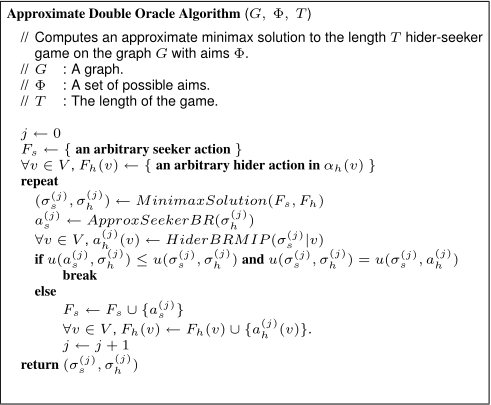
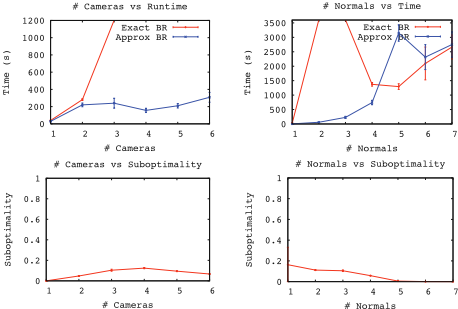
Figure 9 shows the results of running the approximate double oracle algorithm in two distinct experiments. In the first experiment (left) we varied the number of observations available to the seeker in each step. In the second experiment (right) we varied the number of Gaussians in the prior from 1 to 7 with c = 3. The first set indicates how our approach scales with c, and the second set shows scaling with |V |. All reported runtimes are in CPU seconds on a 3.0 GHz Core 2 architecture using CPLEX 10. The suboptimality plots (bottom row) show u(BR(σh), σh) - u(σs, σh), where (σs, σh) is the output of the double oracle algorithm using ApproxBR to generate seeker actions. This bounds the seeker's loss from using an approximate BR. We did not compare with the full linear program that contains all hider and seeker strategies because it is impractical to generate and solve such a large LP.
In the first experiment (varying c), Figure 9 (top left) demonstrates that ApproxBR results in a considerable reduction in runtime to convergence. Even for large numbers of
# Normals
Figure 9: (top left and right) Run time vs. number of observations and number of Gaussians in the prior. Error bars show 1 standard deviation. (bottom left and right) Suboptimality of Approximate Double Oracle Algorithm vs number of observations and number of Gaussians. All experiments on a 100 × 100 grid with T = 3.
observations, the ApproxBR version of the double oracle algorithm converged in minutes, vs. hours when the true BR was used. Figure 9 (bottom left) demonstrates that the utility of the solution is not far from optimal. Suboptimality decreases with c because it is easier to catch the evader with more observations.
In the second experiment (varying the number of Gaussians in the prior), the runtime in Figure 9 (top right) shows widely varying behavior. Unlike the previous experiment, we should expect the run time to scale polynomially for both algorithms, though we should still expect ApproxBR to be faster. The five Gaussian case is an unexpected but reproducible anomaly. Our log files confirm that CPLEX spends significantly less time computing exact BRs for the four Gaussian case than for three Gaussians. The reason for this behavior is a subject of ongoing investigation. The suboptimality, Figure 9 (bottom right), is consistently low and decreasing.
6 Conclusion
This paper presented a multi-step, multi-sensor hider-seeker game where the hider is constrained to move on a graph and, at each time step, the seeker chooses up to a constant number of observations from a set of possible observations. We modeled this game as a two-player zero-sum Bayesian game, and showed that standard techniques for solving the game directly do not scale well with the number of steps or the number of sensors. Consequently, we applied a column and constraint generation technique which uses best response oracles for both players. We also showed, however, that computing the true best response is NP-hard for both the hider and seeker in the multi-step game and NP-hard for the seeker in the singlestep game. We then developed an approximation algorithm for the seeker best response and a mixed-integer program for the hider best response. Experimentally, the combined algorithm fairly quickly results in a solution that is near optimal.
7 Acknowledgments
This work was partially supported by the Sloan Foundation, and by NSF IIS awards 0209088 and 0812113, NSF CAREER award 0546709, and by the DARPA CSSG program. Any opinions, findings, conclusions or recommendations are those of the authors only. The authors also wish to thank Pankaj Agarwal for many useful suggestions.
@inproceedings{ijcai2009p37,
  title     = {Multi-Step Multi-Sensor Hider-Seeker Games},
  author    = {Halvorson, Erik and Conitzer, Vincent and Parr, Ronald},
  booktitle = {Proceedings of the Twenty-First International Joint Conference on
               Artificial Intelligence, {IJCAI-09}},
  publisher = {International Joint Conferences on Artificial Intelligence},
  editor    = {Craig Boutilier},
  pages     = {159--165},
  year      = {2009},
  url       = {https://ijcai.org/proceedings/2009/37},
}
TY - CPAPER TI - Multi-Step Multi-Sensor Hider-Seeker Games AU - Halvorson, Erik AU - Conitzer, Vincent AU - Parr, Ronald T2 - Proceedings of the Twenty-First International Joint Conference on Artificial Intelligence, IJCAI-09 PB - International Joint Conferences on Artificial Intelligence PY - 2009 SP - 159 EP - 165 UR - https://ijcai.org/proceedings/2009/37 ER -Copied
Machine-readable versions of this paper, for tools and AI agents:





