
Planning with graded fluents and actions
Proceedings of the Nineteenth International Joint Conference on Artificial Intelligence. Pages 1711-1711.
© 2005 International Joint Conferences on Artificial Intelligence
Abstract
This work can be seen as a first approach to a new planning model that takes into account the possibility to express actions and fluents with non-boolean values. According to this model, a planning problem is defined using both graded (multi-valued) and classical (boolean) fluents. Moreover, actions that can have different application degrees can be defined. In this work a PDDL extension allowing to describe such new problems is proposed and a planning algorithm for such problems is presented.
- [Baioletti et al., 2003] M. Baioletti, A. Milani, and V. Pog- gioni. Planning with fuzzy resources. In AI*IA 2003: Ad- vances in Artificial Intelligence. In LNAI 2829, 336-348, 2003.
- [Bonet and Geffner, 2003] B. Bonet and H. Geffner. Faster heuristic search algorithms for planning with uncertainty and full feedback. In Proc. of IJCAI 2003, 2003. IJCAI
- [Chien and al., 2000] S. Chien and al. ASPEN: Automated planning and scheduling for space mission operation. In Proc. of SpaceOps 2000, Colorado (USA), 2000.
- [Fox and Long, 2003] M. Fox and D. Long. PDDL2.1: An extension to PDDL for expressing temporal planning do- mains. JAIR, 20:61-124, 2003.
- [Giunchiglia et al., 2004] E. Giunchiglia, J. Lee, V. Lifs- chitz, McCain N., and H. Turner. Nonmonotonic causal theories. Artificial Intelligence, 153:49-104, 2004.
- [Haslum and Geffner, 2000] P. Haslum and H. Geffner. Heuristic planning with resources. In Proc. of ECAI-00, 2000.
- [Hoffmann, 2002] J. Hoffmann. Extending FF to numerical state variables. In Proc. of ECAI 2002, 2002.
- [Koehler, 1998] J. Koehler. Planning under resource con- straints. In Proc. of ECAI-98, 1998.
- [Lee and Lifschitz, 2003] J. Lee and V. Lifschitz. Describing additive fluents in action language +. In Proc. of IJCAI 2003, 2003.
- [Petrick and Bacchus, 2002] R.P.A. Petrick and F. Bacchus. A knowledge-based approach to planning with incomplete information and sensing. In Proc. of AIPS 2002, 2002.
References were extracted automatically from the PDF and may contain errors.
Full text extracted automatically from the PDF; figures, tables and equations may differ. The PDF is the version of record.
1 Introduction
In the last years, extensions of the classical planning model have been investigated, such as temporal models, conditional and contingent models, probabilistic models and other mixed models (for example [Hoffmann, 2002; Petrick and Bacchus, 2002; Bonet and Geffner, 2003; Chien and al., 2000]). But, to the best of our knowledge, a feature of the classical model has never been modi�ed: the use of boolean expressions to describe �uents and actions in the domains. This is often too restrictive in order to represent realistic domains because the world is not black and white (i.e. true or false) but it has a lot of colors (i.e. intermediate truth-values, or �degrees of truth�). A different approach to planning that takes into account a numerical �state� associated to a �uent is proposed in the probabilistic planning model, but, in this case, �numbers� represent our knowledge or uncertainty about the state or the success of an action, while the real world is always two-valued.
This work can be seen as a �rst approach to a new planning model that takes into account the possibility to express both actions and �uents with non-boolean values. According to this model, a planning problem is de�ned using both graded (multi-valued) and classical (boolean) �uents; moreover actions having different application degrees can be de�ned (i.e. actions having adjustable intensity and that can affect �uents proportionally to how much they are applied). In such a way, also the ef�ciency of actions can be easily represented.
The work de�nes an extension of the planning language PDDL that allows us to de�ne planning domains and planning problems having graded �uents and graded actions, and a solving algorithm for such problems, where �rst a candidate plan with partially instantiated actions is constructed, then the plan applicability and correctness is veri�ed by means of a translation into a MIP (Mixed Integer Programming) problem and �nally, if a solution of the MIP problem exists, a complete instantiation is made and the solution plan is found.
2 The Planning Language
The planning language proposed in this paper is based on standard PDDL. It provides two kinds of actions and �uents, representing both classical boolean �uents and actions, and graded �uents and actions. Both actions and �uents have an additional argument denoting their �degree of truth�: in a �uent it means �how much� the predicate is true (0 means that it is false, 1 that it is true) and in an action it means �how much� the action is applied (0 means that it is not applied at all, 1 means that it is applied with the maximum ef�ciency).
The type of such terms is declared as a new type degree in the PDDL domain de�nition. If the �uent is boolean then its truth-value is a natural number in {0, 1} (as in the classical model), otherwise, if the �uent is graded, its truth-value is a real number in [0, 1]. The difference between the two kinds of �uents is declared in the domain description. There are different declaration sections for boolean and graded predicates.
The additional parameter in an action denotes the degree of application of the action. Again, the value of this parameter in boolean actions belongs to {0, 1}, while it ranges in [0, 1] in graded actions. Actions may also have other additional parameters referring to �uent degrees. A speci�c section in action declaration allows one to associate �uents to degree parameters. Such variables maybe used both in preconditions and effects: action preconditions may contain inequality constraints over �uent degrees and effects can be described by means of expressions that de�ne the new �degree of truth� of a �uent as a linear combination of previous �uent values and the application degree of the action.
The choice to include the degrees among the action parameters does not increase the complexity of the operators because, as explained in Section3, such parameters are not instantiated during the solution search phase.
The de�nition of a graded planning problem may contain an objective function, that is a linear function of the action application degrees that must be minimized or maximized when looking for action degree values satisfying a given partially instantiated plan. For example, it can be used in order to minimize the cost of the extracted candidate plan giving different operator costs. It is de�ned in a new section :objective function(...) in the problem description.
3 SystemArchitecture
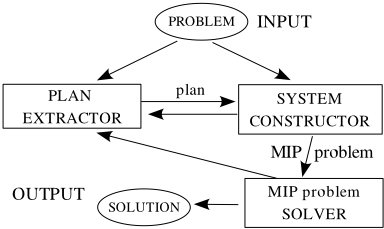
The system takes in input a graded planning problem (I,G, f,O) and if a solution exists it returns a graded solution plan P, otherwise,if it terminates it returns a NoSolution message. The system architecture is presented in Fig.1: it is composed by three modules, the plan extractor, the system constructor, the MIP solver.
The plan extractor synthesizes a �candidate plan� P = (A1(x1),A2(x2), . . . ,Am(xm)) where actions are partially instantiated, i.e. where all application and �uent degrees are unbound but only the variables xi standing for the degree of application of Ai are in evidence. It implements a simple backward algorithm with heuristic functions that solves relaxed problems. Then the system constructor computes the world evolution using these actions (the resulting states depend on the action application degrees) and reduces the veri�cation and full instantiation of the plan to a MIP problem; it builds the MIP problem corresponding to a candidate plan and passes it to the MIP solver. During the system construction phase some conditions in the action preconditions are directly checked and if they are not satis�ed the module fails and another candidate plan must be extracted. In this case the information about which action causes failure is used and another candidate plan is constructed replanning from this point. Finally the MIP solver computes a solution of the generated problem; if a solution exists it is a set of real and/or integer values ⃗g = (g1, . . . , gm) and the plan P = (A1(g1), . . . ,Am(gm)) is the graded solution plan of the given problem, otherwise a new candidate plan is extracted and a new MIP problem is generated.
4 Conclusions and related works
In this work a language and a model of planning with graded �uents and actions are presented. A prototype of the system has been developed.
To the best of our knowledge this is the �rst system able to manage non boolean �uents and actions. Recent works have proposed languages [Fox and Long, 2003; Giunchiglia et al., 2004; Lee and Lifschitz, 2003] and systems (for example [Koehler, 1998; Baioletti et al., 2003; Hoffmann, 2002; Haslum and Geffner, 2000]) that can handle numerical values. Degrees can be represented in PDDL 2.1, but only if their values range on �nite sets. Graded �uents could be represented in PDDL 2.1 by means of numerical �uents (functions) but respecting some more restriction w.r.t. what is done in this work. However, graded actions are not representable at all.
At the moment we are working in two main directions. First of all an algorithm for intelligent backtracking when the MIP solver fails and an improvement of the backtracking phase when the system constructor fails are under investigation. Moreover a set of graded domains and graded problems is under construction in order to carry out a wide set of experiments. The second research direction is theoretical: an extension of the algorithm to planning under uncertainty on the initial state is straightforward, introducing variables for �uent degrees in the world construction. Moreover, we are investigating the possibility of representing and treating vague (fuzzy) �uents, using intervals or sets to represent �uent degrees.
@inproceedings{ijcai2005p311,
  title     = {Planning with graded fluents and actions},
  author    = {Mayer, Marta Cialdea and Limongelli, Carla and Orlandini, Andrea and Poggioni, Valentina},
  booktitle = {Proceedings of the Nineteenth International Joint Conference on
               Artificial Intelligence, {IJCAI-05}},
  publisher = {International Joint Conferences on Artificial Intelligence},
  editor    = {Leslie Pack Kaelbling and Alessandro Saffiotti},
  pages     = {1711--1711},
  year      = {2005},
  url       = {https://ijcai.org/proceedings/2005/311},
}
TY - CPAPER TI - Planning with graded fluents and actions AU - Mayer, Marta Cialdea AU - Limongelli, Carla AU - Orlandini, Andrea AU - Poggioni, Valentina T2 - Proceedings of the Nineteenth International Joint Conference on Artificial Intelligence, IJCAI-05 PB - International Joint Conferences on Artificial Intelligence PY - 2005 SP - 1711 EP - 1711 UR - https://ijcai.org/proceedings/2005/311 ER -Copied
Machine-readable versions of this paper, for tools and AI agents:





