
Automated Adaptive Support for Task and Information Prioritizing
Proceedings of the Nineteenth International Joint Conference on Artificial Intelligence. Pages 1713-1713.
© 2005 International Joint Conferences on Artificial Intelligence
Abstract
This paper discusses a means for automatically supporting humans in information and task prioritizing. A new generic method based on the Competitive Task Model is described. Its implementation is able to calculate priorities of competing information entities, which provides a way of allocating tasks to the process operator. Due to a combination of dynamic states and information entities, it is usable as an adaptive control mechanism for attention and task allocation.
- [Baker et al., 1985] S Baker, David Gertman, Erik Hollnagel, C. Holstrom, E Marshall and F Øwre. An experimental comparison of three computer-based alarm systems: results and conclusions. Halden Reactor Project (HWR-142), Norway.
- [Covery, 1990] Stephen R. Covery. The 7 habits of highly effective people. New York: Simon & Schuster.
- [Freed, 1998] Michael Freed. Managing Multiple Tasks in Complex, Dynamic Environments. In Proceedings of National Conference on Artificial Intelligence and Tenth Innovative Applications of Artificial Intelligence Conference, pages 921-927, Madison, Winsconsin.
- [Nugent et al., 2000] William A. Nugent and Richard W. Obermayer, Human Computer Interaction Design Guidelines for an Alert Warning and Attention Allocation System. I. Literature Review. San Diego, CA: Space and Naval Warfare Systems Center, Code D44209, 17 February 2000.
- [Shannon et al, 1946] C Shannon & W Weaver, The mathematical theory of communications. Urbana: University of Illinois Press.
- [Sheridan, 1981] Thomas B. Sheridan. Understanding human error and aiding human diagnostic behavior in nuclear power plants. In J. Rasmussen and William B. Rouse (Eds), Human detection and diagnosis of system failures. New York: Plenum Press.
- [Stanton et al., 2000] N Stanton, David Harrison, Karin Taylor-Burge, L. Porter, Sorting the Wheat from the Chaff, A study on the detection of alarms. Cognition, Technology and Work, 2(3):134-141, August 2000.
- [Weiland et al., 1998] Monica Weiland, Gwendolyn E. Campbell, Wayne Zachary and Janis A. Cannon-Bowers. Applications of cognitive models in a combat information center. Paper presented at the 1998 Command and Control Research and Technology Symposium. Monterey, CA.
References were extracted automatically from the PDF and may contain errors.
Full text extracted automatically from the PDF; figures, tables and equations may differ. The PDF is the version of record.
1 Introduction
The objective of an intelligent information system is to support the operator with the decision making process by means of offering the right information at the right time and place. This appears not an easy job as experience and research in the field of adaptive decision support learns [e.g., Weiland et al., 1998]. Information with a high interruption level is intended to focus the attention of the operator on important information. A popular scenario in literature describes a process operator facing an emergency situation where the operator is overwhelmed by a huge amount of information, which increases the operator workload and is making it almost impossible to deal with the emergency [Sheridan, 1981]. The mentioned scenario typically occurs when time is limited. It is therefore crucial to use valuable time carefully and it seems obvious to support the operator in managing information flow after (or before) a problematic event.
A reduction of information seems to be a logical first approach, but unfortunately several studies show that the reduction of information not necessarily results in improvement of efficiency [e.g., Baker et al., 1985]. The removed information apparently is relevant for the operator. This may be because this information provides insight into the state of the process [Stanton, 2000]. In the present research a combination of research suggested by Freed [1998], Nugent et al. [2000] and Covery [1990] is further explored and used for a description of a model called the Competitive Task Model (CTM). After this a first description of an algorithm based on CTM is shown.
2 The Competitive Task Model
In the CTM information entities (IEs) are prioritized by means of estimating their relevance, urgency, and importance, in the context of the goal profile, user, and task knowledge (Figure 1). Relevance describes which user tasks have a relation with an offered IE and urgency describes the temporal (response) aspect of the IE for a particular task. Relevance and urgency estimation is done by means of two interpreters that require knowledge of the user and its tasks. User and task knowledge is used to determine if the offered IE reduces uncertainty [Shannon et al., 1946] and to provide an indication of the relation between an IE and a specific task, respectively. The act of combining these interpretations per specific task yields a delta score, indicating the priority of the IE with respect to a certain user
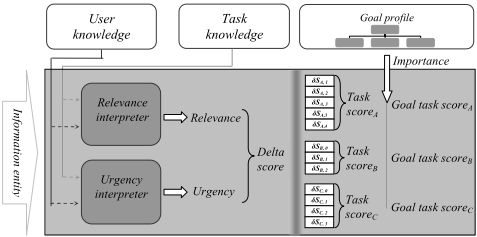
task. For each user task the delta scores are combined for all offered IEs. This results in a task score, indicating the priority of a certain task given a set of IEs. Finally, the task scores are related to the specific goals using a two-layered goal profile (GP). The first layer describes the goals and every goal implies one or more tasks. These tasks populate the second layer. The GP yields an indication of the importance of a specific task with respect to the user's higher goals. The combination of importance of a certain user task and its related task score results in a goal task score, indicating the eventual prioritization of user tasks.
As an example of applying the CTM, imagine a navy officer on a frigate. The task profile consists of three high level goals, i.e. to fight, to sail and to float. Suppose that an IE concerning a fire in the engine room reaches the officer. This IE is highly urgent and relevant for the sailing task, but to a lesser extent for the floating task. Hence the delta score of the sailing task is higher than that of the floating task. But according to the GP (domain knowledge) floating is more important than sailing if the floating capability is in danger, and therefore the CTM indicates that the floating task should receive attention instead of the sailing task.
3 The Basic Algorithm
According to the CTM there are three terms needed to prioritize IEs: relevance (R), urgency (U) and importance (I). The first two terms describe task τ and state σ dependent information for which ) , ( σ τ i R and ) , ( σ τ i U are numbers in the interval [0,1], where i is an IE. These two terms are quantified via relevance and urgency interpreters (Figure 1) and are combined as a quantitative expression of the priority of the IE on the task and state using a function called the delta score (δS):
where ⊕ is an operator combining R and U. In order to calculate the priorities of the competing tasks, a task score (TS) is calculated by means of the summation of all δS's per task, given a state:
The above task score is not taking into account the related higher level importance. Therefore TS and I are combined:
where ⊗ is a operator combining TS and I. The combining operators ⊗ and ⊕ can be for instance normalized linear functions with its form possibly dependent on the given task τ, state σ, and IE i.
4 Discussion
The CTM model described in this paper is able to calculate the priorities of competing tasks based on a set of IEs. The IEs are analysed in the context of the current activities of the operator, the importance of the IE regarding the main goals, and the urgency and relevance of the IE regarding the operator's tasks. Because of the combined input of IEs and dynamic states it can be used as an adaptive control mechanism for operator attention or as task allocation strategies, that are crucial in (automating) adaptive decision support. This is different from traditional models of preference choice from game theory, where preferences are given a priori. Though, further research is needed to optimize the theoretical framework. For instance, Freed [1998] mentions that switching between hierarchies can be an efficient approach when information is applicable for a number of subtasks. The CTM does not elaborate on this. Furthermore, the automatic relevance and urgency interpreters, and the combining operators in de basic algorithm need further experimentation and specification.
Acknowledgments
This research is funded by the Dutch Ministry of Defense under programme numbers V055 and V206.
@inproceedings{ijcai2005p309,
  title     = {Automated Adaptive Support for Task and Information Prioritizing},
  author    = {de Greef, Tjerk and van Maanen, Peter-Paul},
  booktitle = {Proceedings of the Nineteenth International Joint Conference on
               Artificial Intelligence, {IJCAI-05}},
  publisher = {International Joint Conferences on Artificial Intelligence},
  editor    = {Leslie Pack Kaelbling and Alessandro Saffiotti},
  pages     = {1713--1713},
  year      = {2005},
  url       = {https://ijcai.org/proceedings/2005/309},
}
TY - CPAPER TI - Automated Adaptive Support for Task and Information Prioritizing AU - de Greef, Tjerk AU - van Maanen, Peter-Paul T2 - Proceedings of the Nineteenth International Joint Conference on Artificial Intelligence, IJCAI-05 PB - International Joint Conferences on Artificial Intelligence PY - 2005 SP - 1713 EP - 1713 UR - https://ijcai.org/proceedings/2005/309 ER -Copied
Machine-readable versions of this paper, for tools and AI agents:





