
Hypertree-decomposition via Branch-decomposition
Proceedings of the Nineteenth International Joint Conference on Artificial Intelligence. Pages 1535-1535.
© 2005 International Joint Conferences on Artificial Intelligence
Abstract
Hypertree-decomposition is the most general approach in the literature for identifying tractable computation problems encoded as hypergraphs. We show how the heuristic branch-decomposition approach for ordinary graphs of [Cook and Seymour, 2003] can be used for the heuristic construction of hypertree-decompositions.
- [Alon, 1986] N. Alon. Eigenvalues and expanders. Combi- natorica, 6(2):83-96, 1986.
- [Cook and Seymour, 2003] W. Cook and P. Seymour. Tour merging via branch-decomposition. INFORMS Journal on Computing, 15(3):233-248, 2003.
- [Gottlob et al., 2000] G. Gottlob, N. Leone, and F. Scarcello. A comparison of structural CSP decomposition methods. Artificial Intelligence, 124(2):243-282, 2000. IJCAI
- [Gottlob et al., 2002] G. Gottlob, N. Leone, and F. Scarcello. Hypertree decompositions and tractable queries. Journal of Computer and System Sciences, 64(3):579-627, 2002.
- [McMahan, 2004] B. McMahan. Bucket eliminiation and hypertree decompositions. Implementation report, Insti- tute of Information Systems (DBAI), TU Vienna, 2004.
- [Robertson and Seymour, 1991] N. Robertson and P. Sey- mour. Graph minors. X. Obstructions to tree- decomposition. Journal of Combinatorial Theory, Se- ries B, 52:153-190, 1991.
References were extracted automatically from the PDF and may contain errors.
Full text extracted automatically from the PDF; figures, tables and equations may differ. The PDF is the version of record.
1 Introduction
Many NP-complete problems (e.g., the constraint satisfaction problem CSP, the homomorphism problem HOM, the Boolean conjunctive query problem BCQ, etc.) can be described by hypergraphs in a natural way. It was shown by [Gottlob et al., 2002] that in analogy to tree-width of graphs, hypertree-width of hypergraphs is an appropriate measure for the cyclicity and therefore the tractability of the corresponding computation problems. In particular, they have shown that NP-complete problems become polynomially solvable and even highly parallelizable when restricted to instances with bounded hypertree-width. Moreover, it was shown by [Gottlob et al., 2000] that hypertree-decomposition and the corresponding measure of hypertree-width generalizes all other tractability measures for hypergraphs in the literature.
Recent research focuses on heuristic approaches for fast hypertree-decomposition with small width. In this presentation, we show how the heuristic approach of [Cook and Seymour, 2003] for branch-decomposition (of ordinary graphs) can be used for heuristic hypertree-decomposition.
2 Preliminaries
A hypergraph H is a tuple (V, E), where V is a set of vertices (variables) and E ⊆ ℘(V)\{∅} is a set of hyperedges. We define var(H) = V and edges(H) = E. A hypertree for a hypergraph H is a triple (T, χ, λ), where T = (V, E) is a tree and χ : V → var(H) and λ : V → edges(H) are labeling functions.
A hypertree-decomposition of a hypergraph H is a hypertree (T, χ, λ) for H satisfying four conditions. Due to space restrictions, we refer the interested reader to [Gottlob et al., glyph[a114]
∗This work was supported by the Austrian Science Fund (FWF) project P17222-N04.
glyph[a114]
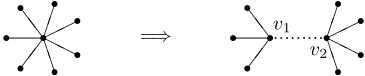
Figure 1: Splitting a vertex
2002] for the formal definition of a hypertree-decomposition. The width of a hypertree-decomposition (T, χ, λ) is given by maxp∈vertices(T) |λ(p)|, and the hypertree-width of a hypergraph is the minimum width over all its hypertreedecompositions.
A branch-decomposition of a hypergraph H is a tuple (T, τ), where T = (V, E) is a tree having |edges(H)| leaves and in which every non-leaf vertex has degree three, and τ is a bijection from the set of leaves of T to edges(H). The order of an edge e ∈ E is the number of vertices v ∈ var(H) such that there are leaves l1 and l2 of T in different components of T when removing e with v ∈ τ(l1) ∩ τ(l2). The width of a branch-decomposition (T, τ) is the maximum order of the edges of T, and the branch-width of a hypergraph is the minimumwidth over all its branch-decompositions.
3 The Branch-decomposition Heuristic
In this section, we summarize the basic steps of the heuristic branch-decomposition approach of [Cook and Seymour, 2003]. Note that this approach was developed for ordinary graphs. Its starting point is the construction of the initial data structure which is a star as shown in Fig. 1. This is done in such a way that for each edge in the graph there exists exactly one edge in the star. This edge is then labeled with the set of vertices of the corresponding edge in the graph (i.e., each edge is labeled with exactly two vertices). Afterwards, the vertices of the star are successively split (cf. Fig. 1) according to the decomposition rules below. In each step, the two vertices v1 and v2 resulting from the splitting are connected by a new edge which is labeled by the intersection of the set of vertices labeling the edges incident with v1 and the set of vertices labeling the edges incident with v2. This process stops when all non-leaf vertices have degree three; the resulting tree is then a branch-decomposition of the underlying graph.
The decomposition rules can be divided into two classes: (i) the application of "safe splits" and (ii) the application of the Eigenvector heuristic [Alon, 1986]. Safe splits divide the graph in such a way that it remains extendible, i.e., there is some way to (repeatedly) divide the subgraphs to obtain a branch-decomposition of width equal to the branch-width of the original graph. In other words, nothing bad can happen when applying safe splits. There are three kinds of safe splits presented by [Cook and Seymour, 2003]: (i) pushing, (ii) 2separations, and (iii) 3-separations. At each stage, these safe splits are applied as long as possible. If none of them is applicable, the Eigenvector heuristic is used.
4 Application to Hypertree-decomposition
We will now show how the branch-decomposition heuristic described in Section 3 can be used for hypertreedecomposition. Recall that this heuristic was developed for ordinary graphs and not for hypergraphs. Thus, our first step is to show that the safe splits as well as the Eigenvector heuristic are also applicable to hypergraphs.
To this aim, recall that the new edge introduced at each vertex splitting (cf. Fig. 1) is labeled with the intersection of two sets of vertices as described above. In general, however, this intersection may contain more than two vertices. Thus, such newly introduced edges represent hyperedges, i.e., the data structure underlying the original branch-decomposition approach starts as an ordinary graph and evolves to a hypergraph during the decomposition process. This can be seen as an intuitive justification for the applicability of the branchdecomposition heuristic to hypergraphs. It is easy to verify that this intuition holds indeed true.
Now, note that given a tree-decomposition 1 of a hypergraph of width k, it is possible to construct a branchdecomposition of width at most k + 1, and given a branchdecomposition of a hypergraph of width k, it is possible to construct a tree-decomposition of width at most 3k/2 [Robertson and Seymour, 1991]. Thus, having small treewidth is equivalent to having small branch-width.
Hence, a simple approach to obtain a hypertreedecomposition via branch-decomposition is to (i) construct a branch-decomposition of the given hypergraph by using the above heuristic, (ii) transform this branch-decomposition into a tree-decomposition, and, in analogy to [McMahan, 2004], (iii) apply set covering heuristics in order to obtain a hypertree-decomposition. In particular, set covering is used to obtain appropriate λ-labels based on the χ-labels given by the tree-decomposition.
1 Intuitively, a tree-decomposition is a hypertree-decomposition without the labeling function λ.
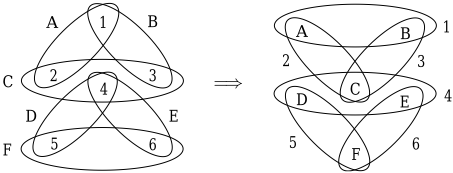
Another approach we investigate is dual to the above one in the sense that we obtain a hypertree where the λ-labels are given and appropriate χ-labels have to be set. To this aim, let us first introduce the dual hypergraph of a hypergraph as exemplified in Fig. 2. The dual hypergraph is simply obtained by swapping the roles of hyperedges and vertices. Our procedure is then to (i) construct a branch-decomposition of the dual hypergraph by using the above heuristic, (ii) transform this branch-decomposition into a tree-decomposition, and (iii) interpret the labels of this tree-decomposition as λlabels of a hypertree and set the χ-labels appropriately in a straight-forward way. The resulting hypertree is then a hypertree-decomposition of the original hypergraph.
The attentive reader may have noticed that there are two problems with the latter approach: First, the branch-width and therefore also the hypertree-width is at least the cardinality of the largest edge in the dual hypergraphwhich is equal to the maximum number of hyperedges having a common vertex in the original hypergraph. Second, since the λ-labels satisfy the conditions of a tree-decomposition by construction, the hypertree-width may be larger than necessary. However, by introducing heuristic pre- and post-processing steps, we are able to overcome both problems.
5 Conclusion
We have tested our approach on hypergraphs representing adder and bridge circuits connected in a line. For all instances of such adder and bridge hypergraphs, we obtained a hypertree-decomposition of almost optimal width within a few seconds. Natural future work will be a full implementation of our approach, the investigation of further improvements, and a systematic comparison with other hypertree-decomposition heuristics. Moreover, an implementation of our second approach in such a way that the treedecomposition of the dual hypergraph is directly constructed (e.g., by bucket elimination) without the intermediate-step of a branch-decomposition seems to be promising.
@inproceedings{ijcai2005p308,
  title     = {Hypertree-decomposition via Branch-decomposition},
  author    = {Samer, Marko},
  booktitle = {Proceedings of the Nineteenth International Joint Conference on
               Artificial Intelligence, {IJCAI-05}},
  publisher = {International Joint Conferences on Artificial Intelligence},
  editor    = {Leslie Pack Kaelbling and Alessandro Saffiotti},
  pages     = {1535--1535},
  year      = {2005},
  url       = {https://ijcai.org/proceedings/2005/308},
}
TY - CPAPER TI - Hypertree-decomposition via Branch-decomposition AU - Samer, Marko T2 - Proceedings of the Nineteenth International Joint Conference on Artificial Intelligence, IJCAI-05 PB - International Joint Conferences on Artificial Intelligence PY - 2005 SP - 1535 EP - 1535 UR - https://ijcai.org/proceedings/2005/308 ER -Copied
Machine-readable versions of this paper, for tools and AI agents:





