
A Machine Learning Approach to Identification and Resolution of One-Anaphora
Proceedings of the Nineteenth International Joint Conference on Artificial Intelligence. Pages 1105-1109.
© 2005 International Joint Conferences on Artificial Intelligence
Abstract
We present a machine learning approach to identifying and resolving one-anaphora. In this approach, the system first learns to distinguish different uses of instances of the word one; in the second stage, the antecedents of those instances of one that are classified as anaphoric are then determined. We evaluated our approach on written texts drawn from the informative domains of the British National Corpus (BNC), and achieved encouraging results. To our knowledge, this is the first learningbased system for the identification and resolution of one-anaphora.
- [Charniak, 2000] E. Charniak. A maximum-entropy inspired parser. In Proceedings of NAACL, pages 132-139, 2000.
- [Dahl, 1985] D. A. Dahl. The structure and function of one- anaphora in English. PhD thesis, Univ. of Minnesota, 1985.
- [Fellbaum, 1998] C. Fellbaum, editor. WordNet: An elec- tronic lexical database. The MIT Press, 1998.
- [Halliday and Hasan, 1976] M. A. K. Halliday and R. Hasan. Cohesion in English. Longman, 1976. [Hankamer and Sag, 1976]
- J. Hankamer and I. Sag. Deep and surface anaphora. Linguistic Inquiry, 7:391-428, 1976.
- [Kennedy and Boguraev, 1996] C. Kennedy and B. Bogu- raev. Anaphora for everyone: pronominal anaphora reso- lution without a parser. In Proceedings of COLING, pages 113-118, Copenhagen, Denmark, 1996.
- [Lappin and Leass, 1994] S. Lappin and H. Leass. A syn- tactically based algorithm for pronominal anaphora reso- lution. Computational Linguistics, 20:535-561, 1994.
- [Luperfoy, 1991] S. Luperfoy. Discourse Pegs: A Compu- tational Analysis of Context-Dependent Referring Expres- sions. PhD thesis, Univ. of Texas at Austin, 1991.
- [Markert et al., 2003] K. Markert, M. Nissim, and N. Mod- jeska. Using the web for nominal anaphora resolution. In Proceedings of the EACL Workshop on Computational Treatment of Anaphora, pages 39-46, 2003. [MUC-7, 1997] MUC-7. Coreference task definition (v3.0, 13 Jul 97). In Proceedings of the Seventh Message Under- standing Conference (MUC-7), 1997.
- [Ng and Cardie, 2002] V. Ng and C. Cardie. Improving ma- chine learning approaches to coreference resolution. In Proceedings of ACL, 2002.
- [Quinlan, 1993] J. R. Quinlan. C4.5: Programs for Machine Learning. Morgan Kaufmann, San Francisco, 1993.
- [Ramshaw and Marcus, 1995] L. Ramshaw and M. Marcus. Text chunking using transformation-based learning. In Proceedings of the ACL Third Workshop on Very Large Corpora, pages 82-94, 1995.
- [Sidner, 1981] C. L. Sidner. Focusing for interpretation of pronouns. American Journal of Computational Linguis- tics, 7(4):217-231, 1981.
- [Soon et al., 2001] W. M. Soon, H. T. Ng, and D. Lim. A ma- chine learning approach to coreference resolution of noun phrases. Computational Linguistics, 27(4):521-544, 2001.
- [Vieira and Poesio, 2000] R. Vieira and M. Poesio. An em- pirically based system for processing definite descriptions. Computational Linguistics, 26(4):539-593, 2000.
- [Webber, 1979] B. Webber. A Formal Approach to Discourse Anaphora. Garland Publishing Inc., 1979.
References were extracted automatically from the PDF and may contain errors.
Full text extracted automatically from the PDF; figures, tables and equations may differ. The PDF is the version of record.
1 Introduction
The word one is a frequently used word in English: in the 100-million-wordBritish National Corpus (BNC), it accounts for 0.26% of all the words, ranking as the 110th most common word, and the 14th most common pronominal form, more frequent than the pronoun us. 1 Not all of these instances of one are anaphoric; the most common use is as a number (as in one book), and there are a number of other uses. However, any natural language processing (NLP) system which tries to process anaphora in unrestricted text will need to be able to determine whether a particular instance of one is being used anaphorically, and when this is the case, what the antecedent of the anaphor is.
In brief, a one-anaphor is an anaphoric noun phrase (NP) headed by the word one, as in the following example:
- Her greater sympathy for the Atlantic connection over the European one is not widely shared by colleagues.
One-anaphora is sometimes referred to as "identity-of-sense anaphora", in contrast to the more common pronominal "identity-of-reference" anaphora [Hankamer and Sag, 1976]. In processing a pronominal reference, we are generally looking for an antecedent noun phrase that refers to the same entity as the anaphoric form; however, one-anaphoric forms are generally used to refer to something of the same kind as something mentioned before. Hence, in order to interpret an instance of one-anaphora, we must identify the antecedent textual material that provides the semantic content alluded to by the use of one. In Example (1), correctly interpreting the European one requires inferring that it has a relationship to the noun phrase the Atlantic connection. The range of semantic relationships that can hold between an one-anaphoric form and its antecedent is broad and complex; for present purposes, we are interested in identifying the antecedent noun phrase that contains the relevant semantic content.
1 These figures are based on Adam Kilgarriff's frequency lists at http://www.itri.brighton.ac.uk/☎ Adam.Kilgarriff/bnc-readme.html.
We designed two systems that are applied consecutively to identify and resolve one-anaphora. In the case of Example (1), our one-expression classifier first determines that the European one is in fact a one-anaphor; then our one-anaphora resolver would identify the noun phrase the Atlantic connection as the antecedent of the one-anaphor. In this paper, an antecedent is defined as the noun phrase fromwhich the head sense of the one-anaphor can be determined.
The pervasiveness of anaphoric reference in general means that anaphora resolution is recognized as an important subtask in natural language processing; one-anaphora resolution, however, has been relatively neglected. As noted, the frequency of occurrence of the word one means that any real NLP system cannot just ignore it; however, the knowledge sources (typically, features of the linguistic context) used in state-of-the-art noun phrase coreference resolution systems (e.g., [Soon et al., 2001; Ng and Cardie, 2002]) are not applicable to one-anaphora. Consequently, one-anaphora resolution is a task that requires special attention.
The rest of this paper is organized as follows. We first introduce the various uses of the word one in English and the different types of antecedents of one-anaphora. Then we give an overview of how our one-expression classifier and oneanaphora resolver are applied consecutively to identify and resolve one-anaphora, followed by two separate sections giving a detailed description and evaluation of the two systems. In the final two sections, we describe related work and conclude.
2 Classes of One-Expressions
In this section, we introduce the various uses of one in English and the different types of antecedents of one-anaphora, along with some statistics of their distribution in the BNC.
2.1 Uses of One and Corpus Annotation
The taxonomy of uses of the word one adopted in this section is based on existing theories of the various uses of one [Halliday and Hasan, 1976; Webber, 1979; Dahl, 1985; Luperfoy, 1991] and our own study of one-expressions. We divided uses of one into six classes: Numeric, Partitive, Anaphoric, Generic, Idiomatic, and Unclassifiable.
- Numeric One: Modifies a head noun to indicate singularity as in Example (2); this is the only adjectival use of one.
- John has one blue T-shirt.
- PartitiveOne: Selects an individual from a set. It is followed by an of-prepositional phrase headed by a plural noun or pronoun as in Example (3).
- A special exhibition of books for children forms one of the centrepieces of the 41st annual Frankfurt Book Fair.
- Anaphoric One: Relates a set of properties to the set of properties mentioned by the antecedent. There are three types of one-anaphors, distinguished by the type of their antecedents. First, the antecedent may be a kind, as in the noisy cameras of Example (4); second, the antecedent may be a set of entities, as in the set of two World Bank men of Example (5); and third, the antecedent may refer to a single instance, as in this book of Example (6).
- I have an aversion to noisy cameras, and this one rings several decibels before it's done with winding on the film.
- The two World Bank men, one German and one British, strode across the tarmac.
- Would you like this book? Yes, I would like that one.
- Generic One: A pronominal use that refers to a generic person or to the speaker of a sentence; often used in subject position followed by a modal verb and a main verb that takes an animate subject.
- One must think a little deeper to discover the underlying social roots of the problem.
- Idiomatic One: Conventionalized uses whose semantics appear not to be based on general use, but rather on idiomatic patterns, as in Example (8).
- It would be perfect to have a loved one accompany me in the whole trip.
- Unclassifiable One: Inevitably, there are instances which are difficult to classify as any of the above, as in Example (9).
- Cursed be every one who curses you.
For the present study, we randomly selected 1,577 one expressions from the BNC 2 , and manually annotated these with the six classes above. The distribution of each class in the annotated corpus is shown in Table 1, and it mirrors the distribution of one expressions in naturally occurring text.
2 These one-expressions are from written text in the informative domains of BNC. Spoken text and written text in the imaginative domain (i.e., texts which are fictional or which are generally per-
| Class | Frequency | % |
|---|---|---|
| Numeric | 739 | 46.9 |
| Partitive | 399 | 25.3 |
| Anaphoric | 240 | 15.2 |
| Generic | 167 | 10.6 |
| Unclassifiable | 25 | 1.6 |
| Idiomatic | 7 | 0.4 |
| Total | 1,577 | 100.0 |
2.2 Annotating Antecedents of One-Anaphora
We annotated the 240 examples of one-anaphors in our corpus a second time, marking the antecedent in each case. Not every one-anaphor has an explicit noun phrase antecedent as shown in the previous anaphoric examples; in such cases, the reader has to infer the nature of the antecedent from the available text. We label those cases where there is no explicit antecedent as "one-anaphors with implicit antecedents". The remaining one-anaphors are "one-anaphors with explicit antecedents". Of the 240 one-anaphors, 98.3% had explicit antecedents.
3 An Overview of Our Approach
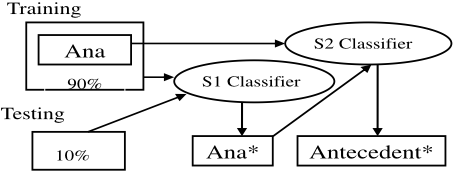
Before we describe our two machine learning systems for one-expression classification and one-anaphora resolution, we first provide an overview of how the two systems are applied consecutively to accomplish the overall task of identifying and resolving one-anaphora. As an example, we use one trial in the 10-fold cross validation to illustrate the process. Here, the identification of one-anaphora is Step 1 (S1), and the resolution of one-anaphora is Step 2 (S2).
As shown in Figure 1, a gold standard corpus is divided into two sets, containing 90% and 10% of the data respectively. The larger set is used to train the S1 classifier. In the S1 training data, there is a set of anaphoric examples, Ana. This set is used to train the S2 classifier.
The smaller set of 10% of the examples is used for testing. First, the test examples are passed to the S1 classifier, which identifies a set of anaphoric examples, Ana*. This set may contain errors in identification (a one-anaphor not classified as anaphoric, or a non-anaphoric example classified as
ceived as literary or creative) are not considered because they contain a large amount of dialog, which makes one-anaphora resolution a harder task. This restriction follows the genre of MUC texts [MUC-7, 1997], a widely used data set in noun phrase coreference research, which also only included written newspaper texts.
anaphoric). Ana* is in turn passed to the S2 classifier, which outputs the antecedents it finds, denoted as Antecedent*. When calculating accuracy, Ana* and Antecedent* are used to compare with the gold standard annotation to measure both the S1 accuracy and the overall accuracy of the combined systems.
4 One-Expression Classification
Our one-expression classifier classifies a given oneexpression into one of the six classes listed in Table 1.
4.1 The Features
We devised a set of features that is useful in determining which of the six classes a given one-expression belongs to. We focus on the classes Numeric, Partitive, Anaphoric, and Generic, since 98%of the instances are from these classes.
The Numeric use of one is the simplest case, since it is the only adjectival use in English. It can be readily identified by the part-of-speech (POS) tag of the word one. Partitive use of one can be identified by checking the syntactic context (i.e., [one [of NPpl]]).
Discrimination between the Anaphoric and Generic classes is more complex. We used the three features isSubj, isAnimateVerb, and isModalVerb to identify instances of the Generic class, in line with the observations mentioned in the definition of Generic One . We also noticed that the relative position of one in its host NP and the category of the word immediately preceding one both give strong hints as to the function of one in its host NP. Therefore, we added two more features, positionInNP and Wa0 ✁ POS, to assist in classification.
We experimented with a total of 7 features as described below. Each instance in the training and test data set is thus represented as a feature vector of seven values. The feature values are acquired by running the Charniak Parser [Charniak, 2000] over the corpus, in combination with information about verbs of cognition from WordNet [Fellbaum, 1998]:
- W✂ POS is the POS tag of one assigned by the Charniak Parser. Its possible values are CD, NN, NNP, PRP.
- isOfPlural checks whether one is followed by of prepositional phrase with a plural head noun/pronoun. Its possible values are plural, notPlural, or NA when the word one is not followed by a PP headed by of. For example:
- (a) plural: One of the patients survived.
- (b) notPlural: The problem was the unusual one of a warmish, wet spring.
- isSubj checks whether the word one is in subject position. This feature value is inferred from the parse tree structure; its possible values are true or false.
- isAnimateVerb checks whether the lemmatized verb following subject one is a verb of cognition according to WordNet: some examples are think, judge, analyze, and doubt. The possible values for this feature are true, false, or NA when one is not the subject. Example (7) would get true for this feature.
- isModalVerb checks whether the verb phrase following a subject one contains a modal verb (i.e., a word with
| Num in data set | Num identified | Num correct | R | P | F1 | |
|---|---|---|---|---|---|---|
| NUM | 739 | 730 | 693 | 93.8 | 94.9 | 94.3 |
| PAR | 399 | 412 | 390 | 97.7 | 94.7 | 96.2 |
| ANA | 240 | 281 | 192 | 80.0 | 68.3 | 73.7 |
| GEN | 167 | 152 | 127 | 76.0 | 83.6 | 79.6 |
| Sub Total | 1,545 | 1,575 | 1,402 | 90.7 | 89.0 | 89.8 |
| UNC | 25 | 2 | 0 | 0 | 0 | - |
| IDIO | 7 | 0 | 0 | 0 | - | - |
| Total | 1,577 | 1,577 | 1,402 | 88.9 | 88.9 | 88.9 |
MD POS tag, such as must). The possible values for this feature are true, false, or NA when one is not the subject. Example (7) would get true for this feature.
- positionInNP indicates the position of the word one in its host NP. It has four possible values: SingleOne when the NP only consists of the word one; Leftmost when the NP has multiple words and one is the leftmost word; Rightmost when the NP has multiple words and one is the rightmost word; and Middle otherwise. For example:
- SingleOne: [One] might suppose that . . .
- Leftmost: I was concerned with [one thing] only.
- Rightmost: [the European one]
- Middle: on [the one hand]
- W a0 ✁ POS is the POS tag of the word immediately preceding one. Its possible values are the 45 POS tags in Penn TreeBank tagset and NA when one is the first word of the sentence.
The learning algorithm used in our one-expression classification system is C4.5 [Quinlan, 1993]. This is a commonly used decision tree learning algorithm and may be considered as a baseline against which other learning algorithms can be compared.
4.2 Evaluation and Error Analysis Evaluation
Table 2 gives the 10-fold cross validation results for the oneexpression classifier for each of the 6 classes.
The accuracy of identifying one-anaphora is 73.7%, which is not as high as the Numeric, Partitive, and Generic classes. The remaining two classes, Idiomatic and Unclassifiable, are poorly discriminated; when counted in, these pull down the overall classification accuracy from 89.8% to 88.9%.
Error Analysis
Table 3 provides a matrix of the number of misclassifications in each class. Row 4 and Column 4, highlighted, show that the major confusion with the Anaphoric class comes from the Generic and Numeric classes, with Partitive making a smaller contribution to the erroneous classifications.
Our classifier's performance is highly impacted by the accuracy of POS tagging and parsing: failures here caused most of the confusion with Numeric and Partitive. For example, one in (4) is classified as Numeric because rings is wrongly tagged as NNS; and Partitive one in the phrase one or more of them is classified as Anaphoric because it is wrongly parsed as [[one] or [more of [them]]].
| classified as a0 ✁ * | NUM* | PAR* | ANA* | GEN* | UNC* | IDIO* |
| NUM | na | 2 | 35 | 8 | 1 | 0 |
| PAR | 3 | na | 6 | 0 | 0 | 0 |
| ANA | 14 | 18 | na | 15 | 1 | 0 |
| GEN | 9 | 0 | 31 | na | 0 | 0 |
| UNC | 10 | 1 | 12 | 2 | na | 0 |
| IDIO | 1 | 1 | 5 | 0 | 0 | na |
The confusion with the Generic class is mainly caused by occurrences of anaphoric one as subject and generic one in non-subject position. Such cases can also be confusing for human readers: in a sentence like One is usually shunting around in the yard, we might think we have a generic use, but the one may refer to a previously mentioned locomotive.
5 One-Anaphora Resolution
Our one-anaphor resolver attempts to identify the NP in the preceding linguistic context that provides the semantic content required for interpretation of a one-anaphor; we refer to this NP as the antecedent NP.
5.1 Experimental Data
We trained and tested a one-anaphor resolution classifier using a set of positive/negative antecedent-anaphor pairs. A pair is positive when the candidate antecedent in this pair is the actual antecedent of the anaphor; otherwise, it is negative.
Training Data
In each trial of the 10-fold cross validation, the actual oneanaphora instances in the gold standard training corpus of Step 1 are used to create Step 2 training instances in the corresponding trial as shown in Figure 1.
Creation of training instances consisted of three steps. First, each sentence containing one and its three preceding sentences 3 were processed by RM NP chunker [Ramshaw and Marcus, 1995] to carry out NP chunking. Second, each pair of an anaphor and its actual antecedent were used to create a positive training instance. Lastly, to generate negative training instances, anaphors were paired with each of the NPs that appeared between the anaphor and its real antecedent.
In our experiment, we further adjusted the ratio of positive to negative instances in the training data by controlling the number of negative instances randomly picked from the whole set of negative instances. We decided to set the ratio at 1:1, which introduces no preference for either one of the two assignments to the classifier. This procedure produced a set of 472 antecedent-anaphor pairs in total, of which 236 (50%) were positive instances. As already noted, each trial used roughly 90% of this set as training data.
3 If the sentence containing one appeared close to the beginning of the text and there were less than three preceding sentences, we used all available preceding sentences.
Test Data
In each trial, instances of one identified as being anaphoric in the test data of Step 1 were used to create Step 2 test instances in the corresponding trial as shown in Figure 1.
Creation of test instances consisted of two steps. The first step is the same as that for the training data; in the second step, every base NP preceding the instance of one is a potential antecedent, so each of these NPs was paired with one.
When doing testing, the one-anaphora resolution algorithm starts from the immediately preceding base NP and proceeds backward in the reverse order of the NPs in the context until there is no remaining NP to test, or an antecedent is found (i.e., the classifier returns true).
5.2 The Features
To decide whether the anaphor in a given antecedent-anaphor pair refers to the candidate antecedent, we need features that show a preference for good candidates.
As with pronominal anaphora, an intuitively appealing feature to use is whether the candidate antecedent NP is in focus [Sidner, 1981; Vieira and Poesio, 2000]. In anaphora resolution, two commonly used features for approximating the notion of focus are syntactic role and recency: a candidate that fills a salient syntactic role such as subject, or one that is very recent, is often the focus of the discourse. We used four features to measure this type of information: AnteIsSubj, AnteInRelClause, AnteIsNearestNP, and bothInPP. The feature bothInPP allows us to take syntactic parallelism into consideration. The POS tag of the head word of the candidate antecedent is also a good feature in filtering out improper candidates: a proper noun should not be the antecedent of a oneanaphor [Dahl, 1985].
We used a total of 5 features as described below. Their values are acquired from the Charniak Parser output of the training/test data set.
- hwPOSofAnte is the POS tag of the head word of the candidate antecedent. Its possible values are the set of POS tags of head words that occur in our training/test data. In this paper, the head word of the candidate antecedent is defined as the rightmost noun, or the rightmost word if no noun is found, in the base NP candidate antecedent.
- bothInPP checks whether the candidate antecedent and the one-anaphor are both in prepositional phrases (PP), and identifies the types of PPs they are in. It has five possible values: NA when the candidate antecedent is not in PP; OnlyAnteInPP when the candidate antecedent is in PP, but the one-anaphor is not in PP; SharePP when the candidate antecedent and the one-anaphor are in the same PP; CommonPreposition when both candidate antecedent and one-anaphor are in different PPs, but the prepositions of the two PPs are the same; and DifferentPreposition when both candidate antecedent and oneanaphor are in different PPs with different prepositions.
- AnteIsSubj checks whether the candidate antecedent is in subject position. Its possible values are true or false.
- AnteIsNearestNP checks whether the candidate antecedent is the nearest NP preceding the one-anaphor. Its possible values are true or false.
- AnteInRelClause checks whether the candidate antecedent is in a relative clause. Its possible values are true or false.
Again, the learning algorithm used in our one-anaphora resolution engine is C4.5.
5.3 Evaluation and Error Analysis
Evaluation
In order to evaluate the overall performance of our approach to one-anaphora identification and resolution, we conducted a 10-fold cross validation of the one-anaphora resolver, where each trial is performed based on the result of our oneexpression classifier in Step 1. The overall recall, precision, and F-measure are presented in Table 4, together with the accuracy of one-anaphora identification from Step 1.
The "S2 correct" in Table 4 Column 9 is the sum of two values. The first value is the number of hits in correctly identifying the explicit antecedent of a one-anaphor. A hit of this type occurs when a one-anaphor with an explicit antecedent is correctly identified as anaphoric in Step 1 and the actual antecedent is found in Step 2. The second value is the number of hits returning no antecedent for a one-anaphor when it has no annotated antecedent. A hit of this type occurs when a oneanaphor without an explicit antecedent is correctly identified as anaphoric in Step 1, and none of the candidate antecedents is accepted in Step 2.
The overall recall is the sum in "S2 correct" divided by the total number of one-anaphors with or without explicit antecedent in the data set (Column 1); the overall precision is the sum in "S2 correct" divided by the total number of one-anaphors with or without explicit antecedent identified in Step 1 (Column 3). The F-measure finally achieved is 45.7%.
We compared two baseline heuristics with our accuracy: nearestNP and nearestSubj, which always assign the nearest NP or Subject preceding the one-anaphor as its antecedent. The two baseline accuracies are calculated by applying the two heuristics on the set of anaphoric ones identified in Step 1; nearestNP (nearestSubj) heuristics achieved 28.8% (23.8%) accuracy, considerably lower than the overall accuracy of our system.
Error Analysis and Future Improvement
Since we perform one-anaphora resolution on the output of our one-anaphora identification system, the 45.7% overall accuracy is a combination of both Step 1 and Step 2 performance. Errors introduced in Step 1 were never remedied in Step 2, and they directly affected both overall recall and precision. In other words, given a perfect Step 2 classifier to work on the current one-anaphora identification output, the highest overall F-measure achievable is 73.7%. Therefore, any further improvement in Step 1 performance would significantly improve the overall accuracy. This could be done by adding features to improve the performance of Step 1, or adding a remedy strategy in later processing.
Our system finds it difficult to locate actual antecedents that are far away from their one-anaphors: preference is wrongly given to closer and more salient candidates. In Example (10), the director has a strong syntactic preference and it is considered before moustache, so the system wrongly returns the director even before checking the actual antecedent.
- He has this ridiculous moustache. Ken Russell, the director, insisted I grew one of my own, rather than wear a false one, so that I looked completely convincing.
We expect that such mistakes could be corrected by using semantic features.
5.4 The Contribution of the Features
To evaluate the relative contribution of the various knowledge sources to the overall accuracy of one-anaphora identification and resolution, we ran a series of leave-one-out classifiers, where we first used all Step 1 features and disabled one Step 2 feature at a time; then we used all Step 2 features and disabled one Step 1 feature at a time. The contribution of the features measured in terms of the overall F-measure is shown in Table 4 Column 12.
The critical features which cause a substantial reduction of overall F-measure when disabled are Step 1 features positionInNP, isOfPlural, and W ✂ POS, as well as Step 2 features hwPOSofAnte and bothInPP. The remaining features only have a small impact on the overall F-measure.
6 RelatedWork
The literature on one-anaphora is small; we cited the most significant works in the area in Section 2. Most of the existing literature is more concerned with describing the phenomenon than in determining how it might be handled automatically.
There is, of course, an extensive literature on computational techniques for resolving pronominal anaphora, going back to at least the 1970s. Of the more recent research in the area, important work is that of Lappin and Leass [1994] and Kennedy and Boguraev [1996], who provided heuristics that could be used to determine the antecedents of pronominal forms. Soon et al. [2001] and Ng and Cardie [2002] used a machine learning approach for coreference resolution. However, most of the linguistic features used in the work on pronominal anaphora are not applicable to the one-anaphora problem. Markert et al. [2003] focused on the related phenomenon of other-anaphora.
7 Conclusion
In this paper, we have presented a machine learning approach to the identification and resolution of one-anaphora and achieved encouraging results; to our knowledge, this is the first learning-based system for resolving one-anaphora. There is scope for refinement to improve both the accuracy of identifying anaphoric uses of one, and of identifying the antecedent noun phrase that contains the semantic content required for interpreting the one-anaphor. Beyond this goal, there are more complex challenges awaiting in terms of oneanaphora interpretation.
| Num of | Step1: 7 features (f1-f7) | Step2: 5 fea- tures (f1-f5) | Overall | Baseline | |||||||||
|---|---|---|---|---|---|---|---|---|---|---|---|---|---|
| Ana in data set | S1 feature | S1 sysout as Ana | S1 correct | S1 R | S1 P | S1 F1 | S2 feature | S2 correct | R | P | F1 | n-NP | n-Subj |
| ALL | 281 | 192 | 80.0 | 68.3 | 73.7 | ALL | 119+0 | 49.6 | 42.3 | 45.7 30.0 | 28.8 | 23.8 | |
| no f1 no f2 | 78+0 99+1 | 32.5 41.7 | 27.8 35.6 | 38.4 | |||||||||
| no f3 | 117+0 | 48.8 49.2 | 41.6 42.0 | 44.9 45.3 | |||||||||
| no f4 | 118+0 | ||||||||||||
| no f5 | 119+0 | 49.6 | 42.3 | 45.7 | |||||||||
| 240 | no f1 | 128 | 76 | 31.7 | 59.4 | 41.3 | ALL | 49+0 | 20.4 | 38.3 | 26.6 | 8.3 | 7.1 |
| no f2 | 126 | 91 | 37.9 | 72.2 | 49.7 | ALL | 60+0 | 25.0 | 47.6 | 32.8 | 12.5 | 13.8 | |
| no f3 | 251 | 165 | 68.8 | 65.7 | 67.2 | ALL | 100+0 | 41.7 | 39.8 | 40.7 | 25.0 | 22.1 | |
| no f4 | 282 | 185 | 77.1 | 65.6 | 70.9 | ALL | 114+0 | 47.5 | 40.4 | 43.7 | 27.1 | 23.3 | |
| no f5 | 295 | 192 | 80.0 | 65.1 | 71.8 | ALL | 118+0 | 49.2 | 40.0 | 44.1 | 29.2 | 24.6 | |
| no f6 | 276 | 187 | 77.9 | 67.8 | 72.5 | ALL | 115+0 | 47.9 | 41.7 | 44.6 | 27.5 | 23.3 | |
| no f7 | 280 | 191 | 79.6 | 68.2 | 73.5 | ALL | 118+0 | 49.2 | 42.1 | 45.4 | 28.3 | 23.8 | |
@inproceedings{ijcai2005p215,
  title     = {A Machine Learning Approach to Identification and Resolution of One-Anaphora},
  author    = {Ng, Hwee Tou and Zhou, Yu and Dale, Robert and Gardiner, Mary},
  booktitle = {Proceedings of the Nineteenth International Joint Conference on
               Artificial Intelligence, {IJCAI-05}},
  publisher = {International Joint Conferences on Artificial Intelligence},
  editor    = {Leslie Pack Kaelbling and Alessandro Saffiotti},
  pages     = {1105--1109},
  year      = {2005},
  url       = {https://ijcai.org/proceedings/2005/215},
}
TY - CPAPER TI - A Machine Learning Approach to Identification and Resolution of One-Anaphora AU - Ng, Hwee Tou AU - Zhou, Yu AU - Dale, Robert AU - Gardiner, Mary T2 - Proceedings of the Nineteenth International Joint Conference on Artificial Intelligence, IJCAI-05 PB - International Joint Conferences on Artificial Intelligence PY - 2005 SP - 1105 EP - 1109 UR - https://ijcai.org/proceedings/2005/215 ER -Copied
Machine-readable versions of this paper, for tools and AI agents:





