
Comparing image-based localization methods
Proceedings of the Eighteenth International Joint Conference on Artificial Intelligence. Pages 1560-1561.
© 2003 International Joint Conferences on Artificial Intelligence
Abstract
This paper compares alternative approaches to pose estimation using visual cues from the environment. We examine approaches that derive pose estimates from global image properties, such as principal components analysis (PCA) versus from local image properties, commonly referred to as landmarks. We also consider the failure-modes of the different methods. Our work is validated with experimental results .
- [Nayar eta!., 1994] S.K. Nayar, H. Murase, and S.A. Nene. Learn- ing, positioning, and tracking visual appearance. In Proc. IEEE Conf on Robotics and Automation, pages 3237-3246, San Diego, CA, May 1994.
- [Pourraz and Crowley, 1999] F. Pourraz and J. L. Crowley. Conti- nuity properties of the appearance manifold for mobile robot po- sition estimation. In Proceedings of the 2nd IEEE Workshop on Perception for Mobile Agents, Ft. Collins, CO, June 1999. IEEE Press.
- [Se eta!., 2002] S. Se, D. Lowe, and J. Little. Global localization using distinctive visual features. In Proc. Int. Conf on Intelligent Robots and Systems (IROS), pages 226-231 , Lausanne, Switze r- land, October 2002.
- [Sim and Dudek, 2001] R. Sim and G. Dudek. Learning ge nera- tive models of scene features. In Proc. IEEE Conf Computer Vision and Pattern Recognition (CVPR) , Lihue, HI, December 200 I. IEEE Press.
- [Ulrich and Nourbakhsh, 2000] Iwan Ulrich and Illah Nourbakhsh. Appearance-based place recognition for topological locali zation. In Proc. IEEE Inti. Conf on Robotics and Automation, pages 1023-1029. IEEE Press, April2000.
References were extracted automatically from the PDF and may contain errors.
Full text extracted automatically from the PDF; figures, tables and equations may differ. The PDF is the version of record.
1 Introduction
A considerable amount of research has been conducted on the problem of using vision to localize a robot in a known environment. Two basic approaches have emerged; the first correlates global properties of the image, such as a principal components subspace projection; whereas the second corre lates a set of local properties, or landmarks. Each approach has its own strengths and weaknesses, and is based on its own assumptions about the environment. It is often argued that lo cal feature-based representations are more robust to scene dy namics and illumination variation than globally-derived rep resentations. It is also widely assumed that feature-based ap proaches require Jess online computation time than global ap proaches.
The goal of this paper is to critically examine a selection of image-based pose estimation methods and compare them for their performance under a variety of conditions. We con sider accuracy and running time as the two major indicators of performance.
2 Previous Work
Pose estimation from monocular vision data is non-intrusive and conceptually appealing as a research direction. Posi tion estimation entails a combination of estimating local dis placement with recognizing familiar locations. It has been approached as both a coarse place-recognition problem (e.g. based on color histograms for familiar locations [Ulrich and Nourbakhsh, 2000]) and also as a problem of recognizing a set oflocal features associated with a specific location (for ex ample [Se et al., 2002]). In several approaches, authors have suggested interpolating between familiar locations to produce a position estimate more accurate than the density of training data, using either global image features ([Nayar et al., 1994; Pourraz and Crowley, 1999]) or sets of local image features ([Sim and Dudek, 2001]). In this paper we compare the per formance of some of these alternatives ..
3 Localization Methods
Framework We assume the same framework for all of the methods presented below. First, a set of training images has been collected from known poses in the environment. A model, or models, are constructed by building an interpolant over the set of training poses. We employ bilinear interpola tion of the observation space over the Delaunay triangulation of the pose space. The cost of constructing the triangulation and any other preprocessing of the training images (such as tracking features) is referred to as the offline cost.
When a pose estimate is required, a probability distribution is computed using a multi-resolution grid-based discretiza tion of the pose space. At each grid position a predicted observation is generated and compared with the actual ob servation. The probability is computed using Bayes' Rule, whereby, assuming a uniform prior, the probability of a pose q is proportional to the probability of the observation z given the pose:
Once a cell with maximal probability is determined, a higher resolution discretization is computed in the neighborhood of that cell, and the process recurses until a desired level of res olution is achieved. By setting the maximum discretization to a fixed value, we fix the number of times the likelihood function is evaluated, thus allowing us to benchmark the per formance of the method. This running time is referred to as the online cost.
3.1 Global Methods
Edge Density Out first globally-based method computes a map of the local edge density of the image. The density is approximated by convolving the image edge map with a wide (33 pixels) Gaussian kernel. The edge map is relatively re· sistant to illumination changes, and measuring edge density propagates edge information locally. Depending on the width of the kernel, a linear combination of neighboring training edge densities can loosely approximate the motion of edges as the camera moves.
Principal Components PCA operates by computing a low dimensional subspace of the space spanned by the training images. For this work, we employ the first twenty principal components. When pose likelihoods are computed online, only the low-dimensional projections of the training inputs are interpolated. The input observation must be projected into the subspace; an operation that is performed once; and subse quent comparisons are between low-dimensional vectors.
3.2 Local Methods
The alternative to computing global image features is to ex tract a set of local image features, or landmarks, and model their behavior as a function of position. Local features must be selected and tracked, and subsequently they are modeled. Finally, when online they must be matched to features in the input observation. Once matching is complete, the individ ual estimates from different landmarks must be combined in a robust manner.
We use the landmark-based method proposed by Sim and Dudek [Sim and Dudek, 2001 ]. That model selects landmarks using saliency, and, once they are tracked across the training space, models the landmark behaviors as a function of pose. The models compute a linear interpolant of the landmark at tributes over the triangulation of the pose space.
We employ two versions of the landmark model; the first, referred to as DynamicLM models the appearance of the landmarks as a function of pose, and thus matching may re quire several instantiations of the landmark before it is suc cessfully matched. The second, referred to as FixedLM, fixes the landmark appearance, speeding up the matching, but re ducing the range of poses that the landmark can model.
4 Experimental Approach
| Mean Err. _{em~ | Max Err. _(_cm_l | Tot. Train'g Tim~ | unune Preproc. _(_s/i m _g}_ | Unlme Loc'zn (slim g) | |
|---|---|---|---|---|---|
| Global Methods Edge Density | 8.22 | 22.4 | 31.4 | 0.309 | 38.1 |
| NN (EdgeDens) | 11.1 | 22.3 | n!a | n!a | n!a |
| PCA | 6.06 | 12.4 | 2170 | 0.234 | 0.208 |
| NN (PCA) | 9.7 | 22.3 | n!a | n!a | n!a |
| Local Methods DynamicLM | 8.49 | 23 .09 | 1581 | 145 | 19.8 |
| FixedLM | 7.61 | 19.7 | 1529 | 10.6 | 17.9 |
Training We used a robot to collect 121 images in a grid pattern at 20cm intervals, over a 2m by 2m area (Figure Ia)). Ground truth was obtained by mounting a laser pointer on the robot and measuring by hand the position of the laser point on the floor. As such, the ground truth is accurate to -o.5cm.
The same set of training images was provided to each lo calization method for preprocessing and training, and the run ning times for this phase were recorded.
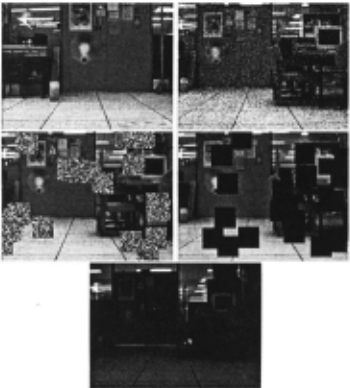
Verification A set of 29 verification images were collected with the robot from random locations at the same orientation as the training images. Ground truth was measured by hand. The images were collected under the same illumination con ditions and observed the same static scene. These images constitute our Normal verification set. Gaussian white noise was added to these images to create a Noisy verification set (Figure la)), and a set of occluders were randomly painted into the images to generate two Occlusion sets (Figure I b) and lc)). The first set of occluders consists of white noise, and the second consists of solid tiles.
A second set of ten images was collected under low light conditions from random locations. Ground truth was recorded by hand. These images are referred to as the Illumi nation verification set (Figure 1 d)).
Each localization method was applied to each verification set, and the mean error between the maximum-likelihood (ML) estimate and ground truth was compiled on a per method, per-set basis. The computational cost of preprocess ing the input images and computing the ML estimate was also recorded. For each image, the multi-resolution grids were evaluated at a total of 2300 distinct poses.
Measuring performance Consider the expected error us ing a method that selects the nearest training image with 100% accuracy. This magic number can be computed to be 7.6cm for our experiments. A mean error of less than 7.6cm could be considered to be successful at interpolating over the training set. In practice a nearest-neighbor implementation is unlikely to be perfect, and will generate larger errors. We have applied a nearest neighbor (NN) approach to the two global methods on the Normal set.
5 Experimental Results
Table 1 depicts the results for the Normal set. The mean lo calization error, maximum outlier, and offline and online running times are depicted. For the two global methods, near est neighbor results are also tabulated for comparison. Only the PCA and FixedLM methods approach the magic number. The nearest neighbor approaches perform poorly against the magic number. As expected, PCA presents a large offline computational cost, but very low online cost.
| Mean (em) | Max (em) | Estimates | |
|---|---|---|---|
| Global Methods Edge Density | 8.4 | 21.9 | 29/29 |
| PCA | 5.9 | 11.9 | 29/29 |
| Local Methods DynamicLM | 11.8 | 26.4 | 29/29 |
| FixedLM | 11.0 | 27.9 | 6/29 |
| Mean (em) | Max (em) | Estimates | |
|---|---|---|---|
| Global Methods | |||
| Edge Density | 30.9 | 103 | 10/10 |
| PCA | 149 | 217 | 10/10 |
| Local Methods | |||
| DynamicLM | 105 | 204 | 10/10 |
| FixedLM | 138 | 271 | 9/10 |
| Mean (em) | Max (em) | Estimates | |
|---|---|---|---|
| Global Methods Edge Density | 60.3 | 215 | 29/29 |
| PCA | 11.2 | 21.7 | 29/29 |
| Local Methods DynamicLM | 22.0 | 205 | 29/29 |
| FixedLM | 27.3 | 180 | 28/29 |
Table 3: Localization results for noisy Occlusion set.
Table 2 depicts the results for the Noisy set. In the case of the landmark-based approach, we have indicated error re sults for only those images where at least one landmark was successfully matched. The number of estimates is indicated in the last column, out of the total number of verification im ages. Both global methods saw an improvement in perfor mance.
Table 3 depicts the results for the Occlusion set with noisy occluders. The local methods perform significantly worse, despite improved matching output in the FixedLM case. PCA continues to perform well, but the edge density approach is confounded by the introduction of regions of high edge den sity.
Table 4 depicts the results for the Occlusion set with solid occluders. The local methods demonstrate a degradation in performance, although not as great as for the white noise oc cluders. There is also a reversal in performance for PCA ver sus Edge Density.
Table 5 indicates the results under altered illumination con ditions. While all of the methods perform poorly, the Edge Density approach suffers the least degradation.
| lYre an (em) | Max (em) | Estimates | |
|---|---|---|---|
| Global Methods Edge Density | 10.5 | 30.8 | 29/29 |
| PCA | 96.3 | 222 | 29/29 |
| Local Methods DynamicLM | 12.1 | 48.6 | 29/29 |
| FixedLM | 15.6 | 100 | 28/29 |
6 Discussion and Conclusions
Both PCA and the landmark-based methods present signi fi cant offline costs, calling into question their practicality for applications such as simultaneous localization and mapping. Howe~er, PCA was robust to some types of adverse imaging cond1t10ns, and was demonstrably faster in computing online pose estimates.
While the Edge Density method was less accurate than PCA, it took significantly less time to train, at the cost of ~lower online performance. However, the ongoing increase m CPU speeds makes global methods such as these increas ingly practical.
Finally, the landmark-based methods presented a smooth degradation in performance as the imaging conditions be came increasingly adverse. In general, these methods per formed well, but were significantly more expensive online due to the cost of matching and frequent invocation of the landmark prediction model. Online performance of these ap proaches depends to a large extent on the nature of the pre diction model itself.
We have presented a comparison of several local ization meth?~s in a known environment against a variety of imaging cond1t10ns. The results challenge some widely held assump tions about the various advantages and disadvantages of local and global methods.
@inproceedings{ijcai2003p272,
  title     = {Comparing image-based localization methods},
  author    = {Sim, Robert and Dudek, Gregory},
  booktitle = {Proceedings of the Eighteenth International Joint Conference on
               Artificial Intelligence, {IJCAI-03}},
  publisher = {International Joint Conferences on Artificial Intelligence},
  editor    = {Georg Gottlob and Toby Walsh},
  pages     = {1560--1561},
  year      = {2003},
  url       = {https://ijcai.org/proceedings/2003/272},
}
TY - CPAPER TI - Comparing image-based localization methods AU - Sim, Robert AU - Dudek, Gregory T2 - Proceedings of the Eighteenth International Joint Conference on Artificial Intelligence, IJCAI-03 PB - International Joint Conferences on Artificial Intelligence PY - 2003 SP - 1560 EP - 1561 UR - https://ijcai.org/proceedings/2003/272 ER -Copied
Machine-readable versions of this paper, for tools and AI agents:





