
Multiple Agents Moving Target Search
Proceedings of the Eighteenth International Joint Conference on Artificial Intelligence. Pages 1536-1537.
© 2003 International Joint Conferences on Artificial Intelligence
Abstract
Traditional si ngle-agent search algorithms usually make simplifying assumptions (single search agent, stationary target, complete knowledge of the state, and sufficient time). There are algorithms for relaxing one or two of these constraints; in this paper we want to relax a ll four. The application domain is to have multiple search agents cooperate to pursue and capture a moving target. Agents are allowed to communicate with each other. For solving Multiple Agents Moving Target (MAMT) applications, we present a framework for specifying a family of suitable search algorithms. This paper investigates several effective approaches for solving problem instances in this domain.
- [Ishida and Korf, 1995] T. Ishida and R. Korf. Moving tar- get search: A real-time search for changing goals. IEEE PAM!, 17(6):609-619, 1995.
- [Koenig and Likhachev, 2003] S. Koenig and M. Likhachev. D* lite. AAAI, pages 476-483, 2003 .
- [Korf, 1990] R. Korf. Real-time heuristic search. Artificial Intelligence, 42(2-3): 189-211 , 1990.
- [Stentz, 1995] A. Stentz. The focussed D* algorithm for real-time replanning. In IJCAI, pages 1652-1659, 1995. IJCAI
References were extracted automatically from the PDF and may contain errors.
Full text extracted automatically from the PDF; figures, tables and equations may differ. The PDF is the version of record.
1 Introduction
In the 2002 Steven Spielberg movie Minority Report, John Anderton (played by Tom Cruise) is on the run. In one se quence, Anderton is hiding in a building, and his pursuers unleash a team of mini-robots to flush him out. The robot team separates, each covering a different part of the building. Anderton, realizing the danger, stops fleeing and comes up with a unique solution - he submerges himself in a bathtub of water so as to avoid the robotic detectors. Sadly, he can only hold his breath for so long, before he has to emerge and is found by the robots.
The classic algorithms (such as A*) are effective for solv ing search problems that satisfy the properties: one search agent, the agent has perfect information about the environ ment, the environment and goal state do not change, and enough time is given to make an optimal decision. ~elax ing even one of the assumptions gives rise to new algonthms (e.g., moving target search [Ishida and Korf, 1995]), real-time search [Korf, 1990], and D* [Stentz, 1995]). Many real world problems do not satisfy all of these properties. In this paper we use an application domain that breaks all of them.
Consider the task of multiple agents having to pursue and capture a moving target; for example a squad of policemen chasing a villain. We want to design a test environment that is as realistic as possible. We assume a grid with obstacles. Agents can only "see" what is directly visible to them. Agents are allowed to communicate with any agent that they can see. As the target flees, it may become obscured from sight.
The agent's knowledge of the locations of the target and other agents may be fuzzy (since some of them may be hid den from sight). Given whatever knowledge of the target and other agents is available, an agent must decide how to pursue the target. The target's possible locations provide informa tion of where to search; the other agents' possible locations provide information that can be used to coordinate the search effort. The challenge is to have the agents act autonomously to catch the target as quickly as possible.
This paper makes the following contributions: MAMT - a challenging application domain for exploring issues related to Multiple Agents pursuing a Moving Target, a framework for expressing real-time search algorithms for the MAMT domain and several solutions that allow an agent to act au tonomo~sly (using information about the possible positions of the target and other agents in the decision-making process).
More details are available at www. cs. ualberta. ca/ -jonathan/Papers/ai.2003.html.
2 Literature
There are a family of A* algorithms that relax solution opti mality by requiring the agent to make the best decision pos sible given limited search resources (e.g., time) [Korf, 1990] . The Minimin Lookahead Search algorithm uses a fixed-depth search (d moves), keeping track of the moves that lead to the (heuristically) best d-move outcome. Real-Time A* (RT A*) is an A · variant that uses the results produced by the mm imin lookahead search as heuristic values in order to guide the search towards achieving the goal [Korf, 1990]. Moving Tar get Search (MTS) is an LRT A* variant that allows a moving target [Ishida and Korf, 1995]. An assumption in most M_TS papers is that the target moves slower than the agent. With out this requirement, the target can stay ahead of the agent and possibly elude capture. There are many real-time search variants (e.g., LPA * [Koenig and Likhachev, 2003]). For the most part, these are orthogonal to our work. The difficult part for an agent is deciding on the search goal ; once achieved, then any of several different search algorithms can be used.
Having multiple agents participating in a search is a topic of recent interest. RoboCup is an example, but that work has more limited scope, and agents (players) generally have global knowledge.
3 Problem Description
The MAMT domain has the following properties. Agents and target: multiple agents pursuing a single moving target. Grid: m x n in size, with randomly-placed obstacles. All agents and the target have complete knowledge of the grid topology. Moving: all moves are horizontal or vertical and are made simultaneously. Starting position: The target al ways starts in the middle of the grid. The agents are all placed in the lower left corner of the grid. The target is visible to at least one agent. Vision: can "see" anything that is in an unobstructed direct line. Communication: between moves, agents communicate with any agent that is visible to them. The agents exchange information as to where they believe the target and other agents are located. Objective: catch the target in the fewest number of moves.
4 Multiple Agent Moving Target Search
The intent of this work is not to build a new search algorithm. Rather, we want to plug standard search algorithms into a framework that, given a goal selection, will find the "best" way to reach the objective.
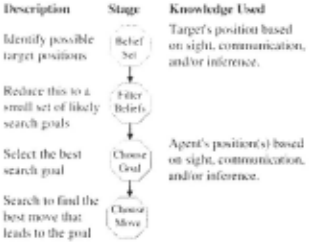
When an agent does not know the exact position of the tar get (from vision or communication), it must maintain a belief set of where the target might be. The belief set can take into account the topology of the grid, knowledge of the opponent, and the time since the last known target location. As the time increases since the last sighting, the knowledge of where the target is gets fuzzier. An agent should choose its search area based on its beliefs about the target and other agents.
Figure I shows the four-step method that is the frame work used for specifying our solution algorithms. There is no "right" way of solving any of these steps. In the following we detail several algorithm alternatives.
4.1 Belief Set
Whenever ari agent knows the exact location of the target, that agent's belief set contains only one location, otherwise it can grow. Since this is a real-time search application, and real agents have limited memory, the belief set size is limited. Before a move, each agent sends its belief set information about the target and other agents to any agent it can see (who may, in turn forward it to agents that they see).
We implemented three strategies for maintaining the belief set. All-scenarios. Expand the current belief set to include all possible locations that can be reached in one more move.
Region belief set. This set has the same update as the all scenarios belief set. After the search goal is chosen, the agent commits to only consider beliefs that are connected to the goal location. Single-location: The agent maintains a single be lief (one grid square). The belief is updated by choosing a random direction and moving the belief in that direction until an obstacle is encountered or new target information is avail able .
We use a simple greedy algorithm to approximate the four "corners" ofthe variable shaped belief set. Thi s subset of the belief set is called the filtered belief set.
4.2 Goal Selection
Each agent selects a goal from their filtered belief set. Ran domly selecting a location from this set is an obvious control strategy to implement. However, a more intelligent strategy is needed- one that considers information about other agents.
The difference metric is used to identify a goal that ideally is (a) closest to the agent and yet (b) farthest from the clos est other agent. For each location in the filtered belief set, we compute two metrics: the distance from the agent to the belief, and the minimum distance from the belief to the last known agent positions. These values can be determined by search (expensive) or by heuristics (inaccurate).
For each location in the filtered belief set, the agent com putes the difference of the above two values, and chooses the one with the minimum difference. The idea is that the agent should assist the other agents by covering the possible es capes of the target that are hard for the other agents to reach.
4.3 Search
Given a goal, each agent performs a search to find a "best" move that progresses towards that goal. Since this has to be a real-time algorithm, the search algorithm is allocated a fi xed number of search nodes (approximating a fixed amount of time per decision). The manhattan distance is used as the search evaluation function.
We experimented with two search algorithms. Single agent minimin search [Korf, 1990]: Here the agent uses single-agent search to find the shortest path to the goal lo cation. The search has the effect of selecting the move that tries to chase the target. Adversarial search: The search can alternate between moves for the agent (move towards the tar get) and target (move away from the agent). This becomes an alpha-beta search, where the agent tries to minimize the minimax value of the search (the distance from the target).
4.4 Comments
For non-trivial belief sets, as long as information is known about other agent's positions the agents will separate to avoid redundancy in the search. Each agent wanders about the grid trying to maximize their coverage, as a function of what they know (about the target and other agents). In many cases (es pecially for large mazes) an agent may go a long time without getting an update on the target's position, effectively negating the effectiveness of the belief set.
5 Experiments
There are a variety of target strategies that can be investi gated. The strategy used is a weighted combination of four I"'
""
Sing i ~_SAS ·
AII_DIMOJ_SAS c
JO II_DISASI_SAS o
All_l>IAilJ_SAS ·
ZO AII_DIAIJ)_Ail --
AII _D(MD)_AA --
0 L---~--~--~--~--~___j
0
10
ID
~
Maze Size Maze Size
Figure 2: Comparing solutions
sub-strategies: distance, mobility, visibility, and random. The maximum scoring move is selected. The weights were hand tuned based on the perceived realism of the target's behavior.
Solutions to MAMT instances were tested using grids of sizes from 10 x 10 to 70 x 70. Grids had obstacles randomly placed, occupying I 0% to 30%, in increments of 5%, of the space. The experiments used 1 to 10 agents. Each pursuer was allocated 50,000 search nodes to make its decision. If search was used to compute the difference metric, then half the search nodes were allocated to this task, and the other half to move selection. Agents were allowed a maximum belief set size of 1 00. An experiment ended when one of the pursuers caught the target, or when a maximum number of moves was reached. For ann x n grid, the maximum was set to 15 x n. With few exceptions, the target was caught in less than 8 x n moves, or not at all.
Figure 2 compares several different solutions. The belief set was maintained using one of: all-scenarios (ALL), region, and single-location (Single). Except for a single-location be lief set, the choice of goal was done using the difference met ric based on either manhattan distance (no search) - D(MD), single-agent search - D(SAS), or alpha-beta - D(AB). Hav ing chosen a goal, single-agent search (SAS) or alpha-beta (AB) was used to select the best move. The graph shows the percentage of problems where the target was caught ( 100 tri als with different random seeds per data point) as a function of the maze size.
The control experiment is randomly selecting a goal (single-location), and using single-agent search (SAS) to de cide on the move choice. Not surprisingly, this gets poor per formance. Region was expected to perform quite well, but instead its results were mixed (not shown).
AILD(MD)_SAS and AILD(SAS)_SAS performed best in all our experiments, with a preference for the manhattan dif ference metric. That the difference heuristic gets the best per formance is gratifying, since it is better informed by using be liefs about the other agents. Using a simple heuristic appears to be as good as or better than using search for determining the "best" search goal. The simplest way of computing the difference metric - using static manhattan distance instead of more accurate search - also leads to shorter solution lengths (up to 10% on average). This shows that it is more beneficial to invest search effort in move selection than in goal selection.
Alpha-beta is out-performed by single-agent search. Since alpha-beta takes into account the target's moves, it cannot reach the search depths that single-agent search can and, hence, usually yields a lesser-quality solution.
In cases where the target eluded capture, a familiar pattern emerged. The target would stay hidden in a small area, and the agent's knowledge of where the target was became obso lete and effectively useless. The agents would independently wander about, hoping to find the target. In the real world, if such a scenario arises, the agents should wait until more help arrives and then begin the search anew, going through the entire grid systematically.
Figure 3 shows that more agents are better than fewer (us ing AILD(MD)_SAS). Note that as the number of agents in creases, the number of nodes per agent per search in the goal selection gets smaller (recall the total search size is limited). Even so, adding more agents is beneficial despite less re sources available.
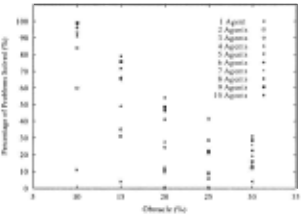
Figure 4 shows that as the mazes become more congested with obstacles, it gets harder for the agents to find the tar get. Essentially, a higher percent of obstacles gives the target more opportunities to hide. However, at 30% of obstacles, our target starts having problems with avoiding the dead ends and is sometimes caught more easily.
Several control experiments were also done, and they gave predictable results. Simplistic targets (e.g., random, or avoid) were much easier to catch.
6 Future Work and Conclusions
This problem domain is rich in possibilities, and can be ex tended to increase the "realism" of the simulations. Some ex amples include: multiple moving targets, more realistic com munication, creating "human-like" target behavior, and op ponent modeling. The framework used of this research has many opportunities for interesting extensions.
7 Acknowledgments
This research was supported by NSERC, iCORE, and IRIS.
@inproceedings{ijcai2003p264,
  title     = {Multiple Agents Moving Target Search},
  author    = {Goldenberg, Mark and Kovarsky, Alexander and Wu, Xiaomeng and Schaeffer, Jonathan},
  booktitle = {Proceedings of the Eighteenth International Joint Conference on
               Artificial Intelligence, {IJCAI-03}},
  publisher = {International Joint Conferences on Artificial Intelligence},
  editor    = {Georg Gottlob and Toby Walsh},
  pages     = {1536--1537},
  year      = {2003},
  url       = {https://ijcai.org/proceedings/2003/264},
}
TY - CPAPER TI - Multiple Agents Moving Target Search AU - Goldenberg, Mark AU - Kovarsky, Alexander AU - Wu, Xiaomeng AU - Schaeffer, Jonathan T2 - Proceedings of the Eighteenth International Joint Conference on Artificial Intelligence, IJCAI-03 PB - International Joint Conferences on Artificial Intelligence PY - 2003 SP - 1536 EP - 1537 UR - https://ijcai.org/proceedings/2003/264 ER -Copied
Machine-readable versions of this paper, for tools and AI agents:





