
Splitting the atom: A new approach to Neighbourhood Interchangeability in Constraint Satisfaction Problems
Proceedings of the Eighteenth International Joint Conference on Artificial Intelligence. Pages 1366-1366.
© 2003 International Joint Conferences on Artificial Intelligence
Abstract
We investigate interchangeability of values in CSPs, based on an approach where a single value in the domain of a variable can be treated as a combination of"sub-values". An algorithm for removing overlapping sub-values is presented. The resulting CSPs take less time to find all solutions and yield a more compactly-representable, but equivalent, solution set. Experimental results show that, especially in loose problems with large numbers of solutions, dramatic savings in search cost are achieved.
- [Freuder, 1991] Eugene C. Freuder. Eliminating inter- changeable values in constraint satisfaction problems. In Proceedings of AAAI'91, pages 227-233, 1991.
- [Hubbe and Freuder, 1992] Paul D. Hubbe and Eugene C. Freuder. An efficient cross-product representation of the constraint satisfaction problem search space. In Proceed- ings of AAAI'92, pages 421-427, 1992.
References were extracted automatically from the PDF and may contain errors.
Full text extracted automatically from the PDF; figures, tables and equations may differ. The PDF is the version of record.
1 Introduction
While most CSP algorithm research is based on the assump tion that only one solution to a CSP need be found, the cen tral idea in this paper is motivated by a requirement of certain interactive constraint-based applications: sometimes, before making his next interactive decision, the user needs to know all solutions to a sub-CSP. Thus, we need an approach which will reduce the search cost of finding all solutions to a (sub )CSP and which will enable a more compact representation of the complete solution set. Neighbourhood Interchange ability (NI) [Freuder, 1991] of domain values suggests itself, since merging NI values in a variable domain reduces both thrashing during search and the complexity of enumerating the solution set. Without loss of generality, we restrict our attention here to binary CSPs, where the constraints involve two variables.
Our idea is based on a new approach toNI. Normally, each domain value is treated as atomic. Our idea is to "split the atom"- a domain value can be split into several "sub-values" so that interchangeable fragments from other values can then be merged to avoid duplicate search effort during the solving process.
When the values in a domain have been split into frag ments, interchangeable fragments of different values can be merged. Figure (i) depicts a constraint network while (ii) shows the microstructure. Figure (iii) shows the result of splitting and merging value fragments, resulting in smaller domains for X and Y.
The approach subsumes NI, as can be seen in X where b and c, which are NI, are merged; similarly, d and g in Y
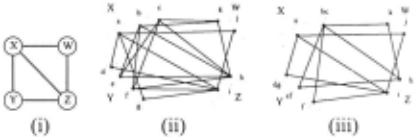
are merged because they, also, are Nl. That the approach sur passes NI can be seen by considering values e and f in Y. Values e and f are not NI because, while both e and f sup port (b, h) and (c, h), f also supports (b, i) and (c, i). How ever, we can split f into two fragments, one of which supports (b, h) and (c, h) , while the other supports (b, i) and (c, i). The first fragment can be merged with e and the second can re main isolated.
2 Background and Definitions
We will use a cross-product representation (CPR) [Hub be and Freuder, 1992] to denote sets of solutions to the star-graph CSPs that we must consider when transforming variable do mains. For example, consider the star-graph centred at Y in Figure (ii). The set of solutions to this star-graph in which the centre variable, Y, has the value f can be represented by the following CPR: { b,c} x { f} x { h,i} .
We define an operator, called "commerge" (commonality extraction and merge), on two CPR sets as follows . The op erator extracts, from the two CPR sets, those solutions which have common values for the leaf variables and merges the values for the centre variable. To compute the commerge of two CPR sets, the sets of values for the leaf variables are combined using normal set intersection but the sets of values for the centre variable are combined using normal set union. We denote the commerge operator as 0 . Thus, for example, {a,b}x{x}x{c} 0 {a}x{y}x{c,d} is {a}x{x,y} x{c}.
We define the "communion" of two CPRs as follows . Two CPRs can be communioned only if the CPRs differ from each other in at most one of the cross-multiplied sets, which cannot be the set for the centre variable. In the communion, all the common cross-multiplied sets are unchanged, but the differ ing leaf sets are subjected to ordinary set union. We denote the communion operator as EB. For example, the two CPRs {a} x {b} x { c} and {a} x {b} x { d} can be communioned be cause they differ only in the right-most subsets which do not correspond to the centre variable; the communion of these two CPRs is {a}x{b}x{c,d}.
We also define a new form of subtraction, the "comminus" of two CPRs, as follows. One CPR can be comminused from another only if they have a common set for the centre variable. Given that provision, the comminus of two CPRs, denoted by e, is the same as subtraction. Note that the operator can result in a set of CPRs. Consider, for example, the result of subtracting {a} x { x} x { c} (which contains only one solution to a star-graph) from { a,b} x { x} x { c,d} (which contains four solutions). The difference between these two CPRs contains three solutions: a-x-d, b-x-c, b-x-d. In CPR form, this set of three solutions needs two CPRs. That is, { a,b} x { x} x { c,d} e {a}x{x}x{c} is {{a}x{x}x{d}, {b}x{x}x{c,d}} or, alternatively, { { a,b} x {x} x { d}, { b} x {x} x { c} }.
3 Transforming CSPs
The procedure for transforming the domain of a single vari able is stated in pseudocode below.
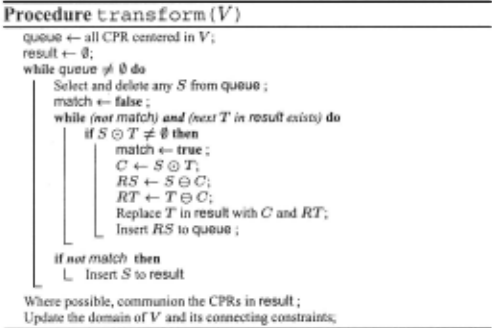
The size of result could be very large if there are many fragments of CPRs, making it unlikely that the result ing CPRs can be compressed so that the resulting domain is smaller than the original. Therefore we impose an upper bound on the size of result; if result exceeds the up per bound, transformation of the variable's domain is aborted. This cutoff heuristic reduces the transformation time, making the algorithm practical even though the worst-case time com plexity is exponential.
The overall transformation process involves transforming each variable domain, one by one, in some order. The or der in which variables are processed affects the result. As a heuristic, we have chosen never to accept the result of trans forming a variable's domain if the result of the transformation is that the number of members in the domain is increased, and choose the variable whose transformation leads to the maxi mum domain size reduction.
3.1 Convergence
We only need to transform the domain of each variable once due to the following theorem:
4 Experimental Results
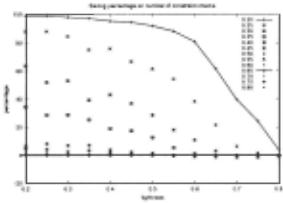
We tested the algorithm over randomly generated CSPs with eight variables and six values in each domain, varying den sity from 0.1 to 0.9 with 0.05 increment step, while tightness ranges from 0.1 to 0.8 with the same increment. For each parameter point, the number of constraint checks required to compute all solutions and the number of representations needed to express these solutions are evaluated, averaged over 100 problem instances. The solver is based on MAC-3 with dom/deg variable ordering. The upper bound of the result is ten times the size of the variable's domain.
For the random problem generator, we use model B where density and tightness are fraction instead of probability. Since the transformation process requires arc-consistent CSPs, we also ensure that every problem is arc-consistent by linking each value to at least one value for every constraint in order to guarantee support.
The results are shown in the above graph. While the trans formation cannot guarantee to reduce the number of con straint checks needed to compute all solutions to a CSP, it can produce huge savings. From the graph, we can see the method works best for problems with low density or low tightness, as either case will lead to a lot of CPR combination. In these cases the work needed for transformed CSPs is less than 1% of the work needed for untransformed CSPs. In those prob lems where the transformation does not produce large sav ings, its effect is usually harmless. Indeed, in the worst case we have seen in the experimental data, which occurred only at a few data points, the number of extra constraint checks for a transformed CSP is around 1% more than for the untrans formed CSP.
@inproceedings{ijcai2003p200,
  title     = {Splitting the atom: A new approach to Neighbourhood Interchangeability in Constraint Satisfaction Problems},
  author    = {Bowen, James and Likitvivatanavong, Chavalit},
  booktitle = {Proceedings of the Eighteenth International Joint Conference on
               Artificial Intelligence, {IJCAI-03}},
  publisher = {International Joint Conferences on Artificial Intelligence},
  editor    = {Georg Gottlob and Toby Walsh},
  pages     = {1366--1366},
  year      = {2003},
  url       = {https://ijcai.org/proceedings/2003/200},
}
TY - CPAPER TI - Splitting the atom: A new approach to Neighbourhood Interchangeability in Constraint Satisfaction Problems AU - Bowen, James AU - Likitvivatanavong, Chavalit T2 - Proceedings of the Eighteenth International Joint Conference on Artificial Intelligence, IJCAI-03 PB - International Joint Conferences on Artificial Intelligence PY - 2003 SP - 1366 EP - 1366 UR - https://ijcai.org/proceedings/2003/200 ER -Copied
Machine-readable versions of this paper, for tools and AI agents:





