
Efficient Representation of Adhoc Constraints
Proceedings of the Eighteenth International Joint Conference on Artificial Intelligence. Pages 1368-1368.
© 2003 International Joint Conferences on Artificial Intelligence
Abstract
- [Abdennadher and Rigotti, 2000] S. Abdennadher and C. Rigotti. Automatic generation of propagation rules for finite domains. In CPOO, pages 18-34,2000.
- K.R. Apt and E. Monfroy. Auto- matic generation of constraint propagation algorithms for small finite domains. In CP99, pages 58-72, 1999.
- Bartak, 200
- R. Bartak. Filtering algorithms for tabular constraints. In CICLOPS 2001, pages 168-182,2001.
- [Dao eta/., 2002] T.B.H. Dao, A. Lallouet, A. Legtchenko, and L. Martin. Indexical-based solver learning. In CP02, pages 541-555, September 2002.
- [Friihwirth, 1998] T. Friihwirth. Theory and practice of con- straint handling rules. Journal of Logic Programming, 37(1-3):95-138, October 1998.
- [Tsang, 1993] E. Tsang. Foundations of Constraint Satisfac- tion. Academic Press, 1993.
References were extracted automatically from the PDF and may contain errors.
Full text extracted automatically from the PDF; figures, tables and equations may differ. The PDF is the version of record.
1 Introduction
Constraint programming is a promising technique for solving many difficult combinatorial problems. Since real-life con straints can be difficult to describe in symbolic expressions, or provide very weak propagation from their symbolic repre sentation, they are sometimes represented in the form of the sets of solutions or sets of nogoods. This adhoc represen tation provides strong propagation through domain (general ized arc) consistency techniques. However, the adhoc repre sentation is expensive in terms of memory and computation, when the adhoc constraint is large.
So there is interest in determining less expensive meth ods for building propagators for adhoc constraints [Friihwirth, 1998; Apt and Monfroy, 1999; Abdennadher and Rigotti, 2000; Bartak, 2001; Dao et al., 2002].
In this paper, we propose a new language-independent rep resentation for adhoc constraints, the box constraint collec tion. The idea is to break up an adhoc constraint into pieces and cover these pieces using box constraints as tiles. This can be done automatically with a greedy algorithm. With the aid of constructive disjunction and a suitable choice of constraint templates in the collection, our new representation achieves domain consistency.
2 Propagation Based Constraint Solving
In this section we give our terminology for constraint satis faction problems, and propagation based constraint solving.
An integer valuation B is a mapping of variables to integer values, written {x1 >--+ dJ, ... ,xn >--+ dn}· We extend the valuation B to map expressions and constraints involving the variables in the natural way. We sometimes treat a valuation B = { x1 >--+ d1, ... , Xn >--+ dn} as the constraint x1 = d1 !\ .. . !\ Xn = dn. Let vars be the function that returns the set of (free) variables appearing in a constraint or valuation.
A domain D is a complete mapping from a fixed (count able) set of variables V to finite sets of integers. A domain D1 is stronger than a domain D2, written D1 ~ D2, if D1 (x) ~ D2 (x) for all variables x.
·we thank the anonymous referees for their constructive com ments. The work described in this paper was substantially supported by a grant from the Research Grants Council of the Hong Kong Spe cial Administrative Region (Project no. CUHK4183/00E).
Peter J. Stuckey Dept. of Comp. Sci. & Soft. Eng. University of Melbourne, Australia
pjs®cs.mu.oz.au
In an abuse of notation, we define a valuation B to be an element of a (non-false) domain D, written B E D, ifB(x;) E D(x;) for all x; E vars(B).
We are also interested in the notion of an initial domain, denoted by D;nit · The initial domain gives the initial values possible for each variable.
A constraint c over variables x1 , · .· , xn, written as c(x1, .. . , xn), restricts the values that e.ach variable x; ca.n take simultaneously. An adhoc constramt c(x1, ... , xn) 1s defined extensionally as a set of valuations B over the vari· abies x1, . .. , Xn. We say B. E c is a solution of c. For any valuation B on variables x1, ... , Xn, with B fl. c, we call B a nogood of c.
Often we define constraints intensionally using some well understood mathematical syntax. For an intensionally defined constraintcwehavethatB E ciffvars(B) = vars(c)!\Z Fe c. Forexampletheconstraintx1 = x2+l whereDinit(xl) = D;nit(x2 ) = {1 , 2, 3} defines the set of solutions {{ :r1 f-t 2,x2 >--+ l},{xl >--+ 3,x2 >--+ 2}}.
A constraint satisfaction problem (CSP) [Tsang, 1993], consists of a set of constraints c1, ... , ck over a set of vari· abies x1 , . . . , xn, where each variable x; can only take values from its domain D;nit(x;), a set of integers. Solving a CSP requires finding a value for each variable from its domain so that no constraint is violated, i.e. all constraints are satisfied.
A propagator f is a monotonically decreasing function from domains to domains. The generalized arc consistent propagator for a constraint cis defined as dom(c)(D)(x) = {B(x) I B E D !\ B E c} where x E vars(c), otherwise dom(c)(D)(x) = D(x) . A propagation solver for prop~· gators F repeatedly applies propagators f E F to a domam D until no further change in D results.
3 Box Constraint Collections
Adhoc constraints are usually implemented as tabled con· straints by listing all the solutions or no goods, incurring space and time overhead. Often we represent a constraint in an ad· hoc manner because it is difficult (or unwieldy) to describe it using a symbolic expression. However, it may be easier to find symbolic expressions if we examine part of the so· lution space. Therefore, we propose representing an adhoc constraint Cadhoc with a set of simple constraints in DNF.
A box B = Il7= 1 [a; .. b;] is ann-dimensional hyper-cube, where [a; .. b;] is a (closed) interval of integers a; and b;. If c(x1 , . .. ,xn) is a constraint on variables xl, ... ,xn, then A7=l a;j ::; Xj ::; b;j 1\ c(x1, ... , xn) is a box constraint, which we write as B => c. We restrict the form of constraints c(x1 , .. . , xn) to certain templates. A box constraint collec tion (BCC) is simply a disjunction of box constraints.
The idea is thus to use box constraints in a collection as "ti les" to cover the solution space of an adhoc constraint. The template defining c in a box constraint B => c determines the shape of the tile. Triangles and rectangular boxes are good tile shapes for filling grids. If cis true, then B => c is simply the box B. If cis of the form LJ=l ajXj ::; a0, then we call B => c a triangle.
Lemma 1 Let
and suppose each constraint c; is implemented by a gener alized arc consistent propagator, then using constructive dis junction on this representation achieves generalized arc con sistency for Cadhoc·
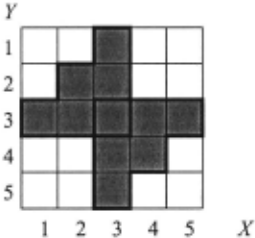
Example 1 A box constraint collection representation of the constraint Ctri shown in Figure 1 is
Due to space limitation, we cannot show how box con straint collections can be compiled into indexicals directly and efficiently.
4 Experiments
We compare the propagation efficiency among box (indexi cal BCCs for boxes only), tri- box (indexical BCCs for trian gles and boxes) and rel (the built-in relation/3 for binary adhoc constraints) on randomly generated cubic inequalities of the form d1X 3 + d2X 2 Y + d3XY 2 + d4Y 3 + d5X 2 + d6XY + d7 Y 2 + d8X + d9 Y < d10 . The coefficients are ran domly chosen between [-9 .. 9]. The domain size is 100. For each variable X andY, we repeat M times picking a subset S ~ D;nit(x) where lSI = W, and adding the constraints x -::j:. v for each v E S. These constraint additions are then re moved and the next set S picked. We do our implementation with SICStus Prolog 3.9.1 on a Sun Blade 1000 workstation.
Table 1 summarizes some results. N is the number of solutions. B and T are the number of boxes and triangles. tri-box generates no boxes (B = 0) in all 3 instances. gen is the generation time. rel and prop (for box and t ri- box) are the time they spend on the propagation test M = 5000 and W = 30. tri-box is the fastest because it compactly rep resents the non-linear constraints with 1 or 2 triangles. box, although is faster than rel, it takes a long time to generate be cause every box covers only a few solutions, and many boxes are needed.
I
| N | z re | box ____ | tri-box __ ___ p_r_o_p~ | |||
|---|---|---|---|---|---|---|
| I ~-B~--g_e_n | I p_r_o_p~~T~ | g_e_n | ||||
| 5601 | 33.78 | 87 | 19.17 | 14.07 | 2 2.25 | 6.04 |
| 7187 | 23.58 | 57 | 20.97 | 10.92 | 1 3.05 | 3.95 |
| 2050 | 11.59 | 40 | 3.43 | 5.11 | 2 0.95 | 4.70 |
5 Conclusion
We have proposed a new language-independent representa tion, box constraint collection, for adhoc constraints. With constructive disjunction, our new representation achieves generalized arc consistency, if all constraints inside the col lection do.
Future work includes improving the current greedy BCC generation algorithm, and optimizing the indexicals of a box constraint collection.
@inproceedings{ijcai2003p201,
  title     = {Efficient Representation of Adhoc Constraints},
  author    = {Cheng, Kenil C. K. and Lee, Jimmy Ho-Man and Stuckey, Peter J.},
  booktitle = {Proceedings of the Eighteenth International Joint Conference on
               Artificial Intelligence, {IJCAI-03}},
  publisher = {International Joint Conferences on Artificial Intelligence},
  editor    = {Georg Gottlob and Toby Walsh},
  pages     = {1368--1368},
  year      = {2003},
  url       = {https://ijcai.org/proceedings/2003/201},
}
TY - CPAPER TI - Efficient Representation of Adhoc Constraints AU - Cheng, Kenil C. K. AU - Lee, Jimmy Ho-Man AU - Stuckey, Peter J. T2 - Proceedings of the Eighteenth International Joint Conference on Artificial Intelligence, IJCAI-03 PB - International Joint Conferences on Artificial Intelligence PY - 2003 SP - 1368 EP - 1368 UR - https://ijcai.org/proceedings/2003/201 ER -Copied
Machine-readable versions of this paper, for tools and AI agents:





