
Automatic Video Interpretation: A Novel Algorithm for Temporal Scenario Recognition
Proceedings of the Eighteenth International Joint Conference on Artificial Intelligence. Pages 1295-1301.
© 2003 International Joint Conferences on Artificial Intelligence
Abstract
This paper presents a new scenario recognition algorithm for Video Interpretation. We represent a scenario model by specifying the characters involved in the scenario, the sub-scenarios composing the scenario and the constraints combining the sub-scenarios. Various types of constraints can be used including spatio-temporal and logical constraints. In this paper, we focus on the performance of the recognition algorithm. Our goal is to propose an efficient algorithm for processing temporal constraints and c?mbining several actors defined within the scenano. By efficient we mean that the recognition process is linear in function of the number of sub-scenarios and in most of the cases in function of the number of characters. To validate this algorithm in term of correctness, robustness and processing time in function of scenario and scene properties (e. g. number of persons in the scene), we have tested the algorithm on several videos of a bank branch and of an office, in on-line and off-line mode and on simulated data. We conclude by comparing our algorithm with the state of the a_rt and showing how the definition of scenano models can influence the results of the real-time scenario recognition.
- [Chleq and Thonnat, 1996] Nicolas Chleq and Monique Thonnat. Real-time image sequence interpretation for video- surveillance applications. International conference on Im- age Processing (ICIP'96). Proceeding IEEE ICIP'96. Vol 2. pp 801-804. Switzerland. 09/ 1996.
- [Ghallab, 1996] Malik Ghallab. On Chronicles : Represen- tation, On-line Recognition and Learning. 5th International Conference on Principles of Knowledge Representation and Reasoning (KR '96), USA, 1111996.
- [Gerber et al., 2002] R. Gerber, H. Nagel and H. Schreiber. Deriving Textual Descriptions of Road Traffic Queues from Video Sequences. The 15-th European Conference on Artifi- cial Intelligence (ECAI'2002), Lyon, France, 21-26/07/2002.
- [Hongeng et al., 2000] S. Hongeng, F. Bremond and R. Ne- vatia. Representation and Optimal Recognition of Human Activities. In IEEE Proceedings of Computer Vision and Pattern Recognition, USA, 2000.
- [Howell and Buxton, 2002] A.J. Howell and H. Buxton . Active vision techniques for visually mediated interaction . Image and Vision Computing, 2002.
- [Oliver and Pentland, 2000] Nuria Oliver and Alex Pen- tland. Graphical Models for Driver Behavior Recognition in a SmartCar. Proceedings of IEEE Inti. Conference on Intel- ligent Vehicles 2000 Detroit. Michigan, 10/2000.
- [Pinhanez and Bobick, 1997] Claudio Pinhanez and Aaron Bobick. Human Action Detection Using PNF Propaga tion of Temporal Constraints. M.T.T Media Laboratory Percep- tual Section Report No. 423, 04/1997 .
- [Rota and Thonnat, 2000] Nathanael Rota and Monique Thonnat. Activity Reco!ft.nition from Video Sequences using Declarative Models. 14 European Conference on Artificial Intelligence (ECAI 2000), Berlin, W. Horn (ed.) lOS Press, Amsterdam, 20-25/08/2000.
- [Vu et al, 2002] Van-Thinh Vu, Fran.yois Bremond and Monique Thonnat. Temporal Constraints for Video Inter- pretation . The 15-th European Conference on Artificial In- telligence (ECAI'2002), Lyon, France, 21-26/07/2002 .
References were extracted automatically from the PDF and may contain errors.
Full text extracted automatically from the PDF; figures, tables and equations may differ. The PDF is the version of record.
1 Introduction
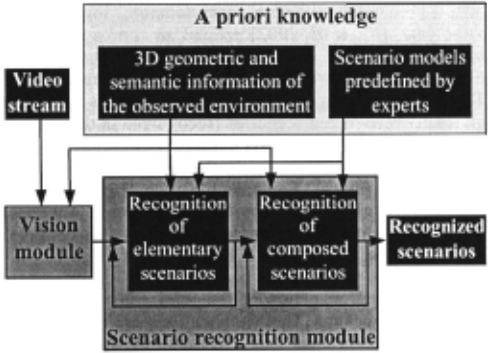
A problem of current focus in cognitive vision is Auto matic Video Interpretation. The goal is to develop a sys tematic methodology for the design, implementation and integration of cognitive vision systems for recognizing scenarios involved in a scene depicted by a video se quence. An Automatic Video ~nterpretation . S~stem as described in Figure 1, takes as mput (1) a pnon knowl edge containing scenario models predefined by experts and the 3D geometric and semantic information of the observed environment and (2) video streams acquired by the camera(s). The output of the system is the set of rec ognized scenarios at each instant. In this paper, w~ focus on the module of scenario recognition. The scenano rec ognition module takes as input the a priori knowledge of the scene and a stream of individual s tracked by a vision module.
To solve scenario recognition issues, we first propose a language to describe scenario models and sec?nd . a tem poral constraint resolution approach t~ recogmze m. rea_l time scenario occurrences. Our scenano representatiOn IS mainly based on the representation of [Vu et a/, ~002] and inspired by the work of [Ghallab, 1996] . In th1~ pa per, we focus on the optimization of the recogmtwn method. We first enhance the processing of temporal op erators by pre-compiling scenario models to decompose them into simpler scenario models. By this way, the sce nario recognition algorithm uses a linear search com pared to an exponential search for non-.compiled scen~r ios. Secondly, we propose a novel algonthm to recogmze composed scenarios that takes advantages. of th~ actors of its sub-scenarios when they are recogmzed mstead of trying all combinations of actors as this is often the cases for similar state of the art algorithms.
We present in section 2 some related works. Our sce nario representation is described in section 3. The recog nition algorithm is detailed in section 4. We con.clude o~r paper by showing experimental results to validate th1s new algorithm.
2 Related works
Since the years 90s, a problem of focus in cognitive vi sion has been Automatic Video Interpretation. There are now several research units and companies defining new approaches to design systems that can understand human activities in dynamic scenes. Three main categories of approaches are used to recognize temporal scenarios based on (I) a probabilistic/neural network combining potentially recognized scenarios, (2) a symbolic network that Stores Totally Recognized Scenarios (STRS) and (3) a symbolic network that Stores Partially Recognized Sce narios (SPRS).
For the computer vision community, a natural ap proach consists in using a probabilistic/neural network [Oliver and Pentland, 2000]. The nodes of this network correspond usually to scenarios that are recognized at a given instant with a computed probability. For example, [Howell and Buxton, 2002] proposed an approach to rec ognize a scenario based on a neuronal network (time de lay Radial Basis Function). [Hongeng et a!., 2000] pro posed a scenario recognition method that uses concur rence Bayesian threads to estimate the likelihood of po tential scenarios. Because video processing is very sensi tive to noisy images, these probabilistic methods are use ful to give an interpretation of the scene while taking into account the stochastic variations of the analysis. In our case, we use classical filtering techniques to get rid off these variations and to obtain coherent data that can be associated with symbolic values.
For the artificial intelligent community, a natural way to recognize a scenario is to use a symbolic network which nodes correspond usually to the boolean recogni tion of scenarios. For example, [Rota and Thonnat, 2000] used a declarative representation of scenarios defined as a set of spatio-temporal and logical constraints. They used a traditional constraint resolution technique to rec ognize scenarios. To reduce the processing time for the recognition step, they proposed to check the consistency of the constraint network using the AC4 algorithm. More recently, [Gerber eta!., 2002] defined a method to recog nize a scenario based on a fuzzy temporal logic. In the same year, [Vu et a!, 2002] present an approach to opti mize the temporal constraint resolution by ordering in time the sub-scenarios of the scenario to be recognized. The common characteristic of these approaches is to store all totally recognized scenarios (recognized in the past).
Another approach consists in using a symbolic network and to store partially recognized scenarios (to be recog nized in the future). For example, [Ghallab, 1996] has used the terminology chronicle to express a temporal scenario. A chronicle is represented as a set of temporal constraints on time-stamped events. The recognition al gorithm keeps and updates partial recognition of scenar ios using the propagation of temporal constraints based on RETE algorithm. Their applications are dedicated to the control of turbines and telephonic networks. [Chleq and Thonnat, 1996] made an adaptation of temporal con straints propagation for video surveillance. In the same period, [Pinhanez and Bobick, 1997] have used Allen's interval algebra to represent scenarios and have presented a specific algorithm to reduce its complexity.
All these techniques allow an efficient recognition of scenarios, but there are still some temporal constraints which cannot be processed. For example, most of these approaches require that the scenarios are bounded in time [Ghallab, 1996], or process temporal constraints and atemporal constraints in the same way [Rota and Thon nat, 2000].
We can distinguish two main categories of approaches to recognize a scenario based on a symbolic network: the STRS approaches recognize scenarios based on an analy sis of scenarios recognized in the past [Rota and Thonnat, 2000; Vu eta!, 2002], whereas the SPRS approaches rec ognize scenarios based on an analysis of scenarios that can be recognized in the future [Ghallab, 1996]. The STRS approaches recognize a scenario by searching in the set of previously recognized scenarios a set of sub scenarios matching the scenario model to be recognized. Thus, if the system fails to recognize a scenario, it will have to retry the same process (re-verify the same con straints) at the next instant, implying a costly processing time. A second problem is that STRS algorithms have to store and maintain all occurrences of previously recog nized scenarios. The SPRS approaches recognize a sce nario by predicting the expected scenarios to be recog nized at the next instants. Thus, the scenarios have to be bounded in time to avoid the never ending expected sce narios. A second problem is that SPRS algorithms have to store and maintain all occurrences of partially recog nized scenarios, implying a costly storing space.
The method presented in this article is a STRS ap proach taking advantages of the SPRS approaches. The objective is to reduce the processing time ( 1) when searching in the past (list of previously recognized sce narios) for an occurrence of a given scenario model and (2) when trying to recognize a scenario involving several actors by avoiding checking all combinations of actors.
3 Scenario Representation
Our goal is to make explicit all the knowledge necessary for the system to be able to recognize scenarios occurring in the scene. The description of this knowledge has to be declarative and intuitive (in natural terms), so that the experts of the application domain can easily define and modify it. Thus, the recognition process uses only the knowledge represented by experts through scenario mod els.
Let .Q be the set of scenario models and <I> be the set of scenario instances (recognized scenarios). For a scenario model ffi E .Q and a scenario instance p E <1>, we note ffi = lL(p) the scenario model of p and we note p( w) the set of recognized scenarios of the model ffi. A scenario is com posed of four parts:
a)a(w) is the set of actor variables (characters) in volved in the scenario ffi. a(p) corresponds to the ac tors. An actor can be a person tracked as a mobile ob ject by a vision module or a static object of the ob served environment like a chair.
- b )cr( ffi) is the set of sub scenarios that compose ffi. ffi is an elementary scenario if cr( ffi) = 0, if not, ffi is called a composed scenario. Each sub-scenario is represented by a variable v. These variables are called temporal variables because their value is a recognized scenario defined on a temporal interval. We note p(v) a scenario instance corresponding to the value of the temporal variable v, and a(v) the set of variables corresponding to the actors of p(v).
- <p( ffi) is the set of sub-scenarios that should not occur during the recognition of the scenario ffi. We call <p(ffi) the forbidden sub scenarios. acp( ffi) is the set of for bidden actor variables involved in <p( ffi) but not already defined in a( ffi).
<p( ffi) and acp( ffi) are called the forbidden variables.
- d)K(ffi) is the set of constraints of ffi. There are three types of constraints:
- -the set of temporal constraints, noted KT(ffi), on at least one variable of cr( ffi) and not on any forbidden variable,
- -the set of atemporal constraints, noted K\ffi), on only a( ffi),
- -the set of forbidden constraints, noted KF(ffi), on any forbidden variable.
The three subsets KT(ffi), K\ffi) and KF(ffi) constitute a partition of K(ffi). We use the operator "and" to link the constraints within a set of constraints. To use the opera tor "or", we propose to define two similar scenario mod els with different constraints. An elementary scenario is only composed of a set of characters and atemporal con straints.
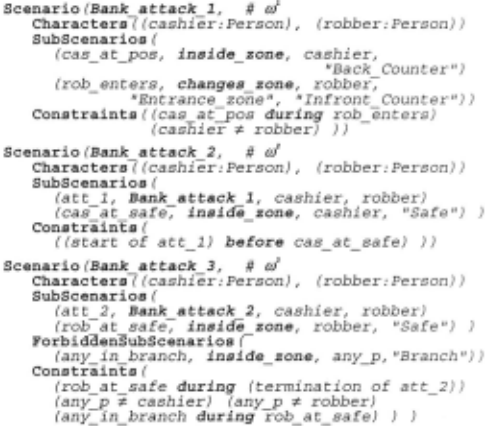
Figure 2 represents a model of a composed scenario "Bank attack". This scenario involves two actors, a cashier and a robber.
In our representation, any scenario ffi involves at least one person, and is defined on a time interval. An interval is represented by its starting and ending times noted start( ffi) and end( ffi). Defining the scenarios on a time interval is important for the experts to describe scenarios in a natural way.
Scenario(Bank attack, Characters ((cashier:Person), (robber:Person)) SubScenarios ( (cas at pos, inside zone, cashier, "Back Counter") (rob-enters, changes zone, robber, - - "Entrance zone", "Infront Counter") (cas at safe, inside zone, cashier, "Safe") (rob-at-safe, inside-zone, robber, "Safe") ) ForbiddenSubScenarios( (any_in_branch, inside_zone, any_p, "Branch")) Constraints ( Temporal ((rob enters during cas at pos) (rob-enters before cas-at-safe) (cas-at pos before cas-at-safe) (rob-enters before rob-at-safe) . (rob-at safe during cas at safe)) Atemporal ( (casnier # robber)) - - Forbidden((any_p #cashier) (any_p #robber) (any_in_branch during rob_at_safe))))4 Scenario Recognition
The scenario recognition process has to detect which sce nario is happening from a stream of observed persons tracked by a vision module at each instant. The recogni tion process takes also as input the a priori knowledge of the scene and the scenario models. As defined in the pre vious section, there are two types of scenarios: elemen tary and composed.
4.1 Recognition of elementary scenarios
The algorithm to recognize an elementary scenario model ffie consists in a loop of the selection of a set of actors then the verification of the corresponding atemporal con straints KA( ffie) until all combinations of actors have been tested. Once a set of actors satisfies all constraints KA( ffie), we say that the elementary scenario ffie is recog nized and we generate an elementary scenario instance p attached with the corresponding scenario model, the set of actors and the recognition time t. The scenario in stance is then stored in the list of recognized scenarios. If at the previous instant, a scenario instance p' of same type (same model, same actors) was recognized on a time interval [t0, t-1], the two scenario instances are merged into a scenario instance that is recognized on the time interval [t0, t].
The selection of actors leads the recognition algorithm to an exponential combination in function of the number of actor variables. However, in practice, there are few actor variables in elementary scenario models, so the rec ognition algorithm is still real-time.
4.2 Compilation of composed scenarios
A composed scenario is a sequence of sub-scenarios or dered in time. Each sub-scenario corresponds to a tempo ral variable in the corresponding scenario model. The STRS algorithms of the state of the art perform at each instant an extensive search process among all possible scenarios and sub-scenarios leading to an exponential algorithm. For example, for a given scenario ffi = (ffi1 be fore Olz before CJ:>:J); if a scenario instance Pw3 of ffi3 has been recognized, it makes sense to try to recognize the main scenario ffi. Therefore, the STRS algorithms will try all combinations of scenario instances p( ffi 1 ), p( ()};.) with Pw3· We propose to decompose the scenario model into a set of simple scenario models containing at most two sub-scenarios.
To compile a predefined composed scenario model ffi, we define three steps: ( 1) build a graph with the temporal variables cr( ffi), (2) generate intermediate scenario models for ffi and (3) link the generated intermediate scenario models based on the constraints K( ffi).
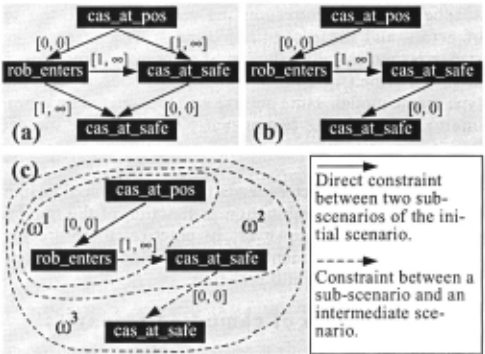
As proposed by [Ghallab, 1996], we first build a graph which nodes correspond to the temporal variables and which arcs correspond to the temporal constraints Kr(ffi). The arcs are oriented and are associated with a time in terval corresponding to the time delay between the end ing time of the two variables. For example, the constraint ci between vi, vi is associated with an interval [a, b] indieating that Vj can end in the interval [end(vi)+a, end(vi)+b]. The constraint before is associated with [1, oo]. After building the graph (called initial graph) with all temporal constraints between temporal variables cr( w), we compute the equivalent complete graph and we check the graph consistency. These two graphs are equivalent because the only difference between them is the redun dancy of some constraints. Then, we simplify the com plete graph by removing unnecessary arcs to obtain the least constrained graph. For any triangle ABC of the graph, an arc AC is redundant (unnecessary), if the arcs AB and BC imply a stronger constraint. The simplified graph is equivalent to the two other graphs. The initial and simplified graphs for the scenario "Bank attack" (Figure 2) are shown on Figure 3. Thanks to the simpli fied graph, all the temporal variables cr( w) are ordered by their ending time.
Second, we generate intermediate scenario models composed at most of two sub-scenarios. For each inter mediate scenario model w, we call start (noted ;c w)) the first sub-scenario of w; and we call termination (noted 't(W)) the second sub-scenario of w.
As cr(w) = (v1, v2, · ·· , V 0 ) is a sequence ofn (n > 2) or dered temporal variables, we generate n-1 intermediate models w 1 , w 2 , ·.. , w"· 1 as followed:
a)cr(w 1 ) = (v~. v2) and
cr(wi) =(vi, vi+l) fori> 1, where vi is a new temporal variable corresponding to the scenario model w··l, b)a(w;) = a(;(w;)) u a('t(wi)) = a(v1) u ... u a(vj+1), c)q>(w"- 1 )= q>(w) and q>(w') = 0 fori< n-1, a%( w"- 1 ) = aq1( w) and aq1( wi) = 0 for i < n-1, d)K (w 1 ) = K\w) n K(a(w 1 )) and K\wi) = KA(w) n K(a(w;))- K(a(wi- 1 )) fori> 1 KT(w') contains the constraints corresponding to the arcs enterin~ vi+ I (i.e. 't( wi)) in the simplified graph. KF(w"- 1 ) = K (w) and K (w') = 0 fori< n-1.The resulting scenario model w"· 1 is equivalent to the initial scenario model w. This two scenarios have the same actor variables and equivalent set of constraints . The only difference is that the constraints of the scenario w are verified at several intermediate levels correspond ing to the intermediate scenario models as shown on Figure 4. Because any sequence of temporal variables can be ordered by their ending time, so any scenario model can be decomposed into intermediate scenarios containing only one or two temporal variables.
The recognition of compiled scenario models is de scribed in the next section. The gain in processing time is due to the search algorithm: we just try several times to link two scenario instances instead of trying to link to gether a whole set of combinations of scenario instances.
4.3 Recognition of composed scenarios
The recognition of a composed scenario model We is trig gered by a scenario template, which has been generated when the last sub-scenario p1 terminating We has been recognized. The scenario template contains We and the scenario instance p1 with its list of actors a(p1) that par tially instanciates a( We)- As We is composed of two sub scenarios, only one sub-scenario p, starting We still needs to be found.
If such a scenario instance p, has been previously rec ognized in the past, then we are able to finish instanciat ing the remaining actors of a( we)- Thus, just a few com binations of actors need to be checked avoiding an expo nential search.
The last step of the algorithm consists in veri?;ing whether all temporal and atemporal constraints ( K (We) and KA(we)) are satisfied with p, and p1· If one forbidden constraint of KF (We) cannot be satisfied then the scenario We is recognized and stored in the list of recognized sce narios.
4.4 Discussion
In the domain of temporal scenario recogmtwn and among SPRS algorithms, the chronicle recognition algo rithm [Ghallab, 1996] is one of the most popular. By storing partially recognized scenarios, it can speed up the whole recognition process. A partially recognized sce nario corresponds to a prediction and enables to store all previous computations that do not need to be recomputed at the following instants. A main difference between the chronicle algorithm and our algorithm is that the chroni cle algorithm has been developed to process scenarios defined with only one "actor" and can only recognize events detected at one time point. Thus, this algorithm is efficient for the configuration "mono-actor". However, in the configuration "multi-actors", the chronicle algorithm has to duplicate the partially recognized scenarios for each combination of actors not already instanciated. This can lead to an explosion of memory allocation and to an exponential search. Our algorithm is as efficient for the configuration "mono-actor" because we store the recog nized scenarios which have been compiled. Moreover, it is efficient for the configuration "multi-actors" because the recognized scenarios do not need to be duplicated even if some actors are not instanciated. The worst case occurs with elementary scenarios because to recognize them at the current instant, all combinations of actors need to be checked. In real world applications, elemen tary scenarios do not contain many actor variables (less than 3) making the proposed algorithm sufficient to ob tain an operational real time video interpretation system.
5 Experiments and results
To validate our recognition algorithm, we first integrated the algorithm with a vision module to obtain an opera tional interpretation system and then we have realized four types of tests: (1) on recorded videos taken in a bank branch and in two metro stations (one in Belgium and one in Spain) to verify if the algorithm can correctly rec ognize the predefined scenario models, (2) on live videos acquired on-line from cameras installed in an office, in a metro station and in a bank branch to verify if the algo rithm can work robustly on a long time mode, (3) on re corded videos taken in a bank branch and on simulated data to study how the complexity of the algorithm de pends on the scenario models (i.e. number of sub scenarios and of actor variables) and (4) on simulated data to study how the complexity of the algorithm de pends on the complexity of the scene (i.e. number of per sons in the scene).
In the first experiment, we verify on recorded videos that the algorithm correctly recognizes several types of "Bank attack" scenarios and several types of "Vandalism against a ticket machine" scenarios in a metro station. The vandalism scenario involves in general two individu als, one looking around to check whether nobody is coming and the other one attempting several times to break the ticket machine. Table 1 shows that the prede fined scenarios were correctly recognized in most of the
;ases. The interpretation system fails to recognize some scenarios only in the cases when the vision module misses to detect the people in the scene. We have not detected any false alarm during all the experiment. The non-detection of false alarms can be explained by the fact that the scenarios are very constrained and there are un likely to be recognized by error.
In the second experiment, we installed the interpreta tion system in an office and in a bank and we connected the system to one or two on-line cameras to acquire di rectly live videos. In this experiment, we used the bank scenarios and we slightly modified them to use them in the office. We ran the system in the bank for few hours and continuously during 4h in the office. As in the first experiment, the scenarios were most of the time correctly recognized, showing that the recognition algorithm can work reliably and robustly in real-time and in continuous mode
| Number of tested sequences | Average number of I persons/frame | Recognition rate(%) | Number of false alarms | |
|---|---|---|---|---|
| Bank cam. I | 10 | 4 | 80 | 0 |
| Bank cam. 2 | I | 2 | 100 | 0 |
| Metro cam. 2 | 3 | 2 | 100 | 0 |
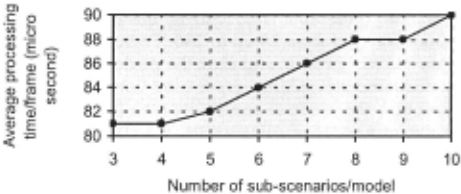
In the third experiment, we studied the processing time of the recognition algorithm in function of the scenario models. First, we studied the processing time of the algo rithm focusing on the resolution of temporal constraints. In this experiment (shown on Figure 5), we tested eight configurations of scenario models: the first configuration is made of scenarios containing 3 sub-scenarios and the last configuration is made of scenarios containing I 0 sub scenarios. On the bank videos containing about 300 frames, we found that the processing time of the classical STRS algorithm is exponential in function of the number of sub-scenarios, whereas the processing time of our al gorithm is closely linear in function of the number of sub-scenarios .
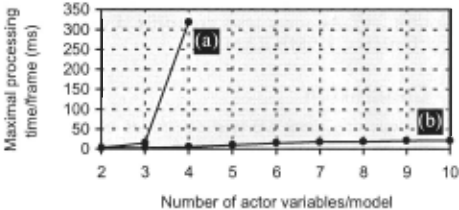
Second, we studied the processing time of the algo rithm focusing on the number of actor variables of the scenario models. In this experiment (shown on Figure 6), we tested nine configurations of scenario models: the first configuration is made of scenarios involving 2 actor variables and the last configuration is made of scenarios involving 10 actor variables. To run the algorithm with enough actors, we simulated bank videos containing 35 persons. On these videos, we found that the processing time of the classical STRS algorithm is exponential in function of the number of actor variables, whereas the processing time of our algorithm is closely linear in function of the number of actor variables.
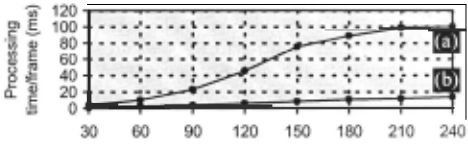
In the fourth experiment, we studied the processing time of the recognition algorithm in function of the scene. To have a continuous variation of the scene, we simulated the scene. We built a scene environment with eight zones of interest and ten pieces of equipment. We simulated the individuals evolving in the scene at each instant. In these simulated videos, the number of indi viduals changed from 30 up to 240. To verify if our algo rithm can recognize in real-time the predefined scenarios, we measured the maximal processing time per frame. We found that, the maximal processing time for each frame is lOOms for a scene of 240 persons. We also found that the average processing time for each frame is closely linear in function of the number of persons. Figure 7 shows several tests of this experiment to illustrate how the proc essing time depends on the complexity of the scene.
With the fourth experiment, we can conclude that our recognition algorithm can recognized in real-time the predefined scenarios if the number of persons/frame is less than 240. All these tests are realized on a PC linux: CPU 700MHz, 320MB RAM.
6 Conclusion
In the literature, there are two categories of symbolic ap proaches to recognize temporal scenarios: the STRS algo rithms reasoning on the past and the SPRS algorithms rea soning on the future . First, we have shown that the STRS algorithms recognize usually a scenario by performing an exponential combination search. Then, we have explained that even if our proposed algorithm is a STRS algorithm, it checks temporal constraints nevertheless by performing a linear search thanks to a step of pre-compilation of scenar ios. Second, we have also shown that the SPRS algorithms have to try all combinations of actors to be able to recognize "multi-actors" scenarios. Thanks to the pre-compilation step this drawback for our algorithm is limited to elementary
.>cenarios. Thus, processing time can still be an issue de pending on the complexity of scenarios. For these two rea sons, the proposed algorithm enables the integrated video interpretation system to be real-time. Up to our knowledge, this video interpretation system is the first operational sys tem able to recognize complex temporal scenarios.
Our future work consists in taking care of the errors and the uncertainty of the vision module. The goal is to be able to continue the interpretation of the videos even when the vision module cannot cope with the real world complexity and then to be able to recognize more com plex scenarios.
Maximal number of persons/frame
Figure 7. The (a) maximal and (b) average processing time/frame of the new algorithm depend on the number of detected persons.
@inproceedings{ijcai2003p184,
  title     = {Automatic Video Interpretation: A Novel Algorithm for Temporal Scenario Recognition},
  author    = {Vu, Van-Thinh and Brémond, François and Thonnat, Monique},
  booktitle = {Proceedings of the Eighteenth International Joint Conference on
               Artificial Intelligence, {IJCAI-03}},
  publisher = {International Joint Conferences on Artificial Intelligence},
  editor    = {Georg Gottlob and Toby Walsh},
  pages     = {1295--1301},
  year      = {2003},
  url       = {https://ijcai.org/proceedings/2003/184},
}
TY - CPAPER TI - Automatic Video Interpretation: A Novel Algorithm for Temporal Scenario Recognition AU - Vu, Van-Thinh AU - Brémond, François AU - Thonnat, Monique T2 - Proceedings of the Eighteenth International Joint Conference on Artificial Intelligence, IJCAI-03 PB - International Joint Conferences on Artificial Intelligence PY - 2003 SP - 1295 EP - 1301 UR - https://ijcai.org/proceedings/2003/184 ER -Copied
Machine-readable versions of this paper, for tools and AI agents:





