
Tractable Pareto Optimization of Temporal Preferences
Proceedings of the Eighteenth International Joint Conference on Artificial Intelligence. Pages 1289-1293.
© 2003 International Joint Conferences on Artificial Intelligence
Abstract
This paper focuses on temporal constraint problems where the objective is to optimize a set of local preferences for when events occur. In previous work, a subclass of these problems has been formalized as a generalization of Temporal CSPs, and a tractable strategy for optimization has been proposed, where global optimality is defined as maximizing the minimum of the component preference values. This criterion for optimality, which we call "Weakest Link Optimization" (WLO), is known to have limited practical usefulness because solutions are compared only on the basis of their worst value; thus, there is no requirement to improve the other values. To address this limitation, we introduce a new algorithm that re-applies WLO iteratively in a way that leads to improvement of all the values. We show the value of this strategy by proving that, with suitable preference functions, the resulting solutions are Pareto Optimal.
- [Bistarelli et al., 1997] S. Bistarelli, U. Montanari, and F. Rossi . Semiring-based Constraint Solving and Optimization. Jour- nal of the ACM, 44(2) :201-236, March 1997.
- [Bacchus and Grove, 1995] F. Bacchus and A. Grove. Graphi- cal Models of Preferences and Utility. Proceedings of the Eleventh Conference on Uncertainty in Artificial Intelligence, 3-10, Morgan Kaufmann, 1999.
- [Cormen eta/., 1990] T.H. Carmen, C.E. Leiserson, and R.L. Rivest. Introduction to Algorithms. MIT press, Cambridge, MA, 1990.
- [Dechter et a/., 1991] R. Dechter, I. Meiri, and J. Pearl. Temporal constraint networks. Artijiciallntelligence, 49,61-95, 1991.
- [Doyle and Thomason, 1999] J. Doyle and R. Thomason . Back- ground to Qualitative Decision Theory. AI Magazine, 55-68, Summer, 1999.
- [Dubois and Prade, 1989] D. Dubois and H. Prade. Processing Fuzzy Temporal Knowledge. IEEE Transactions on Systems, Man, and Cybernetics, 19(4), 1989.
- [Khatib et al., 2001] L. Khatib, P. Morris, R. Morris and F. Rossi. Temporal Reasoning about Preferences. In Proceedings of /JCAI-01 .
- Morgan Kaufman, 1995.
- [Torrens and Faltings , 2002] M. Torrens and B. Faltings. Usi ng Soft CSPs for Approximating Pareto-Optimal Solution Sets. In AAAI Workshop Proceedings Preferences in AI and CP: Symbolic Approaches, AAAI Press, 2002.
References were extracted automatically from the PDF and may contain errors.
Full text extracted automatically from the PDF; figures, tables and equations may differ. The PDF is the version of record.
1 Introduction
The notion of softness has been applied to either a constraint or planning goal, indicating that either can be satisfied to mat ters of degree. It is not hard to find applicable real world problems for such a notion. For example, in an earth orbit ing spacecraft, sensitive instruments like imagers have duty cycles, which impose restrictions on the amount of use of the instrument. A duty cycle is typically a complex function based on both the expected lifetime of the instrument, as well as short term concerns such as the amount of heat it can be exposed to while turned on. Duty cycles impose constraints on the duration of the periods for which the instrument can be on, but it is natural to view this duration as flexible. For example, this restriction might be waived to capture an im portant event such as an active volcano. Thus, the flexibility of the duty cycle "softens" the constraint that the instrument cannot be on beyond a certain duration. Reasoning about soft constraints for planning or scheduling is for the purpose of finding a solution that satisfies the constraints to the highest degree possible.
For temporal reasoning problems, a simple method for evaluating the global temporal preference of a solution to Department of Pure and Applied Mathematics University of Padova via G.Belzoni,7 35131 Padova, Italy a Temporal CSP involving local temporal preferences was introd~c.ed in [Khatib et al., 2001], based on maximizing the mimmally preferred local preference for a time value. B.ecause the locally minimally preferred assignment can be VIewed as a sort of "weakest link" with respect to the global solution, we dub this method "weakest link optimization" (WLO), in the spirit of the television game show. WLO can be formalized using a generalization of Simple Tempo ral Problems (STPs), called STPs with Preferences (STPPs), that preserves the capability to tractably solve for solutions (with suitable preference functions associated with the tem poral constraints). Unfortunately, as often occurs, this effi ciency has a price. Specifically, WLO offers an insufficiently fine-grained method for comparing solutions, for it is based on a single va~ue, viz., the "weakest link." It is consequently easy to conceive of examples where WLO would accept in tuitively inferior solutions because of this myopic focus. Al though it is possible to consider more robust alternatives to a WLO strategy for evaluating solutions, it is not clear whether any of these methods would preserve the computational ben efits of WLO. This impasse is the starting point of the work described in this paper.
We propose here to make WLO more robust by combin ing it. with an iterative strategy for solving STPPs. The pro cess mvolves repeatedly restricting temporal values for the :veakest links, resetting their preference values, and apply mg the WLO procedure to the reduced problem that results from these changes. The intuition is a simple one, and we motivate this technique with an example from a Mars Rover planning domain. In Section 2, we summarize the soft con straint problem solver based on WLO introduced previously. We then illustrate in section 3 the deficiencies of WLO on ~ simple example, which also reveals the intuition underly mg the proposed strategy for overcoming this deficiency. The main contribution of this paper is discussed in sections 4 and 5, which formalize this strategy and prove that any solution generated by an application of this strategy is in the set of Pareto optimal solutions for the original problem.
2 Reasoning about preferences with soft constraints
This section reviews the material first presented in [Khatib et al., 200 1]. There, a class of constrained optimization prob-
!ems, called Temporal Constraint Satisfaction Problems with Preferences (TCSPPs), was first defined. A TCSPP is a gen eralization of classical TCSPs which allows for a represen tation of soft constraints. In classical TCSPs [Dechter et a/., 1991 ], a unary constraint over a variable X represent ing an event restricts the domain of X, representing its pos sible times of occurrence; the constraint is then shorthand for (a1 :S X :S bl) V ... V (an :S X :S bn). Similarly, a binary constraint over X and Y restricts the values of the dis tance Y- X, in which case the constraint can be expressed as (a1 :S Y- X :S b1) V . . . V (an :S Y- X :S bn)· A uniform, binary representation of all the constraints results from intro ducing a variable X 0 for the beginning of time, and recasting unary constraints as binary constraints involving the distance X-Xo .
A soft temporal constraint is a pair (I, f), where I is a set of intervals {[a, b], a :S b} of temporal values, and f is a func tion from U I to a set A of values. Intuitively, f expresses local preferences for temporal values based on the value it as signs from A. For example, the soft constraint represented by ( { [1 , 3], [8, 12]}, min) can be interpreted to mean that the temporal assignments must be selected from either of the in tervals in the set, and the function min assigns a greater pref erence to smaller values. The cardinality of the set A, i.e., the number of distinct preference values, reflects the ability to discriminate among degrees of preference for temporal as signments. The class of TCSPPs in which each soft constraint consists of a single interval is called Simple Temporal Prob lems with Preferences (STPPs).
Local preferences combine to form global preferences for complete assignments. To formalize these operations, A can be structured in the form of a c-semiring [Bistarelli et al., 1997]. A semi ring is a tuple (A, +, x, 0,1 ) such that
- A is a set and 0, 1 E A;
- +, the additive operation, is commutative, associative and 0 is its identity element (a+O= a);
- x, the multiplicative operation, is associative, distributes over +, 1 is its identity element and 0 is its absorbing element (ax 0 = 0 ).
A c-semiring is a semiring in which + is idempotent (i.e., a + a = a, a E A), 1 is its absorbing element, and x is commutative. The semi-ring representation of operations on preference values is used as part of the proof of tractability for restricted sub-classes of TCSPP, which occurs below.
A solution to a TCSPP is a complete assignment to all the variables that satisfies the temporal constraints. An arbi trary assignment of values to variables has a global preference value, obtained by combining the local preference values us ing the semiring operations. A c-semiring induces a partial order relation :Ss over A to compare preference values of ar bitrary assignments; a :Ss b can be read b is more preferred than a. Classical Temporal CSPs can be seen as a special case of TCSPP, with "soft" constraints that assign the "best" pref erence value to each element in the domain, and the "worst" value to everything else. The optimal solutions of a TCSPP are those solutions which have the best preference value in terms of the ordering :S s.
Weakest Link Optimization (WLO) is formalized via the semiring SwLo = (A, max, min, 0, 1), that is, where for a, b E A, a+ b = max( a, b) and a x b = min( a, b) , and 1 (0) is the best (worst) preference value. Given a solution t in a TCSPP with semiring SwLo, let Tij = (Ii, j , ! i,j) be a soft constraint over variables Xi, Xj and (vi, Vj ) be the projection oft over the values assigned to variables X i and Xj (abbreviated as (vi,vj) = (j.x,,x;). The correspond ing preference value given by fii is fii(vj - vi), where Vj - Vi E Ii ,j. The global preference value of t, val ( t ), is defined as val(t) = min{!ij(Vj- vi) \ (vi, Vj) = ttx,,x ; }. Thus, a "weakest link value" for a solution t is any minimum fij (vj- vi) that determines val(t), and the WLO-optimal so lutions to a problem are the ones that have a maximum weak est link value.
As with classical (binary) CSPs, TCSPPs can be arranged to form a network of nodes representing variables, and edges labeled with constraint information. Given a network of soft constraints, under certain restrictions on the properties of the semiring, it can be shown that local consistency techniques can be applied in polynomial time to find an equivalent mini mal network in which the constraints are as explicit as possi ble. The restrictions that suffice for this result apply to
- the "shape" of the preference functions used in the soft constraints;
- the multiplicative operator x (it should be idempotent); and
- the ordering of the preference values (:Ss must be a total ordering).
The class of restricted preference functions that suffice to guarantee that local consistency can be meaningfully applied to soft constraint networks is called semi-convex. This class includes linear, convex, and also some step functions. All of these functions have the property that if one draws a hor izontal line anywhere in the Cartesian plane of the graph of the function, the set of X such that f(X) is not below the line forms an interval. Semi-convexity is preserved under the operations performed by local consistency (intersection and composition). STPPs with semiring Sw LO can easily be seen to satisfy these restrictions.
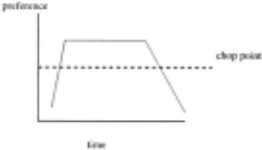
The same restrictions that allow local consistency to be applied are sufficient to prove that STPPs can be solved tractably. Finding an optimal solution of the given STPP with semi-convex preference functions reduces to a two-step search process consisting of iteratively choosing a preference value, "chopping" every preference function at that point, then solving a STP defined by considering the interval of tem poral values whose preference values lies above the chop line (semi-convexity ensures that there is a single interval above the chop point, hence that the problem is indeed an STP). Figure 1 illustrates the chopping process. It has been shown that the "highest" chop point that results in a solvable STP in fact produces an STP whose solutions are exactly the optimal solutions of the original STPP. Binary search can be used to select candidate chop points, making the technique for solv ing the STPP tractable. The second step, solving the induced STP, can be performed by transforming the graph associated with this STP into a distance graph, then solving two single source shortest path problems on the distance graph. (The solutions to these provide upper and lower time bounds for each event. If the problem has a solution, then for each event it is possible to arbitrarily pick a time within its time bounds, and find corresponding times for the other events such that the set of times for all the events satisfy the interval constraints.) For N nodes and E edges, the complexity of this phase is O(EN) (using the Bellman-Ford algorithm [Cormen et al., 1990]).
3 The problem with WLO
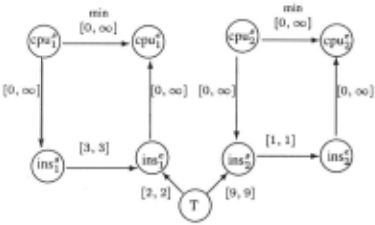
Formalized in this way, WLO offers what amounts to a coarse method for comparing solutions, one based on the minimal preference value over all the projections of the solutions to lo cal preference functions. Consequently, the advice given to a temporal solver by WLO may be insufficient to find solutions that are intuitively more globally preferable. For example, consider the following simple Mars rover planning problem, illustrated in Figure 2. The rover has a sensing instrument and a CPU. There are two sensing events, of durations 3 time units and I time unit (indicated in the figure by the pairs of nodes labeled insf, ins~ and ins~ , ins~ respectively). There is a hard temporal constraint that the CPU be on while the instrument is on, as well as a soft constraint that the CPU should be on as little as possible, to conserve power. This constraint is expressed in the STPP as a function from temporal values in dicating the duration that the CPU is on, to preference values. For simplicity, we assume that the preference function min on the CPU duration constraints is the negated identity func tion; i.e., min(t) = -t; thus higher preference values, i.e. shorter durations, are preferred. Because the CPU must be on at least as long as the sensing events, any globally preferred solution using WLO has preference value -3. The set of solutions that have the optimal value includes solutions in which the CPU duration for the second sensing event varies from I to 3 time units. The fact that WLO is unable to discriminate between the global values of these solutions, despite the fact that the one with I time unit is obviously preferable to the others, is a clear limitation of WLO.
One way of formalizing this drawback of WLO is to ob serve that a WLO policy is not Pareto Optimal. To see this, we reformulate the set of preference functions of a STPP, h , .. . , f m as criteria requiring simultaneous optimization, and lets = [t1 , ... , tn] and s' = [t~ , ... t~J be two solutions to a given STPP. s' dominates s if for each j, fJ ( tj) S fJ ( tj) and for some k, fk(tk ) < fk(tU. In a Pareto optimiza tion problem, the Pareto optimal set of solutions is the set of non-dominated solutions. Similarly, let the WLO-optimal set be the set of optimal solutions that result from applying the chopping technique for solving STPPs described above. Clearly, applying WLO to an STPP does not guarantee that the set of WLO-optimal solutions is a Pareto optimal set. In the rover planning problem, for example, suppose we con sider only solutions where the CPU duration for the first sens ing event is 3. Then the solution in which the CPU duration for the second sensing event is I time unit dominates the so lution in which it is 2 time units, but both are WLO-optimal , since they have the same weakest link value. 1
Assuming that Pareto-optimality is a desirable objective in optimization, a reasonable response to this deficiency is to replace WLO with an alternative strategy for evaluating solu tion tuples. A natural, and more robust alternative evaluates solutions by summing the preference values, and ordering them based on preferences towards larger values. (This strat egy would also ensure Pareto optimality, since every maxi mum sum solution is Pareto optimal.) This policy might be dubbed "utilitarian." The main drawback to this alternative is that the ability to solve STPPs tractably is no longer ap parent. The reason is that the formalization of utilitarianism as a semiring forces the multiplicative operator (in this case, sum), not to be idempotent (i.e., a + a =f. a), a condition required in the proof that a local consistency approach is ap plicable to the soft constraint reasoning problem.
Of course, it is still possible to apply a utilitarian frame work for optimizing preferences, using either local search or a complete search strategy such as branch and bound. Rather than pursuing this direction of resolving the problems with WLO, we select another approach, based on an algorithm that interleaves flexible assignment with propagation using WLO.
4 An algorithm for Pareto Optimization
The proposed solution is based on the intuition that if a con straint solver using WLO could iteratively "ignore" the weak est link values (i.e. the values that contributed to the global solution evaluation) then it could eventually recognize solu tions that dominate others in the Pareto sense. For example, in the Rover Planning problem illustrated earlier, if the weak est link value of the global solution could be "ignored," the WLO solver could recognize that a solution with the CPU on for I time unit during the second instrument event is to be preferred to one where the CPU is on for 2 or 3 time units.
1 This phenomenon is often referred to in the literature as the "drowning effect."
| Inputs: STPP P = (V, C) |
| Output: |
| STP (V, C p) whose solutions are Pareto optimal for P. (l) Cp = C |
| (2) Do |
| (3) Solve (V, C p) using WLO |
| (4) Delete all weakest link soft constraints from Cp |
| (5) For each deleted constraint ([a, b] , f), |
| (6) add ([aopt. bopt], !best) to Cp |
| (7) until (3)-(6) leave (V, C p) unchanged |
| (8) Return (V, C p) |
We formalize this intuition by a procedure wherein the original STPP is transformed by iteratively selecting what we shall refer to as a weakest link constraint, changing the con straint in such a way that it can effectively be "ignored," and solving the transformed problem. A weakest link (soft) con straint for a WLO set of solutions is one in which the prefer ence value of its duration in all the WLO solutions is the same as the chop level v of the optimal STP using WLO. For exam ple, after applying WLO to the problem in Figure 2, the CPU duration constraint associated with the first sensing event will be a weakest link, since it now has a fixed preference value of -3. However, the CPU constraint for the second event will not be a weakest link since its preference value can still vary from -3 to -1.
We also define a weakest link constraint to be open if v is not the "best" preference value (i.e., v < 1, where 1 is the designated "best" value among the values in the semi-ring).
Formalizing the process of "ignoring" weakest link values is a two-step process of restricting the weakest links to their intervals of optimal temporal values, while eliminating their WLO restraining influence by resetting their preferences to a single, "best" value. Formally, the process consists of:
- Squeezing the temporal domain to include all and only those values which are optimally preferred; and
- Replacing the preference function by one that assigns the most preferred value (i.e. 1) to each element in the new domain.
The first step ensures that only the best temporal values are part of any solution, and the second step allows WLO to be re-applied to eliminate Pareto-dominated solutions from the remaining solution space.
The algorithm WLO+ (Figure 3) returns a Simple Tem poral Problem (STP) whose solutions are contained in the WLO-optimal, Pareto-optimal solutions to the original STPP, P. Where C is a set of soft constraints, the STPP (V, C p) is solved (step 3) using the chopping approach described ear lier. In step 5, we denote the soft constraint that results from the two-step process described above as ([aopt, bapt], !best). where [aapt, bapt] is the interval of temporal values that are optimally preferred, and !best is the preference function such that fbest(v) = 1 for any input value v . Notice that the run time of W LO+ is O(ICI) times the time it takes to execute Solve(V, Cp ), which is a polynomial.
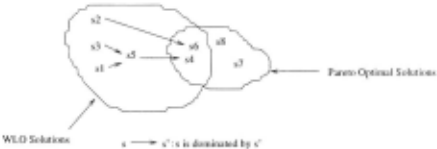
We now proceed to prove the main result, in two steps. In this section we assume the existence of weakest Jinks at every iteration of theW LO+ algorithm, and show that the subset of solutions of the input STPP returned by WLO+ is contained in the intersection of WLO-optimal and Pareto-optimal so lutions. In the next section we show that, given additional restrictions on the shape of the preference functions, such weakest links can be shown to always exist.
Given an STPP P, let Solww(P) (resp. SolPAR(P)) be the set of WLO-optimal (respectively, Pareto-Optimal) solu tions of P, and let Sol WLO+ (P) be the set of solutions toP returned by WLO+. Then the result can be stated as follows.
Theorem 1 If a weakest link constraint is found at each stage ofWLO+, then Solww+(P) ~ Solww(P) n SolPAR(P) . Moreover, if P has any solution, then SolwLO+(P) is nonempty.
Proof:
First note that after an open weakest link is processed in steps (4) to (6), it will never again be an open weakest link (since its preference is reset to !best) . Since the theorem assumes a weakest link constraint is found at each stage of WLO+, the algorithm will terminate when the weakest link constraint is not open, i.e., when all the soft constraints inC p have WLO preferences that equal the best (1) value.
Now assumes E SolwLO+(P). Since the first iteration reduces the set of solutions of (V, Cp) to SolwLo(P), and each subsequent iteration either leaves the set unchanged or reduces it further, it follows that s E SolwLo(P). Now sup poses rf. SolPAR(P). Then s must be dominated by a Pareto optimal solution s'. Let c be a soft constraint in C for which s' is superior to s. Thus, the preference value of the dura tion assigned by s to c cannot be 1. It follows that at some point during the course of the algorithm, c must become an open weakest link. Since s is in Sol WLO+ (P), it survives until then, and so it must provide a value for c that is equal to the chop level. However, since s' dominates s, s' must also survive until then. But this contradicts the assumption that c is a weakest link constraint, since s' has a value greater than the WLO chop level. Hence, s is in SolPAR(P), and so in Solww(P) n SolPAR(P).
Next suppose the original STPP P has at least one solu tion. To see that Sol WLO+(P) is nonempty, observe that the modifications in steps (4) to (6), while stripping out solutions that are not WLO optimal with respect to (V, Cp ), do retain all the WLO optimal solutions. Clearly, if there is any so lution, there is a WLO optimal one. Thus, if the (V, C p) in any iteration has a solution, the (V, Cp) in the next iteration will also have a solution. Since we are assuming the first (V, C p) ( = (V, C)) has a solution, it follows by induction that Sol WLO+ (P) is nonempty. 0

The theorem shows that it is possible to maintain the tractability of WLO-based optimization while overcoming some of the restrictions it imposes. In particular, it is pos sible to improve the quality of the flexible solutions gener ated within an STPP framework from being WLO optimal to being Pareto optimal.
Although the algorithm determines a nonempty set of so lutions that are both WLO optimal and Pareto optimal, the set might not include all such solutions. Consider the example in figure 5. Assume the preference function for all soft con straints is given by f(t) = t, i.e., longer durations are pre ferred (signified by the max label on the edges). The WLO+ algorithm will retain a single solution where BC and CD are both 5. However, the solution where BC = 2 and CD = 8, which is excluded, is also both Pareto optimal and WLO op timal. (Note that AB, with a fixed value of 1, is the weakest link.)
Many optimization schemes seek what is known as utili tarian optimality, where the objective is to maximize the sum of the local preferences. However, the WLO+ solutions are not necessarily utilitarian optimal with respect to all solutions or even the WLO solutions. For example, in figure 5, if the preference function is f(t) = t 2 , a utilitarian optimal WLO solution would be given by BC = 1 and CD = 9, but WLO+ will still return the solution where BC and CD are both 5.
We can summarize the position taken in this paper by say ing that utilitarian strategies, while attractive in many ways, are apparently intractable. The WLO+ approach provides some of the same benefit at lower cost. For example, non competing constraints are fully optimized by WLO+. For competing constraints, WLO+ tends to divide the preferences as equally as possible. In some applications, this might be more desirable than a utilitarian allocation.
5 Existence of Weakest Links
In this section we show that under suitable conditions, a weakest link constraint always exists. This involves a stronger requirement than for WLO: the preference functions must be convex, not merely semi-convex. This would include linear functions, cycloids, and upward-pointing parabolas, for example, but not Gaussian curves, or step functions. (Later on, we will see this requirement can be relaxed somewhat so that Gaussians can be permitted.)
Before proceeding, we note that while a solution s of an STP Pis defined in terms of an assignment to each variable, it also determines a value s(e) for each edge e, given by s(e) = s(Y) - s(X) where X andY are the start and end variables of e, respectively. We will use this notation in what follows.
Now consider any consistent STP P. The minimal net work [Dechter et al., 1991] corresponding toP is another STP P'. The constraints between any two points X and Y in P' are formed by intersecting the constraints induced by all possible paths between X and Y in P.
In the following, a preference function f is said to be con vex if { < x, y > IY ::; f(x)} is a convex set. The claim of the existence of weakest links can be stated as follows :
Theorem 2 Let P be an STPP with continuous domains and convex preference functions. Then there will be at least one weakest link constraint for the WLO optimal set ofsolutions.
Proof:
Consider the (minimal) STP P opt that corresponds to the optimal chopping level for P (as described in the WLO algo rithm). Suppose there is no weakest link constraint. Then for each edge constraint e there is a solution Se to P opt such that f ( Se (e)) > opt, where f is the preference function for the edge. 2
Lets be the average of all these solutions, i.e.
where E is the set of edges and V is the set of tempo ral variables. By the linearity of the constraints, it is easy to show that s is also a solution to Popt· For example, if se(Y) - se(X) ~ a for all e, then s(Y) - s(X) = 1/IEil:eEE(se(Y)- Se(X)) ~ (1/IEI)IEia =a.
Since s is a solution, we must have f ( s( e)) ~ opt for all edges e. Notice, however, that there must be some edge e such that f(s(e)) =opt, otherwise s would be a solution with value greater than the optimal value. It follows that s( e) -::J se(e), since we already know that f(se(e)) >opt.
Thus, either s(e) < se(e) or s(e) > se(e) . We consider only the case where s(e) < se(e). (The proof is similar in the other case.) Note also that mincEE sc(e) < s(e), since the minimum of a set of numbers can only be equal to the average if all the numbers are equal. It follows that mincEE Sc (e) < s(e) < Se(e) . However, f(mincEE Sc(e)) ~opt, j(s(e)) = opt, and f(se(e)) > opt. This violates the convexity off, which establishes the theorem. 0
The operations in the WLO+ algorithm preserve the con vexity property of the preference functions. Each stage of WLO+ repeats a WLO calculation. Thus, theorem 2 implies
Corollary 2.1 Suppose P is an STPP with continuous do mains and convex preference functions. Then a weakest link is found at each iteration ofWLO+.
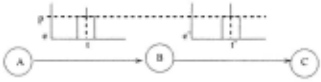
An example of why the existence result does not apply more generally to semi-convex functions is found in figure 6. The STPP in the figure contains two semi-convex step-like func tions with optimal preference values associated with dura tions t and t'. Assume the STPP is minimal, and that the assignment e = t, e' = t' is inconsistent. Then the highest possible chop point is p, and no weakest link exists, i.e., for neither e nor e' is it the case that, for every solutions, pis the value returned by the preference function associated with that constraint for the duration assigned by s.
2 To avoid excessive subscripting, we suppress the implied e sub script on f here and in what follows . In all cases, the applicable preference function will be clear from the context.
6 Discussion and Related Work
An examination of the proof of theorem 2 shows that the weakest link constraint exists under a somewhat less restric tive condition than convexity: it is enough, assuming semi convexity, to require that plateaus (subintervals of non-zero length where the preference function is constant) can only oc cur at the global maximum of the preference function. This means, for example, that the theorem is applicable in princi ple to any semi-convex smooth function such as a Gaussian curve.
However, in the practical setting of a computer program where numbers are computed to a finite precision and contin uous curves are approximated, some adjustments may need to be made. Note that a representation as a discretized step function does not satisfy the no-plateau condition. An alter native is to treat a discretized function as corresponding to a piecewise linear function where the linear segments join suc cessive points on the discretized graph. Even there, the long tails of a Gaussian curve may get approximated by horizontal segments. However, generally we can trim the domain of the curve to eliminate the flat tails without excluding all the so lutions. In that case, the discretized Gaussian is acceptable. (Note that figure 6 could be simulated by an example involv ing extreme Gaussians where the tails are essential for the solution.)
Note that preferences such as longest or shortest durations, or closest to a fixed time, which appear to be the most useful in practice, can be easily modeled within this framework.
WLO+ has been implemented and tested on randomly gen erated problems, where each semi-convex preference func tion is a quadratic ax 2 + bx + c, with randomly selected pa rameters and a ~ 0. We compared the best solution found after applying WLO+ with the quality of the earliest solution found using the chop solver, using the utilitarian measure of quality (i.e., summing preference values). An average im provement of between 6 and 10% was observed, depending on constraint density (more improvement on lower density problems). Future research will focus on the application of WLO+ to the rover science planning domain.
The results described here are clearly relevant to any effort whose objective is representing and reasoning about prefer ences and utility. A detailed survey of this vast literature is clearly beyond our scope; here we provide pointers to work that exhibits significant overlap. First, the idea of extending CSPs to solve multi-criteria optimization problems is pro posed in [Torrens and Faltings , 2002]; this work also uses Pareto-optimality as a criterion for ordering solutions. Sec ond, the idea of applying the notion of degrees of satisfac tion to solving temporal reasoning problems has been applied previously [Dubois and Prade , 1989]. Third, a number of graphical-based representations of local preferences have ap peared; in [Bacchus and Grove , 1995], for example, an ap proach is taken based on drawing connections between pref erences and probabilities, as expressed in a Bayesian network. Finally, for a survey of Al-based approaches to preferences and utility, with an emphasis on qualitative approaches, the reader is referred to [Doyle and Thomason, 1999].
7 Summary
This paper has presented a reformulation of problems in the optimization of temporal preferences using a generalization of Temporal CSPs. The practical context from which this effort arose is temporal decision-making in planning, where associated with domains representing temporal distances be tween events is a function expressing preferences for some temporal values over others. The work here extends previous work by overcoming limitations in the approach that arose when considerations of efficiency in reasoning with prefer ences resulted in coarseness in the evaluation procedure for global temporal assignments.
@inproceedings{ijcai2003p183,
  title     = {Tractable Pareto Optimization of Temporal Preferences},
  author    = {Khatib, Lina and Morris, Paul H. and Morris, Robert A. and Venable, Kristen Brent},
  booktitle = {Proceedings of the Eighteenth International Joint Conference on
               Artificial Intelligence, {IJCAI-03}},
  publisher = {International Joint Conferences on Artificial Intelligence},
  editor    = {Georg Gottlob and Toby Walsh},
  pages     = {1289--1293},
  year      = {2003},
  url       = {https://ijcai.org/proceedings/2003/183},
}
TY - CPAPER TI - Tractable Pareto Optimization of Temporal Preferences AU - Khatib, Lina AU - Morris, Paul H. AU - Morris, Robert A. AU - Venable, Kristen Brent T2 - Proceedings of the Eighteenth International Joint Conference on Artificial Intelligence, IJCAI-03 PB - International Joint Conferences on Artificial Intelligence PY - 2003 SP - 1289 EP - 1293 UR - https://ijcai.org/proceedings/2003/183 ER -Copied
Machine-readable versions of this paper, for tools and AI agents:





