
Where is ...? Learning and Utilizing Motion Patterns of Persons with Mobile Robots
Proceedings of the Eighteenth International Joint Conference on Artificial Intelligence. Pages 909-913.
© 2003 International Joint Conferences on Artificial Intelligence
Abstract
Whenever people move through their environments th ey do not move randomly. Instead, they usually follow specific trajectories or motion patterns corresponding to their intentions. Knowledge about such patterns may enable a mobile robot to robustly keep track of persons in its environment or to improve its obstacle avoidance behavior. This paper proposes a technique for learning collections of trajectories that characterize typical motion patterns of persons. Data recorded with laser-range finders is clustered using the expectation maximization algorithm. Based on the result of the clustering process we derive a Hidden Markov Model (HMM). This HMM is able to estimate the current and future positions of multiple persons given knowledge about their intentions. Experimental results obtained with a mobile robot using laser and vision data collected in a typical office building with several persons illustrate the reliability and robustness of the approach. We also demonstrate that our model provides better estimates than an HMM directly learned from the data.
- H. Asoh, S. Hayamizu, I. Hara, Y. Motomura, S. Akaho, and T. Matsui. Socially embedded learning of office-conversant robot Jijo-2. In Proc. of the Int. Joint Conference on Artificial Intelligence (IJCAI), 1997.
- M. Bennewitz, W. Burgard, and S. Thrun. Using EM to learn motion behaviors of persons with mobile robots. In Proc. of the Int. Conference on Intelligent Robots and Systems (IROS), 2002.
- H. Bui, S. Venkatesh, and G. West. Tracking and survei llance in wide-area spatial environments using the Abstract Hidden Markov Model. Inti. J. of Pattern Rec. and AI, 200 I .
- W. Burgard, A.B. Cremers, D. Fox, D. Hahne!, G. Lakemeyer, D. Schulz, W. Steiner, and S. Thrun. Experiences with an inter- active museum tour-guide robot. Artificial Intelligence, 11 4( 1- 2), 1999.
- H. Endres, W. Feiten, and G. Lawitzky. Field test of a nav- igation system: Autonomous cleaning in supermarkets. In Proc. of the Int. Conference on Robotics & Automation (ICRA) , 1998.
- S. King and C. Weiman. Helpmate autonomous mobile robot navigation system. In Proc. of the SPIE Conference on Mobile Robots, pages 190-198, Boston, MA, November 1990. Vol- ume 2352.
- B. Kluge, C. Kohler, and E. Prassler. Fast and robust tracking of multiple moving objects with a laser range finder. In Proc. of the IEEE Int. Conference on Robotics & Automation (ICRA) , 2001.
- G. Lacey and K. Dawson-Howe. The application of robotics to a mobility aid for the elderly blind. Journal of Robotics and Autonomous Systems (RAS), 23:245-252, 1998.
- S. M. Lavalle, H. H. Gonzalez-Banos, G. Becker, and J.- C. Latombe. Motion strategies for maintaining visibility of a moving target. In Proc. of the IEEE Int. Conference on Robotics & Automation (ICRA), 1997.
- G.J. McLachlan and T. Krishnan. The EM Algorithm and Ex- tensions . Wiley Series in Probability and Statistics, 1997.
- K. P. Murphy. Dynamic Bayesian Networks: Representation, Inference, and Learning. PhD thesis, University of California, Berkely, 2002.
- N. Roy, G. Baltus, D. Fox, F. Gemperle, J. Goetz, T. Hirsch, D. Magaritis, M. Montemerlo, J. Pineau, Schulte J. , and S. Thrun. Towards personal service robots for the elderly. In Proc. of the Workshop on Interactive Robotics and Entertain- ment, 2000.
- C. Schaeffer and T. May. Care-o-bot -a system for assisting elderly or disabled persons in home environments. In Assistive technology on the threshold of the new millenium. lOS Press, Amsterdam, 1999.
- R.D. Schraft and G. Schmierer. Service Robots. Springer Ver- lag, 1998.
- D. Schulz, W. Burgard, D. Fox, and A.B. Cremers. Track- ing multiple moving targets with a mobile robot using particle filters and statistical data association. In Proc. of the Int. Con- ference on Robotics & Automation ( ICRA) , 200 I .
- M. Swain and D. Ballard. Color indexing. International Jour- nal of Computer Vision, 7(1 ), 1991.
- S. Tadokoro, M. Hayashi, Y. Manabe, Y. Nakami, and T. Takamori. On motion planning of mobile robots which co- exist and cooperate with human. In Proc. of the Int. Conference on Intelligent Robots and Systems ( IROS) , 1995.
- Q. Zhu. Hidden Markov model for dynamic obstacle avoidance of mobile robot navigation. IEEE Transactions on Robotics and Automation, 7(3), 1991.
References were extracted automatically from the PDF and may contain errors.
Full text extracted automatically from the PDF; figures, tables and equations may differ. The PDF is the version of record.
1 Introduction
Whenever mobile robots are designed to operate in populated environments, they need to be able to perceive the people in their neighborhood and to adapt their behavior according to the activities of the people. Knowledge about typical motion behaviors of persons can be used in several ways to improve the behavior of a robot since it may provide better estimates about current positions of persons as well as allow better pre diction of future locations.
In this paper we present an approach for learning prob abilistic motion patterns of persons. We use the EM algorithm [10] to simultaneously cluster trajectories belong ing to the same motion behavior and to learn the characteris tic motions of this behavior. We apply our technique to data recorded with laser-range finders . Furthermore, we demon strate how the learned models can be used to predict positions of persons.
*This work has partly been supported by the German Science Foundation (DFG) under contract number SFB!fR8-03 and by the EC under contract numbers IST-2000-29456 and HPMT-CT-00251.
Recently, a variety of service robots has been developed that have been designed to operate in populated environ ments. These robots for example, have been deployed in hos pitals [6], museums [4], office buildings [1], and department stores [5] where they perform various services e.g., deliver, educate, entertain [14] or assist people [13, 8, 12]. A variety of techniques has been developed that allows a robot to track people in its vicinity [15, 7] . Additionally, several authors have used models of people's motions to adapt the behavior of a mobile platform according to predicted movements [18, 17, 9]. These approaches, however, assume that a motion model is given. They provide no means to learn the parame ters of the motion behavior of persons. Bui et al. proposed an Abstract Hidden Markov Model (AHMM) to predict people's motion [3]. They assume that the goals and subgoals a per son might have (i .e. locations the person aims to approach) are given. Our approach, in contrast, is able to learn the in tentions and to automatically derive the parameters of the un derlying HMM. The technique described in this paper is an extension of the approach recently proposed by Bennewitz et al. [2]. We describe how to learn the intentions of persons and how to derive an HMM from the corresponding motion pat terns. This Hidden Markov Model allows the robot to main tain a belief about the current location of a person.
The paper is organized as follows. The next section intro duces our approach to learn motion patterns from observed trajectories and describes how we generate Hidden Markov Models to predict motions of persons. In Section 3 we present several experiments illustrating the robustness of our approach for estimating the positions of single and multiple persons using laser and vision data with a mobile robot. We also give results indicating that our models provide better es timates than Hidden Markov Models directly learned from the observations.
2 Learning Motion Patterns
When people perform their everyday activities in their envi ronment they do not move permanently. They usually stop at several locations and stay there for a certain period of time, depending on what activity they are currently carrying out. Accordingly, we assume that the input to our algorithm is a collection of trajectories d = { d1 , ... , dN} between resting places. The output is a number of different types of motion patterns () = { ()1, ... , () M} a person might exhibit in its nat ural environment. Each trajectory di consists of a sequence di = {xi ,t,Xi ,2, ... ,xi,T.} of positions Xi ,t· Accordingly, Xi ,1 is the first position of the person when it starts leaving a resting area and Xi ,T, is the destination. The task of the algo rithm described in this section is to cluster these trajectories into different motion behaviors and finally to derive an HMM from the resulting clusters.
Throughout this paper we assume that all trajectories have the same length T, where T is chosen as the maximum length of all trajectories. A trajectory di of length Ti < T is ex tended by linear interpolation. The learning algorithm de scribed below operates solely on this information and there fore does not take into account the velocities of the persons during the learning phase. In our experiments, we never found evidence that the walking speed of a person depends on its intention. However, one way to incorporate veloci ties is to introduce further dimensions to the state variables. The necessary changes to our clustering algorithm are then straightforward.
2.1 Motion Patterns
We begin with the description of our model of motion pat terns, which is subsequently estimated from data using EM. Within this paper we assume that a person engages in M dif ferent types of motion patterns. A motion pattern denoted as Om where 1 ~ m ~ M is represented by K probability dis tributions p(x I Om,k) · For each Om,k the probability distri bution p(x I Om,k) is computed based on /3 = fT / Kl subse quent positions on the trajectories. Accordingly, p(x I Om,k) specifies the probability that the person is at location x after [(k- 1) · f3 + 1; k · /3] steps given that it is engaged in motion pattern m . Thus, we calculate the likelihood of a trajectory di under the m-th motion pattern Om as
2.2 Expectation Maximization
In essence, our approach seeks to identify a model() that max imizes the likelihood of the data. To define the likelihood of the data under the model (), it will be useful to introduce a set of correspondence variables denoted as Cim. Here i is the index of the trajectory di, and m is the index of the motion pattern Om. Each correspondence Cim is a binary variable. It is 1 if and only if the i-th trajectory corresponds to the m-th motion pattern. If we think of a motion pattern as a specific motion activity a person ntight be engaged in, then Cim is 1 if person was engaged in motion activity min trajectory i.
In the sequel, we will denote the set of all correspon dence variables for the i-th data item by Ci, that is, Ci = {Cit, ... , CiM}. For any data item i the fact that exactly one of its correspondence variable is 1 leads to "l:~=1 Cim = 1.
Throughout this paper we assume that each motion pat tern is represented by K Gaussian distributions with a fixed standard deviation a-. The goal is to find the set of motion patterns which has the highest data likelihood. EM is an al gorithm that iteratively maximizes expected data likelihood by optimizing a sequence of lower bounds. In particular it generates a sequence of models denoted as ()[ 1 1, ()[ 2 1, . . . of increasing data likelihood. The standard method is to use a so-called Q-function which depends on two models,() and()'. In accordance with [2] this Q-function is factored as follows:
The sequence of models is then given by calculating
starting with some initial model ()(OJ. Whenever the Q function is continuous as in our case, the EM algorithm con verges at least to a local maximum.
In particular, the optimization involves two steps: calculat ing the expectations E[cim I ()Ul, d) given the current model ()[j], and finding the new model ()[j+l] that has the maximum expected data log likelihood under these expectations. The first of these two steps is typically referred to as the E-step (short for: expectation step), and the latter as the M-step (short for: maximization step).
To calculate the expectations E[cim I ()Ul , d) we apply Bayes' rule, obeying independence assumptions between dif ferent data trajectories:
where the normalization constants 'TJ and ry' ensure that the expectations sum up to 1 over all m. If we combine (1) and (4) utilizing the fact that the distributions are represented by Gaussians we obtain:
Finally, theM-step calculates a new model ()[i+l] by max imizing the expected likelihood. Technically, this is done by computing for every motion pattern m and for each probability distribution p(x I Om,k) a new mean Jl~;kl]. We thereby consider the expectations E[cim I ()[J], d) computed in theE step:
2.3 Estimating the Number of Model Components
Since in general the correct number of motion patterns is not known in advance, we need to determine this quantity during the learning phase. If the number of motion patterns is wrong, we can distinguish two different situations. First, if there are too few motion patterns there must be trajectories, that are not explained well by any of the current motion patterns. On the other hand, if there are too many motion patterns then there must be trajectories that are explained well by different model components. Thus, whenever the EM algorithm has converged, we check whether the overall data likelihood can be improved by increasing or decreasing the number of model components. To limit the model complexity, during the eval uation we use a penalty term that depends on the number of model components (see [2]). This avoids that our algorithm learns a model that overfits the data, which in the worst case is a model with one motion pattern for every single trajectory. If the maximum number of iterations is reached or if the overall evaluation cannot be improved after increasing and decreas ing the model complexity our algorithms stops and returns the model with the best value found so far. In most of the experiments carried out with different data sets our approach correctly clustered the trajectories into the corresponding cat egories.
2.4 Laser-based Data Acquisition
The EM-based learning procedure has been implemented for data acquired with laser-range finders. To acquire the data we used several laser-range scanners which were installed in the environment so that the relevant parts of the environment were covered. First, to identify persons in the laser data our system extracts features which are local minima in the range scans that come from the legs of persons. Additionally, it considers changes in consecutive scans to more reliably iden tify the moving people. To keep track of a person, we use a Kalman filter. The state Xr of a person at time step r is repre sented by a vector [x, y, 6x, 6y]'. Whereas x andy represent the position of the person, the terms 6x and 6y represent the velocity of the person in x- andy-direction. Accordingly, the prediction is carried out by the equation:
where tr is the time elapsed between the measurement Zr+l and Zr. Usually, sensors only give the position of an object. Since the laser range sensor does not provide the velocities 6x and 6y, which are also part of our state space, the mea surement matrix projects onto the first two components of the state space. Accordingly, the predicted measurement at step r + 1 is:
In a second step we identify the resting places and perform a segmentation of the data into different slices in which the person moves. Finally, we compute the trajectories, i.e. the sequence of positions covered by the person during that mo tion. When computing these trajectories, we ignore positions which lie closer than 15cm to each other.
2.5 Deriving Hidden Markov Models from Learned Intentions
Once the intentions of the persons have been learned, we can easily derive Hidden Markov Models to estimate their posi tions. To achieve this, we distinguish two types of nodes. The first class are the initial and final nodes that correspond to the resting places. To connect these nodes we introduce so-called intermediate nodes which lie on the learned motion patterns. In our current system we use a sequence of Lm intermediate nodes v;,, ... , vf:.m for each intention em. The intermediate nodes are distributed over em such that the distance between two consecutive nodes is .0. 11 = 50cm . Given this equidis tant distribution of the sub-nodes and assuming a constant speed v with standard deviation Uv of the person, the transi tion probabilities of this HMM depend on the length .0.t of the time interval between consecutive updates of the HMM as well as on v and u v. In our current system, this value is set to .0.t = 0.5secs. Accordingly, we compute the probability that the person will be in node v;., given it is currently in Vm and given that the time .0.t has elapsed as:
Here N ( Vm + v · .0.t, u v, x) is the value of the Gaussian with mean Vm + v · .0.t and standard deviation Uv at posi tion x. The transition probabilities for the resting places are computed based on a statistics about the average time period which elapses before the person starts this particular motion behavior after staying in the corresponding resting area.
Please note that the resulting model can be regarded as a two-level Abstract Hidden Markov Model [3]. Whereas the higher-level goals of this AHMM correspond to the resting places of the person, the lower-level goals are the nodes along the paths to the high-level goals.
2.6 An Application Example
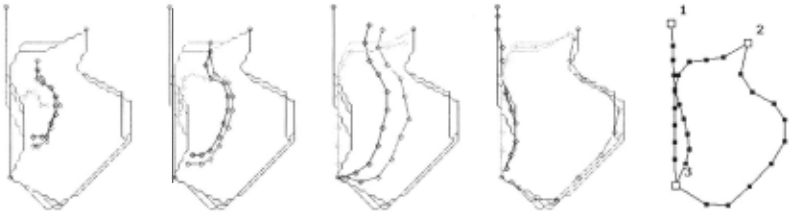
To see how our EM-based learning procedure works in prac tice please consider Figure 1. In this example, a model for nine trajectories with three different intentions has to be learned. The leftmost image shows the initial model (the means of the three model components are indicated by cir cles). In the next two images one can see the evolution of the model components. The fourth image shows the model components after convergence of the EM algorithm. As can be seen, the trajectories are approximated quite well by the corresponding motion patterns. Finally, the rightmost picture shows the HMM derived from these motion patterns. The dif ferent resting places are indicated by rectangles and numbers.
3 Experimental Results
The technique described above has been implemented and evaluated using data acquired in an unmodified office envi ronment. The experiments described in this section are designed to illustrate that the approach can learn complex mo tion behaviors in a typical office environment. We further more demonstrate that the resulting models can be used to robustly estimate the positions of persons. Additionally, we compare the performance of the models learned by our al gorithm to that of a standard HMM. Finally, we present an extension which allows the system to deal with multiple per sons.
3.1 Learning Intentions in an Office Environment
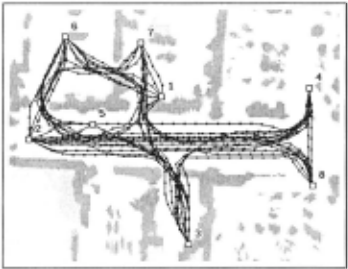
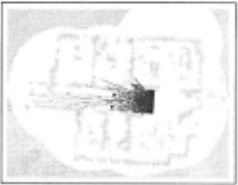
To evaluate our approach, we applied it to data recorded over two hours in our office environment. During the acquisition phase the average speed of the person was v=l07 em/sec with a standard deviation av=25 em/sec. From the resulting data our system extracted 129 trajectories which were successfully clustered into 49 different intentions. The resulting Hidden Markov Model is shown in Figure 2.
3.2 Tracking a Single Person
To analyze the applicability of the learned HMM for the pre diction of the locations of a person, we used our mobile robot Albert, which is a B21r platform equipped with a laser range scanner. While the robot was moving along the corridor of our department with speed up to 40cm/sec, its task was to maintain a belief about the position of the person.
To incorporate observations into the HMM we apply the recursive Bayesian update scheme:
Thereby the likelihood p(zr I v) of an observation Zr given the state v is computed using a Gaussian distribution which depends on both, the variance in the current estimate of the tracking system and the variance a used during the learning of the intentions.
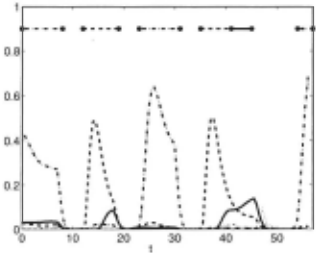
Figure 3 plots for different resting areas the probability that the person stays in this particular place. Whereas the x-axis represents the individual time steps, the y-axis indicates the probability. The graph also includes the ground truth, which is indicated by the corresponding horizontal line-pattern at the .9 level. As can be seen from the figure, the system can reliably determine the current position of the person. During this experiment it predicted the correct place of the person in 93% of the time.
3.3 A Comparison to Standard HMMs
The second experiment is designed to demonstrate that an HMM that takes into account the people's intentions allows a better prediction than a standard HMM that is directly gen erated from the observed trajectories of the persons and that does not take into a account the clustered trajectories. To evaluate the performance of the two different approaches we chose two motion patterns from those depicted in Figure 2. The first pattern is the one leading from resting place 7 via the office containing resting place 6 to the staying area 2. The second one is the motion pattern between the places 6 and 5. We defined a standard HMM over the possible states of the person in the (x, y, dx, dy) space where x andy were discretized in 15cm patches; dx and dy encode 9 possible in cremental moves per cell. The transition probabilities were learned from the trajectories corresponding to both motion patterns by counting. We randomly chose a position along the trajectories of both patterns as the observed position of the person. The states of the HMM were initialized according to the observation model (see Section 3.2). After convergence of the HMM we measured the likelihood of the final destina tion. We compared this value to those obtained by the HMM generated by our algorithm for the trajectories correspond ing to these two intentions. We repeated this experiment for different locations along the trajectories of both patterns and determined the average probability of the true goal location. Whereas we obtained an average of .74 with our model, the corresponding value of the standard HMM is .56. This il lustrates that our model leads to better results and that the standard independence assumption of HMMs is generally not justified in this application domain. Please note that similar observations have been reported by Murphy [11]. In contrast to a standard HMM our model automatically chooses the tran sitions that correspond to the actual intention of the person.
3.4 Estimating the Locations of Multiple Persons
The final experiment described in this section is designed to illustrate that our models can also be used to maintain beliefs about multiple persons. The major difference to the situation with a single person is that we have to be able to represent the beliefs for the individual persons and to detect multiple persons in the observations. In our current system we learn an individual HMM for every person.
To track multiple persons in the range scans, we apply in dependent Kalman filters, one for each feature. To solve the data association problem, we apply a nearest neighbor ap proach, i.e. we update a filter using the observation Zr+1 that is closest to z,:-+ 1 . New filters are introduced for observations from which all predictions are too far away. Furthermore, fil ters are removed if no corresponding feature can be found for one second.
We also need to be able to identify a person in order to ap propriately update the belief about the location of that person. To achieve this we additionally employ the vision system of our robot. To identify a person, we proceed as follows: Ev ery time the laser-based people tracker detects a person in the field of view of the camera, an image is collected and follow ing three steps are applied:
- Segmentation: The size of a rectangular area of the im age containing the person is determined.
- Feature extraction: We compute a color histogram for the area selected in the previous step.
- Database matching: To determine the likelihood of a particular person, we compare the histogram computed in step 2 to all prototypes existing in the database.
To determine the area in the image corresponding to a feature detected by the laser tracking system, we rely on an accurate calibration between the camera and the laser and we use a perspective projection to map the 3D position of the per son in world coordinates to 2D image coordinates. Whereas color histograms are robust with respect to translation, ro tation, scale and to any kind of geometric distortions they are sensitive to varying lighting conditions. To handle this problem we consider the HSV (Hue-Saturation-Value) color space. In this color model the intensity factor can be sepa rated so that its influence is reduced. In our current system we simply ignore this factor. Throughout all our experiments we could not find any evidence that this factor negatively af fected the performance of the system. The image database is created beforehand. For each person it contains one his togram which is built from 20 images.
To compare a given query histogram I with a prototype M in the database we use normalized intersection norm H(I , M) [16]. This quantity can be computed as:
where I and M are color histograms both having n bins. One advantage of this norm is that it also allows to compare partial views, i.e. when the person is close to the camera and only a part of it is visible.
To incorporate the similarity measure provided by the vi sion system into the HMM of the person 71', we simply multi ply the likelihoods provided by the laser tracking system with the similarity measure H(I., M"') of the query histogram Is for the segment s and the data base prototype M"' for person
-rr. If the current estimate of the laser tracker is not in the field of view of the camera we simply update the HMM for all per sons as we do in the case in which we track a single person only.
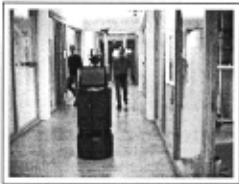
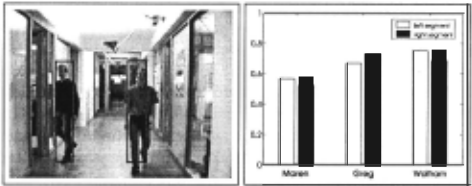
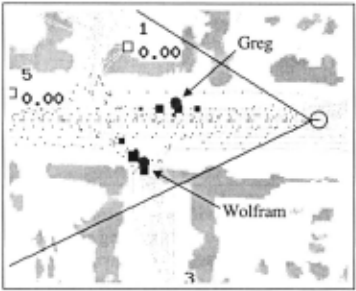
As an application example consider the situation depicted in the left image of Figure 4. In this particular situation two persons (Wolfram and Greg) are walking along the corridor within the perceptual field of the robot. The right image of Figure 4 shows the estimate of the laser-based people tracking system at the same point in time. The corresponding image obtained with the robot's camera is shown in the left image of Figure 5. Also shown there are the two segments of the im age that correspond to the two persons detected with the laser. The right image of this figure plots the similarities of the two segments to the individual prototypes stored in the data base. Finally, Figure 6 depicts the HMM for Wolfram (who is the left person in Figure 5). As can be seen, the probabilities in dicated by the size of the rectangles are slightly higher for the states that correspond to Wolfram's true location. Through out this experiment the robot was able to predict the correct location of the persons in 79% of all cases.
4 Conclusions
In this paper we have presented a method for learning and utilizing motion behaviors of persons. Our approach applies the EM-algorithm to cluster trajectories recorded with laser range sensors into a collection of motion patterns, each cor responding to a possible intention of a person. From these motion patterns we automatically derive an HMM that can be used to predict the positions of persons in their environment.
Our approach has been implemented and applied success fully to trajectories recorded in a typical office environment. Practical experiments demonstrate that our method is able to learn typical motion behaviors of persons and to reliably use them for state estimation. The experiments have been carried out using a mobile robot equipped with a laser-range sensor and a vision system. We have furthermore presented exper iments indicating that standard HMMs directly learned from the same input data are less predictive than our models.
@inproceedings{ijcai2003p130,
  title     = {Where is ...? Learning and Utilizing Motion Patterns of Persons with Mobile Robots},
  author    = {Cielniak, Grzegorz and Bennewitz, Maren and Burgard, Wolfram},
  booktitle = {Proceedings of the Eighteenth International Joint Conference on
               Artificial Intelligence, {IJCAI-03}},
  publisher = {International Joint Conferences on Artificial Intelligence},
  editor    = {Georg Gottlob and Toby Walsh},
  pages     = {909--913},
  year      = {2003},
  url       = {https://ijcai.org/proceedings/2003/130},
}
TY - CPAPER TI - Where is ...? Learning and Utilizing Motion Patterns of Persons with Mobile Robots AU - Cielniak, Grzegorz AU - Bennewitz, Maren AU - Burgard, Wolfram T2 - Proceedings of the Eighteenth International Joint Conference on Artificial Intelligence, IJCAI-03 PB - International Joint Conferences on Artificial Intelligence PY - 2003 SP - 909 EP - 913 UR - https://ijcai.org/proceedings/2003/130 ER -Copied
Machine-readable versions of this paper, for tools and AI agents:





