
ExpertClerk: Navigating Shoppers Buying Process with the Combination of Asking and Proposing
Proceedings of the Seventeenth International Joint Conference on Artificial Intelligence. Pages 1443-1449.
© 2001 International Joint Conferences on Artificial Intelligence
Abstract
This paper analyzes conversation models of human salesclerks interacting with customers. The goal of a salesclerk is to effectively match a customer’s buying points and a product’s selling points. To achieve this, the salesclerk alternates among asking questions, proposing sample goods, and observing the customer’s responses. Based on this analysis, we developed ExpertClerk, an agent system that imitates a human salesclerk and navigates Web shoppers in merchandise databases. In the system, a character agent talks with a shopper in a natural language and consolidates the shopper’s request by narrowing down a list of many matching goods by asking effective questions using entropy (Navigation by Asking). Then, it shows three contrasting samples with explanations of their selling points (Navigation by Proposing). This cycle is repeated until the shopper finds an appropriate good. Evaluations show that the combination of Navigation by asking and Navigation by proposing works as most effectively as human salesclerks.
- [Aha & Breslow, 1997] Aha, D.W. and Breslow, L.A.: 1997, Refining conversational case libraries, Proceedings of the Second International Conference on Case-Based Reason- ing, pp. 267 -278.
- [Aha et al., 1998] Aha, D.W., Maney, T., and Breslow, L.A.: 1998, Supporting dialogue inferencing in conversational case-based reasoning, Proceedings of the 4th European Workshop on Case-Based Reasoning, pp. 267 -278.
- [Burke et al., 1997] Burke, R.D., Hammond, K.J., and Young, B.C.: 1997, The FindMe approach to assisted browsing, Journal of IEEE Expert, Vol. 12, 4, pp. 32 - 40.
- [Burke et al., 1999] Burke, R.: 1999, The Wasabi Personal Shopper: A Case-Based Recommender System. Proceed- ings of the Seventeenth National Conference on Artificial Intelligence, Menlo Park, CA: AAAI Press.
- [Chavez & Maes, 1996] Chavez, A. and Maes, P. : 1996, Kasbah: An Agent Marketplace for Buying and Selling Goods. Proceedings of the First International Confer- ence on the Practical Application of Intelligent Agents and Multi Agent Technology, London.
- [Hammond et al., 1996] Hammond, K.J., Burke, R., and Schumitt, K.: 1996, A case-based approach to knowledge navigation, in: Leake, D.B. (Eds.): Case-Based Reason- ing Experiences, Lessons, & Future Directions, pp. 125 - 136, Menlo Park, Calif.: AAAI Press. IJCAI
- [Kolodner, 1993] Kolodner, J.: 1993, Case-Based Reason- ing, San Francisco, Calif.: Morgan Kaufmann. [Quinlan, 1986]
- Quinlan, J.R.: 1986, Induction of decision trees. Journal of Machine Learning, Vol. 1, pp 81 -106.
- Seybold, P.B. and Miller, J.: 1999, Top 10 Pre-Holiday E-Tailing Picks, Customers.com / Perspec- tive, www.customers.com Link
- [Salton, 1983] Salton, G.: 1983, An Introduction to Modern Information Retrieval New York: McGraw-Hill [
- [Shigeta, 1995] Shigeta, T.: 1995, 30 lessons on how to be an excellent salesclerk. (in Japanese) Keirin Shobo: Tokyo.
- [Shimazu et al., 1992] Shimazu, H., Arita, S., and Takashima, Y.: 1992, Design Tool Combining Keyword Analyzer and Case-based Parser for Developing Natural Language Database Interfaces Proceedings of the Four- teenth International Conference on Computational Lin- guistics.
- [Shimazu et al., 1993] Shimazu, H., Kitano, H., and Shibata, A.: 1993, Retrieving cases from relational data base: An- other stride towards corporate-wide case-based systems, Proceedings of the Thirteenth International Joint Confer- ence on Artificial Intelligence, pp. 909 -914.
- [Shimazu et al., 2001] Shimazu, H., Shibata, A., and Nihei, K.: 2001, ExpertGuide: A Conversational Case-Based Reasoning Tool for Developing Mentors in Knowledge Spaces. Applied Intelligence, 14, pp 33 -48, Kluwer Aca- demic Publishers, January 2001.
- [Watson & Gardingen, 1999] Watson, I. and Gardingen, D.: 1999, A Distributed Case-Based Reasoning Application for Engineering Sales Support, Proceedings of the 16th International Joint Conference on Artificial Intelligence, Morgan Kaufmann. [Wilke et al., 1998] IJCAI
- Wilke, W., Lenz, and M., Wess, S.: 1998, Intelligent Sales Support with CBR, in: Lenz, M., Bartsch-Spörl, B., Burkhard, H-D., and Wess S. (Eds.): Case-Based Reasoning Technology From Foundations to Applications, pp. 91 -113, Lecture Notes in Artificial In- telligence 1400, Springer.
References were extracted automatically from the PDF and may contain errors.
Full text extracted automatically from the PDF; figures, tables and equations may differ. The PDF is the version of record.
1 Introduction
This paper describes a salesclerk conversation model that interacts with customers. It is used in e-tailer Web sites to help customers easily find, compare, and decide on appropriate goods from among a lot of merchandise goods.
Specifically, we have implemented ExpertClerk as an agent system that imitates a human salesclerk and navigates Web shoppers in merchandise databases. In the system, a character agent talks with a shopper in a natural language and consolidates the shopper's request by narrowing down a list of many matching goods by asking effective questions using entropy (Navigation by Asking). Then, ExpertClerk shows three contrasting samples with explanations of their selling points (Navigation by Proposing). This cycle is repeated until the shopper finds an appropriate good.
The motivation behind this research was two-fold. First, we have developed several knowledge retrieval systems for customer support using conversational case-based reasoning techniques [Aha & Breslow, 1997]. Recently, requests have been increasing by internal and external customers to apply these techniques into e-tailer Web sites to help shoppers find and decide on goods in large-scale merchandise databases. This prompted us to develop prototype systems and show them to our clients. However, their responses were not good. This is because the system designs were based on conversations between customers of products and customer support agents. Most complaints centered around the conversations in the shops being different from those in customer supports. Other complaints were heard about the knowledge retrieval systems not having a different conversation structure and control.
Second, the Patricia Seybold Group reported the top 10 e-tailer ranking of the 1999 pre-Christmas season [Seybold, 1999], and Lands' End (landsend.com) earned the numberone spot. According to their survey, it was the company's superb customer service that made it first. The Web site provides the ability to press a button and talk to a customer service representative from the Web site via live chat or phone for shopping help, professional advice, or gift suggestions. We were surprised that even the top e-tailer site relies on the conversation skills of human representatives.
We surveyed various conversation skill's manuals for human salesclerks. The survey taught us that salesclerks effectively match customers' buying points and products' selling points. Today's Web shop sites including Lands' End do not have such human-like salesclerk-customer conversational interfaces. However, ExpertClerk was designed and developed to imitate the conversation techniques of actual salesclerks.
2 Conversations between Salesclerks and Shoppers
In a conversation between a shopper and a salesclerk, the shopper plays the role of a decision-maker and the salesclerk plays the role of an adviser. The conversation is a clarifying process of the subconscious desire of the decision-maker. The adviser is a catalyst that promotes the shopper's decisionmaking. The following sequence shows a typical conversation between a shopper and a salesclerk (S: Shopper, C: Clerk).
- S: Please showme that blouse.
- C: Ok. We have a similar color that may also suit you. And, this is a blouse of the same type but with a different design.
- S: Well, the design is fine, but the neck looks very tight.
- C: How about this one if you prefer a loose neckband? That one also has a loose neckband and an interesting design.
- S: I like this one. Howmuch is it?
- C: It is $200.
- S: Wow. $200 is a bit too expensive.
- C: How about this one? It has a similar design and color, but the price is only $88. The material is polyester.
- S: Ok, I'll take it.
- C: Thank you.
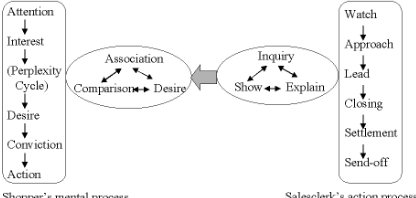
Figure 1 show a typical mental process of shoppers, called AIDCA model [Shigeta, 1995]. A shopper first turns his/her attention towards a specific good and becomes interested in the good. The shopper then starts to desire the good and becomes perplexed about the decision, i.e., in the perplexity cycle of desire, comparison and association. The shopper eventually decides to buy the good with conviction, and moves to the purchasing action.
A salesclerk follows the shopper's AIDCA process to promote each step. The salesclerk watches for a chance and approaches the new shopper. The approach must be done at the appropriate time. If it is too soon, the shopper guards against the salesclerk. If it is too late, the salesclerk is regarded as a dull clerk. When the conversation starts, the salesclerk asks a few questions to identify the shopper's necessary conditions (buying points). Then, the salesclerk picks a few sample goods and shows them to the shopper and explains their selling points.
We analyzed a real conversation corpus between shoppers and salesclerks and interviewed senior salesclerks. In order to understand a customer's buying points, a salesclerk alternates between asking questions and proposing sample goods. Many salesclerks said the best approach is to present three sample goods at the same time. According to these salesclerks, shoppers become frustrated if they are shown only one or two samples. On the other hand, if four or more samples are presented, they become puzzled as to which to choose. Each of these three samples must have clear selling points that differentiate itself from the other two. The salesclerk explains the selling points, like for example, "This is twice as expensive as those because it is made of silk and the other two are made of polyester". While hearing the explanations, the shopper can more easily exclude one of the three proposed goods with a specific reason, like "this one is too dark for me compared with the other two". The salesclerk excludes it and chooses a new one satisfying the shopper's comment. The salesclerk repeats picking sample goods, explaining their selling points, and modifying his/her sample picking strategy by observing the customer's responses.
It is also very important that the salesclerk presents appropriate sample goods. If a proposed sample is opposite to a shopper's preference, the shopper may feel distrust towards the opinion of the salesclerk. In order to avoid this, the salesclerk must first ask a few effective questions to infer the shopper's preference.
3 Design Decision
3.1 Modeling a salesclerk's action sequence
ExpertClerk was designed to model the typical action sequence of human salesclerks. It has the following steps:
- Approach: ExpertClerk approaches a shopper.
- Navigate by asking appropriate questions: ExpertClerk finds a set of goods matching the shopper's request. If too many matching goods exist, ExpertClerk narrows them down by asking a few questions using entropy which effectively discriminates the shopper's intention.
- Navigate by proposing three sample goods: If the shopper can not identify his/her own intention, ExpertClerk shows three contrasting samples with explanations of their selling points.
- Observe: ExpertClerk observes the shopper's reactions on likes/dislikes and why.
- Repair: ExpertClerk modifies the proposal to fit the shopper's responses.
The process repeats until the shopper finds an appropriate good. The key to ExpertClerk effectiveness is its combination of Navigation by asking and Navigation by proposing. The following sections explain these features.
3.2 Merchandise database
ExpertClerk is a front-end system for a merchandise database. We assume that merchandise records are represented as a flat record of n-ary fields, and stored in a table in a commercial RDBMS. Each field stores an attribute of merchandise, such as price, color, material, the country of origin, brand, and so on. For each record attribute, a conceptual hierarchy is defined by domain experts.
This hierarchy represents a classification and is defined as a discrimination tree. Each node in the hierarchy is a question node that subdivides the set of nodes stored underneath it. Each child node represents a different answer to the question posed by its parent. Each leaf node refers to a set of merchandise records which satisfy the above discrimination conditions. For example, the "price" attribute may have a question "Which price range are you interested in?". The possible answers may be divided into "Very expensive", "Expensive", "Reasonable", "Fairly cheap", or "Very cheap". They can be subdivided into more detailed categories. "Very expensive" may be divided into "Over $10,000?" and "Between $1,000 and $9,999?". Each merchandise record is linked from several different leaf nodes of different hierarchies.
These questions and possible answers are used to discriminate merchandise records. The discrimination capability of each question is different. It depends on the set of remaining merchandise records. For example, "Which price range are you interested in?" is useful if the remaining goods have various price ranges. However, the same question is meaningless if all of the remaining goods are over $10,000.
3.3 Navigation by asking
Navigation by asking calculates the information gain of possible questions and sorts them according to their statistical efficiency. It works as follows:
(1) Extracting questions. Within each question hierarchy having leaf-nodes pointing to merchandise records, the paths from each of these leaf-nodes are traversed in the direction of the root, and the first question node reached that is common to all of these leaves is extracted as a question node. Then, the nodes on the level just below this question node are extracted as its answer nodes.
(2) Calculating the information amount of question nodes.
Questions are determined from their calculated information amount. The algorithm is based on ID3's [Quinlan, 1986] information gain approach. Let C = {r1, r2, ..., rk} be the set of retrieved question nodes and let hj be the retrieval counts of rj(1 ≤ j ≤ k). Then, the occurrence probability pj of rj is calculated by Equation (1) . The entropy M(C) of C is given by Equation (2). When C is divided into subsets C1, C2, ..., Cn by answer nodes a1, a2, ... an of question node a, the expected information B(C↪ a) is given by Equation (3). The information gain(C↪ a) gained by question node a is given by Equation (4). Dividing C into subsets by using question node a which maximizes gain(C↪ a) should narrow down the number of result sets efficiently.
3.4 Navigation by proposing
It is very annoying for shoppers to be asked many questions. After merchandise records are narrowed down to a pre-defined threshold number after several questions, ExpertClerk changes its conversation mode from Navigation by asking to Navigation by proposing. In the navigation by proposing mode, three goods as the most contrasting among remaining goods are selected. They are selected by the following algorithm.
- The first sample good (1st-SG) is the goods record closest to the center point of the set. Its selling points directly reflect the customer's request.
- The second sample good (2nd-SG) is the goods record positioned most distantly from the center point of the set. The selling points of 2nd-SG clearly differentiate itself from 1st-SG.
- The third sample goods (3rd-SG) is the goods record positioned most distantly from 2nd-SG. 3rd-SG has selling points which differentiate itself from 1st-SG and 2ndSG.
Let G = {g1, g2, ..., gk} be the set of retrieved goods records and let gi = {fi1↪ fi2↪ ▷▷▷▷fin} be the set of attribute values. Then the median gmed of G is calculated by Equation (5) and the standard deviation of the ith attribute value set gdev(i) is calculated by Equation (6)
The distance (D) between gmed and a sample gi is given by Equation (7).
where gmed(j) is the j-th attribute of gmed, gi(j) is the j-th attribute of gi, and Wj is the j-th attribute weight.
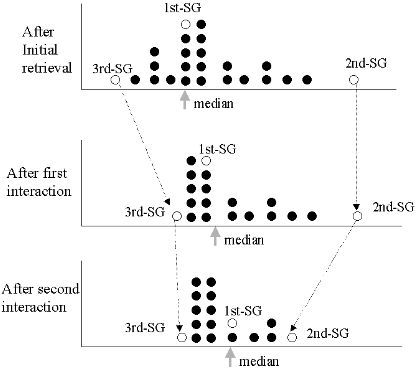
1st-SG is a record whose distance from gmed D(gmed↪ gi) is the shortest among gj(1 ≤ j ≤ k). 2nd-SG (g2nd-sg) is a record whose distance from gmed D(gmed↪ gi) is the largest among gj(1 ≤ j ≤ k). 3rd-SG is a record whose distance from g2nd-sg D(g2nd-sg↪ gi) is the largest among gj(1 ≤ j ≤ k). Figure 2 shows the dot frequency diagram of a set of retrieved goods records. Three points represent the median and range of the set. 1st-SG is located at the center of the diagram, 2nd-SG is located at the right edge of the diagram, and 3rd-SG is at the left edge of the diagram. A salesclerk's proposing strategy is modified by the shopper's response to the proposal. A shopper's response is typically expressed with "I don't like this sample because of this attribute value A. I want the attribute value to be more/less than this value V ". The salesclerk's next proposal reflects this response.
4 The ExpertClerk System
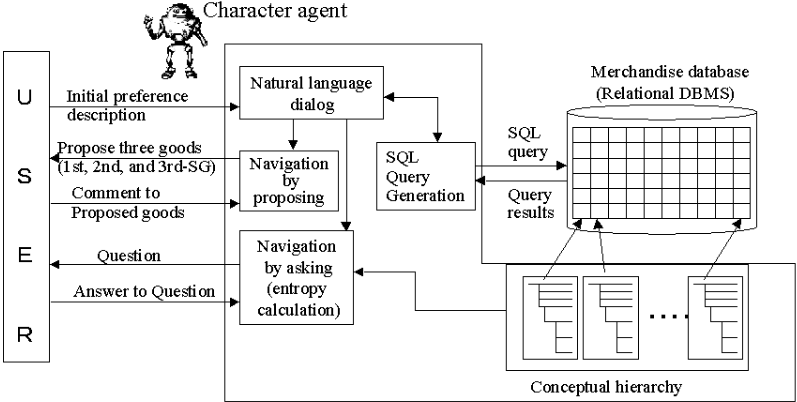
Figure 3 shows the ExpertClerk system structure. The user interaction module uses a natural language dialog system [Shimazu et al., 1992] with a character animation. It translates a user's request into a corresponding SQL query and issues the query to a backward relational DBMS. The module is integrated with the navigation by proposing module and the navigation by asking module and calls these modules when either asking questions to a user or proposing three samples to the user. The navigation by asking module refers to conceptual hierarchies each of which corresponds to each attribute of the backward relational DBMS.
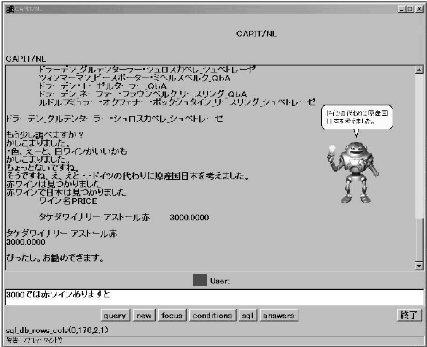
The selection strategy of the two navigation modules is defined and can be changed by a few parameters. A system administrator defines the parameters, such as "If the number of matching records becomes less than seven, change to Navigation by proposing" or "Use both narrowing modules at random". Figure 4 shows the screen image of ExpertClerk.
5 Evaluation
We evaluated the efficiency and precision of ExpertClerk. We used a small wine database of 150 wine records. This database is used to recommend wines meeting a user's specific conditions. All of the wine records have the same structure and each record has ten attribute values. For each attribute, a similarity measure and weight are defined.
Since many of the records in the database have unique solutions, we could not evaluate the retrieval precision based on the correctness of the retrieved merchandise record. Instead, we tested ExpertClerk using Aha and Breslow's leave-one-in testing methodology [Aha & Breslow, 1997] in which each merchandise record is used once as a test record, but without removing it from the merchandise record database during testing. The leave-one-in method randomly selects a test record from the database. A conversation starts by activating retrieval methods in ExpertClerk. A user interacts with ExpertClerk by entering a query or excluding one of three sample wine records proposed by ExpertClerk. The conversation ends after the interaction exceeds m times or after retrieved records are narrowed down to the test record. The efficiency is measured by the degree of narrowing down after n (n ≤ m) interactions. The precision is measured by examining whether the retrieved records match the test record.
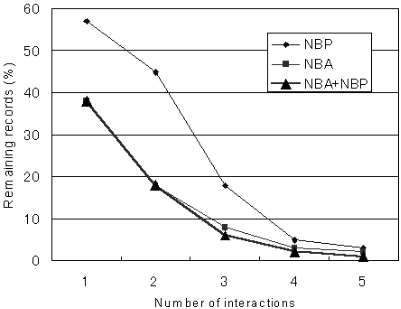
Figure 5 shows how effectively records are narrowed down per interaction by Navigation by asking (NBA), Navigation by proposing (NBP) and their combination (NBA+NBP) . The first and second interaction of NBA+NBP is NBA and the following interactions are NBP.
NBA narrows down possible records to between one third and one half at each interaction, but it can narrow down little at the third, fourth, or fifth interaction. NBP with no customer input can not narrow down records effectively. After a few interactions with a user's response, however, it can work well and the remaining records can decrease rapidly. NBA+NBP takes the best parts of NBA and NBP. At early interactions, NBA works better than NBP. At later interactions, NBP works better than NBA. In addition, because Navigation by proposing sounds more gentle than Navigation by asking as the style of conversation, the combination of NBA and NBP is the best among the three.
Figure 6 shows how precisely records are narrowed down per interaction. The figure shows the similarity between a test record and each retrieved record set (1st-SG, 2nd-SG, and 3rd-SG) per interaction. The higher border shows the best similarity values for a test record among 1st-SG, 2nd-SG, and 3rd-SG and the lower border shows the worst similarity values for a test record among them. The dashed line shows the similarity value between a test record and the center of each retrieved record set. After the first and second interactions, the precision value of three samples are refined, and at the third interaction, the three samples shown to the customer are nearly appropriate with higher than 95% accuracy.
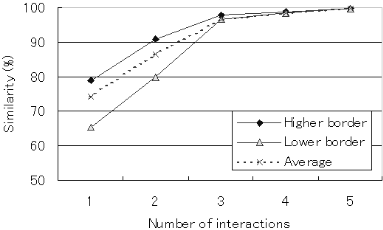
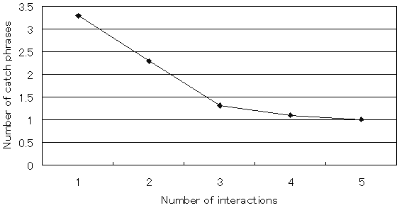
Figure 7 shows how many selling points can be presented to a customer per interaction. At early interactions, each of 1st-SG, 2nd-SG, and 3rd-SG has its own selling points. The number of selling point decreases at later interactions because the retrieved records eventually becomes homogeneous and the three samples also become similar.
6 Related research
Several research projects have focused on user-interface issues of conversational case-based reasoning (CBR). Our research was inspired by FindMe [Hammond et al., 1996; Burke et al., 1997] and its enhanced version The Wasabi Personal Shopper (WPS) [Burke et al., 1999]. FindMe combines instance-based browsing and tweaking by difference. The system shows a user an example of retrieved results. By critiquing the example, the user then indicates his/her preferences and controls the system's retrieval strategies. NaCoDAE [Aha et al., 1998] has a dialogue-inference mechanism to increase the conversational efficiency. It infers the details of a user's problem from his/her incomplete text description by using model-based reasoning. It is especially useful in front office systems like help-desk or sales-support systems. Wilke, Lenz and Wess [Wilke et al., 1998] surveyed various research projects that applied CBR into sales support solutions on the Internet. They pointed out the importance of negotiation, a process in which two parties bargain resources for an intended gain. They classify negotiation into competitive negotiation and cooperative negotiation. The former is used in various Internet auction sites. ExpertClerk can be categorized under the latter.
The incremental query modification technique of Navigation by proposing is influenced by the relevance feedback technique used in the SMART system [Salton, 1983]. Relevance feedback incrementally shifts the query vector to the center of a related document cluster. The navigation by asking module is based on ID3 [Quinlan, 1986] and was first described in our previous work, ExpertGuide [Shimazu et al., 2001]. Selling points finding can be regarded as a salient feature extraction problem and is discussed in many CBR research projects [Kolodner, 1993]. KASBAH [Chavez & Maes, 1996] is an intelligent agent with negotiation capabilities and has a similar idea to selling point. Negotiation rules are defined for each attribute of goods and activated during every negotiation step.
Several CBR projects have applied CBR techniques into commercial RDBMS [Shimazu et al., 1993; Watson & Gardingen, 1999; Burke et al., 1999]. It is important to design an architecture in a simple and scalable manner if it is to be used in large-scale Web shopping sites.
7 Conclusion
This paper analyzed conversation models of salesclerks interacting with customers. A salesclerk alternates among asking questions, proposing sample goods, and observing the customer's responses. Based on this analysis, we developed ExpertClerk, an agent system that imitates a human salesclerk and navigates Web shoppers in merchandise databases. In the system, a character agent talks with a shopper in a natural language and consolidates the shopper's request by narrowing down a list of many matching goods by asking effective questions using entropy (Navigation by asking). Then, it shows three contrasting samples with explanations of their selling points (Navigation by proposing). This cycle is repeated until the shopper finds an appropriate good.
Evaluations showed that the combination of the two navigation modes works most effectively as human salesclerks do. Finally, although the human salesclerks we surveyed insisted that it is the best approach to propose three goods at the same time, we have not examined any subjective evaluation on this. It is a future issue to justify the ExpertClerk conversation model.
@inproceedings{ijcai2001p189,
  title     = {ExpertClerk: Navigating Shoppers Buying Process with the Combination of Asking and Proposing},
  author    = {Shimazu, Hideo},
  booktitle = {Proceedings of the Seventeenth International Joint Conference on
               Artificial Intelligence, {IJCAI-01}},
  publisher = {International Joint Conferences on Artificial Intelligence},
  editor    = {Bernhard Nebel},
  pages     = {1443--1449},
  year      = {2001},
  url       = {https://ijcai.org/proceedings/2001/189},
}
TY - CPAPER TI - ExpertClerk: Navigating Shoppers Buying Process with the Combination of Asking and Proposing AU - Shimazu, Hideo T2 - Proceedings of the Seventeenth International Joint Conference on Artificial Intelligence, IJCAI-01 PB - International Joint Conferences on Artificial Intelligence PY - 2001 SP - 1443 EP - 1449 UR - https://ijcai.org/proceedings/2001/189 ER -Copied
Machine-readable versions of this paper, for tools and AI agents:





