
A Web-based Intelligent System for the Daya Bay Contingency Plan in Hong Kong
Proceedings of the Seventeenth International Joint Conference on Artificial Intelligence. Pages 1437-1441.
© 2001 International Joint Conferences on Artificial Intelligence
Abstract
Decision making is particularly important for emergency managers as they often need to make quick and high quality decisions under stress based on scratch and inadequate information; and to follow expert knowledge or past experience. The potential release of radioactive material from the Guangdong Nuclear Power Station (GNPS) at Daya Bay, though is highly unlikely, could perhaps be the most dreaded disaster which would cause drastic damages to lives and properties. The Government of the Hong Kong Special Administrative Region Government (HKSAR) has therefore in 1990 completed the Daya Bay Contingency Plan (DBCP) to prepare for such disasters. To supplement the experts in assisting disaster managers with a useful tool to make better quality decisions based on well-structured, accurate, sufficient expert knowledge, a prototype expert system has been developed to cover two major areas of the plan, namely: (A) Determination of activation level of the DBCP and provision of an action checklist and (B) recommendation on counter-measures.
- [Boutilier et al., 1997] C. Boutilier, R. Brafman, C. Geib. Processes: Towards a Synthesis of Classical and Decision Theoretic Planning. Proceedings of IJCAI' 97, pages 1156- 1162, 1997.
- [Constantin, 1995] Constantin von Altrock. Fuzzy Logic and NeuroFuzzy Applications Explained. Prentice Hall, Englewood Cliffs, New Jersey, 1995.
- [Hullermeier, 1999] E. Hullermeier. Toward a Probabilistic Formalization of Case-Based Inference. Proceedings of IJCAI' 997, 1999. IJCAI
- [Kingston et al., 1997] J. Kingston, A. Griffith and T. Lydiard. Multi-Perspective Modelling of the Air Compaign Planning process. Proceedings of IJCAI' 97, pages 668-677, 1997.
- [Liu, 2001] Liu, N.K. An intelligent business advisory system for stock investment. Encyclopedia of Microcomputers, 27: 161- 184, 2001.
- [Liu and Jane, 2000] James N.K. Liu and Jane You. An Agent- based intelligent system for E-commerce applications. Proceedings of International ICSC Symposium on Multi- Agents and Mobile Agents in virtual organizations and E- commerce (MAMA'2000), December 11-13, 2000, Wollongong, Australia.
- [Liu and Sin, 2000] Liu, J.N.K. and Sin, D.K.Y. A data mining approach for maintenance scheduling. International Journal of Engineering Intelligent Systems, 8(2): 119-126, 2000.
- [Liu et al., 1998] Liu, J., Mak, T., Tang, B, Ma, K. and Tsang, Z. An intelligent Job Counseling System. Hing-Yan Lee and Hiroshi Motoda, Eds., Springer-Verlag, Lecture Notes in Artificial Intelligence 1531: 518-529, 1998.
- [Martin, 1988] Martin James. Building Expert Systems : A Tutorial. Englewood Cliffs, N. J. :Prentice Hall, 1988.
- [Medsker, 1994] Medsker Larry. Design and Development of Expert Systems and Neural Networks. New York: Macmillan; Toronto: Maxwell Macmillan Canada; New York: Maxwell Macmillan International, 1994.
- [Nourse, 1994] Nourse Hugh O., Watson Hugh J., Bostrom Robert P., and Gatewood Robert D. Evaluation of a Generic Expert system for Corporate Real Estate Disposition. Proceedings of the Twenty-Seventh Annual Hawaii International Conference on System Sciences. Edited by Nunamaker Jay F. Jr. and Sprague Ralph H., Jr., Vol III, IEEE Computer Society Press, 1994.
- [Leary, 1990] O'Leary Timothy J., Goul Michael, Moffitt Kathleen E., Radwan A. Essam Validating Expert Systems. IEEE Expert, 8 (3): pages55-58, 1990.
- [HKSAR, 1999] The Government of Hong Kong Special Administrative Region Daya Bay Contingency Plan, 1999.
- [Turban, 1993] Turban Efraim. Decision Support and Expert Systems: Management Support Systems. New York: Macmillan; Toronto: Maxwell Macmillan Canada; New York: Maxwell Macmillan International, 1993.
- [Wallace, 1985] Wallace William A. and De Balogh Frank. Decision Support Systems for Disaster Management. Public Administration Review, (Special Issue), 45: 134-146, Jan.1985.
- [Zhu and Yang, 1999] J. Zhu and Q. Yang. Remembering to Add: Competence-preserving Case-Addition Policies for Case Base Maintenance. Proceedings of IJCAI' 99, 1999. IJCAI
References were extracted automatically from the PDF and may contain errors.
Full text extracted automatically from the PDF; figures, tables and equations may differ. The PDF is the version of record.
1. Introduction
Decision making is often a challenging job for disaster managers as they often need to make quick and high quality decisions under stress based on scratch, inadequate, unstructured information [Turban, 1993]. The seriousness of consequences in the event of an accident in GNPS resulting release of radioactive materials impose great pressure on disaster managers in the Government of HKSAR [1999]. Unlike some large countries such as Canada, Russia, France, British etc which have long history of developing nuclear industry and some have experienced different scale of accidents e.g. the well-known Chernobyl accident (1986) and the Three Mile Island accident (1978), HK has little experience and relative low public awareness in nuclear industry. Even though we have a comprehensive contingency plan with detailed rules and procedures in hardcopy format and human experts, it is difficult and timeconsuming for disaster managers to retrieve, study and organise such information and expert knowledge to cope with real emergencies under great pressure.
2. The Daya Bay Contingency Plan
The GNPS at Daya Bay is located at about 24 km from the northeast coast of HK. It began commercial operation in 1994. The pressurized water reactors used in the plant adopt a successful French reactor design and the safety review has been conducted by the International Atomic Energy Agency (IAEA) which found to be in accordance with international standards and operated to international practices. Nevertheless, as part of the emergency planning system, the Government of HKSAR has prepared a comprehensive contingency plan [HKSAR, 1999]. The main purpose of emergency planning is to ensure that proper and prompt actions are taken in an accident to protect the health and safety of the general public.
3. An Intelligent Expert System
According to Martin [1988] and Medsker [1994], Expert System (ES) "Reproduced the reasoning process a human decision maker would go through in reaching a decision, diagnosing a problem, or suggesting a course of action". The components of an ES include: (a) knowledge base which contains heuristic and judgmental programs; (b) inference engine consisting of the reasoning logic; and (c) user interface where the user supplies data and receives an answer, and often with the reasoning supporting the answer. EXSYS Professional (Version 5.1.4) by the EXSYS Inc. (note) has been selected to build the prototype because it is user-friendly shell and easy to understand and use. Domain knowledge is captured in a set of rules entered in the system's knowledge base. The system along with other information contained in the working memory to solve a problem. Active research of ES on process planning and scheduling can be found in Kingston et al. [1997], Boutilier et al. [1997] and Liu [2001].
4. Development of DBCP ADVISOR
4.1 Overall System Architecture
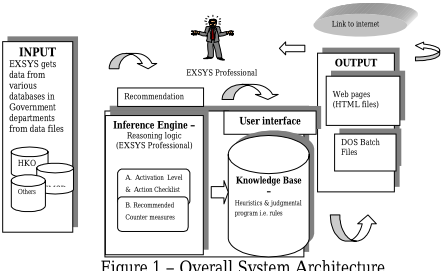
Note: EXSYS Professional is a product of the EXSYS Inc. founded in 1983 (renamed as MultiLogic afterwards) in USA .The company is one of the longest lived Expert System companies in the market.
4.2 Design Structure
The system is divided into two parts " (A) activation level and action checklist; and (B) recommended countermeasures. An overview of the design structure of the prototype is as follows:
Activation level of DBCP and provision of an action checklist
The system will guide managers through the stipulated procedures under the existing DBCP according to different sources of notification.
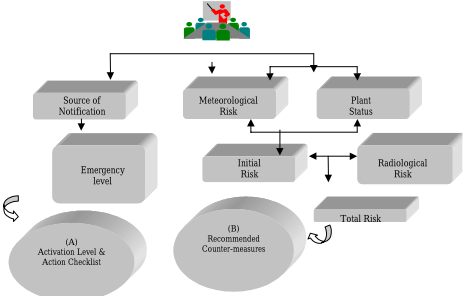
Source of Notification
There are six major sources of notification under the DBCP. They are: (1) from the Guangdong authority, (2) from the Hong Kong Nuclear Investment Company (HKNIC), (3) from the International Atomic Energy Agency (IAEA), (4) Hong Kong Observatory (HKO)'s Radiation Monitory Network (RMN), (5) Water Supplies Department's Water Contamination Monitoring System (WCMS), and (6) any other possible sources. For example, when the source of notification is from the Guangdong authority, the system will ask the disaster managers to supply information on whether it is a request for assistance and advise appropriate action. Expert rule involved will look like this:
For example :
IF the notification message from the Chinese authority received at HKO AND request for assistance is yes
THEN HKO refers message to Security Bureau (SB)
Emergency level of accident
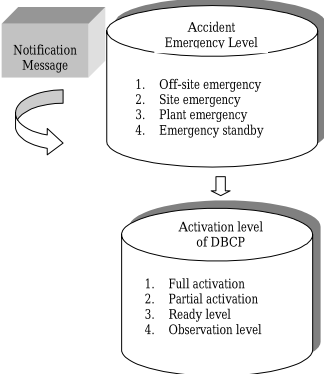
After confirming the notification message, the system will guide the disaster managers to clarify the emergency level of the accident in order to determine the activation level of the DBCP. The management of the GNPS has adopted the IAEA's four-category system for classifying nuclear power emergencies: (i) Emergency standby (ii) Plant emergency (iii) Site emergency and (iv) Off-site emergency.
Activation level of DBCP and Action Checklist
Under the DBCP, according to information on the emergency level and other relevant information, the SB will have to determine the final activation level of on recommendation by operational departments. There are 4 levels of activation, namely: (1) Observation level (2) Ready level (3) Partial activation level and (4) Full activation level, which is corresponding to the emergency level as illustrated in Figure 3.
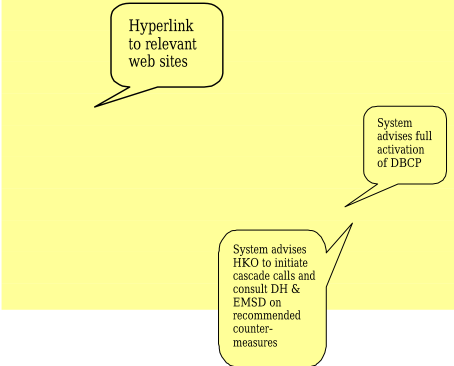
On recommendation of the activation level of the DBCP, DBCP ADVISOR will provide an action checklist as follows:
For Example:
IF the notification message from the Chinese authority received at
HKO
AND request for assistance is no
AND the notified emergency level is off-site emergency
THEN HKO alerts SB - Confidence=1
AND recommends full activation of DBCP - Confidence=1
AND HKO initiates cascade calls according to activation level decided by SB - Confidence=1
AND HKO consults DH and advises EMSD immediately with respect to Ping Chau/Mirs Bay, monitoring centres and border controls - Confidence=1
Recommendation on Counter-measures During Emergencies in GNPS
This part of the system advises disaster managers of the appropriate counter-measures. It is a very complicated process in determining what are the appropriate countermeasures to be taken during different levels of emergency in GNPS. It involves expert advice after numerous discussion on various risk factors among technical departments.
Initially, experts have to assess the (A) INITIAL RISK of Hong Kong (HK) by referencing to the (a) meteorological risk and the (b) plant status; and finally to determine the TOTAL RISK when assessment results of (B) RADIOLOGICAL RISK is available at a later stage. Depending on the degree on total risk to HK, experts will recommend corresponding counter-measures.
(A) INITIAL RISK - At the early stage of activation of the DBCP, initial risk is assessed by looking at (a) meteorological risk and (b) plant risk from different sources.
(a) Meteorological Risk Level (MRL) - Two main attributes: (i) plume track coming from a particular quadrant of GNPS and (ii) plume arrival time will be considered. Plume is the released radioactive fission products carried by wind which behave in a way similar to a cloud of smoke dispersing into the atmosphere and depositing some of its content on the ground. The concentration of radioactive materials in the plume decreases with distance from the site.
(i) Plume track coming from a particular quadrant of GNPS - It is measured in terms of degrees within 0-360 degrees (0 degree=due North). Since GNPS is located at the North-East (NE) direction from HK, wind blowing from SW (i.e. 180 to 270 degrees) will bring the plume to HK which is very unfavourable to HK. Though plumes towards NW and SE quadrants of GNPS are not directly threatening HK, there is the possibility of change in direction, so it is still unfavourable to HK. If the plume is towards NE quadrant of GNPS which will blow the radioactive materials away from HK towards the opposite direction, it will therefore be favourable to HK. HKO will get meteorological information from the Chinese authority during emergencies which will be verified against measurement by HKO.
(ii) Plume arrival time - Plume movement indicates whether sufficient tie is available for preparation and implementation of counter-measures. It is measured in terms of minutes, according to the HKO's guideline, plume arrived within 120 minutes will threaten HK because it takes at least two hours to evacuate residents/visitors from the Ping Chau region and clearance of vessels from Mirs bay; and carry out other counter-measures. HKO will get information on plume movement from the Chinese authority during emergencies. The Accident Consequence Assessment System (ACAS) which is a computerized system operated by HKO will base on meteorological data and radiological information, models the transport and dispersion rates of the released radioactive materials.
Fuzzy Logic - The process to derive the MRL involves expert advice on plume track direction and plume arrival time using linguistic terms such as very favourable, very fast, which are descriptive in nature. The resulted MRL is also description in linguistic terms: high/medium/low. EXSYS Professional can handle inexact reasoning by fuzzy logic which deals with uncertain knowledge. Fuzzy logic is primarily concerned with quantifying and reasoning about vague or fuzzy terms, called fuzzy variables, that appear in our natural language. It provides a rigorous mathematical method to handle parameters that are defined subjectively. It does this by associating membership grades to different values of such parameters and carrying out calculations on those membership grades (Altrock, 1995).
| Class | Description |
|---|---|
| (1) > 170 AND <280 | Very Unfavourable - since GNPS is located at the North-East direction from HK, plume comes from the South-West quadrant of GNPS (i.e. 180 to 270 degrees) means towards HK. |
| (2) >=80 AND <=190 OR >=260 AND <=360 | Unfavourable - though plume moving North- West and South-East quadrants of GNPS are not directly threatening HK, there is the possibility of change in direction. So, it is still unfavourable. |
| (3) > 0 AND <100 | Favourable - Plume moving North-East quadrant of GNPS will be away from HK, so it is favourable to HK. |
The fuzzy inference can identify the rules that apply to the current situation and can compute the values of the output linguistic variable. We first establish rules with linguistic terms according to expert advice, quadrant of GNPS which the plume track is coming from and plume arrival time are associated with the output variable i.e. MRL in linguistic terms (high/medium/low) as shown in the Table 1-3.
| Class | Description |
|---|---|
| (1) <70 min. | Very Fast - Plume moving quickly and will arrive HK within one hour implying very little time to arrange counter-measures. |
| (2) >= 50 AND <=130 min. | Fast - Plume moving quickly and will arrive HK within two hours implying the arrangement of counter-measures must be taken timely. |
| (3) >110 min. | Slow - Plume moving relatively slow with sufficient time to prepare for /implementing counter-measures. |
| GNPS Quadrant | Plume Arrival Time | Meteorological Risk Level (MRL) |
|---|---|---|
| Very unfavourable | Very Fast OR Fast | High |
| Very unfavourable | Slow | Medium |
| Unfavourable | Very Fast OR Fast | Medium |
| Unfavourable | Slow | Medium |
| Favourable | Very Fast | High |
| Favourable | Fast | Medium |
| Favourable | Slow | Low |
At the end of fuzzy inference, the result for MRL is given as a linguistic variable. The system will translate the resulted MRL into mathematical values i.e. defuzzification. EXSYS Professional follows the following procedures to determine the FUZZY MRL (defuzzified) :
[FUZZY MRL] = # Σ [weighting factor assigned to each possible result of MRL (i.e. high/medium/low ) * corresponding confidence level of rules]
(b) Plant Status (PS) - In order to derive the INITIAL RISK, we have also to derive the level of plant risk from the plant status at GNPS. It is measured by the level of defence-in-depth degradation which is classified into three levels with reference to the International Nuclear Event Scale. The higher the level of defence-in-depth degradation, the lower the safety level of the plant, hence the higher the risk.
| P S | Defence-in-depth Degradation |
|---|---|
| Poor | Serious Incident - near accident with no safety layers remaining. |
| Bad | Incident - incidents with significant failures in safety provisions. |
| Fair | Anomaly - anomaly beyond the authorized operation regime. |
In the system, the weighting assigned for different status of the plant to indicate its relative importance are set as below:
| PS | Relative Weighting |
|---|---|
| Poor | 5 |
| Bad | 3 |
| Fair | 1 |
Taking into account the fuzzy scores and weighting assigned by experts of (a) MRL and (b) PS, the INITIAL RISK SCORE can be derived as shown below:
| Factors | Fuzzy score (Si) | Weighting (Wi) | Initial Risk Score (0-10) (Si x Wi) |
| MRL | *0.7 | 0.3 | 2.1 |
| P S | *0.6 | 0.7 | 4.2 |
| ∑ Wi | 1 | ||
| ∑ (Si x Wi) | 6.3 |
- Fuzzy score is derived by system on MRL & Relative Weighting of Specific PS assigned by experts
- Weighting is assigned by experts for MRL & PS
- Assumed that the fuzzy MRL is 3.5 which is normalized to be 0.7 and plant status is bad (i.e. relative weighting=3) which is normalized to be 0.6.
| Class (in mSv) | Description |
|---|---|
| X< 5 | The level of X will not impose any harmful effect on public health. |
| 5 <= X <= 50 | The level of X will impose certain harmful effect on public health, sheltering is recommended. |
| X > 50 | The level of X will impose serious harmful effect on public health, evacuation is recommended. |
RADIOLOGICAL RISK - it is assessed by three main attributes: (i) environmental gamma dose-rate; (ii) radionuclide concentration activity in food; and (iii) radionuclide concentration activity in water.
Taking into account the three attributes, the (B) RADIOLOGICAL RISK can be derived as below:
| Environmental Gamma Dose- rate (X) | Radionuclide Concentration Activity in Food (Y) | Radionuclide Concentration Activity in Water (Z) | Radiological Risk |
|---|---|---|---|
| X > 50 | Yes OR No | Yes OR No | High |
| 5 =< X =< 50 | Yes | Yes OR No | High |
| 5 =< X =< 50 | No | Yes | High |
| 5 =< X =< 50 | No | No | Medium |
| 5 < X | Yes | Yes | High |
| 5 < X | Yes | No | Medium |
| 5 < X | No | Yes | Medium |
| 5 < X | No | No | Low |
In the system, the relative weighting assigned for different levels of radiological risk are set as below:
| Radiological Risk | Relative Weighting |
|---|---|
| High | 5 |
| Medium | 3 |
| Low | 1 |
Taking into account the fuzzy scores and weighting assigned by experts of (A) INITIAL RISK SCORE and the (B) RADIOLOGICAL RISK SCORE, the TOTAL RISK SCORE can be derived. An example is shown below:
| Factors | Scores (St) | Weighting (Wt) | Total Risk Score (0-100) (St x Wt) |
|---|---|---|---|
| Initial Risk Score (IRS) ∑ (Si x Wi) | *0.63 | 40 | 25.2 |
| Radiological Risk Score (RRS) | 0.6 | 60 | 36 |
| ∑ Wt | 100 | ||
| ∑ (St x Wt) | 61.2 |
4.3 User Interface
Activation Level of DBCP
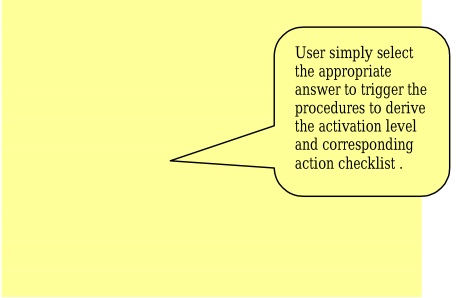
Question Screens - When user starts the EXSYS program on "Activation Level and Action Checklist", DBCP ADVISOR will pop-up a series of screens to ask for the required information in multiple choice format as follows:
Advisory Screen - At the end, DBCP ADVISOR will popup an advisory screen with recommended actions as below:
Recommended Counter-measures
Data File - When the user starts the EXSYS program on "Recommended Counter-measures", DBCP ADVISOR will get information on relevant parameters to derive the TOTAL RISK LEVEL by calling from external databases in relevant government departments through .DAT files. An example is as follows:
| GNPS Quadrant | 280 degrees |
| Plume arrival time | 200 minutes |
| Defence-in-depth Degradation | 2 - significant failure of safety provision |
| Environmental Gamma Dose- rate (X) | 2 (i.e. 5<=X<=50) |
| Radionuclide concentration activity (RCA) in food | 1 (i.e. RCA in food exceeds the intervention level = YES) |
| Radionuclide concentration activity (RAC) in water | 2 (i.e. RCA in water exceeds the intervention level = NO) |
Advisory Screen - At the end, DBCP ADVISOR will derive the TOTAL RISK SCORE (TRS). An example is as follows:
[Initial Risk level(IRS)]* .2*40 + [Radiological Risk Score (RRS)*.2*60] = 3*.2*40 + 5 *.2*60 = 84
Relevant Rule will finally be fired to advise user of the appropriate counter measures as follows:
IF [IRS]*.2*40 + [RRS] *.2*.60 >67
THEN RUN (trial6.bat /B)
AND Immediate evacuation of residents/visitors from Ping Chau and clearance of vessels from Mirs Bay area if sufficient time is available OR temporary sheltering if running out of time AND Radiological screening at the Border Controls Points for returnees from area within 20 Km of the GNPS be implemented AND Monitoring of foodstuff and livestock as well as water be initiated AND
AND All Monitoring Centres be opened for evacuees from Ping Chau and Mirs Bay, and for the returnees via Lo Wu, Man Kam To and Sha Tau Kok. Provided that these centres are unlikely affected by the plume
AND Distribution of iodinetablets when situation required
5. Knowledge Verification and System Evaluation
5.1 Knowledge Verification
Knowledge must be verified for "redundancy, inconsistency, incompleteness, circularity, and other errors" [Tepandi, 1991, quoted in H. O. Nourse et.al., 1994]. Verification has also been characterised as the process of determining "if the system was built right " [O'Keefe et. al., 1987 quoted in H. O. Nourse et.al., 1994]. While T. J. O'Leary [1990] suggested that verification is the " authentication that the formulated problem contains the actual problem in its entirety and is sufficiently well structured to permit the derivation of a sufficiently credible solution".
EXSYS has a self-contained verification function which help identify utilisation (frequency of usage) of rules, qualifiers, variables and choices, and which of them have never been used during the verification. This function are frequently performed during the development of the prototype until no error is identified and rules which have never been used are picked up for testing by case simulation. Besides, testing cases have been conducted: 6 cases for Part A and 10 cases for Part B. These are critical cases and testing results are quite satisfactory.
5.2 System Evaluation
T. L. O'Leary et. al. [1990] defined evaluation as "the process of examining an expert system's ability to solve real-world problems in a particular problem domain. Evaluation focuses on the expert system and the real world."
Validation - According to T. J. O'Leary et. al. [1990], Turing test is to test the system's ability to supply response comparable to an expert's decision [Wallace, 1985]. In Part B, data from a total of four important exercises were used for validation. The experts considered that the recommendation by DBCP ADVISOR were very close to the human experts' recommendations.
User evaluation - A user survey has also been conducted in the form of a user survey to measures (1) usefulness (2) logic (3) system design (4) user-friendliness and (4) potential further development of the system. Twelve colleagues in the Emergency Support Unit of the SB and HKO participated in the survey. Results of the survey indicated that DBCP ADVISOR is well received. The mean scores of colleagues strongly agree (36.4%) and agree (50.6%) in terms of the system's usefulness, system logic, design, user-friendliness as well as the potential for further development are very satisfactory.
6. Limitations
The main difficulty involved is that the process to arrive at final consensus on recommended counter-measures is a very complicated process involving much discussion and exchange of view and opinion among many experts in different fields. The prototype can only base on limited scope of knowledge provided by the nuclear plant experts in a short period of time and numerous determining factors that leading to the recommendations have been simplified. In real situation, sometimes experts have to make decision base on personal experience and intuitive judgement.
7. Recommendation and Further Study
Given the contributions of the prototype and positive user feedback, the usefulness of the system can be further enhanced by developing it into a full version, of course enriching the knowledge-base is required. As the system has very high compatibility with other external programs and can accept inputs from various kinds of database files, it can be further enhanced through system integration. On the output end, the system's capability to link to the Internet provides great flexibility to enrich the system with supplementary information and explanation to the users. Nevertheless the system currently lacks learning capability, further study to develop a hybrid system with the introduction of the Neuro Network technique, or to build up historical databases from previous exercises may enable learning through case-base reasoning [Zhu and Yang, 1999; Eyke Hullermeier, 1999], data mining approaches [Liu and Sin, 2000] and other intelligent business advisory systems [Liu, 2001; Liu et al, 1998; Liu and Jane, 2000]. Finally, further study on the feasibility to apply the system to other contingency plans such as the plans on natural disaster and aircraft crash etc. will also generate benefits in ensuring security in the society.
@inproceedings{ijcai2001p188,
  title     = {A Web-based Intelligent System for the Daya Bay Contingency Plan in Hong Kong},
  author    = {Liu, James N. K. and Lee, Raymond S. T. and You, Jane},
  booktitle = {Proceedings of the Seventeenth International Joint Conference on
               Artificial Intelligence, {IJCAI-01}},
  publisher = {International Joint Conferences on Artificial Intelligence},
  editor    = {Bernhard Nebel},
  pages     = {1437--1441},
  year      = {2001},
  url       = {https://ijcai.org/proceedings/2001/188},
}
TY - CPAPER TI - A Web-based Intelligent System for the Daya Bay Contingency Plan in Hong Kong AU - Liu, James N. K. AU - Lee, Raymond S. T. AU - You, Jane T2 - Proceedings of the Seventeenth International Joint Conference on Artificial Intelligence, IJCAI-01 PB - International Joint Conferences on Artificial Intelligence PY - 2001 SP - 1437 EP - 1441 UR - https://ijcai.org/proceedings/2001/188 ER -Copied
Machine-readable versions of this paper, for tools and AI agents:





