
Sequential Auctions for the Allocation of Resources with Complementarities
Proceedings of the Sixteenth International Joint Conference on Artificial Intelligence. Distributed AI. Pages 527-522.
© 1999 International Joint Conferences on Artificial Intelligence
Abstract
Market-based mechanisms such as auctions are being studied as an appropriate means for reso urce allocation in distributed and multiagen t decision problems. When agents value reso urces in combination rather than in iso la ti on, one ge nerally relies on combinatorial auctions where agents bid for resource bundles, or simultaneous auctions for all resources. We deve lop a diffe rent model , where age nts bid for required resources sequentially. This model has the advantage that it can be applied in settings where combinatorial and simultaneous models are infeasible (e.g., when resources are made available at different points in time by different parties), as well as certain benefits in settings where combinatorial models are applicable. We develop a dynamic programming model for agents to compute bidding policies based on estimated di stributions over price s. We also describe how these distributions are updated to provide a learning model for bidding behavior.
- S. Bikhchandani and J. W. Mamer. Competitive equilibria in and exchange economy with indivisibilities. J. Econ. Theory, 74:385-413, 1997.
- C. Boutilier, T. Dean, and S. Hanks. Decision theoretic plan- ning : Structural assumptions and computational leverage. J. Artif. Intel. Res., 1999. To appear.
- C. Boutilier, M. Goldszmidt, and B. Sabata. Continuous value function approximation for sequential bidding policies. manuscript, 1999.
- G. W. Brown . Iterative solution of games by fictitious play. T. C. Koopmans, ed., Activity Analysis of Production and Al- location. Wiley, New York, 1951.
- S. Clearwater, ed. Market-based Control: A Paradigm for Distributed Resource Allocation. World Scientific, San Ma- teo, 1995 .
- M. H. Degroot. Probability and Statistics. Addison-Wesley, New York, 1986.
- A. P. Dempster, N. M . Laird and D. B. Rubin Maximum likeli- hood from incomplete data via the EM algorithm. J. Roy. Stat. Soc., B-39:1-39, 1977.
- R. Engelbrecht-Wiggans and R. J. Weber. A sequential auc- tion involving assymetrically informed bidders. Inti. J. Game Th eory, 12:123-127,1983.
- Y. Fujisima, K. Leyton-Brown, and Y. Shoham. Taming the computational complexity of combinatorial auctions. /JCAI- 99, Stockholm, 1999. To appear.
- D. B. Hausch. Multi-object auctions: Sequential vs. simulta- neous sales. Mgmt. Sci., 32(12):1599-1610, 1986.
- S. Hon-Snir, D. Monderer, and A. Sela. A learning approach to auctions. J. Econ. Th eory, 82(1):65-88, 1998.
- J. Hu and M. P. Wellman. Online learning about other agents in a dynamic multiagent system. 2nd Inti. Conf Auton. Agents, Minneapolis, 1998.
- R. P. McAfee andJ. McMillan. Auctions and bidding. f Econ. Lit., 25:699-738, 1987.
- R. B. Myerson. Game Theory: Analysis of Conflict. Harvard, 1991.
- M. L. Puterman. Markov Decision Processes. Wiley, 1994.
- S. J. Rassenti, V. L. Smith, and R. L. Bulfin. A combinato- rial auction mechanism for airport time slot allocation. Bell J. Econ., 13:402-417,1982 .
- M. H. Rothkopf. Bidding in simultaneous auctions with a con- straint on exposure. Operations Research, 25:620-629, 1977.
- M. H. Rothkopf, A. Pekec, and R. M . Harstad. Computation- ally manageable combinatorial auctions. Mgmt. Sci., 1998. To appear.
- T. Sandholm. An algorithm for optimal winner determina- tion in combinatorial auctions. Proc. of /JCAI-99, Stockholm, I 999. To appear. IJCAI
- W. Vickrey. Counterspeculation, auctions, and competitive sealed tenders. J. Finance, 16(1 ):8-37, 1961.
- M.P. Wellman, W. E. Walsh, P.R. Wurman, and J. K. MacKie- Mason. Auction protocols for decentralized scheduling. (manuscript), 1998.
References were extracted automatically from the PDF and may contain errors.
Full text extracted automatically from the PDF; figures, tables and equations may differ. The PDF is the version of record.
1 Introduction
A great deal of attention has been paid to the development of appropriate models and protocols for the interaction of agents in distributed and multiagent systems (MASs). Often agents need access to specific resources to pursue their objectives, but the needs of one agent may conflict with those of another. A number of market-based approaches have been proposed as a means to deal with the resource allocation and related problems in MASs [5, 21].
Of particular interest are auction mechanisms, where each agent bids for a resource according to some protocol, and the allocation and price for the resource are determined by specific rules [13]. Auctions have a number of desirable properties as a means for coordinating activities, including minimizing the communication between agents and, in some cases, guaranteeing Pareto efficient outcomes [13, 21].
An agent often requires several resources before pursu ing a particular course of action. Obtaining one resource without another-for example, being allocated trucks with out fuel or drivers, or processing time on a machine with out skilled labor to operate it-makes that resource worth less. When resources exhibit such complementarities, it is unknown whether simple selling mechanisms can lead to effi cient outcomes [21, 1] . Moreover, groups of resources are of ten substitutable: obtaining the bundle needed to pursue one course of action can lower the value of obtaining another, or render it worthless. For instance, once trucks and drivers are
Moises Goldszmidt and Bikash Sabata
SRI International 333 Ravenswood Ave. Menlo Park, CA 94025 {moises,sabata} @erg.sri.com
obtained for transporting material in an optimal fashion , he licopters and pilots lose any value they may have had.
Two methods for dealing with complementarities have been studied: simultaneous auctions for multiple goods [ l, 17] ; and combinatorial auctions in which agents submit bids for resource bundles [16, 18, 19, 9, 21]. Specific models sometimes deal (possibly implicitly) with substitution ef fects, and sometimes not. In this paper, we explore a model that combines features of both simultaneous and combinato rial auctions. Our sequential auctions model supposes that the set of resources of interest are auctioned in sequence. Agents bid for resources in a specific, known order, and can choose how much (and whether) to bid for a resource depend ing on past successes, failures, prices, and so on.
Our model has several advantages over standard combina torial and simultaneous models. The chief benefit of such a model is that is can be applied in situations where combina torial and simultaneous models cannot. Specifically, when multiple sellers offer various resources of interest, or when the resources are sold at different points in time, one does not have the luxury of setting up either combinatorial or simulta neous auctions. As such, our model is suitable for agents who are required to interact with multiple suppliers over time. Even in settings where combinatorial models can be applied, there may be some advantages to using a sequential model. Unlike combinatorial models, our model relieves the (com putational) burden of determining a final allocation from the seller, effectively distributing computation among the buyers (as in the simultaneous case); note that determining an opti mal allocation that maximizes the seller's revenue is NP-hard [ 18]. Our sequential model also has the advantage that buy ers are not required to reveal information about their valu ations for specific resource bundles that they do not obtain. Furthermore, it has greater flexibility in that agents can enter and leave the market without forcing recomputation of entire allocations. In contrast to simultaneous models, agents in the sequential model may lessen their exposure. If an agent does not obtain a certain resource early in the sequence, it need not expose itself by bidding on complementary resources occur ring later in the sequence. Agents are typically bidding in a state of greater knowledge in the sequential model, at least in later stages; however, in earlier stages agents may have lesser information than they would in a simultaneous model.
One difficulty that arises in the sequential model is how an agent computes bids for individual resources (the same dif ficulty arises in simultaneous models). An agent has a val uation for a particular resource bundle b = { r 1 , · · · , rk}, but has no independent assignment of value to the individ ual resources. 1 While auction theory can tell us how an agent should bid as a function of its valuation of resource r; for spe cific auction mechanisms, in our setting no such valuation exists. If b is worth v (b), how is an agent to "distribute the value" among the resources r; in order to compute bids?
In this paper, we develop a dynamic programming algo rithm for doing just this. We assume that each agent has a probabilistic estimate of the size of the maximum bids for each resource (excluding its own). It can then compute a bidding policy that maximizes its expected utility, and apply this policy as dictated by its initial endowment. Bids for re sources early in the sequence are computed as a function of the odds of being able to obtain their complements and sub stitutes, while bids for later resources are conditioned on the resources obtained early in the sequence.
We also interested in adaptive bidding behavior, and to this end investigate a repeated sequential auction model in which agents repeatedly bid for the same resources over time. We consider the problem of estimating the probability distribu tions over maximal bids in this repeated scenario. If agents persistently find themselves requiring resources to pursue their aims, we want them to learn which resources they will be able to obtain and which they will not. This is related tore cently proposed learning models for auctions [11, 12], though our focus is on learning prices and its effect on the valuation of individual resources in bundles.
The problem we study is part of a more general research program designed to study the impact of specific resource allocation schemes on the solution of sequential multiagent decision problems. We motivate the problem studied here as follows. We suppose that a number of agents have cer tain tasks and objectives to pursue, and for any objective there may exist a number of potential courses of action that are more or less suitable. For instance, an agent may con struct a policy for a Markov decision process [15, 2], from which it can determine the value of various courses of action, their likelihood of success, and so on. Any specific course of action will require certain resources, say, bundle bk, whose value can be determined as a function of the expected value of that course of action (and the expected value of alternative courses of action). As such, we suppose each bundle bk has an associated value v( bk) and that the agent will use only one bundle (the one associated with the highest-valued course of action among those bundles it possesses). It is from these val uations that the agent must determine its bidding policy for individual resources. This is the problem considered here.
Ultimately, the decision problem we hope to study is far more complex. Determining appropriate courses of action will depend on perceived probability of obtaining requisite resources, uncertainty in that course of action, alternatives available and so on. We envision very sophisticated reason ing emerging regarding the interaction bidding behavior and
1 In fact, we will assume that several bundles can be valued, with possible overlap. This accounts for possible substitution effects.
"base-level" action choice (in the MDP), such as taking a few critical steps along a specific course of action before decid ing to enter the market for the corresponding resources (e.g., perhaps because this policy is fraught with uncertainty). We also foresee interesting interactions with other coordination and communication protocols.
In Section 2 we describe the basic sequential bidding model. We note a number of dimensions along which our basic model can vary, though we will focus only on specific instantiations of the model for expository reasons. We de scribe our dynamic programming model for constructing bid ding policies in Section 3. We also describe the motivation for using the specific model proposed here instead of using explicit equilibrium computation. We discuss repeated se quential auctions in Section 4, focusing on the problem of highest-bid estimation. In Section 5 we describe some pre liminary experimental results, and conclude in Section 6 with discussion of future research directions.
While bidding strategies for sequential auctions would seem to be an issue worthy of study, there appears to have been little research focussed on this issue. What work exists (see, e.g., [8, 10]) tends to focus the seller's point of view for example, will simultaneous or sequential sales maximize revenue-and does not address the types of complementari ties we consider here. Generally, existing work assumes that single items are of interest to the buyer.
2 Basic Model
We assume we have a finite collection of agents, all of whom require resources from a pool of n resources R = {r1, · · ·, rn}· We denote by Rt the subset {r1, · · ·, rt}, t:::; n, with R 0 = 0 by convention. We describe the quanti ties relevant to a specific agent a below, assuming that these quantities are defined for each agent. Agent a can use ex actly one bundle bi = { ri, · · ·, r(b'l} of resources from a set of k possible bundles: B = { b 1 , · · · , bk}. We denote by U (a) = UB the set of useful resources for our agent.
Agent a has a positive valuation vW) for each resource bundle b; E B. Suppose the holdings of a, H (a) ~ U (a), are those resources it is able to obtain. The value of these holdings is given by v(H(a)) =max{ vW) : b; ~ H(a)}; that is, the agent will be able to use the resource bundle with maximal value from among those it holds in entirety, with the others going unused. This is consistent with our interpreta tion given in Section 1 where resource bundles correspond to alternative plans for achieving some objective (though other value combinators can be accommodated).
The resources will be auctioned sequentially in a com monly known order: without loss of generality, we assume that this ordering is r 1 , r 2 , · · · , rn We use A; to denote the auction for r;. We refer to the sequence of auctions A1 , A2 , · · ·, An as a round of auctions. There may be a single round, some (definite or indefinite) finite numbers of rounds, or an infinite number of rounds.
Supposing for the moment only one round, we assume that agent a is given an initial endowment e which it can use to ob tain resources. At the end of the round, a has holdings H (a)
and d dollars remaining from its endowment. 2 We assume that the utility of being in such a state at the end of the round is given by v(H(a)) + f(d), where f is some function at taching utility to the unused portion of the endowment. Other utility functions could be considered within this framework.
There are a wide range of options one could consider when instantiating this framework. We define a specific model here, but list the options that could be explored. We develop the algorithms in this paper for the specific model, but where appropriate, indicate how they should be modified for other design choices. The main design choices are:
- What auction mechanism is used for the auctions A;?
- What rules are instituted for reselling or speculation?
- What information is revealed to the agents? When?
- What information do agents have when a round begins?
We assume that the individual auctions will be first-price, sealed-bid-each agent will provide a single bid and the highest bidder will be awarded the resource for the price bid. We adopt this model because of the ease with which it fits with our approach to bid computation; however, we believe our model could be adapted for other auction protocols. We also assume that bids are discrete (integer-valued); but we do describe the appropriate amendments to de::tl with continuous bids. Agents, once obtaining a resource, cannot resell that re source to another agent. This, of course, means that an agent may obtain one resource r;, but later be unable to obtain a complementary resource r;+k, essentially being "stuck" with a useless resource r;. We do this primarily for simplicity, though in certain settings this assumption may be realistic. We are currently exploring more sophisticated models where agents can "put back" resources for re-auctioning, or possi bly resell resources directly to other agents.
Each agent is told the winning price at the end of the each auction (and whether it was the winner). We could suppose that no information (other than winning or losing) is pro vided, that the distribution over bids is announced, or that the bids of specific individuals are made public; our assumption seems compatible with the first-price, sealed-bid model.
Finally, agent a believes that the highest bid that will be made for resource r;, excluding any bid a might make, is -=-i drawn from some unknown distribution Pr . Because bids are integer-valued, this unknown distribution is a multino mial over a non-negative, bounded range of integers. 3 To represent a's uncertainty over the parameters of this distri~ bution, we assume a has a prior probability distribution Pr' over the space of bid distributions. Agent . a models Pr; as a Dirichlet distribution with parameters fJb, · · ·, fJ:n; [6], where m; is the (estimated) maximum possible bid forr;. We elaborate on this probability model in Sections 3 and 4.
We make two remarks on this model. First, if the space of possible bids is continuous, a suitable continuous PDF (e.g., Gaussian) could be used to model bid distributions and the uncertainty about the parameters of this PDF. More ques tionable is the implicit assumption that bids for different re sources are uncorrelated. By having distributions Pr; rather than a joint distribution over all bids, agent a is reasoning as if the bids for different resources are independent. When re sources exhibit complementarities, this is unlikely to be the case. For instance, if someone bids up the price of some re source r; (e.g., trucks), they may subsequently bid up the price of complementary resource rj (e.g., fuel or drivers) . If agent a does not admit a model that can capture such correla tions, it may make poor bids for certain resources. Again, we make this assumption primarily for ease of exposition. Ad mitting correlations does not fundamentally change the na ture of the algorithms to follow, though it does raise interest ing modeling and computational issues (see Section 4).
2 If speculation or reselling is allowed, there is the possibility that d > e, depending on the interaction protocols we allow. We will mention this possibility below, but we will examine only protocols that disallow it.
3 We assume that a bound can be placed on the highest bid.
3 Computing Bids by Dynamic Programming
In this section we focus on the decisions facing an agent in a single round of auctions. A key decision facing an agent at the start of a round is how much to bid for each resource that makes up part of a useful bundle b;. In standard single item auctions (e.g., first/second-price, sealed bid) rational agents with an assessment of the valuations of other agents can com pute bids with maximum expected utility [13]. For example, in first-price, sealed bid auctions, an agent should bid a some amount below its true valuation, where this amount is given by its beliefs about the valuations of others.
Unfortunately, the same reasoning cannot be applied to our sequential setting, since individual resources cannot be as sessed a well-defined valuation. For instance, if bundle b' = {rf, r;} has valuation vW), how should agent a apportion this value over the two resources? Intuitively, if there is a greater demand for ri, a larger "portion" of the value should be allotted for bidding in the first auction rather than the sec ond. If the agent fails to obtain ri, the value of 7'~ goes to zero (ignoring other bundles). In contrast, should a obtain rt, it is likely that the agent should offer a substantial bid for r2, ap proaching the valuation vW), since the price paid for ri is essentially a "sunk cost." Of course, if the agent expects this high price to be required, it should probably not have bid for ri in the first place. Finally, the interaction with other bun dles requires the agent to reason about the relative likelihood of obtaining any specific bundle for an acceptable price, and to focus attention on the most promising bundles.
3.1 The Dynamic Programming Model
These considerations suggest that the process by which an agent computes bids should not be one of assigning value to individual resources, but rather one of constructing a bid ding policy by which its bid for any resource is conditioned on the outcome of events earlier in the round. The sequen tial nature of the bidding process means that it can be viewed as a standard sequential decision problem under uncertainty. Specifically, the problem faced by agent a can be modeled as a fully observable Markov decision process (MDP) [15, 2]. The computation of an optimal bidding policy can be imple mented using a standard stochastic dynamic programming algorithm such as value iteration.
We emphasize that agents are computing optimal bids, not true valuations for individual resources. Thus issues involv ing revelation of truthful values for resources are not directly relevant (but see Section 4 on multiple rounds) .
We assume the decision problem is broken into n + 1 stages, n stages at which bidding decisions must be made, and a terminal stage at the end of the round. We use a time index 0 ::; t ::; n to refer to stages-time t refers to the point at which auction At+l for 1't+l is about to begin. The state of the decision problem for a specific agent a at timet is given by two variables: Ht (a) ~ Rt, the subset of resources Rt held by agent a; and dt, the dollar amount (unspent en dowment) available for future bidding. We write (h, d)t to denote the state of a's decision problem at timet. Note that although we could distinguish the state further according to which agents obtained which resources, these distinctions are not relevant to the decision facing a. 4
The dynamics of the decision process can be characterized by a's estimated transition distributions. Specifically, assum ing that prices are drawn independently from the stationary distributions p;:i, agent a can predict the effect of any action (bid) z available to it. If agent a is in state (h, d)t at stage t, it can bid for rt+l with any amount 0 ::; z ::; dt (for conve nience we use a bid of 0 to denote non participation). Letting w denote the highest bid of other agents, if a bids z at timet, it will transition to state (h U { 1't+l} , d- z)t+l with probability p/+ 1 (w < z) and to (h, d)t+ 1 with p/+ 1 (w 2: z). 5
This does not form an MOP per se, since a may be uncertain about the true distribution p/+ 1 , having only a Dirichlet distribution (,Bi+ 1 , · · ·, ,13;,_,~~~) over the possible parameters of p/+ 1 . However, the expectation that the highest bid is w is given by the relative weight of parameter ,B~+l; thus,
While the observation of the true winning bid can cause this estimated probability to change (properly making this a partially observable MOP), the change cannot impact fu ture transition probability estimates or decisions: we have as sumed that the high bid probabilities are independent. Thus, treating this as a fully observable MOP with transition prob abilities given by expected transition probabilities is sound.
The final piece of the MOP is a reward function q. We simply associate a reward of zero with all states at stages 0 through n - 1, and assign reward v (h) + f (d) to ev ery terminal state (h, d)n. A bidding policy rr is a map ping from states into actions: for each legal state (h, d)t , rr((h, d)t) = z means that a will bid z for resource rt+l· The value V" ( (h, d)f) of policy rr at any state (h, d)t is the expected reward E" ( q( (H (a), d)n) I (h, d)t) obtained by ex ecuting rr. The expected value of rr given the agent's initial state (0, e)t is simply V" ( (0, e)t ). An optimal bidding policy is any rr that has maximal expected reward at every state.
4 This is true underthe current assumptions, but may not be under different models; see below.
5 For expository purposes, the mode l assumes ties are won. Sev eral rules can be used for ties; none complicate the analysis.
We compute the optimal policy using value iteration [15] , defining the value of states at stage t using the value of states at stage t + 1. Specifically, we set
and define, for each t < n:
Given that V is defined for all stage t + 1 states, Q ( ( h, d)t, z) denotes the value of bidding z at state (h, d)t and acting op timally thereafter. V((h , d)t) denotes the optimal value at state (h, d)t, while rr( (h, d)t) is the optimal bid.
Implementing value iteration requires that we enumerate, for each t, all possible stage t states and compute the con sequences of every feasible action at that state. This can re quire substantial computational effort. While linear in the state and action spaces (and in the number of stages n), the state and action spaces themselves are potentially quite large. The number of possible states at stage t could potentially con sist of any subset of resources Rt together with any monetary component. The action set at a state with monetary compo nent d has size d+1. Fortunately, we can manage some of this complexity using the following observations: first, a never needs to bid for any resource outside the useful set U(a), so its state space (at stage t) is restricted to subsets of ut (a); and second, if a resource rt requires a complementary resource rt', t' < t, (that is, all bundles containing rt also contain rt' ), then we need never consider a state where a has rt but not rt'· 6 Reducing the impact of the number of possible bids is more difficult. We can certainly restrict the state and action space to dollar values no greater than a's initial endowment e. If the PDF is well-behaved (e.g., concave), pruning is pos sible: e.g., once the expected value of a larger bids starts to decrease, search for a maximizing bid can be halted. 7
This dynamic programming model deals with the com plementarities and substitutability inherent in our resource model; no special devices are required. Furthermore, it auto matically deals with issues such as uncertainty, dynamic val uation, "sunk costs," and so on. Given stationary, uncorre lated bid distributions, the computed policy is optimal.
3.2 Extensions of the Model
While the assumptions underlying our (single-round) model are often reasonable, there are two assumptions that must be relaxed in certain settings: the requirement for discrete bids and the prohibition of reselling or returning resources for re sale. We are currently exploring these relaxations.
6 Th is reasoning extends to arbitrary subset complementarities.
7 If we move to a continuous action space, the value function rep resentation and maximization problems may become easier to man age for certain well-behaved classes of probability distributions and utility functions (see Section 3.2 and [3]).
Continuous bidding models are important for computa tional reasons. Though money is not truly continuous, the in crements that need to be considered generally render explicit value calculations for all discrete bids infeasible. Continu ous function maximization and manipulation techniques are often considerably more efficient that discrete enumeration, and approximately optimal "integer" bids can usually be ex tracted. We are currently exploring specific continuous mod els, specifically using parameterized bid distributions (such as Gaussian and uniform distributions) and linear utility func tions (as described above). The key difficulty in extending value iteration is determining an appropriate value function representation. While the maximization problem (over bids) for a speci fic state is not difficult, we must represent yt as a function of the continuous state space. This function is linear (in d) at all states where the remaining endowment d is greater than the maximal worthwhile bid. But a different function representation is needed for states with endowment less than the best bid. We are currently exploring a value function representation with piecewise, continuous represen tations of V for each (discrete) set of holdings H (a) [3].
Reselling may be appropriate in many settings and canal low agents to bid more aggressively with less risk. We are currently developing a simple model in which agents are al lowed, at the end of a round, to "put back" resources for re auction that are not needed (e.g., are not part of the agent's max-valued complete bundle). 8 Several difficulties arise in this setting, including the fact that agents may need to esti mate the probability that an unobtained resource may be re turned for re-auction.
3.3 Equilibrium Computation
The model described above does not allow for strategic rea soning on the part of the bidding agent. The agent takes the expected prices as given and does not attempt to compute the impact of its bids on the behavior of other agents, how they might estimate its behavior and respond, and so on; that is, no form of equilibrium is computed. Standard models in auc tion theory generally prescribe bidding strategies that are in Bayes-Nash equilibrium: when each agent has beliefs about the types of other agents (i.e., how each agent values the good for sale), and these beliefs are common knowledge, then the agents' bidding policies can be prescribed so that no agent has incentive to change its policy. 9 This, for instance, is the basis for prescribing the well-known strategies for bidding in first- and second-price auctions [20].
Our approach is much more "myopic." There are several reasons for adopting such a model rather that a full Bayes Nash equilibrium model. First, equilibrium computation is often infeasible, especially in a nontrivial sequential, multi resource setting like ours. Second, the information required on the part of each agent, namely a distribution over the possible types of other agents, is incredibly complex-an agent type in this setting is its set of valuations for all resource bun dles, making the space of types unmanagable. Finally, the common knowledge assumptions usually required for equi librium analysis are unlikely to hold in this setting.
8 More complicated models that allow agents to put back re sources during the round or resell directly are also possible.
9 We use type here in the sense used in game theory for games with incomplete information [ 14].
We expect that the MDP model described here could be ex tended to allow for equilibrium computation. Rather than do this, we consider an alternative, adaptive model for bidding in which agents will adjust their estimates of prices-hence their bidding policies-over time. Implicitly, agents learn how others value different resources, and hopefully some type of "equilibrium" will emerge. We turn our attention to this process of adaptation.
4 Repeated Auctions and Value Estimation
In certain domains, agents will repeatedly need resources drawn from some pool to pursue ongoing objectives. We model this by assuming that the same resource collection is auctioned repeatedly in rounds. While agents could compute a single bidding policy and use it at every round, we would like agents to use the behavior they've observed at earlier rounds to update their policies. Specifically, observed win ning prices for resource auctions A; in the past can be used by an agent to update its estimate of the true distribution Pri of high bids for r;. Its bidding strategy at the next round can be based on the updated distributions.
If each agent updates its bidding policy based on past price observations, the prices observed at earlier rounds may not be reflective of the prices that will obtain at the next round. This means that the agents are learning based on observa tions drawn from a nonstationary distribution. This setting is common in game theory, where agents react to each oth ers past behavior. Myopic learning models such asfictitious play [4] (designed to learn strategy profiles) can be shown to converge to a stationary distribution despite the initial non stationarity. This type of learning model has been applied to repeated (single-item) auctions and shown to converge [ ll]. Our model is based on similar intuitions-namely, that learn ing about prices will eventually converge to a steady state. Hu and Wellman [12] also develop a related model for price learning in a somewhat different context.
The advantage of a learning model is that agents can come to learn which resources they can realistically obtain and fo cus their bidding on those. If agents A and B have similar endowments and both equally value having either r 1 or 1·2, they may learn over time not to compete for 1·1 and r 2 ; instead they may learn to anticipate (implicitly, through pricing) each other's strategy and (implicitly) coordinate their activities, with one pursuing r 1 and the other r 2 . If one agent has a greater endowment than another (e.g., it may have higher pri ority objectives in a distributed planning environment), the poorer agent should learn that it can't compete and focus on less contentious (and perhaps less valued) resources. An other important feature of learning models is that they can be used to overcome biased or weak prior assessments.
Given the form of the probabilistic model described in Sec tion 3, an agent can update its estimate of a bid distribution rather easily. Suppose agent a has parameters (,Bi, · · ·, ,e:n,)
th~t characterize its distribution Pr 1 over the true distribution Pr of high bids for resource 1' t· After auction At the win ning bid w is announced to each agent.l 0 If a fails to win the resource, it should update these Dirichlet parameters by setting {3~ to {3~ + 1; at the next round, its estimate that the highest bid will be w is thus increased. If a wins resource r1 for price z , the only information it gets about the highest bid (excluding its own) is that it is less than z. The Dirich let parameters can then be updated with an algorithm such as EM [7]. Roughly, the expectation step computes an update of the parameters of the Dirichlet using current estimates to distribute the observation over the parameters {3f , · · · , {3; _ 1 : each f3j (j < z) is increased by f3j/ 2:::::-~ {3f. The maxi mization step corresponds to the actual update followed by the substitution of these parameters in Pr. Whereas the EM algorithm requires an iteration of these two steps until con vergence, we performed this iteration about 10 times. 11
In the specific probability model developed here, agents cannot profitably use this updated estimate during the cur rent round. Because prices are assumed independent, learn ing about one price cannot influence an agent's bidding strat egy for other resources. 12 Thus the agent continues to im plement the bidding policy computed at the start of the round. The updated bid distributions are used prior to the start of the next round of auctions to compute an new bidding policy.
As mentioned above, the price-independence assumption may be unrealistic. If prices are correlated, the observed price of a resource can impact the estimated price of another resource that will be available later in the round. Agents in this case should revise their bidding policies to reflect this information. Two approaches can be used to deal with cor relations. First, agents can simply recompute their bidding policies during a round based on earlier outcomes. An alter native is to model this directly within the MDP itself: this en tails making the MDP partially observable, which can cause computational difficulties.
One thing we do not consider is agents acting strategi cally within a round to influence prices at subsequent rounds. Agents are reasoning "myopically" within a specific round. By formulating multi-round behavior as a sequential prob lem, we could have agents attempting to manipulate prices for future gain. Our current model does not allow this.
5 Results
We now describe the results of applying this model to some simple resource allocation problems. These illustrate inter esting qualitative behavior such as adaptation and coordina tion. We also explain why such behavior arises. In all runs, multiple rounds are considered and remaining endowment d is valued at 0.5d (a = 0.5). Agent priors have slightly in creasing weights on higher bids. 13
10 0ur model can accommodate both more (e.g., the bids of all agents) and less (e.g., only whether an agent won or lost) revealed information about the auction outcome rather easily.
11 Preliminary experiments showed this sufficient.
12 With correlated prices, an agent could attempt to provide mis leading information about its valuation of one resource in order to secure a later resource at a cheaper price. This type of deception, studied for identical item auctions in [10], cannot arise within a sin gle round in our current model, even if strategic reasoning is used.
The first series of examples illustrates bidding behavior in allocation problems with specific parameter settings.
Example There are two agents whose optimal bundles are disjoint: a1 requires b~ = { r 1 , r3 } (value 20) or b~ = {r4 , rs , r6} (value 30), while a2 requires br = {r2 , r3} (value 20) orb~ = {r7, r8, r 9} (value 30). Initially, both agents focus on the smaller (and lower-valued) bundles. At the first round, a1 obtains bi, while a2 gets "stuck" with r 2 (a1 outbid it for r3). The next round sees a2 bid less for r 2 , and more for r3 (outbidding a1). Since it obtains br, it does not attempt to bid forb~. But without bLand its estimated prices for resources in b~ lowered, a 1 now bids for and gets b~ (its optimal bundle). Up to the 14th round, one of the agents gets its best bundle and the other its worst. At the 14th round, each gets its best bundle, and after the 16th round, the socially optimal allocation (the one with maximal total bundle value) is reached each time: the agents (more or less) "realize" that they need not com pete. The agents do "hedge their bets" and still keep bid ding for resources r 1, r 2 and r 3. They also offer fairly high bids for the nonconflicting resources, though these bids are reduced over time.
This first example shows that optimal allocations will emerge when agents are not in direct competition. It also il lustrates general behavioral phenomenon that occur in almost all examples. (1) Agents tend to bid more aggressively (ini tially) for resources in bundles with smaller size, since the odds of getting all resources in a larger bundle are lower. (2) Agents tend to bid more aggressively for resources that occur later in the sequence. Once an agent obtains all resources in a bundle but one, the last resource is very valuable (for ex ample, in round 16 above, a 1 obtains b~ by paying 1 for r 4 and r 5 , and 27 for r 6 . (3) Agents tend to initially offer high bids for certain resources, and gradually lower their bids over time (realizing slowly that there is no competition). For ex ample, a1 reduces its bid for r 6 to 26 only at round 36. This is a consequence of the simple priors and belief update rules we use, and the lack of information it obtains when it wins the resource consistently: it is not told what the next highest bid is (it is zero), and can only conclude that it was less than 27, making belief update slow. The equivalent sample size of our priors also makes adjustment somewhat slow. Domain specific (more accurate) priors, and the use of exponential decay (or finite histories) in price-estimation would alleviate much of this slowness of response.
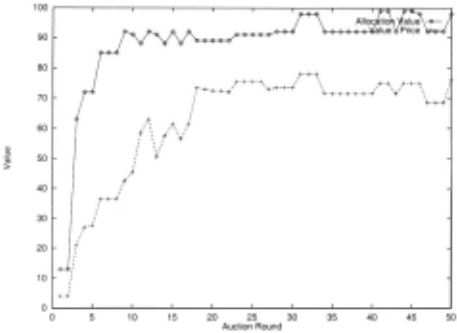
Example There are 25 resources and five agents with four bundles each (with an average of four resources per bun dle). There exists an allocation of five disjoint bundles, one to each agent. For each agent three of the resources occur only in its bundles, so the agents are competing for only 10 of the 25 resources. The socially optimal alloca tion has value 100. Over fifty rounds, the agents gener ally find very good (but not optimal) allocations. Figure 1 shows the value of the allocations obtained at each round, as well as the collective "surplus" (total value minus a adjusted prices paid). The agents quickly find good alloca tions (by the ninth round, no allocation has value less than 88), and also learn to pay less for the resources.
13 More realistic priors could reflect perceived demand.
Example An interesting phenomenon emerges in a two agent example of [21] that has no price equilibrium: as sume resources r 1, r 2 , with a 1 valuing bundle {r1 , r 2} at 6, and a2 valuing either of r 1 , r 2 at 4. The agents have equal endowments. Though there is no price equilibrium, in our adaptive protocol a2 wins one of its bundles much more frequently than a 1 · It bids for r 1 , and if it wins it need not bid for 1·2 ; if it loses it can outbid a1 for r 2 (since a1 has paid for r 1 ). a2 experiments with r 1 and wins it occasion ally. a 2 gradually lowers its bid for r 2 and, since it does not model correlations in prices, occasionally loses r 2, al lowing a 1 to get both r 1 and r 2. When this occurs, a2 will quickly raise its bids and win one of the resources again. By modeling price correlations, or estimating the require ments of a 1 , agent a2 could guarantee that it obtains one of its resources (see Section 6).
Example We have 3 resources and 2 agents, each valuing { r 1 , r 2 } at 10 and r3 at 5, but differing in initial endow ment: a 1 begins with 6, a 2 with 8. Initially, a 1 gets the first (higher-valued) bundle (at prices 2 and 5) and a2 the sec ond (at price 3). By the fourth round, a2 realizes that it can win r 1 with bids of 3 and 5. It spends 8 on { 1·1 , r 2}, leav ing a 1 to bid 4 for r 3 . These prices persist, with a2 not bid ding on 1·3 and a 2 eventually not bidding on r 1 or rz. This illustrates that agents with larger endowments (or less rel ative value for money compared to bundles) have greater odds of obtaining their most important bundles, leaving "poorer" agents to get what is left. 14
14 Th is last property is useful for teams if agents with higher pri ority objectives are given larger endowments.
We also studied the bidding behavior on randomly gener ated allocation problems. Here we describe two sets of ex periments. In problem set PsI , five allocation problems were randomly generated with the following characteristics: four agents are competing for 12 resources with an initial endow ment of 30 each; each agent has a random number of needed bundles (normally distributed with mean 4 and s.d. 1); each bundle contains a random number of resources (normally dis tributed with mean 3 and s.d. I, where the resources are them selves drawn uniformly from the set of 12); and the value of each bundle is random (normally distributed with mean 16 and s.d. 3). Problem set Ps2 is identical except there are five agents and the mean number of resources per bundles is 4: hence problems in Ps2 are more constrained, with more com petition among the agents.
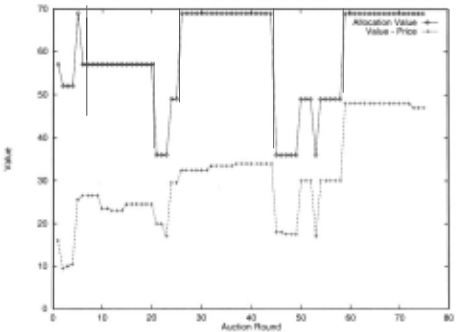
Typical behavior for one trial from Ps2 (the more con strained problem set) is shown in Figure 2, which plots the the value of the allocations obtained at each round, as well as the collective surplus. The agents find good allocations in this problem, reaching the (socially) optimal allocation (with value 69) at many of the rounds. On average, over the 75 rounds, the allocation obtained has value 59 (85% of opti mal). Note that once the agents "find" a good allocation, they may not stick with it-generally such allocations are not in equilibrium in the sequential game induced by a round of auc tions. At the very least, agents have a tendency to attempt to lowet the prices they bid after consistently winning a good, due to the lack of information about what other agents bid and how they update their beliefs (as mentioned above). This it self can cause some instability. The greater cause of instabil ity however is the fact that a socially optimal allocation does not generally make self-interested agents happy.
Other trials illustrate similar qualitative behavior. When comparing Ps 1 (the less constrained problem set) to Ps2 (the more constrained), we find that the allocations in Ps 1 have value that is, on average, within 87% of the optimal, while with Ps2, allocations are within 80% of optimal. This suggests that for less constrained problems, sequential auctions among self-interested agents can lead to allocations with higher social welfare value. Given that agents "dis cover" many different allocations, one might view sequen tial auctions as a heuristic search mechanism for combinato rial auctions. 15 However, we emphasize that the main goal of our model is to compute bidding policies when combina torial and simultaneous auctions are not possible.
6 Concluding Remarks
We have described a model for sequential auctioning of re sources that exhibit complementarities for different agents and described a dynamic programmjng algorithm for the computation of optimal bidding policies. We have also illus trated how price learning can be used to allow agents to adapt there bidding policies to those of other agents. The sequen tial model can be applied in settings where combinatorial and simultaneous models are infeasi ble (e.g., when agents enter or leave markets over time, or when agents require resources from multiple sellers). Preliminary results are encouraging and suggest that desirable behavior often emerges.
We have suggested several possible extensions of the model , some of which we are currently exploring. These in clude developing continuous bidding models, models with reselling/return, incorporating correlated bid distributions and exploring the interactions between decision theoretic planning and bidding for the resources needed to implement plans and policies.
There are several more immediate directions we hope to pursue. One is the investigation of models where prices are estimated with greater weight placed on more recent prices. Along with correlated price distributions, the use of limited "opponent" models may be helpful: by identifying which agents tend to need which resources, a bidder can make more informed decisions. Additional revealed information about specific auctions (such as who bid what amount) could also lead to more informed decisions. This information may be appropriate in team situations, where distributed decision makers are not directly in competition.
Apart from such myopic mechanisms, we would also like to develop a Bayes-Nash equilibrium formulation of these quential model , and study the extent to which myopic mod els like our simple learning scheme approximate it. The con ditions under which our model converges to interesting allo cations (socially optimal allocations, equilibria, etc.) is also worthy of exploration. Other avenues to be considered are the development of different auction ordering heuristics to maximize social welfare, seller's revenue or other objective criteria; and the development of generalization methods to speed up dynamic programming. We are also integrating the sequential auction model for resource allocation into the gen eral planning context described in Section l.
Acknowledgments Craig Boutilier and Moises Goldszmidt ac knowledge partial support from the DARPA Co-ABS program (through Stanford University contract F30602-98-C-0214). Bikash Sabata was funded by DARPA through the SPAWARSYSCEN un der Contract Number N6600 1-97 -C-8525. Craig Boutilier was partially supported by NSERC Research Grant OGP0121843. Thanks to Bill Walsh, Piero La Mura, Tuomas Sandholm, Yoav Shoham and Mike Wellman for their helpful comments, suggestions and pointers to relevant literature.
15 This is reminiscent of the mechanism suggested in [9].
@inproceedings{ijcai1999p76,
  title     = {Sequential Auctions for the Allocation of Resources with Complementarities},
  author    = {Boutilier, Craig and Goldszmidt, Moisés and Sabata, Bikash},
  booktitle = {Proceedings of the Sixteenth International Joint Conference on
               Artificial Intelligence, {IJCAI-99}},
  publisher = {International Joint Conferences on Artificial Intelligence},
  editor    = {Thomas Dean},
  pages     = {527--522},
  year      = {1999},
  note      = {Distributed AI},
  url       = {https://ijcai.org/proceedings/1999/76},
}
TY - CPAPER TI - Sequential Auctions for the Allocation of Resources with Complementarities AU - Boutilier, Craig AU - Goldszmidt, Moisés AU - Sabata, Bikash T2 - Proceedings of the Sixteenth International Joint Conference on Artificial Intelligence, IJCAI-99 PB - International Joint Conferences on Artificial Intelligence PY - 1999 SP - 527 EP - 522 UR - https://ijcai.org/proceedings/1999/76 ER -Copied
Machine-readable versions of this paper, for tools and AI agents:





