
Be Patient and Tolerate Imprecision: How Autonomous Agents can Coordinate Effectively
Proceedings of the Sixteenth International Joint Conference on Artificial Intelligence. Distributed AI. Pages 512-518.
© 1999 International Joint Conferences on Artificial Intelligence
Abstract
A decentralized multiagent system comprises agents who act autonomously based on local knowledge. Achieving coo rdination in such a system is nontrivial, but is essential in most applications, where disjointed or in co herent behavior would be und es irabl e. Coordination in decentralized systems is a richer phenomenon than previously be li eved. In particular , five major att ribut es are crucial: the extent of the local knowledge and choices of the m em ber agents, the exte nt of their shared knowledge , the level of their inertia, and the level of precision of the required coordination. Int erestingly, precision and inertia turn out to co ntrol the coordination process. They define different regions within each of which th e other attributes re lat e nicely with coordination, but among which their relationships are altered or even reversed. Based on our study, we propose simp le design rules to obtain coordinated behavior in decentralized multiagent systems.
- [Baray, 1998] Cristobal Baray. Effects of individu al deci- sion schemes on group behavior. In P roceedings of the 3rd Int ernational Conference on Multiagent Systems (ICMAS), pages 389-390. Jul y 1998.
- [Decker a nd Lesser , 1995] Keith Decker and Victor Lesser. Designing a family of coord ination algorithms . In Proceedings of th e Int ernational Conf erence on Multiagent Systems , pages 73-80, 1995.
- [Durfee , 1999] Edmund Durfee . Distributed problem solving and planning. In Gerhard Weil3, editor, Mul- tiagent Systems: A Modern Approach to Distribut ed Artificial Int ellig ence. MIT Press , Cambridge, MA , chapter 3, pages 121-164. 1999.
- Hogg and Huberman, 199 1
- Tad Hogg and Bernardo Hub erman. Controllin g chaos in distributed systems. IEEE Transactions on Systems, Man, and Cybernet- ics, 21(6) :1325-1332, 199 1.
- Kinny and Georgeff, 1991 ] Dav id Kinny and Michael Georgeff. Commitment and effectiveness of situated agents. In Proceedings of th e Int ernation al Joint Con- f ere n ce on Artificial Int ellig en ce (IJCAI} , pages 82- 88 , 1991. IJCAI
- [Kuwabara et al. , 1996] Kazuhiro Kuwabara, Toru Ishi- da, Yoshiyasu Nishibe, and Tatsuya Suda. An equi- libratory market-based approach for distributed re- source allocation and its app lications to communi- cation network control. In Scott Clearwater , editor , Market Bas ed Control: A Paradigm for Distribut ed R es ource Allocation. World Scientific , 1996.
- [Lewis, 1969] David Lewis. Convent ion. Ha rvard U ni- versity Press, Cambridge, MA , 1969.
- [Rachlin et at. , 1999] John Rachlin , Richard Goodwin, Sesh Murthy, RamaAkkiraju, Fred Wu , Santhosh Ku- m aran , and R aja Das. A-Teams: An agent architec- ture for optimization and decision-support . In Int el- lig ent Agents V: Proceedings of th e 5th Int ernational Workshop on Agent Theories, Architectures, and Lan- guag es (ATAL-98}, pages 261 -276. Springer-Verlag, 1999 .
- [Rustogi and Singh , 1999] Sudhir Rustogi and Munin- dar Singh. The bases of effect ive coordination in de- centralized multi agent systems. In Int ellig ent Agents V: Proceedings of th e 5th Int ernational Workshop on Agent Theories, Architectures, and Languages (ATAL-98} , pages 149-162. Springer-Verl ag, 1999.
- [Schaerf et al., 1995] Andrea Schaerf, Yoav Shoham , and Moshe Tennenholtz. Adaptive load balancing: A study in multi-agent learn ing. Journal of Artificial Intellig en ce R esearch, 2:475-500, 1995.
- [Sen et al., 1996] Sandip Sen , Shounak Roy choudhury, and Neeraj Arora. Effect of local inform ation on group behavior. In Proceedings of th e Int ernational Co nfer- ence on Multiagent Systems, pages 315-321, 1996 .
References were extracted automatically from the PDF and may contain errors.
Full text extracted automatically from the PDF; figures, tables and equations may differ. The PDF is the version of record.
1 Introduction
Coordination is key to the design of multiagent systems. Often, the multiagent systems must be decentrali zed whose member agents act autonomously based on local information. Such systems are essential in a number of applications where the agents may not wish to or be able to communicate or have a common plan.
Coordination has been studied before. In the context of distributed problem-solving and generalized partial planning, many good results have been obtained [Decker and Lesser, 1995; Durfee, 1999]. However, the key fea tures of decentralized systems and their relationship to coordination have not yet been fully explored. Their study is the theme of this paper.
Let's begin with a brief histori cal overview. The early work on coordination considered knowledge as a key fac tor . Although decentralized systems of the kind we study were not always considered, the community's folklore is that more knowledge leads to better coordination. It is also recognized that the locally best actions would not always lead to the best payoff for an individual agent much less for the system as a whole.
*Supported by the NCSU College of Engineering, the Na tional Science Foundation under grant IIS-9624425 (Career Award) , and IBM corporation.
Schaer£ et al. consider multiagent reinforcement learn ing in the context of load balancing in distributed sys tems [1995]. In their framework, the agents share anum ber of resources, which they autonomously select to use. When all agents are noncoo·perative, e.g., by always se lecting their most preferred resources, they all stand to lose. However , when individuals sometimes select the less desirable resources, the entire population benefits. In this system, communication may not be useful in im proving the performance of the population and may in fact be detrimental.
In a simpler framework, Sen et a/. also study coordi nation among agents sharing resources [1996]. Coordi nation corresponds to achieving equilibrium. Sen et al. argue that , contrary to conventional wisdom, giving the interacting agents additional knowledge causes the coor dination to slow down. Baray uses the same framework, but applies genetic algorithms to show how coordination can be speeded up [1998].
Rustogi & Singh study coordination in a similar frame work [1999] . They show that in addition to knowledge, the choices available and the extent of the knowledge shared by the agents are also important . Rustogi & Singh show that coordination slows down when the avail able choices increase. When shared knowledge increases, then too coordination slows down . There is no direct contradiction with Sen et al., because their results cor respond to the case where the agents' knowledge also 111 creases.
The present paper advances the above program of re search by bringing in additional features of decentralized systems in order to better characterize the outcome of co ordination. Our experiments indicate that perfect coor dination is often inordinately more time-consuming than slightly imperfect coordination. Usually, if the agents ex hibit higher patience or inertia in terms of not jumping to another resource, they can coordinate faster.
Organization Section 2 describes our experimental setup. Section 3 describes the main experimental results we obtained. Section 5 discusses some relevant concep tual issues, mentions some related literature, and con cludes with a description of some open problems.
2 Experimental Setup
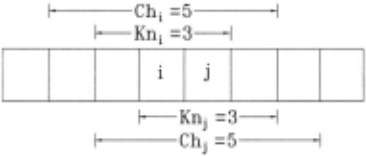
Our setup (Figure 1) consists of an array of equivalent resources . Each agent uses exactly one resource, but a resource can support several agents. The agents prefer resources that support fewer other agents. The agents know the occupancy of a certain number (I< n) of other resources besides their own. They can elect to move to any of a certain number ( C h) of resources. The agents move only to resources that appear better. They grad ually disperse from the more crowded resources toward the less crowded ones.
Equilibrium is achieved when the agents are uniformly distributed over all resources, and none move. Equi librium corresponds to perfect coordination, because it means the agents have achieved a locally and globally optimal sharing of resources. Note that the present set ting requires the same or complementary decisions. In general, complementary decisions are more interesting, because they cannot be hardwired in some trivial mech amsm.
2.1 Decision Protocol
Each agent stochastically decides whether to move and where. All agents use the same decision function and only move to better resources. The expressions used by an agent to compute the probability of moving from cur rent resource i to another resource j in its choice window are given as follows. The /ij are treated as weights.
where a, {3, and Tare control parameters, and r; and rj the number of agents at resources i and j , respectively. In our experiments, we set a = 5, f3 = 2, and T = 1 unless otherwise specified.
The weights are normalized to yield probabilities. Thus , the probability of an agent moving from resource i to resource j is given by
Intuitively, when the choices are limited (as when small problems are considered) , the agent typically has only a few good alternatives. Each good alternative gets a small positive weight; each undesirable alternative gets a weight of 0. Thus, the value of Pii comes out fairly high. As the distribution of the agents levels out, their Pii values increase until each of them becomes 1 meaning that none of the agents can move.
2.2 Key Concepts
This simple framework provides enough structure to cap ture a variety of interesting concepts.
Choice . The number of actions an agent may choose from. A rational agent may find it has fewer realistic choices when it comes to know more facts, but that as pect is not directly measured here. If resource j is not in the choice window, then rj is not used, and Pij = 0.
Knowledge. The number of resources whose occu pancy is known to the agent. Thus , the knowledge of an agent increases as the agent is given information about an increasing number of resources.
The variables r; and rj give the occupancy of resources i and j. They are accurate for resources within the agent's knowledge window. For other resources, they are estimated based on the total number of agents and the occupancy of the known part of the world .
where N is the total number of agents , J( is the number of agents in the knowledge window, and u is the number of resources that are not known about. Thus, N and u are a form of global knowledge in the system. Since elim inating them would complicate the present experiment considerably, that aspect is deferred to future work.
Inertia. This is the tendency of an agent to stay in its resource even if better alternatives are known. Greater inertia means that the probability Pii is higher . In our setup, inertia is controlled by a. As remarked above, if all p;; values increase to 1, coordination is achieved. Thus inertia can facilitate coordination. A system whose agents have low inertia may exhibit chaotic behavior , and never achieve coordination. On the other extreme, very high inertia would lead to an inactive system, with a similar result.
Sharing. Shared knowledge corresponds to overlap ping knowledge windows. Rustogi & Singh estimate the total amount of sharing in the system as roughly propor tional to the cube of the size of the knowledge window.
Under a homogeneous strategy (as here), shared knowl edge would tend to lead to similar decisions, which could influence coordination.
Precision. Imprecision is the distance from a perfectly coordinated state, i.e., the minimum number of agent relocations required to coordinate. Given an accept able level of imprecision, we control the simulations to halt when that level is reached. Introducing precision into the experimental framework had important conse quences. First, because coordination is achieved much faster when imprecision is allowed, we could simulate much larger configurations than otherwise possible. Sec ond, allowing some imprecision made the trends more robust by reducing the likelihood of pathological situa tions in which the system may get stuck. Third, impre cision helps us study the above pathological situations, which are interesting in their own right. This is the basis for some technical results presented later.
3 Results
The following figures indicate our results. The tuple in each caption indicates, respectively, the number of re sources, the number of agents, the initial deviation (dis tance of the agent distribution from a coordinated state), and the imprecision tolerated.
| Know- | Choice | |||||||
|---|---|---|---|---|---|---|---|---|
| ledge | 2 | 4 | 6 | 8 | 10 | 12 | 14 | 16 |
| 2 | 64 | 21 | 22 | 31 | 44 | llO | 127 | 74 |
| 4 | 17 | 20 | 20 | 59 | 115 | 139 | 174 | |
| 6 | 17 | 31 | 103 | 180 | 254 | 366 | ||
| 8 | 51 | 142 | 194 | 518 | 931 | |||
| 10 | 339 | 710 | 1007 | 1464 | ||||
| 12 | 1096 | 2464 | 7270 | |||||
| 14 | 5257 | 10550 | ||||||
| 16 | 21069 | |||||||
We compute the tables only for the upper triangu lar submatrix, because the lower triangular submatrix is readily determined from it. The lower triangular sub matrix corresponds to the knowledge window being a superset of the choice window. In our decision protocol, this extra knowledge is useless and harmless, because it does not affect the agent's decisions . Thus, the values are essentially constant along each column below the prin cipal diagonal. (In simulations, the randomization can cause minor variations.)
3.1 Sharing of Knowledge
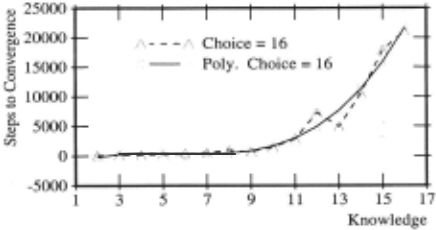
Figure 2 is based on the last column of Table 1. Fig ure 2 shows that the time to achieve coordination has the same order as the sharing metric. To reduce clut ter, we only show the graphs for a cubic polynomial that was fit to the data, and data corresponding to the last column (constant, maximal choice) of Table 1. This fig ure indicates that sharing may have a significant role to play in the final understanding of coordination in decen tralized systems where the agents are homogeneous and coordination calls for complementary decisions, as here.
3.2 Precision
Reducing the required precision enhances the scalability of coordination. In other words, as the quality of the co ordination increases, the cost in terms of time becomes extremely high. We studied this observation further by delineating the effect of the deviation from coordination at the start of each simulation run. In our setup, the de viation ranges from 1 (almost coordinated) to 15 (max imally uncoordinated).
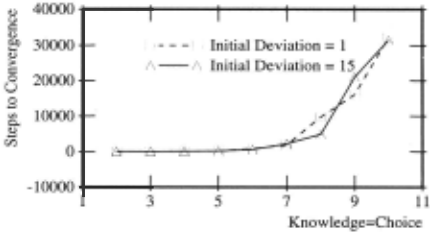
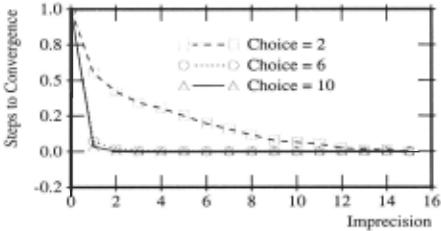
Figure 3 demonstrates that it takes far fewer steps to progress from maximal uncoordination to almost perfect coordination than to go from almost perfect coordination to perfect coordination. The last little bit of precision consumes almost all of the effort.
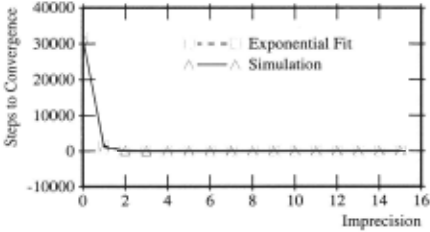
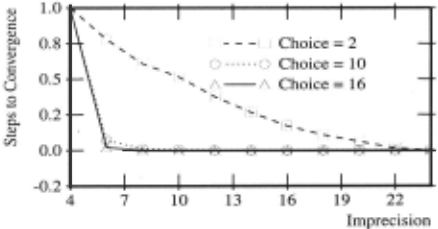
The previous result suggests that the time to coordi nate increases exponentially as the allowed imprecision is reduced to zero. Figure 4 supports this claim. The ex ponential variation occurs as inertia. drops significantly, resulting in increasing instability. The exponential vari ation described above, however, does not manifest itself when the agents have little choice, because in such sce narios, the agents cannot move around much anyway. Instead, as Figures 5 and 6 demonstrate, for small choice windows, the time for coordination increases only poly nomially with reducing allowed imprecision. In these figures, to help visualize the trends better , each curve is normalized to 1 with respect to its maximum value. It should be obvious, however, that for low values of im precision (including 0) , the actual time to coordinate in creases with choice. For higher values, the time to coor dinate is practically independent of the choices available to the agents or the knowledge possessed by them.
3.3 Inertia
Recall that inertia refers to the tendency of an agent to stay in its present resource even if it knows of better re sources. From the probability calculations of section 2, it should be clear that, in general, as the number of choices increase, Lj J;j increases, and consequently the inertia (i.e., p;;) decreases. This reason , especially when cou pled with an imprecision of 0, can prevent coordination for moderately large dimensions.
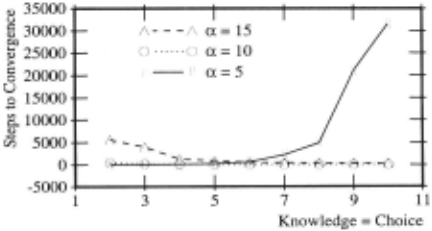
In our setup, inertia is characterized by the parame ter a. The preceding results were based on a= 5; now we vary a above and below this value. Figure 7 shows that increasing the inertia facilitates coordination. This is because when the agents are less likely to move, a low occupancy resource will not suddenly by occupied by sev eral agents. Conversely, decreasing the inertia to a low value can make coordination extremely slow. The agents appear to jump about too much and system takes longer and longer to converge. For such cases, the detrimen tal effect of shared knowledge still applies; thus adding knowledge slows coordination.
Interestingly, for high inertia, an increase in knowl edge or choice further improves the coordination. This relationship is a reversal from when the inertia is low. It appears that the trend changes, because higher in ertia limits agent movement to such an extent that the benefits of additional local knowledge in decision-making overshadow the usual ill effects of increased sharing of knowledge.
The improvement of coordination due to increasing inertia is observed only if the inertia is not too high. Increasing the inertia to a very high value results in slow coordination. This is because very high inertia causes the agents to freeze in whatever resources they occupy.
3.4 Other Variants Considered
Our interest is in understanding the phenomenon of co ordination in general, not analyzing the specific setup used in our experiments . Thus we emphasize the trends observed in the simulations, and the qualitative relation ships among the trends, such as whether the number of steps is increasing or decreasing and if so at what polynomial order. Our experiments included complex scenar ios, but which also yield the same trends as the simple scenarios on which the above results are directly based.
- Our results hold for several decision functions, but we present only the simple decision function used by Sen et al.
- Like Rustogi & Singh, we observed that keeping the knowledge and choice windows of an agent symmet rically distributed around its current resource yield the same trends as when the windows are skewed with respect to each other; therefore, we focus on the simpler situation.
- To enable convergence, we set an integral ratio of agents to resources. This is not strictly necessary when imprecise coordination is allowed, but chang ing the ratio has no effect on the trends, so we report only the integral situations here.
- Except when precision itself is a variable, we can make do with lower precision, because it yields faster convergence without affecting the qualitative nature of the trends.
- We studied the role of inertia and its interplay with knowledge and choice, by altering the control pa rameters (a: , (3, and r) in our protocol. The results highlighted an interesting interplay among the var ious bases of coordination. Varying a: alone, how ever, provides representative results.
4 Mapping the Terrain
Our experimental study of decentralized multiagent sys tems brought out a number of important factors that affect coordination. Some of these factors-inertia and precision- have not been empirically studied in such sys tems. Others-knowledge and choice-have been stud ied but, as our analysis showed, the trends relating to these are richer than believed. Trends due to inertia and precision can dominate and sometimes reverse the simpler trends.
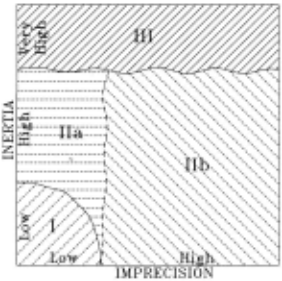
The following simple rules summarize our qualitative results.
- Rl. Low inertia & low imprecision ===} knowledge sharing governs ===? local knowledge & limited choice performs better
- R2a. Moderately high inertia ===? extent of knowledge or choice is less important
- R2b. High imprecision ===? extent of knowledge or choice is less important
- R3. Very high inertia ===? system inactivity
The above rules demarcate the most important regions of our terrain. Figure 8 illustrates the corresponding regions. Rule R1 supported by Figure 2, is mapped to Region I in Figure 8. To achieve effective coordination in this region, agents must limit their knowledge as well as choice. The results of Sen et al. and Rustogi & Singh lie within this region. Figures 5-6 and 7 support the rules R2b and R2a, respectively. The results of Baray lie within this region-this is the reason he obtains much faster coordination than Sen et al. These rules, mapped to region II of Figure 8, imply that knowledge and choice are less relevant for coordination. Rule R3 is intuitively obvious and is represented by region III in Figure 8.
The study of coordination is interesting from a practi cal engineering standpoint. The above rules yield heuris tics to aid in the engineering of a multiagent system. Our first conclusion is that for maximal scalability, we should allow some imperfection in coordination. Even a slight imperfection improves performance considerably. A moderately high value of inertia is desirable. Select ing the right value is nontrivial, especially because it will change in a dynamic system. An open problem is to devise online learning techniques to adapt to the right inertia during execution.
Interestingly, for most of the situations in our setup, local information performs better than global informa tion. Even when local information gives suboptimal re sults, for many applications, it can provide a reasonable tradeoff with the cost incurred in acquiring the global information.
5 Discussion
In addition to the works mentioned above, some inter esting relevant approaches are known in the literature. For instance, Kuwabara et a/. present a market-based approach in which agents controlling different resources set their prices based on previous usage, and buyer agents choose which resources to use [1996]. The buyer agent can use more than one resource concurrently, and seeks to minimize the total price. As in our approach, the buyer's decision-making is probabilistic. Although Kuwabara et al. 's model is similar to ours, they do not study the reasons for achieving effective coordination.
Rachlin et al. show how agents, using the A-Team architecture, can achieve coordination without explicit communication [1999] . An A-Team is an asynchronous team of agents that shares a population of solutions that evolve over time into an optimal set of solutions.
Through sharing of the solution population , cooperative behavior between agents may emerge leading to better solu tions than any one agent could produce. Often , how ever , a human agent may be necessary to help achieve coordinat ion by imparting domain-specific knowledge.
Results by Hogg & Huberman indicate the potential benefits of introducing heterogeneity of different forms [1991]. These agree with the intuition that in homoge neous settings , the sharing of knowledge may have an undesirable effect on coordination. This is especially so when the agents must make complementary decisions so as to coordinate, i. e. , move to different resources. This problem is closely related to the emergence of conven tions for resource sharing [Lewis, 1969] .
There are some limitations of the present experimental setup. It focuses on cases where the resource conflicts are direct and immediately perceived, the resources are ho mogeneous, the agents all use the same decision-making protocol , and the agents do not communicate directly. Further, there are well-known limitat ions of reinforce ment learning in terms of time taken to learn even sim ple concepts . The present experiments leave open the possibility that more sophisticated agents in more flex ible environments, where their learning is supervised in certain ways might discover better ways of coordination, which may t urn out to have different characteristics in terms of the influence of knowledge and choice.
Although we introduced some interesting considera tions, a lot remains to be done. Choice and inertia bear an interesting relationship to the notion of commitments. It appears that the two are complementary in that the greater the agent 's choice the lower its commitment to a particular decision. Previous experimental work ap pears especially relevant. Kinny & Georgeff empirically investigate how the agents ' commitment to their current plan contributes to their effective behavior [1991]. The agents in their work are characterized as bold, normal , or caut ious based on the extent of their commitment (akin to inertia here), ranging from high to low, in that order. The cautious agents continually reconsider their plan at every step, in the face of a dynamic environ ment and therefore exhibit the least commitment. For the dtost part, bold agents , despite their higher degree of blind commitment , perform better than normal and cautious agents except when the rate of change is very high. Kinny & Georgeff, however, do not study the ef fectiveness of behavior when th'e degree of commitment is very high.
We identified several of the key attributes affecting coordination in a way that agrees with but subsumes previous results. We also give some heuristics to de velop decentralized multiagent systems . To cover addi t ional applications, we need to consider communication among agents and to determine the circumstances under which it helps or disrupts coordination. We need to con sider systems whose membership involves agents being removed and added back.
@inproceedings{ijcai1999p74,
  title     = {Be Patient and Tolerate Imprecision: How Autonomous Agents can Coordinate Effectively},
  author    = {Rustogi, Sudhir K. and Singh, Munindar P.},
  booktitle = {Proceedings of the Sixteenth International Joint Conference on
               Artificial Intelligence, {IJCAI-99}},
  publisher = {International Joint Conferences on Artificial Intelligence},
  editor    = {Thomas Dean},
  pages     = {512--518},
  year      = {1999},
  note      = {Distributed AI},
  url       = {https://ijcai.org/proceedings/1999/74},
}
TY - CPAPER TI - Be Patient and Tolerate Imprecision: How Autonomous Agents can Coordinate Effectively AU - Rustogi, Sudhir K. AU - Singh, Munindar P. T2 - Proceedings of the Sixteenth International Joint Conference on Artificial Intelligence, IJCAI-99 PB - International Joint Conferences on Artificial Intelligence PY - 1999 SP - 512 EP - 518 UR - https://ijcai.org/proceedings/1999/74 ER -Copied
Machine-readable versions of this paper, for tools and AI agents:





